Financial Management Practices and Financial Performance: A Report
VerifiedAdded on 2021/09/20
|17
|3127
|38
Report
AI Summary
This report investigates the effect of financial management practices on the financial performance of non-financial firms listed on the National Securities Exchange (NSE). The study explores the influence of liquidity management, capital budgeting, and leverage on financial outcomes, considering the moderating role of inflation. The research employs a positivist paradigm, utilizing a fixed effects model and panel secondary data from financial statements spanning five years (2010-2014). Key variables include Return on Assets (ROA) as a measure of financial performance, and Liquidity Management, Capital Budgeting, and Leverage as independent variables representing financial management practices. The methodology encompasses data collection from the NSE and the bureau of statistics, followed by data analysis and diagnostic tests. The report aims to address research gaps by examining financial management practices comprehensively, including the moderating effect of inflation, providing a detailed analysis of their impact on firm performance, and offering valuable insights into the financial dynamics of non-financial sector firms.

Running head: FINANCIAL MANAGEMENT PRACTICES 1
Topic: Financial Management Practices
[Name of Student]
[Institutional Affiliation]
[Instructor’s Name]
[Date of Submission]
Topic: Financial Management Practices
[Name of Student]
[Institutional Affiliation]
[Instructor’s Name]
[Date of Submission]

Paraphrase This Document
Need a fresh take? Get an instant paraphrase of this document with our AI Paraphraser
FINANCIAL MANAGEMENT PRACTICES 2
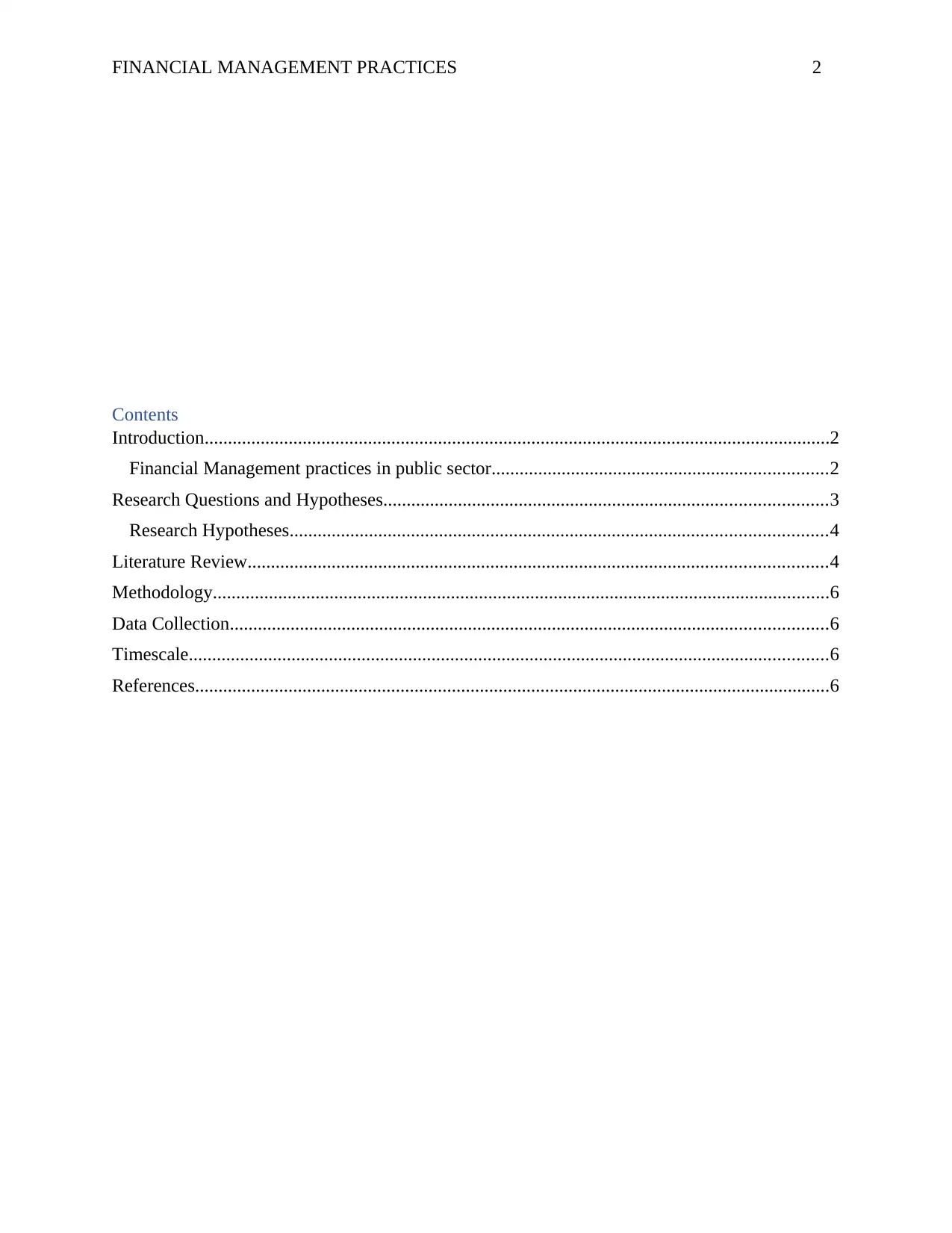
Contents
Introduction......................................................................................................................................2
Financial Management practices in public sector........................................................................2
Research Questions and Hypotheses...............................................................................................3
Research Hypotheses...................................................................................................................4
Literature Review............................................................................................................................4
Methodology....................................................................................................................................6
Data Collection................................................................................................................................6
Timescale.........................................................................................................................................6
References........................................................................................................................................6
Contents
Introduction......................................................................................................................................2
Financial Management practices in public sector........................................................................2
Research Questions and Hypotheses...............................................................................................3
Research Hypotheses...................................................................................................................4
Literature Review............................................................................................................................4
Methodology....................................................................................................................................6
Data Collection................................................................................................................................6
Timescale.........................................................................................................................................6
References........................................................................................................................................6
FINANCIAL MANAGEMENT PRACTICES 3
Introduction
Financial management is one of management functional areas which is core to success of
business enterprises. Inefficient financial management, combined with the uncertainty of the
business environment often led Business Enterprises to serious problems (Deresse & Prabhakara,
2012). Paramasivan and Subramanian (2009) argued that financial management helps to improve
the profitability position of business organizations with the help of strong financial control
devices such as budgetary control and ratio analysis.
As the financial sector at The National Securities’ Exchange, which include banking,
investments and insurance firms, continues to record growth, some firms in the nonfinancial
sector have been characterized by a decline in performance and as a result market prices of their
shares at the National Securities Exchange has recorded a decline. Non-financial sector include,
Agricultural, Automobiles and accessories,
Commercial and services, Construction and allied, Energy and petroleum, Manufacturing and
allied, Telecommunication and technology, (NSE, 2014). Some companies listed under the non-
financial sector at the NSE have been delisted, suspended or even put under receivership due to
poor performance.
Business Enterprises have often recorded poor performance due to lack of knowledge of
efficient financial management (Deresse & Prabhakara, 2012). The uncertainty of the business
environment causes business enterprises to rely excessively on equity and maintain high
liquidity and these financial characteristics affect profitability (Deresse & Prabhakara, 2012). It
is therefore worth investigating the effect of financial management practices on financial
performance of non- financial firms.
Introduction
Financial management is one of management functional areas which is core to success of
business enterprises. Inefficient financial management, combined with the uncertainty of the
business environment often led Business Enterprises to serious problems (Deresse & Prabhakara,
2012). Paramasivan and Subramanian (2009) argued that financial management helps to improve
the profitability position of business organizations with the help of strong financial control
devices such as budgetary control and ratio analysis.
As the financial sector at The National Securities’ Exchange, which include banking,
investments and insurance firms, continues to record growth, some firms in the nonfinancial
sector have been characterized by a decline in performance and as a result market prices of their
shares at the National Securities Exchange has recorded a decline. Non-financial sector include,
Agricultural, Automobiles and accessories,
Commercial and services, Construction and allied, Energy and petroleum, Manufacturing and
allied, Telecommunication and technology, (NSE, 2014). Some companies listed under the non-
financial sector at the NSE have been delisted, suspended or even put under receivership due to
poor performance.
Business Enterprises have often recorded poor performance due to lack of knowledge of
efficient financial management (Deresse & Prabhakara, 2012). The uncertainty of the business
environment causes business enterprises to rely excessively on equity and maintain high
liquidity and these financial characteristics affect profitability (Deresse & Prabhakara, 2012). It
is therefore worth investigating the effect of financial management practices on financial
performance of non- financial firms.
⊘ This is a preview!⊘
Do you want full access?
Subscribe today to unlock all pages.

Trusted by 1+ million students worldwide
FINANCIAL MANAGEMENT PRACTICES 4
Financial Management practices in public sector
The decision function of financial management can be broken down into three major areas: the
investment, financing, and asset management decisions. Financial management practices revolve
around these three key decisions. Efficient financial management requires the existence of some
objective or goal, because judgment as to whether or not a financial decision is efficient must be
made in light of some standard. Different authors and researchers approach the particular areas
of financial management in various ways given their area of focus. For instance, a study carried
out in Malaysia by Mohd et al., (2010) identified the components of financial management as
financial planning and control, financial accounting, financial analysis, management accounting,
capital budgeting and working capital management. Chung and Chuang (2010) studied five
particular areas of financial management practices: capital structure management, working
capital management, financial reporting and analysis, capital budgeting and accounting
information system. From the study variables, Financing, Investing and asset management
decisions play out.
Deresse and Prabhakara (2012), used independent variables such as accounting, reporting, and
analysis, working capital management, fixed asset management and financial planning to
represent financial management practices in the study on the effect of financial management
practices and characteristics on profitability. Other variables which they considered were
Liquidity, Leverage and asset turnover.
Kieu (2006) used financial management practices variables such as accounting information
system, financial reporting and analysis, working capital management, fixed asset management,
financial planning and good performance in financial characteristics such as liquidity and
business activity. Therefore, the study emphasized on three key variables to represent financial
Financial Management practices in public sector
The decision function of financial management can be broken down into three major areas: the
investment, financing, and asset management decisions. Financial management practices revolve
around these three key decisions. Efficient financial management requires the existence of some
objective or goal, because judgment as to whether or not a financial decision is efficient must be
made in light of some standard. Different authors and researchers approach the particular areas
of financial management in various ways given their area of focus. For instance, a study carried
out in Malaysia by Mohd et al., (2010) identified the components of financial management as
financial planning and control, financial accounting, financial analysis, management accounting,
capital budgeting and working capital management. Chung and Chuang (2010) studied five
particular areas of financial management practices: capital structure management, working
capital management, financial reporting and analysis, capital budgeting and accounting
information system. From the study variables, Financing, Investing and asset management
decisions play out.
Deresse and Prabhakara (2012), used independent variables such as accounting, reporting, and
analysis, working capital management, fixed asset management and financial planning to
represent financial management practices in the study on the effect of financial management
practices and characteristics on profitability. Other variables which they considered were
Liquidity, Leverage and asset turnover.
Kieu (2006) used financial management practices variables such as accounting information
system, financial reporting and analysis, working capital management, fixed asset management,
financial planning and good performance in financial characteristics such as liquidity and
business activity. Therefore, the study emphasized on three key variables to represent financial
Paraphrase This Document
Need a fresh take? Get an instant paraphrase of this document with our AI Paraphraser

FINANCIAL MANAGEMENT PRACTICES 5
management practices. The key variables are, Liquidity management, Capital budgeting and
Leverage.
Research Questions and Hypotheses
The main objective of the study was to establish the effect of financial management practices on
financial performance of non-financial firms listed at the National securities exchange.
i. To determine the effect of liquidity management on financial performance of non-
financial firms
ii. To establish the effect of capital budgeting on financial performance of nonfinancial
firms.
iii. To determine the effect of leverage on financial performance of non-financial firms
iv. To evaluate the moderating effect of inflation on the relationship between financial
management practices and financial performance of non-financial firms.
Research Hypotheses
In view of the research objectives the study sought to test the following null hypotheses.
H01: Liquidity management has no significant effect on the financial performance of non-
financial firms listed at the NSE.
H02: Capital budgeting has no significant effect on the financial performance of nonfinancial
firms listed at the NSE.
H03: Leverage has no significant effect on the financial performance of on-financial firms listed
at the NSE.
H04: Inflation has no significant effect on the relationship between financial management
practices and financial performance of non-financial firms listed at the NSE.
management practices. The key variables are, Liquidity management, Capital budgeting and
Leverage.
Research Questions and Hypotheses
The main objective of the study was to establish the effect of financial management practices on
financial performance of non-financial firms listed at the National securities exchange.
i. To determine the effect of liquidity management on financial performance of non-
financial firms
ii. To establish the effect of capital budgeting on financial performance of nonfinancial
firms.
iii. To determine the effect of leverage on financial performance of non-financial firms
iv. To evaluate the moderating effect of inflation on the relationship between financial
management practices and financial performance of non-financial firms.
Research Hypotheses
In view of the research objectives the study sought to test the following null hypotheses.
H01: Liquidity management has no significant effect on the financial performance of non-
financial firms listed at the NSE.
H02: Capital budgeting has no significant effect on the financial performance of nonfinancial
firms listed at the NSE.
H03: Leverage has no significant effect on the financial performance of on-financial firms listed
at the NSE.
H04: Inflation has no significant effect on the relationship between financial management
practices and financial performance of non-financial firms listed at the NSE.
FINANCIAL MANAGEMENT PRACTICES 6
Literature Review
Concerned with financial management practices, previous researchers have concentrated on
examining, investigating and describing the behaviour of Securities Exchange market in
practising financial management. Their findings are mainly related to exploring and describing
the behaviour of Securities Exchange market towards financial management practices. Although
they provided much descriptive statistical data and empirical evidence on Securities Exchange
market financial management practices, it appears that there still are some gaps in the literature,
which need to be addressed. Most research work on performance have looked at individual
components of financial management and not financial management as a whole.
Though comprehensive studies looking at financial management as a whole have been carried
out in developed countries, few studies have been carried out in developing countries.
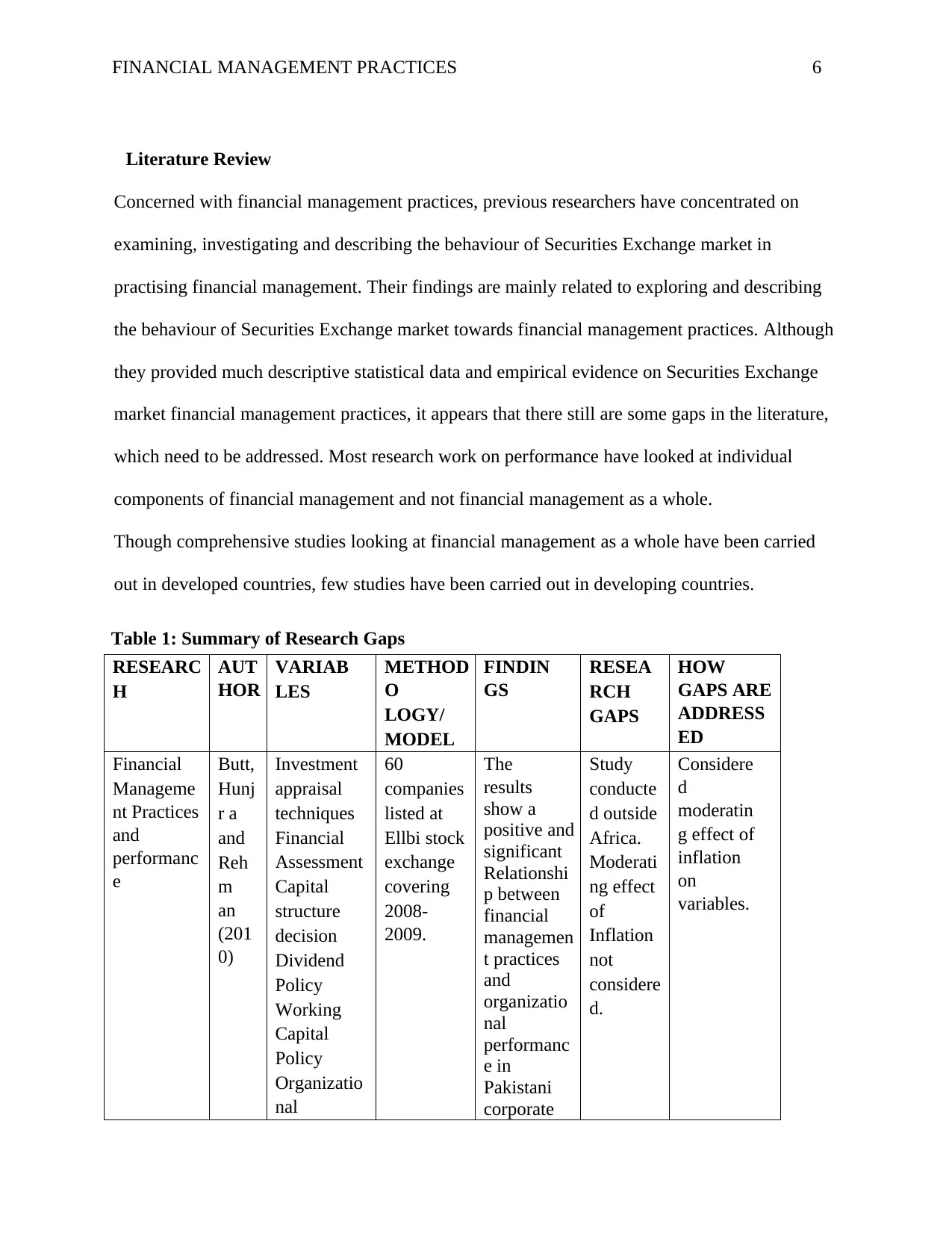
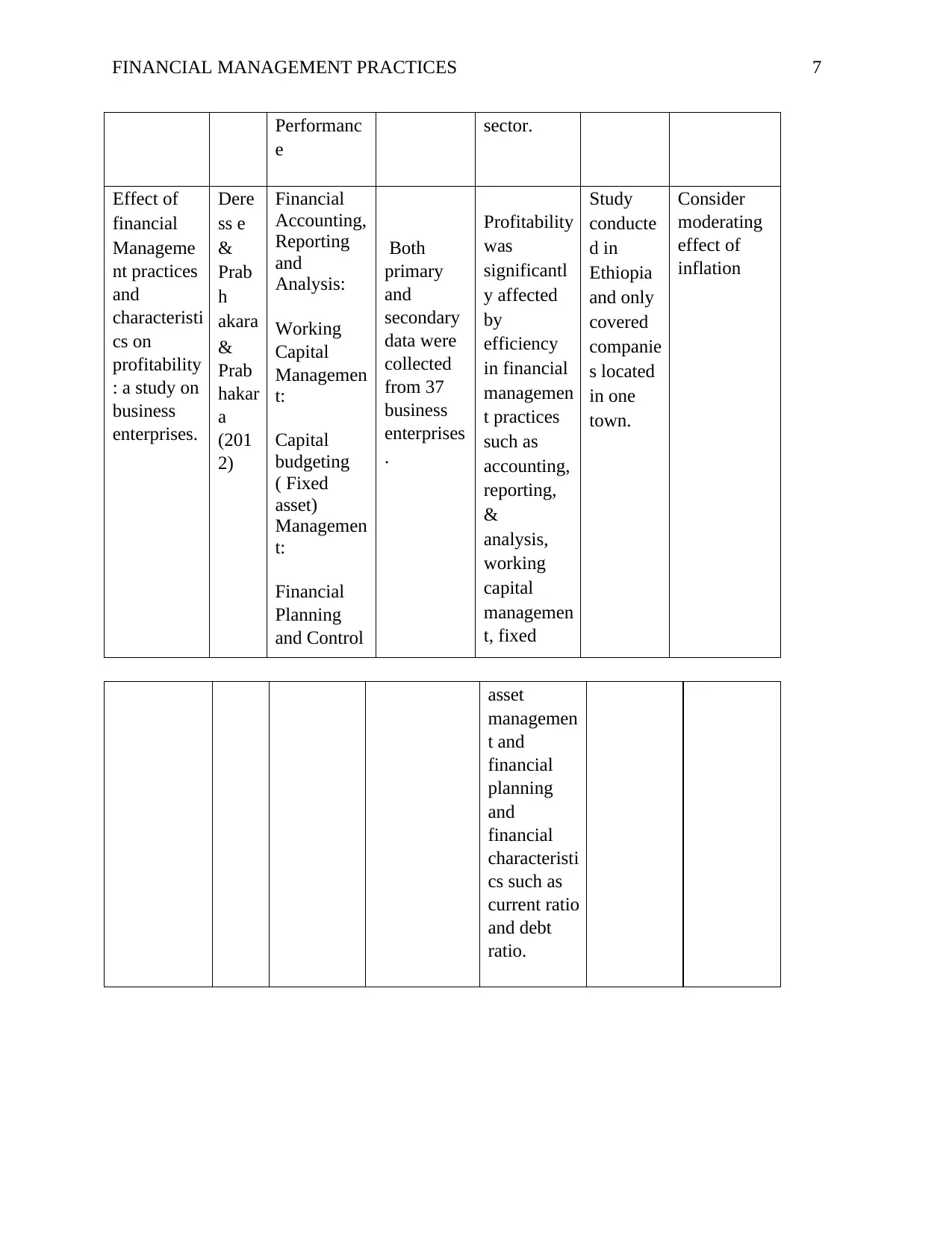
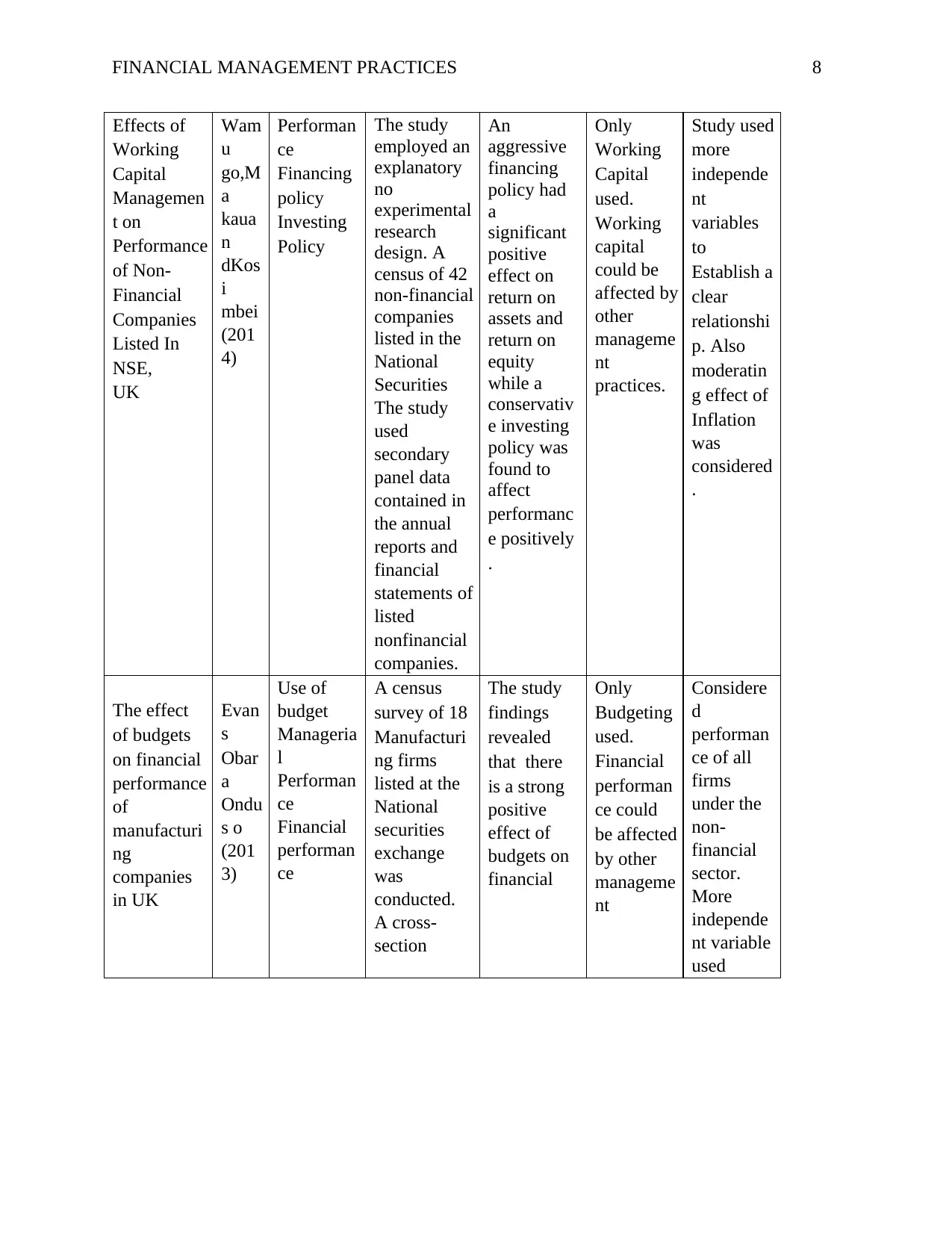
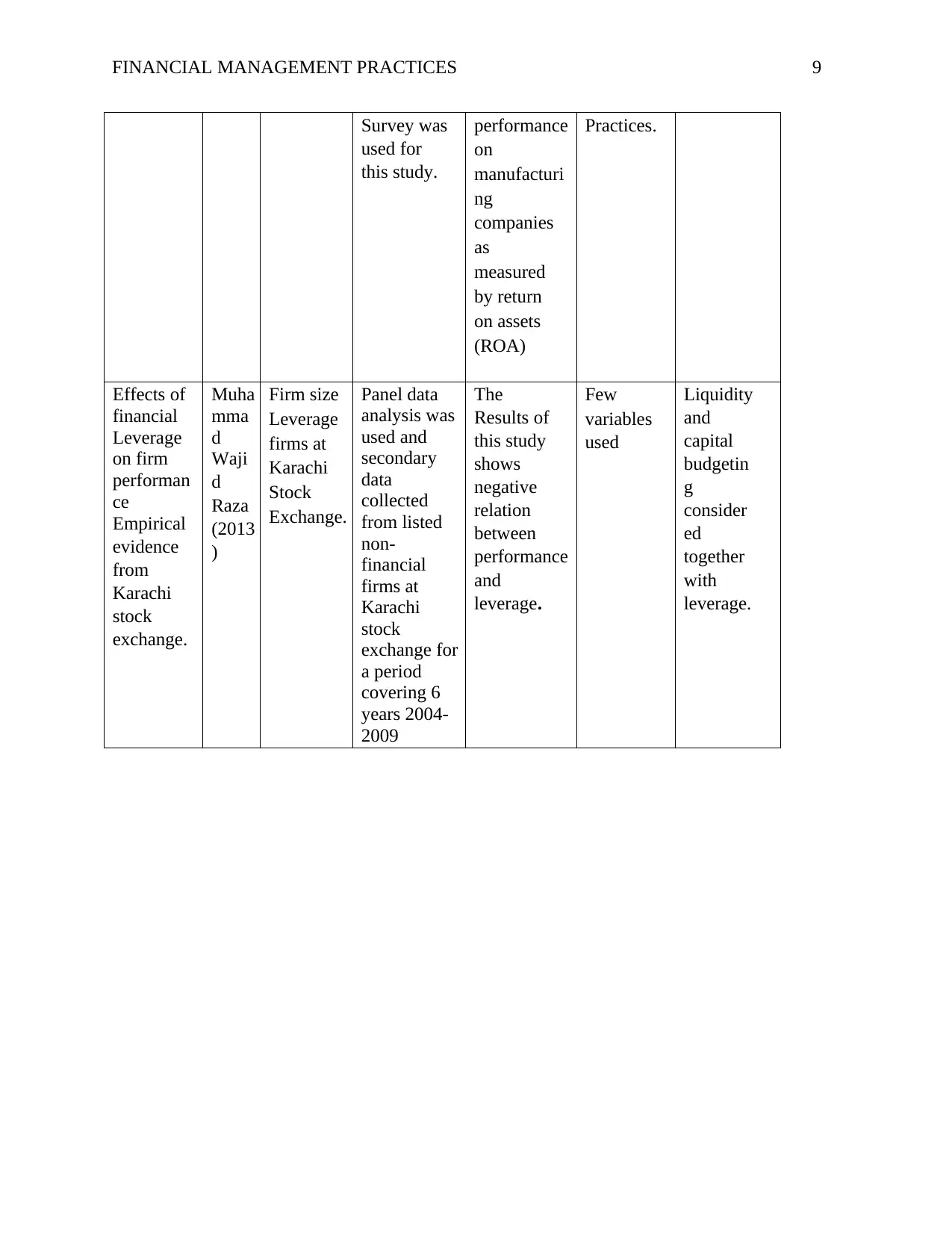
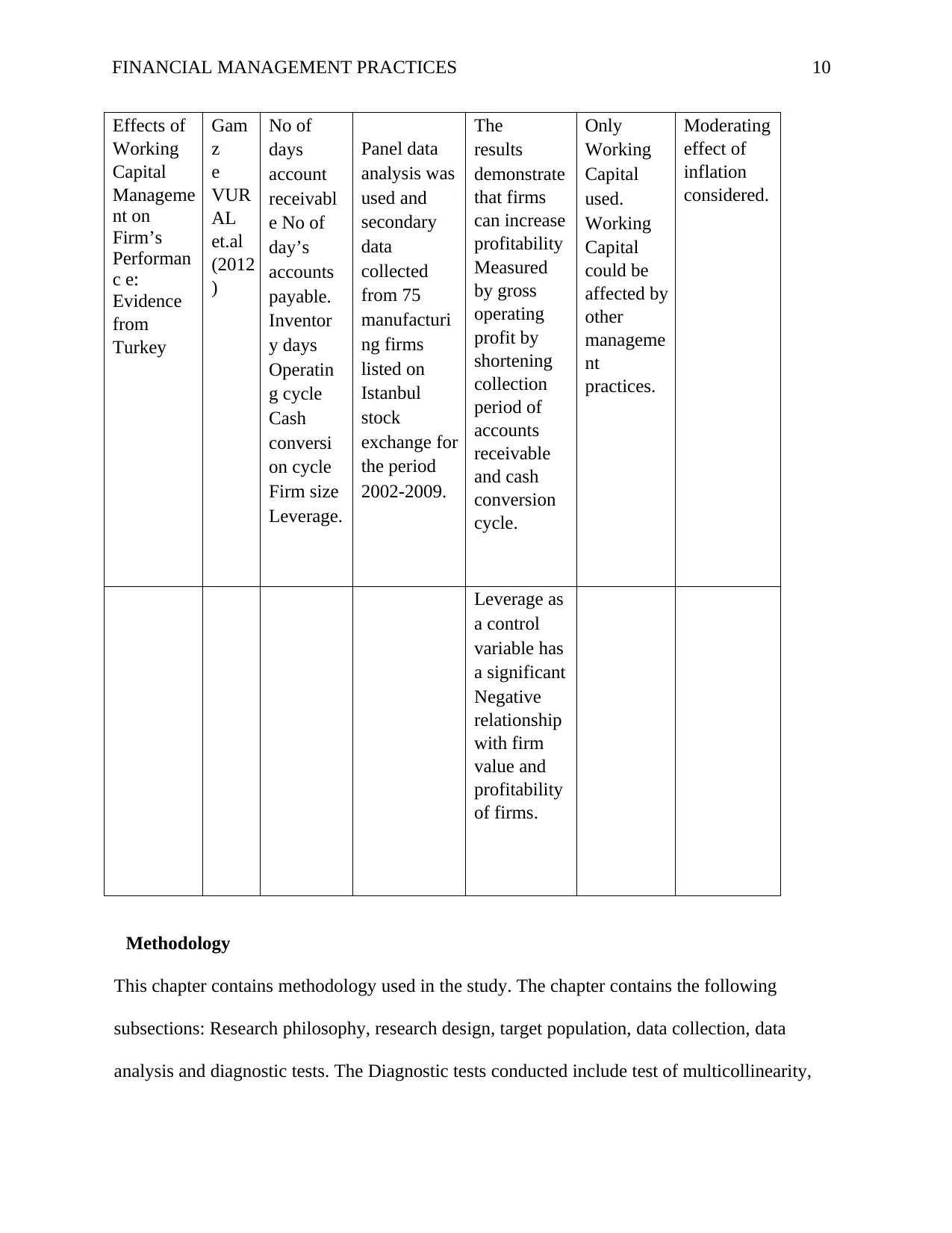
Table 1: Summary of Research Gaps
RESEARC
H
AUT
HOR
VARIAB
LES
METHOD
O
LOGY/
MODEL
FINDIN
GS
RESEA
RCH
GAPS
HOW
GAPS ARE
ADDRESS
ED
Financial
Manageme
nt Practices
and
performanc
e
Butt,
Hunj
r a
and
Reh
m
an
(201
0)
Investment
appraisal
techniques
Financial
Assessment
Capital
structure
decision
Dividend
Policy
Working
Capital
Policy
Organizatio
nal
60
companies
listed at
Ellbi stock
exchange
covering
2008-
2009.
The
results
show a
positive and
significant
Relationshi
p between
financial
managemen
t practices
and
organizatio
nal
performanc
e in
Pakistani
corporate
Study
conducte
d outside
Africa.
Moderati
ng effect
of
Inflation
not
considere
d.
Considere
d
moderatin
g effect of
inflation
on
variables.
Literature Review
Concerned with financial management practices, previous researchers have concentrated on
examining, investigating and describing the behaviour of Securities Exchange market in
practising financial management. Their findings are mainly related to exploring and describing
the behaviour of Securities Exchange market towards financial management practices. Although
they provided much descriptive statistical data and empirical evidence on Securities Exchange
market financial management practices, it appears that there still are some gaps in the literature,
which need to be addressed. Most research work on performance have looked at individual
components of financial management and not financial management as a whole.
Though comprehensive studies looking at financial management as a whole have been carried
out in developed countries, few studies have been carried out in developing countries.
Table 1: Summary of Research Gaps
RESEARC
H
AUT
HOR
VARIAB
LES
METHOD
O
LOGY/
MODEL
FINDIN
GS
RESEA
RCH
GAPS
HOW
GAPS ARE
ADDRESS
ED
Financial
Manageme
nt Practices
and
performanc
e
Butt,
Hunj
r a
and
Reh
m
an
(201
0)
Investment
appraisal
techniques
Financial
Assessment
Capital
structure
decision
Dividend
Policy
Working
Capital
Policy
Organizatio
nal
60
companies
listed at
Ellbi stock
exchange
covering
2008-
2009.
The
results
show a
positive and
significant
Relationshi
p between
financial
managemen
t practices
and
organizatio
nal
performanc
e in
Pakistani
corporate
Study
conducte
d outside
Africa.
Moderati
ng effect
of
Inflation
not
considere
d.
Considere
d
moderatin
g effect of
inflation
on
variables.
⊘ This is a preview!⊘
Do you want full access?
Subscribe today to unlock all pages.
Trusted by 1+ million students worldwide
FINANCIAL MANAGEMENT PRACTICES 7
Performanc
e
sector.
Effect of
financial
Manageme
nt practices
and
characteristi
cs on
profitability
: a study on
business
enterprises.
Dere
ss e
&
Prab
h
akara
&
Prab
hakar
a
(201
2)
Financial
Accounting,
Reporting
and
Analysis:
Working
Capital
Managemen
t:
Capital
budgeting
( Fixed
asset)
Managemen
t:
Financial
Planning
and Control
Both
primary
and
secondary
data were
collected
from 37
business
enterprises
.
Profitability
was
significantl
y affected
by
efficiency
in financial
managemen
t practices
such as
accounting,
reporting,
&
analysis,
working
capital
managemen
t, fixed
Study
conducte
d in
Ethiopia
and only
covered
companie
s located
in one
town.
Consider
moderating
effect of
inflation
asset
managemen
t and
financial
planning
and
financial
characteristi
cs such as
current ratio
and debt
ratio.
Performanc
e
sector.
Effect of
financial
Manageme
nt practices
and
characteristi
cs on
profitability
: a study on
business
enterprises.
Dere
ss e
&
Prab
h
akara
&
Prab
hakar
a
(201
2)
Financial
Accounting,
Reporting
and
Analysis:
Working
Capital
Managemen
t:
Capital
budgeting
( Fixed
asset)
Managemen
t:
Financial
Planning
and Control
Both
primary
and
secondary
data were
collected
from 37
business
enterprises
.
Profitability
was
significantl
y affected
by
efficiency
in financial
managemen
t practices
such as
accounting,
reporting,
&
analysis,
working
capital
managemen
t, fixed
Study
conducte
d in
Ethiopia
and only
covered
companie
s located
in one
town.
Consider
moderating
effect of
inflation
asset
managemen
t and
financial
planning
and
financial
characteristi
cs such as
current ratio
and debt
ratio.
Paraphrase This Document
Need a fresh take? Get an instant paraphrase of this document with our AI Paraphraser
FINANCIAL MANAGEMENT PRACTICES 8
Effects of
Working
Capital
Managemen
t on
Performance
of Non-
Financial
Companies
Listed In
NSE,
UK
Wam
u
go,M
a
kaua
n
dKos
i
mbei
(201
4)
Performan
ce
Financing
policy
Investing
Policy
The study
employed an
explanatory
no
experimental
research
design. A
census of 42
non-financial
companies
listed in the
National
Securities
The study
used
secondary
panel data
contained in
the annual
reports and
financial
statements of
listed
nonfinancial
companies.
An
aggressive
financing
policy had
a
significant
positive
effect on
return on
assets and
return on
equity
while a
conservativ
e investing
policy was
found to
affect
performanc
e positively
.
Only
Working
Capital
used.
Working
capital
could be
affected by
other
manageme
nt
practices.
Study used
more
independe
nt
variables
to
Establish a
clear
relationshi
p. Also
moderatin
g effect of
Inflation
was
considered
.
The effect
of budgets
on financial
performance
of
manufacturi
ng
companies
in UK
Evan
s
Obar
a
Ondu
s o
(201
3)
Use of
budget
Manageria
l
Performan
ce
Financial
performan
ce
A census
survey of 18
Manufacturi
ng firms
listed at the
National
securities
exchange
was
conducted.
A cross-
section
The study
findings
revealed
that there
is a strong
positive
effect of
budgets on
financial
Only
Budgeting
used.
Financial
performan
ce could
be affected
by other
manageme
nt
Considere
d
performan
ce of all
firms
under the
non-
financial
sector.
More
independe
nt variable
used
Effects of
Working
Capital
Managemen
t on
Performance
of Non-
Financial
Companies
Listed In
NSE,
UK
Wam
u
go,M
a
kaua
n
dKos
i
mbei
(201
4)
Performan
ce
Financing
policy
Investing
Policy
The study
employed an
explanatory
no
experimental
research
design. A
census of 42
non-financial
companies
listed in the
National
Securities
The study
used
secondary
panel data
contained in
the annual
reports and
financial
statements of
listed
nonfinancial
companies.
An
aggressive
financing
policy had
a
significant
positive
effect on
return on
assets and
return on
equity
while a
conservativ
e investing
policy was
found to
affect
performanc
e positively
.
Only
Working
Capital
used.
Working
capital
could be
affected by
other
manageme
nt
practices.
Study used
more
independe
nt
variables
to
Establish a
clear
relationshi
p. Also
moderatin
g effect of
Inflation
was
considered
.
The effect
of budgets
on financial
performance
of
manufacturi
ng
companies
in UK
Evan
s
Obar
a
Ondu
s o
(201
3)
Use of
budget
Manageria
l
Performan
ce
Financial
performan
ce
A census
survey of 18
Manufacturi
ng firms
listed at the
National
securities
exchange
was
conducted.
A cross-
section
The study
findings
revealed
that there
is a strong
positive
effect of
budgets on
financial
Only
Budgeting
used.
Financial
performan
ce could
be affected
by other
manageme
nt
Considere
d
performan
ce of all
firms
under the
non-
financial
sector.
More
independe
nt variable
used
FINANCIAL MANAGEMENT PRACTICES 9
Survey was
used for
this study.
performance
on
manufacturi
ng
companies
as
measured
by return
on assets
(ROA)
Practices.
Effects of
financial
Leverage
on firm
performan
ce
Empirical
evidence
from
Karachi
stock
exchange.
Muha
mma
d
Waji
d
Raza
(2013
)
Firm size
Leverage
firms at
Karachi
Stock
Exchange.
Panel data
analysis was
used and
secondary
data
collected
from listed
non-
financial
firms at
Karachi
stock
exchange for
a period
covering 6
years 2004-
2009
The
Results of
this study
shows
negative
relation
between
performance
and
leverage.
Few
variables
used
Liquidity
and
capital
budgetin
g
consider
ed
together
with
leverage.
Survey was
used for
this study.
performance
on
manufacturi
ng
companies
as
measured
by return
on assets
(ROA)
Practices.
Effects of
financial
Leverage
on firm
performan
ce
Empirical
evidence
from
Karachi
stock
exchange.
Muha
mma
d
Waji
d
Raza
(2013
)
Firm size
Leverage
firms at
Karachi
Stock
Exchange.
Panel data
analysis was
used and
secondary
data
collected
from listed
non-
financial
firms at
Karachi
stock
exchange for
a period
covering 6
years 2004-
2009
The
Results of
this study
shows
negative
relation
between
performance
and
leverage.
Few
variables
used
Liquidity
and
capital
budgetin
g
consider
ed
together
with
leverage.
⊘ This is a preview!⊘
Do you want full access?
Subscribe today to unlock all pages.
Trusted by 1+ million students worldwide
FINANCIAL MANAGEMENT PRACTICES 10
Effects of
Working
Capital
Manageme
nt on
Firm’s
Performan
c e:
Evidence
from
Turkey
Gam
z
e
VUR
AL
et.al
(2012
)
No of
days
account
receivabl
e No of
day’s
accounts
payable.
Inventor
y days
Operatin
g cycle
Cash
conversi
on cycle
Firm size
Leverage.
Panel data
analysis was
used and
secondary
data
collected
from 75
manufacturi
ng firms
listed on
Istanbul
stock
exchange for
the period
2002-2009.
The
results
demonstrate
that firms
can increase
profitability
Measured
by gross
operating
profit by
shortening
collection
period of
accounts
receivable
and cash
conversion
cycle.
Only
Working
Capital
used.
Working
Capital
could be
affected by
other
manageme
nt
practices.
Moderating
effect of
inflation
considered.
Leverage as
a control
variable has
a significant
Negative
relationship
with firm
value and
profitability
of firms.
Methodology
This chapter contains methodology used in the study. The chapter contains the following
subsections: Research philosophy, research design, target population, data collection, data
analysis and diagnostic tests. The Diagnostic tests conducted include test of multicollinearity,
Effects of
Working
Capital
Manageme
nt on
Firm’s
Performan
c e:
Evidence
from
Turkey
Gam
z
e
VUR
AL
et.al
(2012
)
No of
days
account
receivabl
e No of
day’s
accounts
payable.
Inventor
y days
Operatin
g cycle
Cash
conversi
on cycle
Firm size
Leverage.
Panel data
analysis was
used and
secondary
data
collected
from 75
manufacturi
ng firms
listed on
Istanbul
stock
exchange for
the period
2002-2009.
The
results
demonstrate
that firms
can increase
profitability
Measured
by gross
operating
profit by
shortening
collection
period of
accounts
receivable
and cash
conversion
cycle.
Only
Working
Capital
used.
Working
Capital
could be
affected by
other
manageme
nt
practices.
Moderating
effect of
inflation
considered.
Leverage as
a control
variable has
a significant
Negative
relationship
with firm
value and
profitability
of firms.
Methodology
This chapter contains methodology used in the study. The chapter contains the following
subsections: Research philosophy, research design, target population, data collection, data
analysis and diagnostic tests. The Diagnostic tests conducted include test of multicollinearity,
Paraphrase This Document
Need a fresh take? Get an instant paraphrase of this document with our AI Paraphraser
FINANCIAL MANAGEMENT PRACTICES 11
equality of means, stationary and houseman test. According to Hudson and Ozanne (1988),
“positivism ontology asserts that there is a single, external and objective reality to any research
question regardless of the researcher’s belief. Thus, the positivist researchers take a controlled
and structural approach in conducting research by initially identifying a research topic,
constructing appropriate research questions and hypotheses and by adopting a suitable
methodology. As positivists’, researchers seek objectivity and use consistently rational and
logical approaches to research.
Further, statistical and mathematical techniques are central in the research methods adopted by
positivist researchers and they adhere to specifically structured research techniques to uncover
single and objective realities. The goal of positivist research is to make generalizations because
human actions can be explained as a result of real causes that precedes their behavior.
An interpretive researcher enters the field with some sort of prior insight about the research topic
but assumes that it is insufficient in developing a fixed research design due to complex, multiple
and unpredictable nature of what is perceived as reality. During data collection stage, the
researcher and his informants are interdependent and mutually interactive with each other. The
goal of interpretive research is to understand and interpret human behavior rather than to
generalize and predict causes and effects (Hopkins, 2000).Given the research problem of this
study positivist paradigm was adopted.
The model used was fixed effects model to test research hypothesis. Independent variables used
were variables to define financial management practices which include Liquidity management,
Capital budgeting and Leverage. Financial performance was measured by ROA ratio. As an
indicator of liquidity (LIQ) the conventional definition was used: The ratio of current assets to
equality of means, stationary and houseman test. According to Hudson and Ozanne (1988),
“positivism ontology asserts that there is a single, external and objective reality to any research
question regardless of the researcher’s belief. Thus, the positivist researchers take a controlled
and structural approach in conducting research by initially identifying a research topic,
constructing appropriate research questions and hypotheses and by adopting a suitable
methodology. As positivists’, researchers seek objectivity and use consistently rational and
logical approaches to research.
Further, statistical and mathematical techniques are central in the research methods adopted by
positivist researchers and they adhere to specifically structured research techniques to uncover
single and objective realities. The goal of positivist research is to make generalizations because
human actions can be explained as a result of real causes that precedes their behavior.
An interpretive researcher enters the field with some sort of prior insight about the research topic
but assumes that it is insufficient in developing a fixed research design due to complex, multiple
and unpredictable nature of what is perceived as reality. During data collection stage, the
researcher and his informants are interdependent and mutually interactive with each other. The
goal of interpretive research is to understand and interpret human behavior rather than to
generalize and predict causes and effects (Hopkins, 2000).Given the research problem of this
study positivist paradigm was adopted.
The model used was fixed effects model to test research hypothesis. Independent variables used
were variables to define financial management practices which include Liquidity management,
Capital budgeting and Leverage. Financial performance was measured by ROA ratio. As an
indicator of liquidity (LIQ) the conventional definition was used: The ratio of current assets to
FINANCIAL MANAGEMENT PRACTICES 12
current liabilities (Jong, Kabir, & Nguyen, 2008).Capital budgeting was measured by ROCE
ratio and Leverage was measured by use of debt ratio.
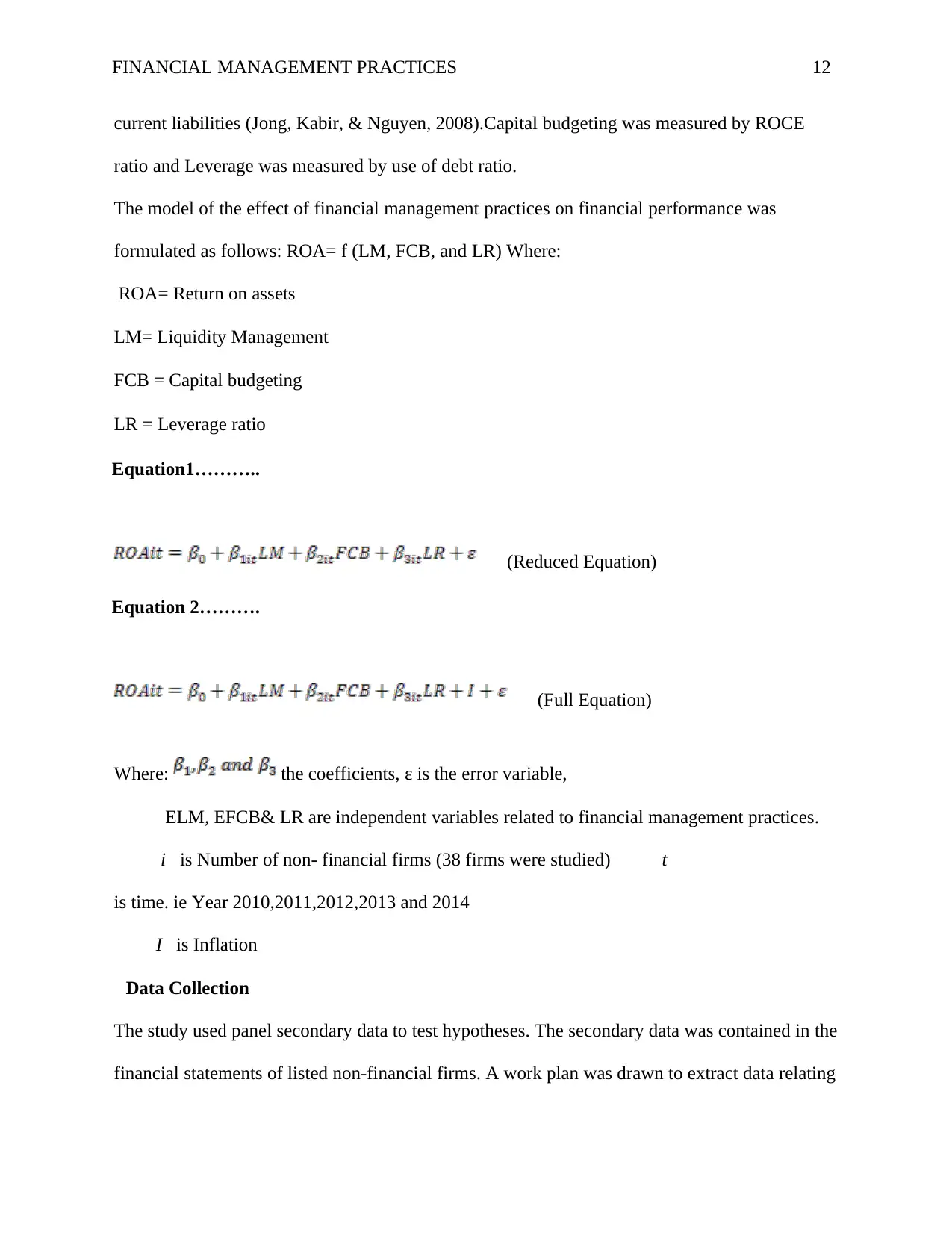
The model of the effect of financial management practices on financial performance was
formulated as follows: ROA= f (LM, FCB, and LR) Where:
ROA= Return on assets
LM= Liquidity Management
FCB = Capital budgeting
LR = Leverage ratio
Equation1………..
(Reduced Equation)
Equation 2……….
(Full Equation)
Where: the coefficients, ε is the error variable,
ELM, EFCB& LR are independent variables related to financial management practices.
i is Number of non- financial firms (38 firms were studied) t
is time. ie Year 2010,2011,2012,2013 and 2014
I is Inflation
Data Collection
The study used panel secondary data to test hypotheses. The secondary data was contained in the
financial statements of listed non-financial firms. A work plan was drawn to extract data relating
current liabilities (Jong, Kabir, & Nguyen, 2008).Capital budgeting was measured by ROCE
ratio and Leverage was measured by use of debt ratio.
The model of the effect of financial management practices on financial performance was
formulated as follows: ROA= f (LM, FCB, and LR) Where:
ROA= Return on assets
LM= Liquidity Management
FCB = Capital budgeting
LR = Leverage ratio
Equation1………..
(Reduced Equation)
Equation 2……….
(Full Equation)
Where: the coefficients, ε is the error variable,
ELM, EFCB& LR are independent variables related to financial management practices.
i is Number of non- financial firms (38 firms were studied) t
is time. ie Year 2010,2011,2012,2013 and 2014
I is Inflation
Data Collection
The study used panel secondary data to test hypotheses. The secondary data was contained in the
financial statements of listed non-financial firms. A work plan was drawn to extract data relating
⊘ This is a preview!⊘
Do you want full access?
Subscribe today to unlock all pages.
Trusted by 1+ million students worldwide

1 out of 17


Related Documents


Your All-in-One AI-Powered Toolkit for Academic Success.
+13062052269
info@desklib.com
Available 24*7 on WhatsApp / Email
![[object Object]](/_next/static/media/star-bottom.7253800d.svg)
Unlock your academic potential
Copyright © 2020–2026 A2Z Services. All Rights Reserved. Developed and managed by ZUCOL.