Detailed Budgeting and Variance Analysis Report for Hospitality
VerifiedAdded on  2022/11/14
|7
|1898
|128
Report
AI Summary
This report provides a comprehensive analysis of budgeting practices within the hospitality industry. Part 1 discusses the reasons for using budgets, highlighting their role in setting financial targets, coordinating departmental objectives, and guiding future planning. It also examines potential behavioral problems associated with budget implementation, such as the impact of environmental changes and time-consuming processes. Part 2 focuses on the shortfalls of using budgets for staff performance evaluation, including the limitations of assumptions and the potential for unrealistic targets. The report further presents revenue and ingredient variance analyses for specific events, exploring the differences between actual and budgeted figures, and identifying price and volume variances. The analysis includes recommendations for improvement, such as strict budget monitoring and controlling consumption. The report concludes by emphasizing the impact of material variance and the importance of balancing short-term gains with long-term quality considerations.
PART 1
1. Discuss reasons for using budgets in the hospitality industry and potential
behavioural problems related to using these budgets.
 The use of budget and budgetary control is a vital part of the Hospitality industry
accounting and can be used to benchmark their performance as well setting up their
financial target. In order to achieve the success in the hospitality industry, careful
management of expenses specially labour cost needs to done. This is because hotels
have relatively large number of staffs to executive the functions of hotels and to
maintain the customer satisfaction. The process of budgetary practices in a hotel starts
with the departmental budget, the consequence behind that is a departmental budget
will give overall cost related to the many parts of the hotel. Also cash budget cannot be
prepared without the knowledge of departmental revenue and expense hence the overall
cost of the hotel.
As the budgets are prepared in the hotels departmental wise, hence budgets help in
coordinating the different department objectives into companies one objective. Budgets
helps the manager in giving clear idea about the future, as the budget requires the
prediction of hotels services over the upcoming years and the direction of overall
economy.
Basic reasons for using budgets are:
ï‚· Budget generate a sense of caution and care that a department must follow along
with the defined objective that need to achieved within a given stipulated time.
ï‚· It also guides the management to for forecasting future and defined the objectives
in numerical terms.
ï‚· Budget helps in fixing the responsibility and empowers the management to
decentralize the obligations without losing the business control. (Benefits or
Advantages of Budgeting to organization, 2019)
ï‚· Budget standardizes production, equipment and processes.
Potential behaviour problem relating to use of Budgets
ï‚· Normally, budgets are prepared based on the lots of assumption and so if there is
any change in the environment due to internal or external factors it may widely
effect the cost and revenue structure which can negatively affect the outcome and
the same cannot be matched with the budgeted figures .
ï‚· Preparation of Budgets for hotels is a time consuming process as the same there are
various types of task which need to be budgeted. Moreover, if the budget requires
the employees to follow new and advance ways of doing the work then it would
become difficult for the employees to catch up quickly. Thus, this all factors lead
1. Discuss reasons for using budgets in the hospitality industry and potential
behavioural problems related to using these budgets.
 The use of budget and budgetary control is a vital part of the Hospitality industry
accounting and can be used to benchmark their performance as well setting up their
financial target. In order to achieve the success in the hospitality industry, careful
management of expenses specially labour cost needs to done. This is because hotels
have relatively large number of staffs to executive the functions of hotels and to
maintain the customer satisfaction. The process of budgetary practices in a hotel starts
with the departmental budget, the consequence behind that is a departmental budget
will give overall cost related to the many parts of the hotel. Also cash budget cannot be
prepared without the knowledge of departmental revenue and expense hence the overall
cost of the hotel.
As the budgets are prepared in the hotels departmental wise, hence budgets help in
coordinating the different department objectives into companies one objective. Budgets
helps the manager in giving clear idea about the future, as the budget requires the
prediction of hotels services over the upcoming years and the direction of overall
economy.
Basic reasons for using budgets are:
ï‚· Budget generate a sense of caution and care that a department must follow along
with the defined objective that need to achieved within a given stipulated time.
ï‚· It also guides the management to for forecasting future and defined the objectives
in numerical terms.
ï‚· Budget helps in fixing the responsibility and empowers the management to
decentralize the obligations without losing the business control. (Benefits or
Advantages of Budgeting to organization, 2019)
ï‚· Budget standardizes production, equipment and processes.
Potential behaviour problem relating to use of Budgets
ï‚· Normally, budgets are prepared based on the lots of assumption and so if there is
any change in the environment due to internal or external factors it may widely
effect the cost and revenue structure which can negatively affect the outcome and
the same cannot be matched with the budgeted figures .
ï‚· Preparation of Budgets for hotels is a time consuming process as the same there are
various types of task which need to be budgeted. Moreover, if the budget requires
the employees to follow new and advance ways of doing the work then it would
become difficult for the employees to catch up quickly. Thus, this all factors lead
Paraphrase This Document
Need a fresh take? Get an instant paraphrase of this document with our AI Paraphraser

to large consumption of time which becomes difficult for hospitality industry, as
this industry require quick responses for the customer satisfaction. (Hill, 2019).
 In hospitality industry, customers always look for good services and well –
designed products and infrastructure, rather than focusing on the profitability of the
hotels but budgets are normally quantitative and numeric in nature.
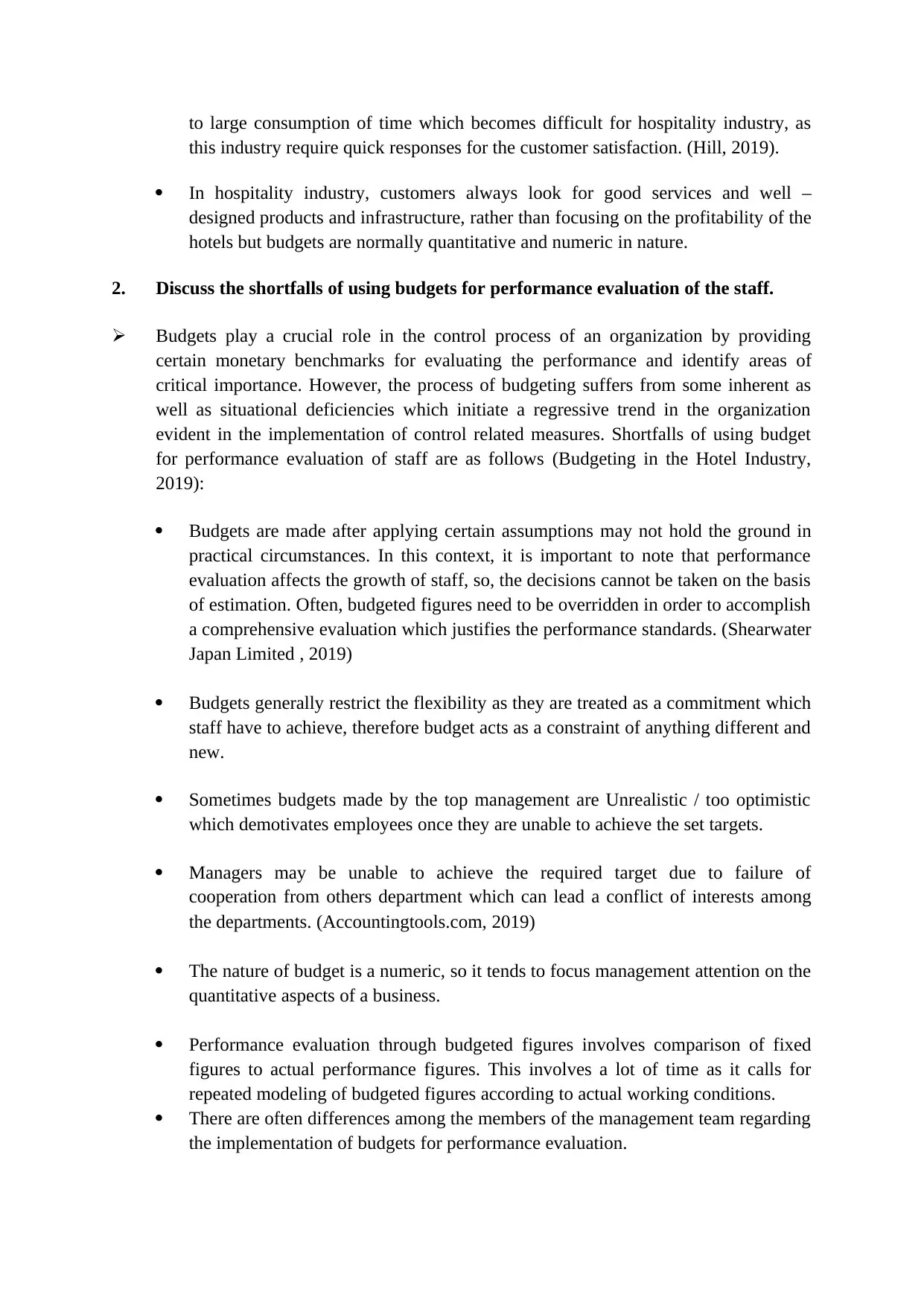
2. Discuss the shortfalls of using budgets for performance evaluation of the staff.
 Budgets play a crucial role in the control process of an organization by providing
certain monetary benchmarks for evaluating the performance and identify areas of
critical importance. However, the process of budgeting suffers from some inherent as
well as situational deficiencies which initiate a regressive trend in the organization
evident in the implementation of control related measures. Shortfalls of using budget
for performance evaluation of staff are as follows (Budgeting in the Hotel Industry,
2019):
ï‚· Budgets are made after applying certain assumptions may not hold the ground in
practical circumstances. In this context, it is important to note that performance
evaluation affects the growth of staff, so, the decisions cannot be taken on the basis
of estimation. Often, budgeted figures need to be overridden in order to accomplish
a comprehensive evaluation which justifies the performance standards. (Shearwater
Japan Limited , 2019)
ï‚· Budgets generally restrict the flexibility as they are treated as a commitment which
staff have to achieve, therefore budget acts as a constraint of anything different and
new.
ï‚· Sometimes budgets made by the top management are Unrealistic / too optimistic
which demotivates employees once they are unable to achieve the set targets.
ï‚· Managers may be unable to achieve the required target due to failure of
cooperation from others department which can lead a conflict of interests among
the departments. (Accountingtools.com, 2019)
ï‚· The nature of budget is a numeric, so it tends to focus management attention on the
quantitative aspects of a business.
ï‚· Performance evaluation through budgeted figures involves comparison of fixed
figures to actual performance figures. This involves a lot of time as it calls for
repeated modeling of budgeted figures according to actual working conditions.
ï‚· There are often differences among the members of the management team regarding
the implementation of budgets for performance evaluation.
this industry require quick responses for the customer satisfaction. (Hill, 2019).
 In hospitality industry, customers always look for good services and well –
designed products and infrastructure, rather than focusing on the profitability of the
hotels but budgets are normally quantitative and numeric in nature.
2. Discuss the shortfalls of using budgets for performance evaluation of the staff.
 Budgets play a crucial role in the control process of an organization by providing
certain monetary benchmarks for evaluating the performance and identify areas of
critical importance. However, the process of budgeting suffers from some inherent as
well as situational deficiencies which initiate a regressive trend in the organization
evident in the implementation of control related measures. Shortfalls of using budget
for performance evaluation of staff are as follows (Budgeting in the Hotel Industry,
2019):
ï‚· Budgets are made after applying certain assumptions may not hold the ground in
practical circumstances. In this context, it is important to note that performance
evaluation affects the growth of staff, so, the decisions cannot be taken on the basis
of estimation. Often, budgeted figures need to be overridden in order to accomplish
a comprehensive evaluation which justifies the performance standards. (Shearwater
Japan Limited , 2019)
ï‚· Budgets generally restrict the flexibility as they are treated as a commitment which
staff have to achieve, therefore budget acts as a constraint of anything different and
new.
ï‚· Sometimes budgets made by the top management are Unrealistic / too optimistic
which demotivates employees once they are unable to achieve the set targets.
ï‚· Managers may be unable to achieve the required target due to failure of
cooperation from others department which can lead a conflict of interests among
the departments. (Accountingtools.com, 2019)
ï‚· The nature of budget is a numeric, so it tends to focus management attention on the
quantitative aspects of a business.
ï‚· Performance evaluation through budgeted figures involves comparison of fixed
figures to actual performance figures. This involves a lot of time as it calls for
repeated modeling of budgeted figures according to actual working conditions.
ï‚· There are often differences among the members of the management team regarding
the implementation of budgets for performance evaluation.

ï‚· Budgets are short term derivative plans which are framed for charting out a definite
financial plan of action in the short term. The implementation of these measures in
the long term poses serious challenges with regard to the stability of the projected
figures and the required level of accuracy in forecasting.
ï‚· Budgetary slacks are often introduced into the system in order to deliberately
manipulate the outcomes. This triggers a wave of ‘crowding out’ where the
efficient staff gets retrenched and the inefficient ones not only survive the
assessment but also gets promoted due to the in accuracy of the process.
ï‚· It is a well proven fact that in the light of goal-oriented budgets, the qualitative
aspects of performances and efforts put in by the staff gets ignored. It is possible
that even the most committed staff are not rewarded back due to non-fulfillment of
end goals.
PART 2
Question 1
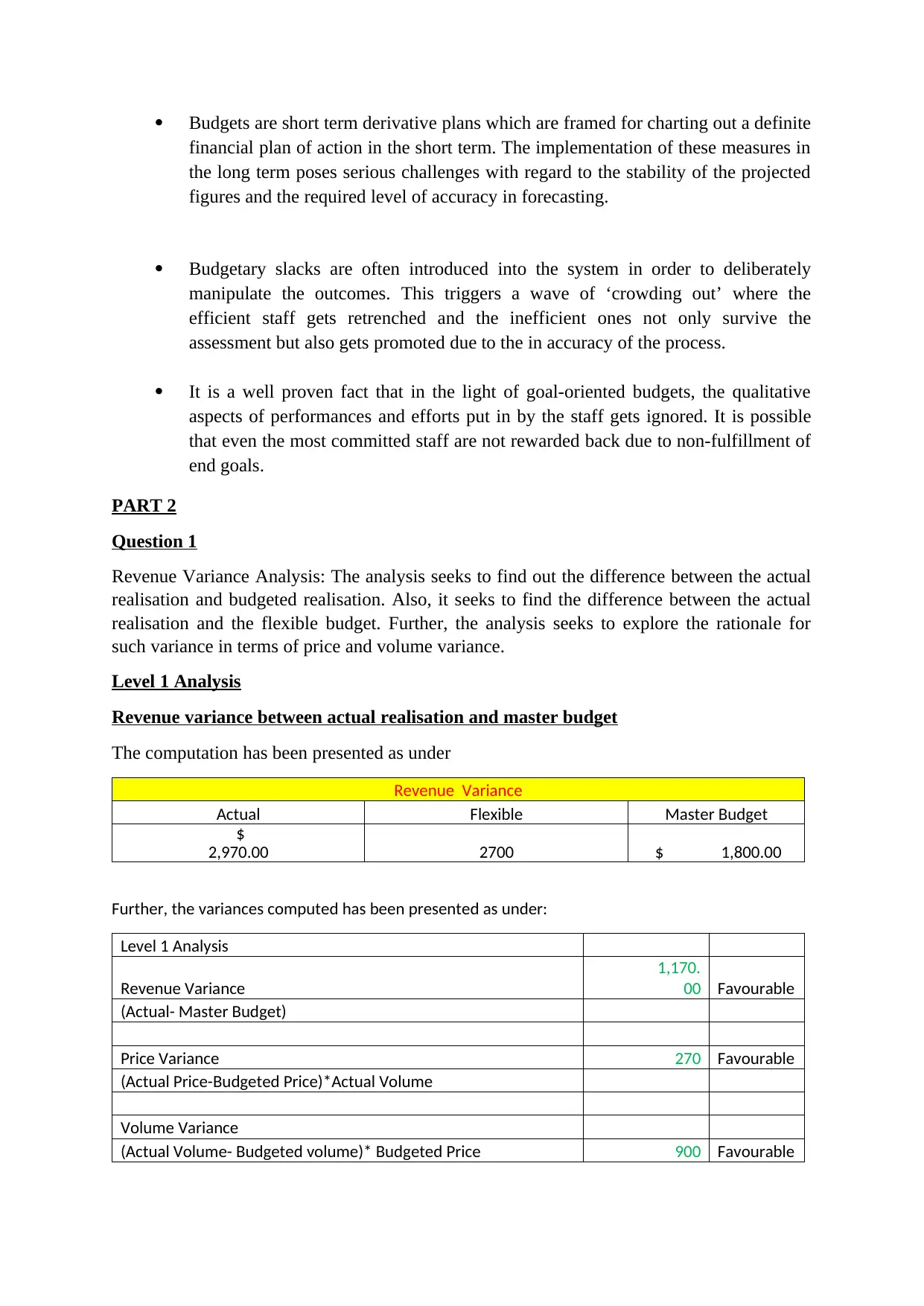
Revenue Variance Analysis: The analysis seeks to find out the difference between the actual
realisation and budgeted realisation. Also, it seeks to find the difference between the actual
realisation and the flexible budget. Further, the analysis seeks to explore the rationale for
such variance in terms of price and volume variance.
Level 1 Analysis
Revenue variance between actual realisation and master budget
The computation has been presented as under
Revenue Variance
Actual Flexible Master Budget
$
2,970.00 2700 $ 1,800.00
Further, the variances computed has been presented as under:
Level 1 Analysis
Revenue Variance
1,170.
00 Favourable
(Actual- Master Budget)
Price Variance 270 Favourable
(Actual Price-Budgeted Price)*Actual Volume
Volume Variance
(Actual Volume- Budgeted volume)* Budgeted Price 900 Favourable
financial plan of action in the short term. The implementation of these measures in
the long term poses serious challenges with regard to the stability of the projected
figures and the required level of accuracy in forecasting.
ï‚· Budgetary slacks are often introduced into the system in order to deliberately
manipulate the outcomes. This triggers a wave of ‘crowding out’ where the
efficient staff gets retrenched and the inefficient ones not only survive the
assessment but also gets promoted due to the in accuracy of the process.
ï‚· It is a well proven fact that in the light of goal-oriented budgets, the qualitative
aspects of performances and efforts put in by the staff gets ignored. It is possible
that even the most committed staff are not rewarded back due to non-fulfillment of
end goals.
PART 2
Question 1
Revenue Variance Analysis: The analysis seeks to find out the difference between the actual
realisation and budgeted realisation. Also, it seeks to find the difference between the actual
realisation and the flexible budget. Further, the analysis seeks to explore the rationale for
such variance in terms of price and volume variance.
Level 1 Analysis
Revenue variance between actual realisation and master budget
The computation has been presented as under
Revenue Variance
Actual Flexible Master Budget
$
2,970.00 2700 $ 1,800.00
Further, the variances computed has been presented as under:
Level 1 Analysis
Revenue Variance
1,170.
00 Favourable
(Actual- Master Budget)
Price Variance 270 Favourable
(Actual Price-Budgeted Price)*Actual Volume
Volume Variance
(Actual Volume- Budgeted volume)* Budgeted Price 900 Favourable
⊘ This is a preview!⊘
Do you want full access?
Subscribe today to unlock all pages.

Trusted by 1+ million students worldwide

On perusal of the above it can be inferred that price is favourable as the organisation was able to
charger a high price to clients. Further, the volume has been favourable and more customers visited
the organisation than expected. Both the said variances shall have a positive impact on the profit of
the company.
Level 2 Analysis
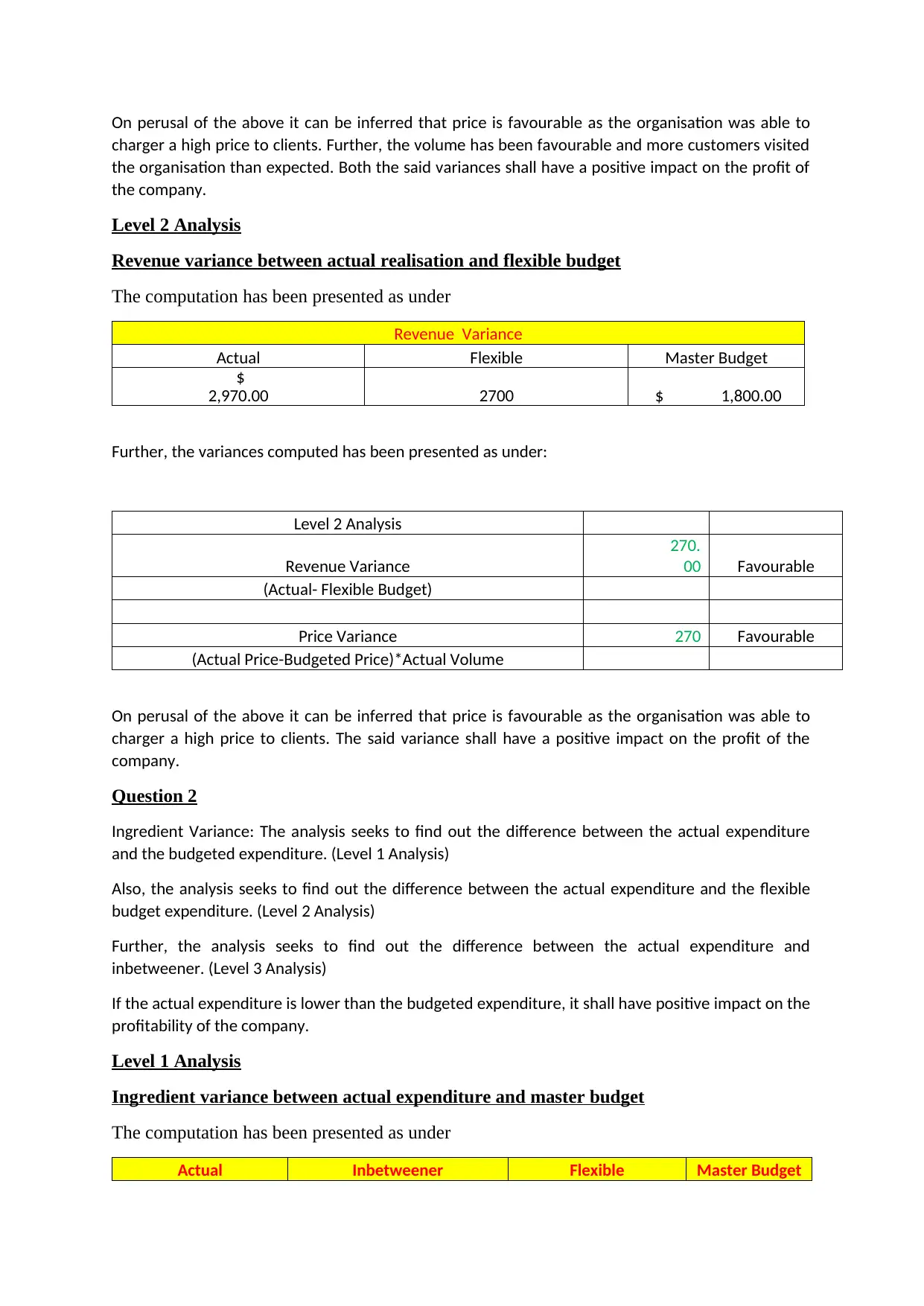
Revenue variance between actual realisation and flexible budget
The computation has been presented as under
Revenue Variance
Actual Flexible Master Budget
$
2,970.00 2700 $ 1,800.00
Further, the variances computed has been presented as under:
Level 2 Analysis
Revenue Variance
270.
00 Favourable
(Actual- Flexible Budget)
Price Variance 270 Favourable
(Actual Price-Budgeted Price)*Actual Volume
On perusal of the above it can be inferred that price is favourable as the organisation was able to
charger a high price to clients. The said variance shall have a positive impact on the profit of the
company.
Question 2
Ingredient Variance: The analysis seeks to find out the difference between the actual expenditure
and the budgeted expenditure. (Level 1 Analysis)
Also, the analysis seeks to find out the difference between the actual expenditure and the flexible
budget expenditure. (Level 2 Analysis)
Further, the analysis seeks to find out the difference between the actual expenditure and
inbetweener. (Level 3 Analysis)
If the actual expenditure is lower than the budgeted expenditure, it shall have positive impact on the
profitability of the company.
Level 1 Analysis
Ingredient variance between actual expenditure and master budget
The computation has been presented as under
Actual Inbetweener Flexible Master Budget
charger a high price to clients. Further, the volume has been favourable and more customers visited
the organisation than expected. Both the said variances shall have a positive impact on the profit of
the company.
Level 2 Analysis
Revenue variance between actual realisation and flexible budget
The computation has been presented as under
Revenue Variance
Actual Flexible Master Budget
$
2,970.00 2700 $ 1,800.00
Further, the variances computed has been presented as under:
Level 2 Analysis
Revenue Variance
270.
00 Favourable
(Actual- Flexible Budget)
Price Variance 270 Favourable
(Actual Price-Budgeted Price)*Actual Volume
On perusal of the above it can be inferred that price is favourable as the organisation was able to
charger a high price to clients. The said variance shall have a positive impact on the profit of the
company.
Question 2
Ingredient Variance: The analysis seeks to find out the difference between the actual expenditure
and the budgeted expenditure. (Level 1 Analysis)
Also, the analysis seeks to find out the difference between the actual expenditure and the flexible
budget expenditure. (Level 2 Analysis)
Further, the analysis seeks to find out the difference between the actual expenditure and
inbetweener. (Level 3 Analysis)
If the actual expenditure is lower than the budgeted expenditure, it shall have positive impact on the
profitability of the company.
Level 1 Analysis
Ingredient variance between actual expenditure and master budget
The computation has been presented as under
Actual Inbetweener Flexible Master Budget
Paraphrase This Document
Need a fresh take? Get an instant paraphrase of this document with our AI Paraphraser

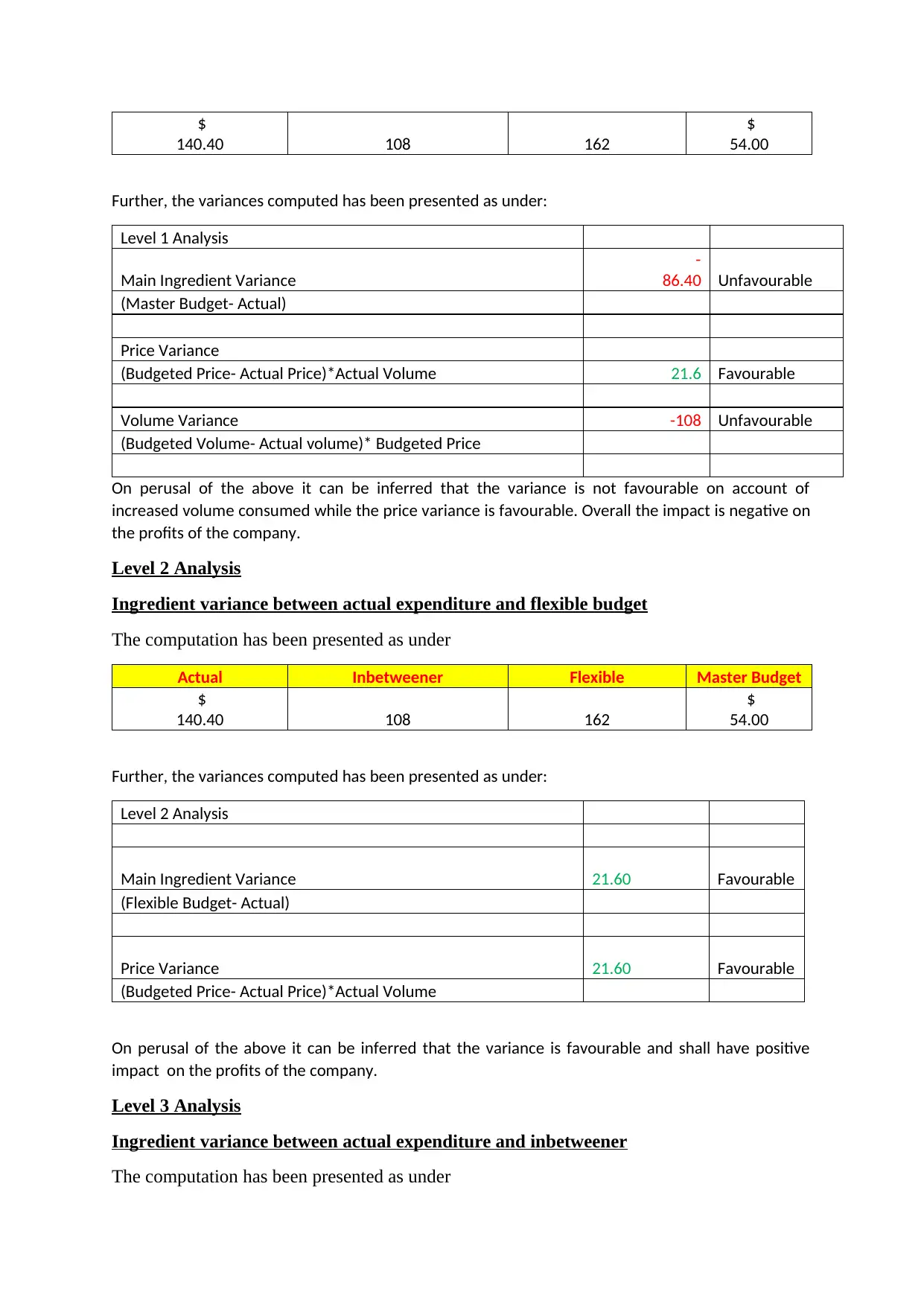
$
140.40 108 162
$
54.00
Further, the variances computed has been presented as under:
Level 1 Analysis
Main Ingredient Variance
-
86.40 Unfavourable
(Master Budget- Actual)
Price Variance
(Budgeted Price- Actual Price)*Actual Volume 21.6 Favourable
Volume Variance -108 Unfavourable
(Budgeted Volume- Actual volume)* Budgeted Price
On perusal of the above it can be inferred that the variance is not favourable on account of
increased volume consumed while the price variance is favourable. Overall the impact is negative on
the profits of the company.
Level 2 Analysis
Ingredient variance between actual expenditure and flexible budget
The computation has been presented as under
Actual Inbetweener Flexible Master Budget
$
140.40 108 162
$
54.00
Further, the variances computed has been presented as under:
Level 2 Analysis
Main Ingredient Variance 21.60 Favourable
(Flexible Budget- Actual)
Price Variance 21.60 Favourable
(Budgeted Price- Actual Price)*Actual Volume
On perusal of the above it can be inferred that the variance is favourable and shall have positive
impact on the profits of the company.
Level 3 Analysis
Ingredient variance between actual expenditure and inbetweener
The computation has been presented as under
140.40 108 162
$
54.00
Further, the variances computed has been presented as under:
Level 1 Analysis
Main Ingredient Variance
-
86.40 Unfavourable
(Master Budget- Actual)
Price Variance
(Budgeted Price- Actual Price)*Actual Volume 21.6 Favourable
Volume Variance -108 Unfavourable
(Budgeted Volume- Actual volume)* Budgeted Price
On perusal of the above it can be inferred that the variance is not favourable on account of
increased volume consumed while the price variance is favourable. Overall the impact is negative on
the profits of the company.
Level 2 Analysis
Ingredient variance between actual expenditure and flexible budget
The computation has been presented as under
Actual Inbetweener Flexible Master Budget
$
140.40 108 162
$
54.00
Further, the variances computed has been presented as under:
Level 2 Analysis
Main Ingredient Variance 21.60 Favourable
(Flexible Budget- Actual)
Price Variance 21.60 Favourable
(Budgeted Price- Actual Price)*Actual Volume
On perusal of the above it can be inferred that the variance is favourable and shall have positive
impact on the profits of the company.
Level 3 Analysis
Ingredient variance between actual expenditure and inbetweener
The computation has been presented as under

Actual Inbetweener Flexible Master Budget
$
140.40 108 162
$
54.00
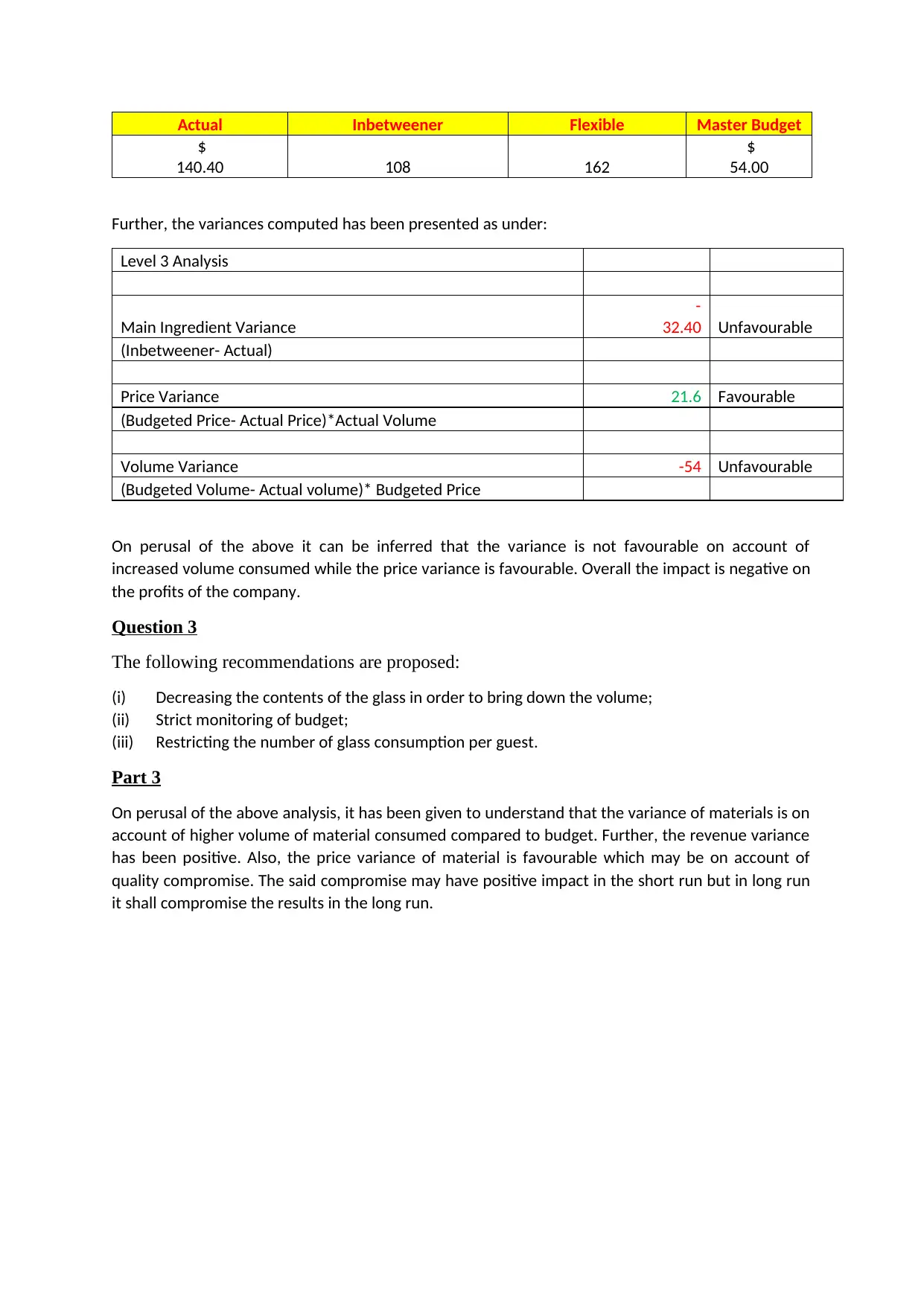
Further, the variances computed has been presented as under:
Level 3 Analysis
Main Ingredient Variance
-
32.40 Unfavourable
(Inbetweener- Actual)
Price Variance 21.6 Favourable
(Budgeted Price- Actual Price)*Actual Volume
Volume Variance -54 Unfavourable
(Budgeted Volume- Actual volume)* Budgeted Price
On perusal of the above it can be inferred that the variance is not favourable on account of
increased volume consumed while the price variance is favourable. Overall the impact is negative on
the profits of the company.
Question 3
The following recommendations are proposed:
(i) Decreasing the contents of the glass in order to bring down the volume;
(ii) Strict monitoring of budget;
(iii) Restricting the number of glass consumption per guest.
Part 3
On perusal of the above analysis, it has been given to understand that the variance of materials is on
account of higher volume of material consumed compared to budget. Further, the revenue variance
has been positive. Also, the price variance of material is favourable which may be on account of
quality compromise. The said compromise may have positive impact in the short run but in long run
it shall compromise the results in the long run.
$
140.40 108 162
$
54.00
Further, the variances computed has been presented as under:
Level 3 Analysis
Main Ingredient Variance
-
32.40 Unfavourable
(Inbetweener- Actual)
Price Variance 21.6 Favourable
(Budgeted Price- Actual Price)*Actual Volume
Volume Variance -54 Unfavourable
(Budgeted Volume- Actual volume)* Budgeted Price
On perusal of the above it can be inferred that the variance is not favourable on account of
increased volume consumed while the price variance is favourable. Overall the impact is negative on
the profits of the company.
Question 3
The following recommendations are proposed:
(i) Decreasing the contents of the glass in order to bring down the volume;
(ii) Strict monitoring of budget;
(iii) Restricting the number of glass consumption per guest.
Part 3
On perusal of the above analysis, it has been given to understand that the variance of materials is on
account of higher volume of material consumed compared to budget. Further, the revenue variance
has been positive. Also, the price variance of material is favourable which may be on account of
quality compromise. The said compromise may have positive impact in the short run but in long run
it shall compromise the results in the long run.
⊘ This is a preview!⊘
Do you want full access?
Subscribe today to unlock all pages.

Trusted by 1+ million students worldwide

References
Accountingtools.com. (2019, May 24). Problem caused by budgeting. Retrieved from
www.accountingtools.com: https://www.accountingtools.com/articles/the-problems-
caused-by-budgeting.html
Benefits or Advantages of Budgeting to organization. (2019, May 24). Retrieved from
accountlearning.com: https://accountlearning.com/benefits-or-advantages-of-budgeting-to-
organization/
Budgeting in the Hotel Industry. (2019, May 24). Retrieved from www.ukessays.com:
https://www.ukessays.com/dissertation/examples/leisure-management/hotel-industry-
marriott.php
Accountingtools.com. (2019, May 24). Problem caused by budgeting. Retrieved from
www.accountingtools.com: https://www.accountingtools.com/articles/the-problems-
caused-by-budgeting.html
Benefits or Advantages of Budgeting to organization. (2019, May 24). Retrieved from
accountlearning.com: https://accountlearning.com/benefits-or-advantages-of-budgeting-to-
organization/
Budgeting in the Hotel Industry. (2019, May 24). Retrieved from www.ukessays.com:
https://www.ukessays.com/dissertation/examples/leisure-management/hotel-industry-
marriott.php
1 out of 7
Related Documents
Your All-in-One AI-Powered Toolkit for Academic Success.
 +13062052269
info@desklib.com
Available 24*7 on WhatsApp / Email
Unlock your academic potential
Copyright © 2020–2025 A2Z Services. All Rights Reserved. Developed and managed by ZUCOL.