Analysis of Management Accounting & Financial Planning - BETA IT
VerifiedAdded on 2023/06/17
|10
|3068
|321
Report
AI Summary
This report provides an analysis of management accounting and financial planning strategies within the context of BETA IT, a Dubai-based IT company. It covers various aspects of standard costing, including its types and limitations, and compares it with target costing. The report also examines the role of the contribution technique in decision-making, highlighting its use in determining minimum sale prices, analyzing profit, calculating break-even points, and deciding the margin of safety. Furthermore, it interprets how the transfer pricing approach can improve business gains by optimizing tax deductions and employing methods like the comparable uncontrolled price method. The analysis uses examples to illustrate the practical application of these techniques, emphasizing their importance in cost control, performance analysis, and profitability enhancement for BETA IT.
Management
Accounting and
Financial Planning
Accounting and
Financial Planning

Paraphrase This Document
Need a fresh take? Get an instant paraphrase of this document with our AI Paraphraser
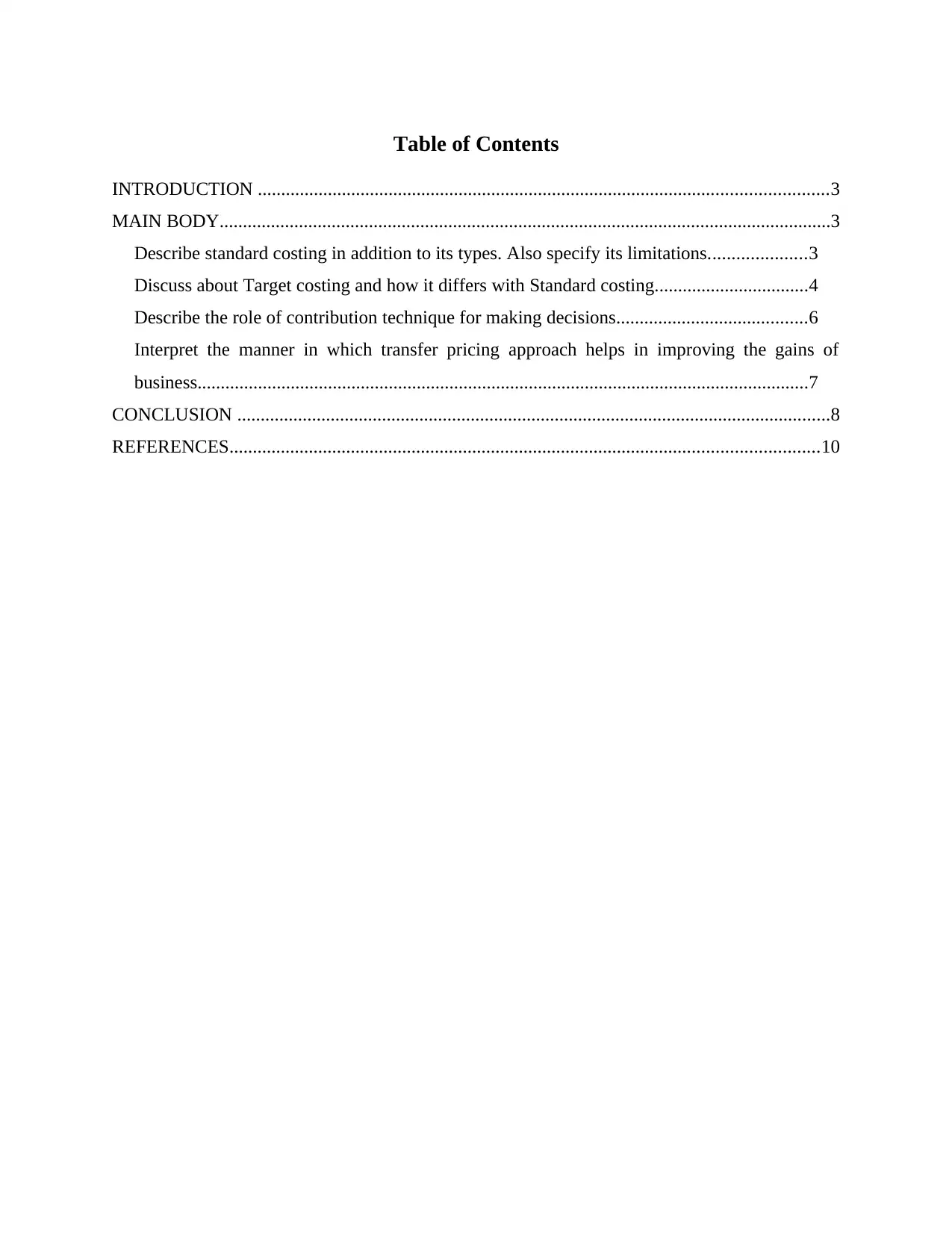
Table of Contents
INTRODUCTION ..........................................................................................................................3
MAIN BODY...................................................................................................................................3
Describe standard costing in addition to its types. Also specify its limitations.....................3
Discuss about Target costing and how it differs with Standard costing.................................4
Describe the role of contribution technique for making decisions.........................................6
Interpret the manner in which transfer pricing approach helps in improving the gains of
business...................................................................................................................................7
CONCLUSION ...............................................................................................................................8
REFERENCES..............................................................................................................................10
INTRODUCTION ..........................................................................................................................3
MAIN BODY...................................................................................................................................3
Describe standard costing in addition to its types. Also specify its limitations.....................3
Discuss about Target costing and how it differs with Standard costing.................................4
Describe the role of contribution technique for making decisions.........................................6
Interpret the manner in which transfer pricing approach helps in improving the gains of
business...................................................................................................................................7
CONCLUSION ...............................................................................................................................8
REFERENCES..............................................................................................................................10
INTRODUCTION
Management accounting refers to the process of identifying, analysing and interpreting
the financial data of organisation for the purpose of taking various monetary as well as non-
monetary decisions. It prepares various types of statements and tries to find out the weaknesses
of firm so that its profitability could be increased (Tsai and Jhong, 2019). The report is based on
BETA IT company. It is a Dubai based business dealing in developing apps, software
consultancy, support and maintenance of application, IOT services ans many more. The report
discusses about various types and limitations of standard costing along with its compression with
target costing. It further provides the role of contribution technique in decision making, in
addition to analyse the approaches of transfer of price to improve the profitability of firm.
MAIN BODY
Describe standard costing in addition to its types. Also specify its limitations.
It is a process of estimating the amount of expenses that can be incurred during
production. The cost estimated in this system is then compared with the actual results to know
the difference about them and collect information about the reason behind this variation. Its
objective is to implement estimated budget correctly and examine the performance of that
operation, so that BETA can control the extra cost incurred on it. They are generally prepared
periodically and work on the previous experience of the firm. It takes advance search and finding
for determining the base for coming year.
Kinds
Normally, it has four types
Ideal standard- These are measures which are very easy to obtained in normal
conditions. It requires BETA to adopt the most favourable cost for its labour and
material along with maximum attainable output that can be produced amid of showing
highest level of efficiency. There is no space for any sort of spoilage or inefficiency in
these types of measures (Bradley and et. al., 2018).
Normal standards- They are the estimated level which are anticipated to be achieved in
future, generally for the duration of single business cycle. BETA frame these standards
while looking at its average capacity that can help it in boom and regression. The cost
recognised in this method is not revised ans remains same for the whole cycle.
Management accounting refers to the process of identifying, analysing and interpreting
the financial data of organisation for the purpose of taking various monetary as well as non-
monetary decisions. It prepares various types of statements and tries to find out the weaknesses
of firm so that its profitability could be increased (Tsai and Jhong, 2019). The report is based on
BETA IT company. It is a Dubai based business dealing in developing apps, software
consultancy, support and maintenance of application, IOT services ans many more. The report
discusses about various types and limitations of standard costing along with its compression with
target costing. It further provides the role of contribution technique in decision making, in
addition to analyse the approaches of transfer of price to improve the profitability of firm.
MAIN BODY
Describe standard costing in addition to its types. Also specify its limitations.
It is a process of estimating the amount of expenses that can be incurred during
production. The cost estimated in this system is then compared with the actual results to know
the difference about them and collect information about the reason behind this variation. Its
objective is to implement estimated budget correctly and examine the performance of that
operation, so that BETA can control the extra cost incurred on it. They are generally prepared
periodically and work on the previous experience of the firm. It takes advance search and finding
for determining the base for coming year.
Kinds
Normally, it has four types
Ideal standard- These are measures which are very easy to obtained in normal
conditions. It requires BETA to adopt the most favourable cost for its labour and
material along with maximum attainable output that can be produced amid of showing
highest level of efficiency. There is no space for any sort of spoilage or inefficiency in
these types of measures (Bradley and et. al., 2018).
Normal standards- They are the estimated level which are anticipated to be achieved in
future, generally for the duration of single business cycle. BETA frame these standards
while looking at its average capacity that can help it in boom and regression. The cost
recognised in this method is not revised ans remains same for the whole cycle.
⊘ This is a preview!⊘
Do you want full access?
Subscribe today to unlock all pages.

Trusted by 1+ million students worldwide
Basic standards- These are measures which are established by firm for an undefined
period of time. These measures normally remains unaltered, but are sometimes revised
according to the fluctuation in price level. These are not used by BETA, only for the
evaluation of actual results, but also for the expected results. In other words, basic
standards work as a measure for other grades (Johnsen and Hvam, 2019).
Currently attainable standards- These measures are usually for short time period and
are related to present conditions of work. BETA follows these standards to bring
efficiency in their operations. The levels formed in them are generally very hard, but are
attainable and demands proper focus. They gives allowance for a particular level of
spoilage, wastage and breakdowns along with idle time.
Shortcomings of standard costing
Costly tool - It requires expert understanding for setting up fixed values and evaluating
them from the actual performance. This type of learning is acquired by professionals and
BETA have to spend lot of money in hiring such persons.
Demands regular revision- Due to frequent fluctuations in market, price and inflation
levels, it is very much important to update these measures from time-to-time. It is very
complicated and slow process, thus consumes a lot of time of BETA company.
Effects employee Psychology- The management has to keep in mind that the level set by
it must be attainable and in the reach of their employees. Unattainable or high measures
can make the employees of BETA dissatisfied instead of motivating them to work more.
So, standard costing guides the firm about the limit of expenses it can incur in its
operations. Though there are various drawbacks related to this technique, still this tool is very
helpful in analysing the performance and controlling the cost of various operations (Fuss, Barros
and Poganietz, 2018).
Discuss about Target costing and how it differs with Standard costing.
In this system , company pre-defines its cost, price and revenue associated with a new product or
service. If the firm feels that the good could not be prepared at planned level, then the idea of
manufacturing is dropped. These pre-set value are based on the deep deep research done by the
BETA on that product in market, on the basis of profits earned by competitors, demand of
customers and many more. Then the designed team determines the minimum and maximum cost
that would be spend for producing that material. Then, that product is created by making sure
period of time. These measures normally remains unaltered, but are sometimes revised
according to the fluctuation in price level. These are not used by BETA, only for the
evaluation of actual results, but also for the expected results. In other words, basic
standards work as a measure for other grades (Johnsen and Hvam, 2019).
Currently attainable standards- These measures are usually for short time period and
are related to present conditions of work. BETA follows these standards to bring
efficiency in their operations. The levels formed in them are generally very hard, but are
attainable and demands proper focus. They gives allowance for a particular level of
spoilage, wastage and breakdowns along with idle time.
Shortcomings of standard costing
Costly tool - It requires expert understanding for setting up fixed values and evaluating
them from the actual performance. This type of learning is acquired by professionals and
BETA have to spend lot of money in hiring such persons.
Demands regular revision- Due to frequent fluctuations in market, price and inflation
levels, it is very much important to update these measures from time-to-time. It is very
complicated and slow process, thus consumes a lot of time of BETA company.
Effects employee Psychology- The management has to keep in mind that the level set by
it must be attainable and in the reach of their employees. Unattainable or high measures
can make the employees of BETA dissatisfied instead of motivating them to work more.
So, standard costing guides the firm about the limit of expenses it can incur in its
operations. Though there are various drawbacks related to this technique, still this tool is very
helpful in analysing the performance and controlling the cost of various operations (Fuss, Barros
and Poganietz, 2018).
Discuss about Target costing and how it differs with Standard costing.
In this system , company pre-defines its cost, price and revenue associated with a new product or
service. If the firm feels that the good could not be prepared at planned level, then the idea of
manufacturing is dropped. These pre-set value are based on the deep deep research done by the
BETA on that product in market, on the basis of profits earned by competitors, demand of
customers and many more. Then the designed team determines the minimum and maximum cost
that would be spend for producing that material. Then, that product is created by making sure
Paraphrase This Document
Need a fresh take? Get an instant paraphrase of this document with our AI Paraphraser
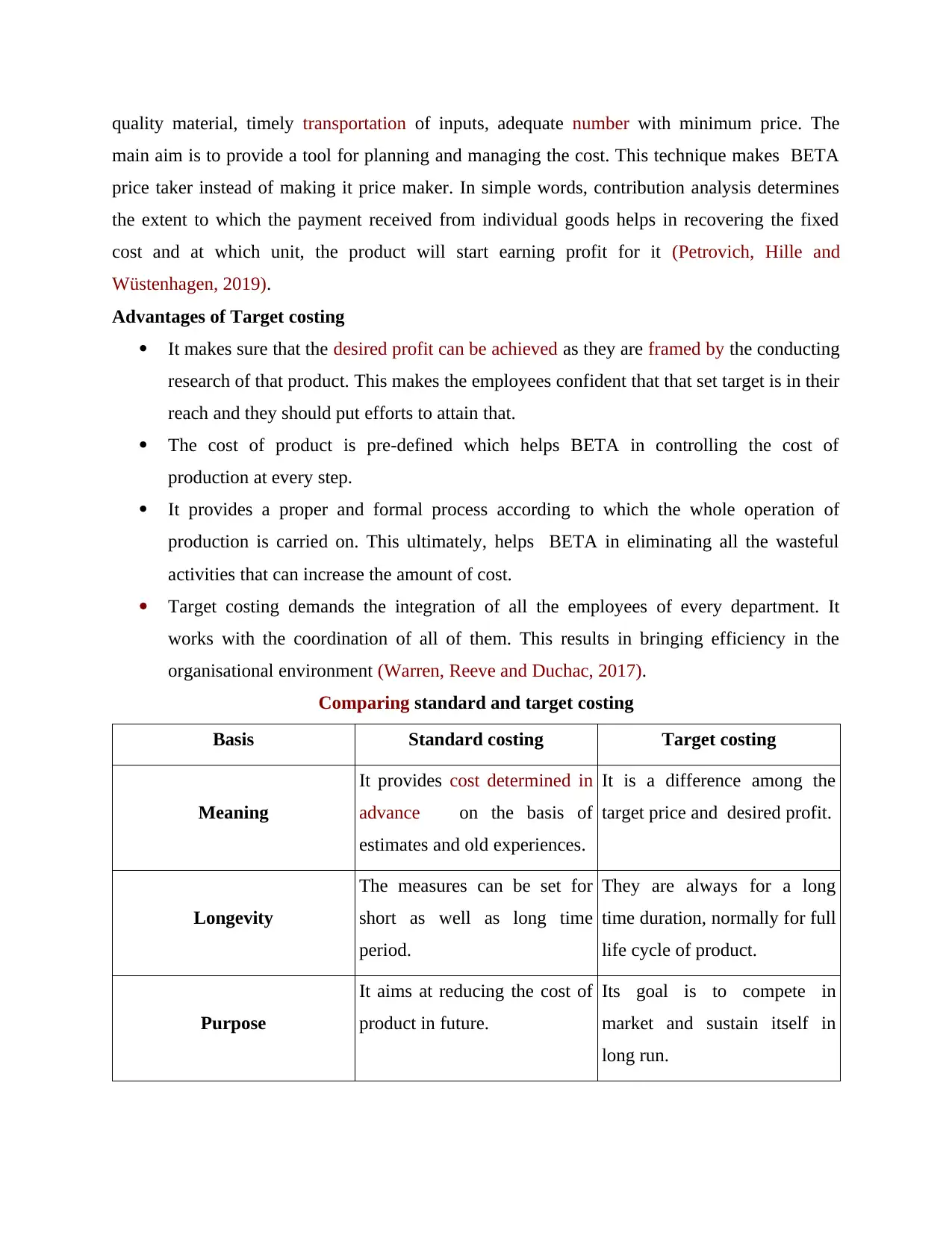
quality material, timely transportation of inputs, adequate number with minimum price. The
main aim is to provide a tool for planning and managing the cost. This technique makes BETA
price taker instead of making it price maker. In simple words, contribution analysis determines
the extent to which the payment received from individual goods helps in recovering the fixed
cost and at which unit, the product will start earning profit for it (Petrovich, Hille and
Wüstenhagen, 2019).
Advantages of Target costing
It makes sure that the desired profit can be achieved as they are framed by the conducting
research of that product. This makes the employees confident that that set target is in their
reach and they should put efforts to attain that.
The cost of product is pre-defined which helps BETA in controlling the cost of
production at every step.
It provides a proper and formal process according to which the whole operation of
production is carried on. This ultimately, helps BETA in eliminating all the wasteful
activities that can increase the amount of cost.
Target costing demands the integration of all the employees of every department. It
works with the coordination of all of them. This results in bringing efficiency in the
organisational environment (Warren, Reeve and Duchac, 2017).
Comparing standard and target costing
Basis Standard costing Target costing
Meaning
It provides cost determined in
advance on the basis of
estimates and old experiences.
It is a difference among the
target price and desired profit.
Longevity
The measures can be set for
short as well as long time
period.
They are always for a long
time duration, normally for full
life cycle of product.
Purpose
It aims at reducing the cost of
product in future.
Its goal is to compete in
market and sustain itself in
long run.
main aim is to provide a tool for planning and managing the cost. This technique makes BETA
price taker instead of making it price maker. In simple words, contribution analysis determines
the extent to which the payment received from individual goods helps in recovering the fixed
cost and at which unit, the product will start earning profit for it (Petrovich, Hille and
Wüstenhagen, 2019).
Advantages of Target costing
It makes sure that the desired profit can be achieved as they are framed by the conducting
research of that product. This makes the employees confident that that set target is in their
reach and they should put efforts to attain that.
The cost of product is pre-defined which helps BETA in controlling the cost of
production at every step.
It provides a proper and formal process according to which the whole operation of
production is carried on. This ultimately, helps BETA in eliminating all the wasteful
activities that can increase the amount of cost.
Target costing demands the integration of all the employees of every department. It
works with the coordination of all of them. This results in bringing efficiency in the
organisational environment (Warren, Reeve and Duchac, 2017).
Comparing standard and target costing
Basis Standard costing Target costing
Meaning
It provides cost determined in
advance on the basis of
estimates and old experiences.
It is a difference among the
target price and desired profit.
Longevity
The measures can be set for
short as well as long time
period.
They are always for a long
time duration, normally for full
life cycle of product.
Purpose
It aims at reducing the cost of
product in future.
Its goal is to compete in
market and sustain itself in
long run.
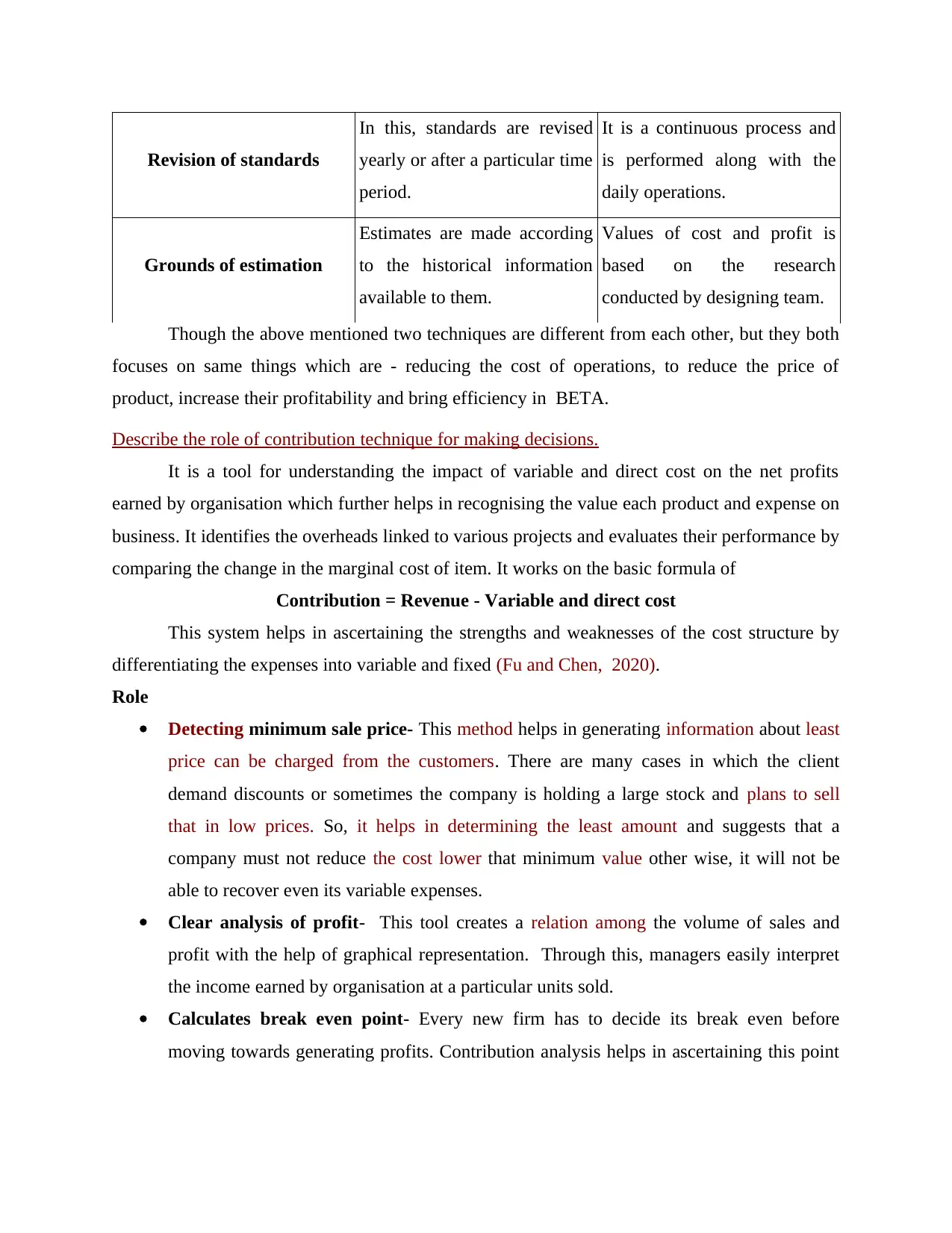
Revision of standards
In this, standards are revised
yearly or after a particular time
period.
It is a continuous process and
is performed along with the
daily operations.
Grounds of estimation
Estimates are made according
to the historical information
available to them.
Values of cost and profit is
based on the research
conducted by designing team.
Though the above mentioned two techniques are different from each other, but they both
focuses on same things which are - reducing the cost of operations, to reduce the price of
product, increase their profitability and bring efficiency in BETA.
Describe the role of contribution technique for making decisions.
It is a tool for understanding the impact of variable and direct cost on the net profits
earned by organisation which further helps in recognising the value each product and expense on
business. It identifies the overheads linked to various projects and evaluates their performance by
comparing the change in the marginal cost of item. It works on the basic formula of
Contribution = Revenue - Variable and direct cost
This system helps in ascertaining the strengths and weaknesses of the cost structure by
differentiating the expenses into variable and fixed (Fu and Chen, 2020).
Role
Detecting minimum sale price- This method helps in generating information about least
price can be charged from the customers. There are many cases in which the client
demand discounts or sometimes the company is holding a large stock and plans to sell
that in low prices. So, it helps in determining the least amount and suggests that a
company must not reduce the cost lower that minimum value other wise, it will not be
able to recover even its variable expenses.
Clear analysis of profit- This tool creates a relation among the volume of sales and
profit with the help of graphical representation. Through this, managers easily interpret
the income earned by organisation at a particular units sold.
Calculates break even point- Every new firm has to decide its break even before
moving towards generating profits. Contribution analysis helps in ascertaining this point
In this, standards are revised
yearly or after a particular time
period.
It is a continuous process and
is performed along with the
daily operations.
Grounds of estimation
Estimates are made according
to the historical information
available to them.
Values of cost and profit is
based on the research
conducted by designing team.
Though the above mentioned two techniques are different from each other, but they both
focuses on same things which are - reducing the cost of operations, to reduce the price of
product, increase their profitability and bring efficiency in BETA.
Describe the role of contribution technique for making decisions.
It is a tool for understanding the impact of variable and direct cost on the net profits
earned by organisation which further helps in recognising the value each product and expense on
business. It identifies the overheads linked to various projects and evaluates their performance by
comparing the change in the marginal cost of item. It works on the basic formula of
Contribution = Revenue - Variable and direct cost
This system helps in ascertaining the strengths and weaknesses of the cost structure by
differentiating the expenses into variable and fixed (Fu and Chen, 2020).
Role
Detecting minimum sale price- This method helps in generating information about least
price can be charged from the customers. There are many cases in which the client
demand discounts or sometimes the company is holding a large stock and plans to sell
that in low prices. So, it helps in determining the least amount and suggests that a
company must not reduce the cost lower that minimum value other wise, it will not be
able to recover even its variable expenses.
Clear analysis of profit- This tool creates a relation among the volume of sales and
profit with the help of graphical representation. Through this, managers easily interpret
the income earned by organisation at a particular units sold.
Calculates break even point- Every new firm has to decide its break even before
moving towards generating profits. Contribution analysis helps in ascertaining this point
⊘ This is a preview!⊘
Do you want full access?
Subscribe today to unlock all pages.
Trusted by 1+ million students worldwide
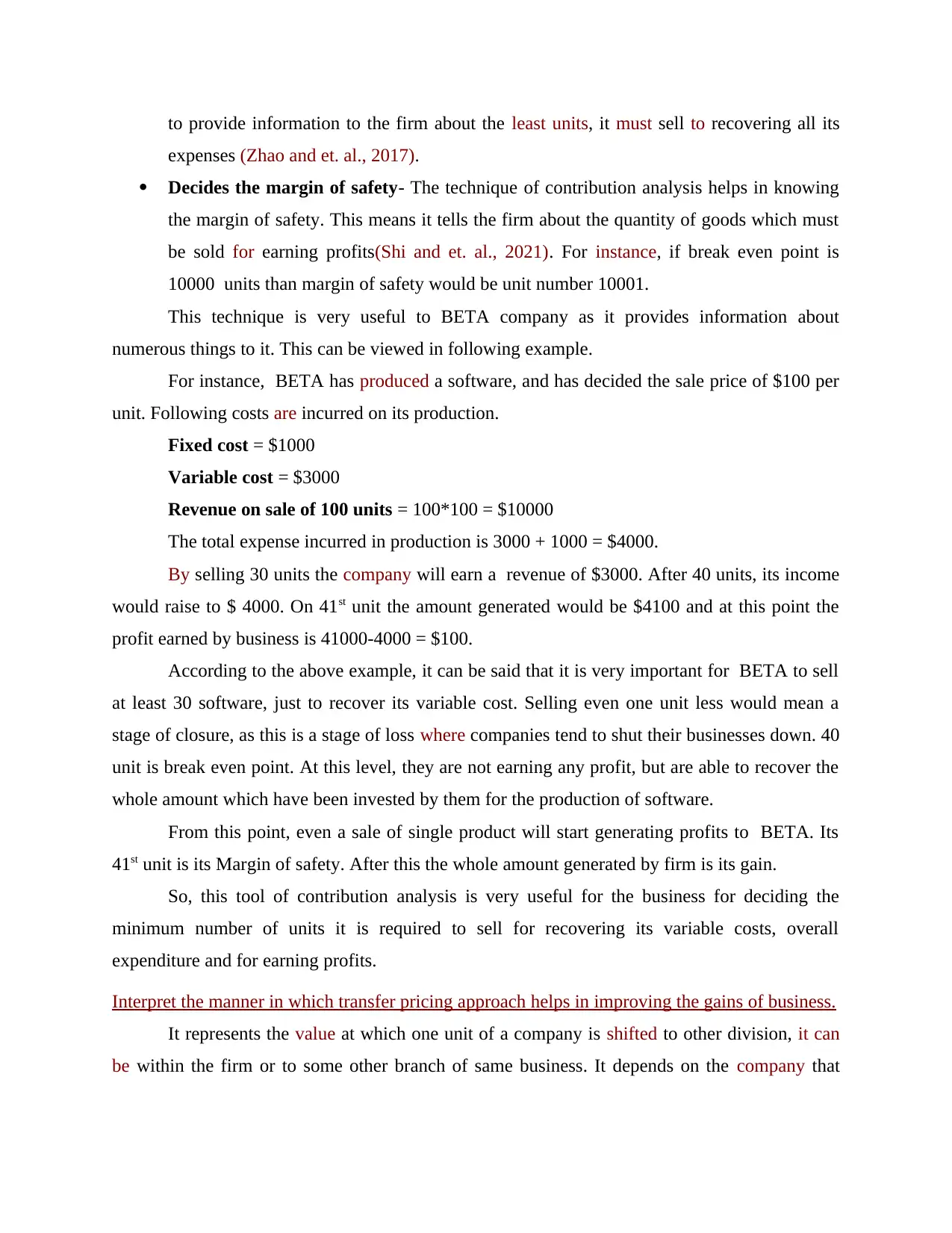
to provide information to the firm about the least units, it must sell to recovering all its
expenses (Zhao and et. al., 2017).
Decides the margin of safety- The technique of contribution analysis helps in knowing
the margin of safety. This means it tells the firm about the quantity of goods which must
be sold for earning profits(Shi and et. al., 2021). For instance, if break even point is
10000 units than margin of safety would be unit number 10001.
This technique is very useful to BETA company as it provides information about
numerous things to it. This can be viewed in following example.
For instance, BETA has produced a software, and has decided the sale price of $100 per
unit. Following costs are incurred on its production.
Fixed cost = $1000
Variable cost = $3000
Revenue on sale of 100 units = 100*100 = $10000
The total expense incurred in production is 3000 + 1000 = $4000.
By selling 30 units the company will earn a revenue of $3000. After 40 units, its income
would raise to $ 4000. On 41st unit the amount generated would be $4100 and at this point the
profit earned by business is 41000-4000 = $100.
According to the above example, it can be said that it is very important for BETA to sell
at least 30 software, just to recover its variable cost. Selling even one unit less would mean a
stage of closure, as this is a stage of loss where companies tend to shut their businesses down. 40
unit is break even point. At this level, they are not earning any profit, but are able to recover the
whole amount which have been invested by them for the production of software.
From this point, even a sale of single product will start generating profits to BETA. Its
41st unit is its Margin of safety. After this the whole amount generated by firm is its gain.
So, this tool of contribution analysis is very useful for the business for deciding the
minimum number of units it is required to sell for recovering its variable costs, overall
expenditure and for earning profits.
Interpret the manner in which transfer pricing approach helps in improving the gains of business.
It represents the value at which one unit of a company is shifted to other division, it can
be within the firm or to some other branch of same business. It depends on the company that
expenses (Zhao and et. al., 2017).
Decides the margin of safety- The technique of contribution analysis helps in knowing
the margin of safety. This means it tells the firm about the quantity of goods which must
be sold for earning profits(Shi and et. al., 2021). For instance, if break even point is
10000 units than margin of safety would be unit number 10001.
This technique is very useful to BETA company as it provides information about
numerous things to it. This can be viewed in following example.
For instance, BETA has produced a software, and has decided the sale price of $100 per
unit. Following costs are incurred on its production.
Fixed cost = $1000
Variable cost = $3000
Revenue on sale of 100 units = 100*100 = $10000
The total expense incurred in production is 3000 + 1000 = $4000.
By selling 30 units the company will earn a revenue of $3000. After 40 units, its income
would raise to $ 4000. On 41st unit the amount generated would be $4100 and at this point the
profit earned by business is 41000-4000 = $100.
According to the above example, it can be said that it is very important for BETA to sell
at least 30 software, just to recover its variable cost. Selling even one unit less would mean a
stage of closure, as this is a stage of loss where companies tend to shut their businesses down. 40
unit is break even point. At this level, they are not earning any profit, but are able to recover the
whole amount which have been invested by them for the production of software.
From this point, even a sale of single product will start generating profits to BETA. Its
41st unit is its Margin of safety. After this the whole amount generated by firm is its gain.
So, this tool of contribution analysis is very useful for the business for deciding the
minimum number of units it is required to sell for recovering its variable costs, overall
expenditure and for earning profits.
Interpret the manner in which transfer pricing approach helps in improving the gains of business.
It represents the value at which one unit of a company is shifted to other division, it can
be within the firm or to some other branch of same business. It depends on the company that
Paraphrase This Document
Need a fresh take? Get an instant paraphrase of this document with our AI Paraphraser
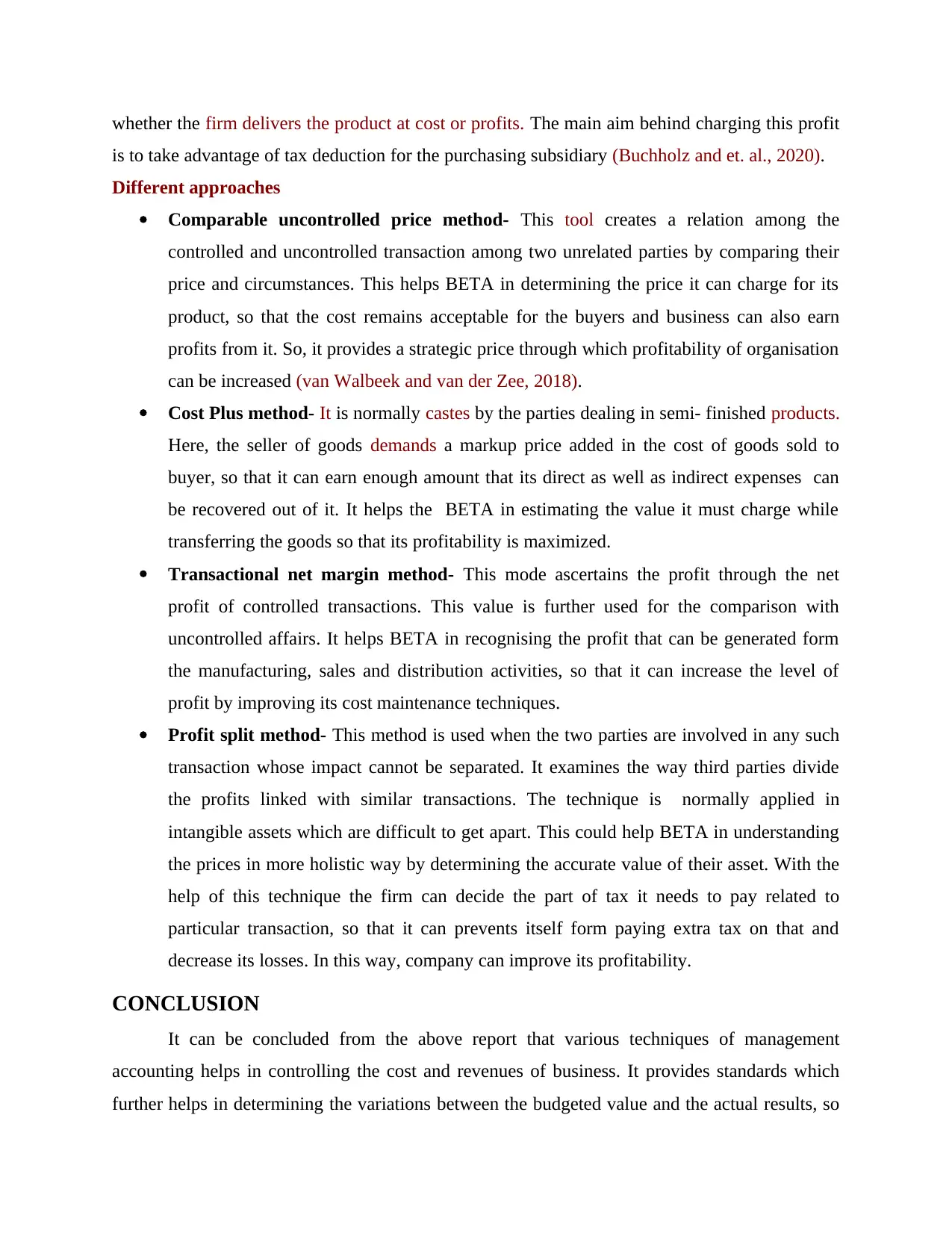
whether the firm delivers the product at cost or profits. The main aim behind charging this profit
is to take advantage of tax deduction for the purchasing subsidiary (Buchholz and et. al., 2020).
Different approaches
Comparable uncontrolled price method- This tool creates a relation among the
controlled and uncontrolled transaction among two unrelated parties by comparing their
price and circumstances. This helps BETA in determining the price it can charge for its
product, so that the cost remains acceptable for the buyers and business can also earn
profits from it. So, it provides a strategic price through which profitability of organisation
can be increased (van Walbeek and van der Zee, 2018).
Cost Plus method- It is normally castes by the parties dealing in semi- finished products.
Here, the seller of goods demands a markup price added in the cost of goods sold to
buyer, so that it can earn enough amount that its direct as well as indirect expenses can
be recovered out of it. It helps the BETA in estimating the value it must charge while
transferring the goods so that its profitability is maximized.
Transactional net margin method- This mode ascertains the profit through the net
profit of controlled transactions. This value is further used for the comparison with
uncontrolled affairs. It helps BETA in recognising the profit that can be generated form
the manufacturing, sales and distribution activities, so that it can increase the level of
profit by improving its cost maintenance techniques.
Profit split method- This method is used when the two parties are involved in any such
transaction whose impact cannot be separated. It examines the way third parties divide
the profits linked with similar transactions. The technique is normally applied in
intangible assets which are difficult to get apart. This could help BETA in understanding
the prices in more holistic way by determining the accurate value of their asset. With the
help of this technique the firm can decide the part of tax it needs to pay related to
particular transaction, so that it can prevents itself form paying extra tax on that and
decrease its losses. In this way, company can improve its profitability.
CONCLUSION
It can be concluded from the above report that various techniques of management
accounting helps in controlling the cost and revenues of business. It provides standards which
further helps in determining the variations between the budgeted value and the actual results, so
is to take advantage of tax deduction for the purchasing subsidiary (Buchholz and et. al., 2020).
Different approaches
Comparable uncontrolled price method- This tool creates a relation among the
controlled and uncontrolled transaction among two unrelated parties by comparing their
price and circumstances. This helps BETA in determining the price it can charge for its
product, so that the cost remains acceptable for the buyers and business can also earn
profits from it. So, it provides a strategic price through which profitability of organisation
can be increased (van Walbeek and van der Zee, 2018).
Cost Plus method- It is normally castes by the parties dealing in semi- finished products.
Here, the seller of goods demands a markup price added in the cost of goods sold to
buyer, so that it can earn enough amount that its direct as well as indirect expenses can
be recovered out of it. It helps the BETA in estimating the value it must charge while
transferring the goods so that its profitability is maximized.
Transactional net margin method- This mode ascertains the profit through the net
profit of controlled transactions. This value is further used for the comparison with
uncontrolled affairs. It helps BETA in recognising the profit that can be generated form
the manufacturing, sales and distribution activities, so that it can increase the level of
profit by improving its cost maintenance techniques.
Profit split method- This method is used when the two parties are involved in any such
transaction whose impact cannot be separated. It examines the way third parties divide
the profits linked with similar transactions. The technique is normally applied in
intangible assets which are difficult to get apart. This could help BETA in understanding
the prices in more holistic way by determining the accurate value of their asset. With the
help of this technique the firm can decide the part of tax it needs to pay related to
particular transaction, so that it can prevents itself form paying extra tax on that and
decrease its losses. In this way, company can improve its profitability.
CONCLUSION
It can be concluded from the above report that various techniques of management
accounting helps in controlling the cost and revenues of business. It provides standards which
further helps in determining the variations between the budgeted value and the actual results, so
that corrective measures could be taken in time. The other technique of target costing also helps
in controlling cost but it estimates all the figures in advance and tries to work within that limit
only. Further, the contribution analysis helps in ascertaining level the product can recover its
variable and fixed cost and the point at which it will start bringing profit for firm. Some firms do
sell their goods to its own branch after adding some gain it. So, this transfer price can be can be
known by implementing its approaches. All these mode from one way or the other helps in
improving the profitability and performance of business.
in controlling cost but it estimates all the figures in advance and tries to work within that limit
only. Further, the contribution analysis helps in ascertaining level the product can recover its
variable and fixed cost and the point at which it will start bringing profit for firm. Some firms do
sell their goods to its own branch after adding some gain it. So, this transfer price can be can be
known by implementing its approaches. All these mode from one way or the other helps in
improving the profitability and performance of business.
⊘ This is a preview!⊘
Do you want full access?
Subscribe today to unlock all pages.
Trusted by 1+ million students worldwide
REFERENCES
Books and Journals
Tsai, W.H. and Jhong, S.Y., 2019. Production decision model with carbon tax for the knitted
footwear industry under activity-based costing. Journal of cleaner production. 207.
pp.1150-1162.
Bradley, R. and et. al., 2018. A total life cycle cost model (TLCCM) for the circular economy
and its application to post-recovery resource allocation. Resources, Conservation and
Recycling. 135. pp.141-149.
Johnsen, S.M. and Hvam, L., 2019. Understanding the impact of non-standard customisations in
an engineer-to-order context: A case study. International Journal of Production
Research. 57(21). pp.6780-6794.
Fuss, M., Barros, R.T.V. and Poganietz, W.R., 2018. Designing a framework for municipal solid
waste management towards sustainability in emerging economy countries-An
application to a case study in Belo Horizonte (Brazil). Journal of Cleaner
Production. 178. pp.655-664.
Petrovich, B., Hille, S.L. and Wüstenhagen, R., 2019. Beauty and the budget: A segmentation of
residential solar adopters. Ecological Economics. 164. p.106353.
Warren, C.S., Reeve, J.M. and Duchac, J., 2017. Accounting. Cengage Learning.
Fu, X. and Chen, S., 2020. Geochemical characteristics and sources of Chang 8 crude oil from
Xiaoxian area, Southwest margin of the Ordos Basin, China. Energy Sources, Part A:
Recovery, Utilization, and Environmental Effects, pp.1-12.
Zhao, Y. and et. al., 2017. Grain price forecasting using a hybrid stochastic method. Asia-Pacific
Journal of Operational Research. 34(05). p.1750020.
Shi, W. and et. al., 2021. An effective Two-Stage Electricity Price forecasting scheme. Electric
Power Systems Research. 199. p.107416.
Buchholz, P. and et. al., 2020. Leaning against the wind: low-price benchmarks for acting
anticyclically in the metal markets. Mineral Economics. 33(1). pp.81-100.
van Walbeek, C. and van der Zee, K., 2018. Collecting cigarette price data on a limited
budget. Tobacco Induced Diseases. 16(1).
Books and Journals
Tsai, W.H. and Jhong, S.Y., 2019. Production decision model with carbon tax for the knitted
footwear industry under activity-based costing. Journal of cleaner production. 207.
pp.1150-1162.
Bradley, R. and et. al., 2018. A total life cycle cost model (TLCCM) for the circular economy
and its application to post-recovery resource allocation. Resources, Conservation and
Recycling. 135. pp.141-149.
Johnsen, S.M. and Hvam, L., 2019. Understanding the impact of non-standard customisations in
an engineer-to-order context: A case study. International Journal of Production
Research. 57(21). pp.6780-6794.
Fuss, M., Barros, R.T.V. and Poganietz, W.R., 2018. Designing a framework for municipal solid
waste management towards sustainability in emerging economy countries-An
application to a case study in Belo Horizonte (Brazil). Journal of Cleaner
Production. 178. pp.655-664.
Petrovich, B., Hille, S.L. and Wüstenhagen, R., 2019. Beauty and the budget: A segmentation of
residential solar adopters. Ecological Economics. 164. p.106353.
Warren, C.S., Reeve, J.M. and Duchac, J., 2017. Accounting. Cengage Learning.
Fu, X. and Chen, S., 2020. Geochemical characteristics and sources of Chang 8 crude oil from
Xiaoxian area, Southwest margin of the Ordos Basin, China. Energy Sources, Part A:
Recovery, Utilization, and Environmental Effects, pp.1-12.
Zhao, Y. and et. al., 2017. Grain price forecasting using a hybrid stochastic method. Asia-Pacific
Journal of Operational Research. 34(05). p.1750020.
Shi, W. and et. al., 2021. An effective Two-Stage Electricity Price forecasting scheme. Electric
Power Systems Research. 199. p.107416.
Buchholz, P. and et. al., 2020. Leaning against the wind: low-price benchmarks for acting
anticyclically in the metal markets. Mineral Economics. 33(1). pp.81-100.
van Walbeek, C. and van der Zee, K., 2018. Collecting cigarette price data on a limited
budget. Tobacco Induced Diseases. 16(1).

1 out of 10


Related Documents


Your All-in-One AI-Powered Toolkit for Academic Success.
+13062052269
info@desklib.com
Available 24*7 on WhatsApp / Email
![[object Object]](/_next/static/media/star-bottom.7253800d.svg)
Unlock your academic potential
Copyright © 2020–2026 A2Z Services. All Rights Reserved. Developed and managed by ZUCOL.