University of Chester - BU6066: Financial Management Report

Verified

Added on  2023/01/05

|6
|1507
|45
Report
AI Summary
This report critically examines the influence of macroeconomic policies, specifically fiscal and monetary policies, on key financial management decisions within a firm to achieve its corporate objectives. It delves into the core financial management decisions: working capital management, long-term investment decisions, dividend decisions, and financing decisions. The report explains how fiscal policy, involving government spending and taxation, and monetary policy, controlled by the central bank through interest rates and money supply, directly affect each of these decision areas. It highlights how financial managers must navigate these policies to maintain the firm's financial health, manage short-term assets and liabilities, make long-term investment choices, determine dividend payouts, and secure necessary financing. The report concludes that financial managers need to apply reasonable skill during work to overcome all the challenges so that all the objectives of a firm are achieved. The report references several academic sources to support its arguments.

Document Page
Financial management
tabler-icon-diamond-filled.svg

Paraphrase This Document

Need a fresh take? Get an instant paraphrase of this document with our AI Paraphraser
Document Page
Table of Contents
INTRODUCTION...........................................................................................................................1
MAIN BODY...................................................................................................................................1
1. Evaluating the macroeconomics (fiscal and monetary) policy impact on financial decision
making so that objectives of the firm are achieved......................................................................1
CONCLUSION................................................................................................................................3
REFERENCES................................................................................................................................4
Document Page
INTRODUCTION
Financial management is a process in which aspects that are related with finance are
deeply analysed, researched, and examined so that decisions regarding it can be taken accurately
and precisely (Adrian, Estrella and Shin, 2019). In this report there is a discussion of fiscal and
monetary policy and its impact on different decision making concept.
MAIN BODY
1. Evaluating the macroeconomics (fiscal and monetary) policy impact on financial decision
making so that objectives of the firm are achieved
Fiscal policy- It is a policy in which tax rates and level at which government spends are
adjusted by the government itself so that it can maintain the desired economy of the country.
These two are used differently according to the needs and requirements of the nation.
Monetary policy- It is a policy in which rate of interest and supply of money is managed
and controlled by central bank of a country so that desired results can be produced. It is used
mainly in difficult times so that a nation can overcome that situation. It is done to provide
liquidity to the firms, growth of a company can also be achieved, moreover it is implied in case
of inflation.
There are mainly four key financial management decisions that a finance manager takes
so that goals laid down by the firm can be achieved. All these are explained briefly below-
Working capital management decision- It is very important aspect for a business as it
involves short term assets and liabilities and decision regarding that has to be taken very
carefully. In this relationship between the two are analysed and any errors are rectified so that
working of a company is not affected by it (Budzinski, 2018). It is a decision taken regarding
assets and liabilities that are of current nature that has time period of one year or less. Fiscal
policy affects working capital management decisions as it can fluctuate the value of assets and
liabilities that are of short term nature and thus directly impacting the working of the firm.
Financial managers make a provision of assets and liabilities so that in case of any fluctuations in
the prices it would not impact the firm. This helps in achieving goals of the organisation.
Monetary policy can also affect the working of a firm inversely and acts as a barrier in current
and future growth and profitability. A manager tends to analyse and evaluate situations of the
1
Document Page
market at present and appropriation of money in assets and liabilities are done on this basis so
that the future conditions cannot have a major impact on the operation of a firm.
Long term investment decision- These are those decisions which are taken on assets
and liabilities that are of long term in nature probably more than a year (Chan and Abdul-Aziz,
2017). This is a very crucial decision that is taken by top level management officials as it can
hinder or prosper a company's growth in long run. It is also known as capital budgeting decision
and the thing that is taken care in this type of decisions is that the cash flow generation because
of the asset must be high enough to meet all the requirements of the firm. Long term assets and
liabilities value increase or decrease due to fiscal policy and it has a negative impact on the
business. Managers faces this challenge and cope up with it by applying reasonable skill during
work. As finance manager takes decision on this aspect early enough which helps in achieving
the goals of an organisation. Different types of provisions are made so that deviations can be
minimised. Monetary policy affects long term investment decisions as it can hamper the overall
growth of the firm. Managers do a detailed analysis and research on this aspect which helps in
achieving objectives of a firm.
Dividend decision- This type of decision holds great value as it is concerned with the
profits. The decision taken in it is that the profit generated either be distributed fully as dividend
to the shareholders or must be fully retained in the business. Further there is a option of retaining
a part of profit and distributing rest of the profit as dividends to shareholders. It is concerned
with the quantity of the profit that is to be distributed to the owners of the company that are
shareholders. So there has to be a balance between all the aspects so that it will increase the
market value of both shareholders and the firm (Ksendzova, Donnelly and Howell, 2017). Fiscal
policy affects dividend decision of the firm as tax rates and spending of money by government
can directly increase or decrease the dividend policy. Managers keep a retained earning so that if
fiscal policy is adverse for a firm it can still give desired dividend to the shareholders which will
benefit overall working of the firm. Monetary policy have the potential to affect a firm's dividend
decision adversely as it can impact liquidity of the firm and thus it can hamper this decision
taken by managers. So mangers do a detailed examination of all the aspects of central bank that
can affect its dividend decision well in advance and thus it helps in achieving the goals laid down
by an organisation.
2
tabler-icon-diamond-filled.svg

Paraphrase This Document

Need a fresh take? Get an instant paraphrase of this document with our AI Paraphraser
Document Page
Financing decision- It is the most important decision as it is a decision regarding raising
the capital or finance of a firm. Two methods are evaluated and analysed in this type of decision
making that is the source from which finance can be obtain and the quantity of that finance. It
can be raised from two sources that is either short or long term, a company can also opt for both
the methods according to the needs, requirements, and demand of the firm. A firm can raise
funds by issuing equity shares and debentures but it has to analyse it deeply as issuing debt will
increase the risk on the firm while equity will expect higher return as dividends, so a firm has to
take a mix of both the things in a correct ratio so that financial issues can be solved without
burdening company's assets (Mbama and Ezepue, 2018). Fiscal policy can affect financing
decision making as tax rates can affect the source and quantity of finance that a firm is willing to
raise. Managers deal with it by keeping a reserve so that rates would not affect the financing
decision of a firm. Monetary policy also affects the financing decision taken by the firm as
inflation and other aspect can affect a firm adversely. Finance managers decide in advance and
keep that provisions aside and it is used for this purpose so monetary policy does not impact that
much and thus achieving the goals laid down by organisation.
CONCLUSION
Financial management is a process which is concerned with the cash flow and a manger
has to take decisions regarding it very carefully. It can be concluded from the above that there
are various aspects of both fiscal and monetary policy on various financial decision making
concept but a manager has to apply reasonable skill during work to overcome all the challenges
so that all the objectives of a firm are achieved.
3
Document Page
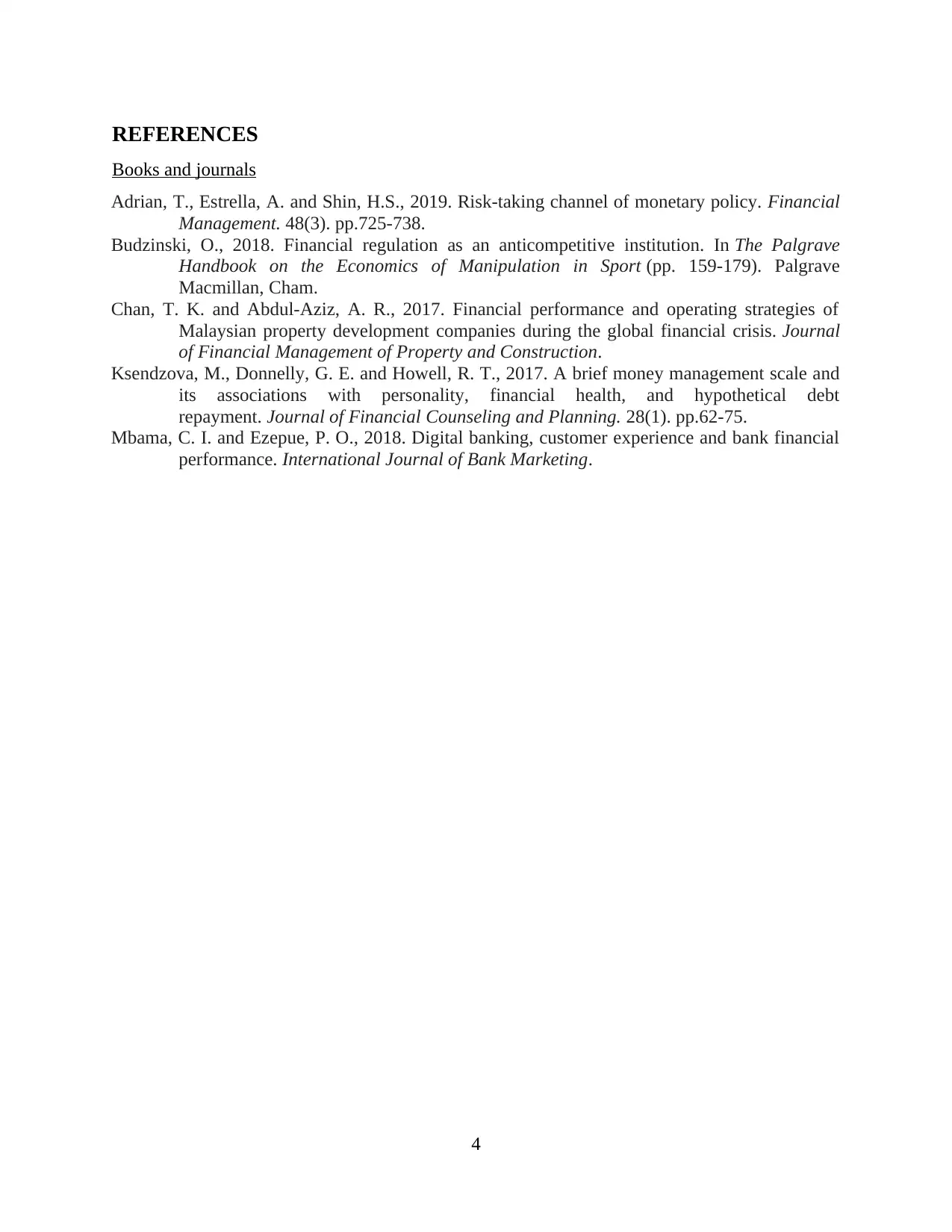
REFERENCES
Books and journals
Adrian, T., Estrella, A. and Shin, H.S., 2019. Risk‐taking channel of monetary policy. Financial
Management. 48(3). pp.725-738.
Budzinski, O., 2018. Financial regulation as an anticompetitive institution. In The Palgrave
Handbook on the Economics of Manipulation in Sport (pp. 159-179). Palgrave
Macmillan, Cham.
Chan, T. K. and Abdul-Aziz, A. R., 2017. Financial performance and operating strategies of
Malaysian property development companies during the global financial crisis. Journal
of Financial Management of Property and Construction.
Ksendzova, M., Donnelly, G. E. and Howell, R. T., 2017. A brief money management scale and
its associations with personality, financial health, and hypothetical debt
repayment. Journal of Financial Counseling and Planning. 28(1). pp.62-75.
Mbama, C. I. and Ezepue, P. O., 2018. Digital banking, customer experience and bank financial
performance. International Journal of Bank Marketing.
4
chevron_up_icon
1 out of 6
circle_padding
hide_on_mobile
zoom_out_icon
[object Object]