Financial Accounting Report: IFRS, PPE, and Proceeds Before Use

Verified

Added on  2020/06/04

|8
|1814
|119
Report
AI Summary
This report provides an overview of financial accounting principles, with a specific focus on Property, Plant, and Equipment (PPE) and the International Financial Reporting Standards (IFRS). The report begins with an introduction to financial accounting and its importance in organizational decision-making, emphasizing the role of cash flow and risk assessment. It then delves into a memo and a letter discussing issues arising from the IFRS exposure draft related to PPE, particularly concerning proceeds before intended use. The memo details the IFRS Interpretations Committee's clarification of IAS 16, addressing how net proceeds from selling items generated during the testing phase of PPE should be accounted for. It highlights proposed amendments to IAS 16 to restrict reducing the cost of PPE by any proceeds from selling items manufactured during the asset's construction. The report includes an example of depreciation calculation and concludes by emphasizing the supportive role of IFRS standards in sustainable development, referencing relevant literature. The report covers the accounting treatment of PPE, including the cost model and revaluation model, and discusses the importance of knowing the actual price of fixed assets for financial companies. Finally, the report presents a calculation of net profits based on sales, cost of production, depreciation, and gross profits.
Document Page
Financial Accounting -
Property Plant &
Equipment, Proceeds
before intended use
tabler-icon-diamond-filled.svg

Paraphrase This Document

Need a fresh take? Get an instant paraphrase of this document with our AI Paraphraser
Document Page
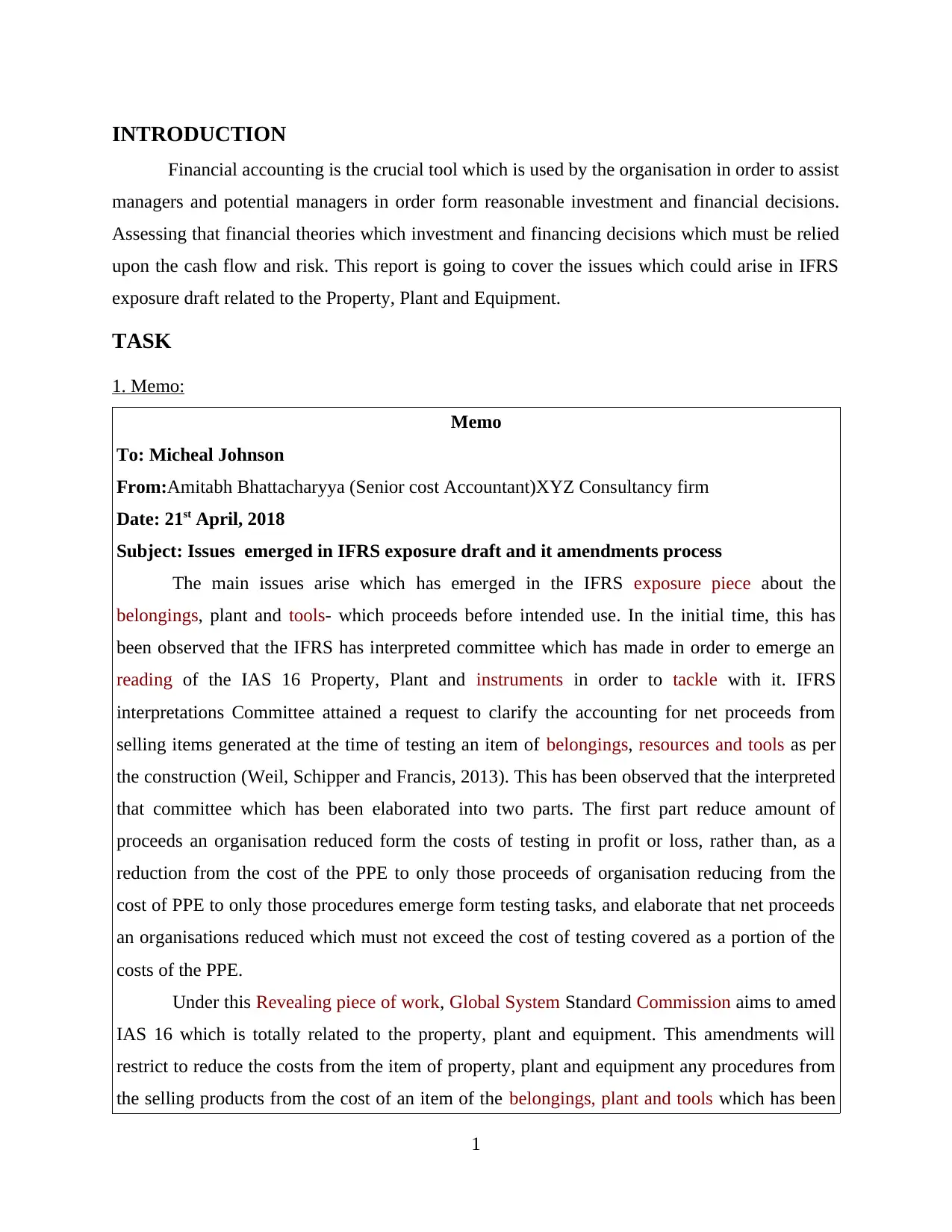
Table of Contents
INTRODUCTION...........................................................................................................................1
TASK...............................................................................................................................................1
1. Memo:.....................................................................................................................................1
2. Letter.......................................................................................................................................2
CONCLUSION................................................................................................................................3
REFERENCES................................................................................................................................4
Document Page
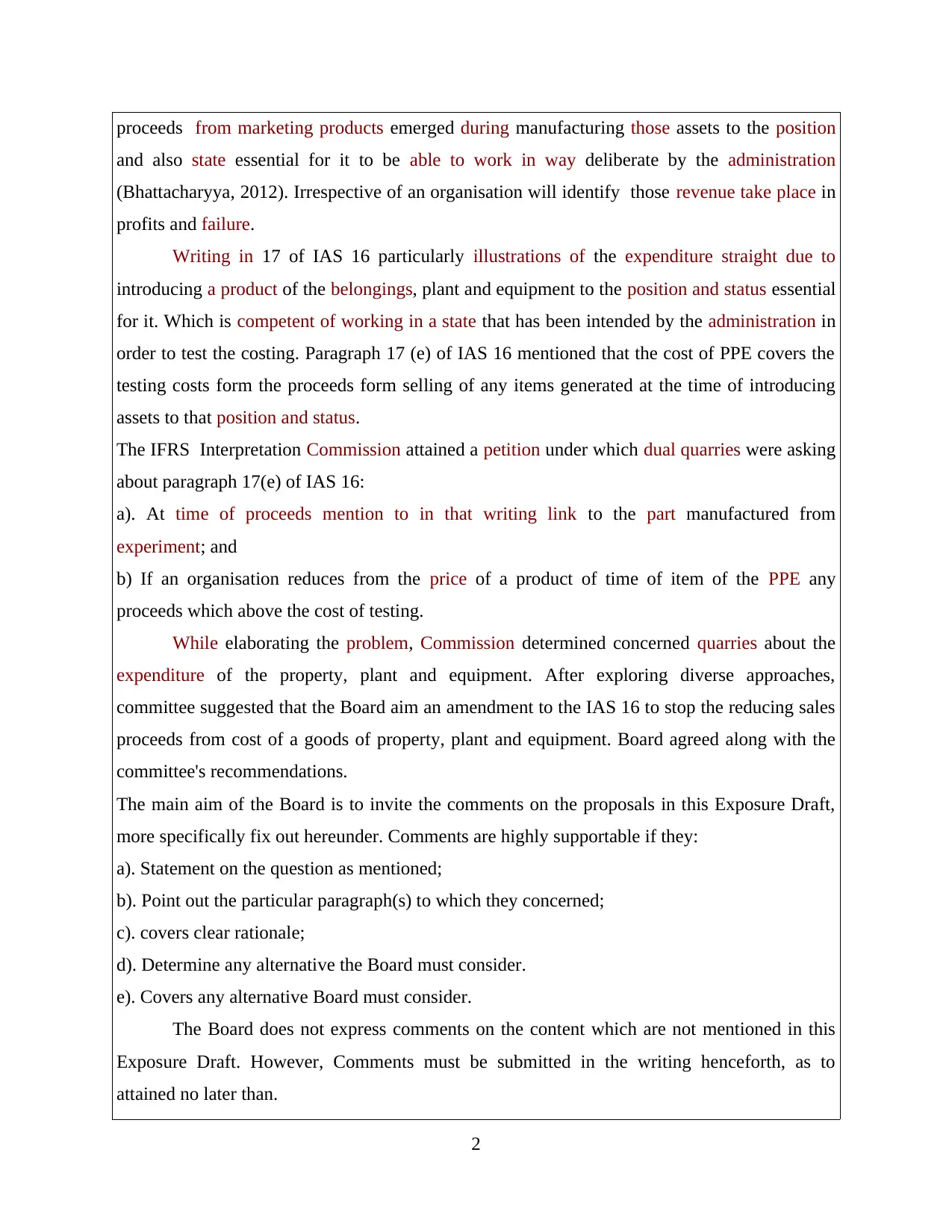
INTRODUCTION
Financial accounting is the crucial tool which is used by the organisation in order to assist
managers and potential managers in order form reasonable investment and financial decisions.
Assessing that financial theories which investment and financing decisions which must be relied
upon the cash flow and risk. This report is going to cover the issues which could arise in IFRS
exposure draft related to the Property, Plant and Equipment.
TASK
1. Memo:
Memo
To: Micheal Johnson
From:Amitabh Bhattacharyya (Senior cost Accountant)XYZ Consultancy firm
Date: 21st April, 2018
Subject: Issues emerged in IFRS exposure draft and it amendments process
The main issues arise which has emerged in the IFRS exposure piece about the
belongings, plant and tools- which proceeds before intended use. In the initial time, this has
been observed that the IFRS has interpreted committee which has made in order to emerge an
reading of the IAS 16 Property, Plant and instruments in order to tackle with it. IFRS
interpretations Committee attained a request to clarify the accounting for net proceeds from
selling items generated at the time of testing an item of belongings, resources and tools as per
the construction (Weil, Schipper and Francis, 2013). This has been observed that the interpreted
that committee which has been elaborated into two parts. The first part reduce amount of
proceeds an organisation reduced form the costs of testing in profit or loss, rather than, as a
reduction from the cost of the PPE to only those proceeds of organisation reducing from the
cost of PPE to only those procedures emerge form testing tasks, and elaborate that net proceeds
an organisations reduced which must not exceed the cost of testing covered as a portion of the
costs of the PPE.
Under this Revealing piece of work, Global System Standard Commission aims to amed
IAS 16 which is totally related to the property, plant and equipment. This amendments will
restrict to reduce the costs from the item of property, plant and equipment any procedures from
the selling products from the cost of an item of the belongings, plant and tools which has been
1
Document Page
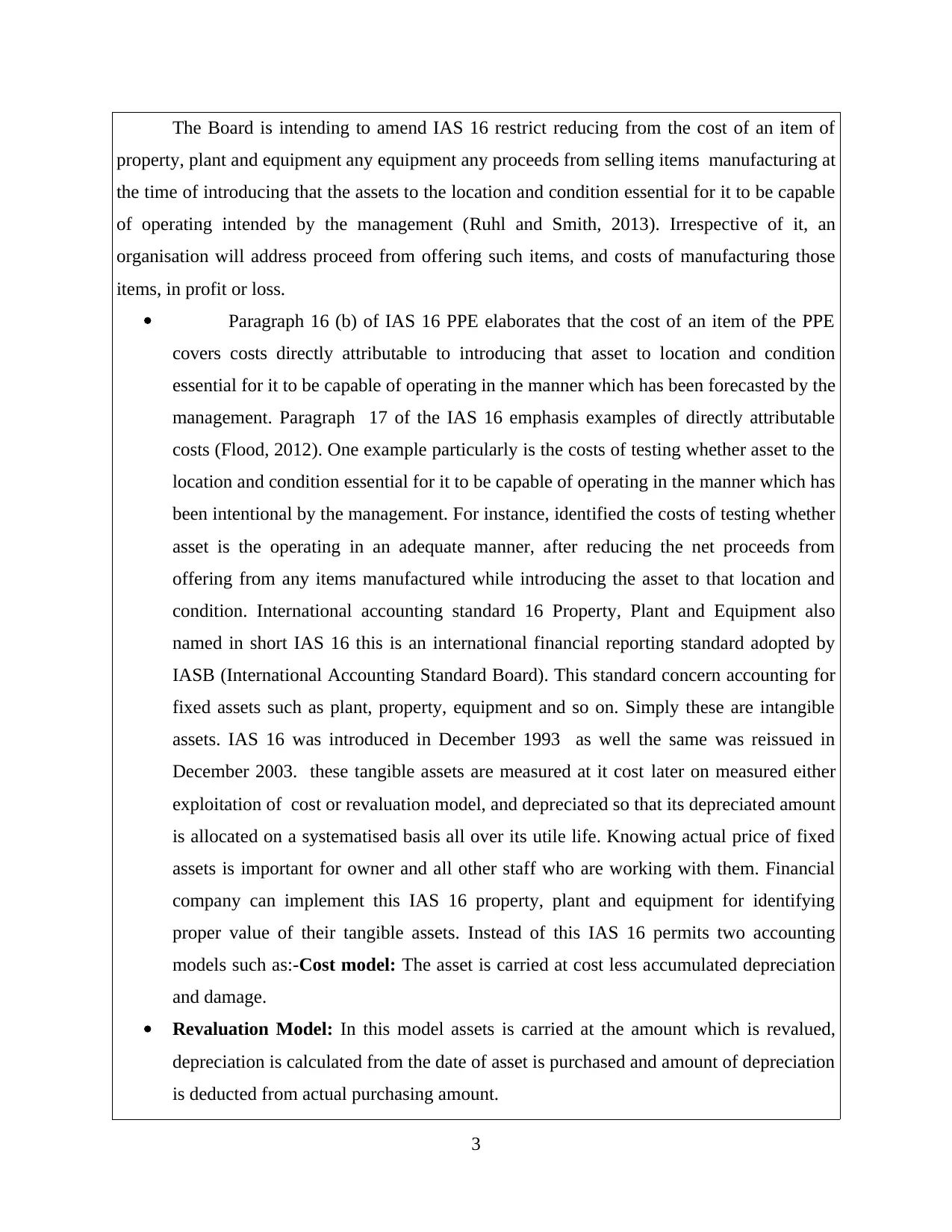
proceeds from marketing products emerged during manufacturing those assets to the position
and also state essential for it to be able to work in way deliberate by the administration
(Bhattacharyya, 2012). Irrespective of an organisation will identify those revenue take place in
profits and failure.
Writing in 17 of IAS 16 particularly illustrations of the expenditure straight due to
introducing a product of the belongings, plant and equipment to the position and status essential
for it. Which is competent of working in a state that has been intended by the administration in
order to test the costing. Paragraph 17 (e) of IAS 16 mentioned that the cost of PPE covers the
testing costs form the proceeds form selling of any items generated at the time of introducing
assets to that position and status.
The IFRS Interpretation Commission attained a petition under which dual quarries were asking
about paragraph 17(e) of IAS 16:
a). At time of proceeds mention to in that writing link to the part manufactured from
experiment; and
b) If an organisation reduces from the price of a product of time of item of the PPE any
proceeds which above the cost of testing.
While elaborating the problem, Commission determined concerned quarries about the
expenditure of the property, plant and equipment. After exploring diverse approaches,
committee suggested that the Board aim an amendment to the IAS 16 to stop the reducing sales
proceeds from cost of a goods of property, plant and equipment. Board agreed along with the
committee's recommendations.
The main aim of the Board is to invite the comments on the proposals in this Exposure Draft,
more specifically fix out hereunder. Comments are highly supportable if they:
a). Statement on the question as mentioned;
b). Point out the particular paragraph(s) to which they concerned;
c). covers clear rationale;
d). Determine any alternative the Board must consider.
e). Covers any alternative Board must consider.
The Board does not express comments on the content which are not mentioned in this
Exposure Draft. However, Comments must be submitted in the writing henceforth, as to
attained no later than.
2
tabler-icon-diamond-filled.svg

Paraphrase This Document

Need a fresh take? Get an instant paraphrase of this document with our AI Paraphraser
Document Page
The Board is intending to amend IAS 16 restrict reducing from the cost of an item of
property, plant and equipment any equipment any proceeds from selling items manufacturing at
the time of introducing that the assets to the location and condition essential for it to be capable
of operating intended by the management (Ruhl and Smith, 2013). Irrespective of it, an
organisation will address proceed from offering such items, and costs of manufacturing those
items, in profit or loss.
Paragraph 16 (b) of IAS 16 PPE elaborates that the cost of an item of the PPE
covers costs directly attributable to introducing that asset to location and condition
essential for it to be capable of operating in the manner which has been forecasted by the
management. Paragraph 17 of the IAS 16 emphasis examples of directly attributable
costs (Flood, 2012). One example particularly is the costs of testing whether asset to the
location and condition essential for it to be capable of operating in the manner which has
been intentional by the management. For instance, identified the costs of testing whether
asset is the operating in an adequate manner, after reducing the net proceeds from
offering from any items manufactured while introducing the asset to that location and
condition. International accounting standard 16 Property, Plant and Equipment also
named in short IAS 16 this is an international financial reporting standard adopted by
IASB (International Accounting Standard Board). This standard concern accounting for
fixed assets such as plant, property, equipment and so on. Simply these are intangible
assets. IAS 16 was introduced in December 1993 as well the same was reissued in
December 2003. these tangible assets are measured at it cost later on measured either
exploitation of cost or revaluation model, and depreciated so that its depreciated amount
is allocated on a systematised basis all over its utile life. Knowing actual price of fixed
assets is important for owner and all other staff who are working with them. Financial
company can implement this IAS 16 property, plant and equipment for identifying
proper value of their tangible assets. Instead of this IAS 16 permits two accounting
models such as:-Cost model: The asset is carried at cost less accumulated depreciation
and damage.
Revaluation Model: In this model assets is carried at the amount which is revalued,
depreciation is calculated from the date of asset is purchased and amount of depreciation
is deducted from actual purchasing amount.
3
Document Page
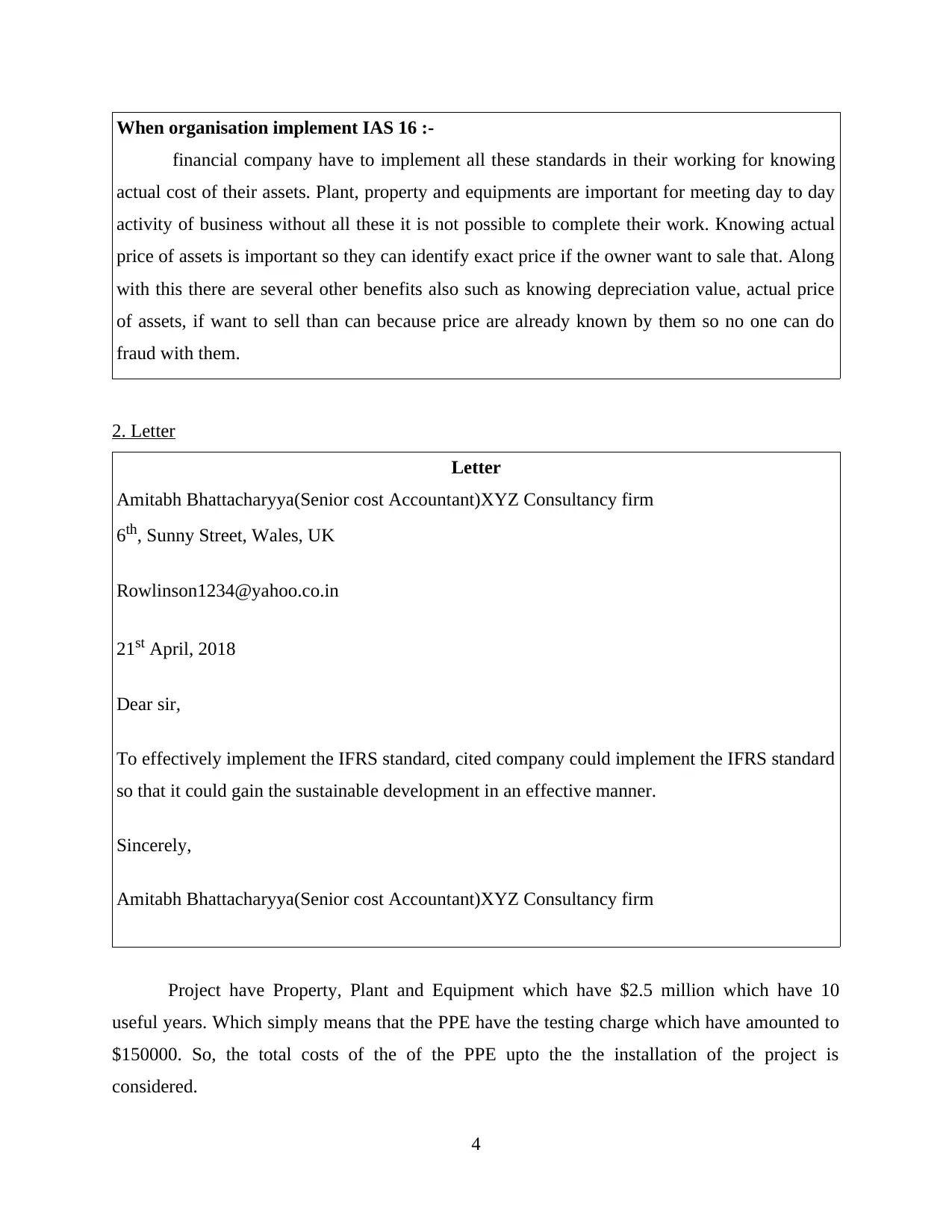
When organisation implement IAS 16 :-
financial company have to implement all these standards in their working for knowing
actual cost of their assets. Plant, property and equipments are important for meeting day to day
activity of business without all these it is not possible to complete their work. Knowing actual
price of assets is important so they can identify exact price if the owner want to sale that. Along
with this there are several other benefits also such as knowing depreciation value, actual price
of assets, if want to sell than can because price are already known by them so no one can do
fraud with them.
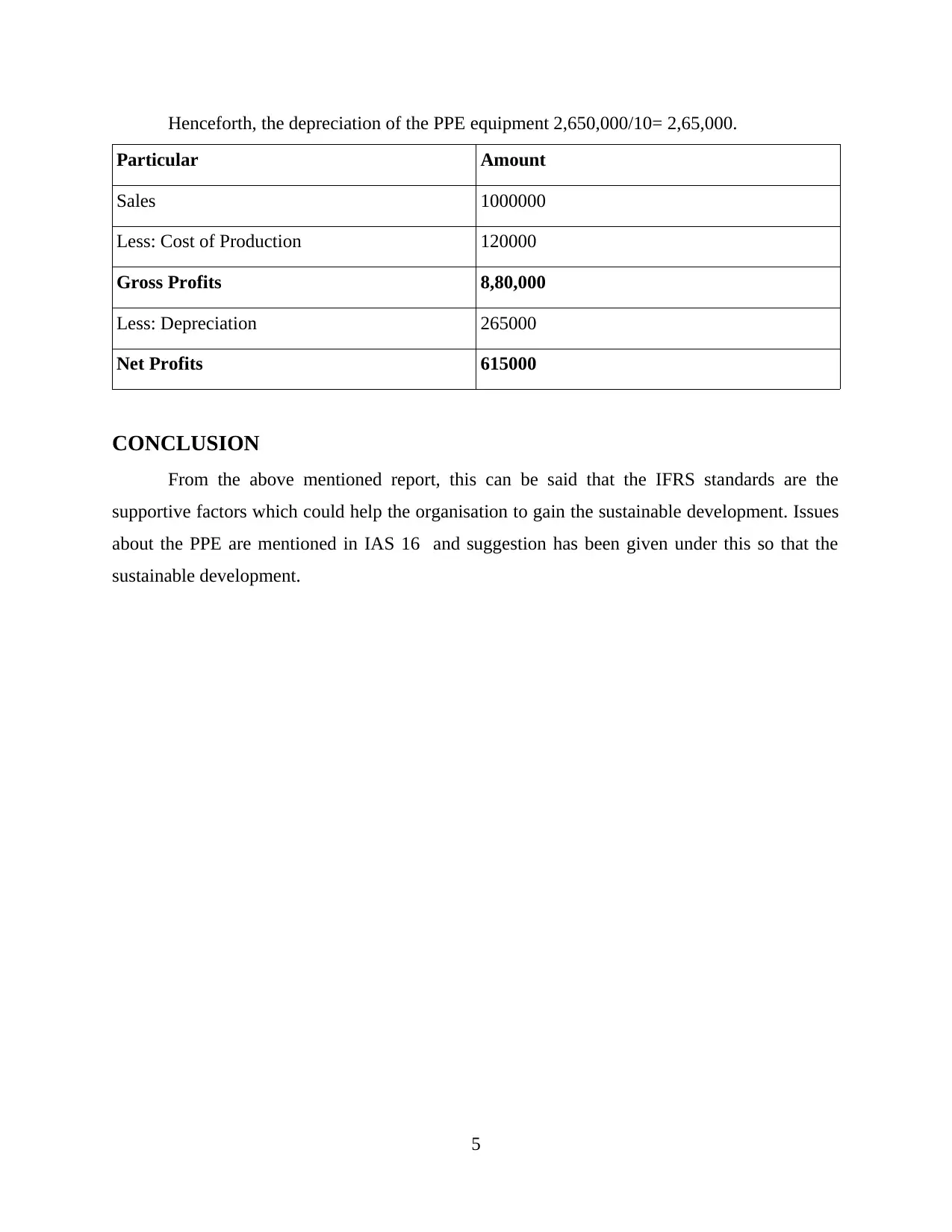
2. Letter
Letter
Amitabh Bhattacharyya(Senior cost Accountant)XYZ Consultancy firm
6th, Sunny Street, Wales, UK
Rowlinson1234@yahoo.co.in
21st April, 2018
Dear sir,
To effectively implement the IFRS standard, cited company could implement the IFRS standard
so that it could gain the sustainable development in an effective manner.
Sincerely,
Amitabh Bhattacharyya(Senior cost Accountant)XYZ Consultancy firm
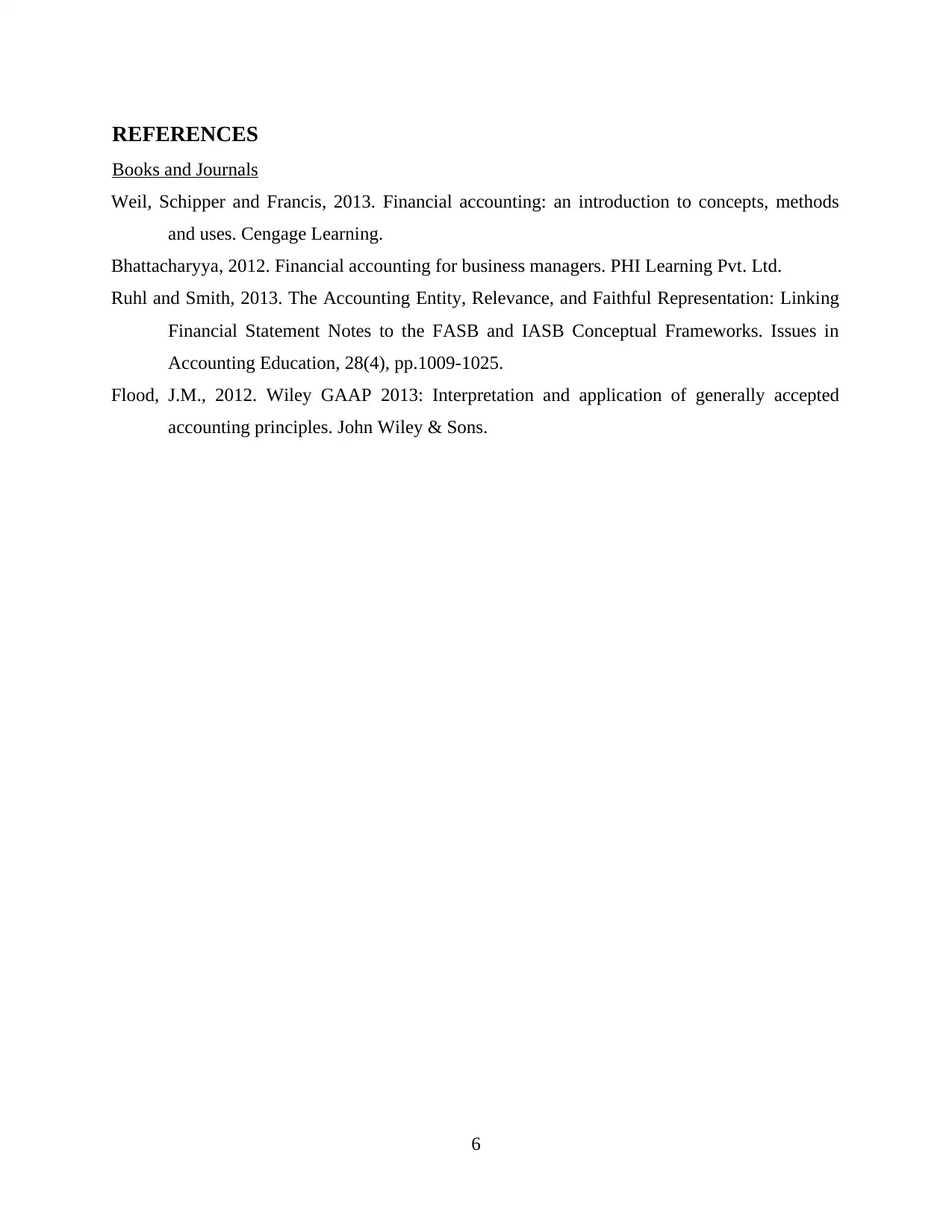
Project have Property, Plant and Equipment which have $2.5 million which have 10
useful years. Which simply means that the PPE have the testing charge which have amounted to
$150000. So, the total costs of the of the PPE upto the the installation of the project is
considered.
4
Document Page
Henceforth, the depreciation of the PPE equipment 2,650,000/10= 2,65,000.
Particular Amount
Sales 1000000
Less: Cost of Production 120000
Gross Profits 8,80,000
Less: Depreciation 265000
Net Profits 615000
CONCLUSION
From the above mentioned report, this can be said that the IFRS standards are the
supportive factors which could help the organisation to gain the sustainable development. Issues
about the PPE are mentioned in IAS 16 and suggestion has been given under this so that the
sustainable development.
5
tabler-icon-diamond-filled.svg

Paraphrase This Document

Need a fresh take? Get an instant paraphrase of this document with our AI Paraphraser
Document Page
REFERENCES
Books and Journals
Weil, Schipper and Francis, 2013. Financial accounting: an introduction to concepts, methods
and uses. Cengage Learning.
Bhattacharyya, 2012. Financial accounting for business managers. PHI Learning Pvt. Ltd.
Ruhl and Smith, 2013. The Accounting Entity, Relevance, and Faithful Representation: Linking
Financial Statement Notes to the FASB and IASB Conceptual Frameworks. Issues in
Accounting Education, 28(4), pp.1009-1025.
Flood, J.M., 2012. Wiley GAAP 2013: Interpretation and application of generally accepted
accounting principles. John Wiley & Sons.
6
chevron_up_icon
1 out of 8
circle_padding
hide_on_mobile
zoom_out_icon
[object Object]