Finance Module: Ratio Analysis and Financial Statement Analysis Report

Verified

Added on  2023/06/08

|5
|1031
|209
Report
AI Summary
This report provides a comprehensive overview of financial ratio analysis and its critical role in understanding and interpreting financial statements. It emphasizes how financial ratios serve as essential tools for stakeholders to make informed decisions regarding a company's performance. The report covers the importance of ratio analysis in evaluating profitability, solvency, and efficiency, and how these aspects can be compared across firms. It acknowledges the limitations of ratio analysis, such as its reliance on historical data and potential challenges in comparing companies due to accounting policy differences. The report further discusses the relevance of different financial ratios for various stakeholders, including short-term lenders, long-term lenders, and stockholders, highlighting the specific ratios that are most pertinent to their respective interests. The report concludes by summarizing the usefulness of ratio analysis while also acknowledging its limitations and the importance of tailoring the analysis to the stakeholder's relationship with the firm.
Document Page
FINANCE
Ratio Analysis
STUDENT ID:
[Pick the date]
tabler-icon-diamond-filled.svg

Paraphrase This Document

Need a fresh take? Get an instant paraphrase of this document with our AI Paraphraser
Document Page
FINANCE
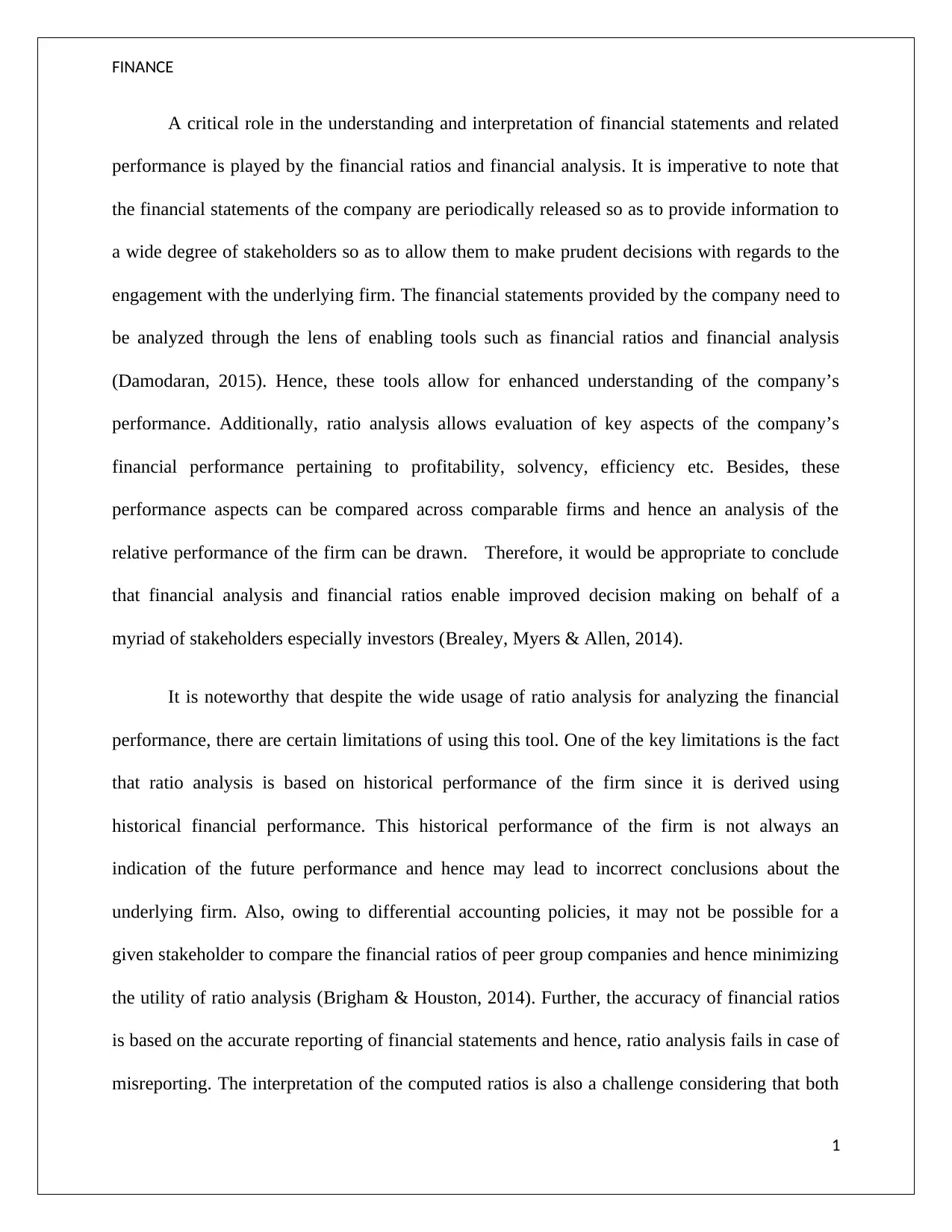
A critical role in the understanding and interpretation of financial statements and related
performance is played by the financial ratios and financial analysis. It is imperative to note that
the financial statements of the company are periodically released so as to provide information to
a wide degree of stakeholders so as to allow them to make prudent decisions with regards to the
engagement with the underlying firm. The financial statements provided by the company need to
be analyzed through the lens of enabling tools such as financial ratios and financial analysis
(Damodaran, 2015). Hence, these tools allow for enhanced understanding of the company’s
performance. Additionally, ratio analysis allows evaluation of key aspects of the company’s
financial performance pertaining to profitability, solvency, efficiency etc. Besides, these
performance aspects can be compared across comparable firms and hence an analysis of the
relative performance of the firm can be drawn. Therefore, it would be appropriate to conclude
that financial analysis and financial ratios enable improved decision making on behalf of a
myriad of stakeholders especially investors (Brealey, Myers & Allen, 2014).
It is noteworthy that despite the wide usage of ratio analysis for analyzing the financial
performance, there are certain limitations of using this tool. One of the key limitations is the fact
that ratio analysis is based on historical performance of the firm since it is derived using
historical financial performance. This historical performance of the firm is not always an
indication of the future performance and hence may lead to incorrect conclusions about the
underlying firm. Also, owing to differential accounting policies, it may not be possible for a
given stakeholder to compare the financial ratios of peer group companies and hence minimizing
the utility of ratio analysis (Brigham & Houston, 2014). Further, the accuracy of financial ratios
is based on the accurate reporting of financial statements and hence, ratio analysis fails in case of
misreporting. The interpretation of the computed ratios is also a challenge considering that both
1
Document Page
FINANCE
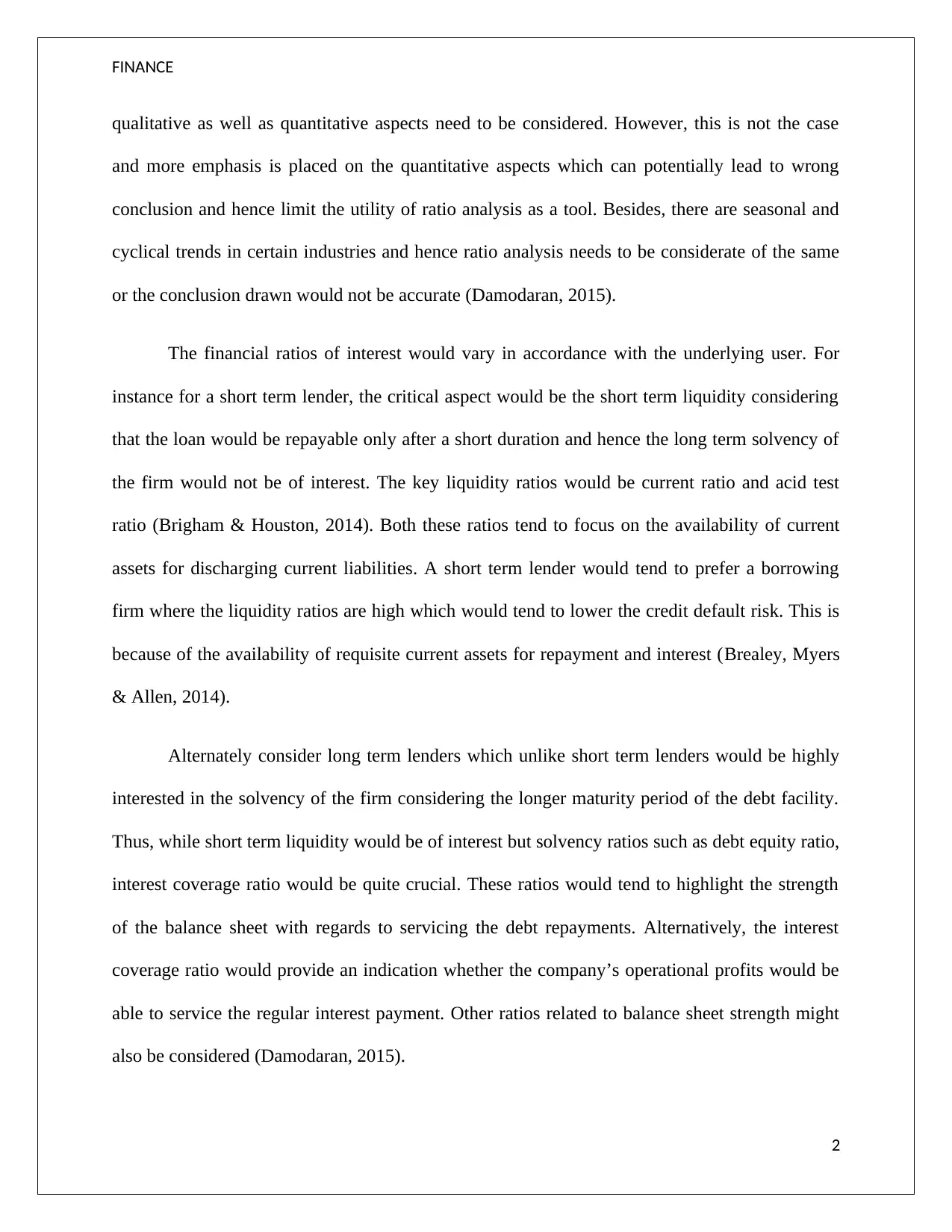
qualitative as well as quantitative aspects need to be considered. However, this is not the case
and more emphasis is placed on the quantitative aspects which can potentially lead to wrong
conclusion and hence limit the utility of ratio analysis as a tool. Besides, there are seasonal and
cyclical trends in certain industries and hence ratio analysis needs to be considerate of the same
or the conclusion drawn would not be accurate (Damodaran, 2015).
The financial ratios of interest would vary in accordance with the underlying user. For
instance for a short term lender, the critical aspect would be the short term liquidity considering
that the loan would be repayable only after a short duration and hence the long term solvency of
the firm would not be of interest. The key liquidity ratios would be current ratio and acid test
ratio (Brigham & Houston, 2014). Both these ratios tend to focus on the availability of current
assets for discharging current liabilities. A short term lender would tend to prefer a borrowing
firm where the liquidity ratios are high which would tend to lower the credit default risk. This is
because of the availability of requisite current assets for repayment and interest (Brealey, Myers
& Allen, 2014).
Alternately consider long term lenders which unlike short term lenders would be highly
interested in the solvency of the firm considering the longer maturity period of the debt facility.
Thus, while short term liquidity would be of interest but solvency ratios such as debt equity ratio,
interest coverage ratio would be quite crucial. These ratios would tend to highlight the strength
of the balance sheet with regards to servicing the debt repayments. Alternatively, the interest
coverage ratio would provide an indication whether the company’s operational profits would be
able to service the regular interest payment. Other ratios related to balance sheet strength might
also be considered (Damodaran, 2015).
2
Document Page
FINANCE
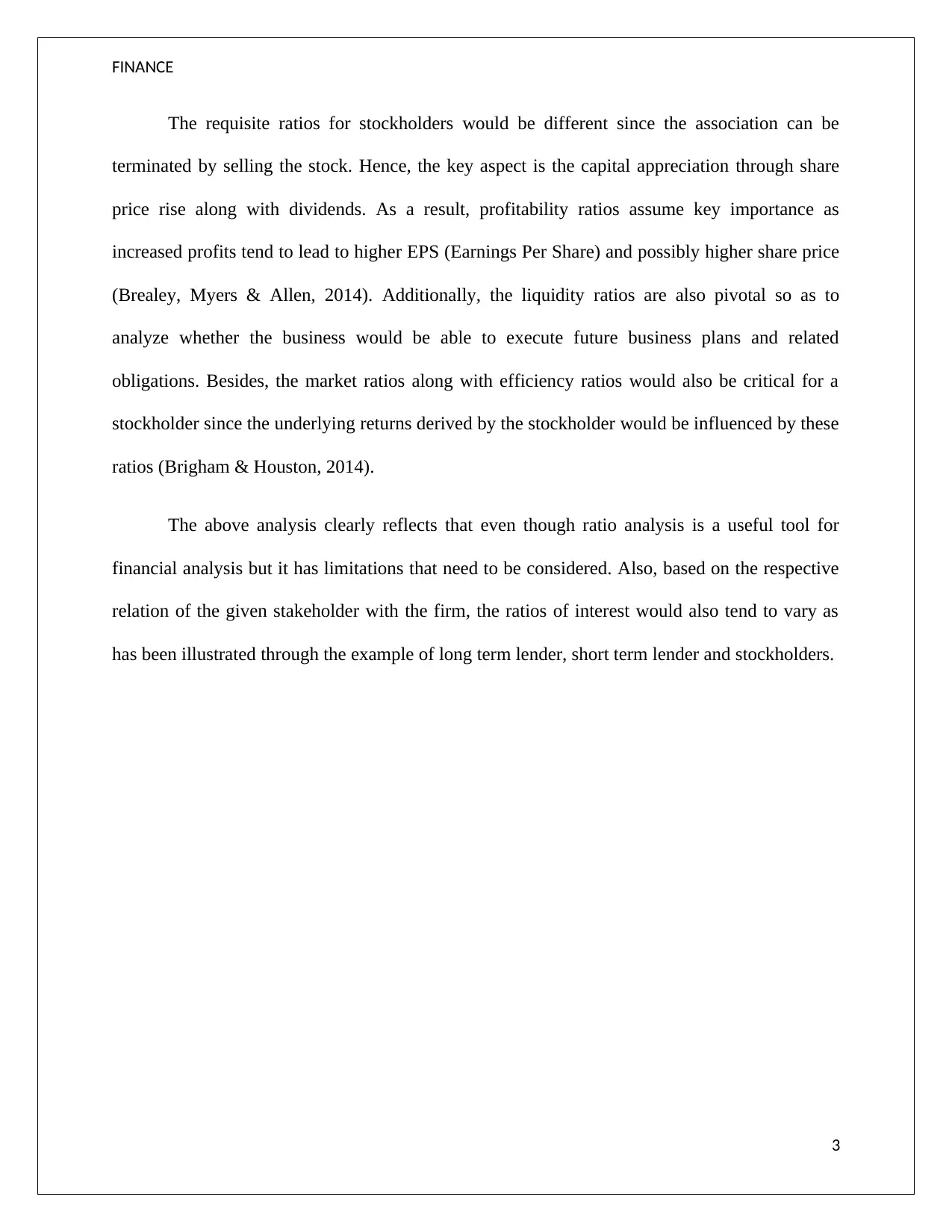
The requisite ratios for stockholders would be different since the association can be
terminated by selling the stock. Hence, the key aspect is the capital appreciation through share
price rise along with dividends. As a result, profitability ratios assume key importance as
increased profits tend to lead to higher EPS (Earnings Per Share) and possibly higher share price
(Brealey, Myers & Allen, 2014). Additionally, the liquidity ratios are also pivotal so as to
analyze whether the business would be able to execute future business plans and related
obligations. Besides, the market ratios along with efficiency ratios would also be critical for a
stockholder since the underlying returns derived by the stockholder would be influenced by these
ratios (Brigham & Houston, 2014).
The above analysis clearly reflects that even though ratio analysis is a useful tool for
financial analysis but it has limitations that need to be considered. Also, based on the respective
relation of the given stakeholder with the firm, the ratios of interest would also tend to vary as
has been illustrated through the example of long term lender, short term lender and stockholders.
3
tabler-icon-diamond-filled.svg

Paraphrase This Document

Need a fresh take? Get an instant paraphrase of this document with our AI Paraphraser
Document Page
FINANCE
References
Brealey, R. A., Myers, S. C., & Allen, F. (2014) Principles of corporate finance (2nd ed.). New
York: McGraw-Hill Inc.
Brigham, E. F. & Houston, J. F., (2014) .Fundamentals of Financial Management (14th ed.).
Boston: Cengage Learning.
Damodaran, A. (2015). Applied corporate finance: A user’s manual (3rd ed.). New York: Wiley,
John & Sons.
4
chevron_up_icon
1 out of 5
circle_padding
hide_on_mobile
zoom_out_icon
[object Object]