Financial Analysis Report: Business Structures, Ratios, and Payback
VerifiedAdded on 2021/11/23
|14
|3093
|153
Report
AI Summary
This report provides a comprehensive financial analysis, beginning with a comparison of business structures including sole proprietorships, corporations, and limited liability companies (LLCs), discussing their advantages, disadvantages, and tax implications. The report then delves into financial ratio analysis, calculating and interpreting key ratios such as current, quick, cash, total asset turnover, inventory turnover, receivables turnover, total debt, debt-equity, profit margin, return on assets, and return on equity. The analysis includes a comparison of these ratios with industry averages, providing insights into a company's financial health and performance. Finally, the report explains the payback period method, its advantages, disadvantages, and applications in investment decision-making, along with a discussion of its limitations, such as ignoring the time value of money and not considering cash flows beyond the payback period. The report concludes with a recommendation for an LLC, its advantages, and importance for business owners.

Table of Contents
Question 01................................................................................................................................................2
Question 02................................................................................................................................................5
Question 03................................................................................................................................................8
References................................................................................................................................................14
Question 01................................................................................................................................................2
Question 02................................................................................................................................................5
Question 03................................................................................................................................................8
References................................................................................................................................................14

Paraphrase This Document
Need a fresh take? Get an instant paraphrase of this document with our AI Paraphraser
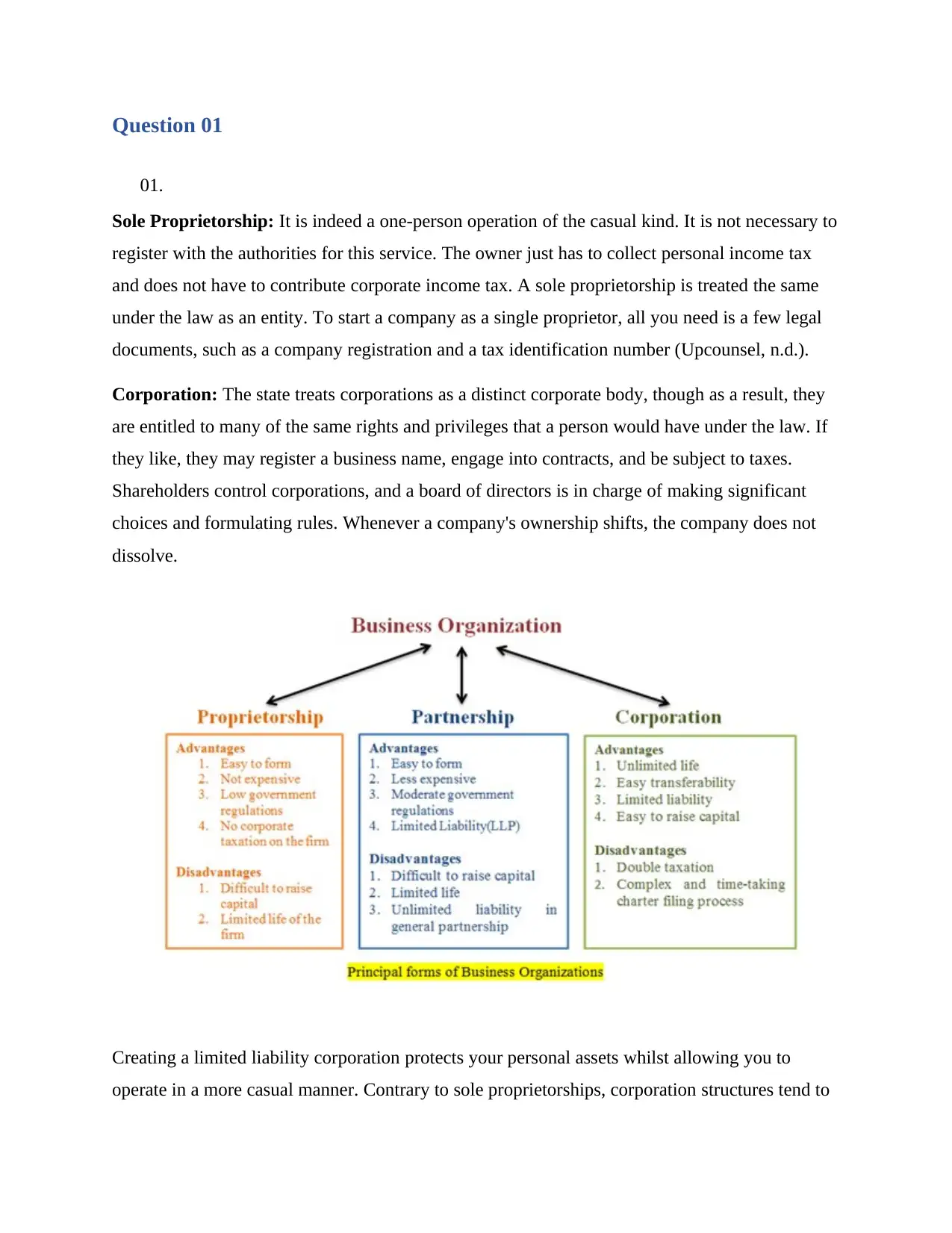
Question 01
01.
Sole Proprietorship: It is indeed a one-person operation of the casual kind. It is not necessary to
register with the authorities for this service. The owner just has to collect personal income tax
and does not have to contribute corporate income tax. A sole proprietorship is treated the same
under the law as an entity. To start a company as a single proprietor, all you need is a few legal
documents, such as a company registration and a tax identification number (Upcounsel, n.d.).
Corporation: The state treats corporations as a distinct corporate body, though as a result, they
are entitled to many of the same rights and privileges that a person would have under the law. If
they like, they may register a business name, engage into contracts, and be subject to taxes.
Shareholders control corporations, and a board of directors is in charge of making significant
choices and formulating rules. Whenever a company's ownership shifts, the company does not
dissolve.
Creating a limited liability corporation protects your personal assets whilst allowing you to
operate in a more casual manner. Contrary to sole proprietorships, corporation structures tend to
01.
Sole Proprietorship: It is indeed a one-person operation of the casual kind. It is not necessary to
register with the authorities for this service. The owner just has to collect personal income tax
and does not have to contribute corporate income tax. A sole proprietorship is treated the same
under the law as an entity. To start a company as a single proprietor, all you need is a few legal
documents, such as a company registration and a tax identification number (Upcounsel, n.d.).
Corporation: The state treats corporations as a distinct corporate body, though as a result, they
are entitled to many of the same rights and privileges that a person would have under the law. If
they like, they may register a business name, engage into contracts, and be subject to taxes.
Shareholders control corporations, and a board of directors is in charge of making significant
choices and formulating rules. Whenever a company's ownership shifts, the company does not
dissolve.
Creating a limited liability corporation protects your personal assets whilst allowing you to
operate in a more casual manner. Contrary to sole proprietorships, corporation structures tend to
give legitimacy and long-term viability. People realize that corporations must adhere to a set of
standards in order to conduct business, while sole proprietorships are not subject to governmental
control or oversight. In addition, it offers tax freedom, requires fewer paperwork, and limits your
legal responsibility. The drawback of an LLC is that, unless you want to be treated as a
corporation, you would owe self-employment taxes on your profits. Because of this, the earnings
made by the LLC will not be taxed at the corporate level, but instead would be distributed to the
LLC's members, who will report them on their individual taxable profits. Uncertainty over duties
and a finite lifespan are two more drawbacks (Hira, 2017).
Liability is minimized when operating as a corporation rather than a single proprietorship. As a
single owner, you are individually liable for any obligations or liabilities your firm accrues. As a
result, if the company is eventually sued for a significant amount of money, his personal assets
might be at risk. Corporations and Limited Liability Companies (LLCs) enable an individual to
use a corporate liability shield to safeguard their financial property against company liabilities.
Usually, assets held by the company are exposed to business liabilities in these organizations;
assets not controlled by the company normally cannot be claimed to satisfy business obligations.
Sole proprietorships, on the other hand, are firms in which there is only one owner. Associating
under an LLC or corporation makes it easier to draw in financiers and collaborators into your
company. The drawback pertains to their tax situation (Villaluz, 2019).
02.
standards in order to conduct business, while sole proprietorships are not subject to governmental
control or oversight. In addition, it offers tax freedom, requires fewer paperwork, and limits your
legal responsibility. The drawback of an LLC is that, unless you want to be treated as a
corporation, you would owe self-employment taxes on your profits. Because of this, the earnings
made by the LLC will not be taxed at the corporate level, but instead would be distributed to the
LLC's members, who will report them on their individual taxable profits. Uncertainty over duties
and a finite lifespan are two more drawbacks (Hira, 2017).
Liability is minimized when operating as a corporation rather than a single proprietorship. As a
single owner, you are individually liable for any obligations or liabilities your firm accrues. As a
result, if the company is eventually sued for a significant amount of money, his personal assets
might be at risk. Corporations and Limited Liability Companies (LLCs) enable an individual to
use a corporate liability shield to safeguard their financial property against company liabilities.
Usually, assets held by the company are exposed to business liabilities in these organizations;
assets not controlled by the company normally cannot be claimed to satisfy business obligations.
Sole proprietorships, on the other hand, are firms in which there is only one owner. Associating
under an LLC or corporation makes it easier to draw in financiers and collaborators into your
company. The drawback pertains to their tax situation (Villaluz, 2019).
02.
⊘ This is a preview!⊘
Do you want full access?
Subscribe today to unlock all pages.

Trusted by 1+ million students worldwide
Would recommend to go with LLC.
A limited liability company (LLC) is regarded as a distinct statutory body than its employees or
owners. Unlike toward a corporation's stockholders, LLC owners are not personally accountable
for the debts or legal obligations of their company. Unlike investors, LLC owners risk losing
their initial financial investment in the company. Although LLCs have legal duties, personal
assets such as a house or a bank account of the LLC owner are not at danger as they would be for
a sole proprietorship or general partnership. If you personally guarantee a company debt or fail to
take reasonable care and cause injury to a third party or violate your duty to your LLC, you may
still be held personally accountable, just as in other corporate organizations.
Standard businesses are subject to two levels of income taxes. Profits accrued by the business are
subject to income tax, and shareholders are responsible for any dividend taxes. LLCs are given a
special tax status known as "pass through," which means that earnings allotted to LLC members
are taxed only once, on their personal income tax returns. LLCs that meet the IRS's definition of
a partnership or S corporation may benefit from the same "pass through" tax status. Additionally,
LLC owners who are pass-through company entities may be eligible to deduct 20% of their
business revenue under the new Tax Cuts and Jobs Act 20% pass-through deduction. If you're a
business owner looking for further information, take a look at the 20% Pass-Through Tax
Deduction (Fitzpatrick, 2012).
A limited liability company (LLC) is regarded as a distinct statutory body than its employees or
owners. Unlike toward a corporation's stockholders, LLC owners are not personally accountable
for the debts or legal obligations of their company. Unlike investors, LLC owners risk losing
their initial financial investment in the company. Although LLCs have legal duties, personal
assets such as a house or a bank account of the LLC owner are not at danger as they would be for
a sole proprietorship or general partnership. If you personally guarantee a company debt or fail to
take reasonable care and cause injury to a third party or violate your duty to your LLC, you may
still be held personally accountable, just as in other corporate organizations.
Standard businesses are subject to two levels of income taxes. Profits accrued by the business are
subject to income tax, and shareholders are responsible for any dividend taxes. LLCs are given a
special tax status known as "pass through," which means that earnings allotted to LLC members
are taxed only once, on their personal income tax returns. LLCs that meet the IRS's definition of
a partnership or S corporation may benefit from the same "pass through" tax status. Additionally,
LLC owners who are pass-through company entities may be eligible to deduct 20% of their
business revenue under the new Tax Cuts and Jobs Act 20% pass-through deduction. If you're a
business owner looking for further information, take a look at the 20% Pass-Through Tax
Deduction (Fitzpatrick, 2012).
Paraphrase This Document
Need a fresh take? Get an instant paraphrase of this document with our AI Paraphraser
Question 02
01.
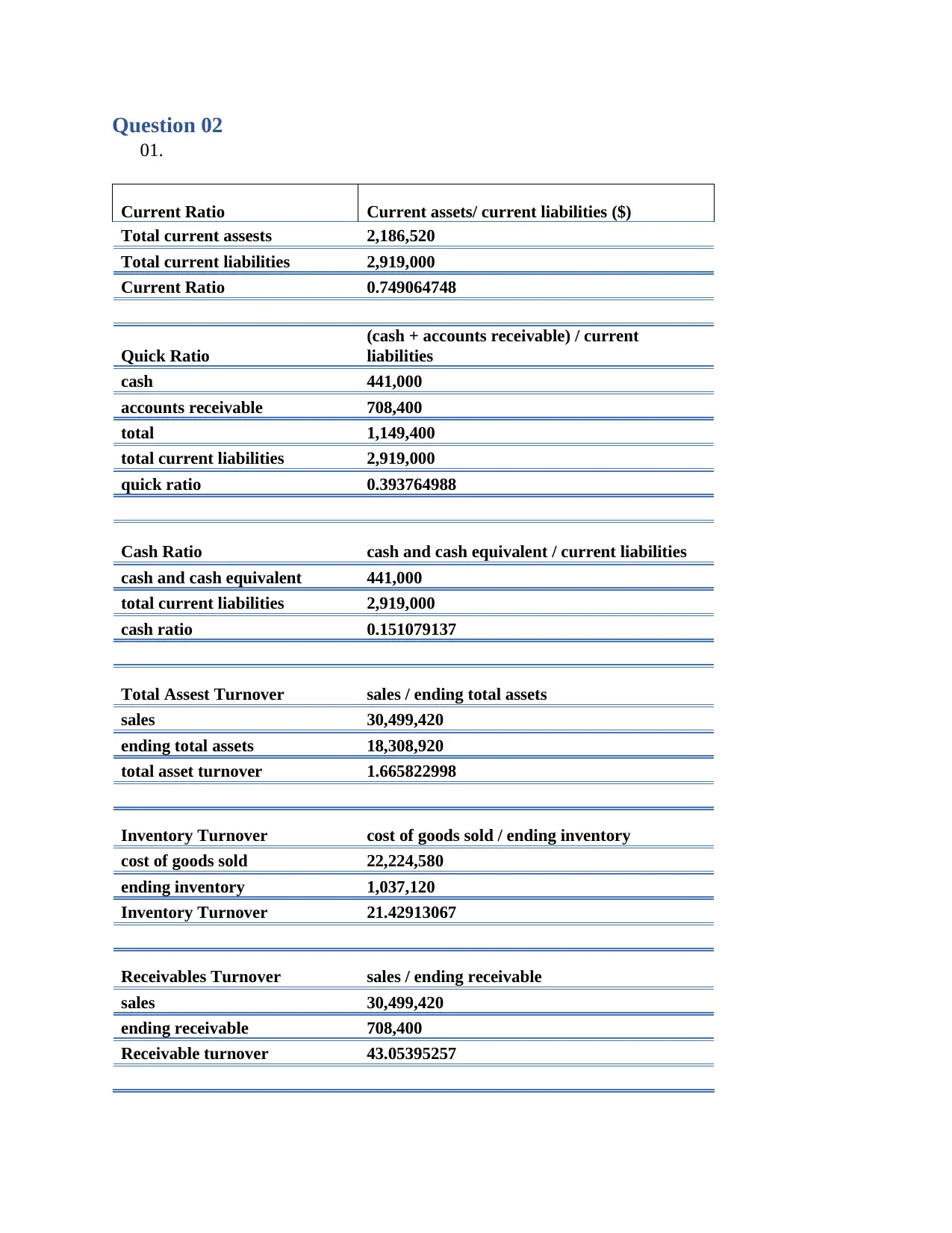
Current Ratio Current assets/ current liabilities ($)
Total current assests 2,186,520
Total current liabilities 2,919,000
Current Ratio 0.749064748
Quick Ratio
(cash + accounts receivable) / current
liabilities
cash 441,000
accounts receivable 708,400
total 1,149,400
total current liabilities 2,919,000
quick ratio 0.393764988
Cash Ratio cash and cash equivalent / current liabilities
cash and cash equivalent 441,000
total current liabilities 2,919,000
cash ratio 0.151079137
Total Assest Turnover sales / ending total assets
sales 30,499,420
ending total assets 18,308,920
total asset turnover 1.665822998
Inventory Turnover cost of goods sold / ending inventory
cost of goods sold 22,224,580
ending inventory 1,037,120
Inventory Turnover 21.42913067
Receivables Turnover sales / ending receivable
sales 30,499,420
ending receivable 708,400
Receivable turnover 43.05395257
01.
Current Ratio Current assets/ current liabilities ($)
Total current assests 2,186,520
Total current liabilities 2,919,000
Current Ratio 0.749064748
Quick Ratio
(cash + accounts receivable) / current
liabilities
cash 441,000
accounts receivable 708,400
total 1,149,400
total current liabilities 2,919,000
quick ratio 0.393764988
Cash Ratio cash and cash equivalent / current liabilities
cash and cash equivalent 441,000
total current liabilities 2,919,000
cash ratio 0.151079137
Total Assest Turnover sales / ending total assets
sales 30,499,420
ending total assets 18,308,920
total asset turnover 1.665822998
Inventory Turnover cost of goods sold / ending inventory
cost of goods sold 22,224,580
ending inventory 1,037,120
Inventory Turnover 21.42913067
Receivables Turnover sales / ending receivable
sales 30,499,420
ending receivable 708,400
Receivable turnover 43.05395257
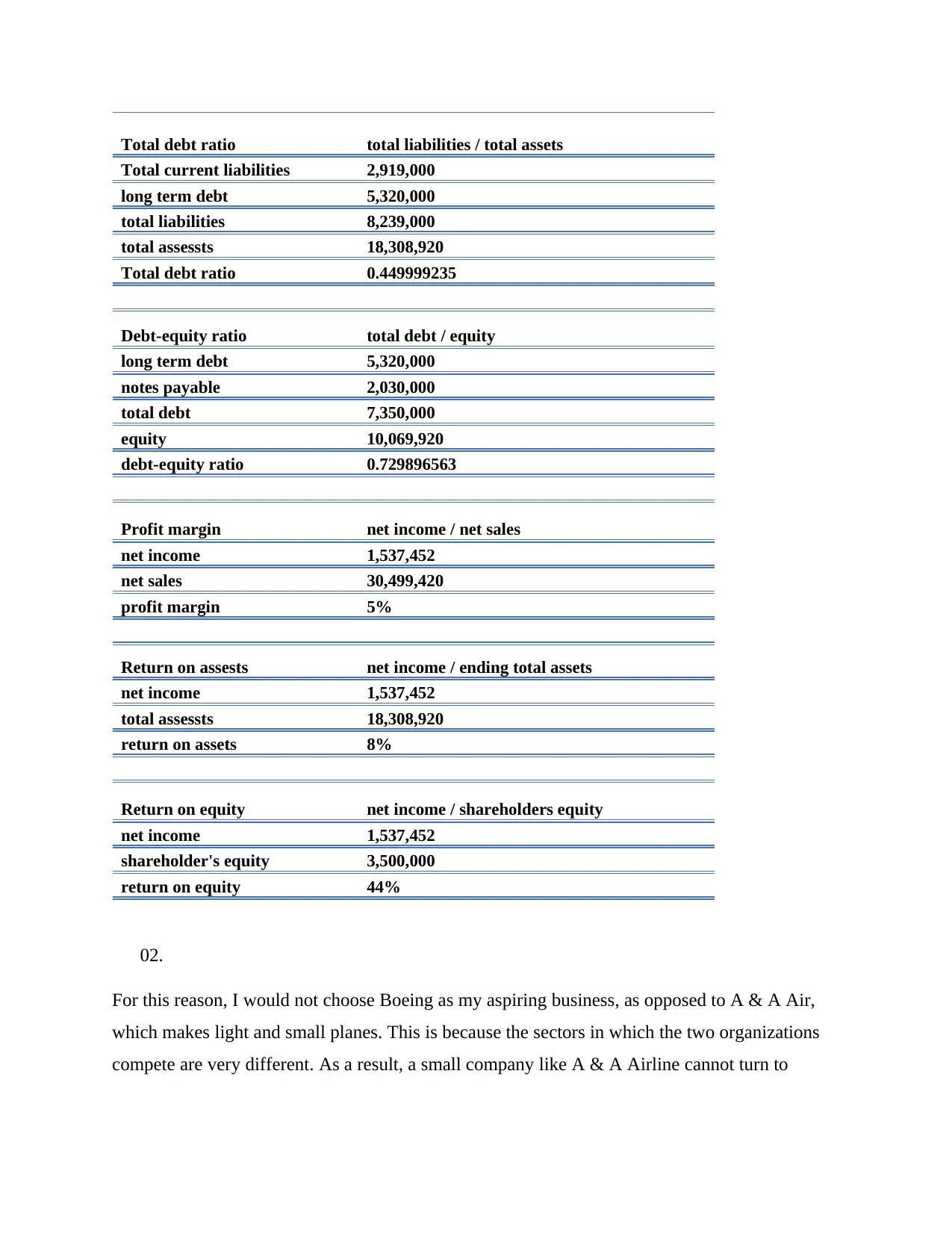
Total debt ratio total liabilities / total assets
Total current liabilities 2,919,000
long term debt 5,320,000
total liabilities 8,239,000
total assessts 18,308,920
Total debt ratio 0.449999235
Debt-equity ratio total debt / equity
long term debt 5,320,000
notes payable 2,030,000
total debt 7,350,000
equity 10,069,920
debt-equity ratio 0.729896563
Profit margin net income / net sales
net income 1,537,452
net sales 30,499,420
profit margin 5%
Return on assests net income / ending total assets
net income 1,537,452
total assessts 18,308,920
return on assets 8%
Return on equity net income / shareholders equity
net income 1,537,452
shareholder's equity 3,500,000
return on equity 44%
02.
For this reason, I would not choose Boeing as my aspiring business, as opposed to A & A Air,
which makes light and small planes. This is because the sectors in which the two organizations
compete are very different. As a result, a small company like A & A Airline cannot turn to
Total current liabilities 2,919,000
long term debt 5,320,000
total liabilities 8,239,000
total assessts 18,308,920
Total debt ratio 0.449999235
Debt-equity ratio total debt / equity
long term debt 5,320,000
notes payable 2,030,000
total debt 7,350,000
equity 10,069,920
debt-equity ratio 0.729896563
Profit margin net income / net sales
net income 1,537,452
net sales 30,499,420
profit margin 5%
Return on assests net income / ending total assets
net income 1,537,452
total assessts 18,308,920
return on assets 8%
Return on equity net income / shareholders equity
net income 1,537,452
shareholder's equity 3,500,000
return on equity 44%
02.
For this reason, I would not choose Boeing as my aspiring business, as opposed to A & A Air,
which makes light and small planes. This is because the sectors in which the two organizations
compete are very different. As a result, a small company like A & A Airline cannot turn to
⊘ This is a preview!⊘
Do you want full access?
Subscribe today to unlock all pages.
Trusted by 1+ million students worldwide
Boeing as a role model to emulate. It should look for a company like that if it wants to be the
market leader.
Sonex also provides services connected to the nation's military, therefore considering it would be
impractical for S & S. Choosing a niche firm in the market is essential for the company's success.
Due to its global reach and operations in commercial aviation as well as executive jets and
military security systems, Phantom Aeronautics, which focuses on the manufacturing of large
commercial aircraft, is neither practical nor desirable for A&A to follow.
Air-Tech Inc. or Aero Adventure Firm may be used as a future aspirant company for the
development of its business plan. Both companies are in the same industry and have been in
business for a long time. Therefore, they both have the potential to provide clients with
innovation, safety, and trustworthiness for their products.
03.
S&S Air is behind the industry average in terms of current and cash ratios. Assuming this is
correct, the company has less cash on hand than its competitors. The company might benefit
from stronger cash flow forecasts or easier access to short-term borrowing. The quick ratio
exceeds the industry norm. To put it another way, S&S Air's inventory to current liabilities is
around average when comparison to the whole market.
Our industry has a higher turnover ratio when compared to others. This means that the three
turnover ratios are all above average. This might mean that S&S Air offers better value than the
competition.
Despite being above the lowest quartile, all of the financial leverage ratios are lower than the
industry standard. S&S Air has less debt than comparable firms, yet it still falls within the norm.
Question 03
01.
market leader.
Sonex also provides services connected to the nation's military, therefore considering it would be
impractical for S & S. Choosing a niche firm in the market is essential for the company's success.
Due to its global reach and operations in commercial aviation as well as executive jets and
military security systems, Phantom Aeronautics, which focuses on the manufacturing of large
commercial aircraft, is neither practical nor desirable for A&A to follow.
Air-Tech Inc. or Aero Adventure Firm may be used as a future aspirant company for the
development of its business plan. Both companies are in the same industry and have been in
business for a long time. Therefore, they both have the potential to provide clients with
innovation, safety, and trustworthiness for their products.
03.
S&S Air is behind the industry average in terms of current and cash ratios. Assuming this is
correct, the company has less cash on hand than its competitors. The company might benefit
from stronger cash flow forecasts or easier access to short-term borrowing. The quick ratio
exceeds the industry norm. To put it another way, S&S Air's inventory to current liabilities is
around average when comparison to the whole market.
Our industry has a higher turnover ratio when compared to others. This means that the three
turnover ratios are all above average. This might mean that S&S Air offers better value than the
competition.
Despite being above the lowest quartile, all of the financial leverage ratios are lower than the
industry standard. S&S Air has less debt than comparable firms, yet it still falls within the norm.
Question 03
01.
Paraphrase This Document
Need a fresh take? Get an instant paraphrase of this document with our AI Paraphraser
The payback technique aids in determining how long it will take to recoup your investment.
When a project's cash flows and earnings cover its original investment, it is said to be in the
payback phase (PBP). CFOs choose projects with shorter payback periods when given an option
(Finance Management, 2018).
Advantages of Payback Period
Ease of Use and Understanding
This is one of the payback period's most important benefits. As compared to other capital
budgeting approaches, this one requires fewer inputs and is thus simpler to compute. Payback
periods may be calculated using only the project's start-up costs and yearly cash flows. While
alternative approaches make use of the same inputs, they also need a greater number of
assumptions. Other methodologies, such as the cost of capital, need various assumptions on the
part of managers.
A Speedy Answer
Managers can rapidly compute the projects' payback periods since the payback time is simple to
calculate and requires fewer inputs. As a result, managers are better equipped to take swift
judgments, which is critical in organizations with limited resources.
Preference for Liquidity
The payback period, which is crucial information, is not shown by capital planning techniques. A
project with a shorter payback period is frequently seen as less risky. This kind of information is
crucial for startups and small businesses who may not have access to huge financing sources.
Small businesses must quickly recover their investment expenditures in order to utilise the cash
for future expansion.
If you're concerned about anything, this is a good place to start.
When dealing in industries with a high degree of uncertainty or where technology is
continuously developing, the payback strategy comes in useful. As a result, forecasting future
When a project's cash flows and earnings cover its original investment, it is said to be in the
payback phase (PBP). CFOs choose projects with shorter payback periods when given an option
(Finance Management, 2018).
Advantages of Payback Period
Ease of Use and Understanding
This is one of the payback period's most important benefits. As compared to other capital
budgeting approaches, this one requires fewer inputs and is thus simpler to compute. Payback
periods may be calculated using only the project's start-up costs and yearly cash flows. While
alternative approaches make use of the same inputs, they also need a greater number of
assumptions. Other methodologies, such as the cost of capital, need various assumptions on the
part of managers.
A Speedy Answer
Managers can rapidly compute the projects' payback periods since the payback time is simple to
calculate and requires fewer inputs. As a result, managers are better equipped to take swift
judgments, which is critical in organizations with limited resources.
Preference for Liquidity
The payback period, which is crucial information, is not shown by capital planning techniques. A
project with a shorter payback period is frequently seen as less risky. This kind of information is
crucial for startups and small businesses who may not have access to huge financing sources.
Small businesses must quickly recover their investment expenditures in order to utilise the cash
for future expansion.
If you're concerned about anything, this is a good place to start.
When dealing in industries with a high degree of uncertainty or where technology is
continuously developing, the payback strategy comes in useful. As a result, forecasting future
annual cash inflows is difficult. The usage of short PBP in projects lowers the risk due to
expiration.
Drawbacks of Payback Period
ignores the principle of compound interest
It overlooks the time worth of money, a critical business concept, which is one of the biggest
drawbacks of the payback period. Money obtained earlier has a higher value because it has the
potential to produce a higher return if it is reinvested, according to the time value of money idea.
As a result, the PBP technique overstates the underlying value of cash flows. There's a
workaround for this here. The Discounted Payback Period may be used to overcome this
drawback.
Not all cash flows have been considered.
Using the payback technique, you only assess future cash flows once you have repaid your
original investment. It does not consider future cash flows. By just considering the short-term
cash flow, you may ignore a project that generates substantial cash flow in the long term.
Unrealistic expectations
Due to the simplicity of the repayment approach, regular business circumstances are not
considered. The majority of the time, capital investments are not one-off purchases. Such
initiatives need further funding long into the future. In addition, project funding is often erratic.
Avoids focusing on the bottom line
Shorter payback periods don't mean a project will be more lucrative in the long run. What
happens if the project's cash flow stops or decreases after the payback period has passed? After
the payback time expires in either situation, the project is doomed.
Uses of Payback Period
Investors, financial experts, and companies all utilize the payback period when calculating
investment returns. You can see how long it takes to recoup your original investment fees using
expiration.
Drawbacks of Payback Period
ignores the principle of compound interest
It overlooks the time worth of money, a critical business concept, which is one of the biggest
drawbacks of the payback period. Money obtained earlier has a higher value because it has the
potential to produce a higher return if it is reinvested, according to the time value of money idea.
As a result, the PBP technique overstates the underlying value of cash flows. There's a
workaround for this here. The Discounted Payback Period may be used to overcome this
drawback.
Not all cash flows have been considered.
Using the payback technique, you only assess future cash flows once you have repaid your
original investment. It does not consider future cash flows. By just considering the short-term
cash flow, you may ignore a project that generates substantial cash flow in the long term.
Unrealistic expectations
Due to the simplicity of the repayment approach, regular business circumstances are not
considered. The majority of the time, capital investments are not one-off purchases. Such
initiatives need further funding long into the future. In addition, project funding is often erratic.
Avoids focusing on the bottom line
Shorter payback periods don't mean a project will be more lucrative in the long run. What
happens if the project's cash flow stops or decreases after the payback period has passed? After
the payback time expires in either situation, the project is doomed.
Uses of Payback Period
Investors, financial experts, and companies all utilize the payback period when calculating
investment returns. You can see how long it takes to recoup your original investment fees using
⊘ This is a preview!⊘
Do you want full access?
Subscribe today to unlock all pages.
Trusted by 1+ million students worldwide

this tool. If you're an investor and you need to make an instant decision regarding a potential
investment, utilize this statistic (Kagan, 2021).
The payback time statistic has additional uses outside capital budgeting and financial planning,
as you'll see below. Energy-efficient solutions such as solar panels and insulation, as well as
infrastructure upgrades, may be calculated using this tool by both households and businesses.
02.
There are a certain number of years in the payback period that must pass before the money spent
in a venture is recouped. We don't consider the time worth of money when figuring up the
payback period.
The number of years after the original investment is fully recouped by the discounted cash flows
is called the discounted payback time;
Payback and discounted payback periods let us know how long it will take to recoup our initial
investment.
Due to the absence of cash flows after the recovery of the initial investment, payback and
discounted payback periods cannot be utilized as indicators of profitability. More often than not,
we utilize them to see whether we can recoup our project costs before a certain deadline. These
two metrics are helpful in determining a project's liquidity.
If the discounted repayment time for investment A is less than the discounted payback period for
investment B, we choose A over B as an investment.
Payback time is usually shorter for a typical project than discounted payback time. It's because
the discounted payback period takes future financial inflows into account when calculating the
discounted payback period. Accordingly, it will take longer to recoup the initial investment using
this criterion.
03.
NPV will be negative if discount rate > IRR
NPV will be zero if discount rate = IRR
investment, utilize this statistic (Kagan, 2021).
The payback time statistic has additional uses outside capital budgeting and financial planning,
as you'll see below. Energy-efficient solutions such as solar panels and insulation, as well as
infrastructure upgrades, may be calculated using this tool by both households and businesses.
02.
There are a certain number of years in the payback period that must pass before the money spent
in a venture is recouped. We don't consider the time worth of money when figuring up the
payback period.
The number of years after the original investment is fully recouped by the discounted cash flows
is called the discounted payback time;
Payback and discounted payback periods let us know how long it will take to recoup our initial
investment.
Due to the absence of cash flows after the recovery of the initial investment, payback and
discounted payback periods cannot be utilized as indicators of profitability. More often than not,
we utilize them to see whether we can recoup our project costs before a certain deadline. These
two metrics are helpful in determining a project's liquidity.
If the discounted repayment time for investment A is less than the discounted payback period for
investment B, we choose A over B as an investment.
Payback time is usually shorter for a typical project than discounted payback time. It's because
the discounted payback period takes future financial inflows into account when calculating the
discounted payback period. Accordingly, it will take longer to recoup the initial investment using
this criterion.
03.
NPV will be negative if discount rate > IRR
NPV will be zero if discount rate = IRR
Paraphrase This Document
Need a fresh take? Get an instant paraphrase of this document with our AI Paraphraser
NPV will be positive if discount rate < IRR
By using the net present value approach, an organization may calculate many of the current and
prospective cash movements associated with a project, including both positive (revenue) and
unfavorable (costs). The value of future cash flows is then "discounted" to represent their current
value. With the "discount rate," it accounts for inflation, danger, and capital costs such as interest
paid on borrowed money or interest not generated on cash spent to execute the project. It
accomplishes this modification. Ultimately, the net present value (NPV) is calculated by adding
the present values of all of the project's positive and negative cash flows. Projects with a positive
net present value (NPV) should be pursued; those with a negative NPV must be discarded. When
choosing among two projects, go with the one that has the highest net present value (NPV).
04.
Because the reinvestment rate used in the NPV method is close to the current cost of capital, re-
investment estimates in the NPV method are more realistic than those in the IRR approach. The
benefit of NPV versus IRR arises when a project has non-standard cash flow patterns.
Also, what makes the profitability index superior to the net present value (NPV)? Nevertheless,
Project X is acceptable based on the Net Present Value technique due to its larger positive NPV;
nevertheless, Project Y is acceptable based on the profitability index approach due to its higher
P.I. As a result, the two mutually contradictory suggestions have a conflicting rating under the
two approaches. Since it provides a fuller view of future cash flows, NPV is preferred above IRR
and payback as other common capital planning strategies.
05.
By using the net present value approach, an organization may calculate many of the current and
prospective cash movements associated with a project, including both positive (revenue) and
unfavorable (costs). The value of future cash flows is then "discounted" to represent their current
value. With the "discount rate," it accounts for inflation, danger, and capital costs such as interest
paid on borrowed money or interest not generated on cash spent to execute the project. It
accomplishes this modification. Ultimately, the net present value (NPV) is calculated by adding
the present values of all of the project's positive and negative cash flows. Projects with a positive
net present value (NPV) should be pursued; those with a negative NPV must be discarded. When
choosing among two projects, go with the one that has the highest net present value (NPV).
04.
Because the reinvestment rate used in the NPV method is close to the current cost of capital, re-
investment estimates in the NPV method are more realistic than those in the IRR approach. The
benefit of NPV versus IRR arises when a project has non-standard cash flow patterns.
Also, what makes the profitability index superior to the net present value (NPV)? Nevertheless,
Project X is acceptable based on the Net Present Value technique due to its larger positive NPV;
nevertheless, Project Y is acceptable based on the profitability index approach due to its higher
P.I. As a result, the two mutually contradictory suggestions have a conflicting rating under the
two approaches. Since it provides a fuller view of future cash flows, NPV is preferred above IRR
and payback as other common capital planning strategies.
05.
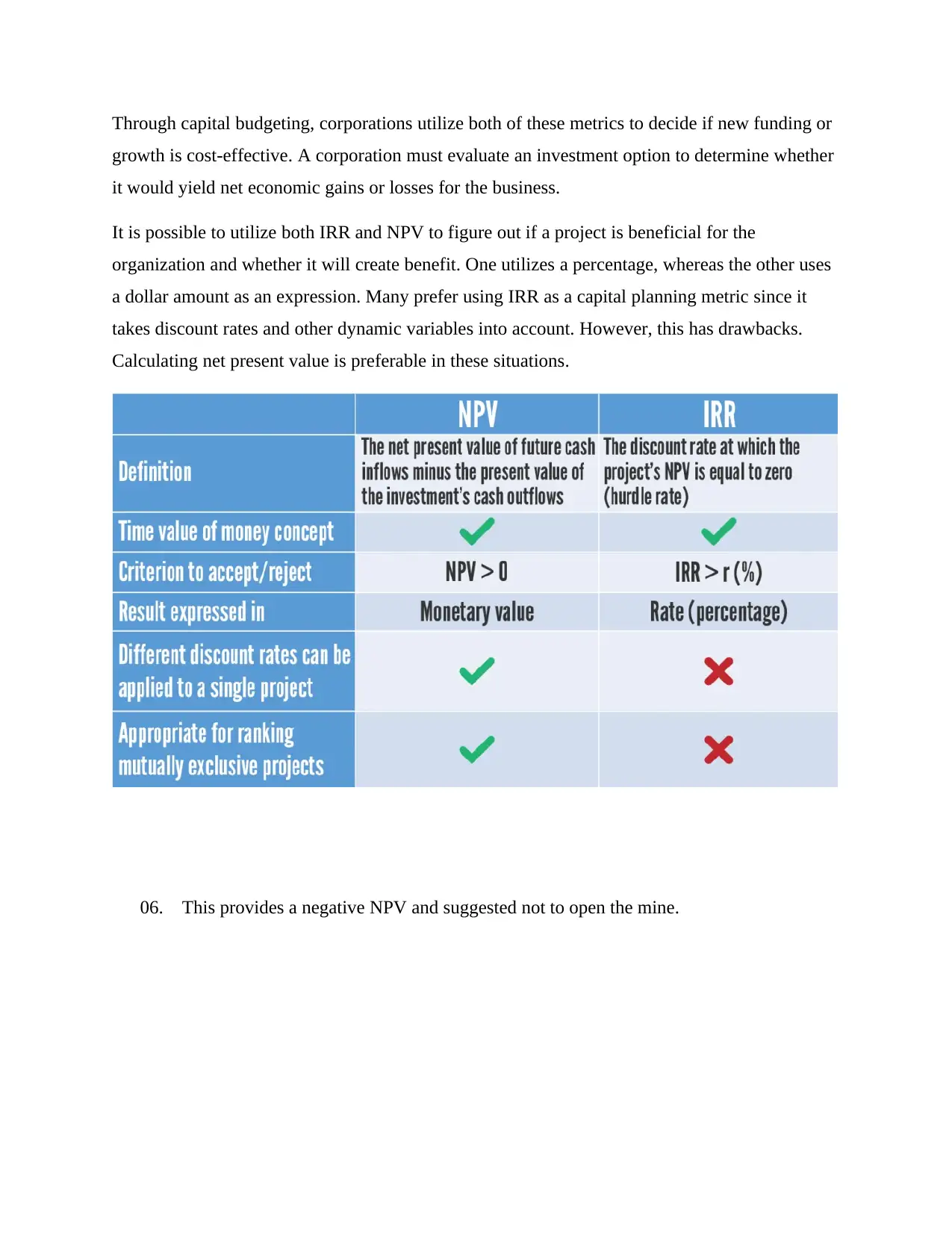
Through capital budgeting, corporations utilize both of these metrics to decide if new funding or
growth is cost-effective. A corporation must evaluate an investment option to determine whether
it would yield net economic gains or losses for the business.
It is possible to utilize both IRR and NPV to figure out if a project is beneficial for the
organization and whether it will create benefit. One utilizes a percentage, whereas the other uses
a dollar amount as an expression. Many prefer using IRR as a capital planning metric since it
takes discount rates and other dynamic variables into account. However, this has drawbacks.
Calculating net present value is preferable in these situations.
06. This provides a negative NPV and suggested not to open the mine.
growth is cost-effective. A corporation must evaluate an investment option to determine whether
it would yield net economic gains or losses for the business.
It is possible to utilize both IRR and NPV to figure out if a project is beneficial for the
organization and whether it will create benefit. One utilizes a percentage, whereas the other uses
a dollar amount as an expression. Many prefer using IRR as a capital planning metric since it
takes discount rates and other dynamic variables into account. However, this has drawbacks.
Calculating net present value is preferable in these situations.
06. This provides a negative NPV and suggested not to open the mine.
⊘ This is a preview!⊘
Do you want full access?
Subscribe today to unlock all pages.
Trusted by 1+ million students worldwide

1 out of 14


Related Documents


Your All-in-One AI-Powered Toolkit for Academic Success.
+13062052269
info@desklib.com
Available 24*7 on WhatsApp / Email
![[object Object]](/_next/static/media/star-bottom.7253800d.svg)
Unlock your academic potential
Copyright © 2020–2026 A2Z Services. All Rights Reserved. Developed and managed by ZUCOL.