Regulation of Financial Institutions in India: RBI, IRDA, SEBI Report
VerifiedAdded on 2021/09/18
|33
|10735
|293
Report
AI Summary
This report provides a comprehensive overview of financial regulations in India, focusing on the Reserve Bank of India (RBI), the Insurance Regulatory and Development Authority (IRDA), and the Securities and Exchange Board of India (SEBI). The report examines the RBI's role in regulating the banking sector through the RBI Act and the Banking Regulation Act, including credit control measures like reserve ratios, open market operations, and moral suasion, as well as the licensing and supervision of banks. It then delves into insurance laws and the functions of IRDA in protecting policyholders and ensuring the systematic growth of the insurance sector, covering both life and general insurance. Finally, the report explores SEBI's role as a statutory regulatory body responsible for regulating the Indian capital markets, protecting investor interests, and promoting the development of the securities market, including its functions related to issuers, traders, and financial intermediaries. The report highlights the objectives, functions, and powers of each regulatory body, providing a detailed understanding of the financial regulatory landscape in India.
1
Session 21
RBI and Banking Regulation Act
The Indian banking sector is regulated by the Reserve Bank of India Act 1934 (RBI Act) and
the Banking Regulation Act 1949 (BR Act). The Reserve Bank of India (RBI), India’s central
bank, issues various guidelines, notifications and policies from time to time to regulate the
banking sector. In addition, the Foreign Exchange Management Act 1999 (FEMA) regulates
cross-border exchange transactions by Indian entities, including banks.
India has both private sector banks (which include branches and subsidiaries of foreign banks)
and public-sector banks (ie, banks in which the government directly or indirectly holds
ownership interest). Banks in India can primarily be classified as:
scheduled commercial banks (ie, commercial banks performing all banking functions);
cooperative banks (set up by cooperative societies for providing financing to small
borrowers); and
regional rural banks (RRBs) (for providing credit to rural and agricultural areas)
Recently, the RBI has also introduced specialised banks such as payments banks and small
finance banks that perform only some banking functions.
The objectives of bank regulation, and the emphasis, vary between jurisdictions. The most
common objectives are:
Prudential - to reduce the level of risk to which bank creditors are exposed (i.e. to protect
depositors)
Systemic risk reduction - to reduce the risk of disruption resulting from adverse trading
conditions for banks causing multiple or major bank failures
To avoid misuse of banks - to reduce the risk of banks being used for criminal purposes,
e.g. laundering the proceeds of crime
To protect banking confidentiality
Credit allocation - to direct credit to favoured sectors
It may also include rules about treating customers fairly and having corporate social
responsibility.
Bank regulation is a complex process and generally consists of two components:
licensing, and
supervision.
The first component, licensing, sets certain requirements for starting a new bank. Licensing
provides the licence holders the right to own and to operate a bank. Licensing involves an
Session 21
RBI and Banking Regulation Act
The Indian banking sector is regulated by the Reserve Bank of India Act 1934 (RBI Act) and
the Banking Regulation Act 1949 (BR Act). The Reserve Bank of India (RBI), India’s central
bank, issues various guidelines, notifications and policies from time to time to regulate the
banking sector. In addition, the Foreign Exchange Management Act 1999 (FEMA) regulates
cross-border exchange transactions by Indian entities, including banks.
India has both private sector banks (which include branches and subsidiaries of foreign banks)
and public-sector banks (ie, banks in which the government directly or indirectly holds
ownership interest). Banks in India can primarily be classified as:
scheduled commercial banks (ie, commercial banks performing all banking functions);
cooperative banks (set up by cooperative societies for providing financing to small
borrowers); and
regional rural banks (RRBs) (for providing credit to rural and agricultural areas)
Recently, the RBI has also introduced specialised banks such as payments banks and small
finance banks that perform only some banking functions.
The objectives of bank regulation, and the emphasis, vary between jurisdictions. The most
common objectives are:
Prudential - to reduce the level of risk to which bank creditors are exposed (i.e. to protect
depositors)
Systemic risk reduction - to reduce the risk of disruption resulting from adverse trading
conditions for banks causing multiple or major bank failures
To avoid misuse of banks - to reduce the risk of banks being used for criminal purposes,
e.g. laundering the proceeds of crime
To protect banking confidentiality
Credit allocation - to direct credit to favoured sectors
It may also include rules about treating customers fairly and having corporate social
responsibility.
Bank regulation is a complex process and generally consists of two components:
licensing, and
supervision.
The first component, licensing, sets certain requirements for starting a new bank. Licensing
provides the licence holders the right to own and to operate a bank. Licensing involves an

Paraphrase This Document
Need a fresh take? Get an instant paraphrase of this document with our AI Paraphraser
2
evaluation of the entity's intent and the ability to meet the regulatory guidelines governing the
bank's operations, financial soundness, and managerial actions. The regulator supervises
licensed banks for compliance with the requirements and responds to breaches of the
requirements by obtaining undertakings, giving directions, imposing penalties or (ultimately)
revoking the bank's license.
The second component, namely, supervision, is an extension of the licence-granting process
and consists of supervision of the bank's activities by a government regulatory body i e The
RBI. Supervision ensures that the functioning of the bank complies with the regulatory
guidelines and monitors for possible deviations from regulatory standards. Supervisory
activities involve on-site inspection of the bank's records, operations and processes or
evaluation of the reports submitted by the bank.
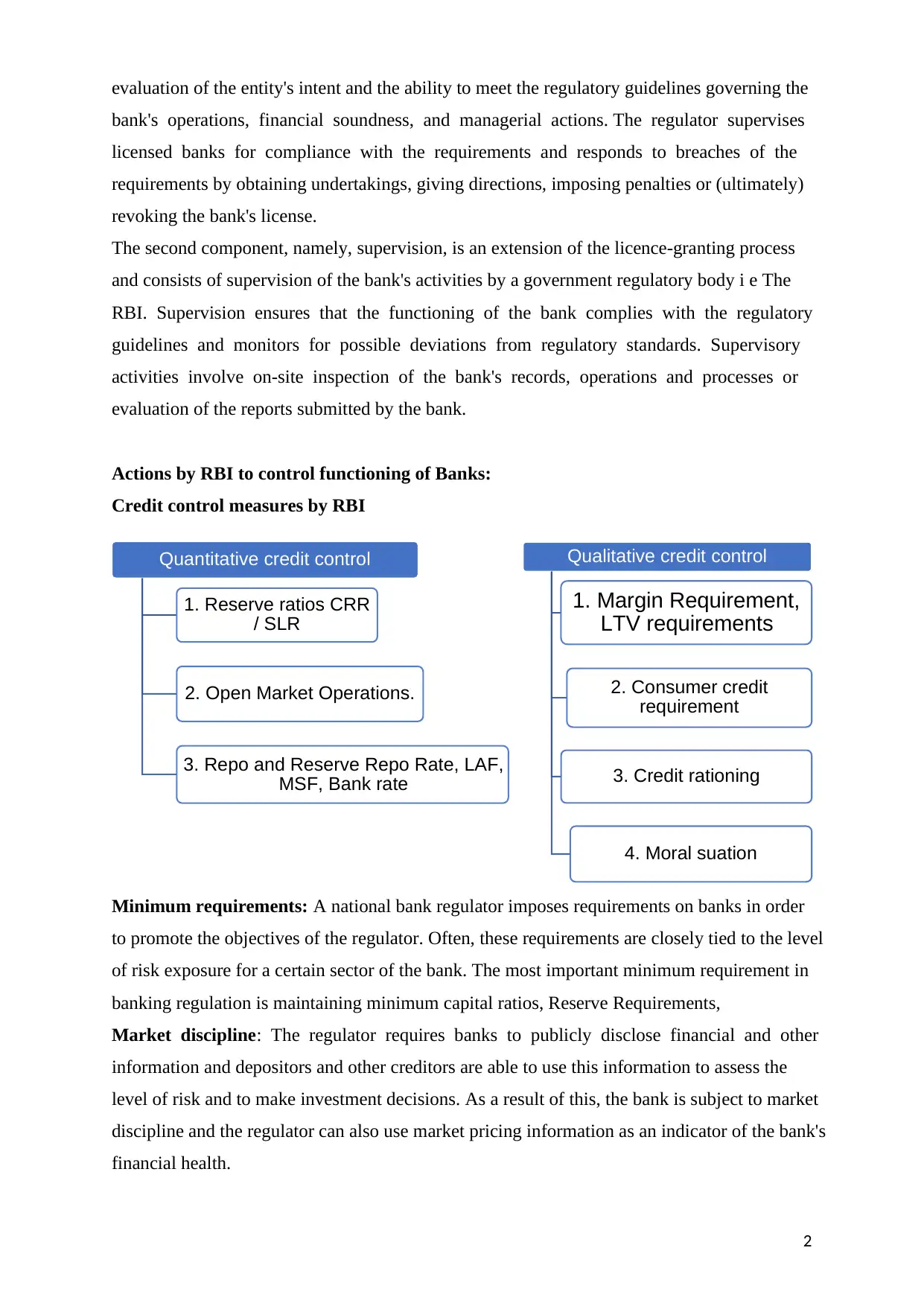
Actions by RBI to control functioning of Banks:
Credit control measures by RBI
Minimum requirements: A national bank regulator imposes requirements on banks in order
to promote the objectives of the regulator. Often, these requirements are closely tied to the level
of risk exposure for a certain sector of the bank. The most important minimum requirement in
banking regulation is maintaining minimum capital ratios, Reserve Requirements,
Market discipline: The regulator requires banks to publicly disclose financial and other
information and depositors and other creditors are able to use this information to assess the
level of risk and to make investment decisions. As a result of this, the bank is subject to market
discipline and the regulator can also use market pricing information as an indicator of the bank's
financial health.
Quantitative credit control
1. Reserve ratios CRR
/ SLR
2. Open Market Operations.
3. Repo and Reserve Repo Rate, LAF,
MSF, Bank rate
Qualitative credit control
1. Margin Requirement,
LTV requirements
2. Consumer credit
requirement
3. Credit rationing
4. Moral suation
evaluation of the entity's intent and the ability to meet the regulatory guidelines governing the
bank's operations, financial soundness, and managerial actions. The regulator supervises
licensed banks for compliance with the requirements and responds to breaches of the
requirements by obtaining undertakings, giving directions, imposing penalties or (ultimately)
revoking the bank's license.
The second component, namely, supervision, is an extension of the licence-granting process
and consists of supervision of the bank's activities by a government regulatory body i e The
RBI. Supervision ensures that the functioning of the bank complies with the regulatory
guidelines and monitors for possible deviations from regulatory standards. Supervisory
activities involve on-site inspection of the bank's records, operations and processes or
evaluation of the reports submitted by the bank.
Actions by RBI to control functioning of Banks:
Credit control measures by RBI
Minimum requirements: A national bank regulator imposes requirements on banks in order
to promote the objectives of the regulator. Often, these requirements are closely tied to the level
of risk exposure for a certain sector of the bank. The most important minimum requirement in
banking regulation is maintaining minimum capital ratios, Reserve Requirements,
Market discipline: The regulator requires banks to publicly disclose financial and other
information and depositors and other creditors are able to use this information to assess the
level of risk and to make investment decisions. As a result of this, the bank is subject to market
discipline and the regulator can also use market pricing information as an indicator of the bank's
financial health.
Quantitative credit control
1. Reserve ratios CRR
/ SLR
2. Open Market Operations.
3. Repo and Reserve Repo Rate, LAF,
MSF, Bank rate
Qualitative credit control
1. Margin Requirement,
LTV requirements
2. Consumer credit
requirement
3. Credit rationing
4. Moral suation
3
Corporate governance: Corporate governance requirements are intended to encourage the
bank to be well managed, and is an indirect way of achieving other objectives. As many banks
are relatively large, and with many divisions, it is important for management to maintain a
close watch on all operations. I
Financial reporting and disclosure requirements: Among the most important regulations
that are placed on banking institutions is the requirement for disclosure of the bank's finances
Credit rating requirement: Banks may be required to obtain and maintain a current credit
rating from an approved credit rating agency, and to disclose it to investors and prospective
investors. Also, banks may be required to maintain a minimum credit rating.
Further to the above:
The RBI conducts periodic audits and also acts as a consumer disputes ombudsman for
retail banking.
RBI also supervises the Indian banking system through various methods such as on-site
inspection, surveillance and reviewing regulatory filings made by the banks.
The RBI also monitors compliance on an ongoing basis by requiring banks to submit
detailed information periodically under an off-site surveillance and monitoring system.
The RBI can conduct compulsory amalgamations:
in the public interest;
in the interests of depositors of a bank;
to secure proper management of a bank; or
in the larger interests of the banking system.
In addition, the RBI has wide powers in appropriate cases to:
require banks to make changes in their management as the RBI considers necessary;
remove any chairman, director, chief executive officer or other employee of a bank;
appoint additional directors to the board of directors of a bank; and
supersede the board of directors of a bank for a maximum period of 12 months and
instead appoint an administrator.
The RBI has the power of winding-up of a banking company. An order for the winding-up
of a banking company can be passed by a High Court:
if it is unable to pay its debts;
if an application has been made by the RBI; or
on request of the GOI.
Corporate governance: Corporate governance requirements are intended to encourage the
bank to be well managed, and is an indirect way of achieving other objectives. As many banks
are relatively large, and with many divisions, it is important for management to maintain a
close watch on all operations. I
Financial reporting and disclosure requirements: Among the most important regulations
that are placed on banking institutions is the requirement for disclosure of the bank's finances
Credit rating requirement: Banks may be required to obtain and maintain a current credit
rating from an approved credit rating agency, and to disclose it to investors and prospective
investors. Also, banks may be required to maintain a minimum credit rating.
Further to the above:
The RBI conducts periodic audits and also acts as a consumer disputes ombudsman for
retail banking.
RBI also supervises the Indian banking system through various methods such as on-site
inspection, surveillance and reviewing regulatory filings made by the banks.
The RBI also monitors compliance on an ongoing basis by requiring banks to submit
detailed information periodically under an off-site surveillance and monitoring system.
The RBI can conduct compulsory amalgamations:
in the public interest;
in the interests of depositors of a bank;
to secure proper management of a bank; or
in the larger interests of the banking system.
In addition, the RBI has wide powers in appropriate cases to:
require banks to make changes in their management as the RBI considers necessary;
remove any chairman, director, chief executive officer or other employee of a bank;
appoint additional directors to the board of directors of a bank; and
supersede the board of directors of a bank for a maximum period of 12 months and
instead appoint an administrator.
The RBI has the power of winding-up of a banking company. An order for the winding-up
of a banking company can be passed by a High Court:
if it is unable to pay its debts;
if an application has been made by the RBI; or
on request of the GOI.
⊘ This is a preview!⊘
Do you want full access?
Subscribe today to unlock all pages.

Trusted by 1+ million students worldwide
4
Session 22
Insurance Laws and IRDA
The word insurance means an arrangement for protection against any likely loss or damage.
Insurance contracts are based on the contingency of an event which causes a loss. Such
contracts are legal agreements which are entered into between two parties wherein, the
company promises to make good the loss as and when it occurs, in return for a regular premium
to be paid by the party.
In India, several insurance laws have been enacted to save the interest of the various
policyholders. Health insurance, fire insurance, car insurance, marine insurance, life insurance,
etc are few examples of the insurance available in India.
There are two main categories of Insurance:
1. Life insurance - Life Insurance is a legal agreement wherein financial compensation is
provided in cases of death or disability. It can be availed by paying lumpsum amount or by
making periodic instalments so as to save the vested interest of your family in your absence.
The periodic instalments are termed as premium.
Depending upon its coverage:
Life insurance can be further classified into either whole life insurance, endowment policy,
life term etc.
2. General insurance- General insurance provides protection from any loss other than life
insurance.
It includes:
Travel insurance
Health insurance
Home insurance
Motor insurance
Fire insurance
To regulate the insurance sector, several regulatory authorities have been formed:
IRDA (Insurance Regulatory and Development Authority)
Tariff Advisory Committee
Insurance Association of India, councils and committees
Ombudsman
Session 22
Insurance Laws and IRDA
The word insurance means an arrangement for protection against any likely loss or damage.
Insurance contracts are based on the contingency of an event which causes a loss. Such
contracts are legal agreements which are entered into between two parties wherein, the
company promises to make good the loss as and when it occurs, in return for a regular premium
to be paid by the party.
In India, several insurance laws have been enacted to save the interest of the various
policyholders. Health insurance, fire insurance, car insurance, marine insurance, life insurance,
etc are few examples of the insurance available in India.
There are two main categories of Insurance:
1. Life insurance - Life Insurance is a legal agreement wherein financial compensation is
provided in cases of death or disability. It can be availed by paying lumpsum amount or by
making periodic instalments so as to save the vested interest of your family in your absence.
The periodic instalments are termed as premium.
Depending upon its coverage:
Life insurance can be further classified into either whole life insurance, endowment policy,
life term etc.
2. General insurance- General insurance provides protection from any loss other than life
insurance.
It includes:
Travel insurance
Health insurance
Home insurance
Motor insurance
Fire insurance
To regulate the insurance sector, several regulatory authorities have been formed:
IRDA (Insurance Regulatory and Development Authority)
Tariff Advisory Committee
Insurance Association of India, councils and committees
Ombudsman
Paraphrase This Document
Need a fresh take? Get an instant paraphrase of this document with our AI Paraphraser
5
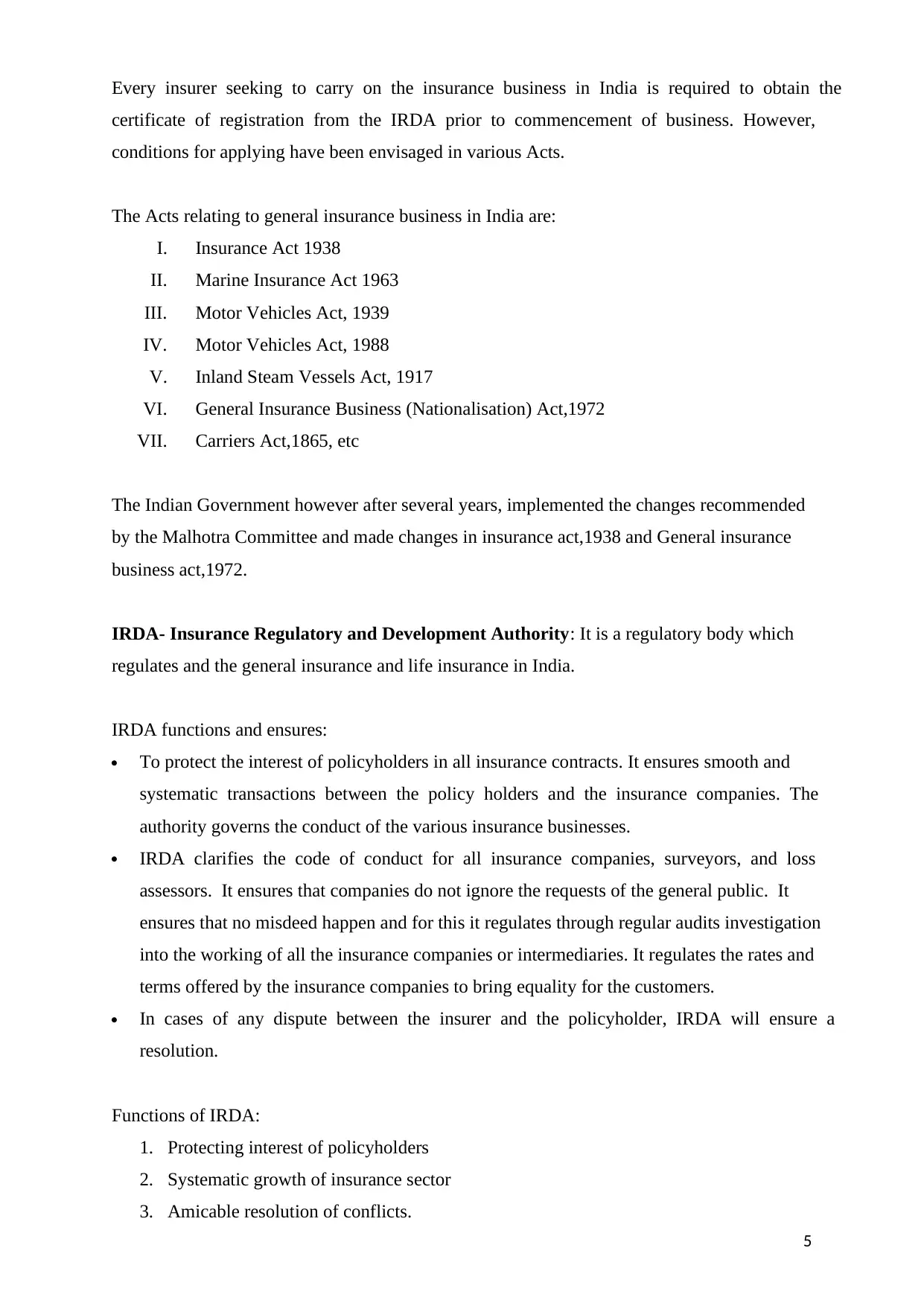
Every insurer seeking to carry on the insurance business in India is required to obtain the
certificate of registration from the IRDA prior to commencement of business. However,
conditions for applying have been envisaged in various Acts.
The Acts relating to general insurance business in India are:
I. Insurance Act 1938
II. Marine Insurance Act 1963
III. Motor Vehicles Act, 1939
IV. Motor Vehicles Act, 1988
V. Inland Steam Vessels Act, 1917
VI. General Insurance Business (Nationalisation) Act,1972
VII. Carriers Act,1865, etc
The Indian Government however after several years, implemented the changes recommended
by the Malhotra Committee and made changes in insurance act,1938 and General insurance
business act,1972.
IRDA- Insurance Regulatory and Development Authority: It is a regulatory body which
regulates and the general insurance and life insurance in India.
IRDA functions and ensures:
To protect the interest of policyholders in all insurance contracts. It ensures smooth and
systematic transactions between the policy holders and the insurance companies. The
authority governs the conduct of the various insurance businesses.
IRDA clarifies the code of conduct for all insurance companies, surveyors, and loss
assessors. It ensures that companies do not ignore the requests of the general public. It
ensures that no misdeed happen and for this it regulates through regular audits investigation
into the working of all the insurance companies or intermediaries. It regulates the rates and
terms offered by the insurance companies to bring equality for the customers.
In cases of any dispute between the insurer and the policyholder, IRDA will ensure a
resolution.
Functions of IRDA:
1. Protecting interest of policyholders
2. Systematic growth of insurance sector
3. Amicable resolution of conflicts.
Every insurer seeking to carry on the insurance business in India is required to obtain the
certificate of registration from the IRDA prior to commencement of business. However,
conditions for applying have been envisaged in various Acts.
The Acts relating to general insurance business in India are:
I. Insurance Act 1938
II. Marine Insurance Act 1963
III. Motor Vehicles Act, 1939
IV. Motor Vehicles Act, 1988
V. Inland Steam Vessels Act, 1917
VI. General Insurance Business (Nationalisation) Act,1972
VII. Carriers Act,1865, etc
The Indian Government however after several years, implemented the changes recommended
by the Malhotra Committee and made changes in insurance act,1938 and General insurance
business act,1972.
IRDA- Insurance Regulatory and Development Authority: It is a regulatory body which
regulates and the general insurance and life insurance in India.
IRDA functions and ensures:
To protect the interest of policyholders in all insurance contracts. It ensures smooth and
systematic transactions between the policy holders and the insurance companies. The
authority governs the conduct of the various insurance businesses.
IRDA clarifies the code of conduct for all insurance companies, surveyors, and loss
assessors. It ensures that companies do not ignore the requests of the general public. It
ensures that no misdeed happen and for this it regulates through regular audits investigation
into the working of all the insurance companies or intermediaries. It regulates the rates and
terms offered by the insurance companies to bring equality for the customers.
In cases of any dispute between the insurer and the policyholder, IRDA will ensure a
resolution.
Functions of IRDA:
1. Protecting interest of policyholders
2. Systematic growth of insurance sector
3. Amicable resolution of conflicts.

6
4. Regular monitoring so as to check any discrepancies /frauds etc.
5. Fair dealings in the market.
For the systematic growth of the economy, it is imperative that government should establish
authorities who govern the working of the companies, ex- insurance companies. An
investor must be protected from any fraudulent activities and his money must be utilised
and put to judicious use. Like Banking sector, is governed by RBI and the later regulates
the entire functioning of the banks, similarly, IRDA regulates all insurance companies
managing different insurance operations.
4. Regular monitoring so as to check any discrepancies /frauds etc.
5. Fair dealings in the market.
For the systematic growth of the economy, it is imperative that government should establish
authorities who govern the working of the companies, ex- insurance companies. An
investor must be protected from any fraudulent activities and his money must be utilised
and put to judicious use. Like Banking sector, is governed by RBI and the later regulates
the entire functioning of the banks, similarly, IRDA regulates all insurance companies
managing different insurance operations.
⊘ This is a preview!⊘
Do you want full access?
Subscribe today to unlock all pages.
Trusted by 1+ million students worldwide
7
Session 23
SEBI as a regulator:
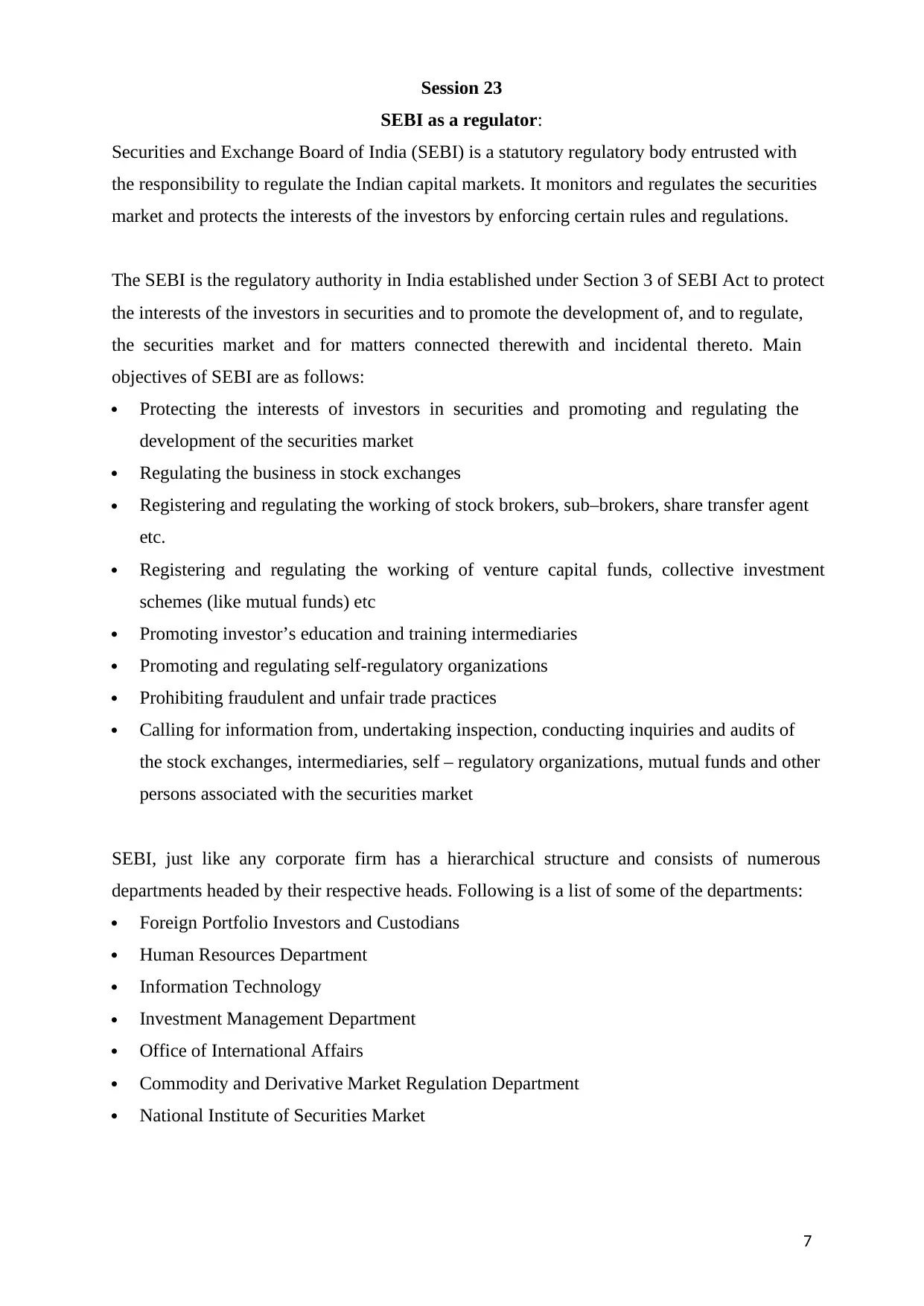
Securities and Exchange Board of India (SEBI) is a statutory regulatory body entrusted with
the responsibility to regulate the Indian capital markets. It monitors and regulates the securities
market and protects the interests of the investors by enforcing certain rules and regulations.
The SEBI is the regulatory authority in India established under Section 3 of SEBI Act to protect
the interests of the investors in securities and to promote the development of, and to regulate,
the securities market and for matters connected therewith and incidental thereto. Main
objectives of SEBI are as follows:
Protecting the interests of investors in securities and promoting and regulating the
development of the securities market
Regulating the business in stock exchanges
Registering and regulating the working of stock brokers, sub–brokers, share transfer agent
etc.
Registering and regulating the working of venture capital funds, collective investment
schemes (like mutual funds) etc
Promoting investor’s education and training intermediaries
Promoting and regulating self-regulatory organizations
Prohibiting fraudulent and unfair trade practices
Calling for information from, undertaking inspection, conducting inquiries and audits of
the stock exchanges, intermediaries, self – regulatory organizations, mutual funds and other
persons associated with the securities market
SEBI, just like any corporate firm has a hierarchical structure and consists of numerous
departments headed by their respective heads. Following is a list of some of the departments:
Foreign Portfolio Investors and Custodians
Human Resources Department
Information Technology
Investment Management Department
Office of International Affairs
Commodity and Derivative Market Regulation Department
National Institute of Securities Market
Session 23
SEBI as a regulator:
Securities and Exchange Board of India (SEBI) is a statutory regulatory body entrusted with
the responsibility to regulate the Indian capital markets. It monitors and regulates the securities
market and protects the interests of the investors by enforcing certain rules and regulations.
The SEBI is the regulatory authority in India established under Section 3 of SEBI Act to protect
the interests of the investors in securities and to promote the development of, and to regulate,
the securities market and for matters connected therewith and incidental thereto. Main
objectives of SEBI are as follows:
Protecting the interests of investors in securities and promoting and regulating the
development of the securities market
Regulating the business in stock exchanges
Registering and regulating the working of stock brokers, sub–brokers, share transfer agent
etc.
Registering and regulating the working of venture capital funds, collective investment
schemes (like mutual funds) etc
Promoting investor’s education and training intermediaries
Promoting and regulating self-regulatory organizations
Prohibiting fraudulent and unfair trade practices
Calling for information from, undertaking inspection, conducting inquiries and audits of
the stock exchanges, intermediaries, self – regulatory organizations, mutual funds and other
persons associated with the securities market
SEBI, just like any corporate firm has a hierarchical structure and consists of numerous
departments headed by their respective heads. Following is a list of some of the departments:
Foreign Portfolio Investors and Custodians
Human Resources Department
Information Technology
Investment Management Department
Office of International Affairs
Commodity and Derivative Market Regulation Department
National Institute of Securities Market
Paraphrase This Document
Need a fresh take? Get an instant paraphrase of this document with our AI Paraphraser
8
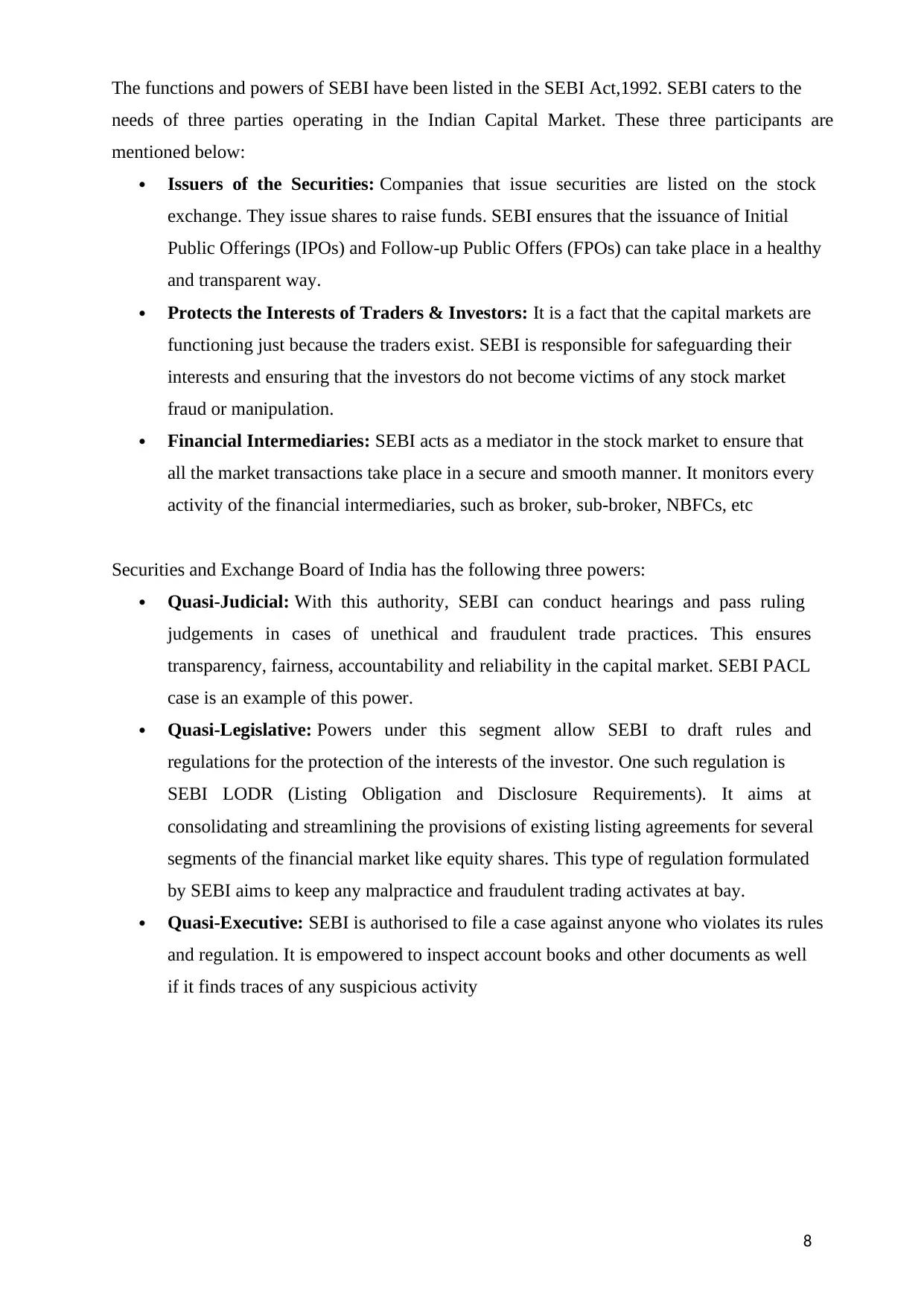
The functions and powers of SEBI have been listed in the SEBI Act,1992. SEBI caters to the
needs of three parties operating in the Indian Capital Market. These three participants are
mentioned below:
Issuers of the Securities: Companies that issue securities are listed on the stock
exchange. They issue shares to raise funds. SEBI ensures that the issuance of Initial
Public Offerings (IPOs) and Follow-up Public Offers (FPOs) can take place in a healthy
and transparent way.
Protects the Interests of Traders & Investors: It is a fact that the capital markets are
functioning just because the traders exist. SEBI is responsible for safeguarding their
interests and ensuring that the investors do not become victims of any stock market
fraud or manipulation.
Financial Intermediaries: SEBI acts as a mediator in the stock market to ensure that
all the market transactions take place in a secure and smooth manner. It monitors every
activity of the financial intermediaries, such as broker, sub-broker, NBFCs, etc
Securities and Exchange Board of India has the following three powers:
Quasi-Judicial: With this authority, SEBI can conduct hearings and pass ruling
judgements in cases of unethical and fraudulent trade practices. This ensures
transparency, fairness, accountability and reliability in the capital market. SEBI PACL
case is an example of this power.
Quasi-Legislative: Powers under this segment allow SEBI to draft rules and
regulations for the protection of the interests of the investor. One such regulation is
SEBI LODR (Listing Obligation and Disclosure Requirements). It aims at
consolidating and streamlining the provisions of existing listing agreements for several
segments of the financial market like equity shares. This type of regulation formulated
by SEBI aims to keep any malpractice and fraudulent trading activates at bay.
Quasi-Executive: SEBI is authorised to file a case against anyone who violates its rules
and regulation. It is empowered to inspect account books and other documents as well
if it finds traces of any suspicious activity
The functions and powers of SEBI have been listed in the SEBI Act,1992. SEBI caters to the
needs of three parties operating in the Indian Capital Market. These three participants are
mentioned below:
Issuers of the Securities: Companies that issue securities are listed on the stock
exchange. They issue shares to raise funds. SEBI ensures that the issuance of Initial
Public Offerings (IPOs) and Follow-up Public Offers (FPOs) can take place in a healthy
and transparent way.
Protects the Interests of Traders & Investors: It is a fact that the capital markets are
functioning just because the traders exist. SEBI is responsible for safeguarding their
interests and ensuring that the investors do not become victims of any stock market
fraud or manipulation.
Financial Intermediaries: SEBI acts as a mediator in the stock market to ensure that
all the market transactions take place in a secure and smooth manner. It monitors every
activity of the financial intermediaries, such as broker, sub-broker, NBFCs, etc
Securities and Exchange Board of India has the following three powers:
Quasi-Judicial: With this authority, SEBI can conduct hearings and pass ruling
judgements in cases of unethical and fraudulent trade practices. This ensures
transparency, fairness, accountability and reliability in the capital market. SEBI PACL
case is an example of this power.
Quasi-Legislative: Powers under this segment allow SEBI to draft rules and
regulations for the protection of the interests of the investor. One such regulation is
SEBI LODR (Listing Obligation and Disclosure Requirements). It aims at
consolidating and streamlining the provisions of existing listing agreements for several
segments of the financial market like equity shares. This type of regulation formulated
by SEBI aims to keep any malpractice and fraudulent trading activates at bay.
Quasi-Executive: SEBI is authorised to file a case against anyone who violates its rules
and regulation. It is empowered to inspect account books and other documents as well
if it finds traces of any suspicious activity
9
Session 24
Environment laws
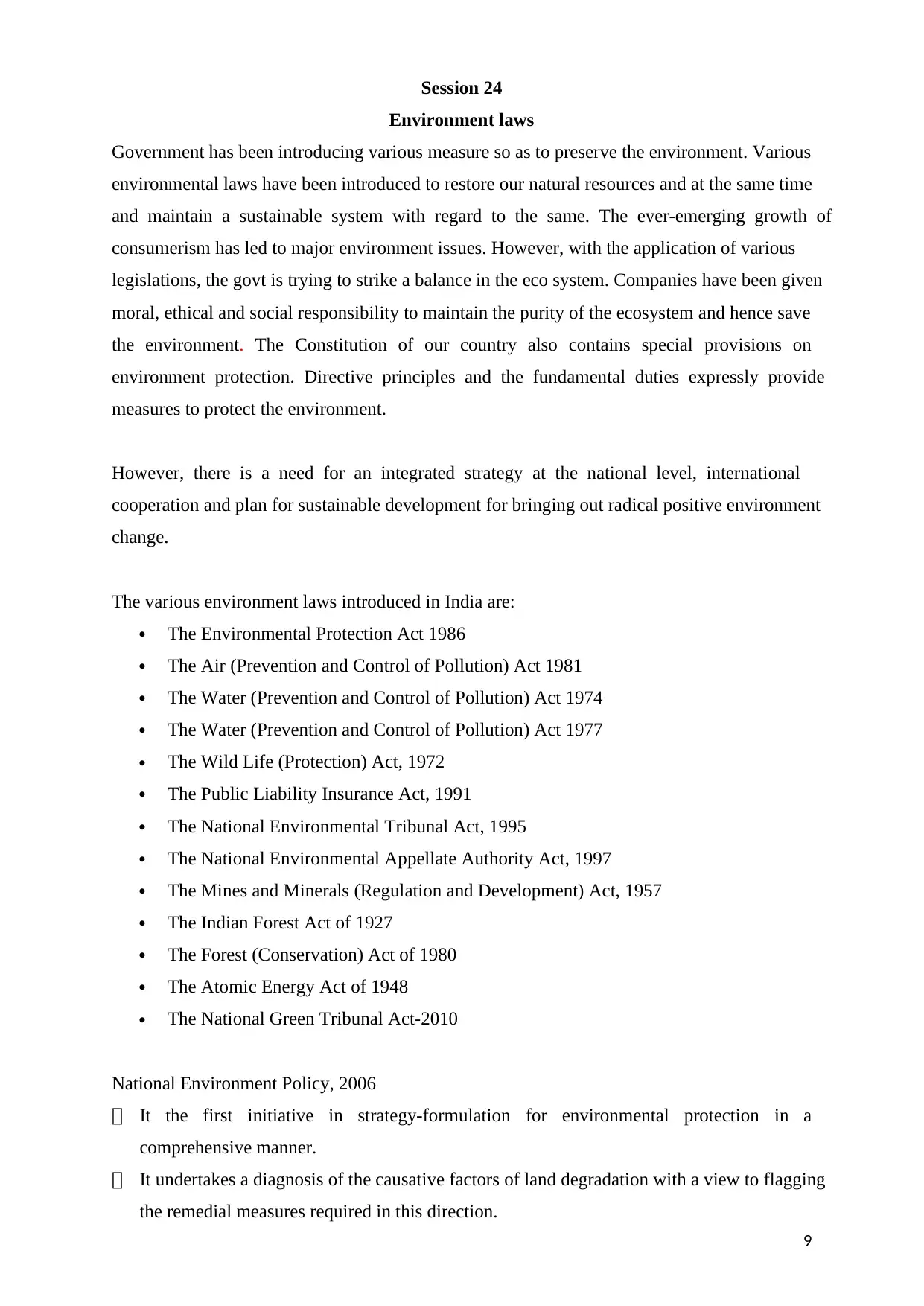
Government has been introducing various measure so as to preserve the environment. Various
environmental laws have been introduced to restore our natural resources and at the same time
and maintain a sustainable system with regard to the same. The ever-emerging growth of
consumerism has led to major environment issues. However, with the application of various
legislations, the govt is trying to strike a balance in the eco system. Companies have been given
moral, ethical and social responsibility to maintain the purity of the ecosystem and hence save
the environment. The Constitution of our country also contains special provisions on
environment protection. Directive principles and the fundamental duties expressly provide
measures to protect the environment.
However, there is a need for an integrated strategy at the national level, international
cooperation and plan for sustainable development for bringing out radical positive environment
change.
The various environment laws introduced in India are:
The Environmental Protection Act 1986
The Air (Prevention and Control of Pollution) Act 1981
The Water (Prevention and Control of Pollution) Act 1974
The Water (Prevention and Control of Pollution) Act 1977
The Wild Life (Protection) Act, 1972
The Public Liability Insurance Act, 1991
The National Environmental Tribunal Act, 1995
The National Environmental Appellate Authority Act, 1997
The Mines and Minerals (Regulation and Development) Act, 1957
The Indian Forest Act of 1927
The Forest (Conservation) Act of 1980
The Atomic Energy Act of 1948
The National Green Tribunal Act-2010
National Environment Policy, 2006
It the first initiative in strategy-formulation for environmental protection in a
comprehensive manner.
It undertakes a diagnosis of the causative factors of land degradation with a view to flagging
the remedial measures required in this direction.
Session 24
Environment laws
Government has been introducing various measure so as to preserve the environment. Various
environmental laws have been introduced to restore our natural resources and at the same time
and maintain a sustainable system with regard to the same. The ever-emerging growth of
consumerism has led to major environment issues. However, with the application of various
legislations, the govt is trying to strike a balance in the eco system. Companies have been given
moral, ethical and social responsibility to maintain the purity of the ecosystem and hence save
the environment. The Constitution of our country also contains special provisions on
environment protection. Directive principles and the fundamental duties expressly provide
measures to protect the environment.
However, there is a need for an integrated strategy at the national level, international
cooperation and plan for sustainable development for bringing out radical positive environment
change.
The various environment laws introduced in India are:
The Environmental Protection Act 1986
The Air (Prevention and Control of Pollution) Act 1981
The Water (Prevention and Control of Pollution) Act 1974
The Water (Prevention and Control of Pollution) Act 1977
The Wild Life (Protection) Act, 1972
The Public Liability Insurance Act, 1991
The National Environmental Tribunal Act, 1995
The National Environmental Appellate Authority Act, 1997
The Mines and Minerals (Regulation and Development) Act, 1957
The Indian Forest Act of 1927
The Forest (Conservation) Act of 1980
The Atomic Energy Act of 1948
The National Green Tribunal Act-2010
National Environment Policy, 2006
It the first initiative in strategy-formulation for environmental protection in a
comprehensive manner.
It undertakes a diagnosis of the causative factors of land degradation with a view to flagging
the remedial measures required in this direction.
⊘ This is a preview!⊘
Do you want full access?
Subscribe today to unlock all pages.
Trusted by 1+ million students worldwide
10
It recognizes that the relevant fiscal, tariffs and sectoral policies need to take explicit
account of their unintentional impacts on land degradation.
The solutions offered to tackle the problem comprise adoption of both, science-based and
traditional land-use practices, pilot-scale demonstrations, large scale dissemination,
adoption of Multi-stakeholder partnerships, promotion of agro-forestry, organic farming,
environmentally sustainable cropping patterns and adoption of efficient irrigation
techniques
As the right to pure environment is an implied right, hence any violation of this fundamental
right, can be pleaded by filling a writ petition to the Supreme Court under Art.32 and the High
Court under Art.226.
The writs of Mandamus, Certiorari and Prohibition can be invoked for such environmental
matters. A writ of mandamus would lie against a municipality which fails to construct sewers
and drains, clean street and clear garbage.
Supreme Court by virtue of various judgments for example: Oleum gas leak case, Bhopal Gas
Leak case etc has laid the rule of absolute liability and following these judgments, even The
Public Liability Insurance Act was passed, following by many other legislations.
Though the Indian Judiciary has done remarkable contribution by enacting various
environment laws but still the responsibility is on each individual to preserve the natural
resources.
It recognizes that the relevant fiscal, tariffs and sectoral policies need to take explicit
account of their unintentional impacts on land degradation.
The solutions offered to tackle the problem comprise adoption of both, science-based and
traditional land-use practices, pilot-scale demonstrations, large scale dissemination,
adoption of Multi-stakeholder partnerships, promotion of agro-forestry, organic farming,
environmentally sustainable cropping patterns and adoption of efficient irrigation
techniques
As the right to pure environment is an implied right, hence any violation of this fundamental
right, can be pleaded by filling a writ petition to the Supreme Court under Art.32 and the High
Court under Art.226.
The writs of Mandamus, Certiorari and Prohibition can be invoked for such environmental
matters. A writ of mandamus would lie against a municipality which fails to construct sewers
and drains, clean street and clear garbage.
Supreme Court by virtue of various judgments for example: Oleum gas leak case, Bhopal Gas
Leak case etc has laid the rule of absolute liability and following these judgments, even The
Public Liability Insurance Act was passed, following by many other legislations.
Though the Indian Judiciary has done remarkable contribution by enacting various
environment laws but still the responsibility is on each individual to preserve the natural
resources.
Paraphrase This Document
Need a fresh take? Get an instant paraphrase of this document with our AI Paraphraser

11
Session 25
Property Law
Property has a wide meaning in its legal sense. It means something of value and includes both
tangible and intangible assets. When a man owns a property, it means he can not only possess
and enjoy the same with an absolute right but can also derive benefit from it without violating
the law of land.
The traditional principles related to property rights include:
1. Control over the use of the property
2. Right to take any benefit from the property
3. Right to transfer or sell the property
4. Right to exclude others from the property
All properties are classified as either personal property or real property. Personal property is
movable property, anything that can be subject to ownership, except land. Real property on
the other hand, is immovable property such as land and anything attached to the land.
Though the Transfer of Property Act, 1882 does not define the term ‘Property’ the
Interpretation of the Act, says Immovable property does not includes standing timber, growing
crops or grass". Section 3(26), The General Clauses Act, 1897, defines, " immovable property"
shall include land, benefits to arise out of the land, and things attached to the earth, or
permanently fastened to anything attached to the earth.
"Immovable property" includes land, buildings, hereditary allowances, rights to ways, lights,
ferries, fisheries or any other benefit to arise out of the land, and things attached to the earth or
permanently fastened to anything which is attached to the earth, but not standing timber,
growing crops nor grass.
Under THE Securitisation And Reconstruction Of Financial
Assets And Enforcement Of Security Interest Act, 2002 "property" means--
(i) immovable property;
(ii) movable property;
(iii) any debt or any right to receive payment of money, whether secured or unsecured;
(iv) receivables, whether existing or future;
(v) intangible assets, being know-how, patent, copyright, trade mark, license, franchise or any
other business or commercial right of similar nature.
Session 25
Property Law
Property has a wide meaning in its legal sense. It means something of value and includes both
tangible and intangible assets. When a man owns a property, it means he can not only possess
and enjoy the same with an absolute right but can also derive benefit from it without violating
the law of land.
The traditional principles related to property rights include:
1. Control over the use of the property
2. Right to take any benefit from the property
3. Right to transfer or sell the property
4. Right to exclude others from the property
All properties are classified as either personal property or real property. Personal property is
movable property, anything that can be subject to ownership, except land. Real property on
the other hand, is immovable property such as land and anything attached to the land.
Though the Transfer of Property Act, 1882 does not define the term ‘Property’ the
Interpretation of the Act, says Immovable property does not includes standing timber, growing
crops or grass". Section 3(26), The General Clauses Act, 1897, defines, " immovable property"
shall include land, benefits to arise out of the land, and things attached to the earth, or
permanently fastened to anything attached to the earth.
"Immovable property" includes land, buildings, hereditary allowances, rights to ways, lights,
ferries, fisheries or any other benefit to arise out of the land, and things attached to the earth or
permanently fastened to anything which is attached to the earth, but not standing timber,
growing crops nor grass.
Under THE Securitisation And Reconstruction Of Financial
Assets And Enforcement Of Security Interest Act, 2002 "property" means--
(i) immovable property;
(ii) movable property;
(iii) any debt or any right to receive payment of money, whether secured or unsecured;
(iv) receivables, whether existing or future;
(v) intangible assets, being know-how, patent, copyright, trade mark, license, franchise or any
other business or commercial right of similar nature.
12
Movable Property
The definition of movable property is given differently under various Statutes. Some of the
definitions are as follows:
Section 3(36) of the General Clauses Act defines Movable Property as: “Movable Property
shall mean property of every description, except immovable property”.
Section 2(9) of the Registration Act, 1908 defines property as: “Moveable property’ includes
standing timber, growing crops and grass, fruit upon and juice in trees, and property of every
other description except immovable property”.
Section 22 of IPC defines property as - The words ‘Moveable property” is intended to include
corporeal property of every description except land and things attached to the earth. Things
attached to the land may become moveable property by severance from the Earth.
Tangible Property
Tangible Property refers to any type of property that can generally be moved (i.e., it is not
attached to real property or land), touched or felt.
Intangible Property
Intangible Property refers to personal property that cannot actually be moved, touched or felt
but instead represents something of value such as negotiable instruments, securities, service
(economics), and intangible assets.
Intellectual Property
Intellectual Property is a term referring to a number of distinct types of creations of the mind
for which property rights are recognized.
Under intellectual property law, owners are granted certain exclusive rights to a variety of
intangible assets, such as musical, literary and artistic works, discoveries and inventions; and
words, phrases, symbols and designs. Patents, trademarks, and copyrights, designs are the four
main categories of intellectual property.
Movable Property
The definition of movable property is given differently under various Statutes. Some of the
definitions are as follows:
Section 3(36) of the General Clauses Act defines Movable Property as: “Movable Property
shall mean property of every description, except immovable property”.
Section 2(9) of the Registration Act, 1908 defines property as: “Moveable property’ includes
standing timber, growing crops and grass, fruit upon and juice in trees, and property of every
other description except immovable property”.
Section 22 of IPC defines property as - The words ‘Moveable property” is intended to include
corporeal property of every description except land and things attached to the earth. Things
attached to the land may become moveable property by severance from the Earth.
Tangible Property
Tangible Property refers to any type of property that can generally be moved (i.e., it is not
attached to real property or land), touched or felt.
Intangible Property
Intangible Property refers to personal property that cannot actually be moved, touched or felt
but instead represents something of value such as negotiable instruments, securities, service
(economics), and intangible assets.
Intellectual Property
Intellectual Property is a term referring to a number of distinct types of creations of the mind
for which property rights are recognized.
Under intellectual property law, owners are granted certain exclusive rights to a variety of
intangible assets, such as musical, literary and artistic works, discoveries and inventions; and
words, phrases, symbols and designs. Patents, trademarks, and copyrights, designs are the four
main categories of intellectual property.
⊘ This is a preview!⊘
Do you want full access?
Subscribe today to unlock all pages.
Trusted by 1+ million students worldwide

1 out of 33


Your All-in-One AI-Powered Toolkit for Academic Success.
+13062052269
info@desklib.com
Available 24*7 on WhatsApp / Email
![[object Object]](/_next/static/media/star-bottom.7253800d.svg)
Unlock your academic potential
Copyright © 2020–2026 A2Z Services. All Rights Reserved. Developed and managed by ZUCOL.