Financial Reporting Analysis: Evaluating ROB PLC Financials
VerifiedAdded on 2020/09/08
|11
|3263
|923
Report
AI Summary
This report provides a comprehensive analysis of financial reporting, covering its purpose, regulatory frameworks, and conceptual underpinnings. It examines the benefits for key stakeholders such as investors, creditors, and management, while also exploring the value of financial reporting in meeting a firm's growth objectives. The report includes a detailed analysis of financial statements, ratio interpretations, and a comparison between IAS and IFRS. It also discusses the advantages of IFRS and the degree of its compliance by companies worldwide. The analysis is based on the financial data of ROB PLC, offering insights into the company's performance and financial position. The report emphasizes the importance of financial reporting in making informed decisions and achieving sustainable business success.

FINANCE REPORTING
1
1

Paraphrase This Document
Need a fresh take? Get an instant paraphrase of this document with our AI Paraphraser
Contents
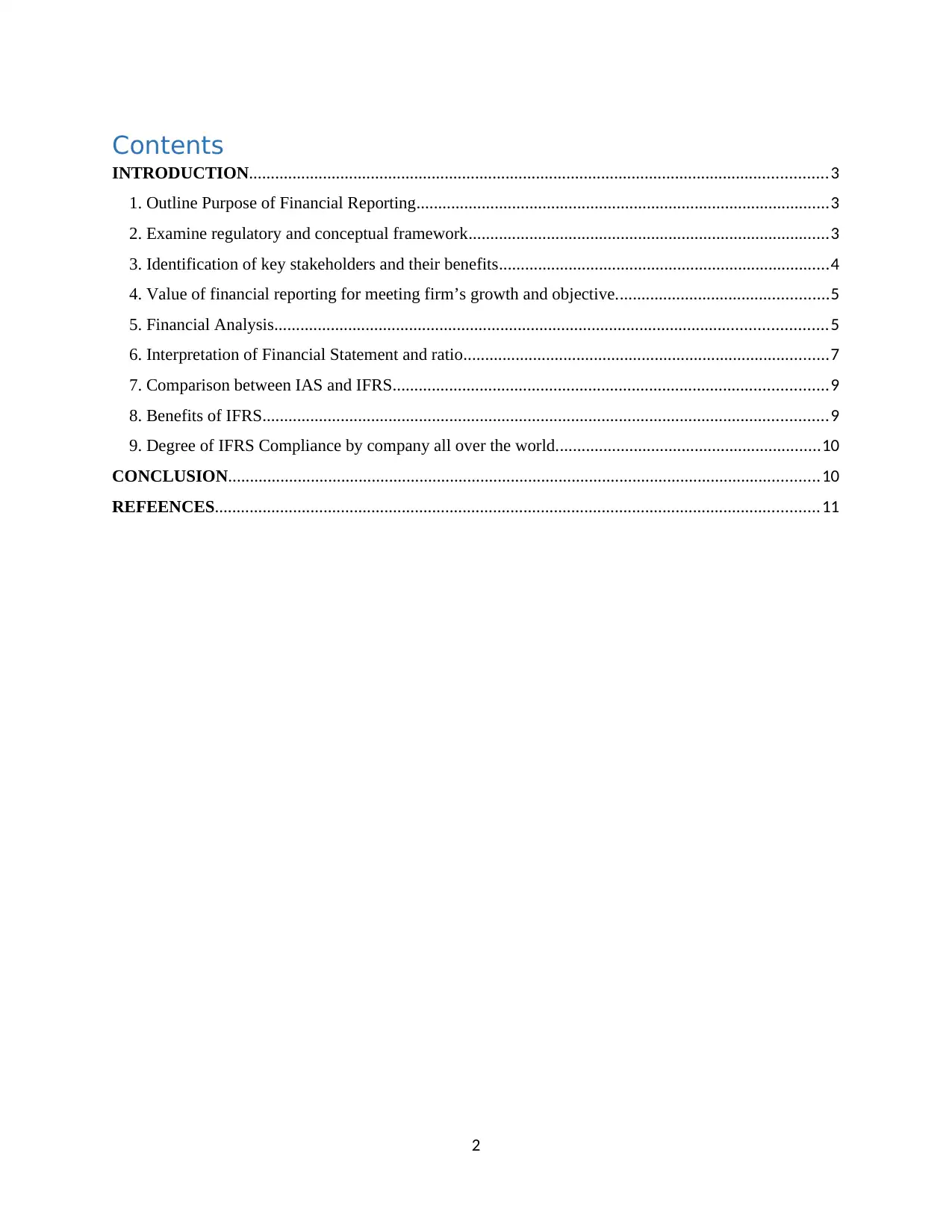
INTRODUCTION.....................................................................................................................................3
1. Outline Purpose of Financial Reporting...............................................................................................3
2. Examine regulatory and conceptual framework...................................................................................3
3. Identification of key stakeholders and their benefits............................................................................4
4. Value of financial reporting for meeting firm’s growth and objective.................................................5
5. Financial Analysis...............................................................................................................................5
6. Interpretation of Financial Statement and ratio....................................................................................7
7. Comparison between IAS and IFRS....................................................................................................9
8. Benefits of IFRS..................................................................................................................................9
9. Degree of IFRS Compliance by company all over the world.............................................................10
CONCLUSION........................................................................................................................................10
REFEENCES...........................................................................................................................................11
2
INTRODUCTION.....................................................................................................................................3
1. Outline Purpose of Financial Reporting...............................................................................................3
2. Examine regulatory and conceptual framework...................................................................................3
3. Identification of key stakeholders and their benefits............................................................................4
4. Value of financial reporting for meeting firm’s growth and objective.................................................5
5. Financial Analysis...............................................................................................................................5
6. Interpretation of Financial Statement and ratio....................................................................................7
7. Comparison between IAS and IFRS....................................................................................................9
8. Benefits of IFRS..................................................................................................................................9
9. Degree of IFRS Compliance by company all over the world.............................................................10
CONCLUSION........................................................................................................................................10
REFEENCES...........................................................................................................................................11
2
INTRODUCTION
Financial Reporting refers to the process of creating statements that reveals financial
status or position of business enterprise to investors, government, stakeholders and management.
These reports are mainly published by organization at the end of accounting or financial year
(Council, 2010). It generally disclose the financial position of a particular company for a
specified time period. It is essential for every enterprise and considered as a main part of
Corporate Governance. For listed companies, it mainly prepared on quarterly & annual basis. It
mainly consist of balance sheet, profit and loss, cash flow, company’s prospectus, management
analysis and discussion. It basically provides information related to company’s growth and
revenue as compared to its competitors. This report is based on ROB PLC. This report also
covers the purpose of financial statement, conceptual and regulatory framework, how
stakeholders get benefit from financial report, benefit of IFRS, analysis of financial performance
and degree of compliance in relation with IFRS.
1. Outline Purpose of Financial Reporting
Financial Reports mainly describes the financial position of the company in terms if
figures. It provides useful information to investors, stakeholders and management. This report
depicts whether the company has yield profit in a year or loss. It also valued their assets and
liabilities. At the end of every year, it is important for business concern to set off their accounts
and figures. They usually prepare profit and loss, cash flow and balance sheet statement. It is
mainly prepared when accounting or financial period or year ends. Following are the purpose of
Financial Reporting:
Providing necessary and useful information to stakeholders, investors and management of
business enterprise that further use is for planning, benchmarking, forecasting, analysis
and decision making.
Providing information to promoters, creditors and debt payer which assist them in
making prudent decision related to credit, investment etc.
Renders information to government bodies, public and shareholders at large that depicts
various aspect of organization in terms of its financial figures.
Provides information related to procurement and utilization of resources.
Delivers information to stakeholders in terms of financial performance of company and
its management as how ethically they are performing its responsibilities and duties.
Provides assistance to auditors by giving them information related to company’s financial
ratios, statement and accounts.
It also provides competitive advantage to company over their rivals in context of its
position in the market place.
Describes how company has arranged its funding for managing its day to day operations
and working capital (Beyer and Cohen and Walther, 2010).
2. Examine regulatory and conceptual framework
It is essential for ever business enterprise to follow and practice guidelines in order to
attain better results or outcome. Accounts manager of firm interpret their financials and numbers
3
Financial Reporting refers to the process of creating statements that reveals financial
status or position of business enterprise to investors, government, stakeholders and management.
These reports are mainly published by organization at the end of accounting or financial year
(Council, 2010). It generally disclose the financial position of a particular company for a
specified time period. It is essential for every enterprise and considered as a main part of
Corporate Governance. For listed companies, it mainly prepared on quarterly & annual basis. It
mainly consist of balance sheet, profit and loss, cash flow, company’s prospectus, management
analysis and discussion. It basically provides information related to company’s growth and
revenue as compared to its competitors. This report is based on ROB PLC. This report also
covers the purpose of financial statement, conceptual and regulatory framework, how
stakeholders get benefit from financial report, benefit of IFRS, analysis of financial performance
and degree of compliance in relation with IFRS.
1. Outline Purpose of Financial Reporting
Financial Reports mainly describes the financial position of the company in terms if
figures. It provides useful information to investors, stakeholders and management. This report
depicts whether the company has yield profit in a year or loss. It also valued their assets and
liabilities. At the end of every year, it is important for business concern to set off their accounts
and figures. They usually prepare profit and loss, cash flow and balance sheet statement. It is
mainly prepared when accounting or financial period or year ends. Following are the purpose of
Financial Reporting:
Providing necessary and useful information to stakeholders, investors and management of
business enterprise that further use is for planning, benchmarking, forecasting, analysis
and decision making.
Providing information to promoters, creditors and debt payer which assist them in
making prudent decision related to credit, investment etc.
Renders information to government bodies, public and shareholders at large that depicts
various aspect of organization in terms of its financial figures.
Provides information related to procurement and utilization of resources.
Delivers information to stakeholders in terms of financial performance of company and
its management as how ethically they are performing its responsibilities and duties.
Provides assistance to auditors by giving them information related to company’s financial
ratios, statement and accounts.
It also provides competitive advantage to company over their rivals in context of its
position in the market place.
Describes how company has arranged its funding for managing its day to day operations
and working capital (Beyer and Cohen and Walther, 2010).
2. Examine regulatory and conceptual framework
It is essential for ever business enterprise to follow and practice guidelines in order to
attain better results or outcome. Accounts manager of firm interpret their financials and numbers
3
⊘ This is a preview!⊘
Do you want full access?
Subscribe today to unlock all pages.

Trusted by 1+ million students worldwide
and draw a conclusion that depicts its performance. Basically it provide presentation, disclosure
and measurement of financial statements in terms of material aspects. It is mainly classified into
two framework:
Conceptual Framework: This framework helps in preparing financial statement or report of the
company that depicts its performance throughout the year in order to accomplish its goals and
objectives (Deegan, 2013). Basically it deals with issues related to financial reporting in terms of
achieving goals, making financial information useful, components of financial statements etc.
Under this framework, information has been gathered for external users regarding the company’s
assets, liabilities, income, equity, expense etc. and the concept for recording it financial
statement.
Benefits
Useful for external users as it provides information related to company’s income,
expense, and profit for a particular accounting year.
Provides guidance and direction at the time of analyzing and reviewing financial
regulation and figures.
Implementing accounting standards at internal level of company.
Regulatory Framework: It deals with regulations and rules prepared by government bodies in
order to record various accounting & financial transaction. Every entry or transaction has been
recorded in its own way. There is defined pattern according to which transactions are being
recorded in the books of accounts. It also involves theories, concepts and principles according to
which entries have been recorded in books. It mainly includes going concern concept, matching
principle. Dual concept etc. Every organization is following this and they record their entries on
the basis of chronological order that includes journal, ledger, subsidiary books, profit and loss
and balance sheet. It eventually help the manager to take strategic decision related to company’s
growth and success.
Benefits
Assist in anticipating future needs related to fund.
Assist in making effective decision concerning firm’s profitability and performance in the
marketplace.
3. Identification of key stakeholders and their benefits
Stakeholder are generally parties, person, authorities and bodies that has specify interest
towards the organization. They are the one who directly or indirectly affects the firm’s
performance, objectives, goals and policies. Some one of the example of stakeholder are
government, investors, directors, suppliers, debtors, shareholders and creditors. They all
contributes in different manner towards accomplishing firm’s goals. Customers are also
considered as an important stakeholder but their contribution is limited to some extent.
Stakeholder basically determines the result or consequence of business decision (Li, 2010). They
can be employees, can be business partner or anyone who possess or holds stake in the company.
Following are the benefits of different stakeholders:
4
and measurement of financial statements in terms of material aspects. It is mainly classified into
two framework:
Conceptual Framework: This framework helps in preparing financial statement or report of the
company that depicts its performance throughout the year in order to accomplish its goals and
objectives (Deegan, 2013). Basically it deals with issues related to financial reporting in terms of
achieving goals, making financial information useful, components of financial statements etc.
Under this framework, information has been gathered for external users regarding the company’s
assets, liabilities, income, equity, expense etc. and the concept for recording it financial
statement.
Benefits
Useful for external users as it provides information related to company’s income,
expense, and profit for a particular accounting year.
Provides guidance and direction at the time of analyzing and reviewing financial
regulation and figures.
Implementing accounting standards at internal level of company.
Regulatory Framework: It deals with regulations and rules prepared by government bodies in
order to record various accounting & financial transaction. Every entry or transaction has been
recorded in its own way. There is defined pattern according to which transactions are being
recorded in the books of accounts. It also involves theories, concepts and principles according to
which entries have been recorded in books. It mainly includes going concern concept, matching
principle. Dual concept etc. Every organization is following this and they record their entries on
the basis of chronological order that includes journal, ledger, subsidiary books, profit and loss
and balance sheet. It eventually help the manager to take strategic decision related to company’s
growth and success.
Benefits
Assist in anticipating future needs related to fund.
Assist in making effective decision concerning firm’s profitability and performance in the
marketplace.
3. Identification of key stakeholders and their benefits
Stakeholder are generally parties, person, authorities and bodies that has specify interest
towards the organization. They are the one who directly or indirectly affects the firm’s
performance, objectives, goals and policies. Some one of the example of stakeholder are
government, investors, directors, suppliers, debtors, shareholders and creditors. They all
contributes in different manner towards accomplishing firm’s goals. Customers are also
considered as an important stakeholder but their contribution is limited to some extent.
Stakeholder basically determines the result or consequence of business decision (Li, 2010). They
can be employees, can be business partner or anyone who possess or holds stake in the company.
Following are the benefits of different stakeholders:
4
Paraphrase This Document
Need a fresh take? Get an instant paraphrase of this document with our AI Paraphraser
Long-Term Relationship: Stakeholders are essential for performance based and instrumental
reasons. When a company possess long term relationship with its various stakeholders, it
automatically operates more efficiently and holds better chance of generating more profits and
revenues. Long term relationship with stakeholder helps business concern to increase
productivity, creates loyal consumer base, High retention rate of employees and gain the
advantage of word of mouth advertising.
Feedback and Product Development: Stakeholders participate actively in the activities and
operation of company. By providing resources they ensures that they have control on business
operations and functions (Barth and Landsman, 2013). They act as per their wish and provide
effective and valuable feedback.
A sense of community: A sense of greater community and responsibility among various
stakeholders within an organization can positively increase its sales figures and provides shape to
its business development. It can generated via promotion, membership, loyalty program, virtual
services etc.
4. Value of financial reporting for meeting firm’s growth and objective.
The success and growth of every business enterprise whether small or large is depend
upon how well the company has perform in terms of earning profit and revenues during a
specified period of time say accounting or financial year. Thus, it become essential for every
single organization to records its transaction in a significant manner. Companies are required to
record every single transaction as per the given format. For instance, entry related to sales will
first record in journal, then in ledger, then in its subsidiary books and then finally in trading for
measuring or calculating gross profit. For instance, financial statement of referred firm describes
its performance, turnover, profits, and expenses for a particular year. It is advisable for every
firm to prepare this statements as they help in measuring the financial performance of company
over their rivals. Managers with the help of this report can take effective decision related to its
future growth or success (Altamuro and Beatty, 2015). It also enable the firm to identify the need
of funding in order to carry out day to day operation and manage sufficient and effective working
capital.
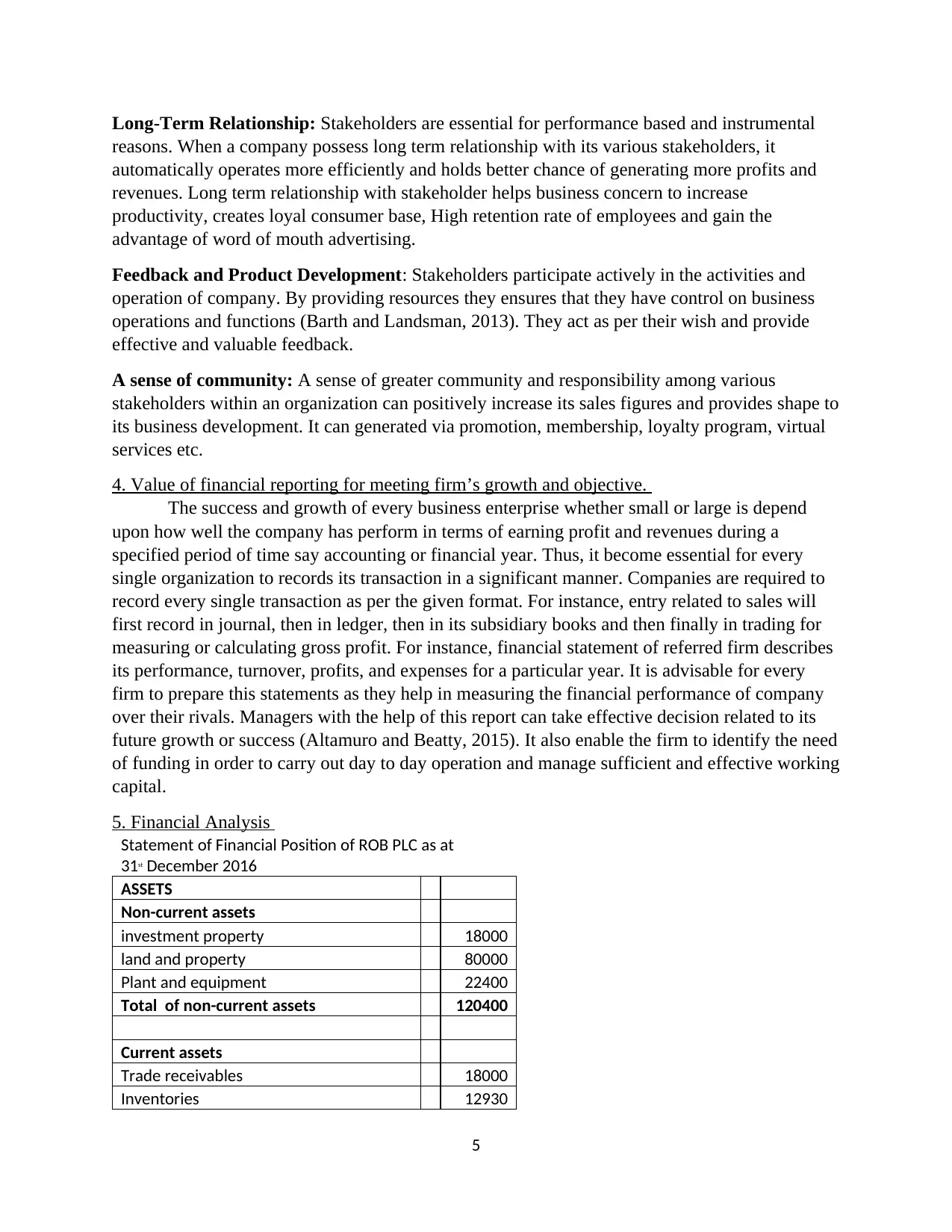
5. Financial Analysis
Statement of Financial Position of ROB PLC as at
31st December 2016
ASSETS
Non-current assets
investment property 18000
land and property 80000
Plant and equipment 22400
Total of non-current assets 120400
Current assets
Trade receivables 18000
Inventories 12930
5
reasons. When a company possess long term relationship with its various stakeholders, it
automatically operates more efficiently and holds better chance of generating more profits and
revenues. Long term relationship with stakeholder helps business concern to increase
productivity, creates loyal consumer base, High retention rate of employees and gain the
advantage of word of mouth advertising.
Feedback and Product Development: Stakeholders participate actively in the activities and
operation of company. By providing resources they ensures that they have control on business
operations and functions (Barth and Landsman, 2013). They act as per their wish and provide
effective and valuable feedback.
A sense of community: A sense of greater community and responsibility among various
stakeholders within an organization can positively increase its sales figures and provides shape to
its business development. It can generated via promotion, membership, loyalty program, virtual
services etc.
4. Value of financial reporting for meeting firm’s growth and objective.
The success and growth of every business enterprise whether small or large is depend
upon how well the company has perform in terms of earning profit and revenues during a
specified period of time say accounting or financial year. Thus, it become essential for every
single organization to records its transaction in a significant manner. Companies are required to
record every single transaction as per the given format. For instance, entry related to sales will
first record in journal, then in ledger, then in its subsidiary books and then finally in trading for
measuring or calculating gross profit. For instance, financial statement of referred firm describes
its performance, turnover, profits, and expenses for a particular year. It is advisable for every
firm to prepare this statements as they help in measuring the financial performance of company
over their rivals. Managers with the help of this report can take effective decision related to its
future growth or success (Altamuro and Beatty, 2015). It also enable the firm to identify the need
of funding in order to carry out day to day operation and manage sufficient and effective working
capital.
5. Financial Analysis
Statement of Financial Position of ROB PLC as at
31st December 2016
ASSETS
Non-current assets
investment property 18000
land and property 80000
Plant and equipment 22400
Total of non-current assets 120400
Current assets
Trade receivables 18000
Inventories 12930
5
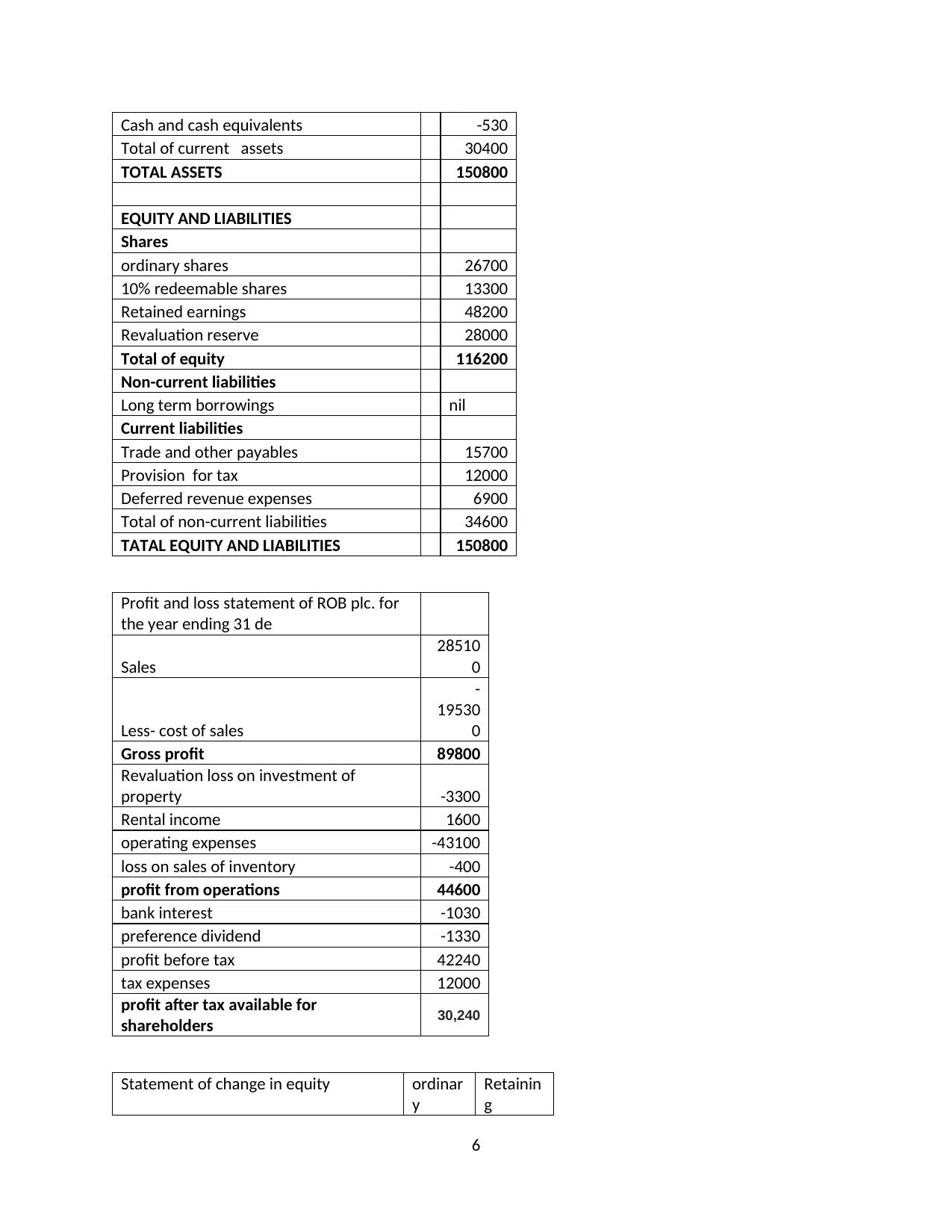
Cash and cash equivalents -530
Total of current assets 30400
TOTAL ASSETS 150800
EQUITY AND LIABILITIES
Shares
ordinary shares 26700
10% redeemable shares 13300
Retained earnings 48200
Revaluation reserve 28000
Total of equity 116200
Non-current liabilities
Long term borrowings nil
Current liabilities
Trade and other payables 15700
Provision for tax 12000
Deferred revenue expenses 6900
Total of non-current liabilities 34600
TATAL EQUITY AND LIABILITIES 150800
Profit and loss statement of ROB plc. for
the year ending 31 de
Sales
28510
0
Less- cost of sales
-
19530
0
Gross profit 89800
Revaluation loss on investment of
property -3300
Rental income 1600
operating expenses -43100
loss on sales of inventory -400
profit from operations 44600
bank interest -1030
preference dividend -1330
profit before tax 42240
tax expenses 12000
profit after tax available for
shareholders 30,240
Statement of change in equity ordinar
y
Retainin
g
6
Total of current assets 30400
TOTAL ASSETS 150800
EQUITY AND LIABILITIES
Shares
ordinary shares 26700
10% redeemable shares 13300
Retained earnings 48200
Revaluation reserve 28000
Total of equity 116200
Non-current liabilities
Long term borrowings nil
Current liabilities
Trade and other payables 15700
Provision for tax 12000
Deferred revenue expenses 6900
Total of non-current liabilities 34600
TATAL EQUITY AND LIABILITIES 150800
Profit and loss statement of ROB plc. for
the year ending 31 de
Sales
28510
0
Less- cost of sales
-
19530
0
Gross profit 89800
Revaluation loss on investment of
property -3300
Rental income 1600
operating expenses -43100
loss on sales of inventory -400
profit from operations 44600
bank interest -1030
preference dividend -1330
profit before tax 42240
tax expenses 12000
profit after tax available for
shareholders 30,240
Statement of change in equity ordinar
y
Retainin
g
6
⊘ This is a preview!⊘
Do you want full access?
Subscribe today to unlock all pages.
Trusted by 1+ million students worldwide
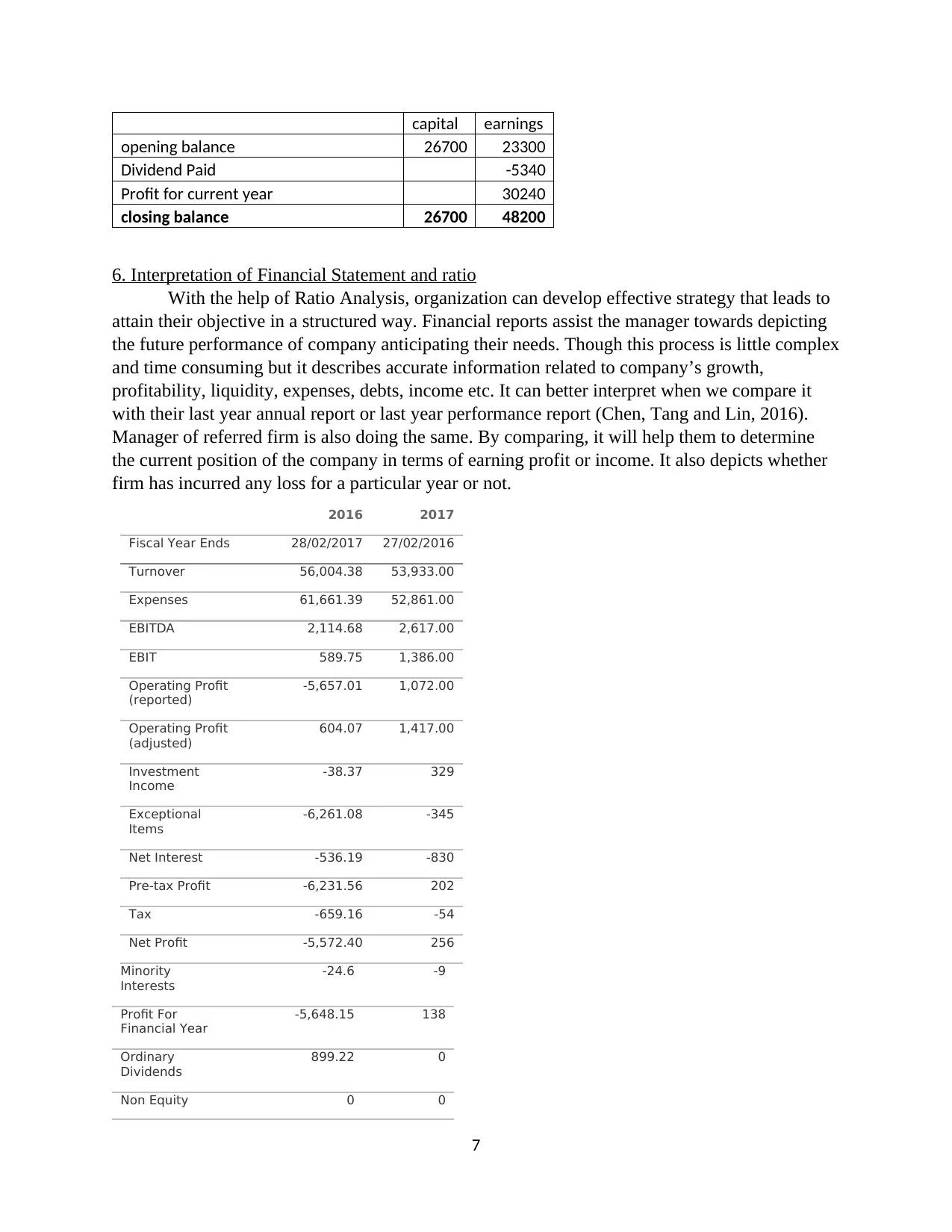
capital earnings
opening balance 26700 23300
Dividend Paid -5340
Profit for current year 30240
closing balance 26700 48200
6. Interpretation of Financial Statement and ratio
With the help of Ratio Analysis, organization can develop effective strategy that leads to
attain their objective in a structured way. Financial reports assist the manager towards depicting
the future performance of company anticipating their needs. Though this process is little complex
and time consuming but it describes accurate information related to company’s growth,
profitability, liquidity, expenses, debts, income etc. It can better interpret when we compare it
with their last year annual report or last year performance report (Chen, Tang and Lin, 2016).
Manager of referred firm is also doing the same. By comparing, it will help them to determine
the current position of the company in terms of earning profit or income. It also depicts whether
firm has incurred any loss for a particular year or not.
2016 2017
Fiscal Year Ends 28/02/2017 27/02/2016
Turnover 56,004.38 53,933.00
Expenses 61,661.39 52,861.00
EBITDA 2,114.68 2,617.00
EBIT 589.75 1,386.00
Operating Profit
(reported)
-5,657.01 1,072.00
Operating Profit
(adjusted)
604.07 1,417.00
Investment
Income
-38.37 329
Exceptional
Items
-6,261.08 -345
Net Interest -536.19 -830
Pre-tax Profit -6,231.56 202
Tax -659.16 -54
Net Profit -5,572.40 256
Minority
Interests
-24.6 -9
Profit For
Financial Year
-5,648.15 138
Ordinary
Dividends
899.22 0
Non Equity 0 0
7
opening balance 26700 23300
Dividend Paid -5340
Profit for current year 30240
closing balance 26700 48200
6. Interpretation of Financial Statement and ratio
With the help of Ratio Analysis, organization can develop effective strategy that leads to
attain their objective in a structured way. Financial reports assist the manager towards depicting
the future performance of company anticipating their needs. Though this process is little complex
and time consuming but it describes accurate information related to company’s growth,
profitability, liquidity, expenses, debts, income etc. It can better interpret when we compare it
with their last year annual report or last year performance report (Chen, Tang and Lin, 2016).
Manager of referred firm is also doing the same. By comparing, it will help them to determine
the current position of the company in terms of earning profit or income. It also depicts whether
firm has incurred any loss for a particular year or not.
2016 2017
Fiscal Year Ends 28/02/2017 27/02/2016
Turnover 56,004.38 53,933.00
Expenses 61,661.39 52,861.00
EBITDA 2,114.68 2,617.00
EBIT 589.75 1,386.00
Operating Profit
(reported)
-5,657.01 1,072.00
Operating Profit
(adjusted)
604.07 1,417.00
Investment
Income
-38.37 329
Exceptional
Items
-6,261.08 -345
Net Interest -536.19 -830
Pre-tax Profit -6,231.56 202
Tax -659.16 -54
Net Profit -5,572.40 256
Minority
Interests
-24.6 -9
Profit For
Financial Year
-5,648.15 138
Ordinary
Dividends
899.22 0
Non Equity 0 0
7
Paraphrase This Document
Need a fresh take? Get an instant paraphrase of this document with our AI Paraphraser
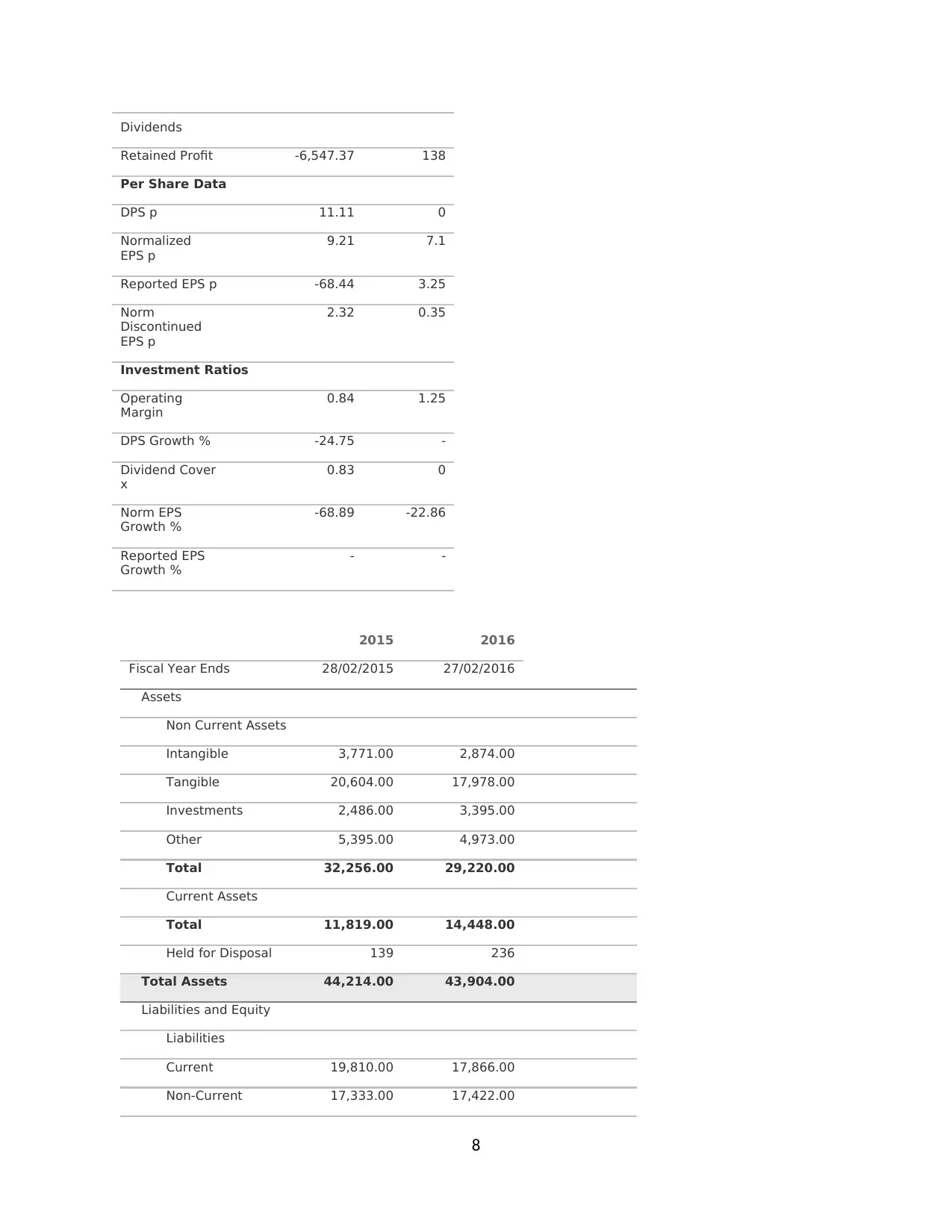
Dividends
Retained Profit -6,547.37 138
Per Share Data
DPS p 11.11 0
Normalized
EPS p
9.21 7.1
Reported EPS p -68.44 3.25
Norm
Discontinued
EPS p
2.32 0.35
Investment Ratios
Operating
Margin
0.84 1.25
DPS Growth % -24.75 -
Dividend Cover
x
0.83 0
Norm EPS
Growth %
-68.89 -22.86
Reported EPS
Growth %
- -
2015 2016
Fiscal Year Ends 28/02/2015 27/02/2016
Assets
Non Current Assets
Intangible 3,771.00 2,874.00
Tangible 20,604.00 17,978.00
Investments 2,486.00 3,395.00
Other 5,395.00 4,973.00
Total 32,256.00 29,220.00
Current Assets
Total 11,819.00 14,448.00
Held for Disposal 139 236
Total Assets 44,214.00 43,904.00
Liabilities and Equity
Liabilities
Current 19,810.00 17,866.00
Non-Current 17,333.00 17,422.00
8
Retained Profit -6,547.37 138
Per Share Data
DPS p 11.11 0
Normalized
EPS p
9.21 7.1
Reported EPS p -68.44 3.25
Norm
Discontinued
EPS p
2.32 0.35
Investment Ratios
Operating
Margin
0.84 1.25
DPS Growth % -24.75 -
Dividend Cover
x
0.83 0
Norm EPS
Growth %
-68.89 -22.86
Reported EPS
Growth %
- -
2015 2016
Fiscal Year Ends 28/02/2015 27/02/2016
Assets
Non Current Assets
Intangible 3,771.00 2,874.00
Tangible 20,604.00 17,978.00
Investments 2,486.00 3,395.00
Other 5,395.00 4,973.00
Total 32,256.00 29,220.00
Current Assets
Total 11,819.00 14,448.00
Held for Disposal 139 236
Total Assets 44,214.00 43,904.00
Liabilities and Equity
Liabilities
Current 19,810.00 17,866.00
Non-Current 17,333.00 17,422.00
8
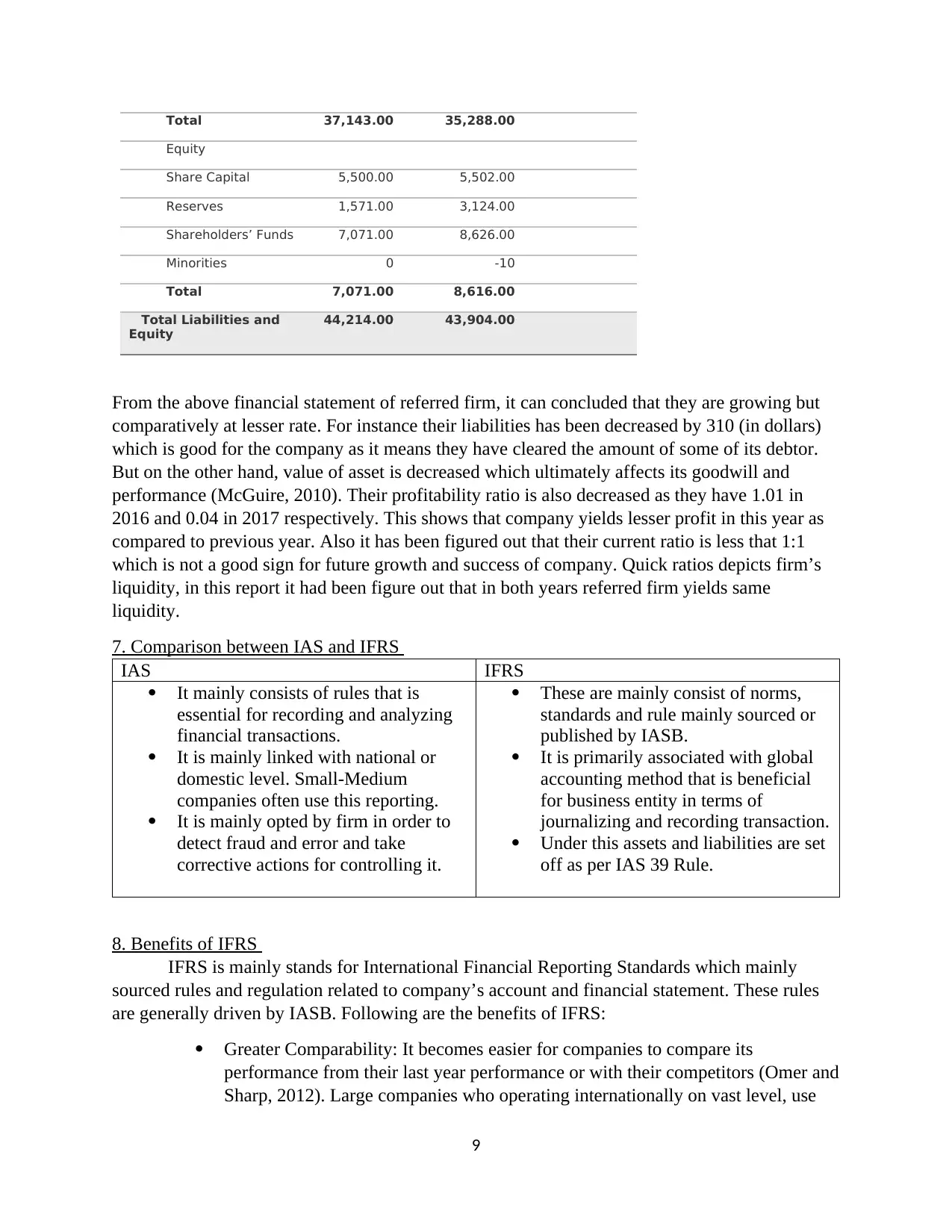
Total 37,143.00 35,288.00
Equity
Share Capital 5,500.00 5,502.00
Reserves 1,571.00 3,124.00
Shareholders’ Funds 7,071.00 8,626.00
Minorities 0 -10
Total 7,071.00 8,616.00
Total Liabilities and
Equity
44,214.00 43,904.00
From the above financial statement of referred firm, it can concluded that they are growing but
comparatively at lesser rate. For instance their liabilities has been decreased by 310 (in dollars)
which is good for the company as it means they have cleared the amount of some of its debtor.
But on the other hand, value of asset is decreased which ultimately affects its goodwill and
performance (McGuire, 2010). Their profitability ratio is also decreased as they have 1.01 in
2016 and 0.04 in 2017 respectively. This shows that company yields lesser profit in this year as
compared to previous year. Also it has been figured out that their current ratio is less that 1:1
which is not a good sign for future growth and success of company. Quick ratios depicts firm’s
liquidity, in this report it had been figure out that in both years referred firm yields same
liquidity.
7. Comparison between IAS and IFRS
IAS IFRS
It mainly consists of rules that is
essential for recording and analyzing
financial transactions.
It is mainly linked with national or
domestic level. Small-Medium
companies often use this reporting.
It is mainly opted by firm in order to
detect fraud and error and take
corrective actions for controlling it.
These are mainly consist of norms,
standards and rule mainly sourced or
published by IASB.
It is primarily associated with global
accounting method that is beneficial
for business entity in terms of
journalizing and recording transaction.
Under this assets and liabilities are set
off as per IAS 39 Rule.
8. Benefits of IFRS
IFRS is mainly stands for International Financial Reporting Standards which mainly
sourced rules and regulation related to company’s account and financial statement. These rules
are generally driven by IASB. Following are the benefits of IFRS:
Greater Comparability: It becomes easier for companies to compare its
performance from their last year performance or with their competitors (Omer and
Sharp, 2012). Large companies who operating internationally on vast level, use
9
Equity
Share Capital 5,500.00 5,502.00
Reserves 1,571.00 3,124.00
Shareholders’ Funds 7,071.00 8,626.00
Minorities 0 -10
Total 7,071.00 8,616.00
Total Liabilities and
Equity
44,214.00 43,904.00
From the above financial statement of referred firm, it can concluded that they are growing but
comparatively at lesser rate. For instance their liabilities has been decreased by 310 (in dollars)
which is good for the company as it means they have cleared the amount of some of its debtor.
But on the other hand, value of asset is decreased which ultimately affects its goodwill and
performance (McGuire, 2010). Their profitability ratio is also decreased as they have 1.01 in
2016 and 0.04 in 2017 respectively. This shows that company yields lesser profit in this year as
compared to previous year. Also it has been figured out that their current ratio is less that 1:1
which is not a good sign for future growth and success of company. Quick ratios depicts firm’s
liquidity, in this report it had been figure out that in both years referred firm yields same
liquidity.
7. Comparison between IAS and IFRS
IAS IFRS
It mainly consists of rules that is
essential for recording and analyzing
financial transactions.
It is mainly linked with national or
domestic level. Small-Medium
companies often use this reporting.
It is mainly opted by firm in order to
detect fraud and error and take
corrective actions for controlling it.
These are mainly consist of norms,
standards and rule mainly sourced or
published by IASB.
It is primarily associated with global
accounting method that is beneficial
for business entity in terms of
journalizing and recording transaction.
Under this assets and liabilities are set
off as per IAS 39 Rule.
8. Benefits of IFRS
IFRS is mainly stands for International Financial Reporting Standards which mainly
sourced rules and regulation related to company’s account and financial statement. These rules
are generally driven by IASB. Following are the benefits of IFRS:
Greater Comparability: It becomes easier for companies to compare its
performance from their last year performance or with their competitors (Omer and
Sharp, 2012). Large companies who operating internationally on vast level, use
9
⊘ This is a preview!⊘
Do you want full access?
Subscribe today to unlock all pages.
Trusted by 1+ million students worldwide
this as they compare between their branches. It enables to notify themselves
regarding the financial position of both branches. With this they can easily
compare its profits, loss, revenues or incomes.
Flexibility: Simple approachability makes regulation and rules easier and flexible.
They follow on the footprints of principle based accounting rather than rule based.
Principle based means recording the amount of asset and liabilities at its revalued
rate. IFRS measure the value of asset and liabilities after deducting depreciation
from it. Thus it is required to record each and every transaction in proper format
and up-to their time period (Nobes, 2014).
Manipulation: This is considered as main Function of IFRS. Organizations are
required to set their own rules and regulation according to which they will record
accounting transaction. There should clear picture of all guidelines related to that.
It helps in determining actual profits and income figure of the firm which enables
them to take the advantage of higher competitiveness level over its rivals or
competitors.
9. Degree of IFRS Compliance by company all over the world.
Compliance means control of standards and rules for better management and operation. IFRS
considered as the set of principles that manages financial statement and accounts in a structured
and thorough manner. Different factors are there that affects the performance and profitability of
business enterprise. Various tools, predetermined standards, prescribing habits are the key
elements that affect the structure and compliance of annual or financial and reporting. Economic
and Demographic are two factors that adversely controls the profitability of company. Liquidity,
market risk, coverage ratio are some factors that falls under this and which directly or indirectly
impacts the overall functioning and management of business concern. Export policies, Interest
Rates, inflation rate, purchasing power, foreign exchange rate are some economic factors also
influence the profitability of company (Epstein and Jermakowicz, 2010).
CONCLUSION
As per the above report it can be concluded that in order to figure out the growth of a
company, it is essential to assess its financial statements as it describes company’s position in
terms of its profits, revenues, growth, debt, liquidity, asset, liabilities etc. All these information
proves to be beneficial and useful for various stakeholders that contributes effectively towards
making strategic decision related to firm’s growth. Financial Report usually made at the end of
year which gives company plenty of time to maintain and record its data on timely basis. IFRS
and IASB has its own regulation and guidelines that company follows and they record the
transaction in that manner.
10
regarding the financial position of both branches. With this they can easily
compare its profits, loss, revenues or incomes.
Flexibility: Simple approachability makes regulation and rules easier and flexible.
They follow on the footprints of principle based accounting rather than rule based.
Principle based means recording the amount of asset and liabilities at its revalued
rate. IFRS measure the value of asset and liabilities after deducting depreciation
from it. Thus it is required to record each and every transaction in proper format
and up-to their time period (Nobes, 2014).
Manipulation: This is considered as main Function of IFRS. Organizations are
required to set their own rules and regulation according to which they will record
accounting transaction. There should clear picture of all guidelines related to that.
It helps in determining actual profits and income figure of the firm which enables
them to take the advantage of higher competitiveness level over its rivals or
competitors.
9. Degree of IFRS Compliance by company all over the world.
Compliance means control of standards and rules for better management and operation. IFRS
considered as the set of principles that manages financial statement and accounts in a structured
and thorough manner. Different factors are there that affects the performance and profitability of
business enterprise. Various tools, predetermined standards, prescribing habits are the key
elements that affect the structure and compliance of annual or financial and reporting. Economic
and Demographic are two factors that adversely controls the profitability of company. Liquidity,
market risk, coverage ratio are some factors that falls under this and which directly or indirectly
impacts the overall functioning and management of business concern. Export policies, Interest
Rates, inflation rate, purchasing power, foreign exchange rate are some economic factors also
influence the profitability of company (Epstein and Jermakowicz, 2010).
CONCLUSION
As per the above report it can be concluded that in order to figure out the growth of a
company, it is essential to assess its financial statements as it describes company’s position in
terms of its profits, revenues, growth, debt, liquidity, asset, liabilities etc. All these information
proves to be beneficial and useful for various stakeholders that contributes effectively towards
making strategic decision related to firm’s growth. Financial Report usually made at the end of
year which gives company plenty of time to maintain and record its data on timely basis. IFRS
and IASB has its own regulation and guidelines that company follows and they record the
transaction in that manner.
10
Paraphrase This Document
Need a fresh take? Get an instant paraphrase of this document with our AI Paraphraser
REFEENCES
Books and Journal
Council, F.R., 2010. The UK corporate governance code. London: Financial Reporting Council.
Beyer, A., Cohen, D.A., and Walther, B.R., 2010. The financial reporting environment: Review of the
recent literature. Journal of accounting and economics. 50(2). pp.296-343.
Deegan, C., 2013. Financial accounting theory. McGraw-Hill Education Australia.
Li, S., 2010. Does mandatory adoption of International Financial Reporting Standards in the European
Union reduce the cost of equity capital?. The accounting review. 85(2). pp.607-636.
Barth, M.E. and Landsman, W.R., 2010. How did financial reporting contribute to the financial
crisis?. European accounting review.19(3). pp.399-423.
Altamuro, J. and Beatty, A., 2010. How does internal control regulation affect financial reporting?. Journal
of accounting and Economics. 49(1). pp.58-74.
Chen, H., Tang, Q., and Lin, Z., 2010. The role of international financial reporting standards in accounting
quality: Evidence from the European Union. Journal of International Financial Management &
Accounting. 21(3). pp.220-278.
McGuire, S.T., Omer, T.C. and Sharp, N.Y., 2011. The impact of religion on financial reporting
irregularities. The Accounting Review. 87(2). pp.645-673.
Nobes, C., 2014. International Classification of Financial Reporting 3e. Routledge.
Epstein, B.J. and Jermakowicz, E.K., 2010. WILEY Interpretation and Application of International
Financial Reporting Standards 2010. John Wiley & Sons.
Ball, R., Jayaraman, S. and Shivakumar, L., 2012. Audited financial reporting and voluntary disclosure as
complements: A test of the confirmation hypothesis. Journal of Accounting and Economics. 53(1). pp.136-
166.
Iatridis, G., 2010. International Financial Reporting Standards and the quality of financial statement
information. International review of financial analysis. 19(3). pp.193-204.
11
Books and Journal
Council, F.R., 2010. The UK corporate governance code. London: Financial Reporting Council.
Beyer, A., Cohen, D.A., and Walther, B.R., 2010. The financial reporting environment: Review of the
recent literature. Journal of accounting and economics. 50(2). pp.296-343.
Deegan, C., 2013. Financial accounting theory. McGraw-Hill Education Australia.
Li, S., 2010. Does mandatory adoption of International Financial Reporting Standards in the European
Union reduce the cost of equity capital?. The accounting review. 85(2). pp.607-636.
Barth, M.E. and Landsman, W.R., 2010. How did financial reporting contribute to the financial
crisis?. European accounting review.19(3). pp.399-423.
Altamuro, J. and Beatty, A., 2010. How does internal control regulation affect financial reporting?. Journal
of accounting and Economics. 49(1). pp.58-74.
Chen, H., Tang, Q., and Lin, Z., 2010. The role of international financial reporting standards in accounting
quality: Evidence from the European Union. Journal of International Financial Management &
Accounting. 21(3). pp.220-278.
McGuire, S.T., Omer, T.C. and Sharp, N.Y., 2011. The impact of religion on financial reporting
irregularities. The Accounting Review. 87(2). pp.645-673.
Nobes, C., 2014. International Classification of Financial Reporting 3e. Routledge.
Epstein, B.J. and Jermakowicz, E.K., 2010. WILEY Interpretation and Application of International
Financial Reporting Standards 2010. John Wiley & Sons.
Ball, R., Jayaraman, S. and Shivakumar, L., 2012. Audited financial reporting and voluntary disclosure as
complements: A test of the confirmation hypothesis. Journal of Accounting and Economics. 53(1). pp.136-
166.
Iatridis, G., 2010. International Financial Reporting Standards and the quality of financial statement
information. International review of financial analysis. 19(3). pp.193-204.
11

1 out of 11


Related Documents


Your All-in-One AI-Powered Toolkit for Academic Success.
+13062052269
info@desklib.com
Available 24*7 on WhatsApp / Email
![[object Object]](/_next/static/media/star-bottom.7253800d.svg)
Unlock your academic potential
Copyright © 2020–2026 A2Z Services. All Rights Reserved. Developed and managed by ZUCOL.