Financial Reporting and Management - University Assignment Report
VerifiedAdded on 2020/02/17
|14
|4640
|51
Report
AI Summary
This report provides a comprehensive overview of financial reporting and management. It begins with an introduction to financial reporting, emphasizing its importance for stakeholders. The report then delves into valuation techniques as per the guidelines of IASB and IAS 13, discussing the reliability and measurement of fair value, and the disclosure requirements of IFRS 13. It further explores the key definitions and characteristics used to differentiate between debt and equity, as per IAS 32, including the discussion of financial instruments and their recognition in financial statements. The report also addresses the issues related to convoluted financial instruments. The report concludes by summarizing the key findings and providing relevant references.
Financial Reporting And
Management
Management

Paraphrase This Document
Need a fresh take? Get an instant paraphrase of this document with our AI Paraphraser
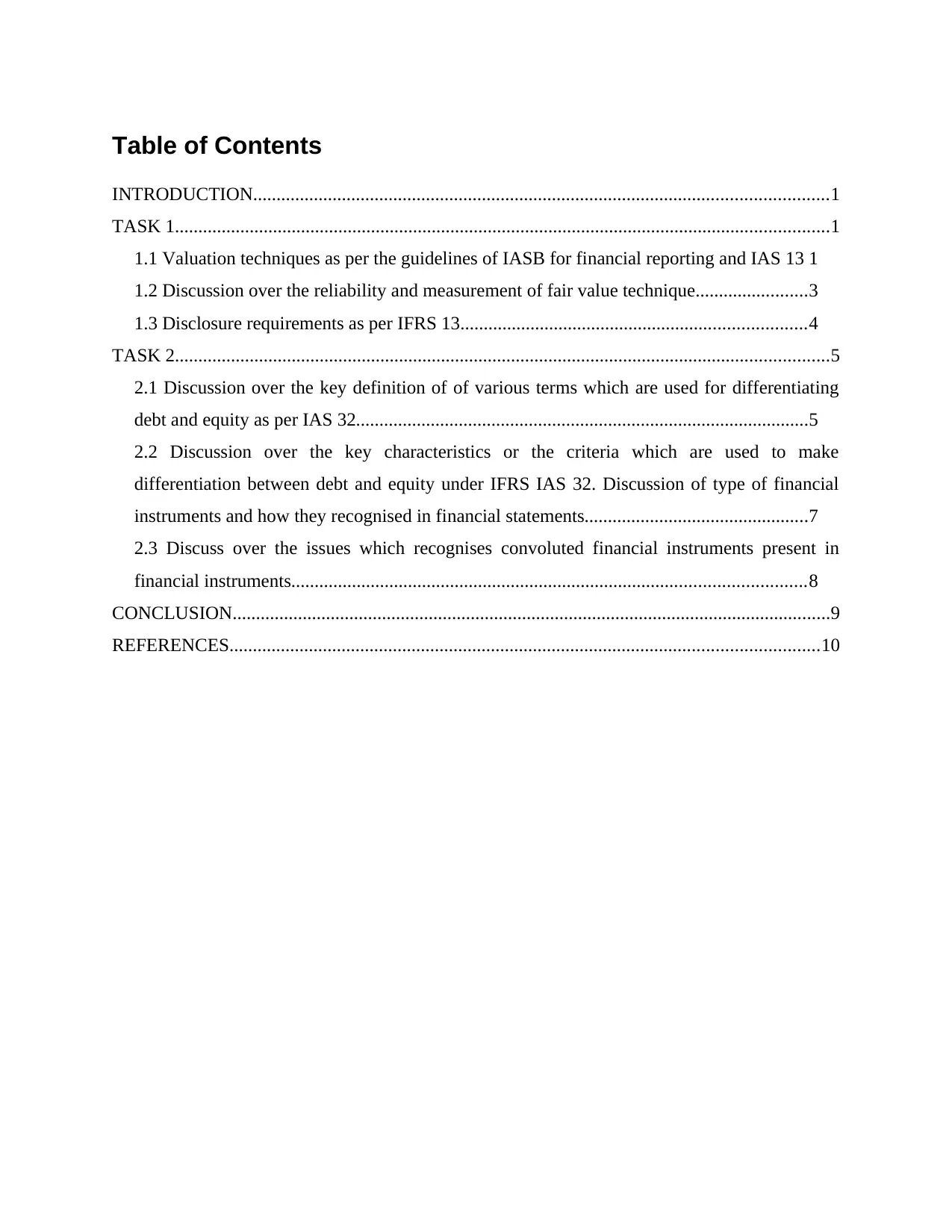
Table of Contents
INTRODUCTION...........................................................................................................................1
TASK 1............................................................................................................................................1
1.1 Valuation techniques as per the guidelines of IASB for financial reporting and IAS 13 1
1.2 Discussion over the reliability and measurement of fair value technique........................3
1.3 Disclosure requirements as per IFRS 13..........................................................................4
TASK 2............................................................................................................................................5
2.1 Discussion over the key definition of of various terms which are used for differentiating
debt and equity as per IAS 32.................................................................................................5
2.2 Discussion over the key characteristics or the criteria which are used to make
differentiation between debt and equity under IFRS IAS 32. Discussion of type of financial
instruments and how they recognised in financial statements................................................7
2.3 Discuss over the issues which recognises convoluted financial instruments present in
financial instruments..............................................................................................................8
CONCLUSION................................................................................................................................9
REFERENCES..............................................................................................................................10
INTRODUCTION...........................................................................................................................1
TASK 1............................................................................................................................................1
1.1 Valuation techniques as per the guidelines of IASB for financial reporting and IAS 13 1
1.2 Discussion over the reliability and measurement of fair value technique........................3
1.3 Disclosure requirements as per IFRS 13..........................................................................4
TASK 2............................................................................................................................................5
2.1 Discussion over the key definition of of various terms which are used for differentiating
debt and equity as per IAS 32.................................................................................................5
2.2 Discussion over the key characteristics or the criteria which are used to make
differentiation between debt and equity under IFRS IAS 32. Discussion of type of financial
instruments and how they recognised in financial statements................................................7
2.3 Discuss over the issues which recognises convoluted financial instruments present in
financial instruments..............................................................................................................8
CONCLUSION................................................................................................................................9
REFERENCES..............................................................................................................................10
INTRODUCTION
Financial reporting should be in a manner so that user or stakeholders can get a complete
information which are required by them in order to take any decisions to invest their money in
any financial instruments. Financial reporting presents an extracted summarised data from all the
parts of financial statement. So that they can get their desired profit or returns on their
investment further stakeholders other than shareholders are also required ton get information
from the financial statements(Agoglia,Doupnik and Tsakumis,2011). Hence as there are a
number of users which frames their decisions as per the basis of figures and facts which are
mentioned there in financial statements so they are required to be credible and reliable. Presented
report is providing evidence regarding whether to use fair market value or to utilize historical
value for the valuation of assets and during the transfer of any liability. The Internal Accounting
Standard Board has framed certain standards which are mandatory to follow during the
preparation financial statements and the concepts which are mentioned in those standards related
with use of fair value is mentioned in this report.
TASK 1
1.1 Valuation techniques as per the guidelines of IASB for financial reporting and IAS 13
The International Accounting Standard Board (IASB) is a privately owned body which
regulates the concepts and principles which can be used by any entity during the formation or
preparation of financial statements. So as to give a better and clear information to its users. For
issuing regulatory laws and to provide information regarding the performance of statement
preparation it have issued a number of standards(Altamuro,and Beatty, 2010). The main work of
this body is to frame IFRS in a way to provide credibility and reliability to its users.
IFRS 13 Fair Value Measurement
This standard has been launched by IASB on 12th May 2011 which deals in fair market
valuation of assets and liabilities. This standard decides some criteria on the basis of which user
can make valuation of its assets and liabilities on fair market value. There is a difference between
fair market value and historical cost as both of this are having some different elements. Fair
market value as per this standard can be defined as that value which a person can get on the sale
of any asset in open market. Which means fair value is that actual cost or value which an asset of
liability possesses on any particular date on which such sale or exchange has been done. On the
other hand historical cost is that cost at which such assets was acquired in past. Historical can be
1
Financial reporting should be in a manner so that user or stakeholders can get a complete
information which are required by them in order to take any decisions to invest their money in
any financial instruments. Financial reporting presents an extracted summarised data from all the
parts of financial statement. So that they can get their desired profit or returns on their
investment further stakeholders other than shareholders are also required ton get information
from the financial statements(Agoglia,Doupnik and Tsakumis,2011). Hence as there are a
number of users which frames their decisions as per the basis of figures and facts which are
mentioned there in financial statements so they are required to be credible and reliable. Presented
report is providing evidence regarding whether to use fair market value or to utilize historical
value for the valuation of assets and during the transfer of any liability. The Internal Accounting
Standard Board has framed certain standards which are mandatory to follow during the
preparation financial statements and the concepts which are mentioned in those standards related
with use of fair value is mentioned in this report.
TASK 1
1.1 Valuation techniques as per the guidelines of IASB for financial reporting and IAS 13
The International Accounting Standard Board (IASB) is a privately owned body which
regulates the concepts and principles which can be used by any entity during the formation or
preparation of financial statements. So as to give a better and clear information to its users. For
issuing regulatory laws and to provide information regarding the performance of statement
preparation it have issued a number of standards(Altamuro,and Beatty, 2010). The main work of
this body is to frame IFRS in a way to provide credibility and reliability to its users.
IFRS 13 Fair Value Measurement
This standard has been launched by IASB on 12th May 2011 which deals in fair market
valuation of assets and liabilities. This standard decides some criteria on the basis of which user
can make valuation of its assets and liabilities on fair market value. There is a difference between
fair market value and historical cost as both of this are having some different elements. Fair
market value as per this standard can be defined as that value which a person can get on the sale
of any asset in open market. Which means fair value is that actual cost or value which an asset of
liability possesses on any particular date on which such sale or exchange has been done. On the
other hand historical cost is that cost at which such assets was acquired in past. Historical can be
1
⊘ This is a preview!⊘
Do you want full access?
Subscribe today to unlock all pages.

Trusted by 1+ million students worldwide
considered irrelevant during making any decision as in this depreciation factor or diminishing
value factor has been ignored. Hence because of this it can be said that the historical value cant
be considered as that value which an asset or liability can fetch if they gets exchanged in the
open market.
As per this standard there may be some issues which an user can face while calculating
the fair market value of any holding or possession(Armstrong, Guay and Weber, 2010). It may
be possible that there is no availability of an active market through which they can evaluate their
assets and liabilities in way which can provide them the accurate value at which their assets can
be get sold and their liabilities can be get exchanged.
Techniques of measurement of fair value
There are some techniques through which an entity can get an accurate value which their
assets are possessing at present. Measurement can be defined as a process for the determination
of a material amount at which the data or the elements of financial statements should be
represented. For example valuation of any fixed asset which is used by an entity during the
production process such measurement techniques can give a value at which that fixed asset can
be shown in statement of changes in financial position. IASB Framework and its para 100
provides a number of different techniques which can be get utilized for the valuation of current
and non current assets and liabilities(Barth and Landsman,2010). These are mentioned below : Historical Cost : Assets gets recorded at an amount which is either cash or cash
equivalent which is paid to the supplier at the time of their acquisition. Liabilities are
recorded at that amount which an entity has get against any obligation. Current Cost: Sometimes assets are recorded at an amount at which the same asset can
be acquired during the current period or as on that date. Settlement or realisable value: It means that amount which the entity can get by the
ordinary disposal of available asset. Liabilities can also be get recorded in the books of
account at a value at which these can be get settled. Hence for getting the settlement
amount total obligatory amount requires to be get reduced by the amount of discount
which is available.
Present Value: Assets can be valued at their present value by multiplying the appropriate
discounting factor with the future net cash inflow. As the time value of money is
2
value factor has been ignored. Hence because of this it can be said that the historical value cant
be considered as that value which an asset or liability can fetch if they gets exchanged in the
open market.
As per this standard there may be some issues which an user can face while calculating
the fair market value of any holding or possession(Armstrong, Guay and Weber, 2010). It may
be possible that there is no availability of an active market through which they can evaluate their
assets and liabilities in way which can provide them the accurate value at which their assets can
be get sold and their liabilities can be get exchanged.
Techniques of measurement of fair value
There are some techniques through which an entity can get an accurate value which their
assets are possessing at present. Measurement can be defined as a process for the determination
of a material amount at which the data or the elements of financial statements should be
represented. For example valuation of any fixed asset which is used by an entity during the
production process such measurement techniques can give a value at which that fixed asset can
be shown in statement of changes in financial position. IASB Framework and its para 100
provides a number of different techniques which can be get utilized for the valuation of current
and non current assets and liabilities(Barth and Landsman,2010). These are mentioned below : Historical Cost : Assets gets recorded at an amount which is either cash or cash
equivalent which is paid to the supplier at the time of their acquisition. Liabilities are
recorded at that amount which an entity has get against any obligation. Current Cost: Sometimes assets are recorded at an amount at which the same asset can
be acquired during the current period or as on that date. Settlement or realisable value: It means that amount which the entity can get by the
ordinary disposal of available asset. Liabilities can also be get recorded in the books of
account at a value at which these can be get settled. Hence for getting the settlement
amount total obligatory amount requires to be get reduced by the amount of discount
which is available.
Present Value: Assets can be valued at their present value by multiplying the appropriate
discounting factor with the future net cash inflow. As the time value of money is
2
Paraphrase This Document
Need a fresh take? Get an instant paraphrase of this document with our AI Paraphraser
considered in this valuation technique hence it can be said that present value technique of
valuation presents a much better position of assets and liabilities in terms of money.
Level 1 Input : It can be defined as the quoted price in the open market which an asset or
liability can fetch on selling them in open market. In this identical assets and liabilities
are evaluated for finding the accurate fair value of any holdings and obligations.
Level 2 Inputs : These inputs can be explained as the value other than quoted market
price of any asset or liability. It contains those values which are not contains in level 1
input.
1.2 Discussion over the reliability and measurement of fair value technique
Fair value as per IAS 13 gives a better and reliable value as the amount which is
calculated as per the guidelines of this standard. As this standard provides various formulas
which are universally accepted and are based on some scientific formulas(Beyer,and et.al.,
2010). Hence through this user can frame a better plan over its investment through which it can
deal with the trends or fluctuations which are there in values.
If an entity is following the international financial reporting frame work then they should
follow all the guidelines or rules which are mentioned there in the these standards. For example
in IAS 13 there are some criteria which are mentioned there in which provides information
regarding on which assets and liabilities fair value has been applied and in some other standards
there is some in information are presented which provides the guidelines over the use of present
value techniques. Some times it has been said that present value technique is controversial as in
many standards it is not used for the valuation of fair value instead of it they are guiding this
technique for some different calculation.
There are two different terms which are described in this IAS 13, which are exit price and
transaction price. The concepts of these two terms can be explained as Entry price and exit price
can be of same level which means due to trends and fluctuation in market it may be possible that
exit value of an asset is same as entry price, sometimes it may be lower then the entry price but
comparatively higher than the fair value. On the other hand transaction price possess a distinct
concept as in this value of holdings and obligations are not fetched.
Fair value provide some credible data which can relied upon. As provided above, fair
value is that amount at which an asset can be sold out and proceeds can be received. There are
some major features of IFRSC which are listed below :
3
valuation presents a much better position of assets and liabilities in terms of money.
Level 1 Input : It can be defined as the quoted price in the open market which an asset or
liability can fetch on selling them in open market. In this identical assets and liabilities
are evaluated for finding the accurate fair value of any holdings and obligations.
Level 2 Inputs : These inputs can be explained as the value other than quoted market
price of any asset or liability. It contains those values which are not contains in level 1
input.
1.2 Discussion over the reliability and measurement of fair value technique
Fair value as per IAS 13 gives a better and reliable value as the amount which is
calculated as per the guidelines of this standard. As this standard provides various formulas
which are universally accepted and are based on some scientific formulas(Beyer,and et.al.,
2010). Hence through this user can frame a better plan over its investment through which it can
deal with the trends or fluctuations which are there in values.
If an entity is following the international financial reporting frame work then they should
follow all the guidelines or rules which are mentioned there in the these standards. For example
in IAS 13 there are some criteria which are mentioned there in which provides information
regarding on which assets and liabilities fair value has been applied and in some other standards
there is some in information are presented which provides the guidelines over the use of present
value techniques. Some times it has been said that present value technique is controversial as in
many standards it is not used for the valuation of fair value instead of it they are guiding this
technique for some different calculation.
There are two different terms which are described in this IAS 13, which are exit price and
transaction price. The concepts of these two terms can be explained as Entry price and exit price
can be of same level which means due to trends and fluctuation in market it may be possible that
exit value of an asset is same as entry price, sometimes it may be lower then the entry price but
comparatively higher than the fair value. On the other hand transaction price possess a distinct
concept as in this value of holdings and obligations are not fetched.
Fair value provide some credible data which can relied upon. As provided above, fair
value is that amount at which an asset can be sold out and proceeds can be received. There are
some major features of IFRSC which are listed below :
3
IAS 16 can be used by an enterprise in order to compute the value of any property, plant
and machinery which can be used by it for its production and operating process.
IAS 36 has a concept of asset impairment and its reversal for adjusting the given amount
up to its fair value.
In IAS 38 there are some principles are given which supports the impairment of
intangible assets for its valuation.
Further it also provides a basic rule that if market price is available for any intangible
asset then it should be value at that amount only because market value provide a better
price which can be pointed at a price which such asset can fetch, if sold in open market.
There are some issues which are related with the reliability of fair value as it is a bit
controversial so its credibility can be questioned. Proponents of using fair market value for the
valuation of assets and liabilities appeals that it contains many desirable imputes. The factors
which creates the first element through which its reliability can be questioned is absence of
active market. As in this case an organisation or user cannot determine the accurate fair value of
an asset at which it can be sold or in case of any liability at which it can be exchanged.
1.3 Disclosure requirements as per IFRS 13
There are some disclosure requirements and supporting guidelines are there which is
mentioned in International financial reporting standards 13. Disclosure requirements is to be
fulfilled so that financial statements can provide more reliable information to the users or the
stakeholder so that the user can make more better decisions in order to invest their money or time
in any entity. Certain disclosure requirements are mentioned below :
Disclosure requirement for such assets and liabilities which are actually measured at fair
value on some recurring and non recurring basis in balance sheets after the recognition at
beginning.
For recurring fair value measurements through significant unobservable inputs. Which
have certain impact over the measurement of profit or loss during a certain period.
For non recurring fair value fair value measurements organisation need to provide the
reasons for the valuation of assets on non recurring basis.
Further for recurring fair value they require to address the a hierarchy has been made
which is categorised in three different levels. A narrative description related with the
sensitivity of fair value measurements is required to mention. Financial assets and
4
and machinery which can be used by it for its production and operating process.
IAS 36 has a concept of asset impairment and its reversal for adjusting the given amount
up to its fair value.
In IAS 38 there are some principles are given which supports the impairment of
intangible assets for its valuation.
Further it also provides a basic rule that if market price is available for any intangible
asset then it should be value at that amount only because market value provide a better
price which can be pointed at a price which such asset can fetch, if sold in open market.
There are some issues which are related with the reliability of fair value as it is a bit
controversial so its credibility can be questioned. Proponents of using fair market value for the
valuation of assets and liabilities appeals that it contains many desirable imputes. The factors
which creates the first element through which its reliability can be questioned is absence of
active market. As in this case an organisation or user cannot determine the accurate fair value of
an asset at which it can be sold or in case of any liability at which it can be exchanged.
1.3 Disclosure requirements as per IFRS 13
There are some disclosure requirements and supporting guidelines are there which is
mentioned in International financial reporting standards 13. Disclosure requirements is to be
fulfilled so that financial statements can provide more reliable information to the users or the
stakeholder so that the user can make more better decisions in order to invest their money or time
in any entity. Certain disclosure requirements are mentioned below :
Disclosure requirement for such assets and liabilities which are actually measured at fair
value on some recurring and non recurring basis in balance sheets after the recognition at
beginning.
For recurring fair value measurements through significant unobservable inputs. Which
have certain impact over the measurement of profit or loss during a certain period.
For non recurring fair value fair value measurements organisation need to provide the
reasons for the valuation of assets on non recurring basis.
Further for recurring fair value they require to address the a hierarchy has been made
which is categorised in three different levels. A narrative description related with the
sensitivity of fair value measurements is required to mention. Financial assets and
4
⊘ This is a preview!⊘
Do you want full access?
Subscribe today to unlock all pages.
Trusted by 1+ million students worldwide
liabilities in case of change in observable value should reflect possible alternative
assumptions.
These disclosure requirements are mandatory to follow hence any entity cannot ignore
such a legal and statutory requirements (Agoglia, Doupnik and Tsakumis, 2011). It they do so
then it will be considered as an offence and then the financial statements will not provide the
accurate information which are required to be stated there in.
For the increment in consistency and comparability regarding fair value measurement and
other disclosures related with it. International financial reporting standards had established a fair
value hierarchy. Such hierarchy is categorised into three levels. This gives highest priority to
unadjusted prices in which no any adjustments are worked out. Such price is quoted open market
of identical assets and liabilities and the lowest priority is given to unobservable inputs. There
are three levels which are categorised as below :
Level one : Quoted Price
Level two : Inputs other than quoted price
Level three : Unobservable inputs
TASK 2
2.1 Discussion over the key definition of of various terms which are used for differentiating debt
and equity as per IAS 32
As per IAS 32 debt and equity has different definition. But in normal sense, Debt reflects
the obligations in terms of money which are related with the outsiders. The cost associated with
such debts can be considered as a charge against profit (Altamuro and Beatty, 2010). For
instance debentures, are one of the example of debt as it is basically a long term loan. Debentures
are having a fixed charge i.e. rate of interest which remains fixed during the total period of
debentures. They may carry right against the property of company as debentures are sometimes
secured against some assets. On the other hand, equity can be considered as the owners fund or
liabilities and obligations which are related with the insiders or the owners. Because of the
separate entity concepts, owners and the enterprises are considered as separate from each other
hence the capital or fund which is invested in business by its owner is recognised as a liability for
the business entity.
5
assumptions.
These disclosure requirements are mandatory to follow hence any entity cannot ignore
such a legal and statutory requirements (Agoglia, Doupnik and Tsakumis, 2011). It they do so
then it will be considered as an offence and then the financial statements will not provide the
accurate information which are required to be stated there in.
For the increment in consistency and comparability regarding fair value measurement and
other disclosures related with it. International financial reporting standards had established a fair
value hierarchy. Such hierarchy is categorised into three levels. This gives highest priority to
unadjusted prices in which no any adjustments are worked out. Such price is quoted open market
of identical assets and liabilities and the lowest priority is given to unobservable inputs. There
are three levels which are categorised as below :
Level one : Quoted Price
Level two : Inputs other than quoted price
Level three : Unobservable inputs
TASK 2
2.1 Discussion over the key definition of of various terms which are used for differentiating debt
and equity as per IAS 32
As per IAS 32 debt and equity has different definition. But in normal sense, Debt reflects
the obligations in terms of money which are related with the outsiders. The cost associated with
such debts can be considered as a charge against profit (Altamuro and Beatty, 2010). For
instance debentures, are one of the example of debt as it is basically a long term loan. Debentures
are having a fixed charge i.e. rate of interest which remains fixed during the total period of
debentures. They may carry right against the property of company as debentures are sometimes
secured against some assets. On the other hand, equity can be considered as the owners fund or
liabilities and obligations which are related with the insiders or the owners. Because of the
separate entity concepts, owners and the enterprises are considered as separate from each other
hence the capital or fund which is invested in business by its owner is recognised as a liability for
the business entity.
5
Paraphrase This Document
Need a fresh take? Get an instant paraphrase of this document with our AI Paraphraser
In IAS 32 several terms are used which have different meanings through which user can
identify the headings in which they should get categorised. These terms are mentioned below:
Financial asset : Financial asset can be described as any asset which carry :-
◦ Cash
◦ Equity instrument which is related with some other firm or entity
◦ Investments made in some commodities
◦ Financial asset also include contractual rights over any entity for receipt of
payment .
◦ Contractual rights also includes exchange of financial rights or financial obligations
in other words it can be referred as the exchange of assets and liabilities.
Financial Liabilities : These are also defined in IAS 32, these can be referred as :
◦ Any contractual obligations related with payment of cash or any other financial
assets which are related with some other firm.
◦ Obligation in relation with exchange of assets with some other entity.
◦ Non derivative contract that may be get settled in own equity of entity.
◦ Derivative which can be get settled other than through exchange of fixed amount,
cash or some other financial holdings. Discuss over the issues which recognises
convoluted financial instruments present in financial instruments.
Equity Instruments: These instruments can be defined as the instruments which shows
the ownership of any person over the entity. Equity instruments consists voting rights.
Share certificate is given to the owner of the equity shares.
Debt is the outsiders right over the entity. Debt security holder cannot get the share of
profit but they carries less risk as compared with equity owners. Total equity consists of the
amount of equity shares, preference shares and retained earnings (Armstrong, Guay and Weber,
2010). Equity share can be considered as the holders fund. Issuer of financial instrument can
classify the instrument and its components. As on the initial recognition of financial liability,
financial asset as per the conditions which are mentioned there in the contractual agreement
between the holder of financial asset or bearer of liability and the person or entity with which
such asset and liability is related. Equity can be considered as the owners fund which can also be
categorised internal liability for which entity have less obligations. The outsider liabilities are
considered as preferable than internal liability holders.
6
identify the headings in which they should get categorised. These terms are mentioned below:
Financial asset : Financial asset can be described as any asset which carry :-
◦ Cash
◦ Equity instrument which is related with some other firm or entity
◦ Investments made in some commodities
◦ Financial asset also include contractual rights over any entity for receipt of
payment .
◦ Contractual rights also includes exchange of financial rights or financial obligations
in other words it can be referred as the exchange of assets and liabilities.
Financial Liabilities : These are also defined in IAS 32, these can be referred as :
◦ Any contractual obligations related with payment of cash or any other financial
assets which are related with some other firm.
◦ Obligation in relation with exchange of assets with some other entity.
◦ Non derivative contract that may be get settled in own equity of entity.
◦ Derivative which can be get settled other than through exchange of fixed amount,
cash or some other financial holdings. Discuss over the issues which recognises
convoluted financial instruments present in financial instruments.
Equity Instruments: These instruments can be defined as the instruments which shows
the ownership of any person over the entity. Equity instruments consists voting rights.
Share certificate is given to the owner of the equity shares.
Debt is the outsiders right over the entity. Debt security holder cannot get the share of
profit but they carries less risk as compared with equity owners. Total equity consists of the
amount of equity shares, preference shares and retained earnings (Armstrong, Guay and Weber,
2010). Equity share can be considered as the holders fund. Issuer of financial instrument can
classify the instrument and its components. As on the initial recognition of financial liability,
financial asset as per the conditions which are mentioned there in the contractual agreement
between the holder of financial asset or bearer of liability and the person or entity with which
such asset and liability is related. Equity can be considered as the owners fund which can also be
categorised internal liability for which entity have less obligations. The outsider liabilities are
considered as preferable than internal liability holders.
6
When an issuer applies the definition in paragraph 11 which classify whether financial
instrument is to be put in the category of equity, debt or as an asset.
Those instruments which doesn't contain any obligations which are related with any
contract
Debt instrument contains obligations which are to be paid back to the owner of that debt
instruments (Barth and Landsman, 2010). These are also having some fixed as well as
floating charges.
2.2 Discussion over the key characteristics or the criteria which are used to make differentiation
between debt and equity under IFRS IAS 32. Discussion of type of financial instruments
and how they recognised in financial statements.
Principle of IAS 32 define that the classification of financial instruments should be done either as
financial liabilities or as financial equity and it should not be in its legal form.
Equity instruments are considered as financial instrument only when-
a)There is no obligation in delivering in cash,
b)The is done by the issuer's equity instrument. It includes the following.
i)no contractual obligation should be there for the issuer for a non derivatives.
ii)by exchanging fixed amount of cash only a derivatives get settled.
Financial Instruments.
Equity Shares- This shares define the ownership of a shareholder in a particular organisation.
The holders has the rights to contribute their views and time. They also has the voting right.
Those who holds the equity shares have to bear all the losses as well as can enjoy the
benefits of the profit as per the ratio of the share held by him/her.
Preference shares- A person who hold preference share just get a fixed rate of dividend.
Preference share holder gets the priority in the sharing of the dividends as compared to the
ordinary shares (Bédard and Gendron, 2010). In case any kind of issue occurs as such
bankruptcy then too the preference share holders gets their share of fixed dividends.
7
instrument is to be put in the category of equity, debt or as an asset.
Those instruments which doesn't contain any obligations which are related with any
contract
Debt instrument contains obligations which are to be paid back to the owner of that debt
instruments (Barth and Landsman, 2010). These are also having some fixed as well as
floating charges.
2.2 Discussion over the key characteristics or the criteria which are used to make differentiation
between debt and equity under IFRS IAS 32. Discussion of type of financial instruments
and how they recognised in financial statements.
Principle of IAS 32 define that the classification of financial instruments should be done either as
financial liabilities or as financial equity and it should not be in its legal form.
Equity instruments are considered as financial instrument only when-
a)There is no obligation in delivering in cash,
b)The is done by the issuer's equity instrument. It includes the following.
i)no contractual obligation should be there for the issuer for a non derivatives.
ii)by exchanging fixed amount of cash only a derivatives get settled.
Financial Instruments.
Equity Shares- This shares define the ownership of a shareholder in a particular organisation.
The holders has the rights to contribute their views and time. They also has the voting right.
Those who holds the equity shares have to bear all the losses as well as can enjoy the
benefits of the profit as per the ratio of the share held by him/her.
Preference shares- A person who hold preference share just get a fixed rate of dividend.
Preference share holder gets the priority in the sharing of the dividends as compared to the
ordinary shares (Bédard and Gendron, 2010). In case any kind of issue occurs as such
bankruptcy then too the preference share holders gets their share of fixed dividends.
7
⊘ This is a preview!⊘
Do you want full access?
Subscribe today to unlock all pages.
Trusted by 1+ million students worldwide
Debentures- It is a long term security which has a fixed interest rate and it is issued and secured
against the assets. It is not issued to everyone, the person with good reputation and has good
credit worthiness are preferred for debentures.
Bonds- It is a kind of debt investment in which the money is lend by the investors to the
person(A businessmen or any government profile holder) who borrows for a variable or
fixed time period.
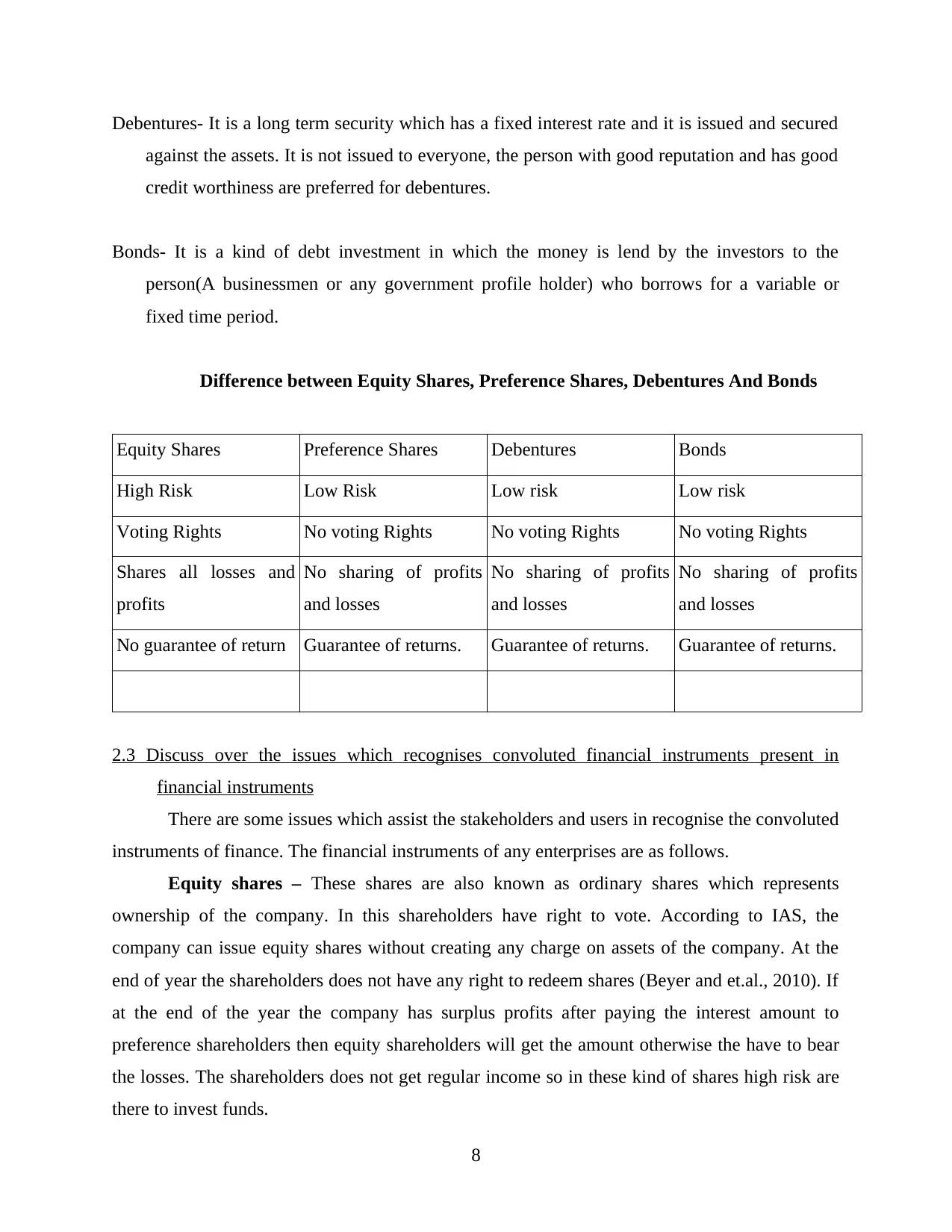
Difference between Equity Shares, Preference Shares, Debentures And Bonds
Equity Shares Preference Shares Debentures Bonds
High Risk Low Risk Low risk Low risk
Voting Rights No voting Rights No voting Rights No voting Rights
Shares all losses and
profits
No sharing of profits
and losses
No sharing of profits
and losses
No sharing of profits
and losses
No guarantee of return Guarantee of returns. Guarantee of returns. Guarantee of returns.
2.3 Discuss over the issues which recognises convoluted financial instruments present in
financial instruments
There are some issues which assist the stakeholders and users in recognise the convoluted
instruments of finance. The financial instruments of any enterprises are as follows.
Equity shares – These shares are also known as ordinary shares which represents
ownership of the company. In this shareholders have right to vote. According to IAS, the
company can issue equity shares without creating any charge on assets of the company. At the
end of year the shareholders does not have any right to redeem shares (Beyer and et.al., 2010). If
at the end of the year the company has surplus profits after paying the interest amount to
preference shareholders then equity shareholders will get the amount otherwise the have to bear
the losses. The shareholders does not get regular income so in these kind of shares high risk are
there to invest funds.
8
against the assets. It is not issued to everyone, the person with good reputation and has good
credit worthiness are preferred for debentures.
Bonds- It is a kind of debt investment in which the money is lend by the investors to the
person(A businessmen or any government profile holder) who borrows for a variable or
fixed time period.
Difference between Equity Shares, Preference Shares, Debentures And Bonds
Equity Shares Preference Shares Debentures Bonds
High Risk Low Risk Low risk Low risk
Voting Rights No voting Rights No voting Rights No voting Rights
Shares all losses and
profits
No sharing of profits
and losses
No sharing of profits
and losses
No sharing of profits
and losses
No guarantee of return Guarantee of returns. Guarantee of returns. Guarantee of returns.
2.3 Discuss over the issues which recognises convoluted financial instruments present in
financial instruments
There are some issues which assist the stakeholders and users in recognise the convoluted
instruments of finance. The financial instruments of any enterprises are as follows.
Equity shares – These shares are also known as ordinary shares which represents
ownership of the company. In this shareholders have right to vote. According to IAS, the
company can issue equity shares without creating any charge on assets of the company. At the
end of year the shareholders does not have any right to redeem shares (Beyer and et.al., 2010). If
at the end of the year the company has surplus profits after paying the interest amount to
preference shareholders then equity shareholders will get the amount otherwise the have to bear
the losses. The shareholders does not get regular income so in these kind of shares high risk are
there to invest funds.
8
Paraphrase This Document
Need a fresh take? Get an instant paraphrase of this document with our AI Paraphraser
Preference shares – These are those shares in which shareholders have preferential
rights over the dividends. The shareholders who had invest the money in these shares have
voting right to vote in the shareholder meeting and even they can speak also. There are two kind
of preference shares i.e. redeemable and irredeemable. In redeemable preference shares the
shareholders get the amount at particular point of time period. But in irredeemable preference
shares when the company goes into liquidation the these shares are redeem at that time period.
The shareholders get profits before the equity shareholders (Chen and et. al., 2010). Preference
shares doesn't carry risk. When investors or company issues these kind of shares then they does
not have to mortgage any property of the organisation.
Debentures – These are the debt instruments which help the company to raise the funds.
At the time of incorporation of the company can cannot issue the debenture on discount rate for
one year. Debentures are of two types secured and unsecured. In secured debentures the
company has to mortgage some property. But on unsecured debentures the company does not
have to mortgage and property (Dyreng, Mayew and Williams, 2012). In this the investors get
the regular income even after profits are not available by the company.
Separations of Debt and Equity
There are several factors through which it can be said that both debt and equity are two
different terms. The very first fact which can separate them out of each other is Debt is outsiders
liability and equity can categorised as internal liabilities. External liabilities are always preferred
over the internal liabilities. Equity shares and preference shares as owners capital can be put in
the category of Equity. And debentures and other long term loans and short term liabilities like
creditors for goods etc. can be classified in the category of debt.
CONCLUSION
As per the above mentioned facts and concepts it can be concluded that when the user
uses and follows the guidelines which are mentioned in IFRS which have been issued by the
IASB. Then it can be said that through following these guidelines an entity can show or present a
better view in front of its users or stakeholder. As per the given facts it can be observed that if an
entity follows the rules and guidelines mentioned there in the IFRS.
9
rights over the dividends. The shareholders who had invest the money in these shares have
voting right to vote in the shareholder meeting and even they can speak also. There are two kind
of preference shares i.e. redeemable and irredeemable. In redeemable preference shares the
shareholders get the amount at particular point of time period. But in irredeemable preference
shares when the company goes into liquidation the these shares are redeem at that time period.
The shareholders get profits before the equity shareholders (Chen and et. al., 2010). Preference
shares doesn't carry risk. When investors or company issues these kind of shares then they does
not have to mortgage any property of the organisation.
Debentures – These are the debt instruments which help the company to raise the funds.
At the time of incorporation of the company can cannot issue the debenture on discount rate for
one year. Debentures are of two types secured and unsecured. In secured debentures the
company has to mortgage some property. But on unsecured debentures the company does not
have to mortgage and property (Dyreng, Mayew and Williams, 2012). In this the investors get
the regular income even after profits are not available by the company.
Separations of Debt and Equity
There are several factors through which it can be said that both debt and equity are two
different terms. The very first fact which can separate them out of each other is Debt is outsiders
liability and equity can categorised as internal liabilities. External liabilities are always preferred
over the internal liabilities. Equity shares and preference shares as owners capital can be put in
the category of Equity. And debentures and other long term loans and short term liabilities like
creditors for goods etc. can be classified in the category of debt.
CONCLUSION
As per the above mentioned facts and concepts it can be concluded that when the user
uses and follows the guidelines which are mentioned in IFRS which have been issued by the
IASB. Then it can be said that through following these guidelines an entity can show or present a
better view in front of its users or stakeholder. As per the given facts it can be observed that if an
entity follows the rules and guidelines mentioned there in the IFRS.
9

REFERENCES
Books and Journals
Agoglia, C. P., Doupnik, T. S. and Tsakumis, G. T., 2011. Principles-based versus rules-based
accounting standards: The influence of standard precision and audit committee strength
on financial reporting decisions. The accounting review. 86(3). pp.747-767.
10
Books and Journals
Agoglia, C. P., Doupnik, T. S. and Tsakumis, G. T., 2011. Principles-based versus rules-based
accounting standards: The influence of standard precision and audit committee strength
on financial reporting decisions. The accounting review. 86(3). pp.747-767.
10
⊘ This is a preview!⊘
Do you want full access?
Subscribe today to unlock all pages.
Trusted by 1+ million students worldwide

1 out of 14


Related Documents


Your All-in-One AI-Powered Toolkit for Academic Success.
+13062052269
info@desklib.com
Available 24*7 on WhatsApp / Email
![[object Object]](/_next/static/media/star-bottom.7253800d.svg)
Unlock your academic potential
Copyright © 2020–2026 A2Z Services. All Rights Reserved. Developed and managed by ZUCOL.