Semester 2 Financial Reporting for Management BMP6015 Exam Solution

Verified

Added on  2023/06/11

|21
|3467
|58
Report
AI Summary
This document presents a comprehensive solution to a Financial Reporting for Management exam, covering topics such as activity-based costing (ABC), net present value (NPV), internal rate of return (IRR), profitability index, financial ratio analysis, and balanced scorecard. The solution includes detailed calculations and critical evaluations of different costing methods and project appraisal techniques. It analyzes a company's financial performance between 2019 and 2020 based on calculated ratios and discusses the balanced scorecard as a method of assessing performance. Desklib offers a platform for students to access similar solved assignments and past papers.
Document Page
BUSINESS MANAGEMENT PATHWAYS
SEMESTER 2, EXAMINATION 2021/22
FINANCIAL REPORTING FOR MANAGEMENT
MODULE NO: BMP6015
==============================================================
1 of 21
tabler-icon-diamond-filled.svg

Paraphrase This Document

Need a fresh take? Get an instant paraphrase of this document with our AI Paraphraser
Document Page
Question 1
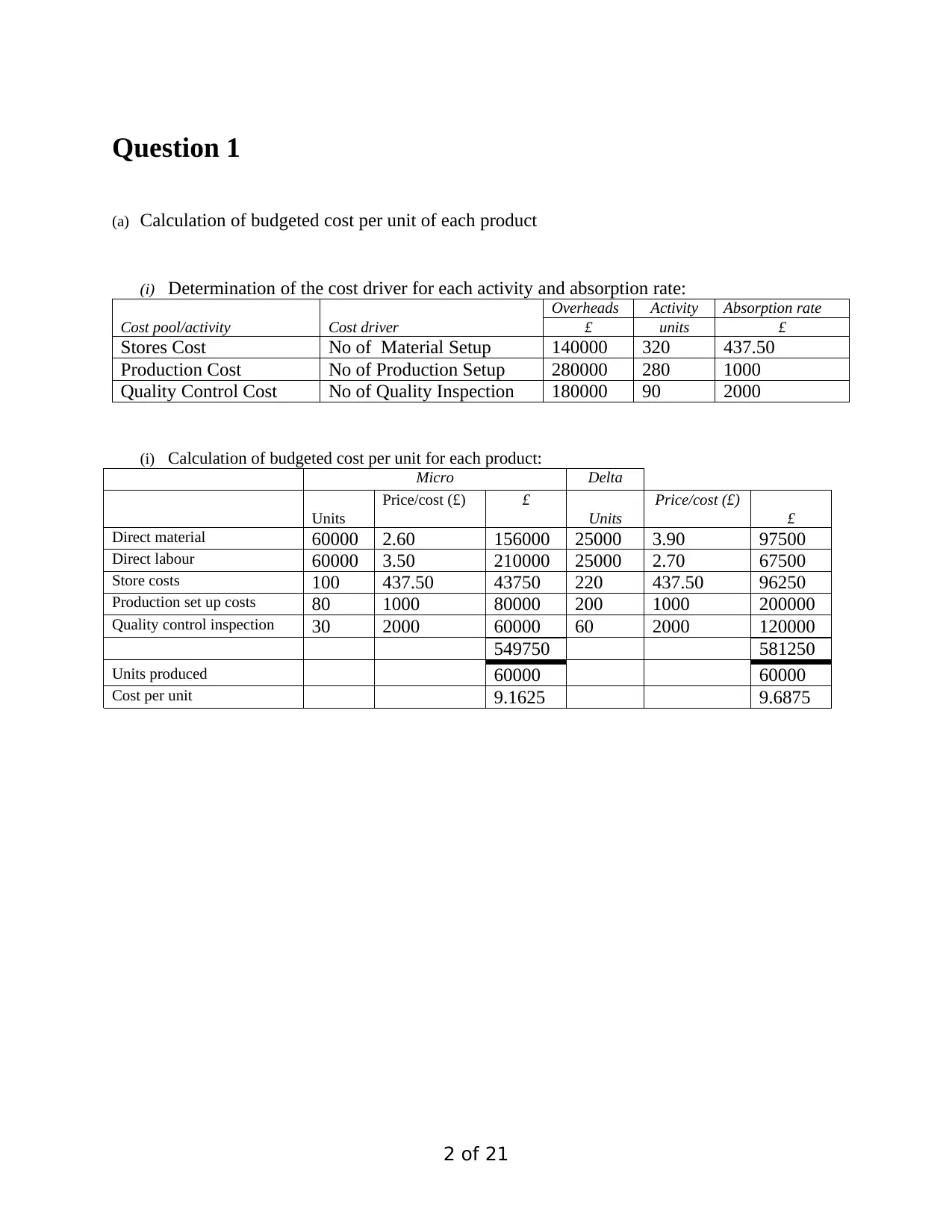
(a) Calculation of budgeted cost per unit of each product
(i) Determination of the cost driver for each activity and absorption rate:
Cost pool/activity Cost driver
Overheads Activity Absorption rate
£ units £
Stores Cost No of Material Setup 140000 320 437.50
Production Cost No of Production Setup 280000 280 1000
Quality Control Cost No of Quality Inspection 180000 90 2000
(i) Calculation of budgeted cost per unit for each product:
Micro Delta
Units
Price/cost (£) £
Units
Price/cost (£)
£
Direct material 60000 2.60 156000 25000 3.90 97500
Direct labour 60000 3.50 210000 25000 2.70 67500
Store costs 100 437.50 43750 220 437.50 96250
Production set up costs 80 1000 80000 200 1000 200000
Quality control inspection 30 2000 60000 60 2000 120000
549750 581250
Units produced 60000 60000
Cost per unit 9.1625 9.6875
2 of 21
Document Page
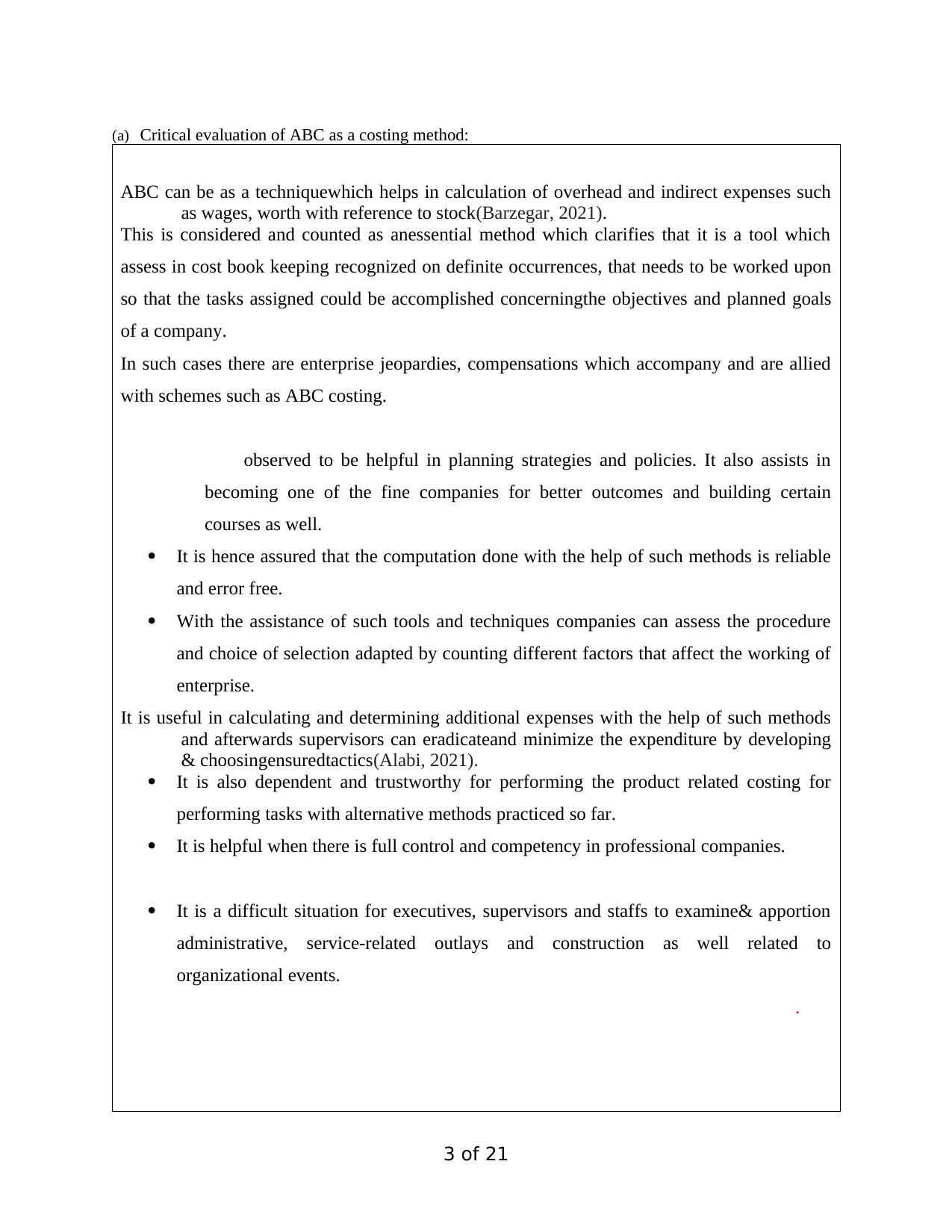
(a) Critical evaluation of ABC as a costing method:
ABC can be as a techniquewhich helps in calculation of overhead and indirect expenses such
as wages, worth with reference to stock(Barzegar, 2021).
This is considered and counted as anessential method which clarifies that it is a tool which
assess in cost book keeping recognized on definite occurrences, that needs to be worked upon
so that the tasks assigned could be accomplished concerningthe objectives and planned goals
of a company.
In such cases there are enterprise jeopardies, compensations which accompany and are allied
with schemes such as ABC costing.
Pros:
It is observed to be helpful in planning strategies and policies. It also assists in
becoming one of the fine companies for better outcomes and building certain
courses as well.
It is hence assured that the computation done with the help of such methods is reliable
and error free.
With the assistance of such tools and techniques companies can assess the procedure
and choice of selection adapted by counting different factors that affect the working of
enterprise.
It is useful in calculating and determining additional expenses with the help of such methods
and afterwards supervisors can eradicateand minimize the expenditure by developing
& choosingensuredtactics(Alabi, 2021).
It is also dependent and trustworthy for performing the product related costing for
performing tasks with alternative methods practiced so far.
It is helpful when there is full control and competency in professional companies.
Cons:
It is a difficult situation for executives, supervisors and staffs to examine& apportion
administrative, service-related outlays and construction as well related to
organizational events.
is a complex activity to explain and make owners & stakeholders understand.It is
possible that the actions and price drivers might result in unsuitable and unresponsive
situations.
3 of 21
Document Page
4 of 21
tabler-icon-diamond-filled.svg

Paraphrase This Document

Need a fresh take? Get an instant paraphrase of this document with our AI Paraphraser
Document Page
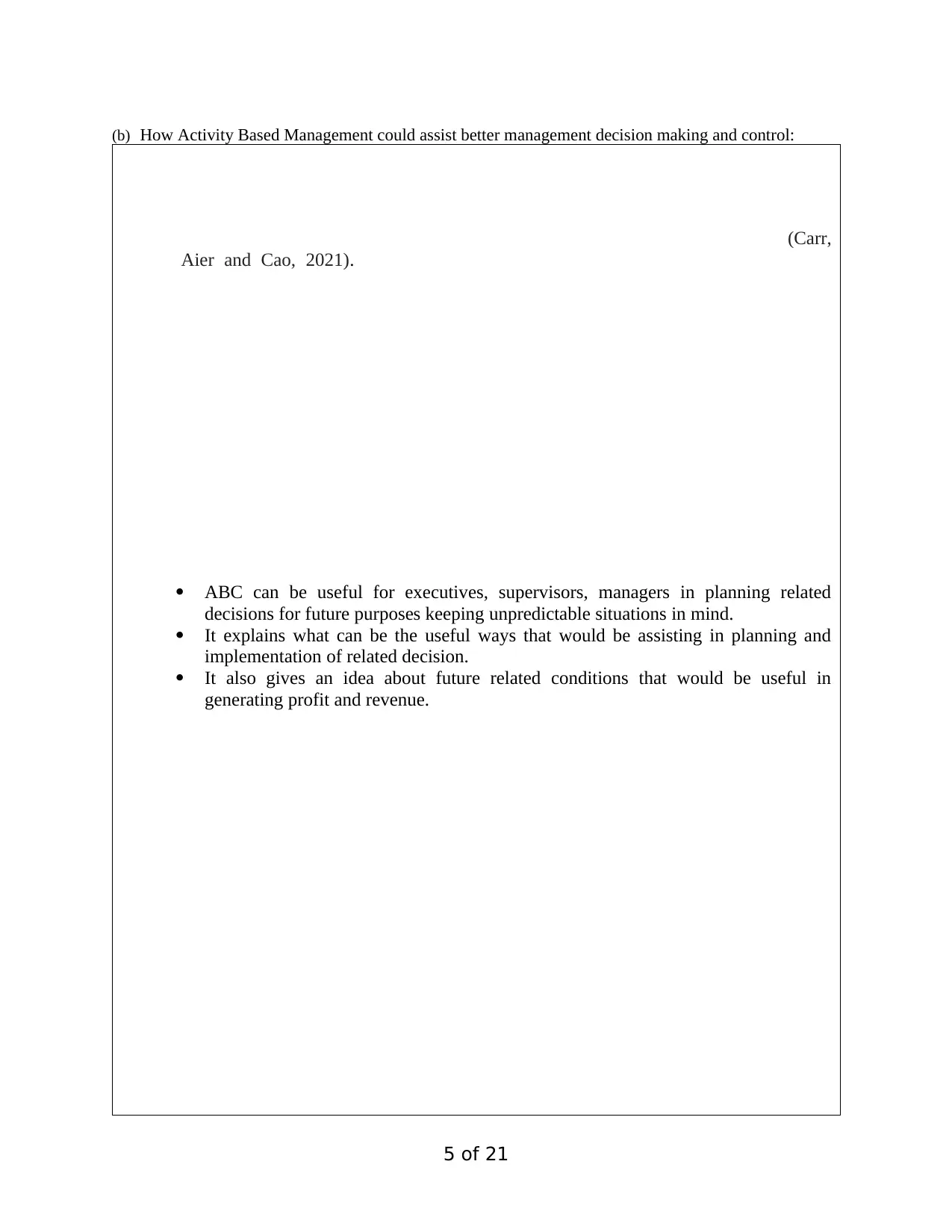
(b) How Activity Based Management could assist better management decision making and control:
Activity based management is observed to perform and serve as a tool when compared to other
tools and techniques prevailing in competitive market.ABC is well known for
improving the effectiveness and efficiency of the organisation by cutting down
costs,minimizing risks and developing proper plans for having better control(Carr,
Aier and Cao, 2021). It counts expenditure that related to production costs and
machinery related expenses as well. It also helps to increase revenue and profitable
margin that would help to improve working and functioning of a business in
competition. ABC method is counted as one of the effective toolsthat helps companies
to enjoy stabilityand sustainability in unpredictable situationswhich would help them
to prevail better chances for growth and expansion as well.Such methods are kept at
foremost priority when compared to other tools the reason behind is that it ascertains
ideas related to what time would best suit which method and would serve right in
fulfilment and achievement of organisational goals in precise manner.Activity based
costing Is helpful in management of plans, controlling operation related works in a
firm that might lead to rise in unwanted expenditures.It also facilitates assistancein
minimizing cost incurred which is functioning as a hurdle in growth and expansion of
company.It helps to understand elementsthat leads to miscellaneous costs and the ways
that would assist in controlling the same within given time frame.
ABC Can serve as a guiding medium in specific ways such described as under:
ABC can be useful for executives, supervisors, managers in planning related
decisions for future purposes keeping unpredictable situations in mind.
It explains what can be the useful ways that would be assisting in planning and
implementation of related decision.
It also gives an idea about future related conditions that would be useful in
generating profit and revenue.
It is useful in keeping profit related margins of company set well in advance.
In case of Traditional costing,it does not allow working and functioning in specific
industries such as service-related areas.
It can be used for finding reasons behind unwanted risks, costs and obstacles which
increase unpredictable results in a certain business sector.
5 of 21
Document Page
6 of 21
Document Page
7 of 21
tabler-icon-diamond-filled.svg

Paraphrase This Document

Need a fresh take? Get an instant paraphrase of this document with our AI Paraphraser
Document Page
Question 2
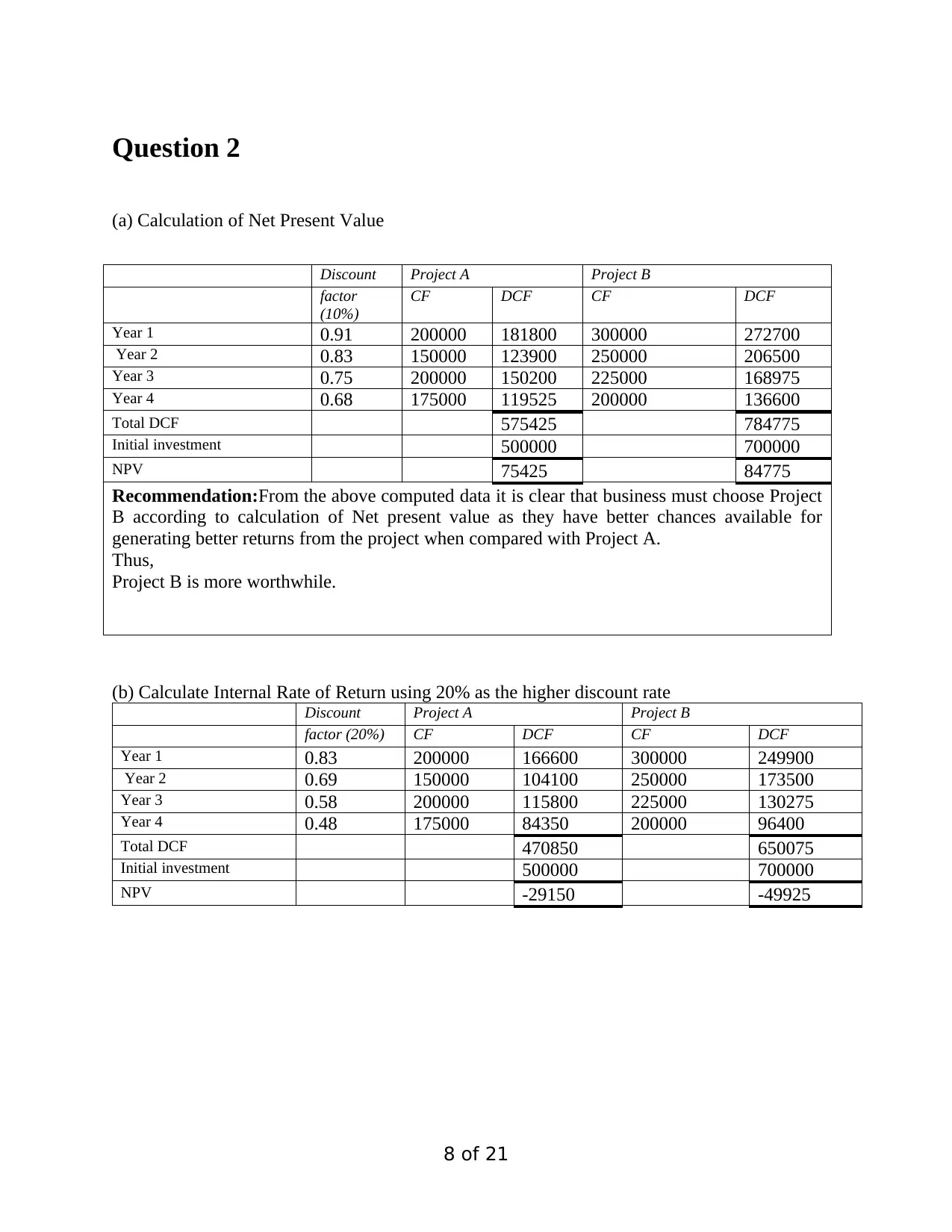
(a) Calculation of Net Present Value
Discount Project A Project B
factor
(10%)
CF DCF CF DCF
Year 1 0.91 200000 181800 300000 272700
Year 2 0.83 150000 123900 250000 206500
Year 3 0.75 200000 150200 225000 168975
Year 4 0.68 175000 119525 200000 136600
Total DCF 575425 784775
Initial investment 500000 700000
NPV 75425 84775
Recommendation:From the above computed data it is clear that business must choose Project
B according to calculation of Net present value as they have better chances available for
generating better returns from the project when compared with Project A.
Thus,
Project B is more worthwhile.
(b) Calculate Internal Rate of Return using 20% as the higher discount rate
Discount Project A Project B
factor (20%) CF DCF CF DCF
Year 1 0.83 200000 166600 300000 249900
Year 2 0.69 150000 104100 250000 173500
Year 3 0.58 200000 115800 225000 130275
Year 4 0.48 175000 84350 200000 96400
Total DCF 470850 650075
Initial investment 500000 700000
NPV -29150 -49925
8 of 21
Document Page
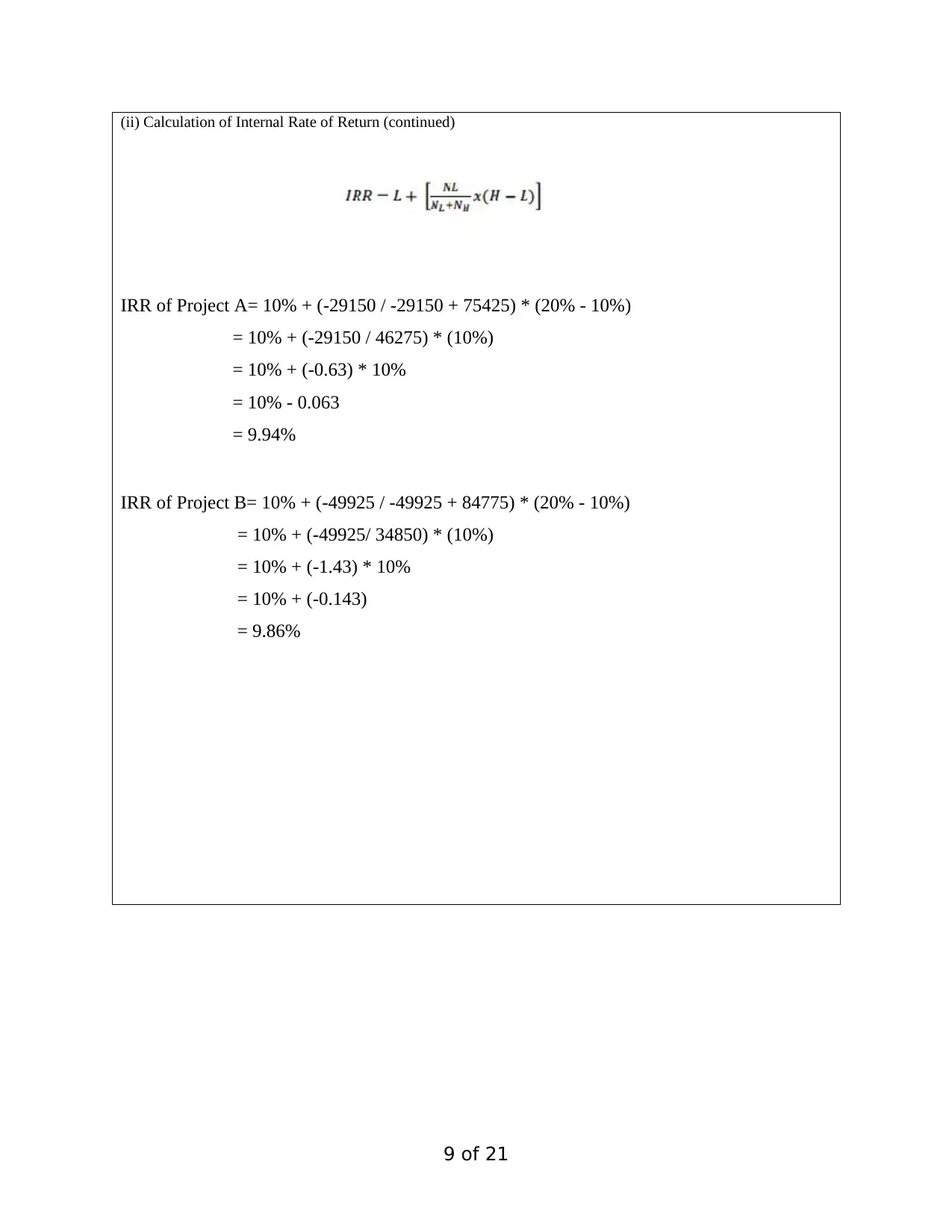
(ii) Calculation of Internal Rate of Return (continued)
IRR of Project A= 10% + (-29150 / -29150 + 75425) * (20% - 10%)
= 10% + (-29150 / 46275) * (10%)
= 10% + (-0.63) * 10%
= 10% - 0.063
= 9.94%
IRR of Project B= 10% + (-49925 / -49925 + 84775) * (20% - 10%)
= 10% + (-49925/ 34850) * (10%)
= 10% + (-1.43) * 10%
= 10% + (-0.143)
= 9.86%
9 of 21
Document Page
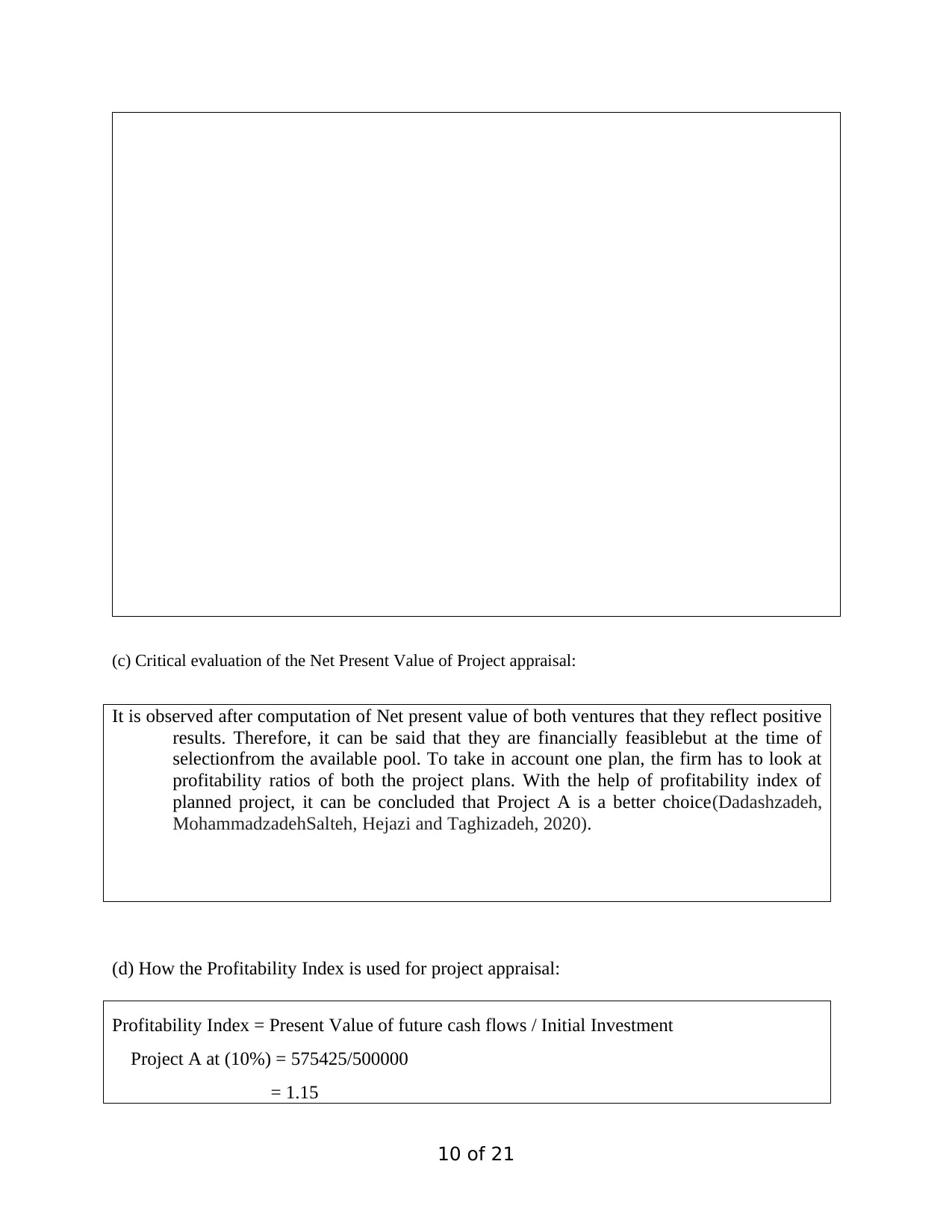
(c) Critical evaluation of the Net Present Value of Project appraisal:
It is observed after computation of Net present value of both ventures that they reflect positive
results. Therefore, it can be said that they are financially feasiblebut at the time of
selectionfrom the available pool. To take in account one plan, the firm has to look at
profitability ratios of both the project plans. With the help of profitability index of
planned project, it can be concluded that Project A is a better choice(Dadashzadeh,
MohammadzadehSalteh, Hejazi and Taghizadeh, 2020).
(d) How the Profitability Index is used for project appraisal:
Profitability Index = Present Value of future cash flows / Initial Investment
Project A at (10%) = 575425/500000
= 1.15
10 of 21
tabler-icon-diamond-filled.svg

Paraphrase This Document

Need a fresh take? Get an instant paraphrase of this document with our AI Paraphraser
Document Page
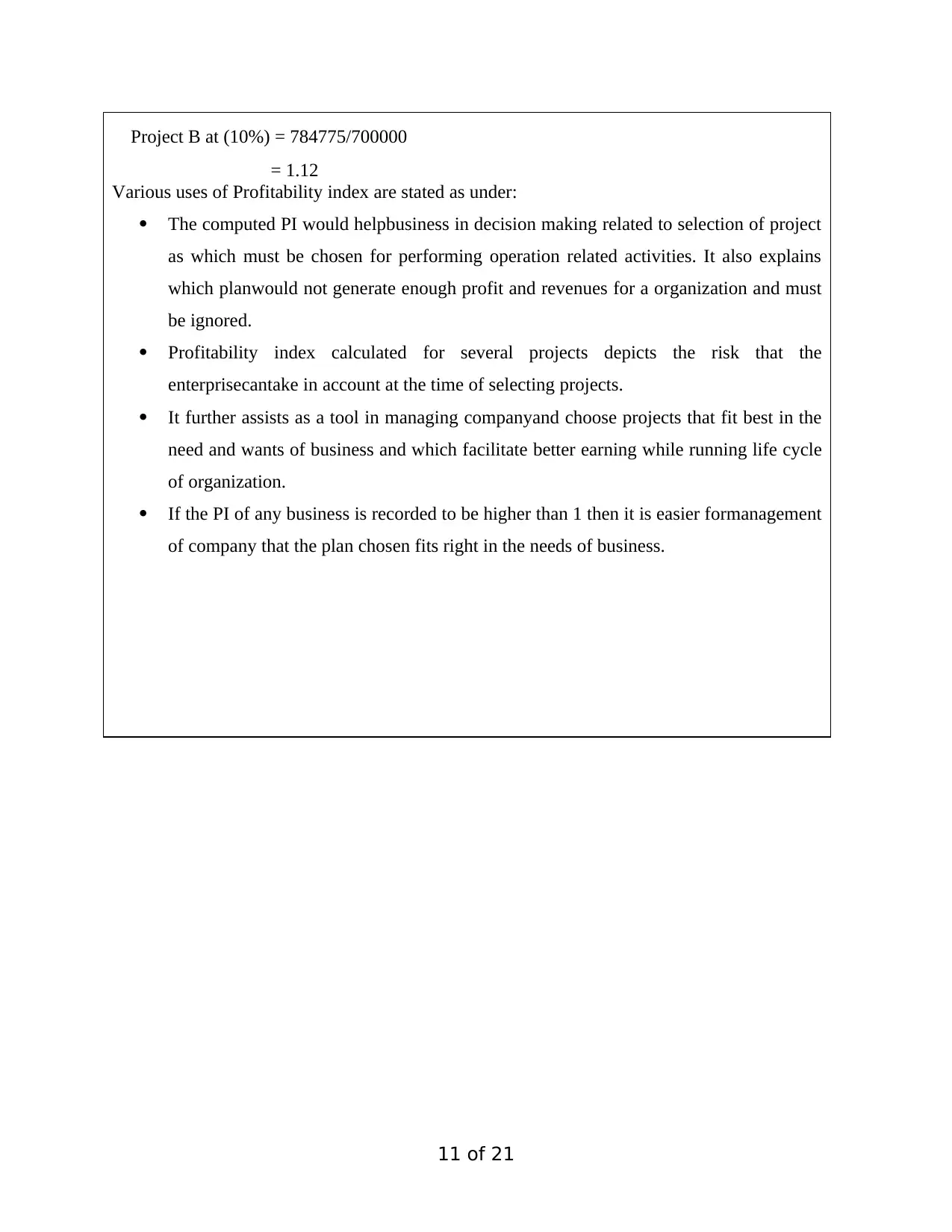
Project B at (10%) = 784775/700000
= 1.12
Various uses of Profitability index are stated as under:
The computed PI would helpbusiness in decision making related to selection of project
as which must be chosen for performing operation related activities. It also explains
which planwould not generate enough profit and revenues for a organization and must
be ignored.
Profitability index calculated for several projects depicts the risk that the
enterprisecantake in account at the time of selecting projects.
It further assists as a tool in managing companyand choose projects that fit best in the
need and wants of business and which facilitate better earning while running life cycle
of organization.
If the PI of any business is recorded to be higher than 1 then it is easier formanagement
of company that the plan chosen fits right in the needs of business.
11 of 21
Document Page
Question 3
(a) Calculation of ratios and discussion of the financial performance of the company between
2019 and 2020.
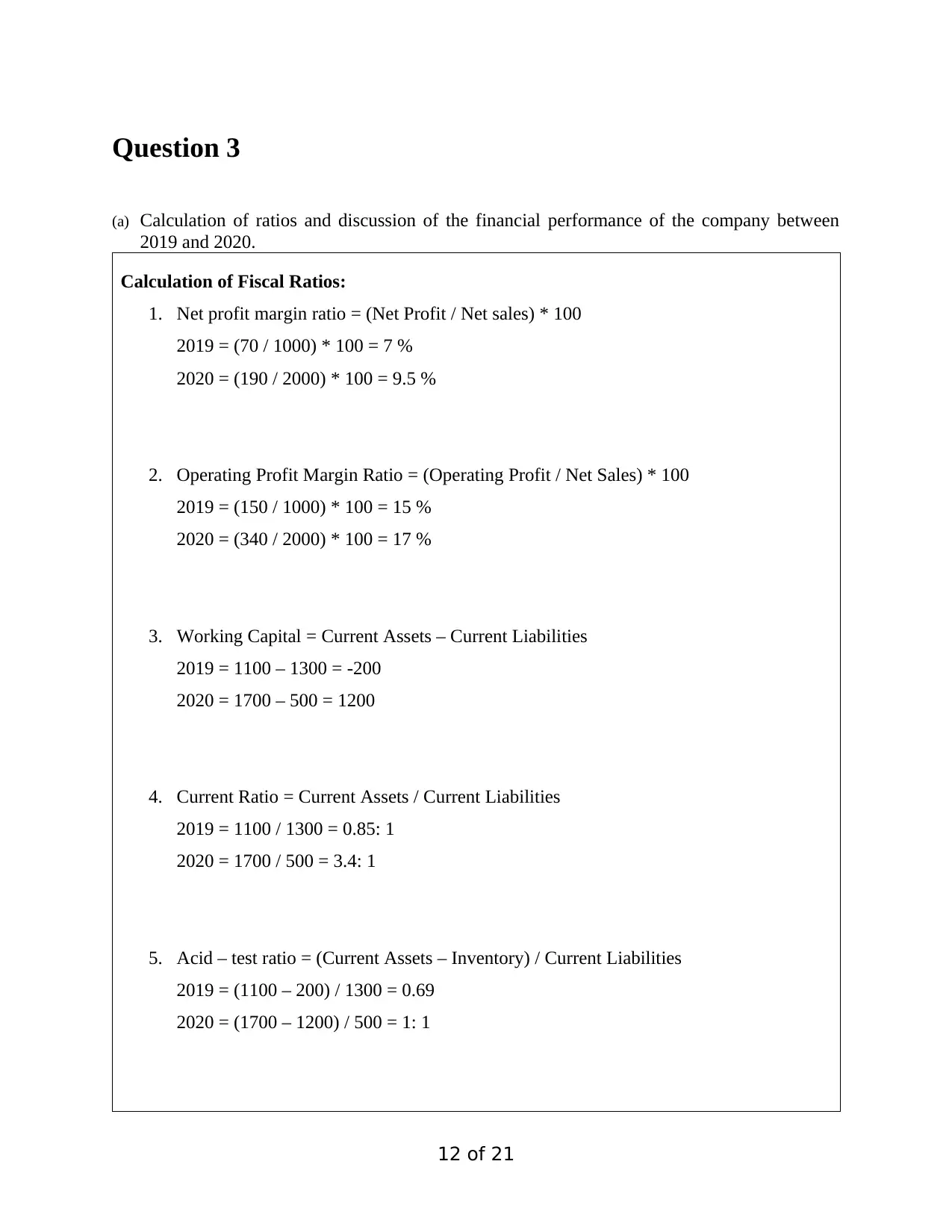
Calculation of Fiscal Ratios:
1. Net profit margin ratio = (Net Profit / Net sales) * 100
2019 = (70 / 1000) * 100 = 7 %
2020 = (190 / 2000) * 100 = 9.5 %
2. Operating Profit Margin Ratio = (Operating Profit / Net Sales) * 100
2019 = (150 / 1000) * 100 = 15 %
2020 = (340 / 2000) * 100 = 17 %
3. Working Capital = Current Assets – Current Liabilities
2019 = 1100 – 1300 = -200
2020 = 1700 – 500 = 1200
4. Current Ratio = Current Assets / Current Liabilities
2019 = 1100 / 1300 = 0.85: 1
2020 = 1700 / 500 = 3.4: 1
5. Acid – test ratio = (Current Assets – Inventory) / Current Liabilities
2019 = (1100 – 200) / 1300 = 0.69
2020 = (1700 – 1200) / 500 = 1: 1
12 of 21
chevron_up_icon
1 out of 21
circle_padding
hide_on_mobile
zoom_out_icon
[object Object]