Financial Reporting Updates and Analysis of Blake Ltd. Statements
VerifiedAdded on 2023/06/15
|12
|1884
|264
Report
AI Summary
This report provides a summary of recent changes in financial reporting, focusing on updates relevant to preparers of general-purpose financial reports for large ASX companies. It covers news, changes, and developments, including technical and political issues. The second part of the report analyzes financial statements prepared for Blake Ltd. by a trainee, highlighting corrections and recommendations based on AASB 101 regulations, which require minimum line items on the balance sheet and profit and loss account, with additional details in the notes. The revised statements and explanations for required changes are provided, addressing aspects such as asset and liability categorization, equity presentation, gross profit and cost of sales display, dividend treatment, and property, plant, and equipment schedules.


Paraphrase This Document
Need a fresh take? Get an instant paraphrase of this document with our AI Paraphraser
1
By student name
Professor
University
Date: 07 March 2018.
1 | P a g e
By student name
Professor
University
Date: 07 March 2018.
1 | P a g e
2
Executive Summary
In the given report, a brief summary of the changes introduced in the financial reporting arean in the
last 4 months needs to be prepared to to enlighten the preparers of general purpose financial reports of
the large companies oin ASX. This will include anys news/changes/deveopments in reporting and their
impact and can include technical as well as political issue. In the 2nd part of the assignment the financial
reports have been prepared by one of the trainees for Blake Ltd., however as per the regulations given
in AASB 101, the directors of the company require minimum line items on the face of both the balance
sheet as well as profit and loss account and the rest to be reported in Notes on accounts. The
corrections, suggestions, recommendations and the revised statements have be prepared and discussed.
2 | P a g e
Executive Summary
In the given report, a brief summary of the changes introduced in the financial reporting arean in the
last 4 months needs to be prepared to to enlighten the preparers of general purpose financial reports of
the large companies oin ASX. This will include anys news/changes/deveopments in reporting and their
impact and can include technical as well as political issue. In the 2nd part of the assignment the financial
reports have been prepared by one of the trainees for Blake Ltd., however as per the regulations given
in AASB 101, the directors of the company require minimum line items on the face of both the balance
sheet as well as profit and loss account and the rest to be reported in Notes on accounts. The
corrections, suggestions, recommendations and the revised statements have be prepared and discussed.
2 | P a g e
⊘ This is a preview!⊘
Do you want full access?
Subscribe today to unlock all pages.

Trusted by 1+ million students worldwide
3
Contents
Question No. 1: Regulatory environment and financial reporting...............................................................4
Introduction.............................................................................................................................................4
Exposure draft for changes in the accounting policies............................................................................4
New Australian accounting standard introduced....................................................................................4
Amendments to the existing Australian accounting standards...............................................................5
Making materiality judgements...............................................................................................................5
Other highlights of changes.....................................................................................................................6
Question No. 2: Financial Statement Presentation......................................................................................7
References.................................................................................................................................................11
3 | P a g e
Contents
Question No. 1: Regulatory environment and financial reporting...............................................................4
Introduction.............................................................................................................................................4
Exposure draft for changes in the accounting policies............................................................................4
New Australian accounting standard introduced....................................................................................4
Amendments to the existing Australian accounting standards...............................................................5
Making materiality judgements...............................................................................................................5
Other highlights of changes.....................................................................................................................6
Question No. 2: Financial Statement Presentation......................................................................................7
References.................................................................................................................................................11
3 | P a g e
Paraphrase This Document
Need a fresh take? Get an instant paraphrase of this document with our AI Paraphraser
4
Question No. 1: Regulatory environment and financial reporting
Introduction
There have been many accounting changes in the accounting arena in the last 4 months including the
reduction in the tax rates and the structure for the small entities, calculation of the defereed tax for the
intangible assets having indefinite life, recognition of the deferred tax assets for unrealised losses of the
entity, increase in the cash flow disclosures, financiual reporting relief for whilly owned entity but the
changes which have took place in the financial reporting include release of the exposure draft for
changes in the accounting policies, introduction of new Australian accounting standard on employee
benefits, amendments to the existing Australian accounting standards, Australian financial reporting for
Charities, etc. some of which are explained below in details (Belton, 2017).
Exposure draft for changes in the accounting policies
This would bring about a change in AASB 108, Accounting policies, changes in the accounting estimates
and errors. This would simplify the procedure a bit and there would a voluntary change in the
accounting policy as a result of decision of the IFRS implementation committee (Alexander, 2016).
New Australian accounting standard introduced
This is on employee benefits named AASB 2018-2 which will be having an impact on all the entities
having defined benefit plan which are planning to change the plans. This AASB standard will give more
clarity on how to measure the defined benefit asset or liability and other such related amounts like past
4 | P a g e
Question No. 1: Regulatory environment and financial reporting
Introduction
There have been many accounting changes in the accounting arena in the last 4 months including the
reduction in the tax rates and the structure for the small entities, calculation of the defereed tax for the
intangible assets having indefinite life, recognition of the deferred tax assets for unrealised losses of the
entity, increase in the cash flow disclosures, financiual reporting relief for whilly owned entity but the
changes which have took place in the financial reporting include release of the exposure draft for
changes in the accounting policies, introduction of new Australian accounting standard on employee
benefits, amendments to the existing Australian accounting standards, Australian financial reporting for
Charities, etc. some of which are explained below in details (Belton, 2017).
Exposure draft for changes in the accounting policies
This would bring about a change in AASB 108, Accounting policies, changes in the accounting estimates
and errors. This would simplify the procedure a bit and there would a voluntary change in the
accounting policy as a result of decision of the IFRS implementation committee (Alexander, 2016).
New Australian accounting standard introduced
This is on employee benefits named AASB 2018-2 which will be having an impact on all the entities
having defined benefit plan which are planning to change the plans. This AASB standard will give more
clarity on how to measure the defined benefit asset or liability and other such related amounts like past
4 | P a g e
5
cost, current service cost, when will the modification has to be done during the reporting period. The
meeting was being held on 23rd March, 2018 and the changes will be effective from 01st Jan, 2019
(Boccia & Leonardi, 2016).
Amendments to the existing Australian accounting standards
Another major change was AASB 3 on Business combinations and AASB 11 on Joint Arrangements with
res[ect to the interest previously being held in the joint operations, implication on the income payment
on the payment of the financial instruments (AASB 112 on income taxes) and computation of the
borrowing cost eligible for capitalisation as per AASB 123 borrowing costs (Das, 2017).
Making materiality judgements
Materiality is judgemental and based on the estimates and opinion of the top management of the
company. Directors, trustees and other responsible stakeholders are the one who make continuous
judgements on the scope of materiality during the preparation and presentation of the financial
statements. AASB practice statement 2 gives a brief and the outline of how the materiality can be
determined and gives practical examples for public sector and non for profit entities. It gives examples
which may help while discussion with the auditors and othe regulators.
5 | P a g e
cost, current service cost, when will the modification has to be done during the reporting period. The
meeting was being held on 23rd March, 2018 and the changes will be effective from 01st Jan, 2019
(Boccia & Leonardi, 2016).
Amendments to the existing Australian accounting standards
Another major change was AASB 3 on Business combinations and AASB 11 on Joint Arrangements with
res[ect to the interest previously being held in the joint operations, implication on the income payment
on the payment of the financial instruments (AASB 112 on income taxes) and computation of the
borrowing cost eligible for capitalisation as per AASB 123 borrowing costs (Das, 2017).
Making materiality judgements
Materiality is judgemental and based on the estimates and opinion of the top management of the
company. Directors, trustees and other responsible stakeholders are the one who make continuous
judgements on the scope of materiality during the preparation and presentation of the financial
statements. AASB practice statement 2 gives a brief and the outline of how the materiality can be
determined and gives practical examples for public sector and non for profit entities. It gives examples
which may help while discussion with the auditors and othe regulators.
5 | P a g e
⊘ This is a preview!⊘
Do you want full access?
Subscribe today to unlock all pages.
Trusted by 1+ million students worldwide
6
Other highlights of changes
The AASB also clarified that the calculation of depreciation based on the revenue streams or the
cash flow of the entity is not acceptable and is not appropriate (Dumay & Baard, 2017).
The amendments also allows the companies to use the equity method while measuring the
investments in the joint ventures, the subsidiaries and the associates while preparing the
separate financial statements.
The IFRS implementation committee also clarified in one of the recent accouncements that
entities should not presume that the intangible asset having the indefinite life can be recovered
through sale if it has not been amortized (Dichev, 2017).
With respect to additional disclosures in the statement of cash flows, it clarified via an
amendment that entities should make a disclosure that enables the users to identify the
changes in the liabilities due to the financing activities (Gooley, 2016). The amendment basically
requires disclosures of changes resulting cash flows such as repayment of borrowings and also
the non cash changes like acquisitions, disposals and exchanges gain or losses that have
remained unrealised.
6 | P a g e
Other highlights of changes
The AASB also clarified that the calculation of depreciation based on the revenue streams or the
cash flow of the entity is not acceptable and is not appropriate (Dumay & Baard, 2017).
The amendments also allows the companies to use the equity method while measuring the
investments in the joint ventures, the subsidiaries and the associates while preparing the
separate financial statements.
The IFRS implementation committee also clarified in one of the recent accouncements that
entities should not presume that the intangible asset having the indefinite life can be recovered
through sale if it has not been amortized (Dichev, 2017).
With respect to additional disclosures in the statement of cash flows, it clarified via an
amendment that entities should make a disclosure that enables the users to identify the
changes in the liabilities due to the financing activities (Gooley, 2016). The amendment basically
requires disclosures of changes resulting cash flows such as repayment of borrowings and also
the non cash changes like acquisitions, disposals and exchanges gain or losses that have
remained unrealised.
6 | P a g e
Paraphrase This Document
Need a fresh take? Get an instant paraphrase of this document with our AI Paraphraser
7
Question No. 2: Financial Statement Presentation
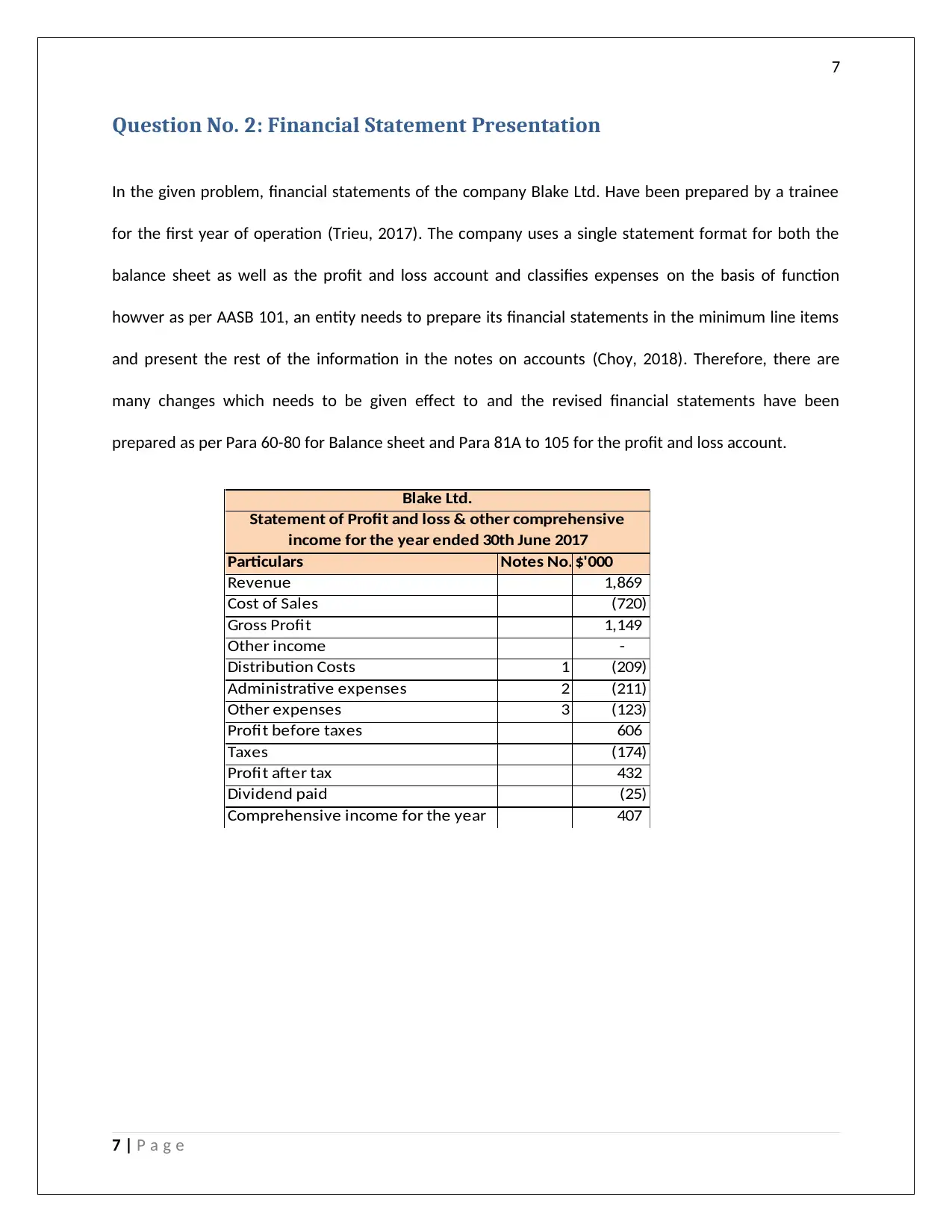
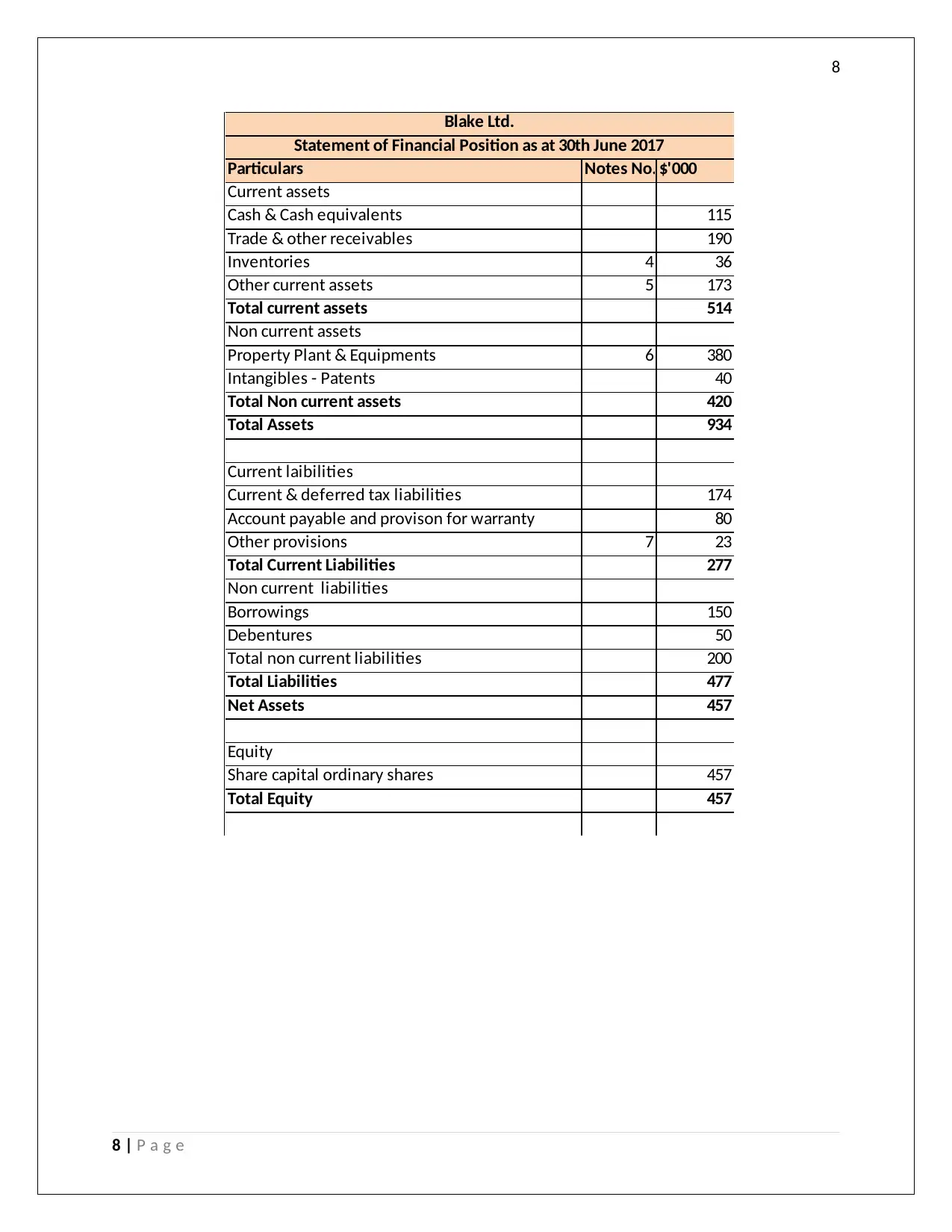
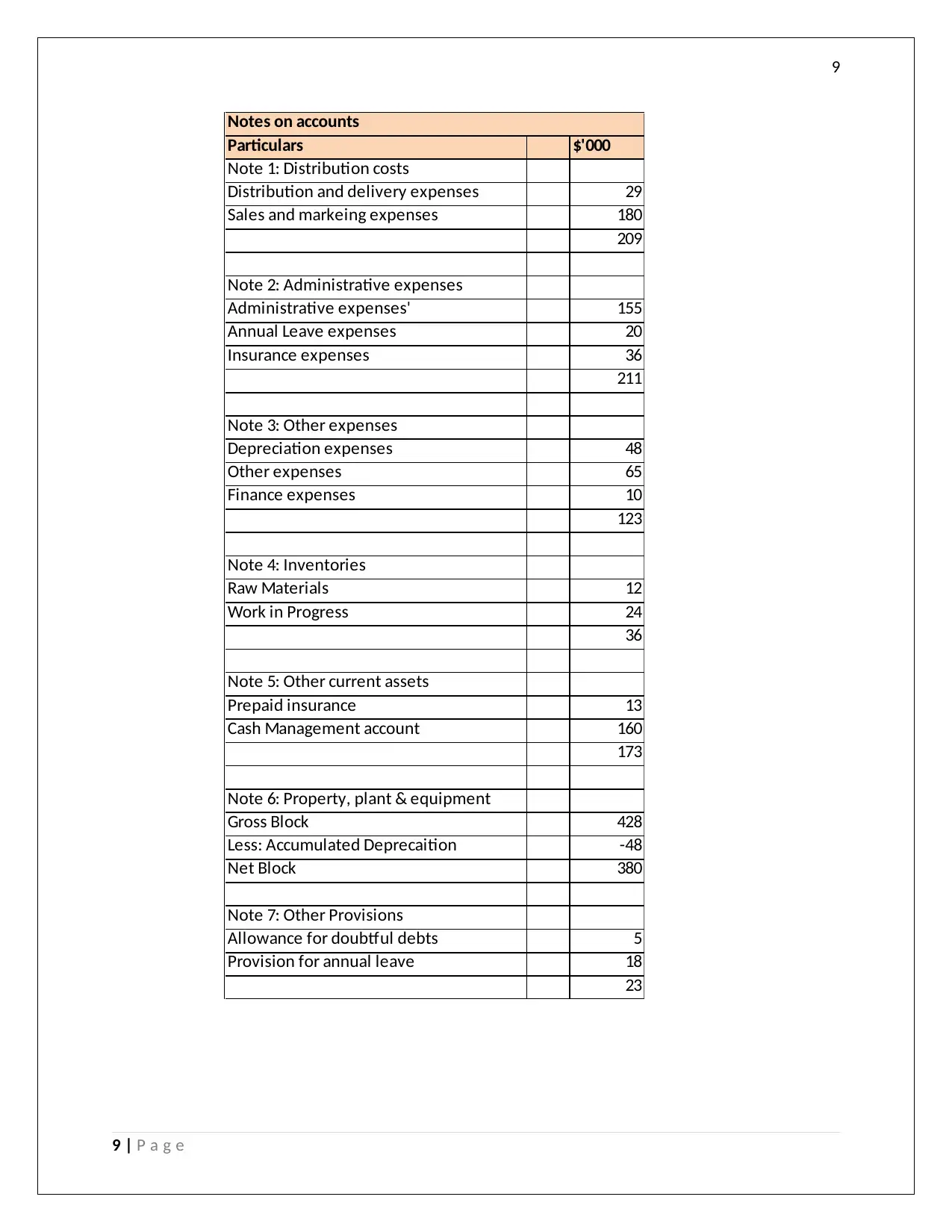
In the given problem, financial statements of the company Blake Ltd. Have been prepared by a trainee
for the first year of operation (Trieu, 2017). The company uses a single statement format for both the
balance sheet as well as the profit and loss account and classifies expenses on the basis of function
howver as per AASB 101, an entity needs to prepare its financial statements in the minimum line items
and present the rest of the information in the notes on accounts (Choy, 2018). Therefore, there are
many changes which needs to be given effect to and the revised financial statements have been
prepared as per Para 60-80 for Balance sheet and Para 81A to 105 for the profit and loss account.
Particulars Notes No. $'000
Revenue 1,869
Cost of Sales (720)
Gross Profit 1,149
Other income -
Distribution Costs 1 (209)
Administrative expenses 2 (211)
Other expenses 3 (123)
Profit before taxes 606
Taxes (174)
Profit after tax 432
Dividend paid (25)
Comprehensive income for the year 407
Blake Ltd.
Statement of Profit and loss & other comprehensive
income for the year ended 30th June 2017
7 | P a g e
Question No. 2: Financial Statement Presentation
In the given problem, financial statements of the company Blake Ltd. Have been prepared by a trainee
for the first year of operation (Trieu, 2017). The company uses a single statement format for both the
balance sheet as well as the profit and loss account and classifies expenses on the basis of function
howver as per AASB 101, an entity needs to prepare its financial statements in the minimum line items
and present the rest of the information in the notes on accounts (Choy, 2018). Therefore, there are
many changes which needs to be given effect to and the revised financial statements have been
prepared as per Para 60-80 for Balance sheet and Para 81A to 105 for the profit and loss account.
Particulars Notes No. $'000
Revenue 1,869
Cost of Sales (720)
Gross Profit 1,149
Other income -
Distribution Costs 1 (209)
Administrative expenses 2 (211)
Other expenses 3 (123)
Profit before taxes 606
Taxes (174)
Profit after tax 432
Dividend paid (25)
Comprehensive income for the year 407
Blake Ltd.
Statement of Profit and loss & other comprehensive
income for the year ended 30th June 2017
7 | P a g e
8
Particulars Notes No. $'000
Current assets
Cash & Cash equivalents 115
Trade & other receivables 190
Inventories 4 36
Other current assets 5 173
Total current assets 514
Non current assets
Property Plant & Equipments 6 380
Intangibles - Patents 40
Total Non current assets 420
Total Assets 934
Current laibilities
Current & deferred tax liabilities 174
Account payable and provison for warranty 80
Other provisions 7 23
Total Current Liabilities 277
Non current liabilities
Borrowings 150
Debentures 50
Total non current liabilities 200
Total Liabilities 477
Net Assets 457
Equity
Share capital ordinary shares 457
Total Equity 457
Blake Ltd.
Statement of Financial Position as at 30th June 2017
8 | P a g e
Particulars Notes No. $'000
Current assets
Cash & Cash equivalents 115
Trade & other receivables 190
Inventories 4 36
Other current assets 5 173
Total current assets 514
Non current assets
Property Plant & Equipments 6 380
Intangibles - Patents 40
Total Non current assets 420
Total Assets 934
Current laibilities
Current & deferred tax liabilities 174
Account payable and provison for warranty 80
Other provisions 7 23
Total Current Liabilities 277
Non current liabilities
Borrowings 150
Debentures 50
Total non current liabilities 200
Total Liabilities 477
Net Assets 457
Equity
Share capital ordinary shares 457
Total Equity 457
Blake Ltd.
Statement of Financial Position as at 30th June 2017
8 | P a g e
⊘ This is a preview!⊘
Do you want full access?
Subscribe today to unlock all pages.
Trusted by 1+ million students worldwide
9
Particulars $'000
Note 1: Distribution costs
Distribution and delivery expenses 29
Sales and markeing expenses 180
209
Note 2: Administrative expenses
Administrative expenses' 155
Annual Leave expenses 20
Insurance expenses 36
211
Note 3: Other expenses
Depreciation expenses 48
Other expenses 65
Finance expenses 10
123
Note 4: Inventories
Raw Materials 12
Work in Progress 24
36
Note 5: Other current assets
Prepaid insurance 13
Cash Management account 160
173
Note 6: Property, plant & equipment
Gross Block 428
Less: Accumulated Deprecaition -48
Net Block 380
Note 7: Other Provisions
Allowance for doubtful debts 5
Provision for annual leave 18
23
Notes on accounts
9 | P a g e
Particulars $'000
Note 1: Distribution costs
Distribution and delivery expenses 29
Sales and markeing expenses 180
209
Note 2: Administrative expenses
Administrative expenses' 155
Annual Leave expenses 20
Insurance expenses 36
211
Note 3: Other expenses
Depreciation expenses 48
Other expenses 65
Finance expenses 10
123
Note 4: Inventories
Raw Materials 12
Work in Progress 24
36
Note 5: Other current assets
Prepaid insurance 13
Cash Management account 160
173
Note 6: Property, plant & equipment
Gross Block 428
Less: Accumulated Deprecaition -48
Net Block 380
Note 7: Other Provisions
Allowance for doubtful debts 5
Provision for annual leave 18
23
Notes on accounts
9 | P a g e
Paraphrase This Document
Need a fresh take? Get an instant paraphrase of this document with our AI Paraphraser
10
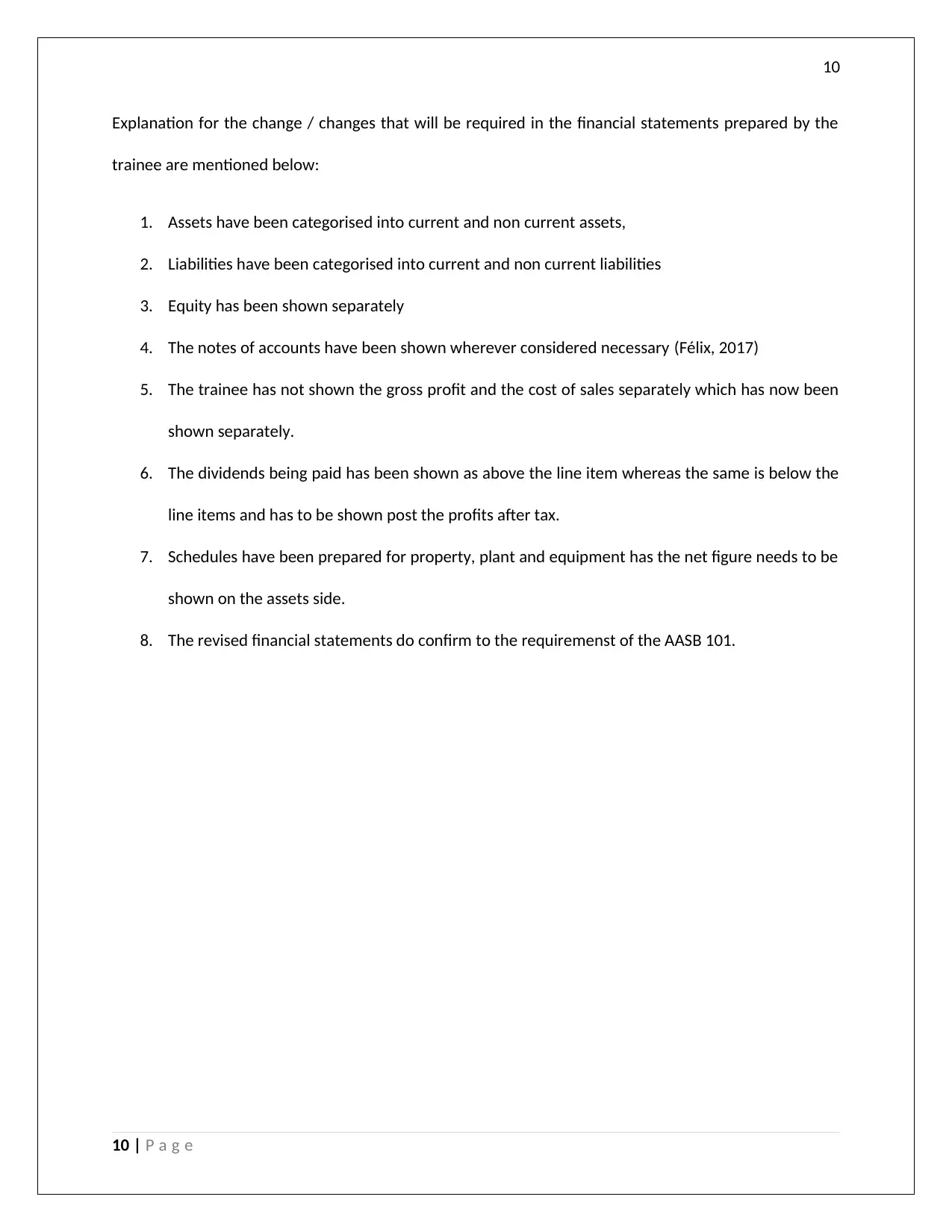
Explanation for the change / changes that will be required in the financial statements prepared by the
trainee are mentioned below:
1. Assets have been categorised into current and non current assets,
2. Liabilities have been categorised into current and non current liabilities
3. Equity has been shown separately
4. The notes of accounts have been shown wherever considered necessary (Félix, 2017)
5. The trainee has not shown the gross profit and the cost of sales separately which has now been
shown separately.
6. The dividends being paid has been shown as above the line item whereas the same is below the
line items and has to be shown post the profits after tax.
7. Schedules have been prepared for property, plant and equipment has the net figure needs to be
shown on the assets side.
8. The revised financial statements do confirm to the requiremenst of the AASB 101.
10 | P a g e
Explanation for the change / changes that will be required in the financial statements prepared by the
trainee are mentioned below:
1. Assets have been categorised into current and non current assets,
2. Liabilities have been categorised into current and non current liabilities
3. Equity has been shown separately
4. The notes of accounts have been shown wherever considered necessary (Félix, 2017)
5. The trainee has not shown the gross profit and the cost of sales separately which has now been
shown separately.
6. The dividends being paid has been shown as above the line item whereas the same is below the
line items and has to be shown post the profits after tax.
7. Schedules have been prepared for property, plant and equipment has the net figure needs to be
shown on the assets side.
8. The revised financial statements do confirm to the requiremenst of the AASB 101.
10 | P a g e
11
References
Alexander, F. (2016). The Changing Face of Accountability. The Journal of Higher Education, 71(4), 411-
431.
Belton, P. (2017). Competitive Strategy: Creating and Sustaining Superior Performance. London: Macat
International ltd. Retrieved from https://www.routledge.com/Competitive-Strategy-Creating-
and-Sustaining-Superior-Performance/Belton/p/book/9781912128808
Boccia, F., & Leonardi, R. (2016). The Challenge of the Digital Economy: Markets, Taxation and
Appropriate Economic Models. Springer.
Choy, Y. K. (2018). Cost-benefit Analysis, Values, Wellbeing and Ethics: An Indigenous Worldview
Analysis. Ecological Economics, 145. Retrieved from
https://doi.org/10.1016/j.ecolecon.2017.08.005
Das, P. (2017). Financing Pattern and Utilization of Fixed Assets - A Study. Asian Journal of Social Science
Studies, 2(2), 10-17.
Dichev, I. (2017). On the conceptual foundations of financial reporting. Accounting and Business
Research, 47(6), 617-632. Retrieved from https://doi.org/10.1080/00014788.2017.1299620
Dumay, J., & Baard, V. (2017). An introduction to interventionist research in accounting. The Routledge
Companion to Qualitative Accounting Research Methods, 265. Retrieved from
https://books.google.co.in/books?
hl=en&lr=&id=PzQlDwAAQBAJ&oi=fnd&pg=PA265&dq=Dumay,+J.,+%26+Baard,+V.+(2017).
+An+introduction+to+interventionist+research+in+accounting.
+The+Routledge+Companion+to+Qualitative+Accounting+Research+Methods,
+265.&ots=ta1isTHB
Félix, M. (2017). A study on the expected impact of IFRS 17 on the transparency of financial statements
of insurance companies. MASTER THESIS, 1-69.
Gooley, J. (2016). Principles of Australian Contract Law. Australia: Lexis Nexis.
Trieu, V. (2017). Getting value from Business Intelligence systems: A review and research agenda.
Decision Support Systems, 93, 111-124.
11 | P a g e
References
Alexander, F. (2016). The Changing Face of Accountability. The Journal of Higher Education, 71(4), 411-
431.
Belton, P. (2017). Competitive Strategy: Creating and Sustaining Superior Performance. London: Macat
International ltd. Retrieved from https://www.routledge.com/Competitive-Strategy-Creating-
and-Sustaining-Superior-Performance/Belton/p/book/9781912128808
Boccia, F., & Leonardi, R. (2016). The Challenge of the Digital Economy: Markets, Taxation and
Appropriate Economic Models. Springer.
Choy, Y. K. (2018). Cost-benefit Analysis, Values, Wellbeing and Ethics: An Indigenous Worldview
Analysis. Ecological Economics, 145. Retrieved from
https://doi.org/10.1016/j.ecolecon.2017.08.005
Das, P. (2017). Financing Pattern and Utilization of Fixed Assets - A Study. Asian Journal of Social Science
Studies, 2(2), 10-17.
Dichev, I. (2017). On the conceptual foundations of financial reporting. Accounting and Business
Research, 47(6), 617-632. Retrieved from https://doi.org/10.1080/00014788.2017.1299620
Dumay, J., & Baard, V. (2017). An introduction to interventionist research in accounting. The Routledge
Companion to Qualitative Accounting Research Methods, 265. Retrieved from
https://books.google.co.in/books?
hl=en&lr=&id=PzQlDwAAQBAJ&oi=fnd&pg=PA265&dq=Dumay,+J.,+%26+Baard,+V.+(2017).
+An+introduction+to+interventionist+research+in+accounting.
+The+Routledge+Companion+to+Qualitative+Accounting+Research+Methods,
+265.&ots=ta1isTHB
Félix, M. (2017). A study on the expected impact of IFRS 17 on the transparency of financial statements
of insurance companies. MASTER THESIS, 1-69.
Gooley, J. (2016). Principles of Australian Contract Law. Australia: Lexis Nexis.
Trieu, V. (2017). Getting value from Business Intelligence systems: A review and research agenda.
Decision Support Systems, 93, 111-124.
11 | P a g e
⊘ This is a preview!⊘
Do you want full access?
Subscribe today to unlock all pages.
Trusted by 1+ million students worldwide

1 out of 12


Related Documents


Your All-in-One AI-Powered Toolkit for Academic Success.
+13062052269
info@desklib.com
Available 24*7 on WhatsApp / Email
![[object Object]](/_next/static/media/star-bottom.7253800d.svg)
Unlock your academic potential
Copyright © 2020–2026 A2Z Services. All Rights Reserved. Developed and managed by ZUCOL.