Financial Accounting Exam: IAS 2, Depreciation, and Reporting Concepts

Verified

Added on  2023/06/07

|8
|1515
|477
Homework Assignment
AI Summary
This assignment presents a comprehensive solution to an online finance exam. The document begins with an overview of the Conceptual Framework, detailing its objectives and key assumptions, followed by definitions of IAS 2 terms, including 'inventories' and 'net realisable value,' and how costs should be measured according to IAS 2. The solution then addresses specific questions related to inventory valuation, including calculations for Sean Morris Plc and Danke Linited. The document also explores the differences between current and non-current assets, capital and revenue expenditures, and depreciation methods, with examples from Joy plc and Tom limited. Finally, the assignment includes journal entries for revaluation of assets and a discussion on the differences between depreciation and amortization. The solution is supported by relevant references.

Document Page
ONLINE EXAM
tabler-icon-diamond-filled.svg

Paraphrase This Document

Need a fresh take? Get an instant paraphrase of this document with our AI Paraphraser
Document Page
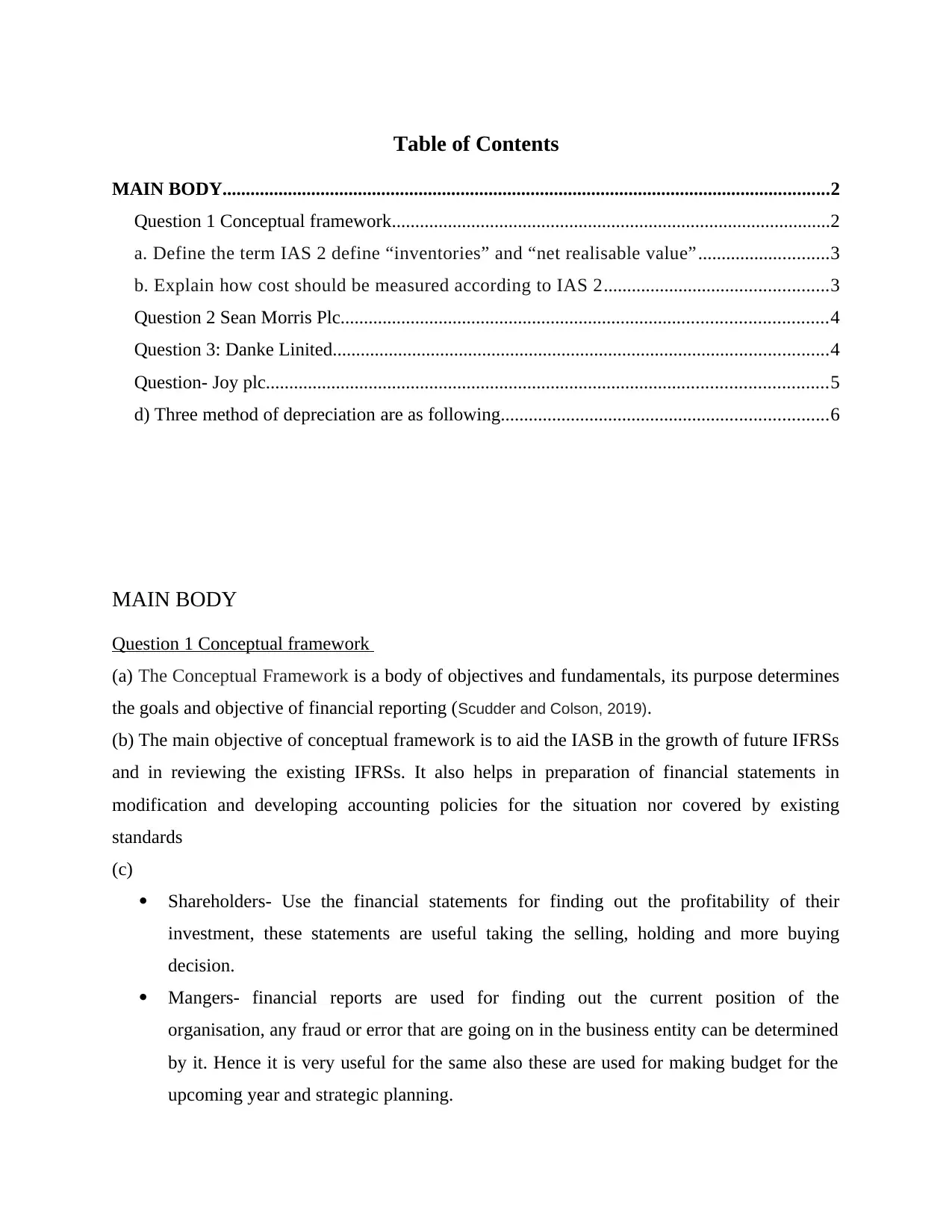
Table of Contents
MAIN BODY..................................................................................................................................2
Question 1 Conceptual framework..............................................................................................2
a. Define the term IAS 2 define “inventories” and “net realisable value”............................3
b. Explain how cost should be measured according to IAS 2................................................3
Question 2 Sean Morris Plc........................................................................................................4
Question 3: Danke Linited..........................................................................................................4
Question- Joy plc........................................................................................................................5
d) Three method of depreciation are as following......................................................................6
MAIN BODY
Question 1 Conceptual framework
(a) The Conceptual Framework is a body of objectives and fundamentals, its purpose determines
the goals and objective of financial reporting (Scudder and Colson, 2019).
(b) The main objective of conceptual framework is to aid the IASB in the growth of future IFRSs
and in reviewing the existing IFRSs. It also helps in preparation of financial statements in
modification and developing accounting policies for the situation nor covered by existing
standards
(c)
Shareholders- Use the financial statements for finding out the profitability of their
investment, these statements are useful taking the selling, holding and more buying
decision.
Mangers- financial reports are used for finding out the current position of the
organisation, any fraud or error that are going on in the business entity can be determined
by it. Hence it is very useful for the same also these are used for making budget for the
upcoming year and strategic planning.
Document Page
Creditor and debtors- To seek the potential and efficiency of the business entity, it helps
in determining whether to continue the business or not.
Staff- The employees seek stability and security in a job, these reports help them to know
about details of the company.
Other parties are financial advisor, analyst, authorities and government they use financial
records of the organisation for their needs and requirements.
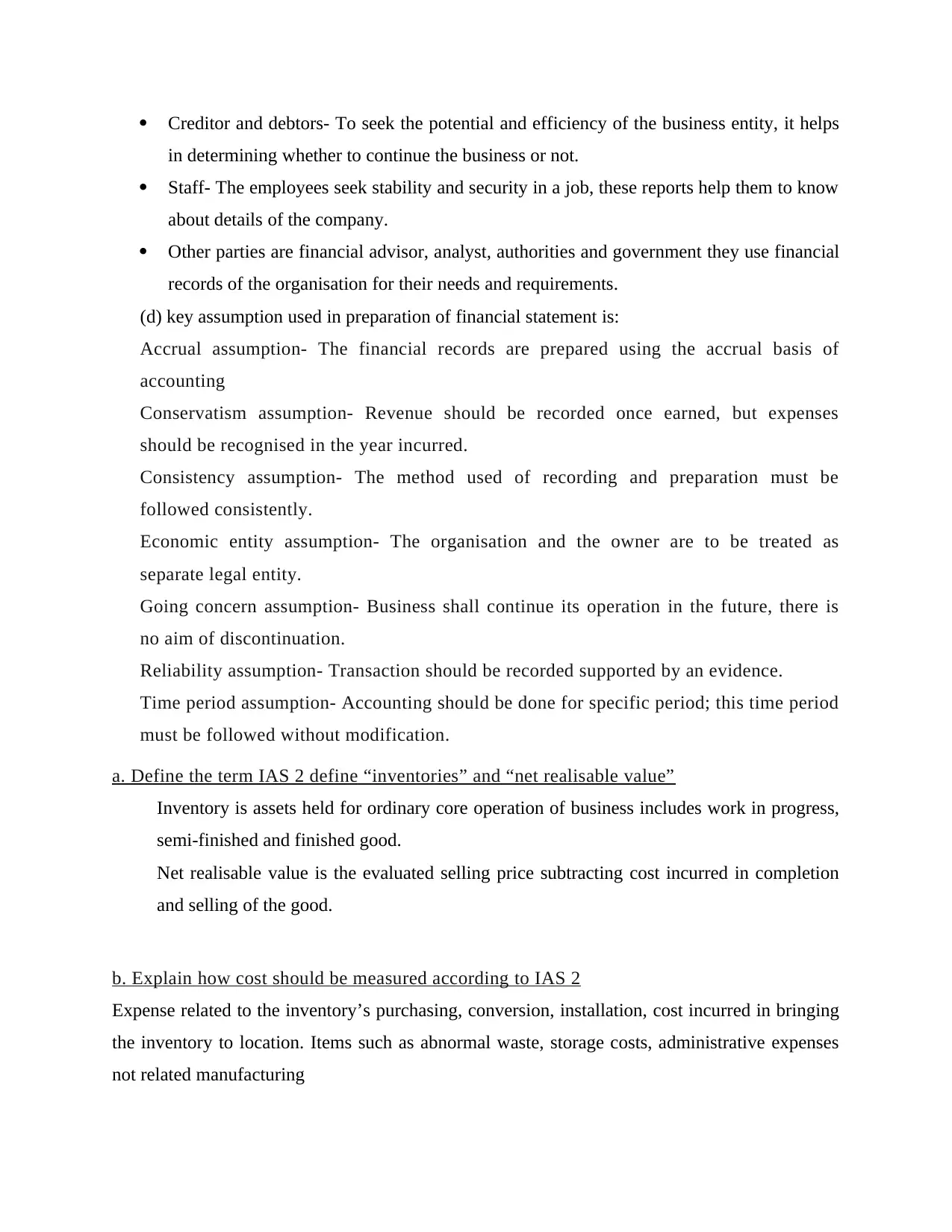
(d) key assumption used in preparation of financial statement is:
Accrual assumption- The financial records are prepared using the accrual basis of
accounting
Conservatism assumption- Revenue should be recorded once earned, but expenses
should be recognised in the year incurred.
Consistency assumption- The method used of recording and preparation must be
followed consistently.
Economic entity assumption- The organisation and the owner are to be treated as
separate legal entity.
Going concern assumption- Business shall continue its operation in the future, there is
no aim of discontinuation.
Reliability assumption- Transaction should be recorded supported by an evidence.
Time period assumption- Accounting should be done for specific period; this time period
must be followed without modification.
a. Define the term IAS 2 define “inventories” and “net realisable value”
Inventory is assets held for ordinary core operation of business includes work in progress,
semi-finished and finished good.
Net realisable value is the evaluated selling price subtracting cost incurred in completion
and selling of the good.
b. Explain how cost should be measured according to IAS 2
Expense related to the inventory’s purchasing, conversion, installation, cost incurred in bringing
the inventory to location. Items such as abnormal waste, storage costs, administrative expenses
not related manufacturing
Document Page
Question 2 Sean Morris Plc
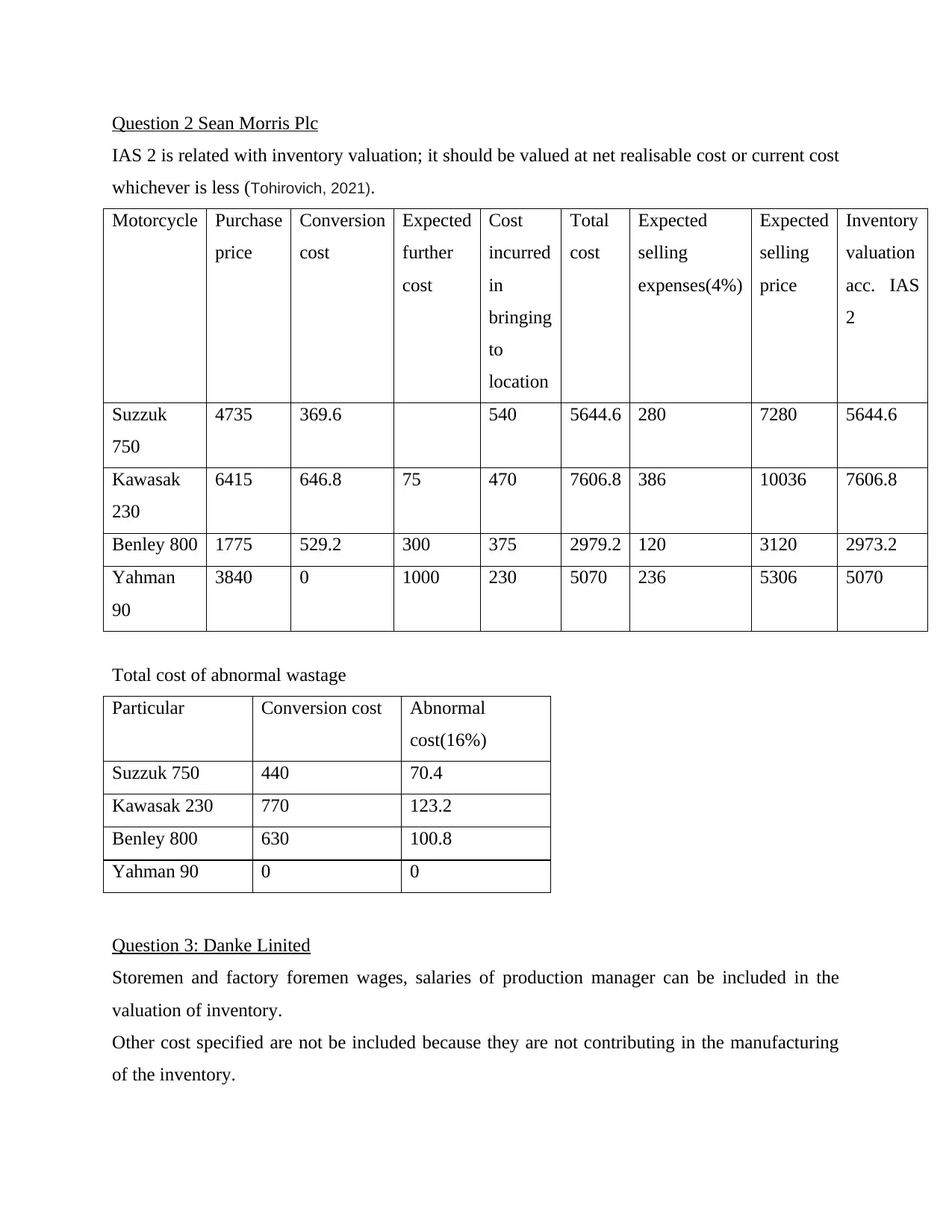
IAS 2 is related with inventory valuation; it should be valued at net realisable cost or current cost
whichever is less (Tohirovich, 2021).
Motorcycle Purchase
price
Conversion
cost
Expected
further
cost
Cost
incurred
in
bringing
to
location
Total
cost
Expected
selling
expenses(4%)
Expected
selling
price
Inventory
valuation
acc. IAS
2
Suzzuk
750
4735 369.6 540 5644.6 280 7280 5644.6
Kawasak
230
6415 646.8 75 470 7606.8 386 10036 7606.8
Benley 800 1775 529.2 300 375 2979.2 120 3120 2973.2
Yahman
90
3840 0 1000 230 5070 236 5306 5070
Total cost of abnormal wastage
Particular Conversion cost Abnormal
cost(16%)
Suzzuk 750 440 70.4
Kawasak 230 770 123.2
Benley 800 630 100.8
Yahman 90 0 0
Question 3: Danke Linited
Storemen and factory foremen wages, salaries of production manager can be included in the
valuation of inventory.
Other cost specified are not be included because they are not contributing in the manufacturing
of the inventory.
tabler-icon-diamond-filled.svg

Paraphrase This Document

Need a fresh take? Get an instant paraphrase of this document with our AI Paraphraser
Document Page
Question- Joy plc
a) Current assets are the possession of the company that can be readily converted into cash
in the market. example; Cash in hand, cash at bank, stock and account receivables. While,
non-current assets are those which cannot be liquidated according to organisation’s need.
Noncurrent assets are long term asset which is held by company for more than 1 year.
Example- heavy equipment, land purchased, investments that are made for than 1 year.
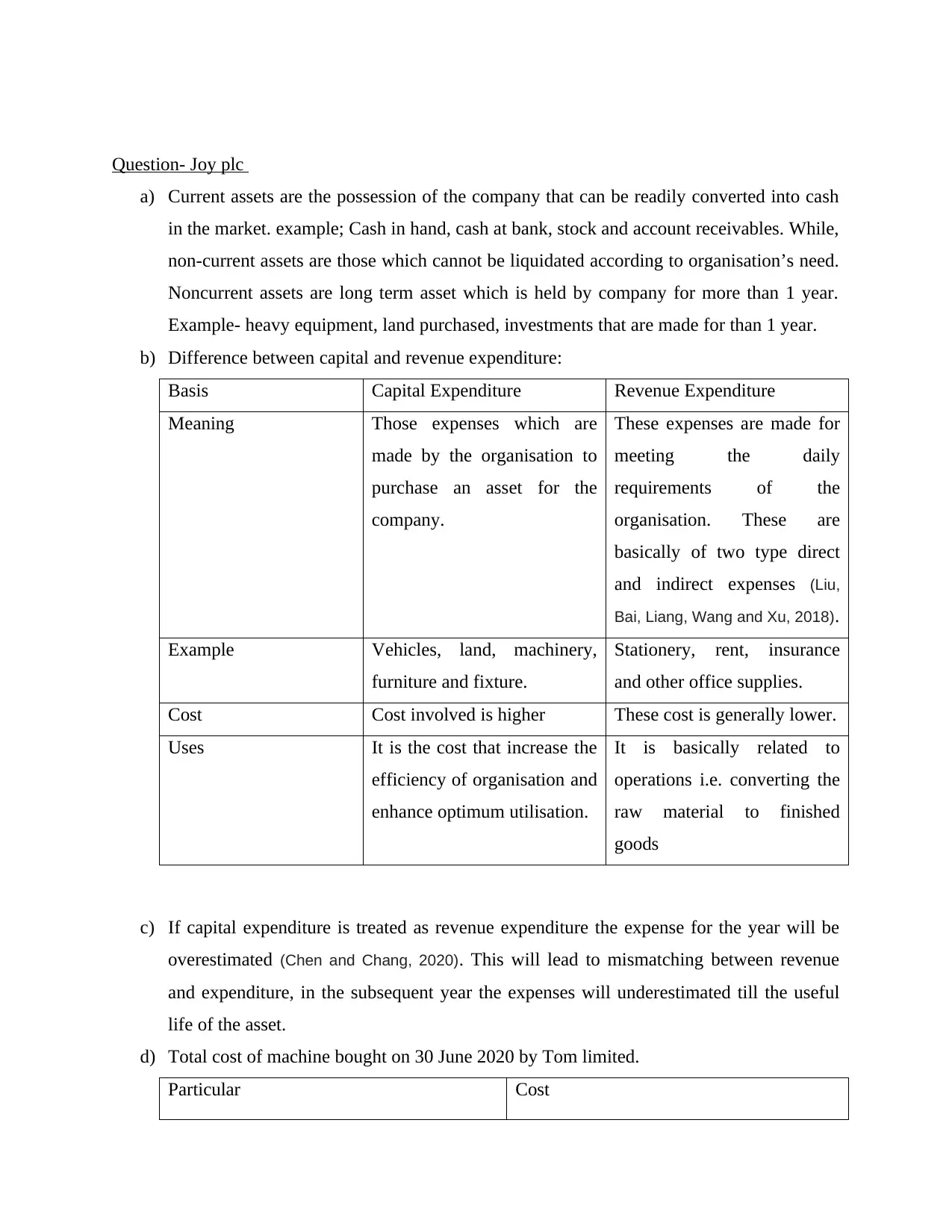
b) Difference between capital and revenue expenditure:
Basis Capital Expenditure Revenue Expenditure
Meaning Those expenses which are
made by the organisation to
purchase an asset for the
company.
These expenses are made for
meeting the daily
requirements of the
organisation. These are
basically of two type direct
and indirect expenses (Liu,
Bai, Liang, Wang and Xu, 2018).
Example Vehicles, land, machinery,
furniture and fixture.
Stationery, rent, insurance
and other office supplies.
Cost Cost involved is higher These cost is generally lower.
Uses It is the cost that increase the
efficiency of organisation and
enhance optimum utilisation.
It is basically related to
operations i.e. converting the
raw material to finished
goods
c) If capital expenditure is treated as revenue expenditure the expense for the year will be
overestimated (Chen and Chang, 2020). This will lead to mismatching between revenue
and expenditure, in the subsequent year the expenses will underestimated till the useful
life of the asset.
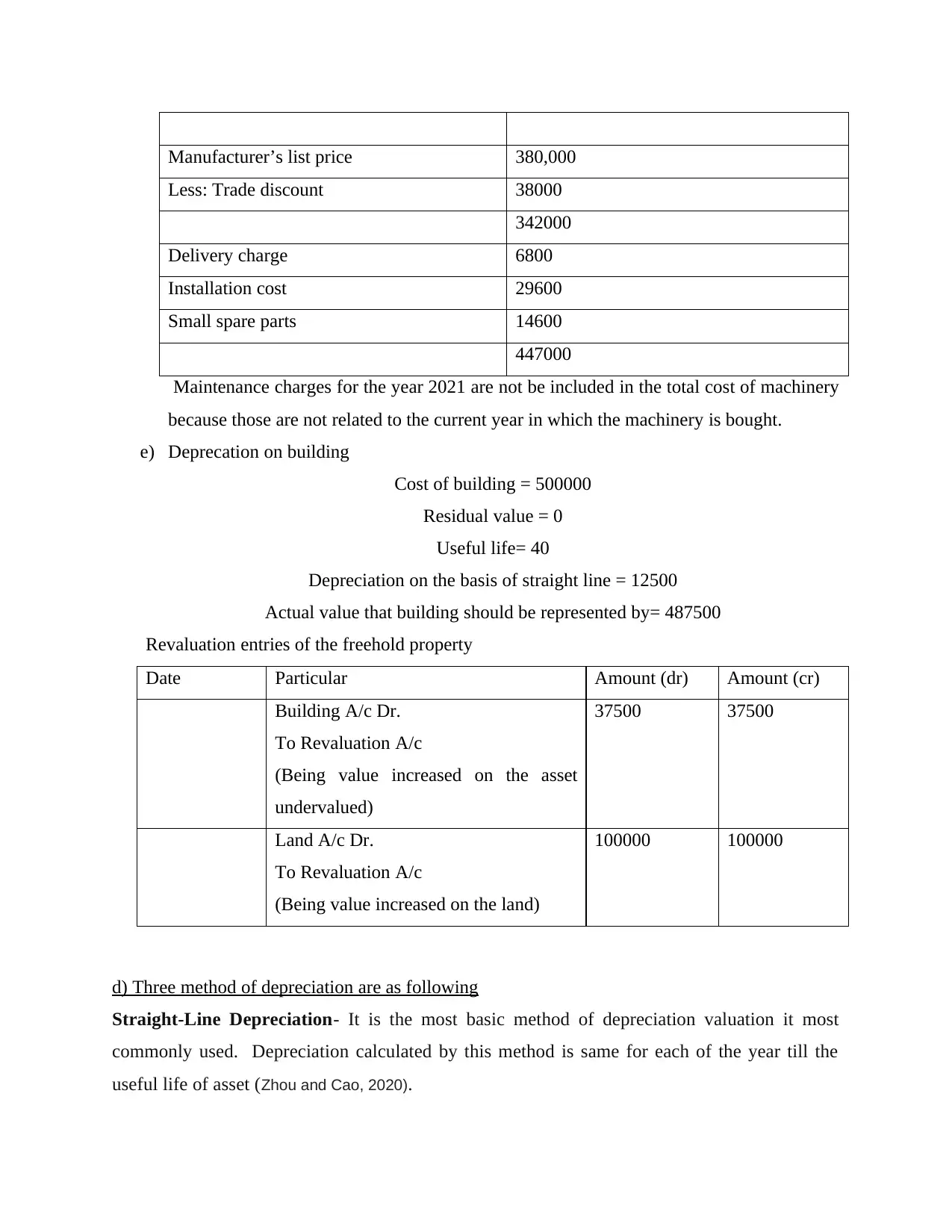
d) Total cost of machine bought on 30 June 2020 by Tom limited.
Particular Cost
Document Page
Manufacturer’s list price 380,000
Less: Trade discount 38000
342000
Delivery charge 6800
Installation cost 29600
Small spare parts 14600
447000
Maintenance charges for the year 2021 are not be included in the total cost of machinery
because those are not related to the current year in which the machinery is bought.
e) Deprecation on building
Cost of building = 500000
Residual value = 0
Useful life= 40
Depreciation on the basis of straight line = 12500
Actual value that building should be represented by= 487500
Revaluation entries of the freehold property
Date Particular Amount (dr) Amount (cr)
Building A/c Dr.
To Revaluation A/c
(Being value increased on the asset
undervalued)
37500 37500
Land A/c Dr.
To Revaluation A/c
(Being value increased on the land)
100000 100000
d) Three method of depreciation are as following
Straight-Line Depreciation- It is the most basic method of depreciation valuation it most
commonly used. Depreciation calculated by this method is same for each of the year till the
useful life of asset (Zhou and Cao, 2020).
Document Page
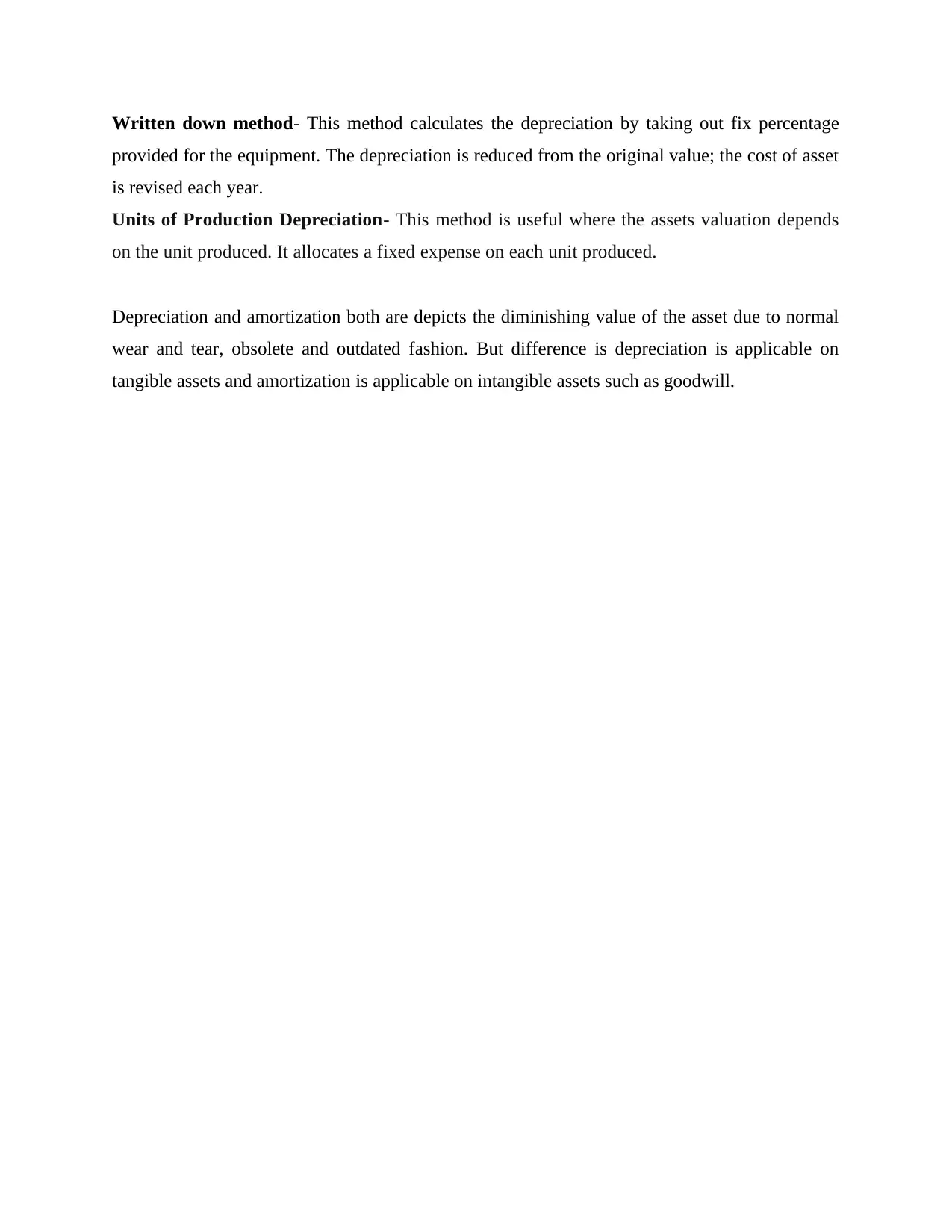
Written down method- This method calculates the depreciation by taking out fix percentage
provided for the equipment. The depreciation is reduced from the original value; the cost of asset
is revised each year.
Units of Production Depreciation- This method is useful where the assets valuation depends
on the unit produced. It allocates a fixed expense on each unit produced.
Depreciation and amortization both are depicts the diminishing value of the asset due to normal
wear and tear, obsolete and outdated fashion. But difference is depreciation is applicable on
tangible assets and amortization is applicable on intangible assets such as goodwill.
tabler-icon-diamond-filled.svg

Paraphrase This Document

Need a fresh take? Get an instant paraphrase of this document with our AI Paraphraser
Document Page
REFERENCES
Books and Journals
Chen, I.F. and Chang, S.C., 2020. Spillover effects of capital expenditure announcements within
business groups. British Journal of Management, 31(4). pp.709-727.
Liu, J., Bai, H., Liang, H., Wang, Y. and Xu, H., 2018. How to recycle the small waste
household appliances in China? A revenue-expenditure analysis. Resources,
Conservation and Recycling, 137. pp.292-301.
Scudder, T. and Colson, E., 2019. From welfare to development: A conceptual framework for the
analysis of dislocated people. In Involuntary migration and resettlement (pp. 267-287).
Routledge.
Tohirovich, Q.N., 2021. International financial accounting standards in
Uzbekistan. ACADEMICIA: An International Multidisciplinary Research
Journal, 11(4). pp.328-333.
Zhou, Y. and Cao, S., 2020. Coordinated multi-criteria framework for cycling aging-based
battery storage management strategies for positive building–vehicle system with
renewable depreciation: Life-cycle based techno-economic feasibility study. Energy
conversion and management, 226. p.113473.
chevron_up_icon
1 out of 8
circle_padding
hide_on_mobile
zoom_out_icon
[object Object]