Financial Reporting Analysis: IFRS, Financial Ratios, and Stakeholders
VerifiedAdded on 2020/07/22
|17
|4508
|325
Report
AI Summary
This report provides a detailed analysis of financial reporting, beginning with an introduction to its context and objectives. It outlines the conceptual and regulatory framework, emphasizing qualitative characteristics that enhance the reliability of financial statements. The report identifies key stakeholders, explaining the benefits of financial information to each group, such as investors, creditors, employees, and shareholders. It assesses the value of financial reporting in meeting organizational objectives and fostering market growth. Furthermore, it presents financial statements, including the income statement, statement of changes in equity, and statement of financial position for ROB plc. The report then interprets the financial performance of Marks & Spencer using various financial ratios and explains the differences between IAS and IFRS, evaluating the advantages of IFRS and factors affecting its compliance worldwide. The report concludes with a summary of the key findings and a list of references.

FINANCIAL REPORTING

Paraphrase This Document
Need a fresh take? Get an instant paraphrase of this document with our AI Paraphraser
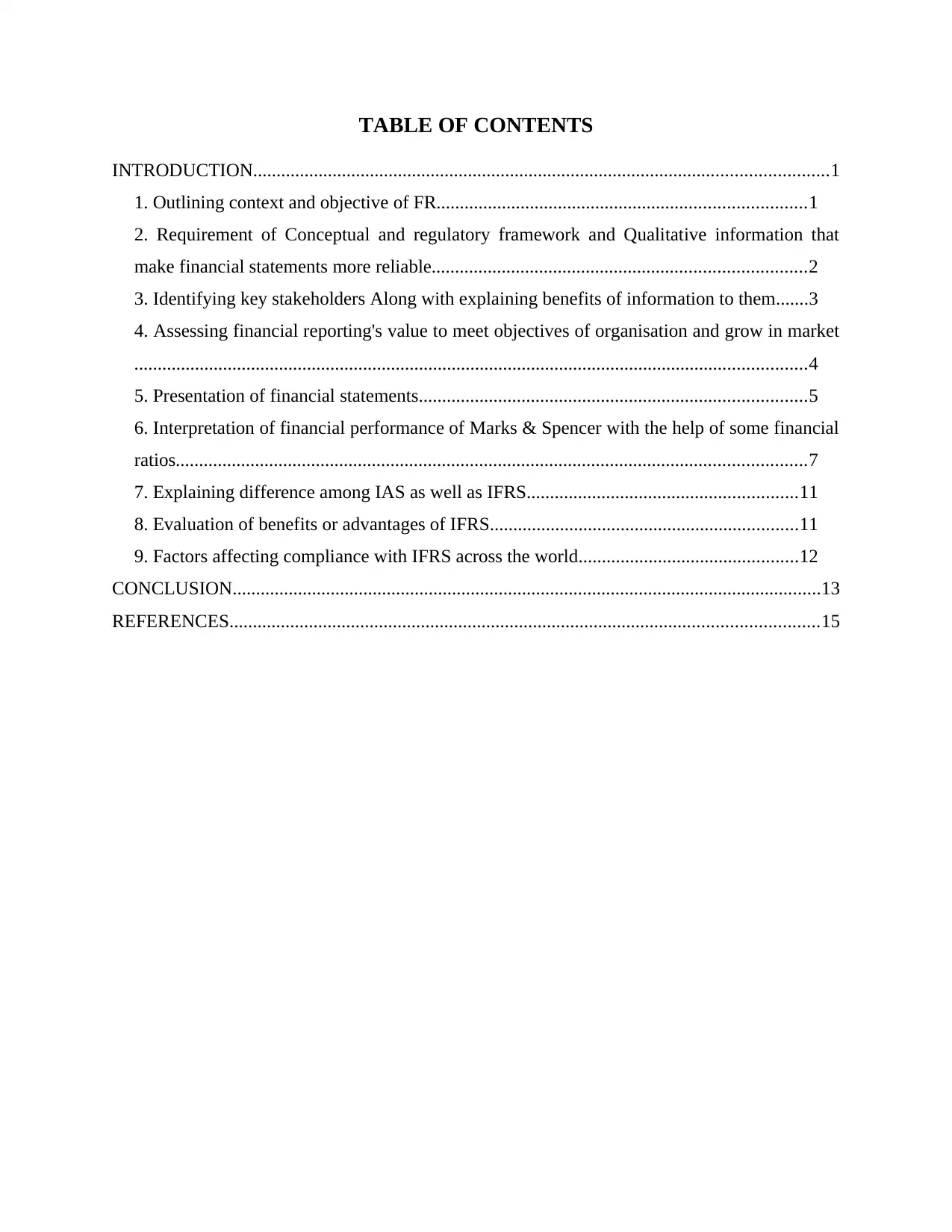
TABLE OF CONTENTS
INTRODUCTION...........................................................................................................................1
1. Outlining context and objective of FR...............................................................................1
2. Requirement of Conceptual and regulatory framework and Qualitative information that
make financial statements more reliable................................................................................2
3. Identifying key stakeholders Along with explaining benefits of information to them.......3
4. Assessing financial reporting's value to meet objectives of organisation and grow in market
................................................................................................................................................4
5. Presentation of financial statements...................................................................................5
6. Interpretation of financial performance of Marks & Spencer with the help of some financial
ratios.......................................................................................................................................7
7. Explaining difference among IAS as well as IFRS..........................................................11
8. Evaluation of benefits or advantages of IFRS..................................................................11
9. Factors affecting compliance with IFRS across the world...............................................12
CONCLUSION..............................................................................................................................13
REFERENCES..............................................................................................................................15
INTRODUCTION...........................................................................................................................1
1. Outlining context and objective of FR...............................................................................1
2. Requirement of Conceptual and regulatory framework and Qualitative information that
make financial statements more reliable................................................................................2
3. Identifying key stakeholders Along with explaining benefits of information to them.......3
4. Assessing financial reporting's value to meet objectives of organisation and grow in market
................................................................................................................................................4
5. Presentation of financial statements...................................................................................5
6. Interpretation of financial performance of Marks & Spencer with the help of some financial
ratios.......................................................................................................................................7
7. Explaining difference among IAS as well as IFRS..........................................................11
8. Evaluation of benefits or advantages of IFRS..................................................................11
9. Factors affecting compliance with IFRS across the world...............................................12
CONCLUSION..............................................................................................................................13
REFERENCES..............................................................................................................................15
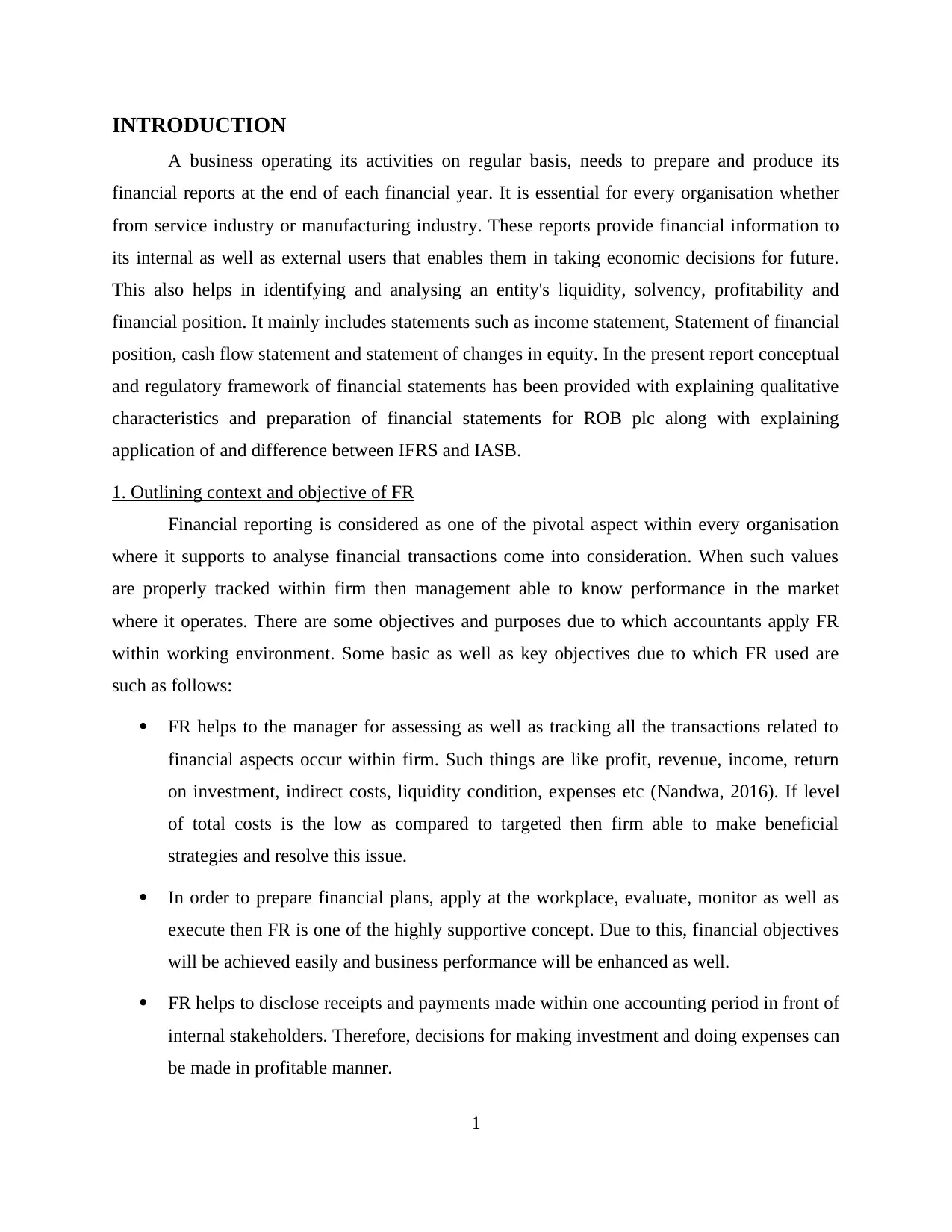
INTRODUCTION
A business operating its activities on regular basis, needs to prepare and produce its
financial reports at the end of each financial year. It is essential for every organisation whether
from service industry or manufacturing industry. These reports provide financial information to
its internal as well as external users that enables them in taking economic decisions for future.
This also helps in identifying and analysing an entity's liquidity, solvency, profitability and
financial position. It mainly includes statements such as income statement, Statement of financial
position, cash flow statement and statement of changes in equity. In the present report conceptual
and regulatory framework of financial statements has been provided with explaining qualitative
characteristics and preparation of financial statements for ROB plc along with explaining
application of and difference between IFRS and IASB.
1. Outlining context and objective of FR
Financial reporting is considered as one of the pivotal aspect within every organisation
where it supports to analyse financial transactions come into consideration. When such values
are properly tracked within firm then management able to know performance in the market
where it operates. There are some objectives and purposes due to which accountants apply FR
within working environment. Some basic as well as key objectives due to which FR used are
such as follows:
FR helps to the manager for assessing as well as tracking all the transactions related to
financial aspects occur within firm. Such things are like profit, revenue, income, return
on investment, indirect costs, liquidity condition, expenses etc (Nandwa, 2016). If level
of total costs is the low as compared to targeted then firm able to make beneficial
strategies and resolve this issue.
In order to prepare financial plans, apply at the workplace, evaluate, monitor as well as
execute then FR is one of the highly supportive concept. Due to this, financial objectives
will be achieved easily and business performance will be enhanced as well.
FR helps to disclose receipts and payments made within one accounting period in front of
internal stakeholders. Therefore, decisions for making investment and doing expenses can
be made in profitable manner.
1
A business operating its activities on regular basis, needs to prepare and produce its
financial reports at the end of each financial year. It is essential for every organisation whether
from service industry or manufacturing industry. These reports provide financial information to
its internal as well as external users that enables them in taking economic decisions for future.
This also helps in identifying and analysing an entity's liquidity, solvency, profitability and
financial position. It mainly includes statements such as income statement, Statement of financial
position, cash flow statement and statement of changes in equity. In the present report conceptual
and regulatory framework of financial statements has been provided with explaining qualitative
characteristics and preparation of financial statements for ROB plc along with explaining
application of and difference between IFRS and IASB.
1. Outlining context and objective of FR
Financial reporting is considered as one of the pivotal aspect within every organisation
where it supports to analyse financial transactions come into consideration. When such values
are properly tracked within firm then management able to know performance in the market
where it operates. There are some objectives and purposes due to which accountants apply FR
within working environment. Some basic as well as key objectives due to which FR used are
such as follows:
FR helps to the manager for assessing as well as tracking all the transactions related to
financial aspects occur within firm. Such things are like profit, revenue, income, return
on investment, indirect costs, liquidity condition, expenses etc (Nandwa, 2016). If level
of total costs is the low as compared to targeted then firm able to make beneficial
strategies and resolve this issue.
In order to prepare financial plans, apply at the workplace, evaluate, monitor as well as
execute then FR is one of the highly supportive concept. Due to this, financial objectives
will be achieved easily and business performance will be enhanced as well.
FR helps to disclose receipts and payments made within one accounting period in front of
internal stakeholders. Therefore, decisions for making investment and doing expenses can
be made in profitable manner.
1
⊘ This is a preview!⊘
Do you want full access?
Subscribe today to unlock all pages.

Trusted by 1+ million students worldwide
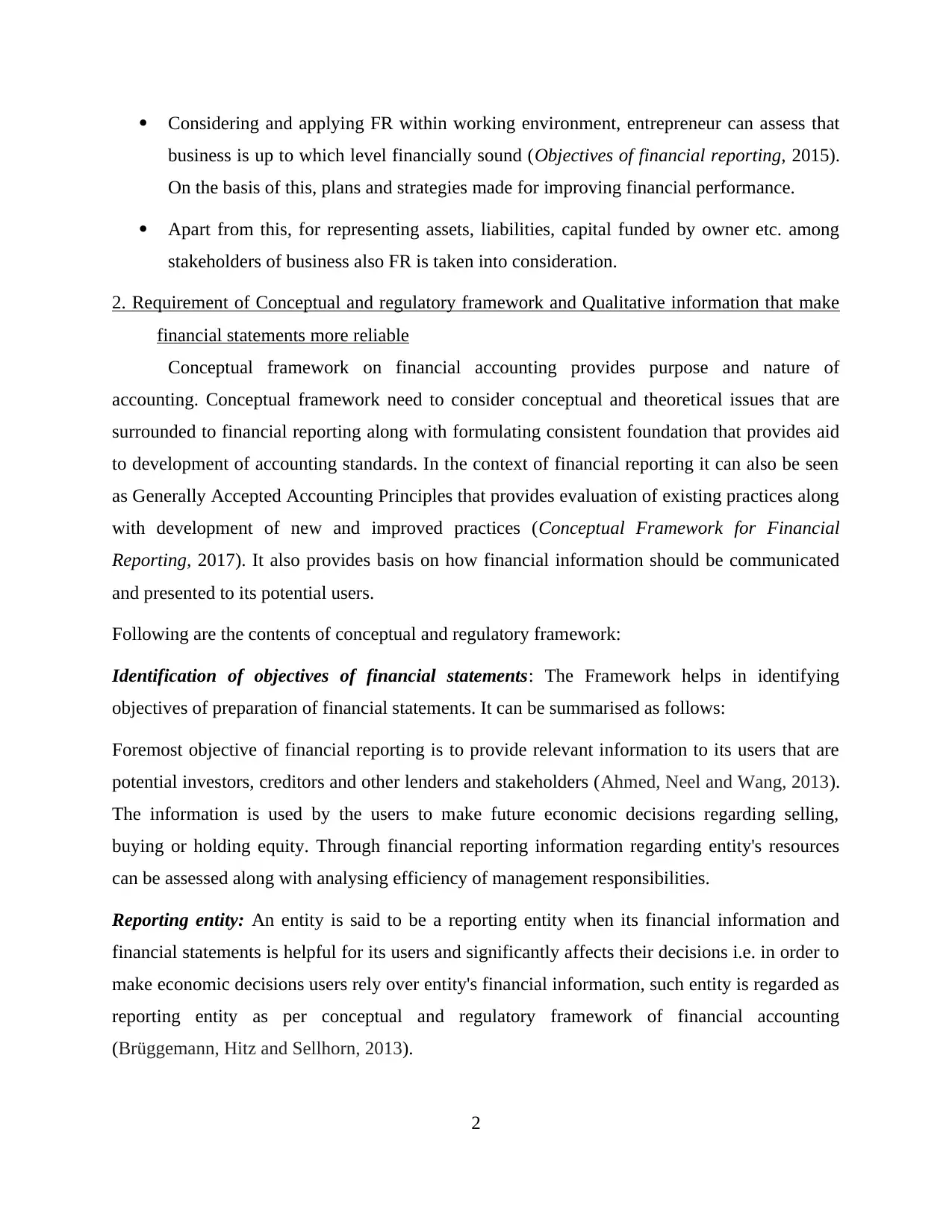
Considering and applying FR within working environment, entrepreneur can assess that
business is up to which level financially sound (Objectives of financial reporting, 2015).
On the basis of this, plans and strategies made for improving financial performance.
Apart from this, for representing assets, liabilities, capital funded by owner etc. among
stakeholders of business also FR is taken into consideration.
2. Requirement of Conceptual and regulatory framework and Qualitative information that make
financial statements more reliable
Conceptual framework on financial accounting provides purpose and nature of
accounting. Conceptual framework need to consider conceptual and theoretical issues that are
surrounded to financial reporting along with formulating consistent foundation that provides aid
to development of accounting standards. In the context of financial reporting it can also be seen
as Generally Accepted Accounting Principles that provides evaluation of existing practices along
with development of new and improved practices (Conceptual Framework for Financial
Reporting, 2017). It also provides basis on how financial information should be communicated
and presented to its potential users.
Following are the contents of conceptual and regulatory framework:
Identification of objectives of financial statements: The Framework helps in identifying
objectives of preparation of financial statements. It can be summarised as follows:
Foremost objective of financial reporting is to provide relevant information to its users that are
potential investors, creditors and other lenders and stakeholders (Ahmed, Neel and Wang, 2013).
The information is used by the users to make future economic decisions regarding selling,
buying or holding equity. Through financial reporting information regarding entity's resources
can be assessed along with analysing efficiency of management responsibilities.
Reporting entity: An entity is said to be a reporting entity when its financial information and
financial statements is helpful for its users and significantly affects their decisions i.e. in order to
make economic decisions users rely over entity's financial information, such entity is regarded as
reporting entity as per conceptual and regulatory framework of financial accounting
(Brüggemann, Hitz and Sellhorn, 2013).
2
business is up to which level financially sound (Objectives of financial reporting, 2015).
On the basis of this, plans and strategies made for improving financial performance.
Apart from this, for representing assets, liabilities, capital funded by owner etc. among
stakeholders of business also FR is taken into consideration.
2. Requirement of Conceptual and regulatory framework and Qualitative information that make
financial statements more reliable
Conceptual framework on financial accounting provides purpose and nature of
accounting. Conceptual framework need to consider conceptual and theoretical issues that are
surrounded to financial reporting along with formulating consistent foundation that provides aid
to development of accounting standards. In the context of financial reporting it can also be seen
as Generally Accepted Accounting Principles that provides evaluation of existing practices along
with development of new and improved practices (Conceptual Framework for Financial
Reporting, 2017). It also provides basis on how financial information should be communicated
and presented to its potential users.
Following are the contents of conceptual and regulatory framework:
Identification of objectives of financial statements: The Framework helps in identifying
objectives of preparation of financial statements. It can be summarised as follows:
Foremost objective of financial reporting is to provide relevant information to its users that are
potential investors, creditors and other lenders and stakeholders (Ahmed, Neel and Wang, 2013).
The information is used by the users to make future economic decisions regarding selling,
buying or holding equity. Through financial reporting information regarding entity's resources
can be assessed along with analysing efficiency of management responsibilities.
Reporting entity: An entity is said to be a reporting entity when its financial information and
financial statements is helpful for its users and significantly affects their decisions i.e. in order to
make economic decisions users rely over entity's financial information, such entity is regarded as
reporting entity as per conceptual and regulatory framework of financial accounting
(Brüggemann, Hitz and Sellhorn, 2013).
2
Paraphrase This Document
Need a fresh take? Get an instant paraphrase of this document with our AI Paraphraser
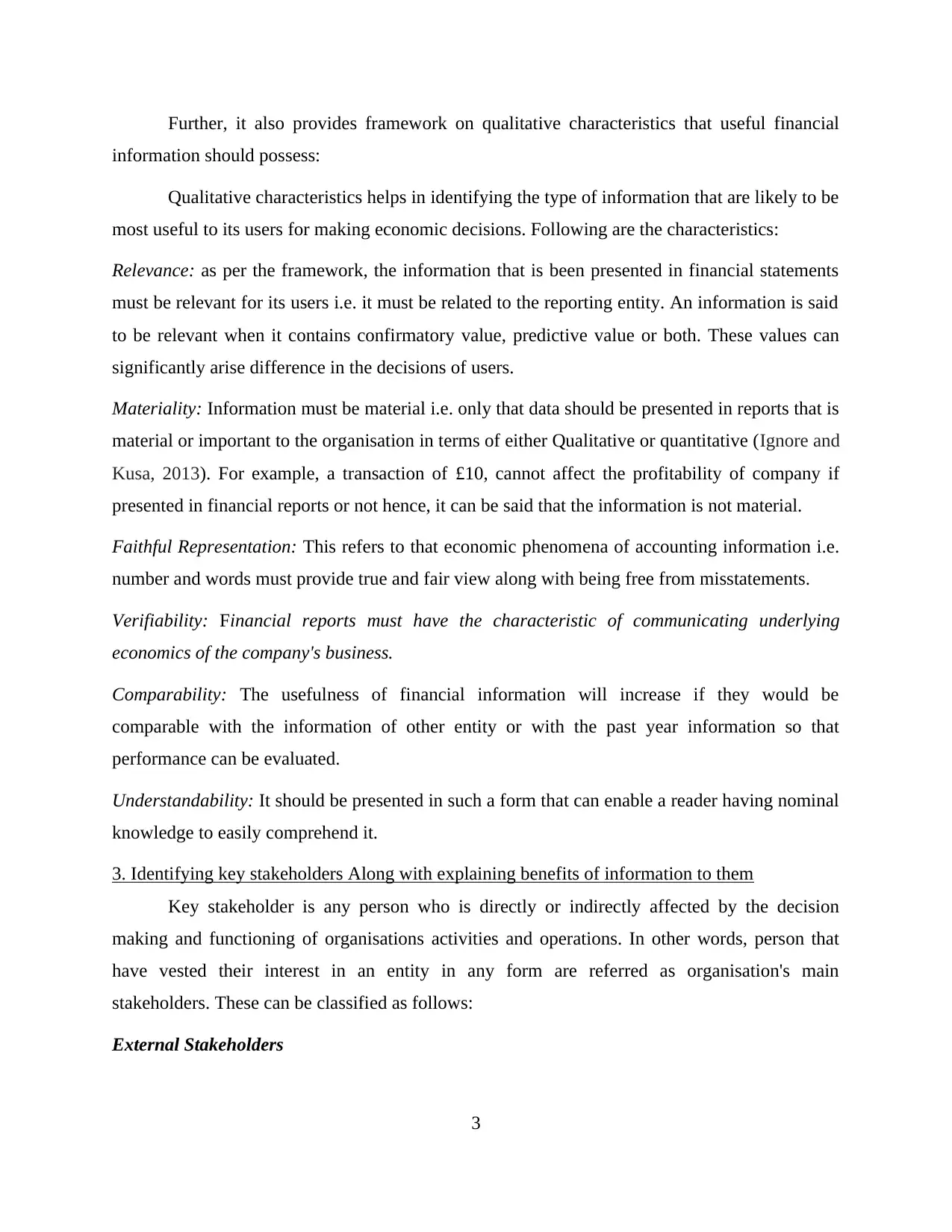
Further, it also provides framework on qualitative characteristics that useful financial
information should possess:
Qualitative characteristics helps in identifying the type of information that are likely to be
most useful to its users for making economic decisions. Following are the characteristics:
Relevance: as per the framework, the information that is been presented in financial statements
must be relevant for its users i.e. it must be related to the reporting entity. An information is said
to be relevant when it contains confirmatory value, predictive value or both. These values can
significantly arise difference in the decisions of users.
Materiality: Information must be material i.e. only that data should be presented in reports that is
material or important to the organisation in terms of either Qualitative or quantitative (Ignore and
Kusa, 2013). For example, a transaction of £10, cannot affect the profitability of company if
presented in financial reports or not hence, it can be said that the information is not material.
Faithful Representation: This refers to that economic phenomena of accounting information i.e.
number and words must provide true and fair view along with being free from misstatements.
Verifiability: Financial reports must have the characteristic of communicating underlying
economics of the company's business.
Comparability: The usefulness of financial information will increase if they would be
comparable with the information of other entity or with the past year information so that
performance can be evaluated.
Understandability: It should be presented in such a form that can enable a reader having nominal
knowledge to easily comprehend it.
3. Identifying key stakeholders Along with explaining benefits of information to them
Key stakeholder is any person who is directly or indirectly affected by the decision
making and functioning of organisations activities and operations. In other words, person that
have vested their interest in an entity in any form are referred as organisation's main
stakeholders. These can be classified as follows:
External Stakeholders
3
information should possess:
Qualitative characteristics helps in identifying the type of information that are likely to be
most useful to its users for making economic decisions. Following are the characteristics:
Relevance: as per the framework, the information that is been presented in financial statements
must be relevant for its users i.e. it must be related to the reporting entity. An information is said
to be relevant when it contains confirmatory value, predictive value or both. These values can
significantly arise difference in the decisions of users.
Materiality: Information must be material i.e. only that data should be presented in reports that is
material or important to the organisation in terms of either Qualitative or quantitative (Ignore and
Kusa, 2013). For example, a transaction of £10, cannot affect the profitability of company if
presented in financial reports or not hence, it can be said that the information is not material.
Faithful Representation: This refers to that economic phenomena of accounting information i.e.
number and words must provide true and fair view along with being free from misstatements.
Verifiability: Financial reports must have the characteristic of communicating underlying
economics of the company's business.
Comparability: The usefulness of financial information will increase if they would be
comparable with the information of other entity or with the past year information so that
performance can be evaluated.
Understandability: It should be presented in such a form that can enable a reader having nominal
knowledge to easily comprehend it.
3. Identifying key stakeholders Along with explaining benefits of information to them
Key stakeholder is any person who is directly or indirectly affected by the decision
making and functioning of organisations activities and operations. In other words, person that
have vested their interest in an entity in any form are referred as organisation's main
stakeholders. These can be classified as follows:
External Stakeholders
3
Creditors and other Investors: These individuals have provided goods on credit basis to the
business entity or have provided their money as loan to the entity (Brigham, 2014.). Therefore,
knowing liquidity position and solvency position of the company is important to them in order to
determine whether t will be able to refund their money within stipulated time.
Local Authority and Government: Government of the country in which the business is operating
is also a key stakeholder in order to determine profitability to secure its taxation revenue. Also,
to ensure that the policies of company is adhered to required regulations and legislations.
Customers: Customers are those stakeholders that can either make or break the company. An
organisation to become successful need to consider expectations and requirements of its
customers along with fulfilling customer satisfaction.
Internal Stakeholders
Employees: Employees are the main pillars of company, without whom a business cannot
operate its functions efficiently (Bonetti, Magnan and Parbonetti, 2016). The only interest they
have vested in company is their salaries. They assess financial information to determine whether
the company is in position to pay off their salaries on time or not.
Shareholders: Shareholders are considered as owners of business they are only interested in
knowing profit earning ability of an entity.
Following are the benefits of financial information to stakeholders:
Identification of earning capacity of business.
To get an idea about company's future plans, tactics and strategies.
To determine the value of assets and liabilities that a business possess.
To determine entity's liquidity, solvency and profitability position.
4. Assessing financial reporting's value to meet objectives of organisation and grow in market
A concept in which various kinds of financial transactions are recorded, analysed and
final accounts are prepared is known as financial reporting. It provides opportunity to managers
as well as accountants for assessing each and every transaction comes into consideration at the
workplace. During this, if any kind of problem or malpractices seen then firm able to make
strategies for resolving it. Considering to financial reporting, the firm able to prepare all the
4
business entity or have provided their money as loan to the entity (Brigham, 2014.). Therefore,
knowing liquidity position and solvency position of the company is important to them in order to
determine whether t will be able to refund their money within stipulated time.
Local Authority and Government: Government of the country in which the business is operating
is also a key stakeholder in order to determine profitability to secure its taxation revenue. Also,
to ensure that the policies of company is adhered to required regulations and legislations.
Customers: Customers are those stakeholders that can either make or break the company. An
organisation to become successful need to consider expectations and requirements of its
customers along with fulfilling customer satisfaction.
Internal Stakeholders
Employees: Employees are the main pillars of company, without whom a business cannot
operate its functions efficiently (Bonetti, Magnan and Parbonetti, 2016). The only interest they
have vested in company is their salaries. They assess financial information to determine whether
the company is in position to pay off their salaries on time or not.
Shareholders: Shareholders are considered as owners of business they are only interested in
knowing profit earning ability of an entity.
Following are the benefits of financial information to stakeholders:
Identification of earning capacity of business.
To get an idea about company's future plans, tactics and strategies.
To determine the value of assets and liabilities that a business possess.
To determine entity's liquidity, solvency and profitability position.
4. Assessing financial reporting's value to meet objectives of organisation and grow in market
A concept in which various kinds of financial transactions are recorded, analysed and
final accounts are prepared is known as financial reporting. It provides opportunity to managers
as well as accountants for assessing each and every transaction comes into consideration at the
workplace. During this, if any kind of problem or malpractices seen then firm able to make
strategies for resolving it. Considering to financial reporting, the firm able to prepare all the
4
⊘ This is a preview!⊘
Do you want full access?
Subscribe today to unlock all pages.
Trusted by 1+ million students worldwide
accounts properly along with in the appropriate structure (Ball, Jayaraman and Shivakumar,
2012).
Once the financials are appropriately structured then performance of whole business can
be easily determined in the industry where it has presence. Due to this specific procedure, actual
business performance can be interpreted where correction actions taken, if required then. On the
basis of this, management able to meet aims and objectives which are prepared while preparing
financial plans or operating in the market. For instance: with the help of financial reporting, firm
able to known profitability position along with making comparison with the last accounting
period. Herein, if low or negligible growth evaluated then strategies for managing cost and
enhancing profit will be applied. Therefore, objectives will be achieved easily which is clear sign
of grow in the market.
5. Presentation of financial statements
Income Statement
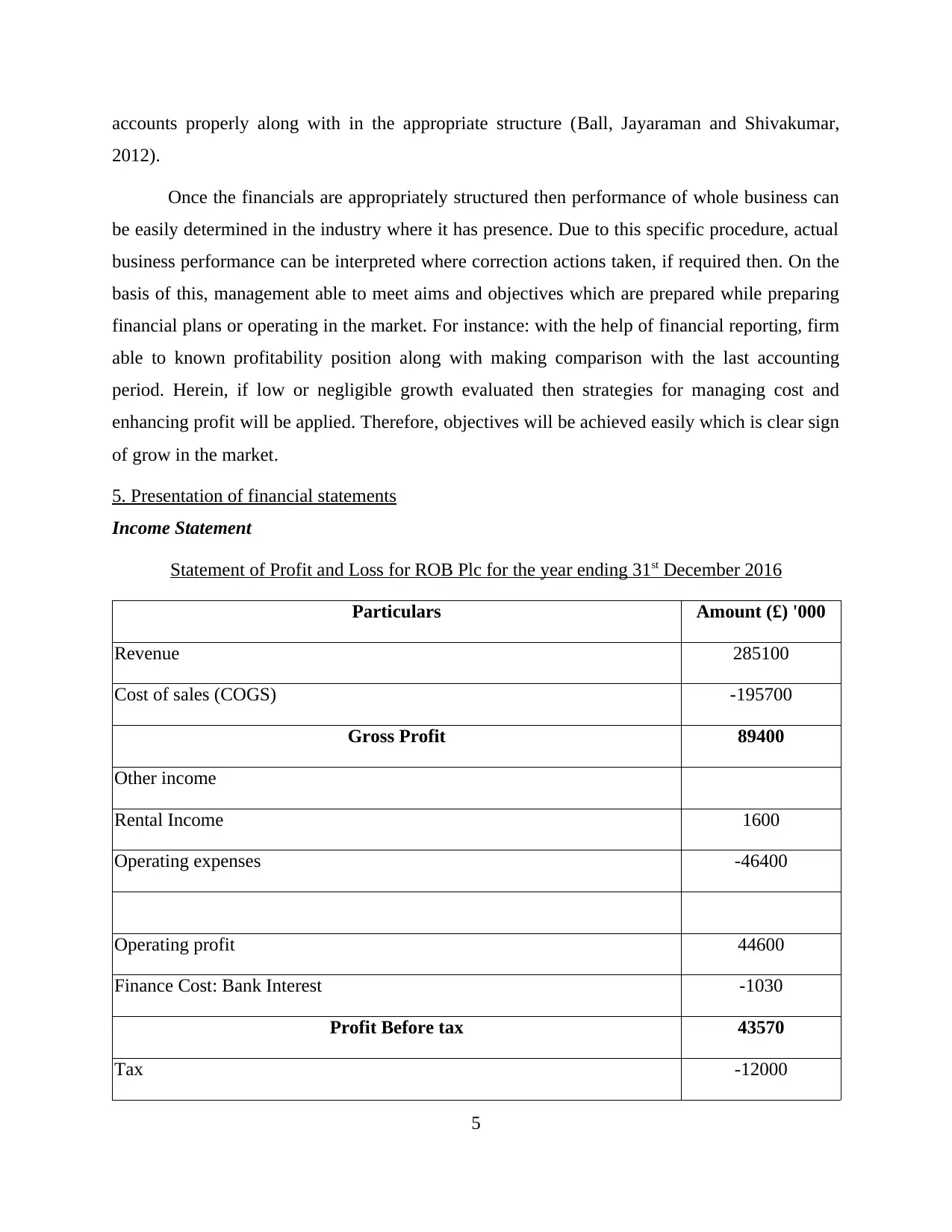
Statement of Profit and Loss for ROB Plc for the year ending 31st December 2016
Particulars Amount (£) '000
Revenue 285100
Cost of sales (COGS) -195700
Gross Profit 89400
Other income
Rental Income 1600
Operating expenses -46400
Operating profit 44600
Finance Cost: Bank Interest -1030
Profit Before tax 43570
Tax -12000
5
2012).
Once the financials are appropriately structured then performance of whole business can
be easily determined in the industry where it has presence. Due to this specific procedure, actual
business performance can be interpreted where correction actions taken, if required then. On the
basis of this, management able to meet aims and objectives which are prepared while preparing
financial plans or operating in the market. For instance: with the help of financial reporting, firm
able to known profitability position along with making comparison with the last accounting
period. Herein, if low or negligible growth evaluated then strategies for managing cost and
enhancing profit will be applied. Therefore, objectives will be achieved easily which is clear sign
of grow in the market.
5. Presentation of financial statements
Income Statement
Statement of Profit and Loss for ROB Plc for the year ending 31st December 2016
Particulars Amount (£) '000
Revenue 285100
Cost of sales (COGS) -195700
Gross Profit 89400
Other income
Rental Income 1600
Operating expenses -46400
Operating profit 44600
Finance Cost: Bank Interest -1030
Profit Before tax 43570
Tax -12000
5
Paraphrase This Document
Need a fresh take? Get an instant paraphrase of this document with our AI Paraphraser
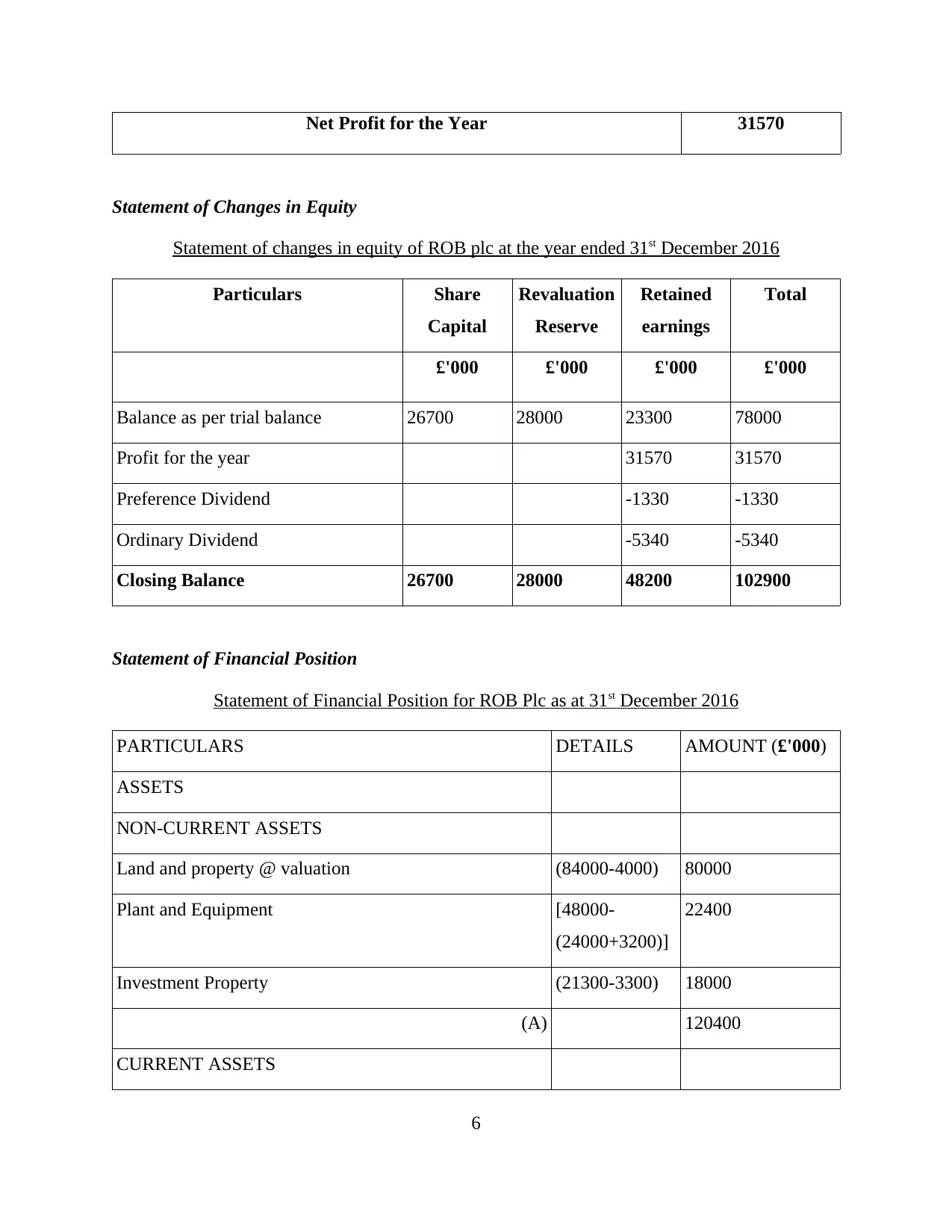
Net Profit for the Year 31570
Statement of Changes in Equity
Statement of changes in equity of ROB plc at the year ended 31st December 2016
Particulars Share
Capital
Revaluation
Reserve
Retained
earnings
Total
£'000 £'000 £'000 £'000
Balance as per trial balance 26700 28000 23300 78000
Profit for the year 31570 31570
Preference Dividend -1330 -1330
Ordinary Dividend -5340 -5340
Closing Balance 26700 28000 48200 102900
Statement of Financial Position
Statement of Financial Position for ROB Plc as at 31st December 2016
PARTICULARS DETAILS AMOUNT (£'000)
ASSETS
NON-CURRENT ASSETS
Land and property @ valuation (84000-4000) 80000
Plant and Equipment [48000-
(24000+3200)]
22400
Investment Property (21300-3300) 18000
(A) 120400
CURRENT ASSETS
6
Statement of Changes in Equity
Statement of changes in equity of ROB plc at the year ended 31st December 2016
Particulars Share
Capital
Revaluation
Reserve
Retained
earnings
Total
£'000 £'000 £'000 £'000
Balance as per trial balance 26700 28000 23300 78000
Profit for the year 31570 31570
Preference Dividend -1330 -1330
Ordinary Dividend -5340 -5340
Closing Balance 26700 28000 48200 102900
Statement of Financial Position
Statement of Financial Position for ROB Plc as at 31st December 2016
PARTICULARS DETAILS AMOUNT (£'000)
ASSETS
NON-CURRENT ASSETS
Land and property @ valuation (84000-4000) 80000
Plant and Equipment [48000-
(24000+3200)]
22400
Investment Property (21300-3300) 18000
(A) 120400
CURRENT ASSETS
6
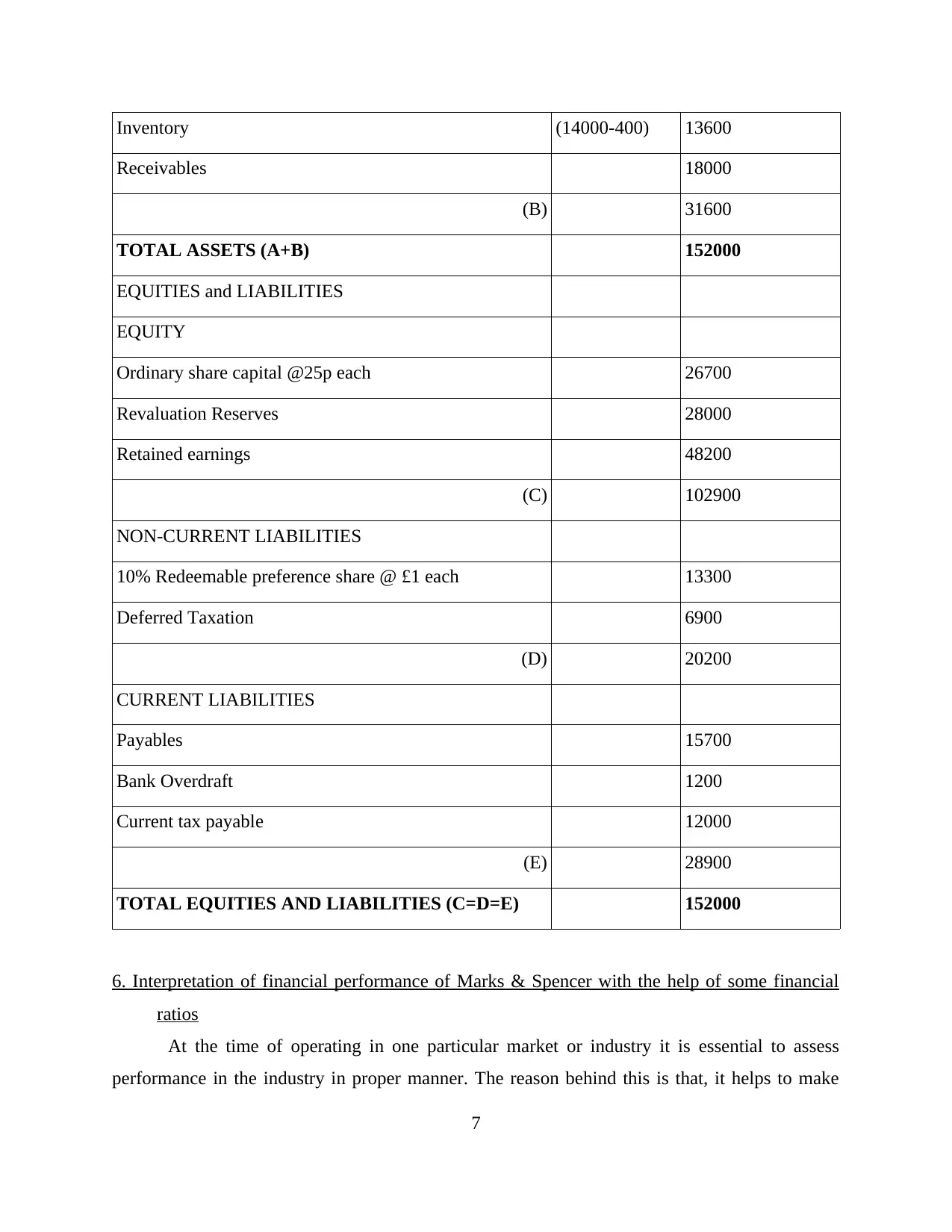
Inventory (14000-400) 13600
Receivables 18000
(B) 31600
TOTAL ASSETS (A+B) 152000
EQUITIES and LIABILITIES
EQUITY
Ordinary share capital @25p each 26700
Revaluation Reserves 28000
Retained earnings 48200
(C) 102900
NON-CURRENT LIABILITIES
10% Redeemable preference share @ £1 each 13300
Deferred Taxation 6900
(D) 20200
CURRENT LIABILITIES
Payables 15700
Bank Overdraft 1200
Current tax payable 12000
(E) 28900
TOTAL EQUITIES AND LIABILITIES (C=D=E) 152000
6. Interpretation of financial performance of Marks & Spencer with the help of some financial
ratios
At the time of operating in one particular market or industry it is essential to assess
performance in the industry in proper manner. The reason behind this is that, it helps to make
7
Receivables 18000
(B) 31600
TOTAL ASSETS (A+B) 152000
EQUITIES and LIABILITIES
EQUITY
Ordinary share capital @25p each 26700
Revaluation Reserves 28000
Retained earnings 48200
(C) 102900
NON-CURRENT LIABILITIES
10% Redeemable preference share @ £1 each 13300
Deferred Taxation 6900
(D) 20200
CURRENT LIABILITIES
Payables 15700
Bank Overdraft 1200
Current tax payable 12000
(E) 28900
TOTAL EQUITIES AND LIABILITIES (C=D=E) 152000
6. Interpretation of financial performance of Marks & Spencer with the help of some financial
ratios
At the time of operating in one particular market or industry it is essential to assess
performance in the industry in proper manner. The reason behind this is that, it helps to make
7
⊘ This is a preview!⊘
Do you want full access?
Subscribe today to unlock all pages.
Trusted by 1+ million students worldwide
effective strategies can be applied when needed and make the whole organisation financially
sound. For assessing performance, financial ratios are taken into consideration as these are
effectual measurement tool (Robinson and et.al., 2015). For the current section, Marks and
Spencer (M&S) Company is considered which has global presence in retail sector. Further, this
is listed in two stock markets which are LSE as well as FTSE 100 component. Herein,
profitability, liquidity as well as gearing ratios are computed and analysed below:
2016 2017
0.00%
1.00%
2.00%
3.00%
4.00%
5.00%
6.00%
4.88%
1.79%
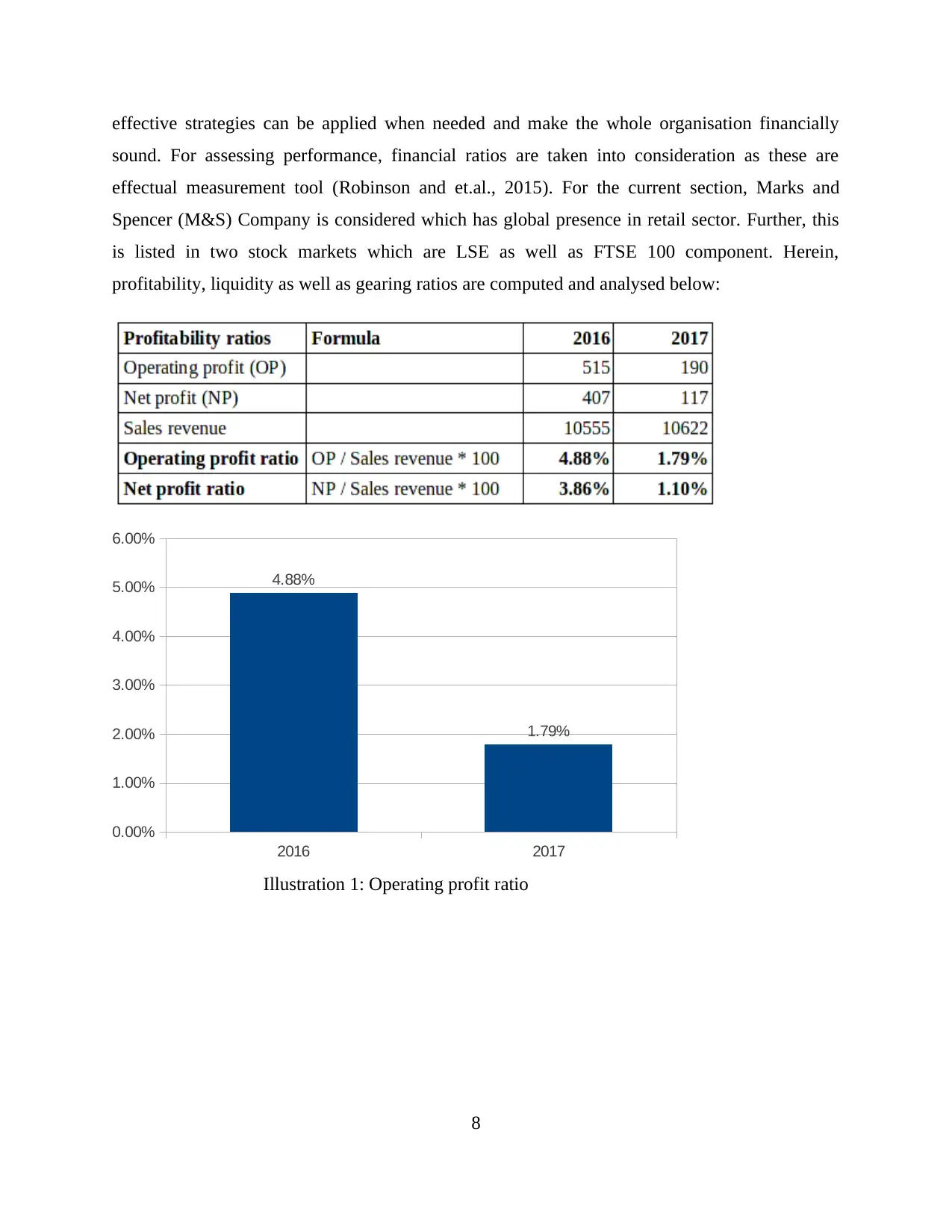
Illustration 1: Operating profit ratio
8
sound. For assessing performance, financial ratios are taken into consideration as these are
effectual measurement tool (Robinson and et.al., 2015). For the current section, Marks and
Spencer (M&S) Company is considered which has global presence in retail sector. Further, this
is listed in two stock markets which are LSE as well as FTSE 100 component. Herein,
profitability, liquidity as well as gearing ratios are computed and analysed below:
2016 2017
0.00%
1.00%
2.00%
3.00%
4.00%
5.00%
6.00%
4.88%
1.79%
Illustration 1: Operating profit ratio
8
Paraphrase This Document
Need a fresh take? Get an instant paraphrase of this document with our AI Paraphraser
2016 2017
0.00%
0.50%
1.00%
1.50%
2.00%
2.50%
3.00%
3.50%
4.00%
4.50%
3.86%
1.10%
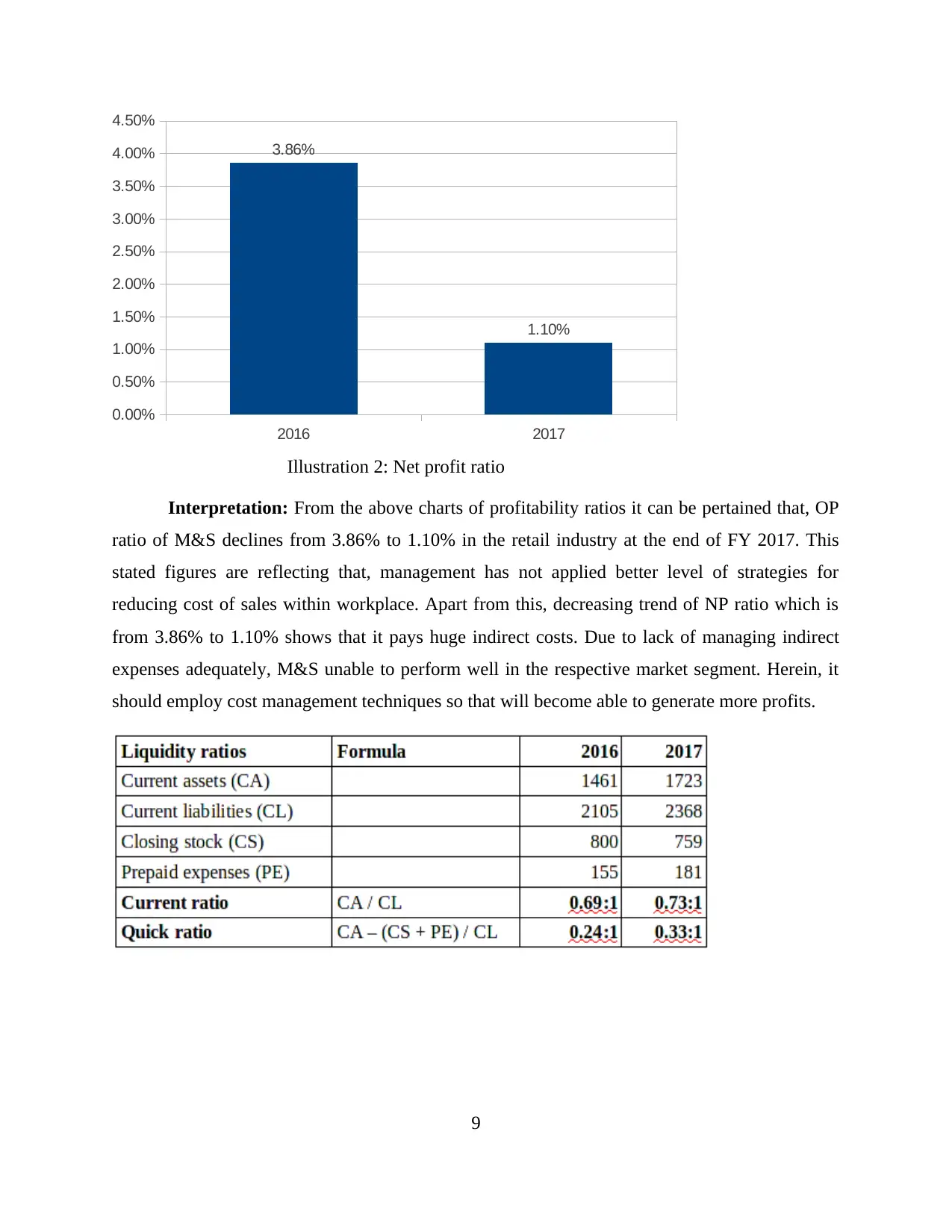
Illustration 2: Net profit ratio
Interpretation: From the above charts of profitability ratios it can be pertained that, OP
ratio of M&S declines from 3.86% to 1.10% in the retail industry at the end of FY 2017. This
stated figures are reflecting that, management has not applied better level of strategies for
reducing cost of sales within workplace. Apart from this, decreasing trend of NP ratio which is
from 3.86% to 1.10% shows that it pays huge indirect costs. Due to lack of managing indirect
expenses adequately, M&S unable to perform well in the respective market segment. Herein, it
should employ cost management techniques so that will become able to generate more profits.
9
0.00%
0.50%
1.00%
1.50%
2.00%
2.50%
3.00%
3.50%
4.00%
4.50%
3.86%
1.10%
Illustration 2: Net profit ratio
Interpretation: From the above charts of profitability ratios it can be pertained that, OP
ratio of M&S declines from 3.86% to 1.10% in the retail industry at the end of FY 2017. This
stated figures are reflecting that, management has not applied better level of strategies for
reducing cost of sales within workplace. Apart from this, decreasing trend of NP ratio which is
from 3.86% to 1.10% shows that it pays huge indirect costs. Due to lack of managing indirect
expenses adequately, M&S unable to perform well in the respective market segment. Herein, it
should employ cost management techniques so that will become able to generate more profits.
9
2016 2017
0.67
0.68
0.69
0.70
0.71
0.72
0.73
0.74
0.69
0.73
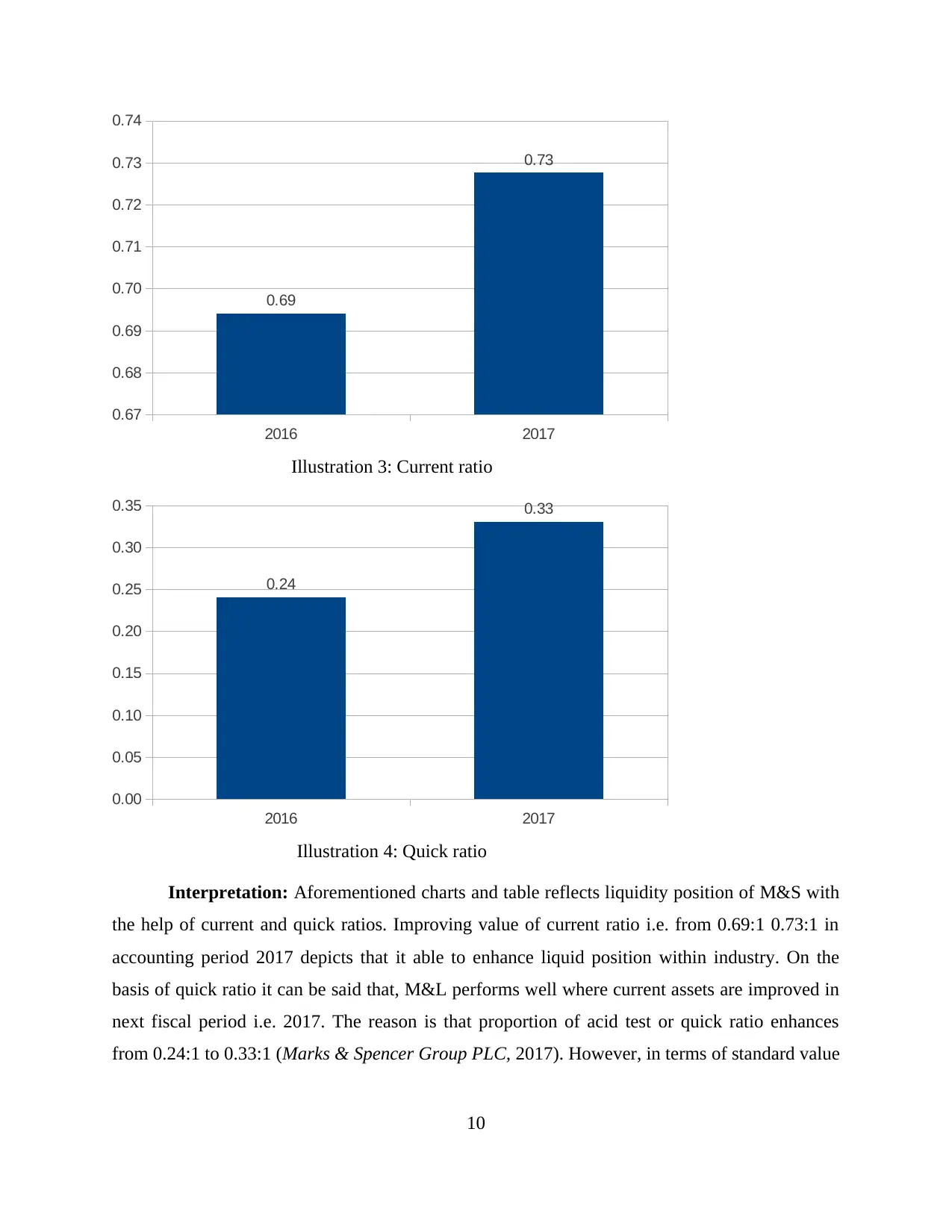
Illustration 3: Current ratio
2016 2017
0.00
0.05
0.10
0.15
0.20
0.25
0.30
0.35
0.24
0.33
Illustration 4: Quick ratio
Interpretation: Aforementioned charts and table reflects liquidity position of M&S with
the help of current and quick ratios. Improving value of current ratio i.e. from 0.69:1 0.73:1 in
accounting period 2017 depicts that it able to enhance liquid position within industry. On the
basis of quick ratio it can be said that, M&L performs well where current assets are improved in
next fiscal period i.e. 2017. The reason is that proportion of acid test or quick ratio enhances
from 0.24:1 to 0.33:1 (Marks & Spencer Group PLC, 2017). However, in terms of standard value
10
0.67
0.68
0.69
0.70
0.71
0.72
0.73
0.74
0.69
0.73
Illustration 3: Current ratio
2016 2017
0.00
0.05
0.10
0.15
0.20
0.25
0.30
0.35
0.24
0.33
Illustration 4: Quick ratio
Interpretation: Aforementioned charts and table reflects liquidity position of M&S with
the help of current and quick ratios. Improving value of current ratio i.e. from 0.69:1 0.73:1 in
accounting period 2017 depicts that it able to enhance liquid position within industry. On the
basis of quick ratio it can be said that, M&L performs well where current assets are improved in
next fiscal period i.e. 2017. The reason is that proportion of acid test or quick ratio enhances
from 0.24:1 to 0.33:1 (Marks & Spencer Group PLC, 2017). However, in terms of standard value
10
⊘ This is a preview!⊘
Do you want full access?
Subscribe today to unlock all pages.
Trusted by 1+ million students worldwide

1 out of 17


Related Documents


Your All-in-One AI-Powered Toolkit for Academic Success.
+13062052269
info@desklib.com
Available 24*7 on WhatsApp / Email
![[object Object]](/_next/static/media/star-bottom.7253800d.svg)
Unlock your academic potential
Copyright © 2020–2026 A2Z Services. All Rights Reserved. Developed and managed by ZUCOL.