Financial Reporting in Private Firms: A Literature Review
VerifiedAdded on 2023/04/21
|10
|2420
|434
Report
AI Summary
This report presents a structured literature review focused on the significance of financial reporting within private business firms. It begins with an introduction to the core concepts of financial reporting, emphasizing its role in ensuring financial stability and providing insights into a company's financial condition. The discussion explores the importance of financial reporting, outlining its contributions to financial planning, analysis, and decision-making. The report then delves into various theories of financial reporting, including the materiality and matching principles of accountancy, and examines the pivotal roles of managers in preparing conclusive and transparent financial reports. It highlights the responsibilities of the Chief Financial Officer, the importance of adherence to accounting standards, and the collaborative nature of financial reporting. The literature review also acknowledges limitations and identifies gaps in existing research, particularly concerning empirical evidence in Australian private firms and the efficacy of financial reporting. The conclusion reiterates the relevance of financial reporting in maximizing organizational performance and emphasizes the importance of accounting theories in developing better financial reporting practices.
Running Head: APPLIED BUSINESS RESEARCH
APPLIED BUSINESS RESEARCH
Name of the Student:
Name of University:
Author Note:
APPLIED BUSINESS RESEARCH
Name of the Student:
Name of University:
Author Note:

Paraphrase This Document
Need a fresh take? Get an instant paraphrase of this document with our AI Paraphraser
1APPLIED BUSINESS RESEARCH
Table of Contents
Introduction......................................................................................................................................2
Discussion........................................................................................................................................2
Understanding the financial reporting.........................................................................................2
Importance of the financial reporting..........................................................................................3
Theories of financial reporting....................................................................................................4
Managerial roles in financial reporting........................................................................................5
Limitation and gaps.........................................................................................................................6
Conclusion.......................................................................................................................................7
Referencing......................................................................................................................................8
Table of Contents
Introduction......................................................................................................................................2
Discussion........................................................................................................................................2
Understanding the financial reporting.........................................................................................2
Importance of the financial reporting..........................................................................................3
Theories of financial reporting....................................................................................................4
Managerial roles in financial reporting........................................................................................5
Limitation and gaps.........................................................................................................................6
Conclusion.......................................................................................................................................7
Referencing......................................................................................................................................8
2APPLIED BUSINESS RESEARCH
Introduction
Financial reporting is considered to be one of the most important aspect for a private
business firm that contributes to the financial stability and transparency of the organisation along
with providing better understanding of the financial condition of that private firm. Based on this
understanding, the purpose of this literature review is to evaluate the relevance and significance
of financial reporting. As a matter of fact, identifying different financial reporting practice and
models is also considered to be a major aspect of this discussion. Moreover, the literature review
also tries to find out the role of the managers in order to make an effective financial reporting.
Finally, the literature comes up with the literature gaps and the limitations of this literature
review that pushed the researcher to prepare further researches on the same topic.
Discussion
Understanding the financial reporting
According to Leuz and Wysocki (2016) it is important a business firm to develop its
financial condition and understanding on the basis of the financial reporting. It requires in-depth
knowledge regarding various elements of the financial reporting and the key purposes that can
enhance the efficiency within the organisation. From that point of view, Francis et al. (2015)
argued that the financial reporting is a report that includes the disclosure of financial
performance of an organisation and links with the views of different stakeholders about the
financial performance and the financial position of that organisation. In this context, Council
(2014) mentioned that the financial report connotes the investors, creditors, public, debt
providers and different government agencies. Therefore, it can be asserted that the financial
Introduction
Financial reporting is considered to be one of the most important aspect for a private
business firm that contributes to the financial stability and transparency of the organisation along
with providing better understanding of the financial condition of that private firm. Based on this
understanding, the purpose of this literature review is to evaluate the relevance and significance
of financial reporting. As a matter of fact, identifying different financial reporting practice and
models is also considered to be a major aspect of this discussion. Moreover, the literature review
also tries to find out the role of the managers in order to make an effective financial reporting.
Finally, the literature comes up with the literature gaps and the limitations of this literature
review that pushed the researcher to prepare further researches on the same topic.
Discussion
Understanding the financial reporting
According to Leuz and Wysocki (2016) it is important a business firm to develop its
financial condition and understanding on the basis of the financial reporting. It requires in-depth
knowledge regarding various elements of the financial reporting and the key purposes that can
enhance the efficiency within the organisation. From that point of view, Francis et al. (2015)
argued that the financial reporting is a report that includes the disclosure of financial
performance of an organisation and links with the views of different stakeholders about the
financial performance and the financial position of that organisation. In this context, Council
(2014) mentioned that the financial report connotes the investors, creditors, public, debt
providers and different government agencies. Therefore, it can be asserted that the financial
⊘ This is a preview!⊘
Do you want full access?
Subscribe today to unlock all pages.

Trusted by 1+ million students worldwide
3APPLIED BUSINESS RESEARCH
report encompasses all the required and important financial data and information that are
important for the organisation and help the private firm to develop its understanding regarding
the financial condition of that company. In this context, Davidson, Dey and Smith (2015)
showed that the financial reporting generates its data from different financial statement like
balance sheet, cash flow statement, profit and loss account and stock holder’s equity. In addition
to this, the quarterly and annual reports of the company are also contributed a lot in preparing the
financial report effectively. For the private firms the management discussion and analysis are
identified as important facets that helps to prepare proper financial report. In this regard, the
management decision will encircled the business related financial statements and decision and in
the financial report this decision making and strategy will also get an important place in order to
understand the motive behind the change and transformation in the financial figures and matters.
Importance of the financial reporting
As far as the importance of the financial reporting is considered it can be argued that the
objective and purpose of the financial reporting creates financial planning, analysis,
benchmarking and decision making in order to make the flow of organisational finance a
continuous process. According to Abbott et al. (2016) the financial reporting helps to comply
with various statues and regulatory requirements that can build up strong and transparent
operational framework for the business firm. As a result of that the future sustainability of the
organisation becomes secured enough to cope with the obstacles and mitigate the issues
effectively. Moreover, it is also essential for the organisation to evaluate the annual results of the
company in order to publish the stock exchange strength of that company.
In case of the Australian private firms Frias‐Aceituno, Rodríguez‐Ariza and Garcia‐
Sánchez (2014) opined that the financial report is the backbone for financial planning, analysis
report encompasses all the required and important financial data and information that are
important for the organisation and help the private firm to develop its understanding regarding
the financial condition of that company. In this context, Davidson, Dey and Smith (2015)
showed that the financial reporting generates its data from different financial statement like
balance sheet, cash flow statement, profit and loss account and stock holder’s equity. In addition
to this, the quarterly and annual reports of the company are also contributed a lot in preparing the
financial report effectively. For the private firms the management discussion and analysis are
identified as important facets that helps to prepare proper financial report. In this regard, the
management decision will encircled the business related financial statements and decision and in
the financial report this decision making and strategy will also get an important place in order to
understand the motive behind the change and transformation in the financial figures and matters.
Importance of the financial reporting
As far as the importance of the financial reporting is considered it can be argued that the
objective and purpose of the financial reporting creates financial planning, analysis,
benchmarking and decision making in order to make the flow of organisational finance a
continuous process. According to Abbott et al. (2016) the financial reporting helps to comply
with various statues and regulatory requirements that can build up strong and transparent
operational framework for the business firm. As a result of that the future sustainability of the
organisation becomes secured enough to cope with the obstacles and mitigate the issues
effectively. Moreover, it is also essential for the organisation to evaluate the annual results of the
company in order to publish the stock exchange strength of that company.
In case of the Australian private firms Frias‐Aceituno, Rodríguez‐Ariza and Garcia‐
Sánchez (2014) opined that the financial report is the backbone for financial planning, analysis
Paraphrase This Document
Need a fresh take? Get an instant paraphrase of this document with our AI Paraphraser
4APPLIED BUSINESS RESEARCH
and decision making process which is lack in case of the Australian financial organisations. Due
to lack of understanding regarding the importance of the financial report it becomes a problem
for the Australian private firms to ensure their financial stability in a firm and solid basis. Putting
limited emphasis on the stakeholders’ opinion caused a discrepancy in the financial details that
the stakeholders could not enjoy. Therefore, miscommunication and indecisions caused serious
problem for the organisation.
Moreover, it can also be stated that due to get clear insights of the financial report the
organisation can evaluate its strengths and weaknesses in a pro-active manner. As a result of that
the decision based on the evaluation will be effective enough to deliver better decision making.
In response to this, Gigler et al. (2014) asserted that the role of the financial reporting is to guide
the organisation financially so that the private firm is able to capitalise in the market both
domestic and internationally. Due to the advent of the globalisation the high competitiveness in
the market makes it becomes difficult for the Australian private firms to outreach the overseas
the overseas market. As a result of that financial reporting creates a business friendly
environment for the organisation to compete and sustain in the intense competitive market of
Australia (Francis et al. 2015).
Theories of financial reporting
In this context, there are several theories that are responsible to make financial reporting
effective. In this regard, the materiality and matching principles of accountancy are highly
important. According to Zimmerman and Bloom (2016) the matching principles of accounting
reports the expenses of a company on its income statement in a certain period of time. In this
context, the matching principles makes it more effective for the organisations to measure its
expenses and also keep the income and revenue matters under consideration. Moreover, it can be
and decision making process which is lack in case of the Australian financial organisations. Due
to lack of understanding regarding the importance of the financial report it becomes a problem
for the Australian private firms to ensure their financial stability in a firm and solid basis. Putting
limited emphasis on the stakeholders’ opinion caused a discrepancy in the financial details that
the stakeholders could not enjoy. Therefore, miscommunication and indecisions caused serious
problem for the organisation.
Moreover, it can also be stated that due to get clear insights of the financial report the
organisation can evaluate its strengths and weaknesses in a pro-active manner. As a result of that
the decision based on the evaluation will be effective enough to deliver better decision making.
In response to this, Gigler et al. (2014) asserted that the role of the financial reporting is to guide
the organisation financially so that the private firm is able to capitalise in the market both
domestic and internationally. Due to the advent of the globalisation the high competitiveness in
the market makes it becomes difficult for the Australian private firms to outreach the overseas
the overseas market. As a result of that financial reporting creates a business friendly
environment for the organisation to compete and sustain in the intense competitive market of
Australia (Francis et al. 2015).
Theories of financial reporting
In this context, there are several theories that are responsible to make financial reporting
effective. In this regard, the materiality and matching principles of accountancy are highly
important. According to Zimmerman and Bloom (2016) the matching principles of accounting
reports the expenses of a company on its income statement in a certain period of time. In this
context, the matching principles makes it more effective for the organisations to measure its
expenses and also keep the income and revenue matters under consideration. Moreover, it can be
5APPLIED BUSINESS RESEARCH
asserted that due to the miscalculations and misjudgements most of times companies calculates
the expenses at the period when it is paid rather than the time when the expenses and liability
incur. As a result of that it causes problems to measure the expenses for both quarterly and
annual financial report. On the other hand, Kulikova et al. (2015) advocated that the matching
principle keeps an eye on the systematic allocation of the cost to a certain accounting period in
which the cost is used up. It becomes also a strategic measure to keep the track of both the
expenses and the income at the same time through using the matching principle.
The materiality principle, on the other hand puts emphasis on the relationship between
accounting standard and net impact on the financial statements. In other words, Edgley (2014)
opined that the role of the materiality principles is to identify almost all the materials that cause
heavy impact on the financial statements. In most of the cases small materials are neglected due
to its volume and values. However, having high impact on the financial statement, the materiality
principles helps to make it a valuable element. Therefore, Libby (2017) stated that the materiality
principles are considered to have effective advantages in order to make a clear and proper
financial reporting.
Managerial roles in financial reporting
In this context, the role of the managers are pivotal in order to prepare a conclusive and
transparent financial report for the company both in quarterly and annually. The role of the Chief
Financial Officer of a private organisation I not only preparing the financial statements, income
statements and balance sheets. The standard of the reports is also a subject of further
investigation and it is the responsibility of the CFO to consult with the chief consultant about this
matter. As per the research of Gomariz and Ballesta (2014) it can be argued that the financial
matters of a private firm changes its process in accordance with the situation and the financial
asserted that due to the miscalculations and misjudgements most of times companies calculates
the expenses at the period when it is paid rather than the time when the expenses and liability
incur. As a result of that it causes problems to measure the expenses for both quarterly and
annual financial report. On the other hand, Kulikova et al. (2015) advocated that the matching
principle keeps an eye on the systematic allocation of the cost to a certain accounting period in
which the cost is used up. It becomes also a strategic measure to keep the track of both the
expenses and the income at the same time through using the matching principle.
The materiality principle, on the other hand puts emphasis on the relationship between
accounting standard and net impact on the financial statements. In other words, Edgley (2014)
opined that the role of the materiality principles is to identify almost all the materials that cause
heavy impact on the financial statements. In most of the cases small materials are neglected due
to its volume and values. However, having high impact on the financial statement, the materiality
principles helps to make it a valuable element. Therefore, Libby (2017) stated that the materiality
principles are considered to have effective advantages in order to make a clear and proper
financial reporting.
Managerial roles in financial reporting
In this context, the role of the managers are pivotal in order to prepare a conclusive and
transparent financial report for the company both in quarterly and annually. The role of the Chief
Financial Officer of a private organisation I not only preparing the financial statements, income
statements and balance sheets. The standard of the reports is also a subject of further
investigation and it is the responsibility of the CFO to consult with the chief consultant about this
matter. As per the research of Gomariz and Ballesta (2014) it can be argued that the financial
matters of a private firm changes its process in accordance with the situation and the financial
⊘ This is a preview!⊘
Do you want full access?
Subscribe today to unlock all pages.
Trusted by 1+ million students worldwide
6APPLIED BUSINESS RESEARCH
statement. There is no hard and fast regulation or process to follow. It has to be the role of the
financial teams and the auditors to implement such a plan that can generate accurate financial
report and check the reliability of the report. Authenticity of the report is the prime concern in
this context. Full compliance with the existing accounting standard is also a subject of
investigation for the finance team of a private company. In this context, the notion of due
diligence is highly relevant that connotes the reliability of the financial information provided by
the financial statements and balance sheets (Badolato, Donelson and Ege 2014). In this context,
the CFO and the organisational management should have a clear conversation regarding the
objective of the company. There are both short term and long term objectives that the company
sets in order to make profitability and smoothen the business performance. However, the
efficiency and success of the organisation depends on the objectivity of the organisation. In this
regard, the managers and executives of that particular organisation held responsible. Based on
their decision making the CFO sets the financial targets (Garrett, Hoitash and Prawitt 2014).
Therefore, it can be argued that the entire process of financial reporting is a collaborative process
that encapsulate all the decision makers and stakeholders in order to execute adequate decision
making that subsequently delivers better exposure for the development of the financial reporting.
Limitation and gaps
The above discussion is not free from any limitation. There are number of gaps that the
previous researches have done in terms of understanding the role of financial reporting in
developing the organisational profitability. Firstly, there are little empirical evidences about the
problem of financial reporting in Australian private firms. Moreover, it can also be stated that
there are lack of articles that can contribute to increase the efficacy of financial reporting.
statement. There is no hard and fast regulation or process to follow. It has to be the role of the
financial teams and the auditors to implement such a plan that can generate accurate financial
report and check the reliability of the report. Authenticity of the report is the prime concern in
this context. Full compliance with the existing accounting standard is also a subject of
investigation for the finance team of a private company. In this context, the notion of due
diligence is highly relevant that connotes the reliability of the financial information provided by
the financial statements and balance sheets (Badolato, Donelson and Ege 2014). In this context,
the CFO and the organisational management should have a clear conversation regarding the
objective of the company. There are both short term and long term objectives that the company
sets in order to make profitability and smoothen the business performance. However, the
efficiency and success of the organisation depends on the objectivity of the organisation. In this
regard, the managers and executives of that particular organisation held responsible. Based on
their decision making the CFO sets the financial targets (Garrett, Hoitash and Prawitt 2014).
Therefore, it can be argued that the entire process of financial reporting is a collaborative process
that encapsulate all the decision makers and stakeholders in order to execute adequate decision
making that subsequently delivers better exposure for the development of the financial reporting.
Limitation and gaps
The above discussion is not free from any limitation. There are number of gaps that the
previous researches have done in terms of understanding the role of financial reporting in
developing the organisational profitability. Firstly, there are little empirical evidences about the
problem of financial reporting in Australian private firms. Moreover, it can also be stated that
there are lack of articles that can contribute to increase the efficacy of financial reporting.
Paraphrase This Document
Need a fresh take? Get an instant paraphrase of this document with our AI Paraphraser
7APPLIED BUSINESS RESEARCH
Conclusion
Therefore, it can be argued that the literature review on the theme of importance of
financial reporting on maximising performance of the Australian private firms is rightly pointed
out the efficacy of the financial reporting on organisational efficiency. In this regard, the
discussion also identifies relevant accountancy theories that can help to develop a better financial
reporting. Henceforth, it can be stated that the literature review is clear and relevant to
understanding the mentioned theme of the research.
Conclusion
Therefore, it can be argued that the literature review on the theme of importance of
financial reporting on maximising performance of the Australian private firms is rightly pointed
out the efficacy of the financial reporting on organisational efficiency. In this regard, the
discussion also identifies relevant accountancy theories that can help to develop a better financial
reporting. Henceforth, it can be stated that the literature review is clear and relevant to
understanding the mentioned theme of the research.
8APPLIED BUSINESS RESEARCH
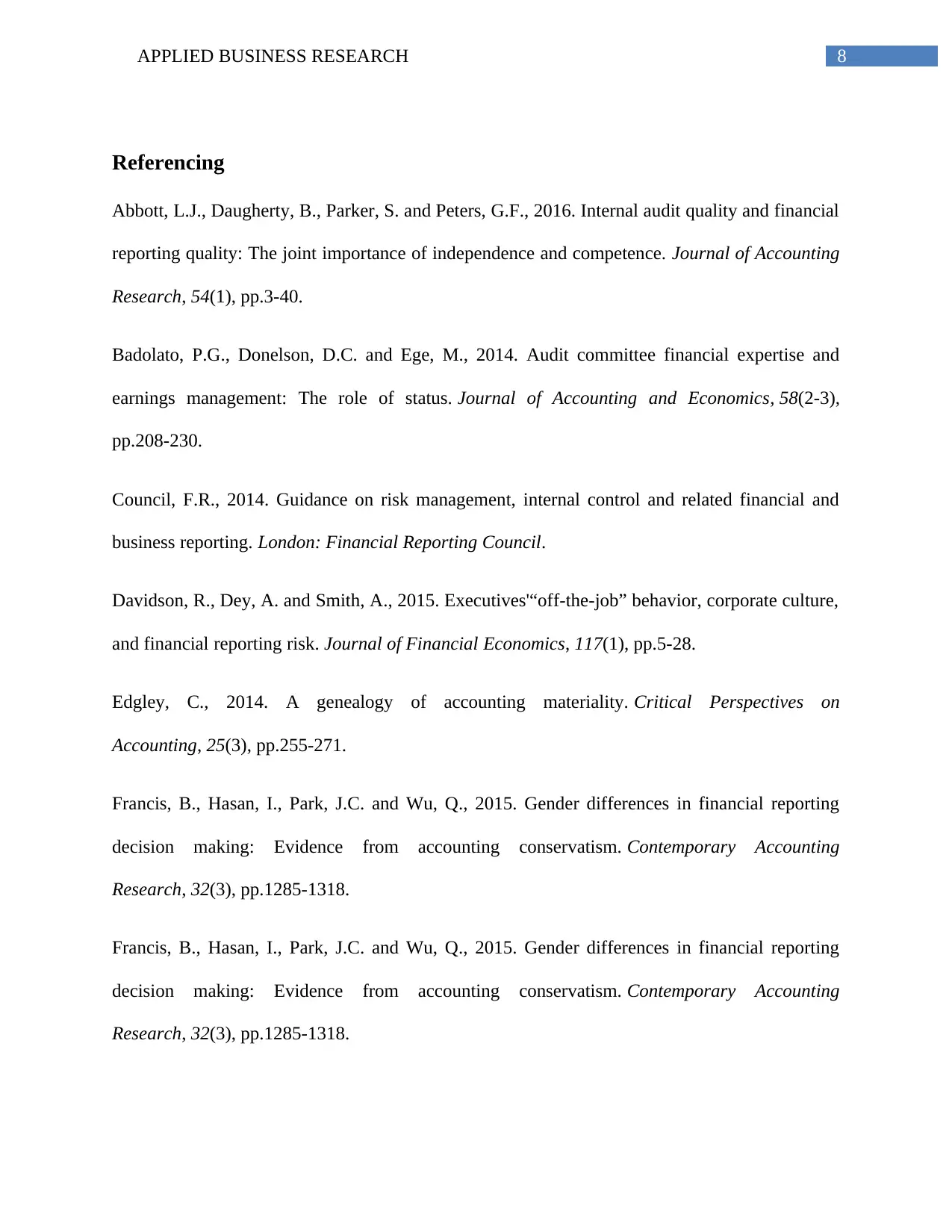
Referencing
Abbott, L.J., Daugherty, B., Parker, S. and Peters, G.F., 2016. Internal audit quality and financial
reporting quality: The joint importance of independence and competence. Journal of Accounting
Research, 54(1), pp.3-40.
Badolato, P.G., Donelson, D.C. and Ege, M., 2014. Audit committee financial expertise and
earnings management: The role of status. Journal of Accounting and Economics, 58(2-3),
pp.208-230.
Council, F.R., 2014. Guidance on risk management, internal control and related financial and
business reporting. London: Financial Reporting Council.
Davidson, R., Dey, A. and Smith, A., 2015. Executives'“off-the-job” behavior, corporate culture,
and financial reporting risk. Journal of Financial Economics, 117(1), pp.5-28.
Edgley, C., 2014. A genealogy of accounting materiality. Critical Perspectives on
Accounting, 25(3), pp.255-271.
Francis, B., Hasan, I., Park, J.C. and Wu, Q., 2015. Gender differences in financial reporting
decision making: Evidence from accounting conservatism. Contemporary Accounting
Research, 32(3), pp.1285-1318.
Francis, B., Hasan, I., Park, J.C. and Wu, Q., 2015. Gender differences in financial reporting
decision making: Evidence from accounting conservatism. Contemporary Accounting
Research, 32(3), pp.1285-1318.
Referencing
Abbott, L.J., Daugherty, B., Parker, S. and Peters, G.F., 2016. Internal audit quality and financial
reporting quality: The joint importance of independence and competence. Journal of Accounting
Research, 54(1), pp.3-40.
Badolato, P.G., Donelson, D.C. and Ege, M., 2014. Audit committee financial expertise and
earnings management: The role of status. Journal of Accounting and Economics, 58(2-3),
pp.208-230.
Council, F.R., 2014. Guidance on risk management, internal control and related financial and
business reporting. London: Financial Reporting Council.
Davidson, R., Dey, A. and Smith, A., 2015. Executives'“off-the-job” behavior, corporate culture,
and financial reporting risk. Journal of Financial Economics, 117(1), pp.5-28.
Edgley, C., 2014. A genealogy of accounting materiality. Critical Perspectives on
Accounting, 25(3), pp.255-271.
Francis, B., Hasan, I., Park, J.C. and Wu, Q., 2015. Gender differences in financial reporting
decision making: Evidence from accounting conservatism. Contemporary Accounting
Research, 32(3), pp.1285-1318.
Francis, B., Hasan, I., Park, J.C. and Wu, Q., 2015. Gender differences in financial reporting
decision making: Evidence from accounting conservatism. Contemporary Accounting
Research, 32(3), pp.1285-1318.
⊘ This is a preview!⊘
Do you want full access?
Subscribe today to unlock all pages.
Trusted by 1+ million students worldwide
9APPLIED BUSINESS RESEARCH
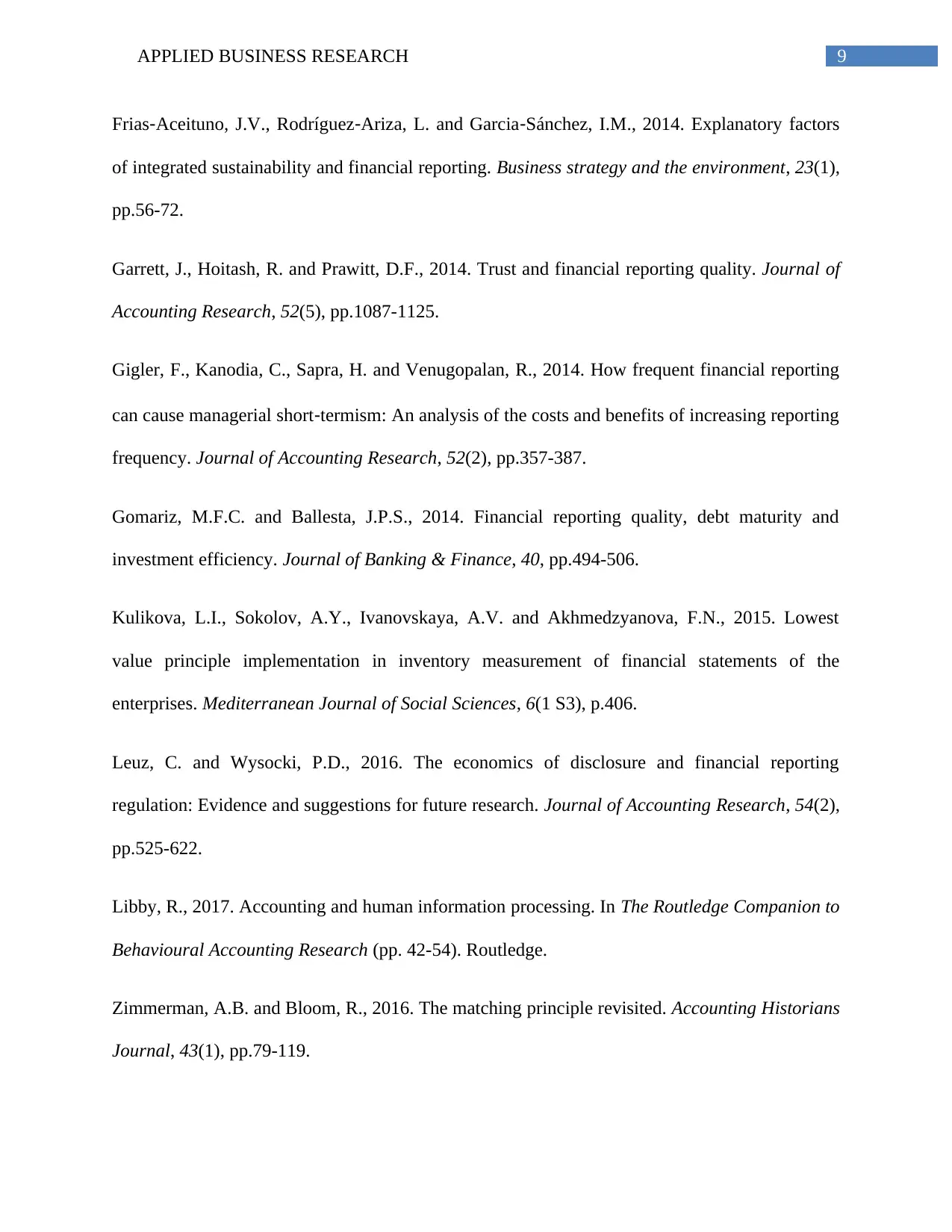
Frias‐Aceituno, J.V., Rodríguez‐Ariza, L. and Garcia‐Sánchez, I.M., 2014. Explanatory factors
of integrated sustainability and financial reporting. Business strategy and the environment, 23(1),
pp.56-72.
Garrett, J., Hoitash, R. and Prawitt, D.F., 2014. Trust and financial reporting quality. Journal of
Accounting Research, 52(5), pp.1087-1125.
Gigler, F., Kanodia, C., Sapra, H. and Venugopalan, R., 2014. How frequent financial reporting
can cause managerial short‐termism: An analysis of the costs and benefits of increasing reporting
frequency. Journal of Accounting Research, 52(2), pp.357-387.
Gomariz, M.F.C. and Ballesta, J.P.S., 2014. Financial reporting quality, debt maturity and
investment efficiency. Journal of Banking & Finance, 40, pp.494-506.
Kulikova, L.I., Sokolov, A.Y., Ivanovskaya, A.V. and Akhmedzyanova, F.N., 2015. Lowest
value principle implementation in inventory measurement of financial statements of the
enterprises. Mediterranean Journal of Social Sciences, 6(1 S3), p.406.
Leuz, C. and Wysocki, P.D., 2016. The economics of disclosure and financial reporting
regulation: Evidence and suggestions for future research. Journal of Accounting Research, 54(2),
pp.525-622.
Libby, R., 2017. Accounting and human information processing. In The Routledge Companion to
Behavioural Accounting Research (pp. 42-54). Routledge.
Zimmerman, A.B. and Bloom, R., 2016. The matching principle revisited. Accounting Historians
Journal, 43(1), pp.79-119.
Frias‐Aceituno, J.V., Rodríguez‐Ariza, L. and Garcia‐Sánchez, I.M., 2014. Explanatory factors
of integrated sustainability and financial reporting. Business strategy and the environment, 23(1),
pp.56-72.
Garrett, J., Hoitash, R. and Prawitt, D.F., 2014. Trust and financial reporting quality. Journal of
Accounting Research, 52(5), pp.1087-1125.
Gigler, F., Kanodia, C., Sapra, H. and Venugopalan, R., 2014. How frequent financial reporting
can cause managerial short‐termism: An analysis of the costs and benefits of increasing reporting
frequency. Journal of Accounting Research, 52(2), pp.357-387.
Gomariz, M.F.C. and Ballesta, J.P.S., 2014. Financial reporting quality, debt maturity and
investment efficiency. Journal of Banking & Finance, 40, pp.494-506.
Kulikova, L.I., Sokolov, A.Y., Ivanovskaya, A.V. and Akhmedzyanova, F.N., 2015. Lowest
value principle implementation in inventory measurement of financial statements of the
enterprises. Mediterranean Journal of Social Sciences, 6(1 S3), p.406.
Leuz, C. and Wysocki, P.D., 2016. The economics of disclosure and financial reporting
regulation: Evidence and suggestions for future research. Journal of Accounting Research, 54(2),
pp.525-622.
Libby, R., 2017. Accounting and human information processing. In The Routledge Companion to
Behavioural Accounting Research (pp. 42-54). Routledge.
Zimmerman, A.B. and Bloom, R., 2016. The matching principle revisited. Accounting Historians
Journal, 43(1), pp.79-119.

1 out of 10


Related Documents


Your All-in-One AI-Powered Toolkit for Academic Success.
+13062052269
info@desklib.com
Available 24*7 on WhatsApp / Email
![[object Object]](/_next/static/media/star-bottom.7253800d.svg)
Unlock your academic potential
Copyright © 2020–2025 A2Z Services. All Rights Reserved. Developed and managed by ZUCOL.