Financial Reporting: Conceptual Framework, Regulatory Framework in NZ

Verified

Added on  2023/06/07

|8
|1797
|330
Report
AI Summary
This report provides an in-depth analysis of the conceptual framework for financial reporting, emphasizing its importance and key components as defined by accounting boards like the IASB. It highlights the framework's role in establishing consistent accounting practices, aiding in the identification and measurement of business assets, liabilities, income, and expenses, and promoting transparency in financial reporting. The report details the objectives of financial reporting, the quality of information, the elements of financial statements, and the significance of recognition, measurement, presentation, and disclosure. Furthermore, it discusses the regulatory framework in New Zealand, focusing on the statutory and accounting standard regulations, and critically examines the indicators of public accountability, economic significance, and separation of ownership and management in relation to entity regulation, underlining the need for ethical practices and accurate financial reporting. Desklib offers a wealth of resources, including past papers and solved assignments, to support students in their academic endeavors.
Document Page
Running head: FINANCIAL REPORTING
Financial Reporting
Name of the Student:
Name of the University:
Author’s Note
tabler-icon-diamond-filled.svg

Paraphrase This Document

Need a fresh take? Get an instant paraphrase of this document with our AI Paraphraser
Document Page
1
FINANCIAL REPORTING
Table of Contents
Conceptual Framework and Its Components...................................................................................2
Requirement of a Regulatory Framework.......................................................................................4
Reference.........................................................................................................................................6
Document Page
2
FINANCIAL REPORTING
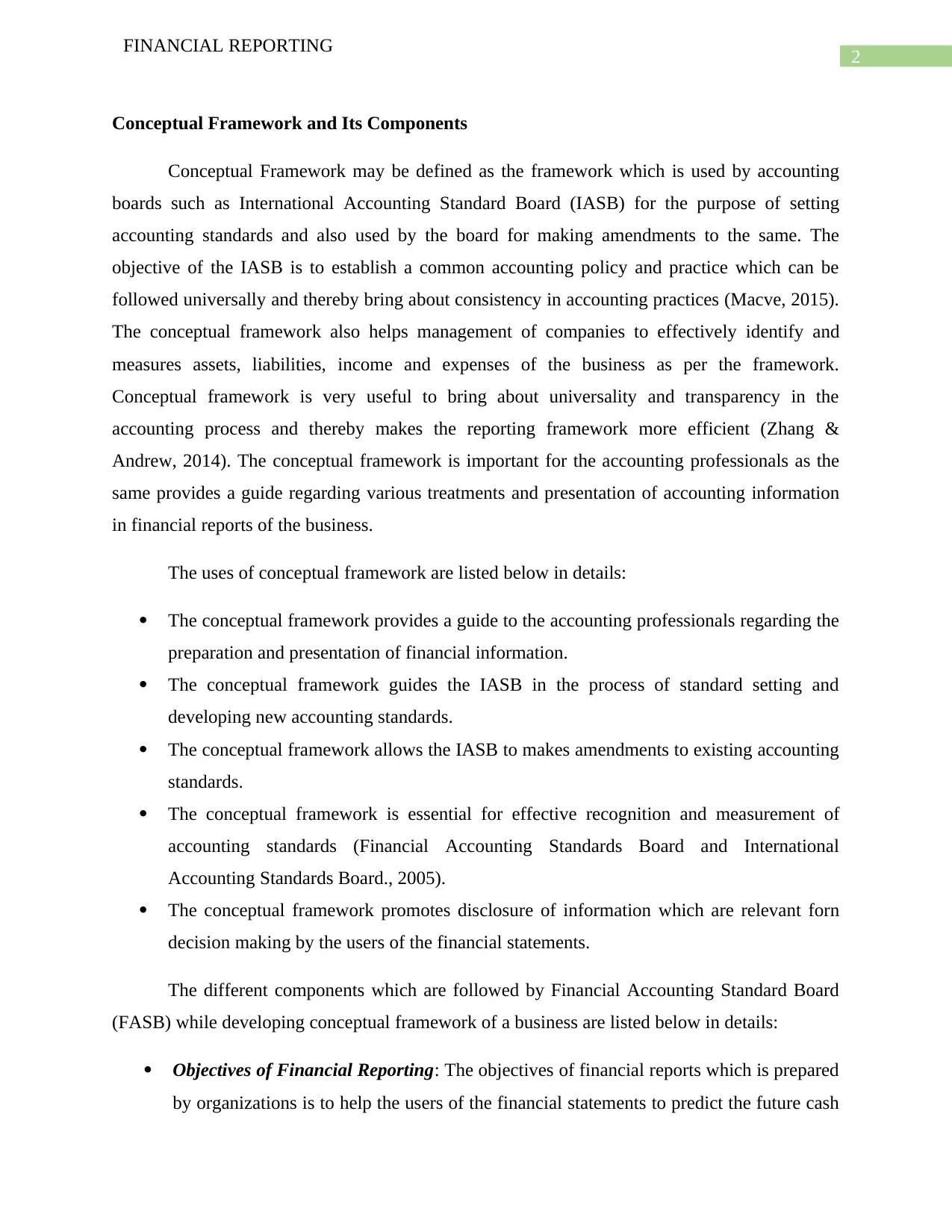
Conceptual Framework and Its Components
Conceptual Framework may be defined as the framework which is used by accounting
boards such as International Accounting Standard Board (IASB) for the purpose of setting
accounting standards and also used by the board for making amendments to the same. The
objective of the IASB is to establish a common accounting policy and practice which can be
followed universally and thereby bring about consistency in accounting practices (Macve, 2015).
The conceptual framework also helps management of companies to effectively identify and
measures assets, liabilities, income and expenses of the business as per the framework.
Conceptual framework is very useful to bring about universality and transparency in the
accounting process and thereby makes the reporting framework more efficient (Zhang &
Andrew, 2014). The conceptual framework is important for the accounting professionals as the
same provides a guide regarding various treatments and presentation of accounting information
in financial reports of the business.
The uses of conceptual framework are listed below in details:
The conceptual framework provides a guide to the accounting professionals regarding the
preparation and presentation of financial information.
The conceptual framework guides the IASB in the process of standard setting and
developing new accounting standards.
The conceptual framework allows the IASB to makes amendments to existing accounting
standards.
The conceptual framework is essential for effective recognition and measurement of
accounting standards (Financial Accounting Standards Board and International
Accounting Standards Board., 2005).
The conceptual framework promotes disclosure of information which are relevant forn
decision making by the users of the financial statements.
The different components which are followed by Financial Accounting Standard Board
(FASB) while developing conceptual framework of a business are listed below in details:
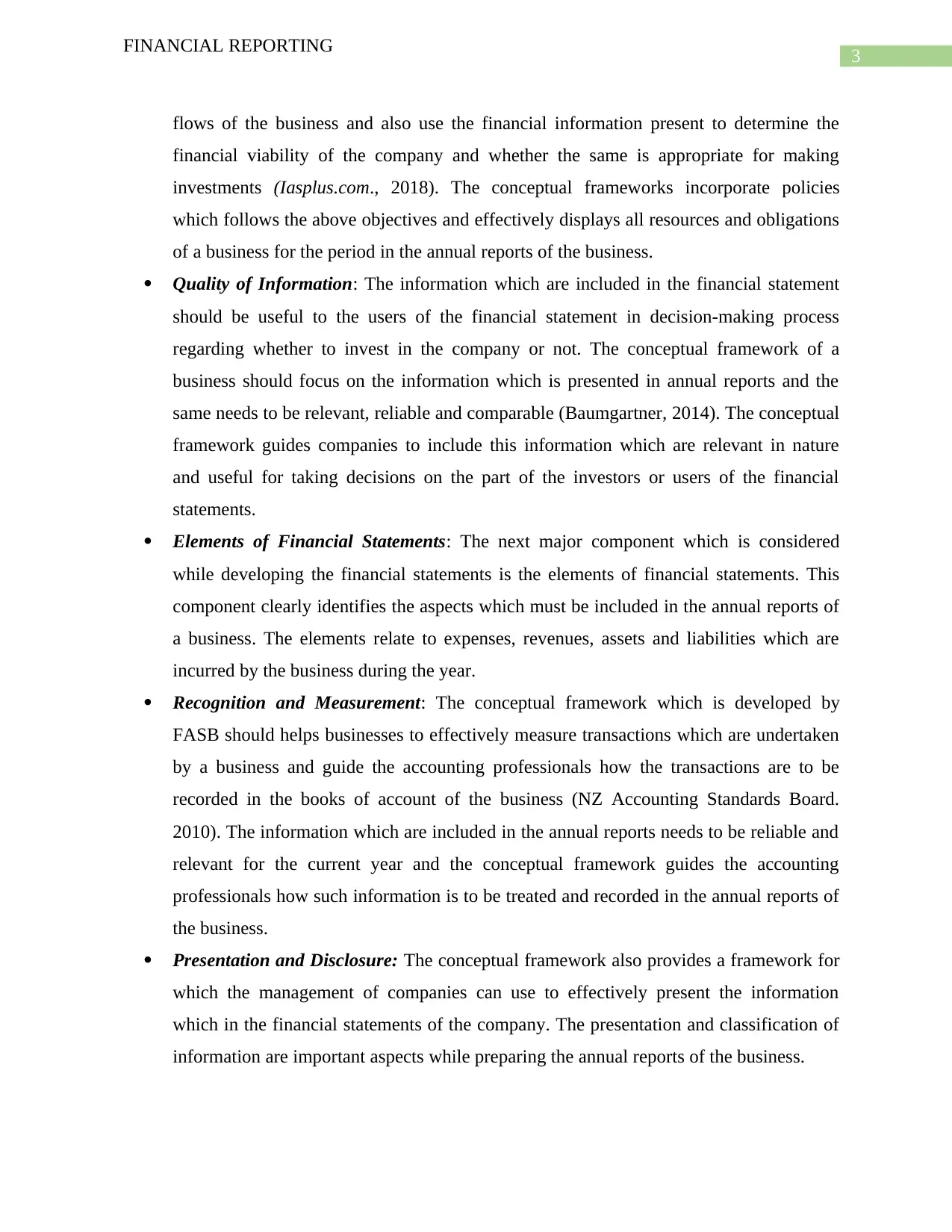
Objectives of Financial Reporting: The objectives of financial reports which is prepared
by organizations is to help the users of the financial statements to predict the future cash
Document Page
3
FINANCIAL REPORTING
flows of the business and also use the financial information present to determine the
financial viability of the company and whether the same is appropriate for making
investments (Iasplus.com., 2018). The conceptual frameworks incorporate policies
which follows the above objectives and effectively displays all resources and obligations
of a business for the period in the annual reports of the business.
Quality of Information: The information which are included in the financial statement
should be useful to the users of the financial statement in decision-making process
regarding whether to invest in the company or not. The conceptual framework of a
business should focus on the information which is presented in annual reports and the
same needs to be relevant, reliable and comparable (Baumgartner, 2014). The conceptual
framework guides companies to include this information which are relevant in nature
and useful for taking decisions on the part of the investors or users of the financial
statements.
Elements of Financial Statements: The next major component which is considered
while developing the financial statements is the elements of financial statements. This
component clearly identifies the aspects which must be included in the annual reports of
a business. The elements relate to expenses, revenues, assets and liabilities which are
incurred by the business during the year.
Recognition and Measurement: The conceptual framework which is developed by
FASB should helps businesses to effectively measure transactions which are undertaken
by a business and guide the accounting professionals how the transactions are to be
recorded in the books of account of the business (NZ Accounting Standards Board.
2010). The information which are included in the annual reports needs to be reliable and
relevant for the current year and the conceptual framework guides the accounting
professionals how such information is to be treated and recorded in the annual reports of
the business.
Presentation and Disclosure: The conceptual framework also provides a framework for
which the management of companies can use to effectively present the information
which in the financial statements of the company. The presentation and classification of
information are important aspects while preparing the annual reports of the business.
tabler-icon-diamond-filled.svg

Paraphrase This Document

Need a fresh take? Get an instant paraphrase of this document with our AI Paraphraser
Document Page
4
FINANCIAL REPORTING
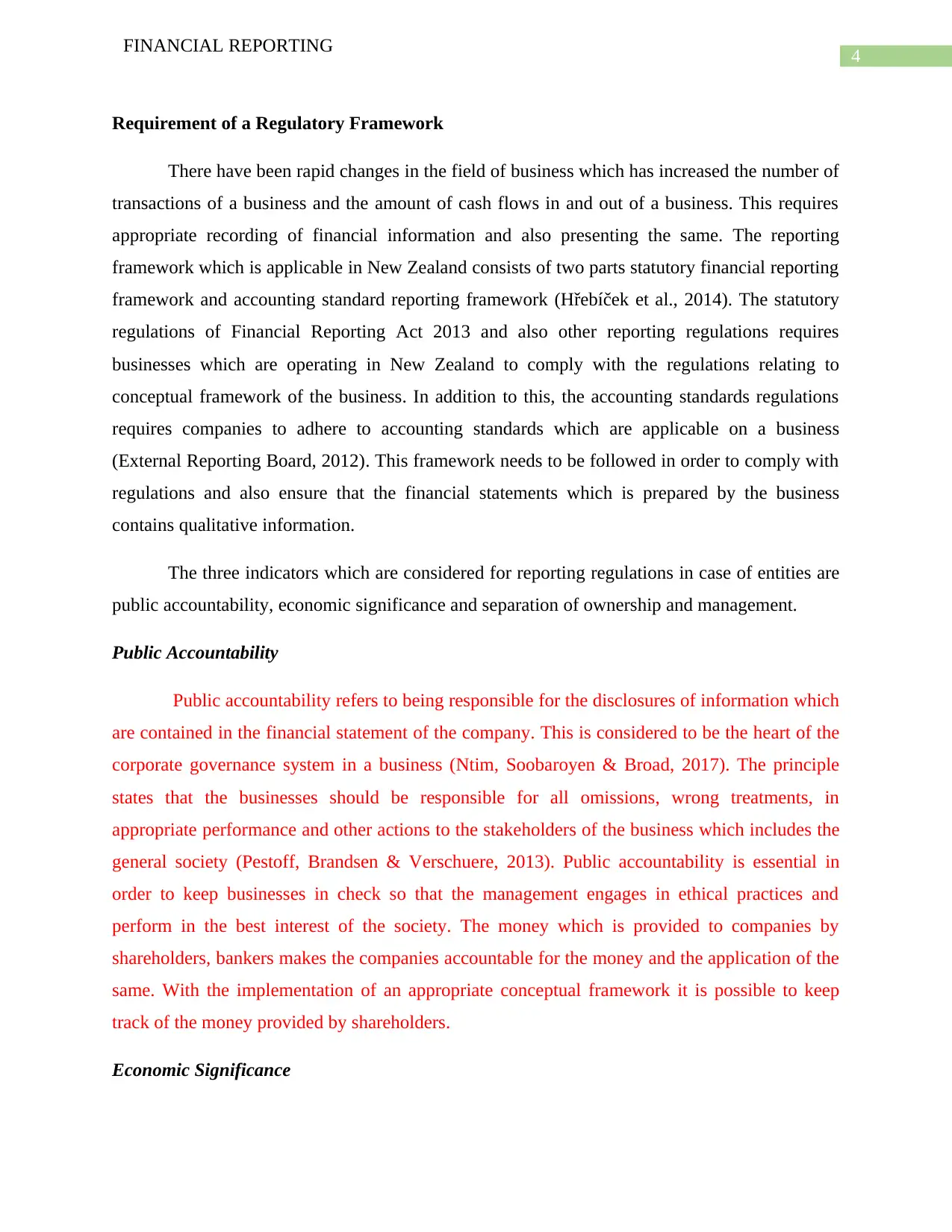
Requirement of a Regulatory Framework
There have been rapid changes in the field of business which has increased the number of
transactions of a business and the amount of cash flows in and out of a business. This requires
appropriate recording of financial information and also presenting the same. The reporting
framework which is applicable in New Zealand consists of two parts statutory financial reporting
framework and accounting standard reporting framework (Hřebíček et al., 2014). The statutory
regulations of Financial Reporting Act 2013 and also other reporting regulations requires
businesses which are operating in New Zealand to comply with the regulations relating to
conceptual framework of the business. In addition to this, the accounting standards regulations
requires companies to adhere to accounting standards which are applicable on a business
(External Reporting Board, 2012). This framework needs to be followed in order to comply with
regulations and also ensure that the financial statements which is prepared by the business
contains qualitative information.
The three indicators which are considered for reporting regulations in case of entities are
public accountability, economic significance and separation of ownership and management.
Public Accountability
Public accountability refers to being responsible for the disclosures of information which
are contained in the financial statement of the company. This is considered to be the heart of the
corporate governance system in a business (Ntim, Soobaroyen & Broad, 2017). The principle
states that the businesses should be responsible for all omissions, wrong treatments, in
appropriate performance and other actions to the stakeholders of the business which includes the
general society (Pestoff, Brandsen & Verschuere, 2013). Public accountability is essential in
order to keep businesses in check so that the management engages in ethical practices and
perform in the best interest of the society. The money which is provided to companies by
shareholders, bankers makes the companies accountable for the money and the application of the
same. With the implementation of an appropriate conceptual framework it is possible to keep
track of the money provided by shareholders.
Economic Significance
Document Page
5
FINANCIAL REPORTING
The economic significance of a business refers to the overall size of operations of the
business in the market and how the same can affect the society (Page, 2014). The conceptual
framework application helps such entities in meeting the reporting requirements and thereby
ensure ethical practices in a business.
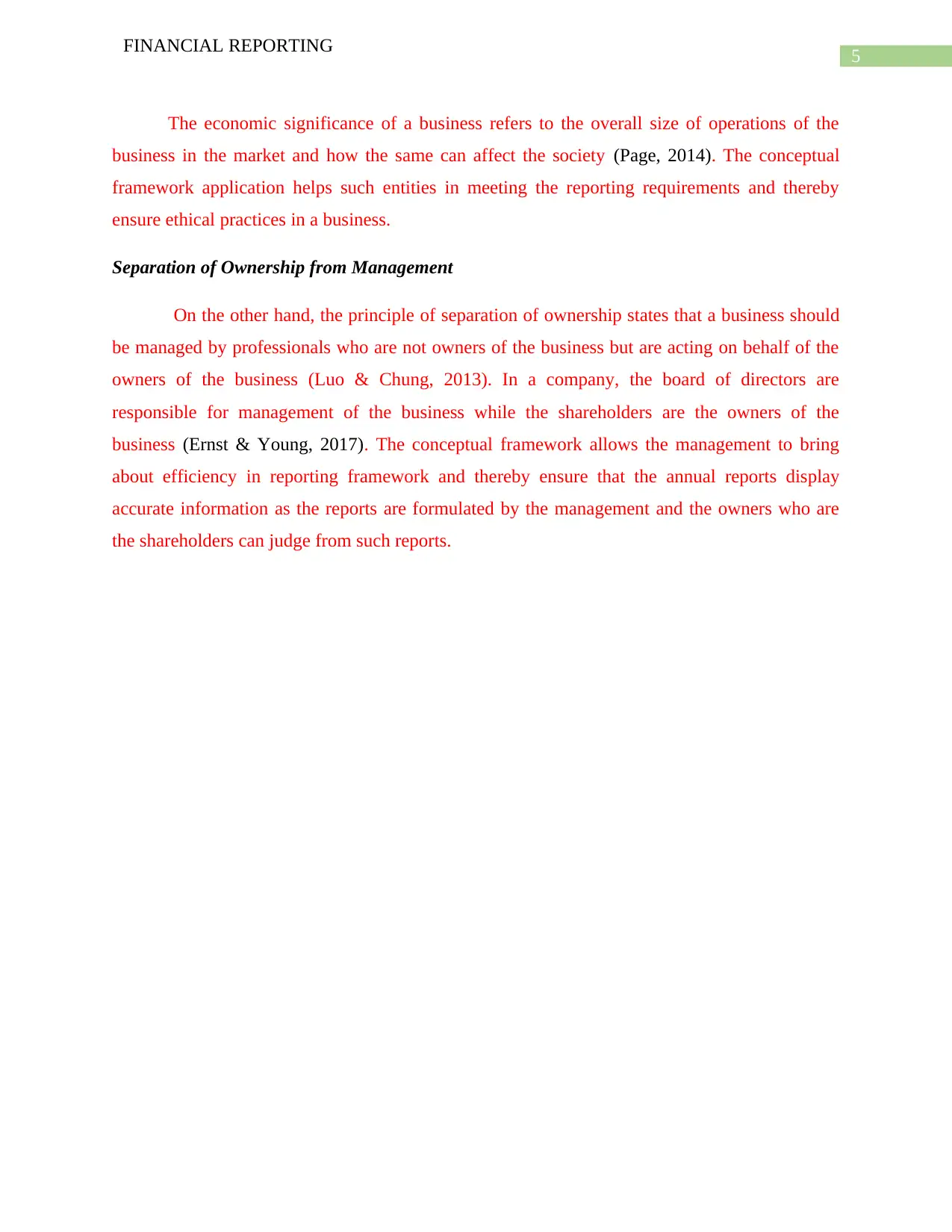
Separation of Ownership from Management
On the other hand, the principle of separation of ownership states that a business should
be managed by professionals who are not owners of the business but are acting on behalf of the
owners of the business (Luo & Chung, 2013). In a company, the board of directors are
responsible for management of the business while the shareholders are the owners of the
business (Ernst & Young, 2017). The conceptual framework allows the management to bring
about efficiency in reporting framework and thereby ensure that the annual reports display
accurate information as the reports are formulated by the management and the owners who are
the shareholders can judge from such reports.
Document Page
6
FINANCIAL REPORTING
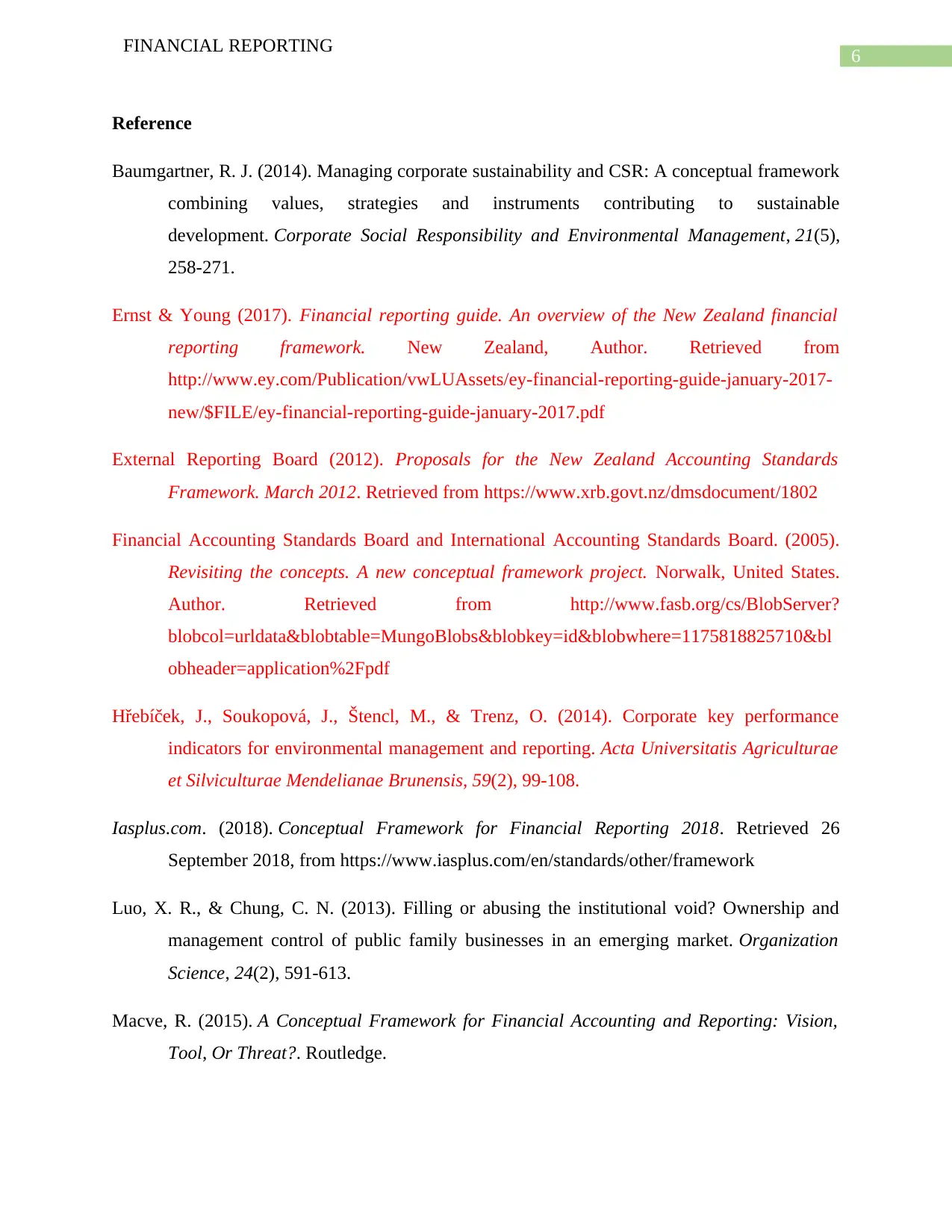
Reference
Baumgartner, R. J. (2014). Managing corporate sustainability and CSR: A conceptual framework
combining values, strategies and instruments contributing to sustainable
development. Corporate Social Responsibility and Environmental Management, 21(5),
258-271.
Ernst & Young (2017). Financial reporting guide. An overview of the New Zealand financial
reporting framework. New Zealand, Author. Retrieved from
http://www.ey.com/Publication/vwLUAssets/ey-financial-reporting-guide-january-2017-
new/$FILE/ey-financial-reporting-guide-january-2017.pdf
External Reporting Board (2012). Proposals for the New Zealand Accounting Standards
Framework. March 2012. Retrieved from https://www.xrb.govt.nz/dmsdocument/1802
Financial Accounting Standards Board and International Accounting Standards Board. (2005).
Revisiting the concepts. A new conceptual framework project. Norwalk, United States.
Author. Retrieved from http://www.fasb.org/cs/BlobServer?
blobcol=urldata&blobtable=MungoBlobs&blobkey=id&blobwhere=1175818825710&bl
obheader=application%2Fpdf
Hřebíček, J., Soukopová, J., Štencl, M., & Trenz, O. (2014). Corporate key performance
indicators for environmental management and reporting. Acta Universitatis Agriculturae
et Silviculturae Mendelianae Brunensis, 59(2), 99-108.
Iasplus.com. (2018). Conceptual Framework for Financial Reporting 2018. Retrieved 26
September 2018, from https://www.iasplus.com/en/standards/other/framework
Luo, X. R., & Chung, C. N. (2013). Filling or abusing the institutional void? Ownership and
management control of public family businesses in an emerging market. Organization
Science, 24(2), 591-613.
Macve, R. (2015). A Conceptual Framework for Financial Accounting and Reporting: Vision,
Tool, Or Threat?. Routledge.
tabler-icon-diamond-filled.svg

Paraphrase This Document

Need a fresh take? Get an instant paraphrase of this document with our AI Paraphraser
Document Page
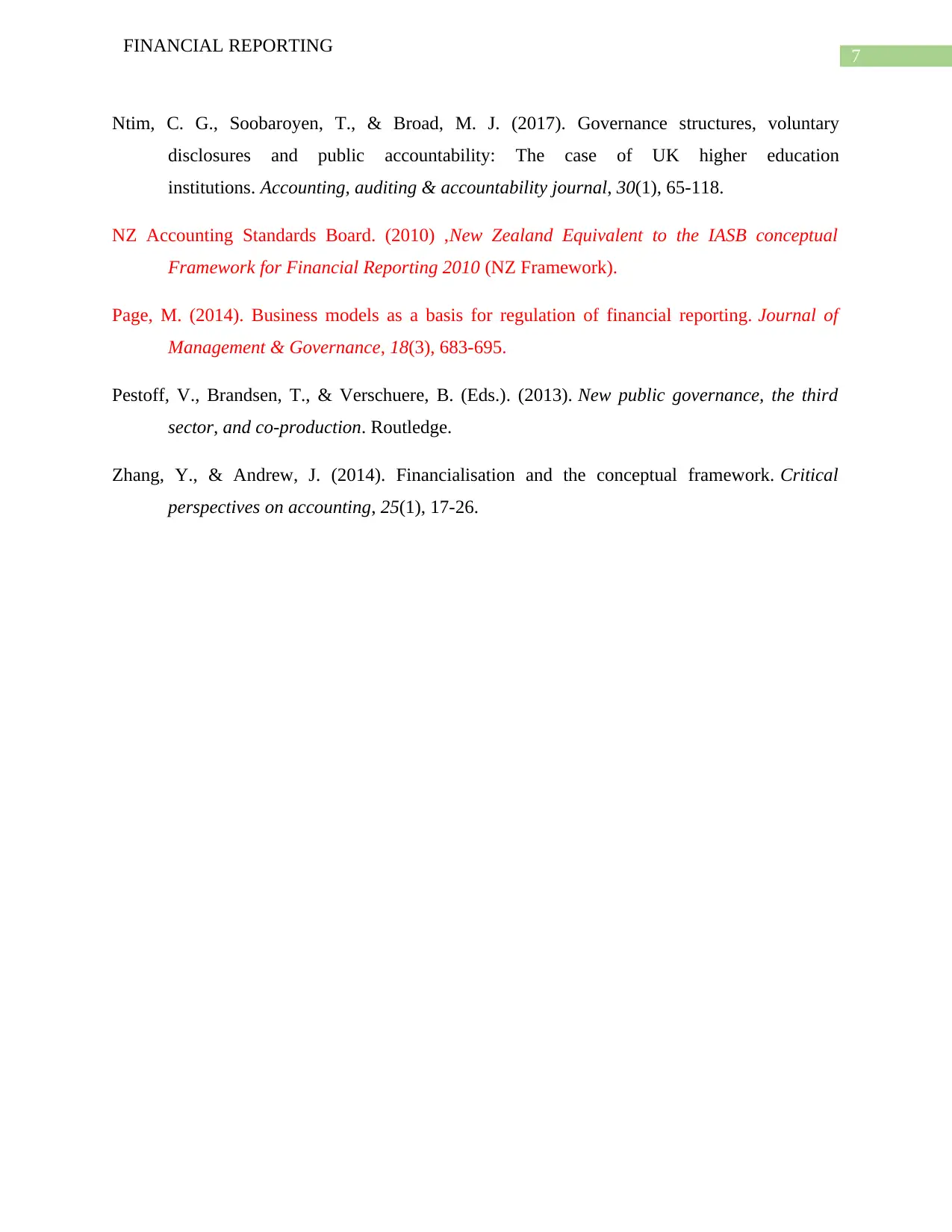
7
FINANCIAL REPORTING
Ntim, C. G., Soobaroyen, T., & Broad, M. J. (2017). Governance structures, voluntary
disclosures and public accountability: The case of UK higher education
institutions. Accounting, auditing & accountability journal, 30(1), 65-118.
NZ Accounting Standards Board. (2010) ,New Zealand Equivalent to the IASB conceptual
Framework for Financial Reporting 2010 (NZ Framework).
Page, M. (2014). Business models as a basis for regulation of financial reporting. Journal of
Management & Governance, 18(3), 683-695.
Pestoff, V., Brandsen, T., & Verschuere, B. (Eds.). (2013). New public governance, the third
sector, and co-production. Routledge.
Zhang, Y., & Andrew, J. (2014). Financialisation and the conceptual framework. Critical
perspectives on accounting, 25(1), 17-26.
chevron_up_icon
1 out of 8
circle_padding
hide_on_mobile
zoom_out_icon
[object Object]