Management Accounting: Systems, Reports, and Performance Analysis
VerifiedAdded on 2022/12/26
|19
|4540
|48
Report
AI Summary
This report on management accounting provides a comprehensive overview of various systems, methods, and their applications within an organizational context, specifically referencing The London College. It explores the role of management accounting in decision-making, planning, and controlling business strategies, including the use of tools like variance analysis and break-even analysis. The report details different reporting methods, such as inventory management and job costing, and their benefits in terms of relevance, updated information, reliability, understandability, and accuracy. It includes calculations for cost cards using both absorption and marginal costing, along with income statements under both costing methods. The report also covers financial report analysis, including estimating expenses, inventory valuation, and break-even point calculations, demonstrating how these techniques can be applied to improve organizational performance and achieve sustainable success. Finally, the report touches on cash flow management and collection schedules.
MANAGEMENT
ACCOUNTING
1
ACCOUNTING
1

Paraphrase This Document
Need a fresh take? Get an instant paraphrase of this document with our AI Paraphraser
Table of Contents
INTRODUCTION...........................................................................................................................3
MAIN BODY...................................................................................................................................3
Section one...................................................................................................................................3
1.1. ...............................................................................................................................................3
1.2.................................................................................................................................................4
1.3 ................................................................................................................................................4
1.4.................................................................................................................................................5
2.1. ...............................................................................................................................................5
2.2. ...............................................................................................................................................8
2.3 ................................................................................................................................................8
2.4.................................................................................................................................................9
Part 2..............................................................................................................................................10
3.1...............................................................................................................................................10
3.2 ..............................................................................................................................................11
4.1...............................................................................................................................................11
4.2...............................................................................................................................................12
4.3 ..............................................................................................................................................13
4.4 ..............................................................................................................................................13
CONCLUSION..............................................................................................................................15
REFERENCES..............................................................................................................................16
2
INTRODUCTION...........................................................................................................................3
MAIN BODY...................................................................................................................................3
Section one...................................................................................................................................3
1.1. ...............................................................................................................................................3
1.2.................................................................................................................................................4
1.3 ................................................................................................................................................4
1.4.................................................................................................................................................5
2.1. ...............................................................................................................................................5
2.2. ...............................................................................................................................................8
2.3 ................................................................................................................................................8
2.4.................................................................................................................................................9
Part 2..............................................................................................................................................10
3.1...............................................................................................................................................10
3.2 ..............................................................................................................................................11
4.1...............................................................................................................................................11
4.2...............................................................................................................................................12
4.3 ..............................................................................................................................................13
4.4 ..............................................................................................................................................13
CONCLUSION..............................................................................................................................15
REFERENCES..............................................................................................................................16
2
INTRODUCTION
Management accounting refers to that aspect of accounting which provides financial
information for the purpose of relevant decision making by the managers in the organisation. It
can be defined in different ways like the application of professional knowledge and skills while
preparing financial reports that could aid internal management of the business in framing
strategic policies along with carrying out effective planning and controlling the operation of the
concern (Pasch, 2019). Costing, budgeting and variance analysis are some of the tools and
techniques of management accounting. In this report, the various management accounting
systems, methods of preparing financial reports along with the preparation of financial reports
using tools and techniques of MA will be discussed. Also, it will be explained how these MAS
can be applied within organisation and how it helps in improving the performance of the concern
which leads to sustainable success for the organisation. This report will be based on The London
College, UK.
MAIN BODY
Section one
1.1.
Management accounting is the process of analysing the financial statement of the
company with the help of systems in order to take decision. For this purpose, the company have
to appoint the well qualified managers (Ammar, 2017). The requirements of management
accounting systems are including the following which helps the managers of The London
College in achieving their goals:
The managers of the London college use the MA information for the purpose of creating
and analysing the budgets and forecasts in order to plan, organise and control the
business strategies.
In order to analyse the data, they also use the variance analysis and break even analysis
tool so that they can identify the performance of the business is under or over
performance or balance (Yoder, and et.al., 2017).
With the help of accounting systems, they complete their work in less time and also
without any error. It is because the manual work involves lots of mistakes and errors.
3
Management accounting refers to that aspect of accounting which provides financial
information for the purpose of relevant decision making by the managers in the organisation. It
can be defined in different ways like the application of professional knowledge and skills while
preparing financial reports that could aid internal management of the business in framing
strategic policies along with carrying out effective planning and controlling the operation of the
concern (Pasch, 2019). Costing, budgeting and variance analysis are some of the tools and
techniques of management accounting. In this report, the various management accounting
systems, methods of preparing financial reports along with the preparation of financial reports
using tools and techniques of MA will be discussed. Also, it will be explained how these MAS
can be applied within organisation and how it helps in improving the performance of the concern
which leads to sustainable success for the organisation. This report will be based on The London
College, UK.
MAIN BODY
Section one
1.1.
Management accounting is the process of analysing the financial statement of the
company with the help of systems in order to take decision. For this purpose, the company have
to appoint the well qualified managers (Ammar, 2017). The requirements of management
accounting systems are including the following which helps the managers of The London
College in achieving their goals:
The managers of the London college use the MA information for the purpose of creating
and analysing the budgets and forecasts in order to plan, organise and control the
business strategies.
In order to analyse the data, they also use the variance analysis and break even analysis
tool so that they can identify the performance of the business is under or over
performance or balance (Yoder, and et.al., 2017).
With the help of accounting systems, they complete their work in less time and also
without any error. It is because the manual work involves lots of mistakes and errors.
3
⊘ This is a preview!⊘
Do you want full access?
Subscribe today to unlock all pages.

Trusted by 1+ million students worldwide
The systems record the performance of each employee on daily basis. So mangers use
this to visualize the performance of employees and further motivate them for the same.
In case if the actual and planned performance have any gap and such gaps are
controllable, then the company motivates their employees in order to improve their
efficiency.
1.2
Management Accounting reporting methods
Inventory management system: It is the system of reporting the inventory movement in and
from the business, where the store manager tracks and simultaneously reports the inventory
throughout the chain of supply that is right from inventory acquisition to production to end sales.
By overseeing the inventory of the business, the management undertakes to ensure that there
would be no situations like under stocking and over stocking (Hlaciuc and et.al., 2017).
Job costing system: It refers to that system of costing where the overhead costs are assigned to
specific jobs or to various cost pools. This costing method is suitable where there are various
tasks or jobs or contracts are performed under one head.
Price optimization: Here the price of the products or services are determined by studying how
the variations in a demand is occurring due to corresponding change in the level of price. These
data of demand variations when combined with the cost related and available inventory levels in
order to determine and reach at an optimum price level (Li, 2018).
1.3
Benefits and application of management accounting system
Relevance: MA provides for key insights into a company's internal management to help
managers in decision making activities. They provide support in accomplishing decision making
tasks by providing useful information related to financial health (Gatti, 2018).
Updated information: As management accounting is done throughout the year, so it provides for
up to date information to the financial decision makers regarding various aspects of the business
operations.
Reliability: MA accounting reports and budgets as prepared on the basis of past information and
future estimations are done on the basis of these information, so there is a factor of reliability
which is ensured by management accounting systems (Dearman, Lechner and Shanklin, 2018).
4
this to visualize the performance of employees and further motivate them for the same.
In case if the actual and planned performance have any gap and such gaps are
controllable, then the company motivates their employees in order to improve their
efficiency.
1.2
Management Accounting reporting methods
Inventory management system: It is the system of reporting the inventory movement in and
from the business, where the store manager tracks and simultaneously reports the inventory
throughout the chain of supply that is right from inventory acquisition to production to end sales.
By overseeing the inventory of the business, the management undertakes to ensure that there
would be no situations like under stocking and over stocking (Hlaciuc and et.al., 2017).
Job costing system: It refers to that system of costing where the overhead costs are assigned to
specific jobs or to various cost pools. This costing method is suitable where there are various
tasks or jobs or contracts are performed under one head.
Price optimization: Here the price of the products or services are determined by studying how
the variations in a demand is occurring due to corresponding change in the level of price. These
data of demand variations when combined with the cost related and available inventory levels in
order to determine and reach at an optimum price level (Li, 2018).
1.3
Benefits and application of management accounting system
Relevance: MA provides for key insights into a company's internal management to help
managers in decision making activities. They provide support in accomplishing decision making
tasks by providing useful information related to financial health (Gatti, 2018).
Updated information: As management accounting is done throughout the year, so it provides for
up to date information to the financial decision makers regarding various aspects of the business
operations.
Reliability: MA accounting reports and budgets as prepared on the basis of past information and
future estimations are done on the basis of these information, so there is a factor of reliability
which is ensured by management accounting systems (Dearman, Lechner and Shanklin, 2018).
4
Paraphrase This Document
Need a fresh take? Get an instant paraphrase of this document with our AI Paraphraser
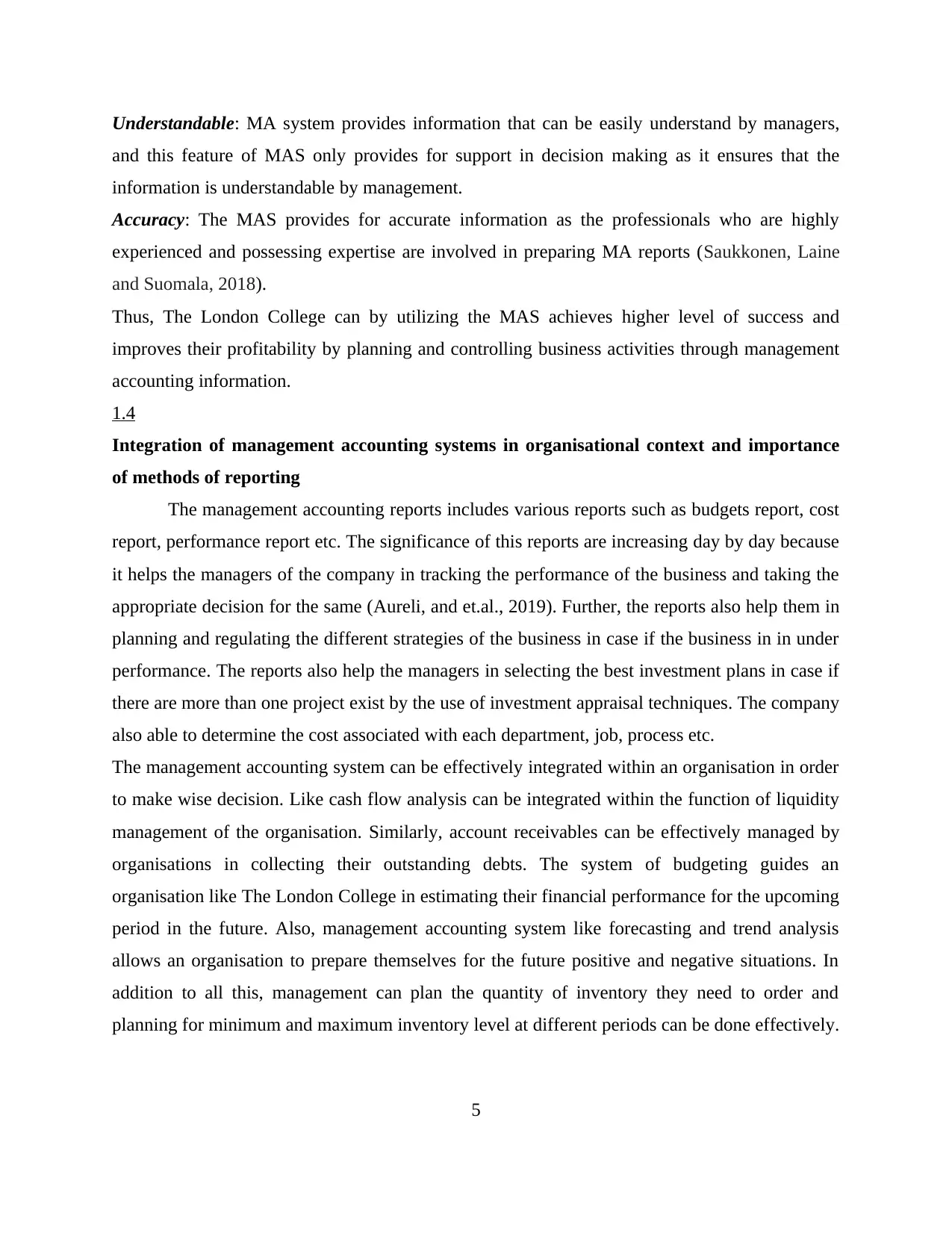
Understandable: MA system provides information that can be easily understand by managers,
and this feature of MAS only provides for support in decision making as it ensures that the
information is understandable by management.
Accuracy: The MAS provides for accurate information as the professionals who are highly
experienced and possessing expertise are involved in preparing MA reports (Saukkonen, Laine
and Suomala, 2018).
Thus, The London College can by utilizing the MAS achieves higher level of success and
improves their profitability by planning and controlling business activities through management
accounting information.
1.4
Integration of management accounting systems in organisational context and importance
of methods of reporting
The management accounting reports includes various reports such as budgets report, cost
report, performance report etc. The significance of this reports are increasing day by day because
it helps the managers of the company in tracking the performance of the business and taking the
appropriate decision for the same (Aureli, and et.al., 2019). Further, the reports also help them in
planning and regulating the different strategies of the business in case if the business in in under
performance. The reports also help the managers in selecting the best investment plans in case if
there are more than one project exist by the use of investment appraisal techniques. The company
also able to determine the cost associated with each department, job, process etc.
The management accounting system can be effectively integrated within an organisation in order
to make wise decision. Like cash flow analysis can be integrated within the function of liquidity
management of the organisation. Similarly, account receivables can be effectively managed by
organisations in collecting their outstanding debts. The system of budgeting guides an
organisation like The London College in estimating their financial performance for the upcoming
period in the future. Also, management accounting system like forecasting and trend analysis
allows an organisation to prepare themselves for the future positive and negative situations. In
addition to all this, management can plan the quantity of inventory they need to order and
planning for minimum and maximum inventory level at different periods can be done effectively.
5
and this feature of MAS only provides for support in decision making as it ensures that the
information is understandable by management.
Accuracy: The MAS provides for accurate information as the professionals who are highly
experienced and possessing expertise are involved in preparing MA reports (Saukkonen, Laine
and Suomala, 2018).
Thus, The London College can by utilizing the MAS achieves higher level of success and
improves their profitability by planning and controlling business activities through management
accounting information.
1.4
Integration of management accounting systems in organisational context and importance
of methods of reporting
The management accounting reports includes various reports such as budgets report, cost
report, performance report etc. The significance of this reports are increasing day by day because
it helps the managers of the company in tracking the performance of the business and taking the
appropriate decision for the same (Aureli, and et.al., 2019). Further, the reports also help them in
planning and regulating the different strategies of the business in case if the business in in under
performance. The reports also help the managers in selecting the best investment plans in case if
there are more than one project exist by the use of investment appraisal techniques. The company
also able to determine the cost associated with each department, job, process etc.
The management accounting system can be effectively integrated within an organisation in order
to make wise decision. Like cash flow analysis can be integrated within the function of liquidity
management of the organisation. Similarly, account receivables can be effectively managed by
organisations in collecting their outstanding debts. The system of budgeting guides an
organisation like The London College in estimating their financial performance for the upcoming
period in the future. Also, management accounting system like forecasting and trend analysis
allows an organisation to prepare themselves for the future positive and negative situations. In
addition to all this, management can plan the quantity of inventory they need to order and
planning for minimum and maximum inventory level at different periods can be done effectively.
5
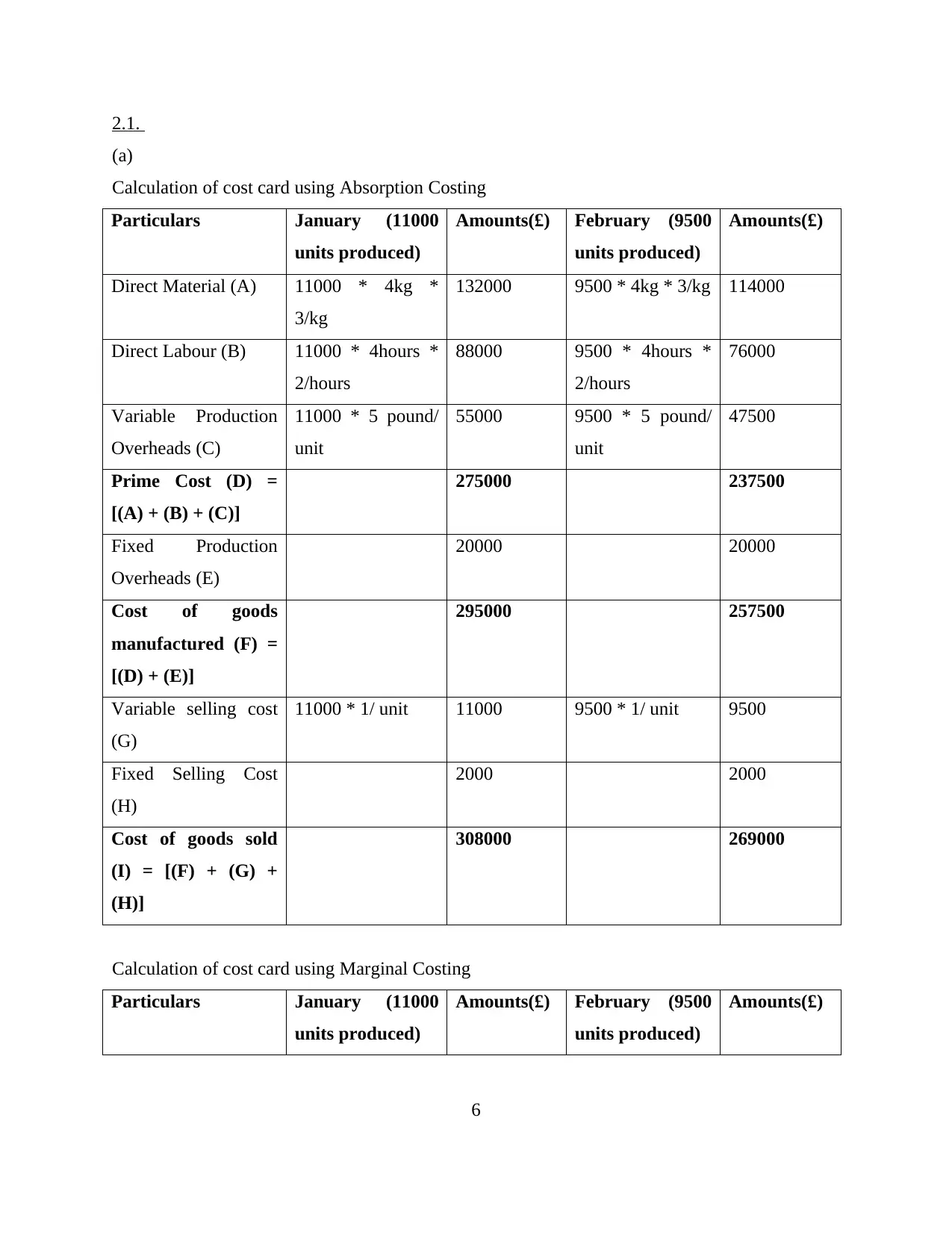
2.1.
(a)
Calculation of cost card using Absorption Costing
Particulars January (11000
units produced)
Amounts(£) February (9500
units produced)
Amounts(£)
Direct Material (A) 11000 * 4kg *
3/kg
132000 9500 * 4kg * 3/kg 114000
Direct Labour (B) 11000 * 4hours *
2/hours
88000 9500 * 4hours *
2/hours
76000
Variable Production
Overheads (C)
11000 * 5 pound/
unit
55000 9500 * 5 pound/
unit
47500
Prime Cost (D) =
[(A) + (B) + (C)]
275000 237500
Fixed Production
Overheads (E)
20000 20000
Cost of goods
manufactured (F) =
[(D) + (E)]
295000 257500
Variable selling cost
(G)
11000 * 1/ unit 11000 9500 * 1/ unit 9500
Fixed Selling Cost
(H)
2000 2000
Cost of goods sold
(I) = [(F) + (G) +
(H)]
308000 269000
Calculation of cost card using Marginal Costing
Particulars January (11000
units produced)
Amounts(£) February (9500
units produced)
Amounts(£)
6
(a)
Calculation of cost card using Absorption Costing
Particulars January (11000
units produced)
Amounts(£) February (9500
units produced)
Amounts(£)
Direct Material (A) 11000 * 4kg *
3/kg
132000 9500 * 4kg * 3/kg 114000
Direct Labour (B) 11000 * 4hours *
2/hours
88000 9500 * 4hours *
2/hours
76000
Variable Production
Overheads (C)
11000 * 5 pound/
unit
55000 9500 * 5 pound/
unit
47500
Prime Cost (D) =
[(A) + (B) + (C)]
275000 237500
Fixed Production
Overheads (E)
20000 20000
Cost of goods
manufactured (F) =
[(D) + (E)]
295000 257500
Variable selling cost
(G)
11000 * 1/ unit 11000 9500 * 1/ unit 9500
Fixed Selling Cost
(H)
2000 2000
Cost of goods sold
(I) = [(F) + (G) +
(H)]
308000 269000
Calculation of cost card using Marginal Costing
Particulars January (11000
units produced)
Amounts(£) February (9500
units produced)
Amounts(£)
6
⊘ This is a preview!⊘
Do you want full access?
Subscribe today to unlock all pages.
Trusted by 1+ million students worldwide
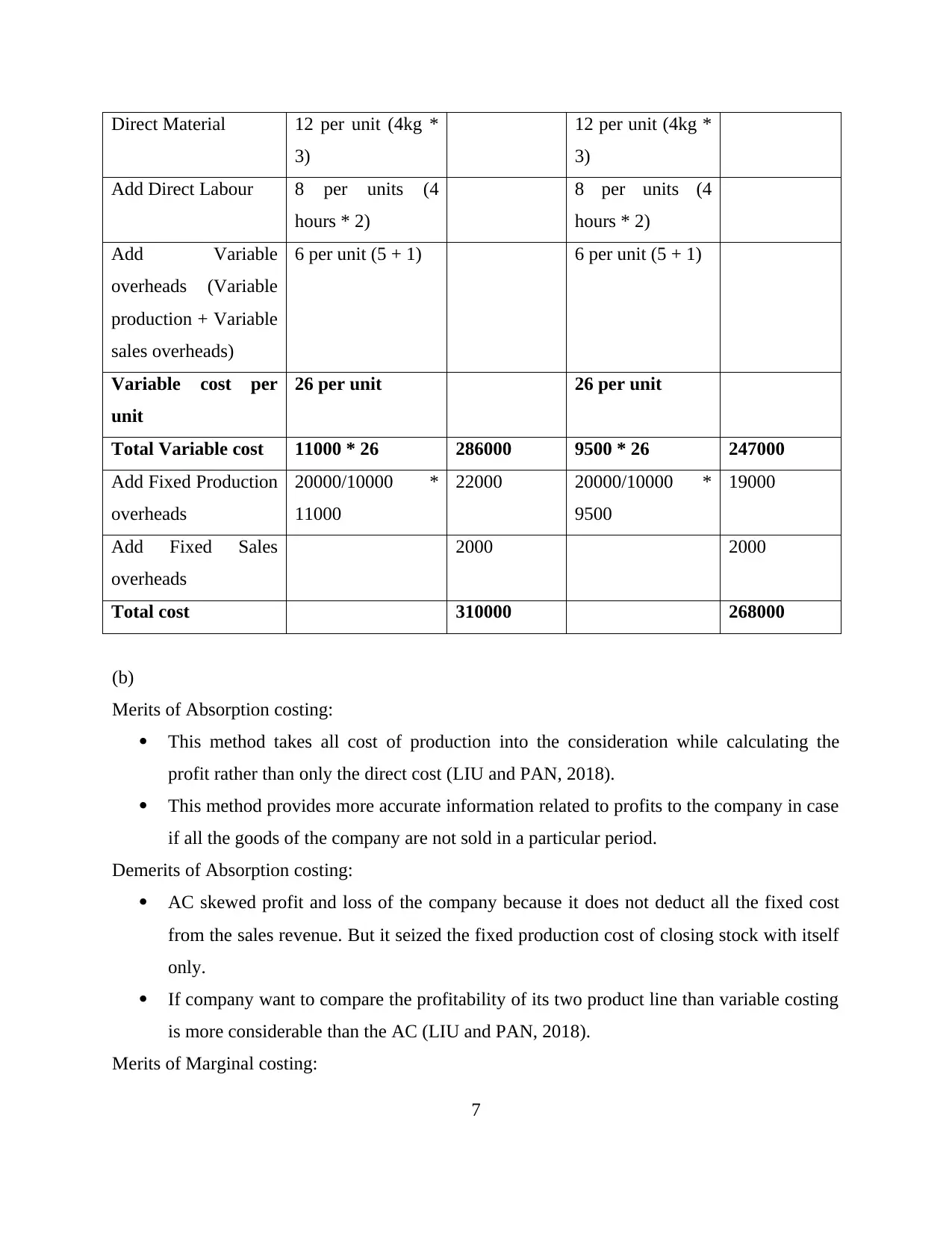
Direct Material 12 per unit (4kg *
3)
12 per unit (4kg *
3)
Add Direct Labour 8 per units (4
hours * 2)
8 per units (4
hours * 2)
Add Variable
overheads (Variable
production + Variable
sales overheads)
6 per unit (5 + 1) 6 per unit (5 + 1)
Variable cost per
unit
26 per unit 26 per unit
Total Variable cost 11000 * 26 286000 9500 * 26 247000
Add Fixed Production
overheads
20000/10000 *
11000
22000 20000/10000 *
9500
19000
Add Fixed Sales
overheads
2000 2000
Total cost 310000 268000
(b)
Merits of Absorption costing:
This method takes all cost of production into the consideration while calculating the
profit rather than only the direct cost (LIU and PAN, 2018).
This method provides more accurate information related to profits to the company in case
if all the goods of the company are not sold in a particular period.
Demerits of Absorption costing:
AC skewed profit and loss of the company because it does not deduct all the fixed cost
from the sales revenue. But it seized the fixed production cost of closing stock with itself
only.
If company want to compare the profitability of its two product line than variable costing
is more considerable than the AC (LIU and PAN, 2018).
Merits of Marginal costing:
7
3)
12 per unit (4kg *
3)
Add Direct Labour 8 per units (4
hours * 2)
8 per units (4
hours * 2)
Add Variable
overheads (Variable
production + Variable
sales overheads)
6 per unit (5 + 1) 6 per unit (5 + 1)
Variable cost per
unit
26 per unit 26 per unit
Total Variable cost 11000 * 26 286000 9500 * 26 247000
Add Fixed Production
overheads
20000/10000 *
11000
22000 20000/10000 *
9500
19000
Add Fixed Sales
overheads
2000 2000
Total cost 310000 268000
(b)
Merits of Absorption costing:
This method takes all cost of production into the consideration while calculating the
profit rather than only the direct cost (LIU and PAN, 2018).
This method provides more accurate information related to profits to the company in case
if all the goods of the company are not sold in a particular period.
Demerits of Absorption costing:
AC skewed profit and loss of the company because it does not deduct all the fixed cost
from the sales revenue. But it seized the fixed production cost of closing stock with itself
only.
If company want to compare the profitability of its two product line than variable costing
is more considerable than the AC (LIU and PAN, 2018).
Merits of Marginal costing:
7
Paraphrase This Document
Need a fresh take? Get an instant paraphrase of this document with our AI Paraphraser
This method is useful in comparison of two product line as it is constant in nature and do
not change with the change in the production level (Hirose, Lee and Matsumura, 2017).
Because of the separation of the fixed production overheads from the production cost, the
degree of over and under absorption cost is reduces.
Demerits of Marginal costing:
While distributing the overall cost into fixed and variable cost, the time element is get
ignored by the company. It is one of the disadvantage because all cost is variable in the
long run.
These methods assume that the selling price and variable cost remain same at all level of
activity, which is generally not possible in real life (Thabet and Alaeddin, 2017).
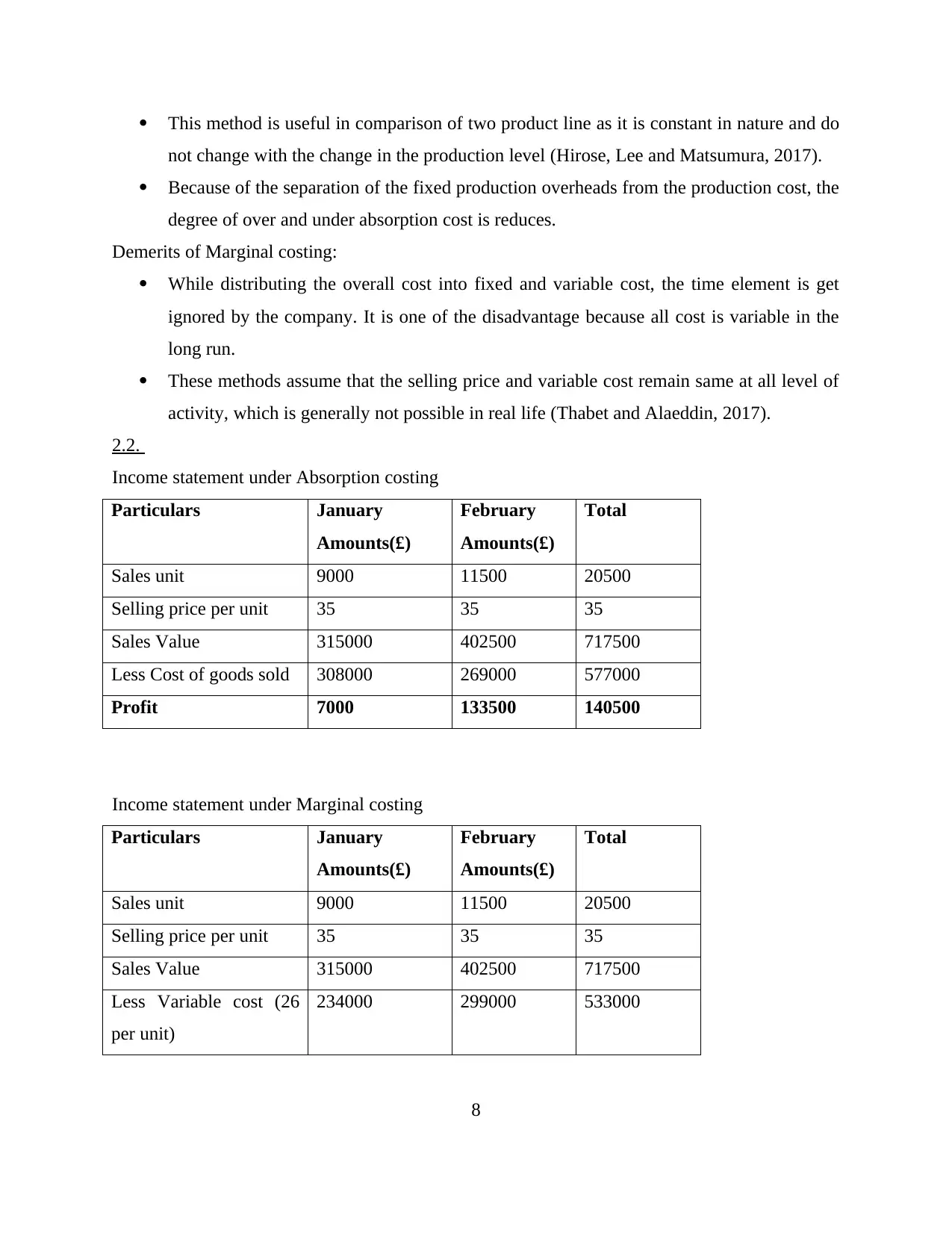
2.2.
Income statement under Absorption costing
Particulars January
Amounts(£)
February
Amounts(£)
Total
Sales unit 9000 11500 20500
Selling price per unit 35 35 35
Sales Value 315000 402500 717500
Less Cost of goods sold 308000 269000 577000
Profit 7000 133500 140500
Income statement under Marginal costing
Particulars January
Amounts(£)
February
Amounts(£)
Total
Sales unit 9000 11500 20500
Selling price per unit 35 35 35
Sales Value 315000 402500 717500
Less Variable cost (26
per unit)
234000 299000 533000
8
not change with the change in the production level (Hirose, Lee and Matsumura, 2017).
Because of the separation of the fixed production overheads from the production cost, the
degree of over and under absorption cost is reduces.
Demerits of Marginal costing:
While distributing the overall cost into fixed and variable cost, the time element is get
ignored by the company. It is one of the disadvantage because all cost is variable in the
long run.
These methods assume that the selling price and variable cost remain same at all level of
activity, which is generally not possible in real life (Thabet and Alaeddin, 2017).
2.2.
Income statement under Absorption costing
Particulars January
Amounts(£)
February
Amounts(£)
Total
Sales unit 9000 11500 20500
Selling price per unit 35 35 35
Sales Value 315000 402500 717500
Less Cost of goods sold 308000 269000 577000
Profit 7000 133500 140500
Income statement under Marginal costing
Particulars January
Amounts(£)
February
Amounts(£)
Total
Sales unit 9000 11500 20500
Selling price per unit 35 35 35
Sales Value 315000 402500 717500
Less Variable cost (26
per unit)
234000 299000 533000
8
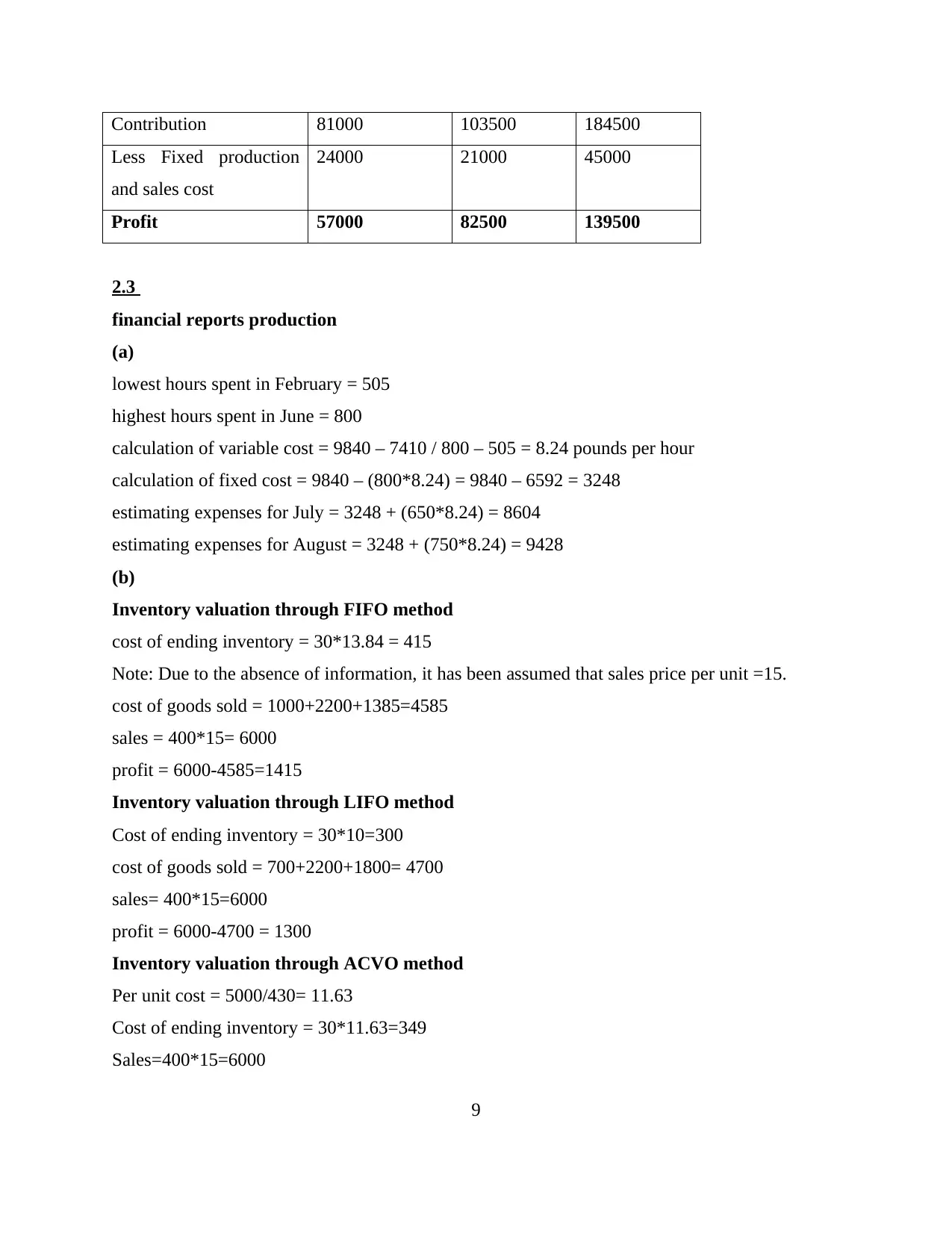
Contribution 81000 103500 184500
Less Fixed production
and sales cost
24000 21000 45000
Profit 57000 82500 139500
2.3
financial reports production
(a)
lowest hours spent in February = 505
highest hours spent in June = 800
calculation of variable cost = 9840 – 7410 / 800 – 505 = 8.24 pounds per hour
calculation of fixed cost = 9840 – (800*8.24) = 9840 – 6592 = 3248
estimating expenses for July = 3248 + (650*8.24) = 8604
estimating expenses for August = 3248 + (750*8.24) = 9428
(b)
Inventory valuation through FIFO method
cost of ending inventory = 30*13.84 = 415
Note: Due to the absence of information, it has been assumed that sales price per unit =15.
cost of goods sold = 1000+2200+1385=4585
sales = 400*15= 6000
profit = 6000-4585=1415
Inventory valuation through LIFO method
Cost of ending inventory = 30*10=300
cost of goods sold = 700+2200+1800= 4700
sales= 400*15=6000
profit = 6000-4700 = 1300
Inventory valuation through ACVO method
Per unit cost = 5000/430= 11.63
Cost of ending inventory = 30*11.63=349
Sales=400*15=6000
9
Less Fixed production
and sales cost
24000 21000 45000
Profit 57000 82500 139500
2.3
financial reports production
(a)
lowest hours spent in February = 505
highest hours spent in June = 800
calculation of variable cost = 9840 – 7410 / 800 – 505 = 8.24 pounds per hour
calculation of fixed cost = 9840 – (800*8.24) = 9840 – 6592 = 3248
estimating expenses for July = 3248 + (650*8.24) = 8604
estimating expenses for August = 3248 + (750*8.24) = 9428
(b)
Inventory valuation through FIFO method
cost of ending inventory = 30*13.84 = 415
Note: Due to the absence of information, it has been assumed that sales price per unit =15.
cost of goods sold = 1000+2200+1385=4585
sales = 400*15= 6000
profit = 6000-4585=1415
Inventory valuation through LIFO method
Cost of ending inventory = 30*10=300
cost of goods sold = 700+2200+1800= 4700
sales= 400*15=6000
profit = 6000-4700 = 1300
Inventory valuation through ACVO method
Per unit cost = 5000/430= 11.63
Cost of ending inventory = 30*11.63=349
Sales=400*15=6000
9
⊘ This is a preview!⊘
Do you want full access?
Subscribe today to unlock all pages.
Trusted by 1+ million students worldwide
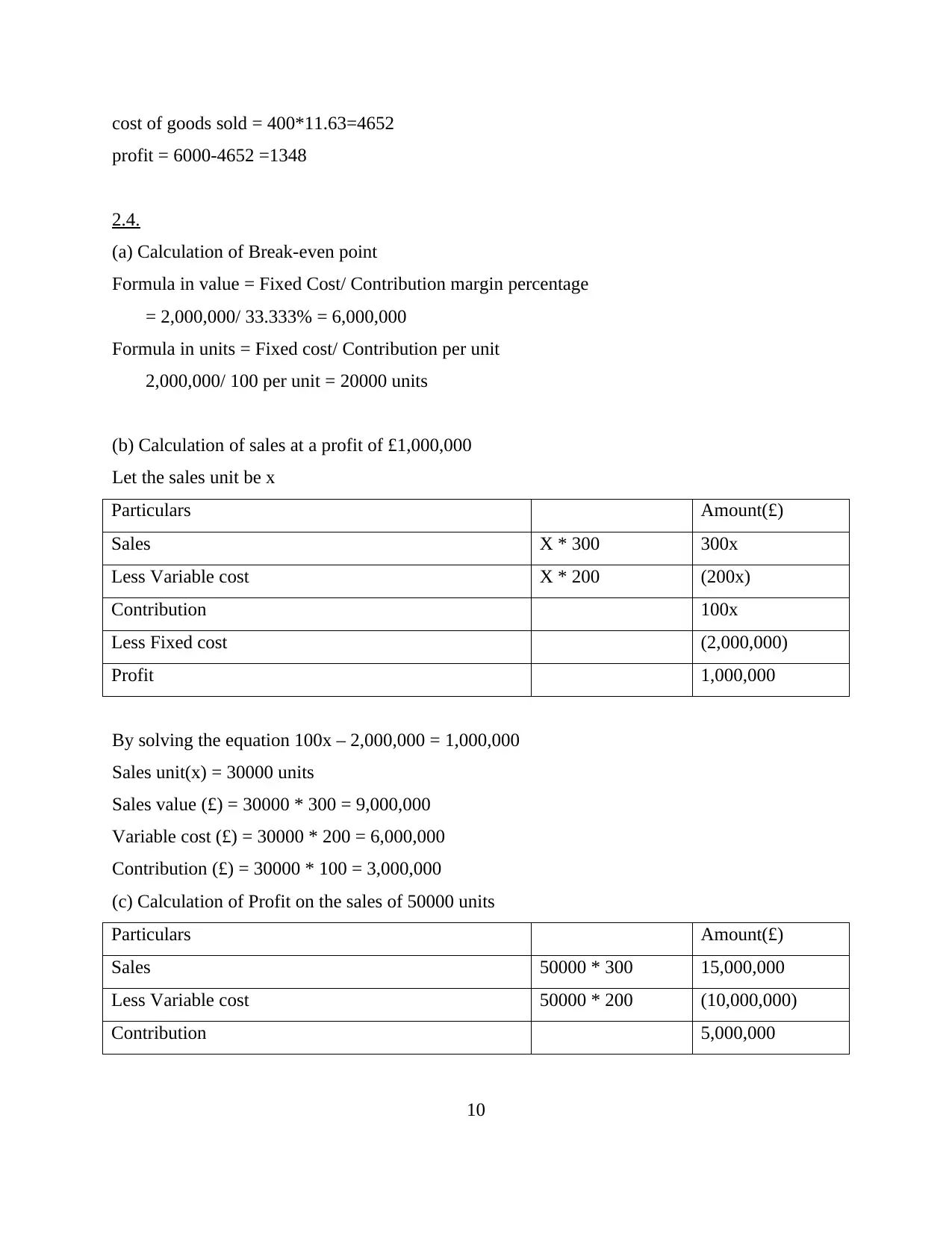
cost of goods sold = 400*11.63=4652
profit = 6000-4652 =1348
2.4.
(a) Calculation of Break-even point
Formula in value = Fixed Cost/ Contribution margin percentage
= 2,000,000/ 33.333% = 6,000,000
Formula in units = Fixed cost/ Contribution per unit
2,000,000/ 100 per unit = 20000 units
(b) Calculation of sales at a profit of £1,000,000
Let the sales unit be x
Particulars Amount(£)
Sales X * 300 300x
Less Variable cost X * 200 (200x)
Contribution 100x
Less Fixed cost (2,000,000)
Profit 1,000,000
By solving the equation 100x – 2,000,000 = 1,000,000
Sales unit(x) = 30000 units
Sales value (£) = 30000 * 300 = 9,000,000
Variable cost (£) = 30000 * 200 = 6,000,000
Contribution (£) = 30000 * 100 = 3,000,000
(c) Calculation of Profit on the sales of 50000 units
Particulars Amount(£)
Sales 50000 * 300 15,000,000
Less Variable cost 50000 * 200 (10,000,000)
Contribution 5,000,000
10
profit = 6000-4652 =1348
2.4.
(a) Calculation of Break-even point
Formula in value = Fixed Cost/ Contribution margin percentage
= 2,000,000/ 33.333% = 6,000,000
Formula in units = Fixed cost/ Contribution per unit
2,000,000/ 100 per unit = 20000 units
(b) Calculation of sales at a profit of £1,000,000
Let the sales unit be x
Particulars Amount(£)
Sales X * 300 300x
Less Variable cost X * 200 (200x)
Contribution 100x
Less Fixed cost (2,000,000)
Profit 1,000,000
By solving the equation 100x – 2,000,000 = 1,000,000
Sales unit(x) = 30000 units
Sales value (£) = 30000 * 300 = 9,000,000
Variable cost (£) = 30000 * 200 = 6,000,000
Contribution (£) = 30000 * 100 = 3,000,000
(c) Calculation of Profit on the sales of 50000 units
Particulars Amount(£)
Sales 50000 * 300 15,000,000
Less Variable cost 50000 * 200 (10,000,000)
Contribution 5,000,000
10
Paraphrase This Document
Need a fresh take? Get an instant paraphrase of this document with our AI Paraphraser
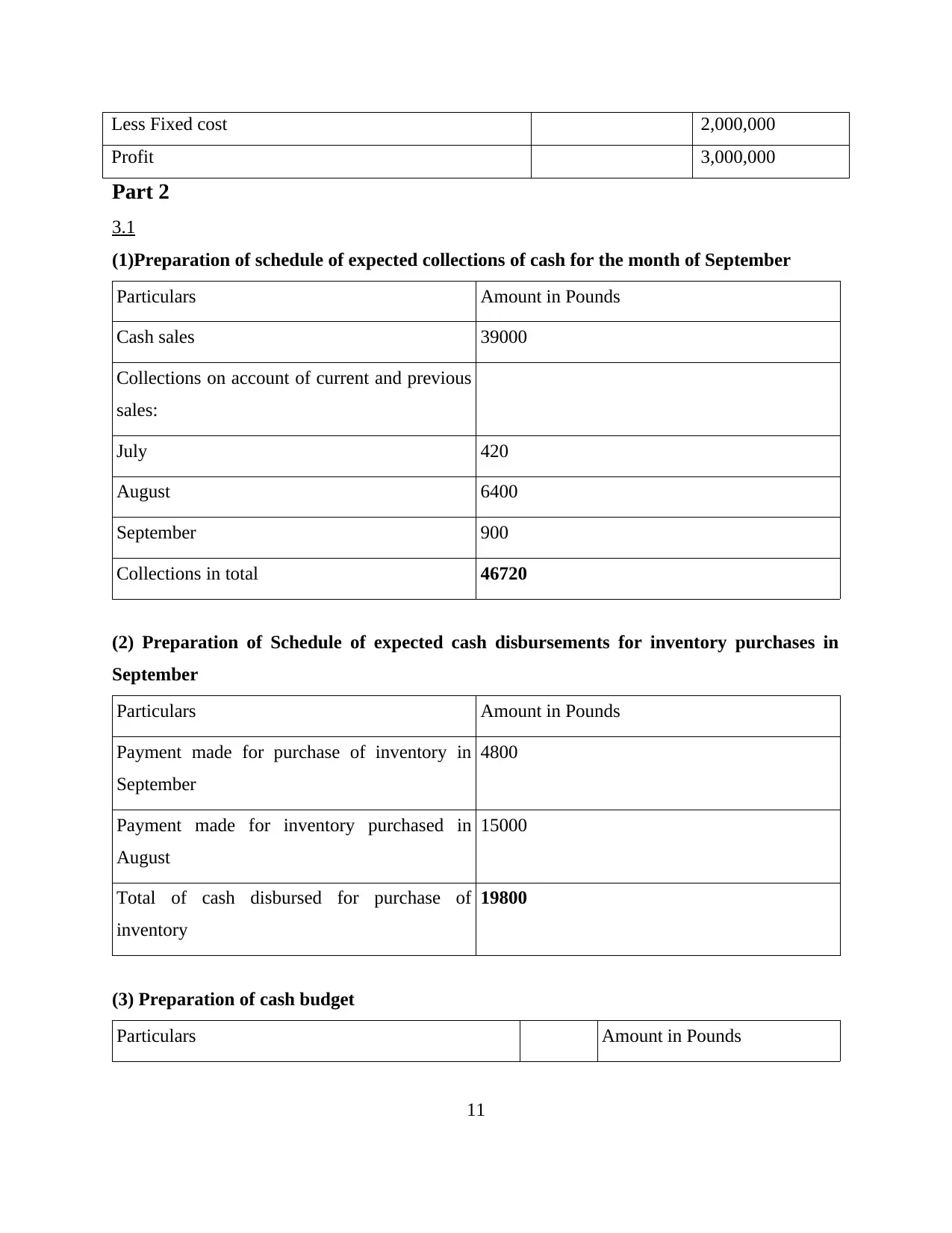
Less Fixed cost 2,000,000
Profit 3,000,000
Part 2
3.1
(1)Preparation of schedule of expected collections of cash for the month of September
Particulars Amount in Pounds
Cash sales 39000
Collections on account of current and previous
sales:
July 420
August 6400
September 900
Collections in total 46720
(2) Preparation of Schedule of expected cash disbursements for inventory purchases in
September
Particulars Amount in Pounds
Payment made for purchase of inventory in
September
4800
Payment made for inventory purchased in
August
15000
Total of cash disbursed for purchase of
inventory
19800
(3) Preparation of cash budget
Particulars Amount in Pounds
11
Profit 3,000,000
Part 2
3.1
(1)Preparation of schedule of expected collections of cash for the month of September
Particulars Amount in Pounds
Cash sales 39000
Collections on account of current and previous
sales:
July 420
August 6400
September 900
Collections in total 46720
(2) Preparation of Schedule of expected cash disbursements for inventory purchases in
September
Particulars Amount in Pounds
Payment made for purchase of inventory in
September
4800
Payment made for inventory purchased in
August
15000
Total of cash disbursed for purchase of
inventory
19800
(3) Preparation of cash budget
Particulars Amount in Pounds
11
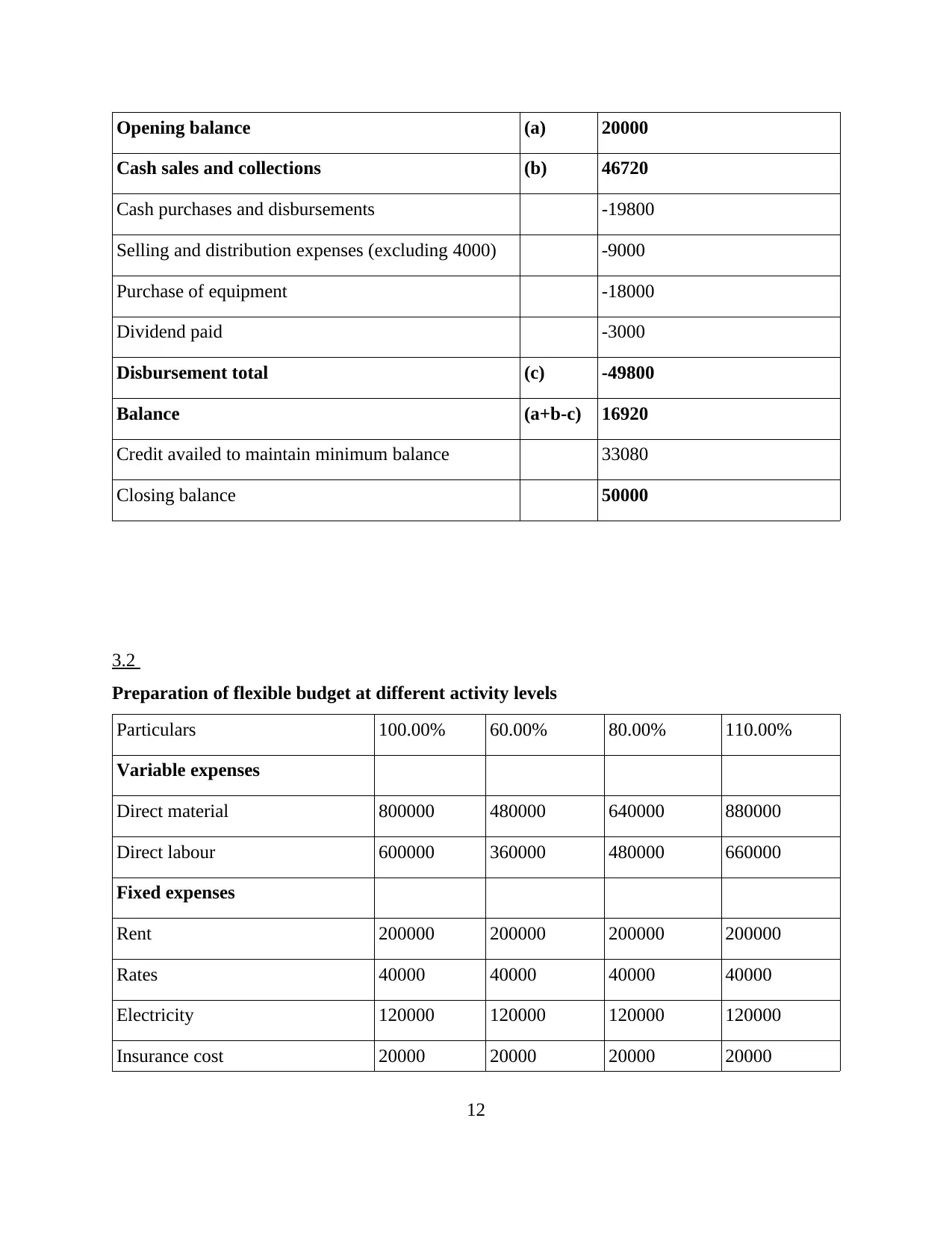
Opening balance (a) 20000
Cash sales and collections (b) 46720
Cash purchases and disbursements -19800
Selling and distribution expenses (excluding 4000) -9000
Purchase of equipment -18000
Dividend paid -3000
Disbursement total (c) -49800
Balance (a+b-c) 16920
Credit availed to maintain minimum balance 33080
Closing balance 50000
3.2
Preparation of flexible budget at different activity levels
Particulars 100.00% 60.00% 80.00% 110.00%
Variable expenses
Direct material 800000 480000 640000 880000
Direct labour 600000 360000 480000 660000
Fixed expenses
Rent 200000 200000 200000 200000
Rates 40000 40000 40000 40000
Electricity 120000 120000 120000 120000
Insurance cost 20000 20000 20000 20000
12
Cash sales and collections (b) 46720
Cash purchases and disbursements -19800
Selling and distribution expenses (excluding 4000) -9000
Purchase of equipment -18000
Dividend paid -3000
Disbursement total (c) -49800
Balance (a+b-c) 16920
Credit availed to maintain minimum balance 33080
Closing balance 50000
3.2
Preparation of flexible budget at different activity levels
Particulars 100.00% 60.00% 80.00% 110.00%
Variable expenses
Direct material 800000 480000 640000 880000
Direct labour 600000 360000 480000 660000
Fixed expenses
Rent 200000 200000 200000 200000
Rates 40000 40000 40000 40000
Electricity 120000 120000 120000 120000
Insurance cost 20000 20000 20000 20000
12
⊘ This is a preview!⊘
Do you want full access?
Subscribe today to unlock all pages.
Trusted by 1+ million students worldwide

1 out of 19


Related Documents


Your All-in-One AI-Powered Toolkit for Academic Success.
+13062052269
info@desklib.com
Available 24*7 on WhatsApp / Email
![[object Object]](/_next/static/media/star-bottom.7253800d.svg)
Unlock your academic potential
Copyright © 2020–2026 A2Z Services. All Rights Reserved. Developed and managed by ZUCOL.