Comprehensive Report: Financial Risks Faced by Modern Businesses

Verified

Added on  2022/12/26

|9
|1282
|59
Report
AI Summary
This report examines the financial risks encountered by contemporary businesses, encompassing both public and private sectors. It emphasizes the importance of effective risk management, including identification, assessment, and mitigation strategies. The literature review explores operational risk, Enterprise Risk Management (ERM), and cash risk management, highlighting the challenges faced by independent companies, particularly Small and Medium Enterprises (SMEs). The research design employs a mixed-methods approach, combining qualitative and quantitative data analysis to provide a comprehensive understanding of financial risk determinants. The theoretical framework focuses on leadership, governance, and corporate culture as key factors influencing financial risk management. The methodology includes data collection from journal articles, websites, and digital books, with data analysis conducted using statistical tools like SPSS and Excel. The report aims to develop a theoretical framework for effective financial risk management, offering valuable insights for businesses seeking to enhance their resilience and performance.
Document Page
Topic: Financial risks that a modern business
faces today
tabler-icon-diamond-filled.svg

Paraphrase This Document

Need a fresh take? Get an instant paraphrase of this document with our AI Paraphraser
Document Page
Table of Contents
Introduction......................................................................................................................................4
Literature Review............................................................................................................................5
Research Design and Methodology.................................................................................................7
Data analyses...................................................................................................................................8
References........................................................................................................................................9
Document Page
Document Page
Introduction
The administration of any association, whether operating in the public sector or operating in the
private sector, identifies the achievement of its screening and risk reduction objectives. Risk
control is achieved through effective monitoring, specific to the implementation of an adequate
risk within the officer framework.
Identifying board risk with a company's financial well-being and honesty is an important
consideration, and risk assessment is an important part of its critical turn of events. The board's
approach to risk should be that the board should have all the risks it faces identified, investigated,
reviewed and delivered until holding at a specific breaking point is identified, identified by the
administration of the material.
Research Objective.
1. To develop a theoretical framework on the determinants of effective financial
risk management
tabler-icon-diamond-filled.svg

Paraphrase This Document

Need a fresh take? Get an instant paraphrase of this document with our AI Paraphraser
Document Page
Literature Review
This part clarifies the meaning of an independent company in Malaysia and its problems. Later,
the distinction between operational risk, Enterprise Risk Management (ERM) and cash risk
management was fully considered. To date, there is no definitive agreement among researchers
on how best to identify financial risk among operators among independents. There are few
written reviews on this subject that make it very difficult to explain clearly the financial risk to
operators for private companies. However, it is clear how important the independent enterprise
will last. In this sense, it is difficult to place money risk management at the heart of this
document to improve the resilience and business performance of private enterprise. The National
Council for the Development of SMEs (NSDC) is designed to regulate and encourage
government in their approach and to co-ordinate all activities, whether in development or in
different issues. However, due to certain conditions, these private companies face significant
obstacles. For example, as simple as starting a business; capital, skills, knowledge, business plan,
money management and systems management are the components that determine a company’s
time frame (Lucky and Olusegun, 2012). According to Dinu (2013) the unsystemisation of SMEs
’money management shows that it is not constrained as indicated by the essential guidelines
about the finances of large companies and that they have hard characters of spontaneity and
individuation. This will definitely add a whole lot of raw thread to operators as it will be clear
that the industry will be run without instructions and guidelines to great loss in the future.
This is where the board had to go too far to see the existence of the independent company. Like
Anastasio (nd), Risk Management involves identifying and analyzing the times that can cause
bad luck as well as choosing the most appropriate approach. suitable for managing all of the
potential misfortunes. At the same time, the Australian CPA (2009) makes it clear that risk
management begins by identifying potential risks and then cycling to limit or eliminate them.
Sound danger the board can create lower protection expenses, diminished possibility that the
business might be the objective of legitimate activity, decreased misfortunes of money or stock
and furthermore can reduced business down time. Also, Harner (2011) expressed that Risk
Management underlines the capabilities of a business to foresee changes, not to keep away from
Document Page
hazard. Evasion of dangers means waiting for the occasion to happen then respond to it, as
opposed to get ready for the changes.
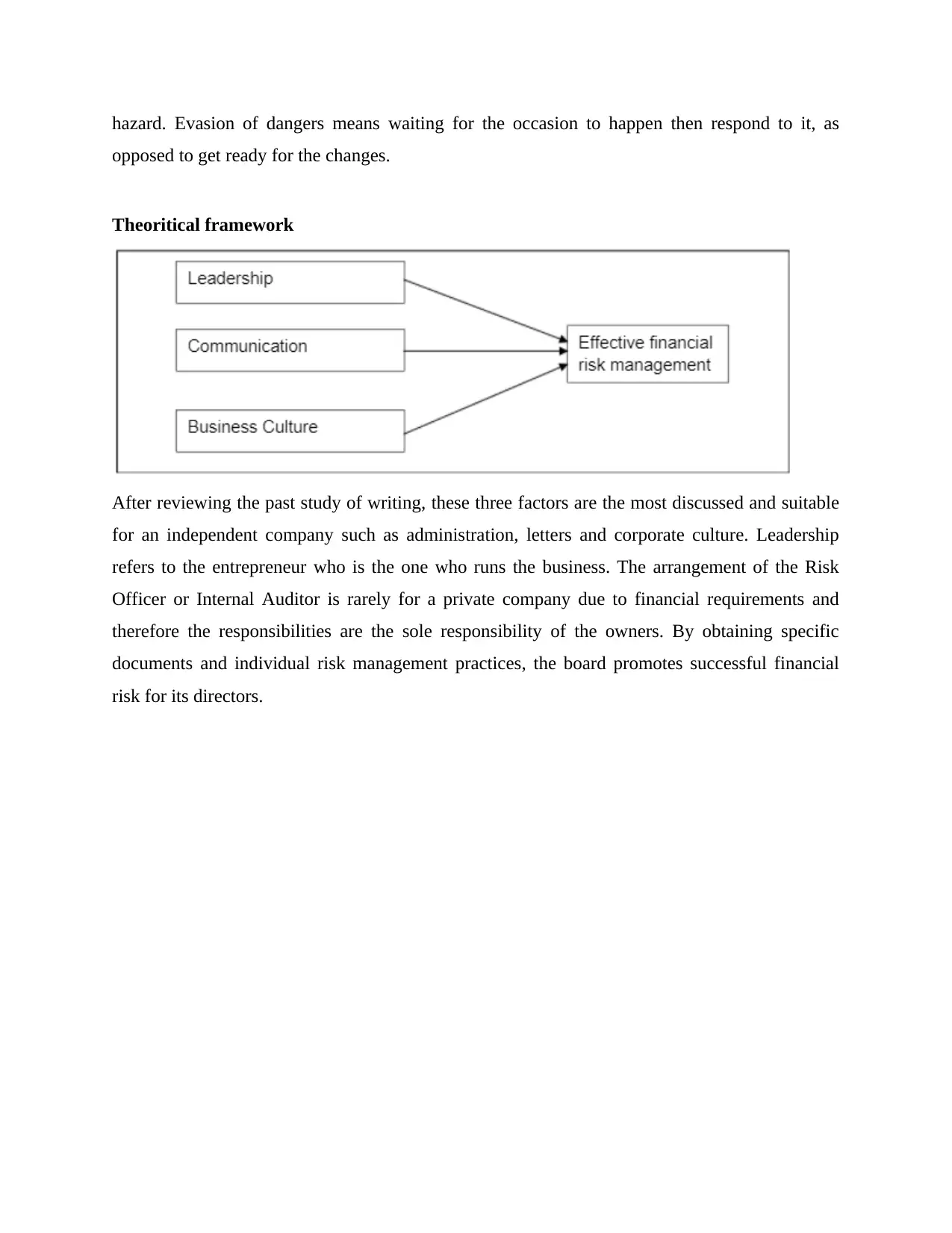
Theoritical framework
After reviewing the past study of writing, these three factors are the most discussed and suitable
for an independent company such as administration, letters and corporate culture. Leadership
refers to the entrepreneur who is the one who runs the business. The arrangement of the Risk
Officer or Internal Auditor is rarely for a private company due to financial requirements and
therefore the responsibilities are the sole responsibility of the owners. By obtaining specific
documents and individual risk management practices, the board promotes successful financial
risk for its directors.
Document Page
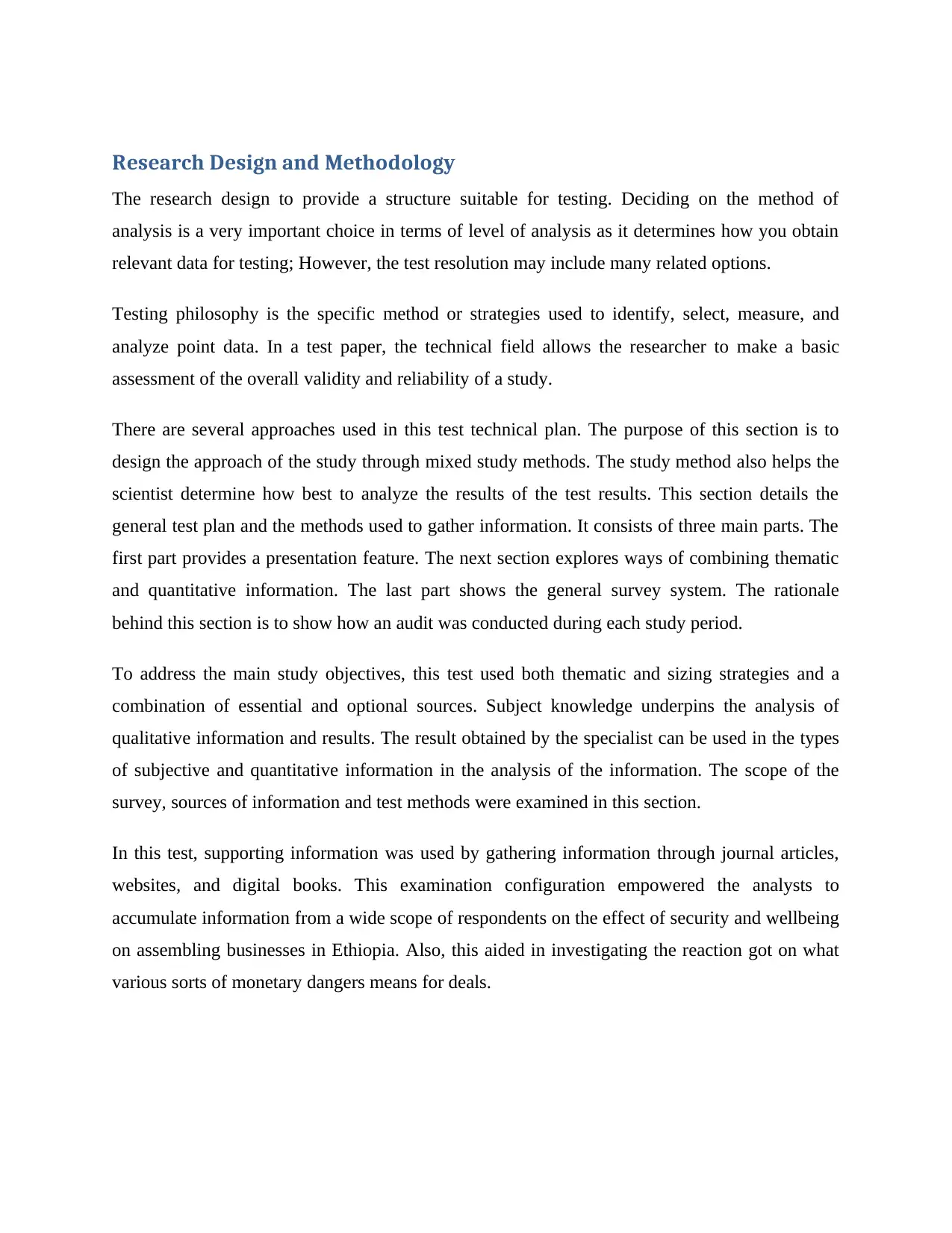
Research Design and Methodology
The research design to provide a structure suitable for testing. Deciding on the method of
analysis is a very important choice in terms of level of analysis as it determines how you obtain
relevant data for testing; However, the test resolution may include many related options.
Testing philosophy is the specific method or strategies used to identify, select, measure, and
analyze point data. In a test paper, the technical field allows the researcher to make a basic
assessment of the overall validity and reliability of a study.
There are several approaches used in this test technical plan. The purpose of this section is to
design the approach of the study through mixed study methods. The study method also helps the
scientist determine how best to analyze the results of the test results. This section details the
general test plan and the methods used to gather information. It consists of three main parts. The
first part provides a presentation feature. The next section explores ways of combining thematic
and quantitative information. The last part shows the general survey system. The rationale
behind this section is to show how an audit was conducted during each study period.
To address the main study objectives, this test used both thematic and sizing strategies and a
combination of essential and optional sources. Subject knowledge underpins the analysis of
qualitative information and results. The result obtained by the specialist can be used in the types
of subjective and quantitative information in the analysis of the information. The scope of the
survey, sources of information and test methods were examined in this section.
In this test, supporting information was used by gathering information through journal articles,
websites, and digital books. This examination configuration empowered the analysts to
accumulate information from a wide scope of respondents on the effect of security and wellbeing
on assembling businesses in Ethiopia. Also, this aided in investigating the reaction got on what
various sorts of monetary dangers means for deals.
tabler-icon-diamond-filled.svg

Paraphrase This Document

Need a fresh take? Get an instant paraphrase of this document with our AI Paraphraser
Document Page
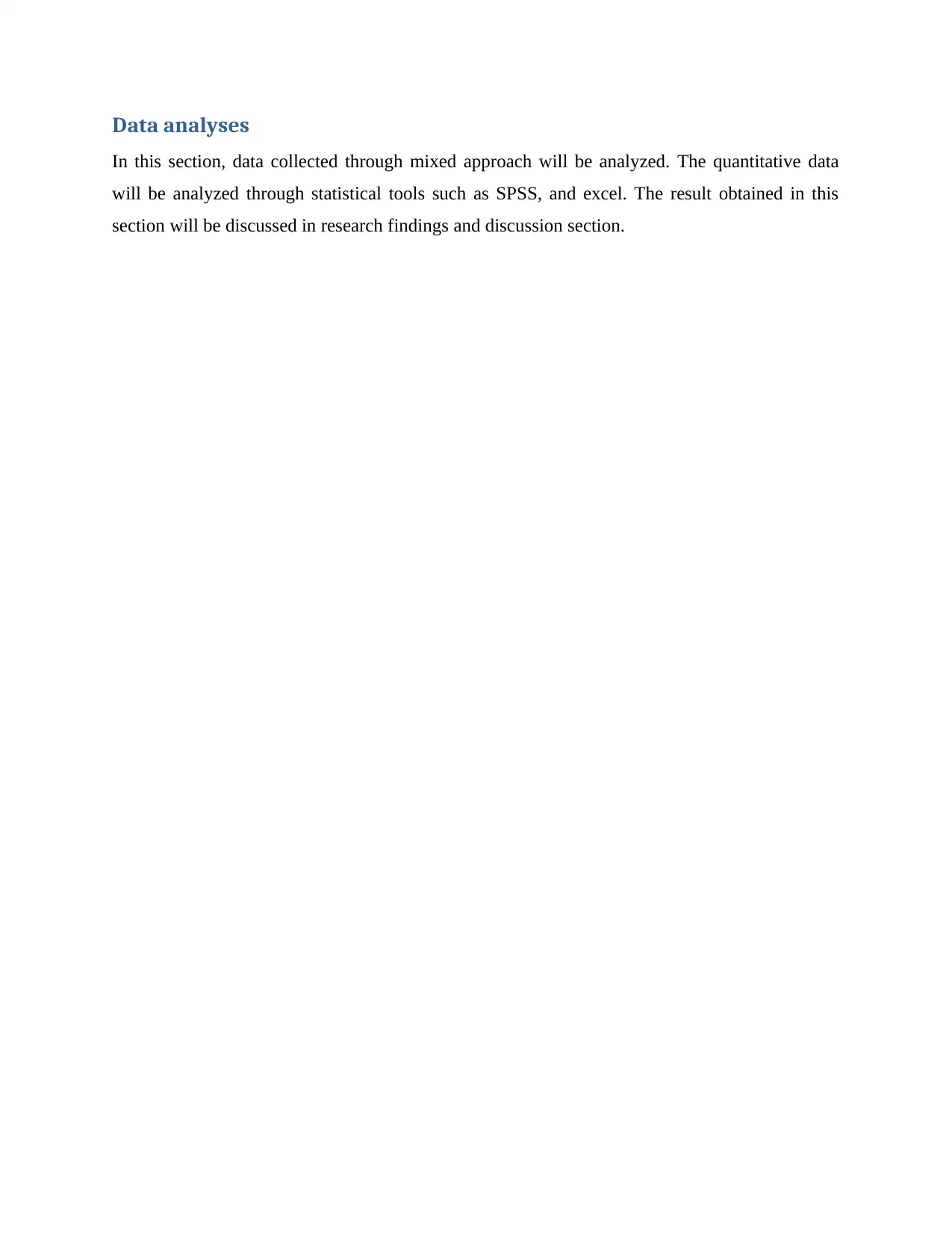
Data analyses
In this section, data collected through mixed approach will be analyzed. The quantitative data
will be analyzed through statistical tools such as SPSS, and excel. The result obtained in this
section will be discussed in research findings and discussion section.
Document Page
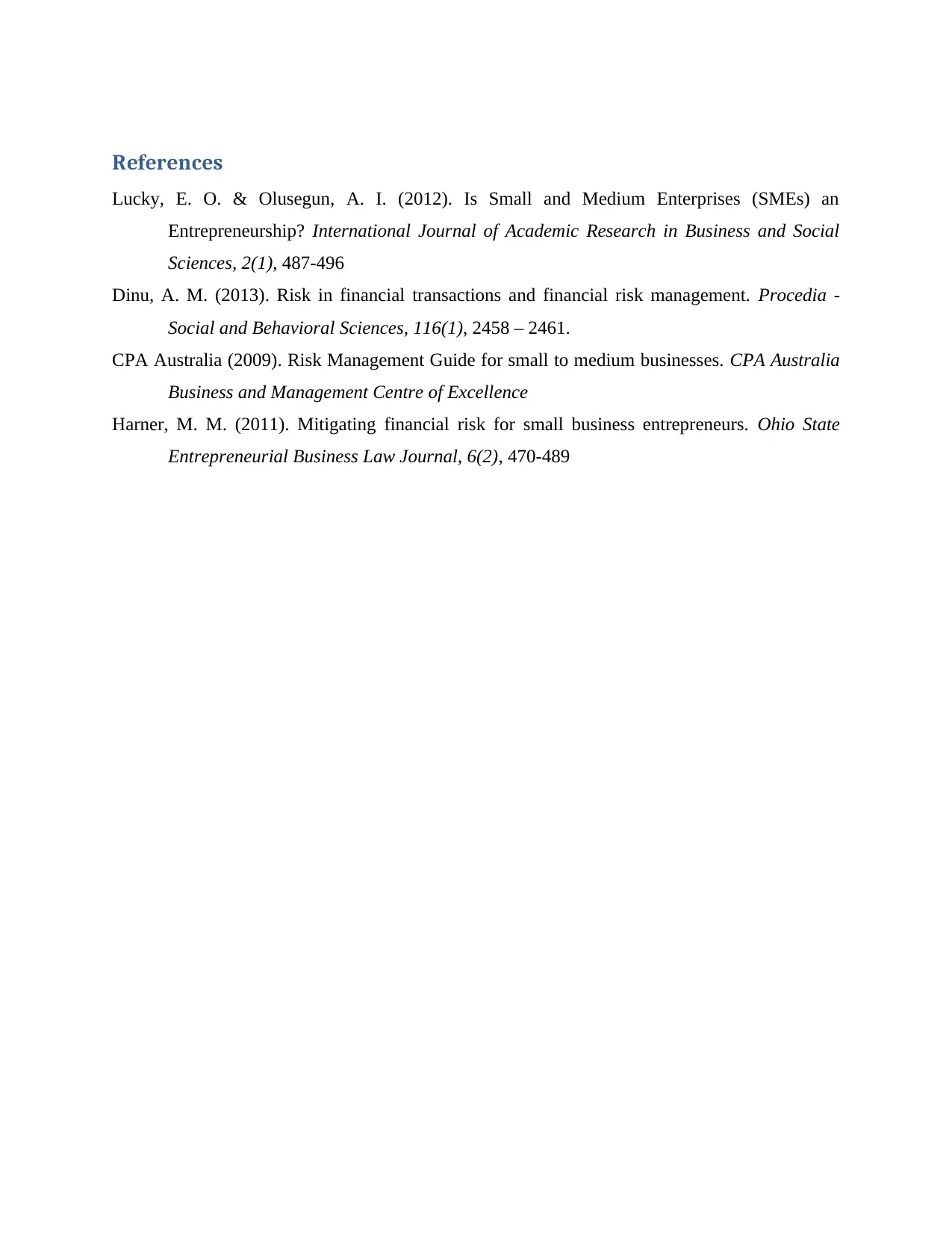
References
Lucky, E. O. & Olusegun, A. I. (2012). Is Small and Medium Enterprises (SMEs) an
Entrepreneurship? International Journal of Academic Research in Business and Social
Sciences, 2(1), 487-496
Dinu, A. M. (2013). Risk in financial transactions and financial risk management. Procedia -
Social and Behavioral Sciences, 116(1), 2458 – 2461.
CPA Australia (2009). Risk Management Guide for small to medium businesses. CPA Australia
Business and Management Centre of Excellence
Harner, M. M. (2011). Mitigating financial risk for small business entrepreneurs. Ohio State
Entrepreneurial Business Law Journal, 6(2), 470-489
chevron_up_icon
1 out of 9
circle_padding
hide_on_mobile
zoom_out_icon
[object Object]