Financial Risk Management Report: Analysis of Commonwealth Bank

Verified

Added on  2022/09/29

|7
|1054
|23
Report
AI Summary
This report provides an in-depth analysis of financial risk management practices at Commonwealth Bank (CBA). The report begins with an introduction to financial risk management, followed by an examination of CBA's use of derivatives, including an analysis of assets, gains and losses, and relevant accounting standards. The analysis extends to the maturity distribution of assets and liabilities, providing insights into CBA's financial structure. Furthermore, the report evaluates CBA's risk-weighted assets and capital adequacy, assessing the bank's ability to absorb losses. The report utilizes data from CBA's annual reports and other public sources to support its findings and concludes with a summary of the key findings and their implications for the bank's financial stability. The report adheres to the structure outlined in the assignment brief, including sections on the introduction, derivatives, maturity distribution, risk-weighted assets, capital adequacy, and a conclusion.
Document Page
Running head: Financial Risk Management
Financial Risk Management
Name of the Student-
Name of the University-
Author’s note-
tabler-icon-diamond-filled.svg

Paraphrase This Document

Need a fresh take? Get an instant paraphrase of this document with our AI Paraphraser
Document Page
1Financial Risk Management
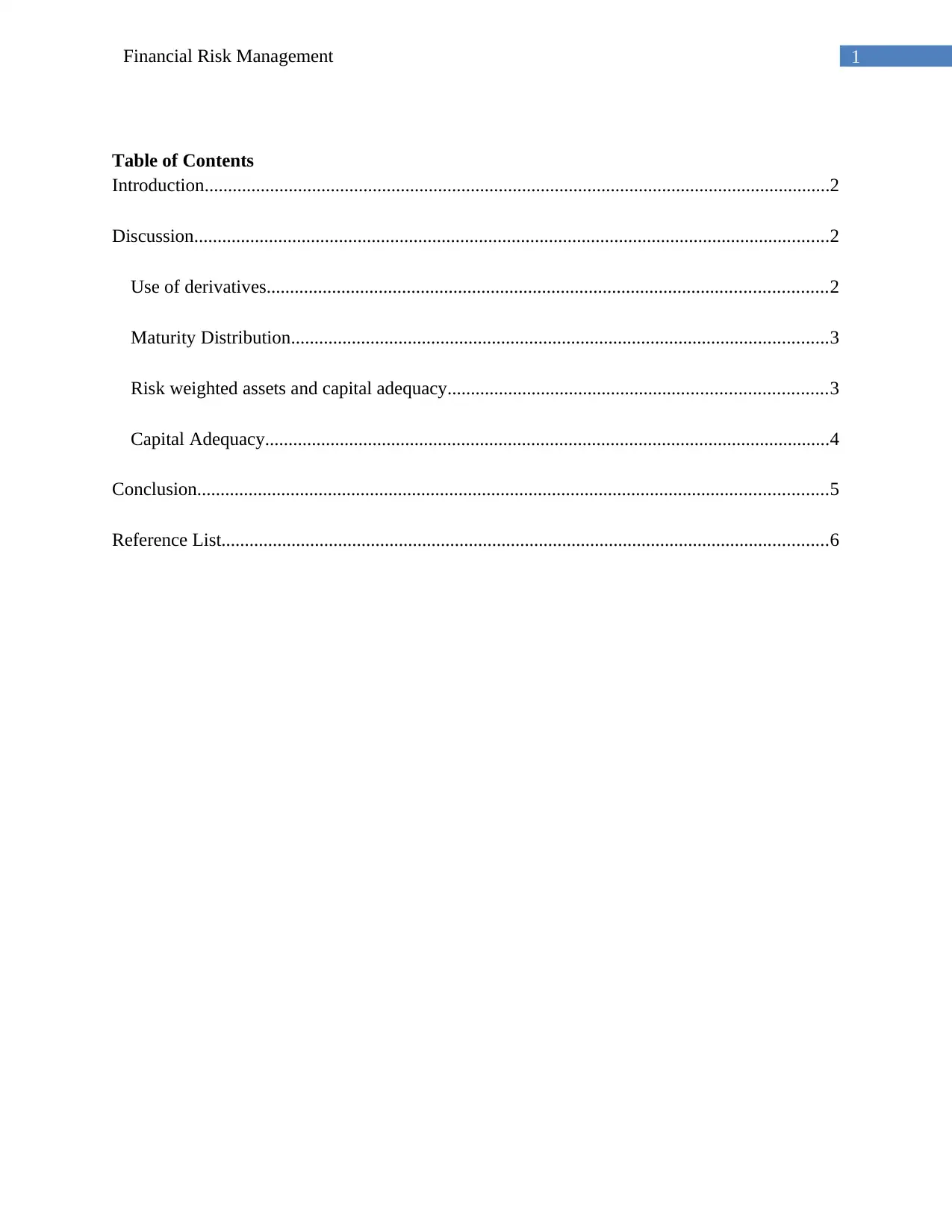
Table of Contents
Introduction......................................................................................................................................2
Discussion........................................................................................................................................2
Use of derivatives........................................................................................................................2
Maturity Distribution...................................................................................................................3
Risk weighted assets and capital adequacy.................................................................................3
Capital Adequacy.........................................................................................................................4
Conclusion.......................................................................................................................................5
Reference List..................................................................................................................................6
Document Page
2Financial Risk Management
Introduction
Financial Risk Management is the procedure practiced of economic value in a company
using the financial instruments in order to minimize the degree of risk. The attribute deals with
identifying the sources, measuring it appropriately and applying plans to implement it
correctively. Use of derivatives has been highlighted in this report. Assets, gain and losses,
accounting standard has been discussed. Maturity distribution of assets and liabilities featuring
the company been involved in the report, risk weighted assets and capital adequacy has been
elated in accordance to annual report of the firm (Brown and Ulgiati. 2018).
Discussion
Use of derivatives
Total cash and due from banks is $16,665, which means they will be receiving this
amount of money from the particular entities. Trading account securities of the company amount
to $32,506 which quite higher than the previous years. Federal funds which are sold in the
market and securities purchased are 12,732$ and securities which are considered buying under
resale agreement amount to 12,732$. Treasury securities in the market is $50,566 this security is
safer because it is been guaranteed by Australian government itself (Schuster et al. 2018). The
amount of value possessing by the security is profitable to the government and the investors
Plants, equipment of the company stands to $2,383, and intangible asset is $29,210. Gains and
losses of the company is referred to when first half profit which came in at $4.6 billion which is
quite lower comparing to last year’s profit at $4.9 billion (Commbank.com.au. 2019). Cash profit
of company measures out one-off gains and losses, which resulted marginal profit to billions.
However, risk and compliances investments resulted to outflow of $432 million, which is two-
Document Page
3Financial Risk Management
third of the overall investment budget. Accounting principles according to this standard helps to
incorporate interpretations in order to apply in accounting standards. It is required in order to
prepare financial reports in accordance to the corporation acts. Loans and commitments, which
are operated by the company in order to deliver financial statements (Blumberg et al. 2018).
These are settled in accordance to Australia Accounting Standard.
Maturity Distribution
Fund’s profile consists of allocation of the value of assets in accordance to percentage
and time left to the maturity respectively. It usually records the summary of breakup value of
assets respectively (Johansson et al. 2018). These different sorts of assets contain diversified
maturity period. This maturity distribution signifies summary of key information on risk in
mutual funds and market volatility. Performance of a firm is also measured in relation to interest
rate variation. Maturity distribution of assets and liabilities through income statement in
Commonwealth Bank stands to: $33,450 in 2019 and $32,247 in 2018. In case of referring to
more than twelve months calculation then it shows as 227$ in 2019 and 637$ in 2018.
Risk weighted assets and capital adequacy
This attribute is practiced by banks in order to absorb losses if bank losses its Tier-1
capital. Hence, the two capital tiers are added, divided by risk-weighted assets for calculating
adequacy ratio of bank. Risk weighted assets of Commonwealth Bank in 2019 is 452,762 $ in
2018 it is 458,612$ and in 2017 it is 437,063$. Lower risk weighted assets are preferable by the
banks because lower the degree of risk is more favorable than higher risk models. The firm needs
to reduce the amount of weighted risk.
tabler-icon-diamond-filled.svg

Paraphrase This Document

Need a fresh take? Get an instant paraphrase of this document with our AI Paraphraser
Document Page
4Financial Risk Management
Capital Adequacy
Total capital of the company in terms of tier 1 is 12.9% and in tier 2 is 2.9%, which sums
up to 15.8%. Higher capital adequacy indicates that it is above the requirement and lower shows
that it is lesser than the requirement. Hence, Commonwealth Bank has capital adequacy ratio of
15.8%, which is much above than normal rate 8%.
Document Page
5Financial Risk Management
Conclusion
It can be concluded from the above statement that use of derivatives in appropriate way is
crucial for an organization. The use of accounting standards and implementing the concepts in
the company is useful in this scenario. Maturity distribution of assets and liabilities are required
to segregate properly in order to determine amount of percentage left out in assets and liabilities
of the organization. The company shall maintain a minimum reserve of capital to meet all its
obligations. Commonwealth Bank must its efficiency in maintaining the adequacy level above
the normal rate.
Document Page
6Financial Risk Management
Reference List
Blumberg, J., Frei, B., Fulgoni, V., Weaver, C. and Zeisel, S., 2018. Contribution of dietary
supplements to nutritional adequacy by socioeconomic subgroups in adults of the United
States. Nutrients, 10(1), p.4.
Brown, M.T. and Ulgiati, S., 2018. Emergy evaluation of the biosphere and natural capital.
In Green Accounting (pp. 177-184). Routledge.
Commbank.com.au. 2019. online Available at: commbank.com.au/content/dam/commbank-
assets/about-us/2019-08/CBA-2019-Annual-Report-Financial-report.pdf Accessed 9 Oct. 2019.
Johansson, F.D., Kallus, N., Shalit, U. and Sontag, D., 2018. Learning weighted representations
for generalization across designs. arXiv preprint arXiv:1802.08598.
Schuster, P.F., Schaefer, K.M., Aiken, G.R., Antweiler, R.C., Dewild, J.F., Gryziec, J.D.,
Gusmeroli, A., Hugelius, G., Jafarov, E., Krabbenhoft, D.P. and Liu, L., 2018. Permafrost stores
a globally significant amount of mercury. Geophysical Research Letters, 45(3), pp.1463-1471.
chevron_up_icon
1 out of 7
circle_padding
hide_on_mobile
zoom_out_icon
[object Object]