Financial Services: Lead Compliance and AML/CTF Report Analysis

Verified

Added on  2023/01/23

|8
|1898
|95
Report
AI Summary
This report provides an in-depth analysis of Anti-Money Laundering and Counter-Terrorism Financing (AML/CTF) compliance within the financial services sector. It begins by outlining and evaluating issues raised in the Mutual Evaluation Report (MER) concerning agents of individual customers, emphasizing the importance of verification processes. The report then delves into Section 89 of the AML/CTF Act and Part 4.11 of the AML/CTF Rules, detailing the obligations of financial institutions regarding customer due diligence (CDD) and the verification of agents acting on behalf of customers. It examines FATF recommendations, including the updated guidelines on agent verification and the application of AML/CTF requirements. The report further explores the CDD measures, including customer identification, beneficial owner verification, and risk-based approaches, while highlighting the significance of the Financial Action Task Force's (FATF) new methodology in assessing compliance. Finally, it assesses the deficiencies in the existing provisions, emphasizing the need for streamlined reporting obligations, strengthened enforcement measures, and enhanced industry assistance in understanding and complying with the regulations.

Document Page
Lead compliance with financial services
legislation and industry codes
tabler-icon-diamond-filled.svg

Paraphrase This Document

Need a fresh take? Get an instant paraphrase of this document with our AI Paraphraser
Document Page
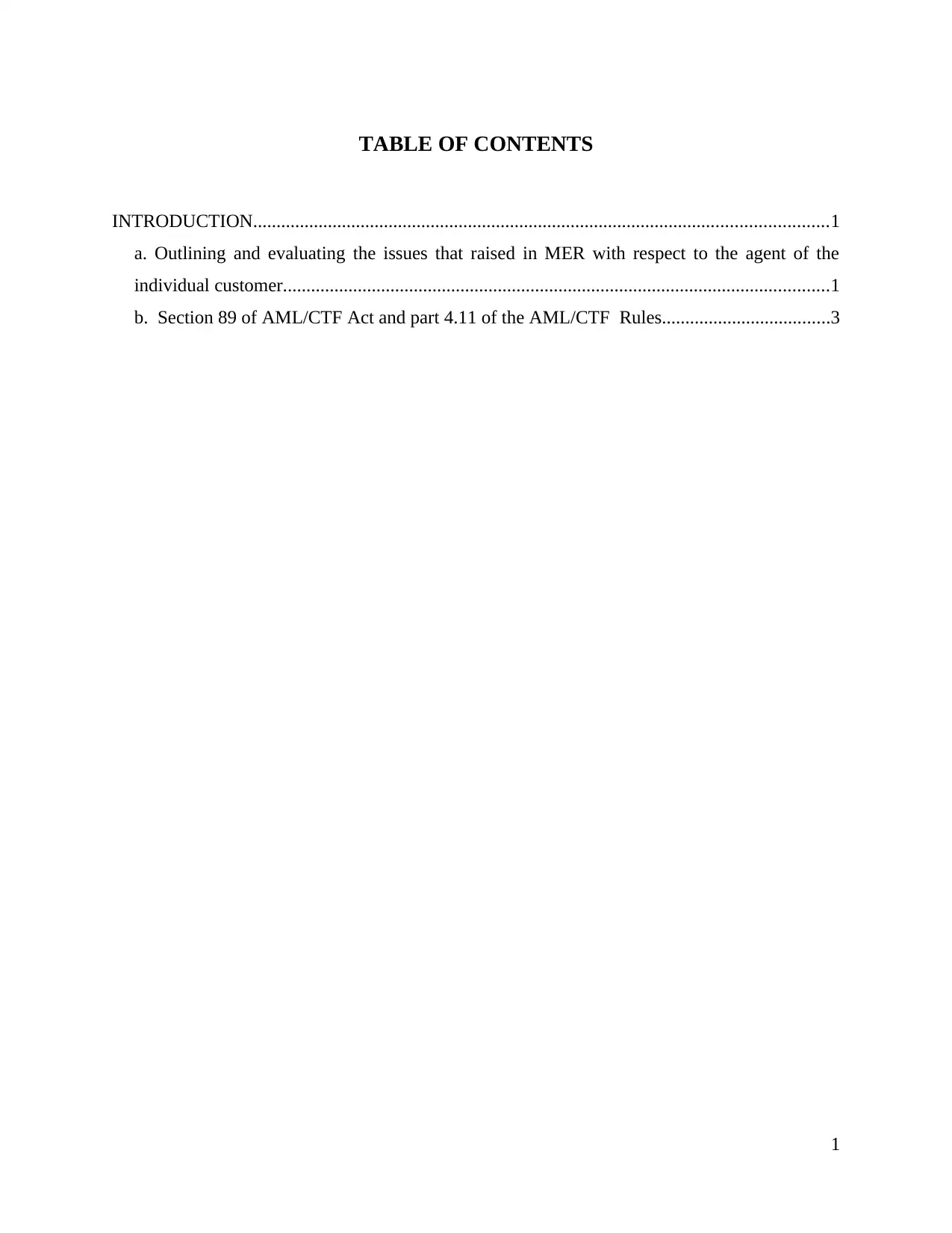
TABLE OF CONTENTS
INTRODUCTION...........................................................................................................................1
a. Outlining and evaluating the issues that raised in MER with respect to the agent of the
individual customer.....................................................................................................................1
b. Section 89 of AML/CTF Act and part 4.11 of the AML/CTF Rules....................................3
1
Document Page
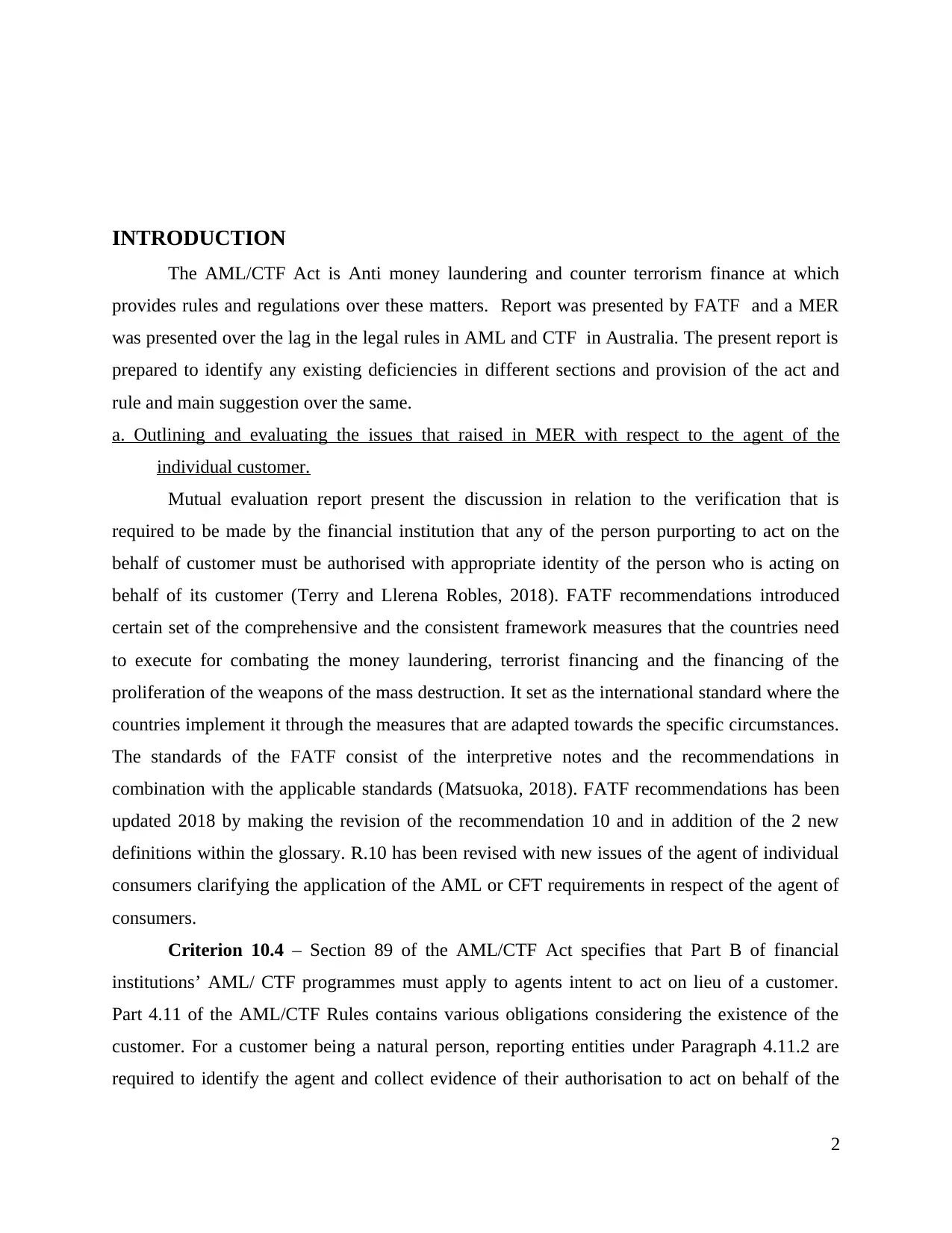
INTRODUCTION
The AML/CTF Act is Anti money laundering and counter terrorism finance at which
provides rules and regulations over these matters. Report was presented by FATF and a MER
was presented over the lag in the legal rules in AML and CTF in Australia. The present report is
prepared to identify any existing deficiencies in different sections and provision of the act and
rule and main suggestion over the same.
a. Outlining and evaluating the issues that raised in MER with respect to the agent of the
individual customer.
Mutual evaluation report present the discussion in relation to the verification that is
required to be made by the financial institution that any of the person purporting to act on the
behalf of customer must be authorised with appropriate identity of the person who is acting on
behalf of its customer (Terry and Llerena Robles, 2018). FATF recommendations introduced
certain set of the comprehensive and the consistent framework measures that the countries need
to execute for combating the money laundering, terrorist financing and the financing of the
proliferation of the weapons of the mass destruction. It set as the international standard where the
countries implement it through the measures that are adapted towards the specific circumstances.
The standards of the FATF consist of the interpretive notes and the recommendations in
combination with the applicable standards (Matsuoka, 2018). FATF recommendations has been
updated 2018 by making the revision of the recommendation 10 and in addition of the 2 new
definitions within the glossary. R.10 has been revised with new issues of the agent of individual
consumers clarifying the application of the AML or CFT requirements in respect of the agent of
consumers.
Criterion 10.4 – Section 89 of the AML/CTF Act specifies that Part B of financial
institutions’ AML/ CTF programmes must apply to agents intent to act on lieu of a customer.
Part 4.11 of the AML/CTF Rules contains various obligations considering the existence of the
customer. For a customer being a natural person, reporting entities under Paragraph 4.11.2 are
required to identify the agent and collect evidence of their authorisation to act on behalf of the
2
Document Page
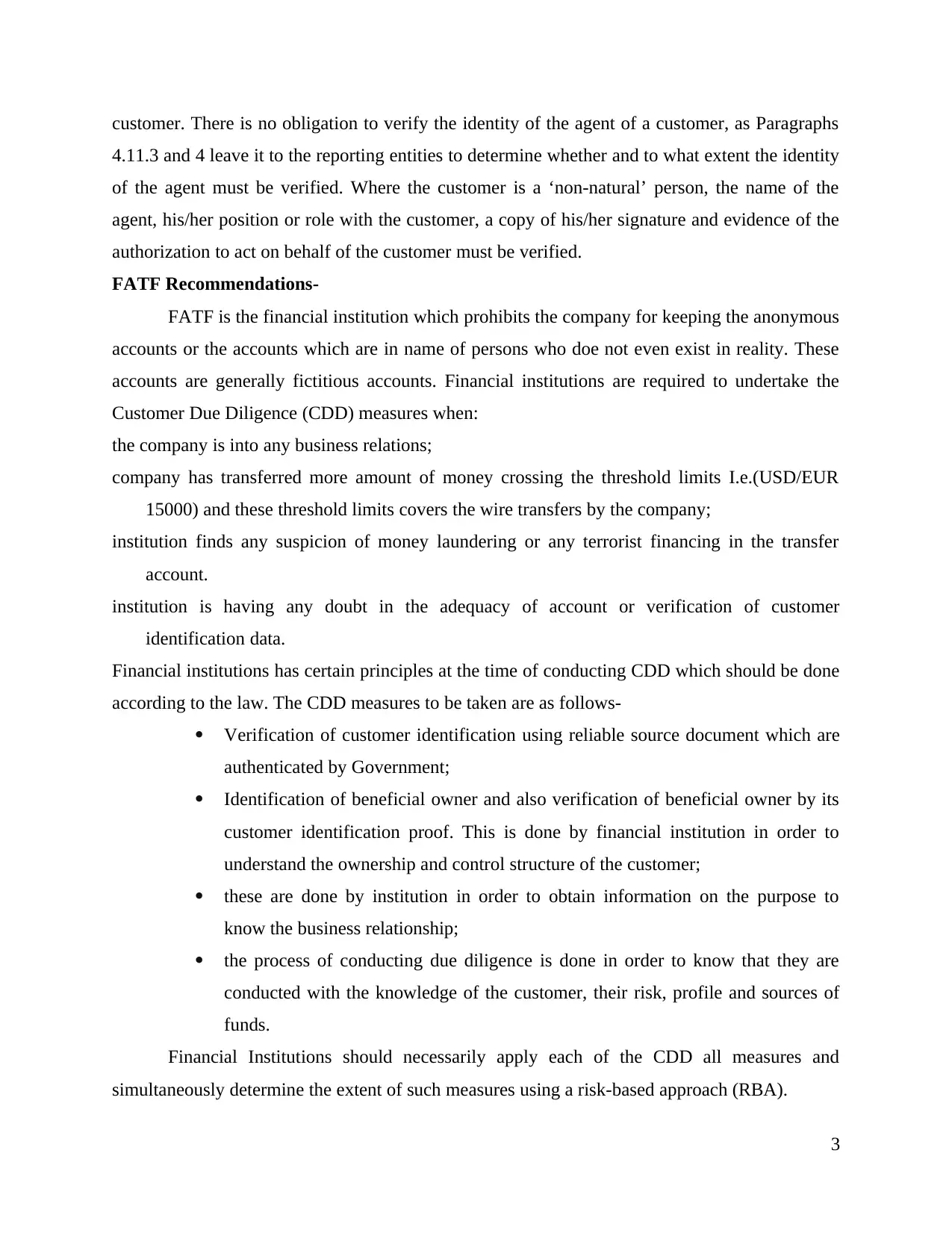
customer. There is no obligation to verify the identity of the agent of a customer, as Paragraphs
4.11.3 and 4 leave it to the reporting entities to determine whether and to what extent the identity
of the agent must be verified. Where the customer is a ‘non-natural’ person, the name of the
agent, his/her position or role with the customer, a copy of his/her signature and evidence of the
authorization to act on behalf of the customer must be verified.
FATF Recommendations-
FATF is the financial institution which prohibits the company for keeping the anonymous
accounts or the accounts which are in name of persons who doe not even exist in reality. These
accounts are generally fictitious accounts. Financial institutions are required to undertake the
Customer Due Diligence (CDD) measures when:
the company is into any business relations;
company has transferred more amount of money crossing the threshold limits I.e.(USD/EUR
15000) and these threshold limits covers the wire transfers by the company;
institution finds any suspicion of money laundering or any terrorist financing in the transfer
account.
institution is having any doubt in the adequacy of account or verification of customer
identification data.
Financial institutions has certain principles at the time of conducting CDD which should be done
according to the law. The CDD measures to be taken are as follows-
Verification of customer identification using reliable source document which are
authenticated by Government;
Identification of beneficial owner and also verification of beneficial owner by its
customer identification proof. This is done by financial institution in order to
understand the ownership and control structure of the customer;
these are done by institution in order to obtain information on the purpose to
know the business relationship;
the process of conducting due diligence is done in order to know that they are
conducted with the knowledge of the customer, their risk, profile and sources of
funds.
Financial Institutions should necessarily apply each of the CDD all measures and
simultaneously determine the extent of such measures using a risk-based approach (RBA).
3
tabler-icon-diamond-filled.svg

Paraphrase This Document

Need a fresh take? Get an instant paraphrase of this document with our AI Paraphraser
Document Page
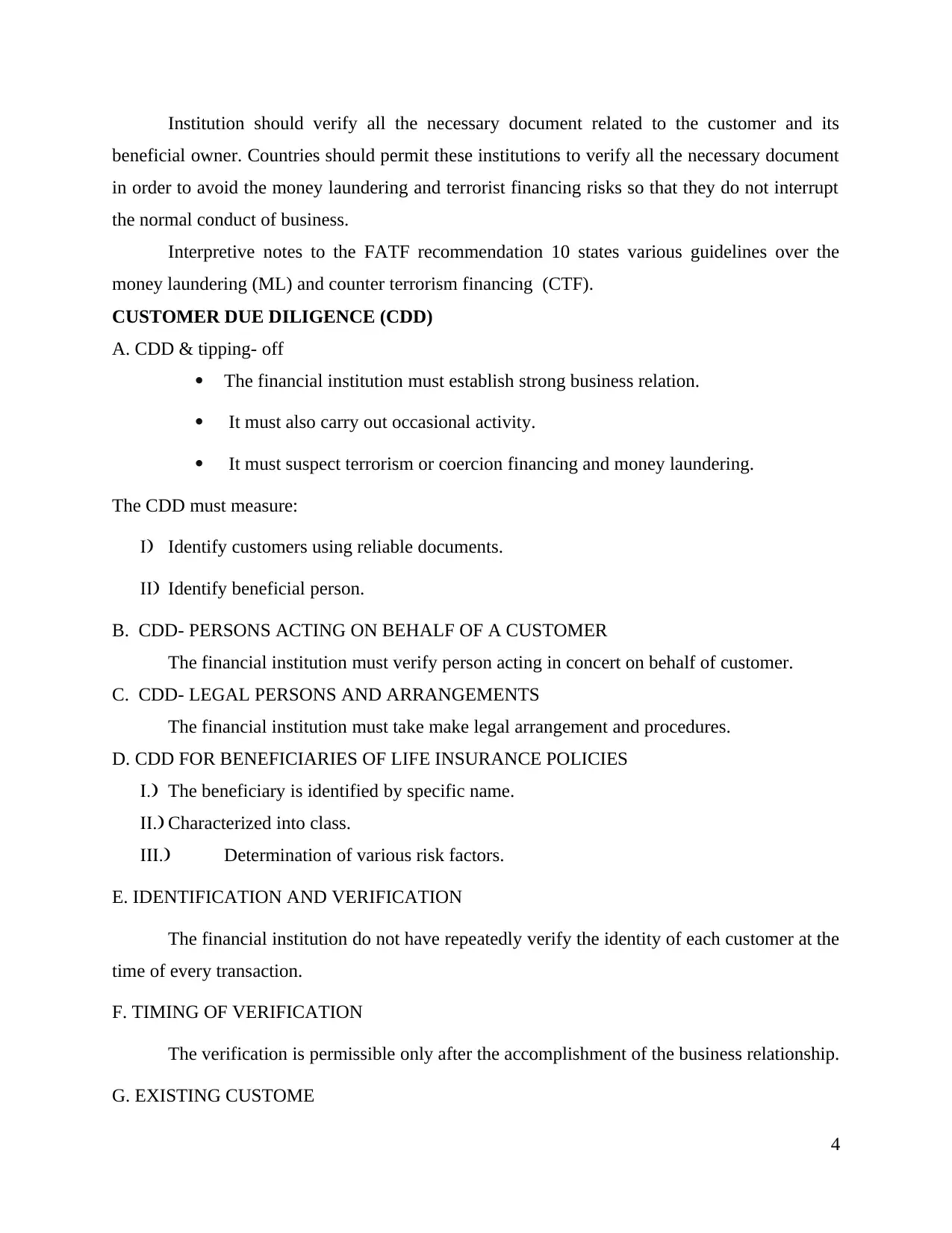
Institution should verify all the necessary document related to the customer and its
beneficial owner. Countries should permit these institutions to verify all the necessary document
in order to avoid the money laundering and terrorist financing risks so that they do not interrupt
the normal conduct of business.
Interpretive notes to the FATF recommendation 10 states various guidelines over the
money laundering (ML) and counter terrorism financing (CTF).
CUSTOMER DUE DILIGENCE (CDD)
A. CDD & tipping- off
The financial institution must establish strong business relation.
It must also carry out occasional activity.
It must suspect terrorism or coercion financing and money laundering.
The CDD must measure:
I) Identify customers using reliable documents.
II) Identify beneficial person.
B. CDD- PERSONS ACTING ON BEHALF OF A CUSTOMER
The financial institution must verify person acting in concert on behalf of customer.
C. CDD- LEGAL PERSONS AND ARRANGEMENTS
The financial institution must take make legal arrangement and procedures.
D. CDD FOR BENEFICIARIES OF LIFE INSURANCE POLICIES
I.) The beneficiary is identified by specific name.
II.) Characterized into class.
III.) Determination of various risk factors.
E. IDENTIFICATION AND VERIFICATION
The financial institution do not have repeatedly verify the identity of each customer at the
time of every transaction.
F. TIMING OF VERIFICATION
The verification is permissible only after the accomplishment of the business relationship.
G. EXISTING CUSTOME
4
Document Page
The financial institution must comply with CDD measures current customers by taking into
consideration various material risk factors.
H. RISK BASED APPROACH
Must take into consideration:
1. Customer risk factors
2. Geographical risk factor.
3. Risk variables.
The financial action task force's new methodology in order to assess the technical
compliance with respect to the FATF recommendations and effectiveness of the AML/CFT
systems that sets out the FATF and will determine that the country is been sufficiently compliant
with that of the 2012 standards of FATF and in assessing the effectiveness of the AML or CFT
system (Syed Mustapha Nazri, Zolkaflil and Omar, 2019). The new methodology facilitates the
base for an integrated analysis of an extent to which the country is been complied with FATF
standards and the effectiveness level of the system. The methodology consist of the two
interlinked elements that are as follows-
The assessment of the technical compliance that addresses the particular requirements for
each of FATF recommendations, as they relate to relevant institutional and the legal framework
of country and powers of the competent authorities.
The analysis of the effectiveness within which the country reaches a defined set of the outcomes
which are considered as central to robust system as AML/CFT. It analyses an extent up-to which
the legal and the institutional framework of the country produced the expected result.
From the above evaluation it is been assessed that the nature of the deficiencies
provisioned in the report is complex in nature. Industry needs more and more assistance for
understanding and complying with the rules and the regulations (Zolkaflil, Omar and Syed
Mustapha Nazri, 2017). The reporting obligations that are provided should get streamlined. It
should review the period of record keeping in respect of combating the terrorism and
strengthening the measures. The AML/CFT includes the inefficient reporting obligations and the
enforcement measures must be strengthened.
Document Page
b. Section 89 of AML/CTF Act and part 4.11 of the AML/CTF Rules
Section 89 of the AML/CTF Act outlines Standard/Joint/Special money laundering and
counter terrorism financing program. The sub section 1 of section 89 defines the Standard
program which states that a customer who deals with a reporting entity regarding the designated
services through an agent and consumers act in accordance with the circumstance outlined in the
AML/CTF rules, are required to be fulfilled in order to hold the consumer liable for the act of
agent.
The part 4.11 of AML/CTF rules states that the rules are applicable in relation to an
agent of a consumer which is a single person and in relation to agent who is authorized to act on
behalf of consumer regarding the designated service. As per part 4.11.1 and 4.11.2, the
AML/CTF program must include a process to report the entity for collection at a minimum, the
information defined below and the documentations for consumer; full name of each individual
who is acting on the behalf of consumer in the reporting entity regarding the provision of the
services designated (Anti-Money Laundering and Counter-Terrorism Financing Rules
Amendment Instrument, 2019). The evidence in relation to authorisation of costumer regarding a
specific person is also required. Part 4.11.3 states that risk based controls and systems must be
included in the program defined under section 89 of the AML/CTF Act to determined that
whether or not the reporting entity and to what extent shall be verified for identification of any
individual appointed to act on the behalf of the consumer. Part 4.11.4 states that there is a
requirement that reporting entity have regards to money laundering or terrorism financing in
context to provisions of the designated services in order to determine that whether and to what
extent the identify of the individual work on behalf of the consumer must be verified.
However, as far as the recommendation 10 regarding the issue of agent of consumer
defined under the interpretive notes to recommendation 10 over consumer due diligence states
that during the establishment of the course of the customer relations a financial institution on
subsection of a transaction of money laundering or terrorism financing , the bank or institution is
required to identify and verify the identity of the costumer as well the beneficiary owner where
occasional or permanent, irrespective of any exemption or designated threshold limit. Also, a
suspicious transaction report to the financial intelligence unit is also required to be made. In
relation to the above task to be performed under the consumer due diligence the financial
institutions are also required to conduct the same procedure of vitrification and report formation
6
tabler-icon-diamond-filled.svg

Paraphrase This Document

Need a fresh take? Get an instant paraphrase of this document with our AI Paraphraser
Document Page
for any person who is acting on the behalf of a consumer as an agent. The agent authorized by
the customer is required to be identified and verified for authentication.
7
chevron_up_icon
1 out of 8
circle_padding
hide_on_mobile
zoom_out_icon
[object Object]