HSBC Financial Software Development: A Project Report Analysis
VerifiedAdded on 2022/12/27
|7
|2381
|50
Report
AI Summary
This project report investigates the development and implementation of financial software within the UK's financial sector, with a specific focus on HSBC. The report begins by outlining the identified issue of technological advancements and their impact on financial institutions, particularly in minimizing risks and ensuring secure operations. It then provides a project background, business case, and a detailed cost-benefit analysis, comparing the costs of software development and implementation with the anticipated benefits, such as reduced operational costs and increased efficiency. A comprehensive literature review is included, exploring operational efficiency, feasibility aspects, and the challenges associated with new software development and implementation, along with security considerations. The report examines the existing literature from books, journals, and scholarly articles. The analysis concludes that financial firms like HSBC should proceed with software implementation due to the projected benefits exceeding the costs. The report highlights the importance of addressing challenges related to regulatory compliance, software management, and security to maximize the benefits of new financial software.

KNOWLEDGE EXCHANGE
PROJECT
PROJECT

Paraphrase This Document
Need a fresh take? Get an instant paraphrase of this document with our AI Paraphraser
INTRODUCTION
Overview of the identified issue
The present era is known for continuous advancement in technology. The technology is
changing every next day causing an impact on the operations of the companies in all sectors of
the economy. The present report will focus specifically on financial sector of the UK’s economy.
Actually financial sector is considered to be the most sensitive sector among all other sector of
the economy, as this sector handles and manages the financial aspect of the citizens of the
country including their savings, investments, loans and deposits. In this project report, the
researcher will take and explain the issues of various technological advancement into the
financial sector and the resulting development of financial software in order to minimize risk
associated with financial concern and detecting preventive and cautious controls needed for safe
and secure operations of the financial institutions.
Project background and business case
In the modern time, there seems high level of social dependence over software systems,
which has increase the development of products like software for making the operations easier
against the traditional methods. There is no denying of the fact that such software development
due to the technological advancement has improve customer’s experience and companies are
taking such development as source of enhancing customer satisfaction. In this project report we
will focus on development of software for financial institutions which helps them to reduce
fallacious acts from both their employees and hacker’s. In the report pertaining to the research
undertaken for the purpose of studying the viability of such software development within the
financial sector of UK, the main focus will be given on how HSBC holdings acting and operating
as a financial player can develop and implement such financial software to improvise their
operational efficiency and reduce the chances of financial losses. Financial services firm like
HSBC, can adopt such financial software keeping in mind that this will allow for improving
customer’s experience and should be customer handy too. The software will also allow for
providing guidance to financial executive in performing their roles and activities.
Project cost benefit analysis
Cost – benefit analysis helps in identifying what would be the resulting benefits for the
concern after incurring various expenditure for any particular project. It is an evaluation of
whether the cost incurred for a project will release sufficient benefits in terms of profits to cover
up the cost of implementing a project. A project manager always strives for minimizing the risks
by ensuring that the project implementation will be having more certainty over uncertainty.
There always remains a matter of concern for a project manager that by combining all the
benefits of the project and comparing the same with the overall cost associated with it will lead
to profitability or not. The analysis begins with the collection of cost data, which would be seems
like as follows in the present project of financial software development.
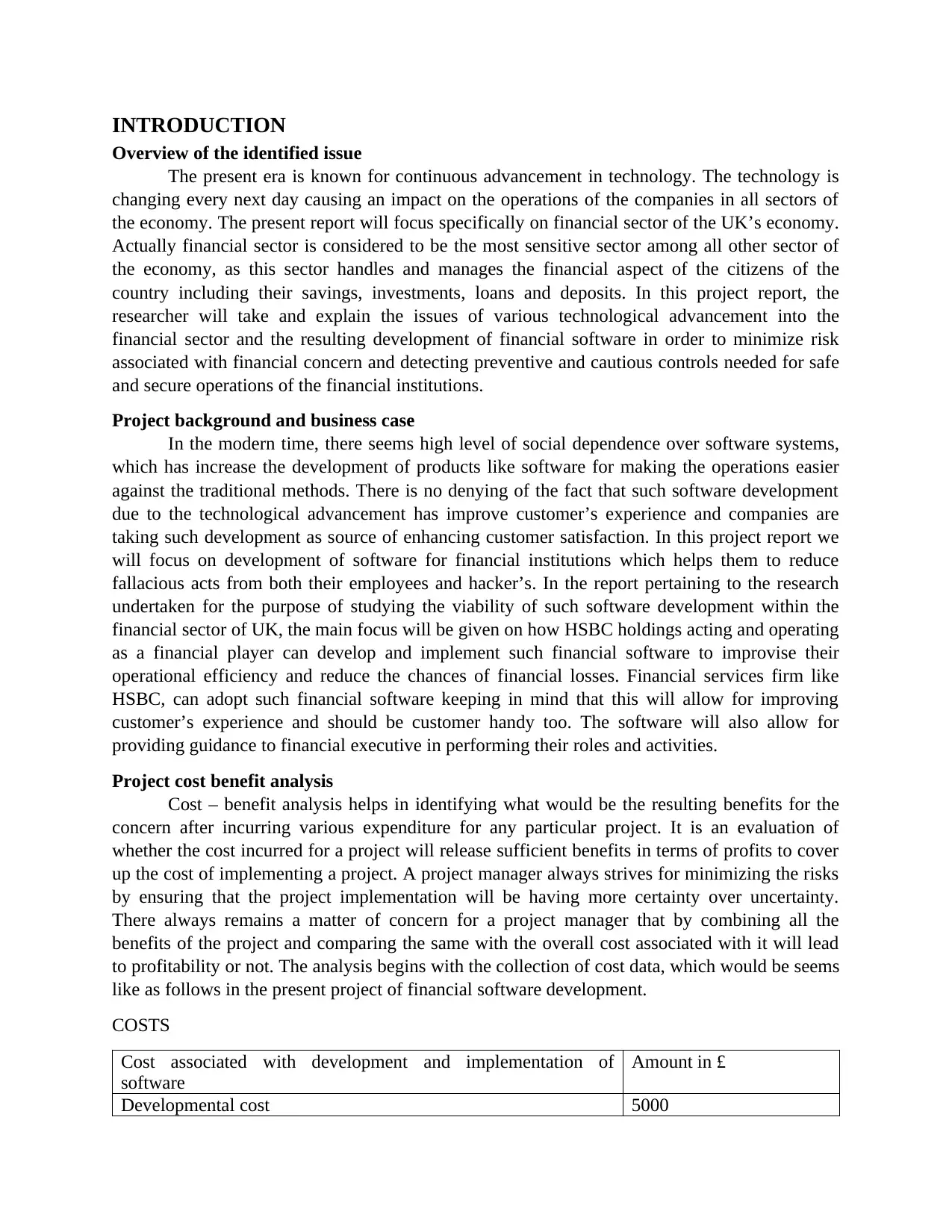
COSTS
Cost associated with development and implementation of
software
Amount in £
Developmental cost 5000
Overview of the identified issue
The present era is known for continuous advancement in technology. The technology is
changing every next day causing an impact on the operations of the companies in all sectors of
the economy. The present report will focus specifically on financial sector of the UK’s economy.
Actually financial sector is considered to be the most sensitive sector among all other sector of
the economy, as this sector handles and manages the financial aspect of the citizens of the
country including their savings, investments, loans and deposits. In this project report, the
researcher will take and explain the issues of various technological advancement into the
financial sector and the resulting development of financial software in order to minimize risk
associated with financial concern and detecting preventive and cautious controls needed for safe
and secure operations of the financial institutions.
Project background and business case
In the modern time, there seems high level of social dependence over software systems,
which has increase the development of products like software for making the operations easier
against the traditional methods. There is no denying of the fact that such software development
due to the technological advancement has improve customer’s experience and companies are
taking such development as source of enhancing customer satisfaction. In this project report we
will focus on development of software for financial institutions which helps them to reduce
fallacious acts from both their employees and hacker’s. In the report pertaining to the research
undertaken for the purpose of studying the viability of such software development within the
financial sector of UK, the main focus will be given on how HSBC holdings acting and operating
as a financial player can develop and implement such financial software to improvise their
operational efficiency and reduce the chances of financial losses. Financial services firm like
HSBC, can adopt such financial software keeping in mind that this will allow for improving
customer’s experience and should be customer handy too. The software will also allow for
providing guidance to financial executive in performing their roles and activities.
Project cost benefit analysis
Cost – benefit analysis helps in identifying what would be the resulting benefits for the
concern after incurring various expenditure for any particular project. It is an evaluation of
whether the cost incurred for a project will release sufficient benefits in terms of profits to cover
up the cost of implementing a project. A project manager always strives for minimizing the risks
by ensuring that the project implementation will be having more certainty over uncertainty.
There always remains a matter of concern for a project manager that by combining all the
benefits of the project and comparing the same with the overall cost associated with it will lead
to profitability or not. The analysis begins with the collection of cost data, which would be seems
like as follows in the present project of financial software development.
COSTS
Cost associated with development and implementation of
software
Amount in £
Developmental cost 5000
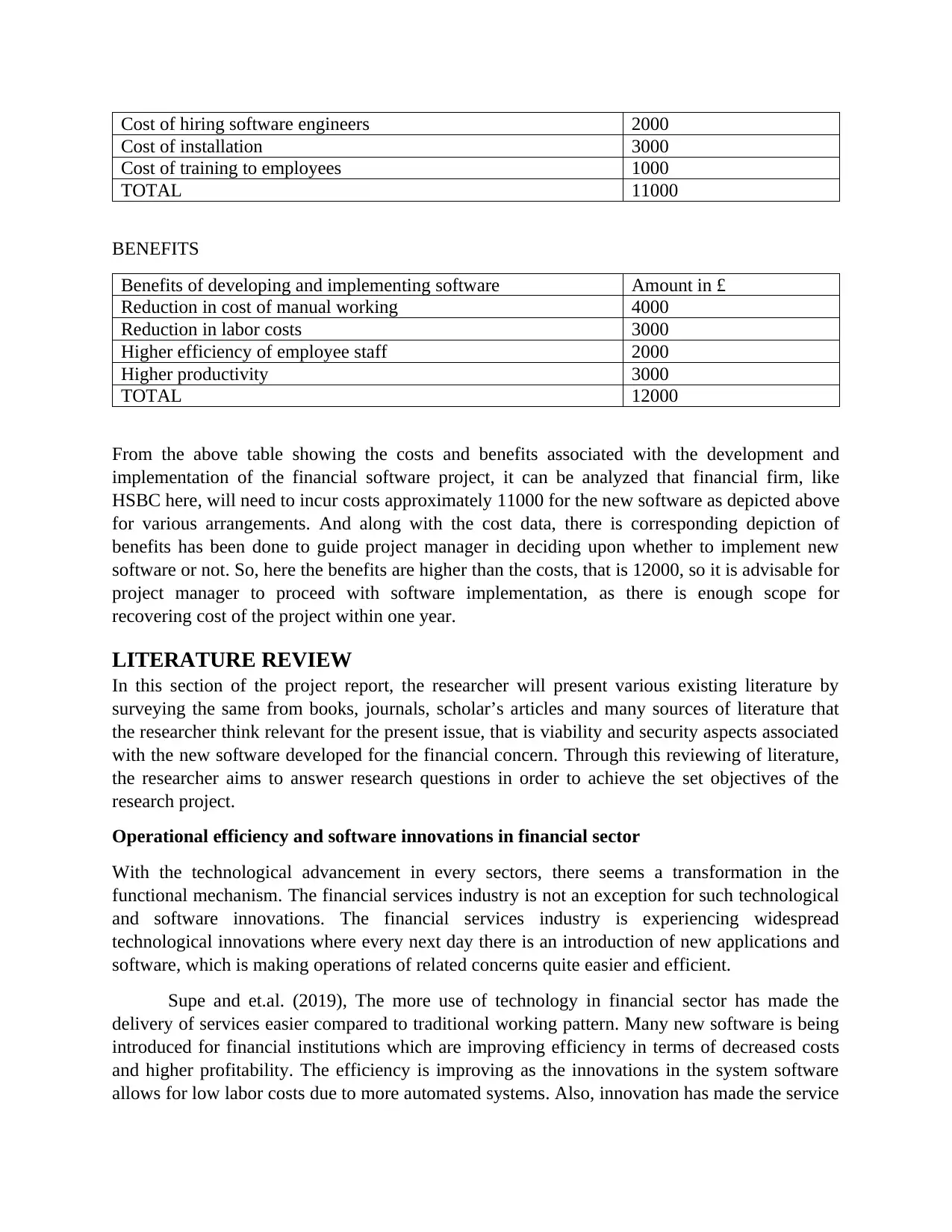
Cost of hiring software engineers 2000
Cost of installation 3000
Cost of training to employees 1000
TOTAL 11000
BENEFITS
Benefits of developing and implementing software Amount in £
Reduction in cost of manual working 4000
Reduction in labor costs 3000
Higher efficiency of employee staff 2000
Higher productivity 3000
TOTAL 12000
From the above table showing the costs and benefits associated with the development and
implementation of the financial software project, it can be analyzed that financial firm, like
HSBC here, will need to incur costs approximately 11000 for the new software as depicted above
for various arrangements. And along with the cost data, there is corresponding depiction of
benefits has been done to guide project manager in deciding upon whether to implement new
software or not. So, here the benefits are higher than the costs, that is 12000, so it is advisable for
project manager to proceed with software implementation, as there is enough scope for
recovering cost of the project within one year.
LITERATURE REVIEW
In this section of the project report, the researcher will present various existing literature by
surveying the same from books, journals, scholar’s articles and many sources of literature that
the researcher think relevant for the present issue, that is viability and security aspects associated
with the new software developed for the financial concern. Through this reviewing of literature,
the researcher aims to answer research questions in order to achieve the set objectives of the
research project.
Operational efficiency and software innovations in financial sector
With the technological advancement in every sectors, there seems a transformation in the
functional mechanism. The financial services industry is not an exception for such technological
and software innovations. The financial services industry is experiencing widespread
technological innovations where every next day there is an introduction of new applications and
software, which is making operations of related concerns quite easier and efficient.
Supe and et.al. (2019), The more use of technology in financial sector has made the
delivery of services easier compared to traditional working pattern. Many new software is being
introduced for financial institutions which are improving efficiency in terms of decreased costs
and higher profitability. The efficiency is improving as the innovations in the system software
allows for low labor costs due to more automated systems. Also, innovation has made the service
Cost of installation 3000
Cost of training to employees 1000
TOTAL 11000
BENEFITS
Benefits of developing and implementing software Amount in £
Reduction in cost of manual working 4000
Reduction in labor costs 3000
Higher efficiency of employee staff 2000
Higher productivity 3000
TOTAL 12000
From the above table showing the costs and benefits associated with the development and
implementation of the financial software project, it can be analyzed that financial firm, like
HSBC here, will need to incur costs approximately 11000 for the new software as depicted above
for various arrangements. And along with the cost data, there is corresponding depiction of
benefits has been done to guide project manager in deciding upon whether to implement new
software or not. So, here the benefits are higher than the costs, that is 12000, so it is advisable for
project manager to proceed with software implementation, as there is enough scope for
recovering cost of the project within one year.
LITERATURE REVIEW
In this section of the project report, the researcher will present various existing literature by
surveying the same from books, journals, scholar’s articles and many sources of literature that
the researcher think relevant for the present issue, that is viability and security aspects associated
with the new software developed for the financial concern. Through this reviewing of literature,
the researcher aims to answer research questions in order to achieve the set objectives of the
research project.
Operational efficiency and software innovations in financial sector
With the technological advancement in every sectors, there seems a transformation in the
functional mechanism. The financial services industry is not an exception for such technological
and software innovations. The financial services industry is experiencing widespread
technological innovations where every next day there is an introduction of new applications and
software, which is making operations of related concerns quite easier and efficient.
Supe and et.al. (2019), The more use of technology in financial sector has made the
delivery of services easier compared to traditional working pattern. Many new software is being
introduced for financial institutions which are improving efficiency in terms of decreased costs
and higher profitability. The efficiency is improving as the innovations in the system software
allows for low labor costs due to more automated systems. Also, innovation has made the service
⊘ This is a preview!⊘
Do you want full access?
Subscribe today to unlock all pages.

Trusted by 1+ million students worldwide
delivery process much faster compared to manual systems of the past times. This fastest service
delivery led to the higher productivity of the financial institutions and related concerns.
However, as per the views of Guerrero, Segura and Lucio (2020), the exploitation rate of
technological innovations like implementation of efficient system and application software is
much lower than the rate at which these are advancing. Also, in their research “Adopting
innovative software in financial sector”, it has been found that banks and other financial
institutions do not even perform 10 % of their sales through such advance technology. The
underlying reason of such gap between innovations and its implementation in real sense is
nothing but the inability of financial concern to appropriately exploit such innovations towards
improving customer experiences.
Feasibility aspects and software development and implementation
Feasibility aspects determine the viability of the project in terms of technical, operational
and economic factors relevant to the project. Technical feasibility associated with the new
software can be explained as the companies in the financial sector to have technically sound
employee base to adjust according to the changing working pattern, this also include the
expertise, experience and efficiency of the technical team successfully implement and install
innovative software to reap the actual and maximum benefits of the innovations. An important
aspect considered while determining the viability of the new software is the resources available
for providing training to the employees to handle new software in the best possible manner.
Wójcik and Ioannou (2020), identified that technological advancement in financial sector
is at high pace, where all the procedures and processes associated with the financial concern is
done through innovative software allowing for greater ease in operations. The individual
employed in financial sector are comparatively technically sound and even there is enough scope
of providing training to the employees and staff.
Labbé and Robert (2020), finds that negative side of such innovative software can’t be
oversighted. Software development and installation requires huge cost in terms of designing,
developing and deploying a software solution. Also, there seems rising cases of hacking which
can’t be ignored. The reason behind such hacking and frauds are just due to fact that as much as
the operations gets easier, it has open many opportunities for hackers to secretly obtain
customers confidential details with the use of technology itself. And if this will happen in
financial sector, this would definitely result in financial loss to company and customers both.
Kleiner, Rybachuk and Karpinskaya (2020), investigated that one of the most important
study done before developing and implementing software is the economic feasibility study. It
includes obtaining information that whether innovations in system software will be beneficial or
not, and this can be done through cost – benefit analysis where the all the costs and benefits
expected to be derived from the project are placed together to decide upon whether the particular
course of action should be implement or not. In the same way when there is any innovation in
technology associated with financial sector, there are many cost which need to be incurred like,
developmental cost, installation and training costs. These costs are then compared with the
delivery led to the higher productivity of the financial institutions and related concerns.
However, as per the views of Guerrero, Segura and Lucio (2020), the exploitation rate of
technological innovations like implementation of efficient system and application software is
much lower than the rate at which these are advancing. Also, in their research “Adopting
innovative software in financial sector”, it has been found that banks and other financial
institutions do not even perform 10 % of their sales through such advance technology. The
underlying reason of such gap between innovations and its implementation in real sense is
nothing but the inability of financial concern to appropriately exploit such innovations towards
improving customer experiences.
Feasibility aspects and software development and implementation
Feasibility aspects determine the viability of the project in terms of technical, operational
and economic factors relevant to the project. Technical feasibility associated with the new
software can be explained as the companies in the financial sector to have technically sound
employee base to adjust according to the changing working pattern, this also include the
expertise, experience and efficiency of the technical team successfully implement and install
innovative software to reap the actual and maximum benefits of the innovations. An important
aspect considered while determining the viability of the new software is the resources available
for providing training to the employees to handle new software in the best possible manner.
Wójcik and Ioannou (2020), identified that technological advancement in financial sector
is at high pace, where all the procedures and processes associated with the financial concern is
done through innovative software allowing for greater ease in operations. The individual
employed in financial sector are comparatively technically sound and even there is enough scope
of providing training to the employees and staff.
Labbé and Robert (2020), finds that negative side of such innovative software can’t be
oversighted. Software development and installation requires huge cost in terms of designing,
developing and deploying a software solution. Also, there seems rising cases of hacking which
can’t be ignored. The reason behind such hacking and frauds are just due to fact that as much as
the operations gets easier, it has open many opportunities for hackers to secretly obtain
customers confidential details with the use of technology itself. And if this will happen in
financial sector, this would definitely result in financial loss to company and customers both.
Kleiner, Rybachuk and Karpinskaya (2020), investigated that one of the most important
study done before developing and implementing software is the economic feasibility study. It
includes obtaining information that whether innovations in system software will be beneficial or
not, and this can be done through cost – benefit analysis where the all the costs and benefits
expected to be derived from the project are placed together to decide upon whether the particular
course of action should be implement or not. In the same way when there is any innovation in
technology associated with financial sector, there are many cost which need to be incurred like,
developmental cost, installation and training costs. These costs are then compared with the
Paraphrase This Document
Need a fresh take? Get an instant paraphrase of this document with our AI Paraphraser
benefits that is expected to be availed by the company. And then finally, decisions are taken for
adopting software innovations.
Sare (2021), identified that many financial institutions fail to install and operate
innovative software, which leads to financial loss for the company rather than maximizing
benefits and improving customer experience. It has been noticed that the reason of such inability
to operate software are identified as improper training and the resulting frustration among
customers as they will not get their services delivered in a desired manner.
Challenges and issues with reference to new software development and implementation in
financial sector
Kuhrmann and et.al. (2018), in their study finds that there is no denying the fact that
software innovations have made functioning of the financial company quite easier, but there are
many challenges and issues that has been faced by many banks and financial institutions in
adopting innovative software. First of all, financial companies and banks are required to
complied with much regulations. Financial regulators are much concerned about the systems and
software that are developed and implemented. They require that such software must be tested
against policies and regulations pertaining to the financial sector. The second challenge is to
manage software in order to avoid bugs, as this can be caused due to not upgrading software on a
timely and regular basis. Another challenge in developing and implementing financial software is
to ensure quick release of the software and speedy operations which are sometime becomes
impossible to ensure.
Security aspects and new software development
Feltus (2019), studied that, the most challenging aspect associated with software
development is to ensure that the existing security should not be compromised at all. The
security is the base of any financial sector company. They are required by the regulatory body to
make sure that their customer's wealth must be kept in a safe and secured manner. Many times it
has been noticed that software innovation causes problems like encouragement of fraudulent act
like hacking and this create problems of losing their customer's trust and other financial
institutions.
Tsaurai (2018), identified that many a times company with a motive of detecting faulty
acts installed new and innovative software which is meant for ensuring cyber security. Such
measure towards ensuring security helps financial concern in increasing customer base and acts
as a marketing tool for the banks and financial institutions in minimizing risks and losses
associated with the assets of the customers.
adopting software innovations.
Sare (2021), identified that many financial institutions fail to install and operate
innovative software, which leads to financial loss for the company rather than maximizing
benefits and improving customer experience. It has been noticed that the reason of such inability
to operate software are identified as improper training and the resulting frustration among
customers as they will not get their services delivered in a desired manner.
Challenges and issues with reference to new software development and implementation in
financial sector
Kuhrmann and et.al. (2018), in their study finds that there is no denying the fact that
software innovations have made functioning of the financial company quite easier, but there are
many challenges and issues that has been faced by many banks and financial institutions in
adopting innovative software. First of all, financial companies and banks are required to
complied with much regulations. Financial regulators are much concerned about the systems and
software that are developed and implemented. They require that such software must be tested
against policies and regulations pertaining to the financial sector. The second challenge is to
manage software in order to avoid bugs, as this can be caused due to not upgrading software on a
timely and regular basis. Another challenge in developing and implementing financial software is
to ensure quick release of the software and speedy operations which are sometime becomes
impossible to ensure.
Security aspects and new software development
Feltus (2019), studied that, the most challenging aspect associated with software
development is to ensure that the existing security should not be compromised at all. The
security is the base of any financial sector company. They are required by the regulatory body to
make sure that their customer's wealth must be kept in a safe and secured manner. Many times it
has been noticed that software innovation causes problems like encouragement of fraudulent act
like hacking and this create problems of losing their customer's trust and other financial
institutions.
Tsaurai (2018), identified that many a times company with a motive of detecting faulty
acts installed new and innovative software which is meant for ensuring cyber security. Such
measure towards ensuring security helps financial concern in increasing customer base and acts
as a marketing tool for the banks and financial institutions in minimizing risks and losses
associated with the assets of the customers.
REFERENCES
Supe, L., and et.al., 2019. Information Technology Competency Management in Financial
Sector: Literature Review. RURAL DEVELOPMENT 2019, 2, p.268.
Guerrero, M., Segura, M. and Lucio, J., 2020, July. Proposal of a Framework for Information
Migration from Legacy Applications in Solidarity Financial Sector Entities.
In International Conference on Systems and Information Sciences (pp. 309-320).
Springer, Cham.
Feltus, C., 2019. Deriving Information System Security and Privacy From Value Cocreation
Theory: Case Study in the Financial Sector. International Journal of Service Science,
Management, Engineering, and Technology (IJSSMET), 10(4), pp.1-25.
Tsaurai, K., 2018. The role of financial sector development in the tourism-growth nexus: A case
of Southern African countries. Journal of Economics and Behavioral Studies, 10(3),
pp.100-110.
Kuhrmann, M., and et.al., 2018. Hybrid software development approaches in practice: a
European perspective. Ieee Software, 36(4), pp.20-31.
Kleiner, G. B., Rybachuk, M. A. and Karpinskaya, V. A., 2020. Development of ecosystems in
the financial sector of Russia. Upravlenets, 11(4), pp.2-15.
Sare, Y. A., 2021. Threshold Effects of Financial Sector Development on International Trade in
Africa. International Journal of Finance & Economics, 26(1), pp.515-541.
Labbé, J. and Robert, M., 2020, December. English private equity financing and merger in
Luxembourg: study of the cultural forces on the corporate governance of an SME in the
Luxembourg financial sector. In 46th EIBA Annual Conference, International Business in
the Pandemic and Post-Pandemic Era.
Wójcik, D. and Ioannou, S., 2020. COVID‐19 and Finance: Market Developments So Far and
Potential Impacts on the Financial Sector and Centres. Tijdschrift voor economische en
sociale geografie, 111(3), pp.387-400.
Supe, L., and et.al., 2019. Information Technology Competency Management in Financial
Sector: Literature Review. RURAL DEVELOPMENT 2019, 2, p.268.
Guerrero, M., Segura, M. and Lucio, J., 2020, July. Proposal of a Framework for Information
Migration from Legacy Applications in Solidarity Financial Sector Entities.
In International Conference on Systems and Information Sciences (pp. 309-320).
Springer, Cham.
Feltus, C., 2019. Deriving Information System Security and Privacy From Value Cocreation
Theory: Case Study in the Financial Sector. International Journal of Service Science,
Management, Engineering, and Technology (IJSSMET), 10(4), pp.1-25.
Tsaurai, K., 2018. The role of financial sector development in the tourism-growth nexus: A case
of Southern African countries. Journal of Economics and Behavioral Studies, 10(3),
pp.100-110.
Kuhrmann, M., and et.al., 2018. Hybrid software development approaches in practice: a
European perspective. Ieee Software, 36(4), pp.20-31.
Kleiner, G. B., Rybachuk, M. A. and Karpinskaya, V. A., 2020. Development of ecosystems in
the financial sector of Russia. Upravlenets, 11(4), pp.2-15.
Sare, Y. A., 2021. Threshold Effects of Financial Sector Development on International Trade in
Africa. International Journal of Finance & Economics, 26(1), pp.515-541.
Labbé, J. and Robert, M., 2020, December. English private equity financing and merger in
Luxembourg: study of the cultural forces on the corporate governance of an SME in the
Luxembourg financial sector. In 46th EIBA Annual Conference, International Business in
the Pandemic and Post-Pandemic Era.
Wójcik, D. and Ioannou, S., 2020. COVID‐19 and Finance: Market Developments So Far and
Potential Impacts on the Financial Sector and Centres. Tijdschrift voor economische en
sociale geografie, 111(3), pp.387-400.
⊘ This is a preview!⊘
Do you want full access?
Subscribe today to unlock all pages.
Trusted by 1+ million students worldwide

Evdokimova, Y., Egorova, E. and Shinkareva, O., 2020. Information technology in financial
sector Russian Federation-driver of the formation of the Russian economy. In E3S Web
of Conferences (Vol. 208, p. 03017). EDP Sciences.
sector Russian Federation-driver of the formation of the Russian economy. In E3S Web
of Conferences (Vol. 208, p. 03017). EDP Sciences.

1 out of 7


Related Documents


Your All-in-One AI-Powered Toolkit for Academic Success.
+13062052269
info@desklib.com
Available 24*7 on WhatsApp / Email
![[object Object]](/_next/static/media/star-bottom.7253800d.svg)
Unlock your academic potential
Copyright © 2020–2026 A2Z Services. All Rights Reserved. Developed and managed by ZUCOL.