Finance Assignment - Financial Statement Analysis and Solutions

Verified

Added on  2022/08/27

|5
|732
|25
Homework Assignment
AI Summary
This finance assignment solution addresses various aspects of financial reporting and accounting principles. It includes detailed answers to questions on post-balance sheet events, intangible assets, and the classification of investment property according to IFRS. The solution provides step-by-step calculations for asset valuation, including the determination of initial costs, the allocation of financing, and the impact of grants. Furthermore, it covers the revaluation of assets, including the calculation of revaluation gains, depreciation, and the presentation of these effects in the income statement and statement of financial position. The assignment emphasizes the application of accounting standards and the accurate representation of financial information.
Document Page
Running head: FINANCE ASSIGNMENT 1
Finance Assignment
Student’s Name
Institution Affiliation
tabler-icon-diamond-filled.svg

Paraphrase This Document

Need a fresh take? Get an instant paraphrase of this document with our AI Paraphraser
Document Page
FINANCE ASSIGNMENT 2
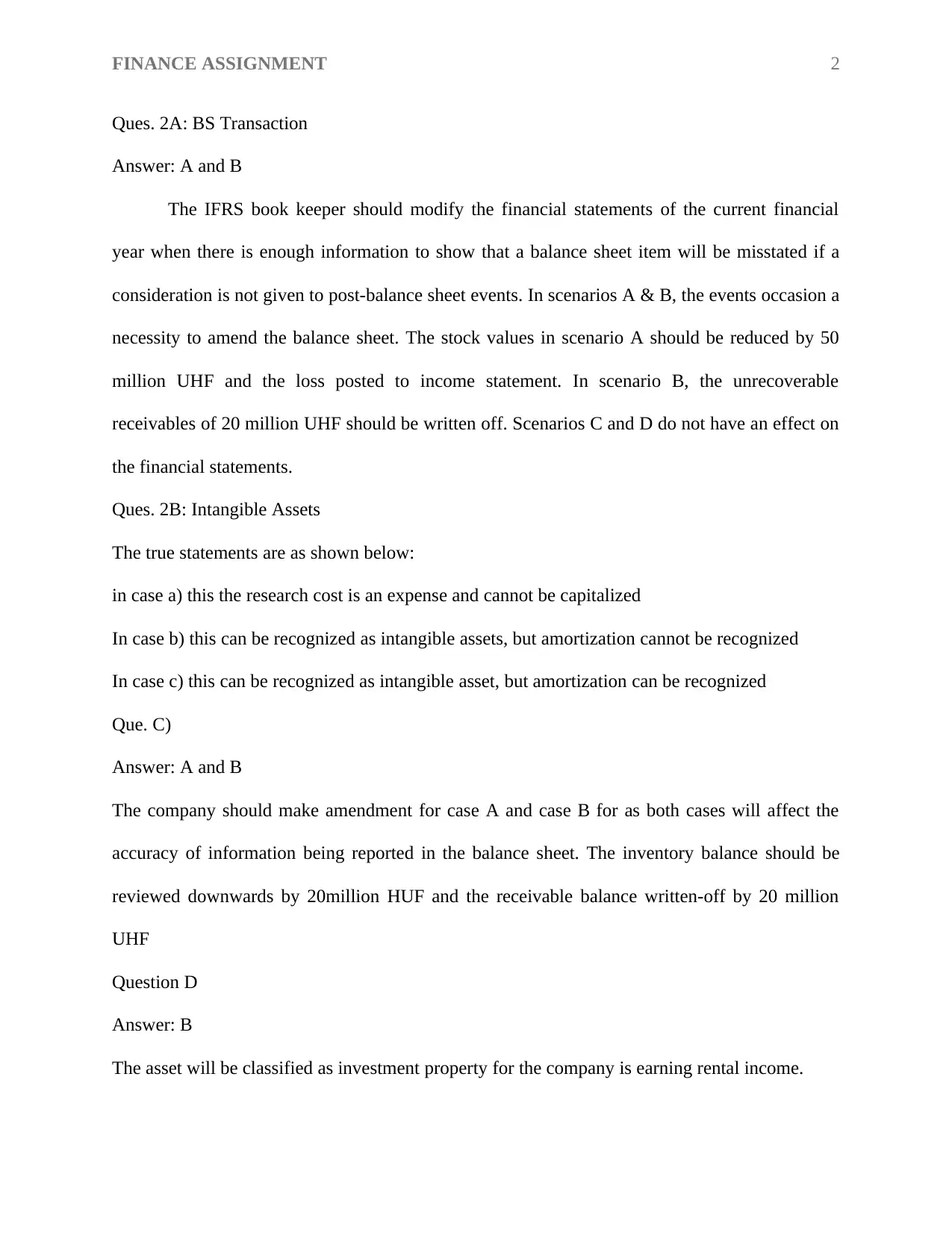
Ques. 2A: BS Transaction
Answer: A and B
The IFRS book keeper should modify the financial statements of the current financial
year when there is enough information to show that a balance sheet item will be misstated if a
consideration is not given to post-balance sheet events. In scenarios A & B, the events occasion a
necessity to amend the balance sheet. The stock values in scenario A should be reduced by 50
million UHF and the loss posted to income statement. In scenario B, the unrecoverable
receivables of 20 million UHF should be written off. Scenarios C and D do not have an effect on
the financial statements.
Ques. 2B: Intangible Assets
The true statements are as shown below:
in case a) this the research cost is an expense and cannot be capitalized
In case b) this can be recognized as intangible assets, but amortization cannot be recognized
In case c) this can be recognized as intangible asset, but amortization can be recognized
Que. C)
Answer: A and B
The company should make amendment for case A and case B for as both cases will affect the
accuracy of information being reported in the balance sheet. The inventory balance should be
reviewed downwards by 20million HUF and the receivable balance written-off by 20 million
UHF
Question D
Answer: B
The asset will be classified as investment property for the company is earning rental income.
Document Page
FINANCE ASSIGNMENT 3
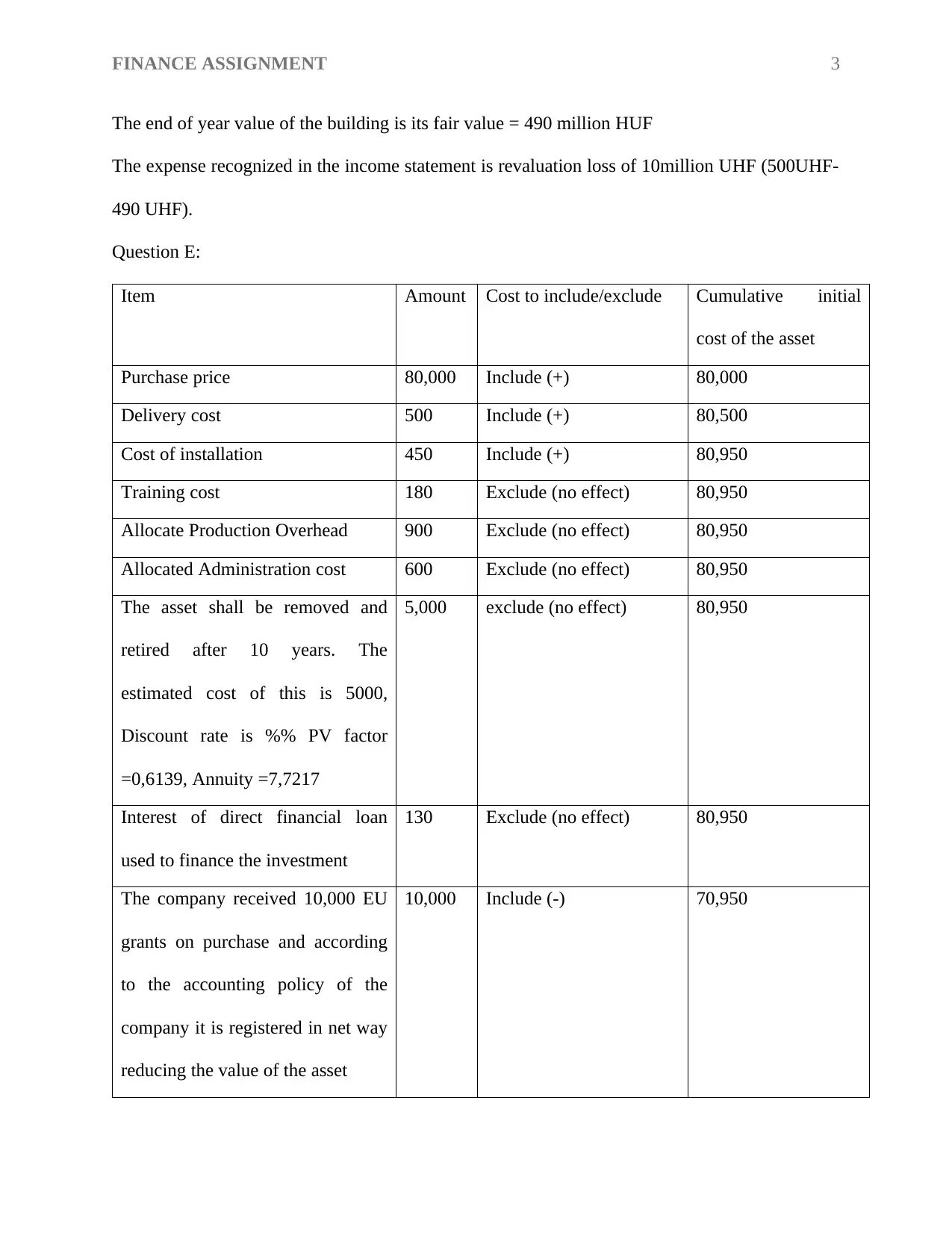
The end of year value of the building is its fair value = 490 million HUF
The expense recognized in the income statement is revaluation loss of 10million UHF (500UHF-
490 UHF).
Question E:
Item Amount Cost to include/exclude Cumulative initial
cost of the asset
Purchase price 80,000 Include (+) 80,000
Delivery cost 500 Include (+) 80,500
Cost of installation 450 Include (+) 80,950
Training cost 180 Exclude (no effect) 80,950
Allocate Production Overhead 900 Exclude (no effect) 80,950
Allocated Administration cost 600 Exclude (no effect) 80,950
The asset shall be removed and
retired after 10 years. The
estimated cost of this is 5000,
Discount rate is %% PV factor
=0,6139, Annuity =7,7217
5,000 exclude (no effect) 80,950
Interest of direct financial loan
used to finance the investment
130 Exclude (no effect) 80,950
The company received 10,000 EU
grants on purchase and according
to the accounting policy of the
company it is registered in net way
reducing the value of the asset
10,000 Include (-) 70,950
Document Page
FINANCE ASSIGNMENT 4
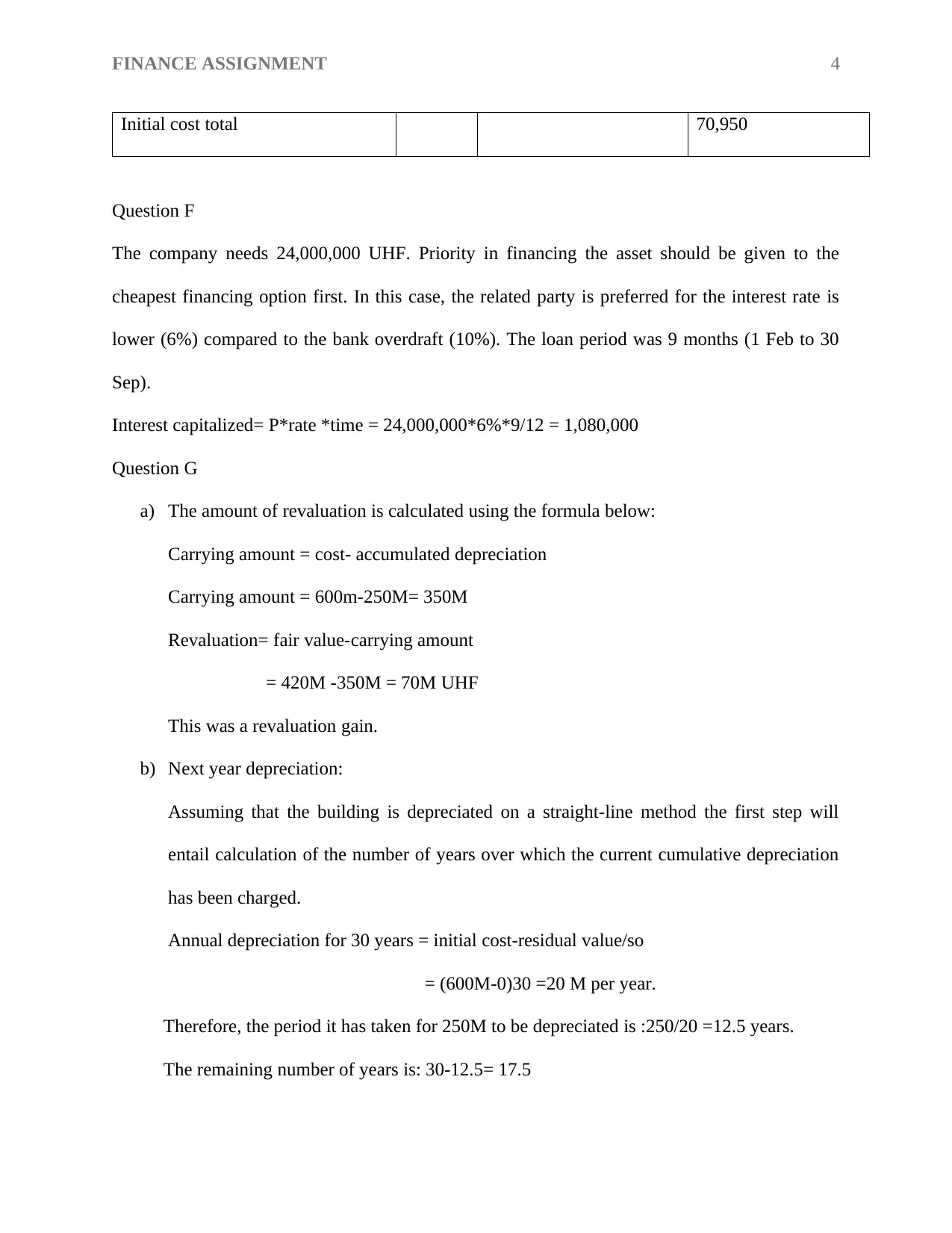
Initial cost total 70,950
Question F
The company needs 24,000,000 UHF. Priority in financing the asset should be given to the
cheapest financing option first. In this case, the related party is preferred for the interest rate is
lower (6%) compared to the bank overdraft (10%). The loan period was 9 months (1 Feb to 30
Sep).
Interest capitalized= P*rate *time = 24,000,000*6%*9/12 = 1,080,000
Question G
a) The amount of revaluation is calculated using the formula below:
Carrying amount = cost- accumulated depreciation
Carrying amount = 600m-250M= 350M
Revaluation= fair value-carrying amount
= 420M -350M = 70M UHF
This was a revaluation gain.
b) Next year depreciation:
Assuming that the building is depreciated on a straight-line method the first step will
entail calculation of the number of years over which the current cumulative depreciation
has been charged.
Annual depreciation for 30 years = initial cost-residual value/so
= (600M-0)30 =20 M per year.
Therefore, the period it has taken for 250M to be depreciated is :250/20 =12.5 years.
The remaining number of years is: 30-12.5= 17.5
tabler-icon-diamond-filled.svg

Paraphrase This Document

Need a fresh take? Get an instant paraphrase of this document with our AI Paraphraser
Document Page
FINANCE ASSIGNMENT 5
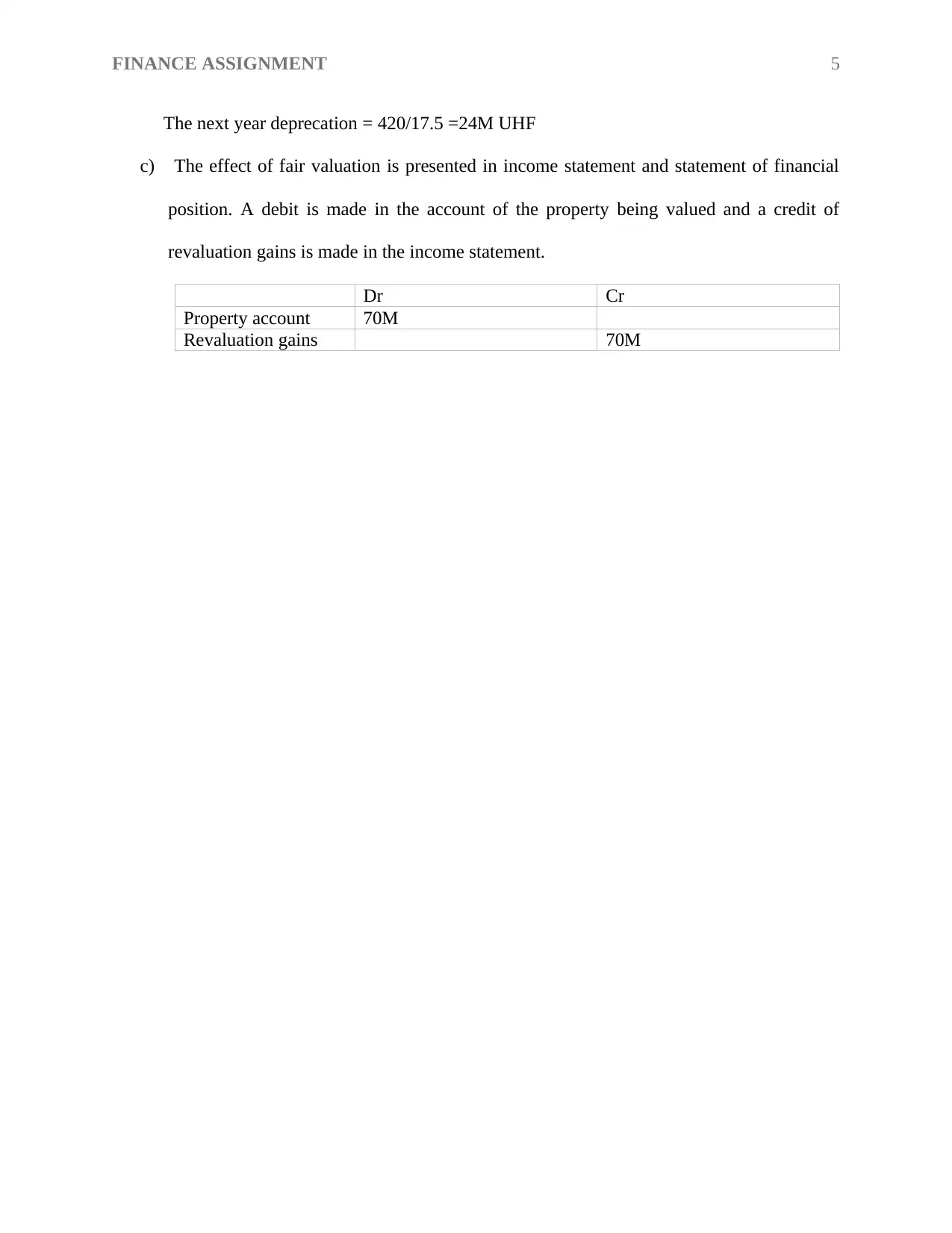
The next year deprecation = 420/17.5 =24M UHF
c) The effect of fair valuation is presented in income statement and statement of financial
position. A debit is made in the account of the property being valued and a credit of
revaluation gains is made in the income statement.
Dr Cr
Property account 70M
Revaluation gains 70M
chevron_up_icon
1 out of 5
circle_padding
hide_on_mobile
zoom_out_icon
[object Object]