Financial Statement Auditing Case Study and PCAOB Report Analysis

Verified

Added on  2022/09/09

|7
|1333
|15
Case Study
AI Summary
This case study analyzes financial statement auditing, focusing on PCAOB inspection reports of Big Four accounting firms (Deloitte & Touche LLP, Ernst & Young, PricewaterhouseCoopers, and KPMG). The study examines audit deficiencies, particularly in revenue recognition, internal controls, and accounts receivables. It explores the weaknesses identified in each firm's auditing practices, including issues with revenue testing, computer system access, and the use of external sources for revenue calculation. The assignment also includes an analysis of the Sarbox Scooters, Inc. case, evaluating material and significant weaknesses related to revenue recognition and accounts receivables, and considering risk assessments based on revenue levels. The student's analysis highlights the importance of effective internal controls and the impact of deficiencies on financial reporting.
Document Page
Running head: FINANCIAL STATEMENT AUDITING
Financial Statement Auditing
Name of the Student:
Name of the University:
Author Note
tabler-icon-diamond-filled.svg

Paraphrase This Document

Need a fresh take? Get an instant paraphrase of this document with our AI Paraphraser
Document Page
3FINANCIAL STATEMENT AUDITING
Executive Summary
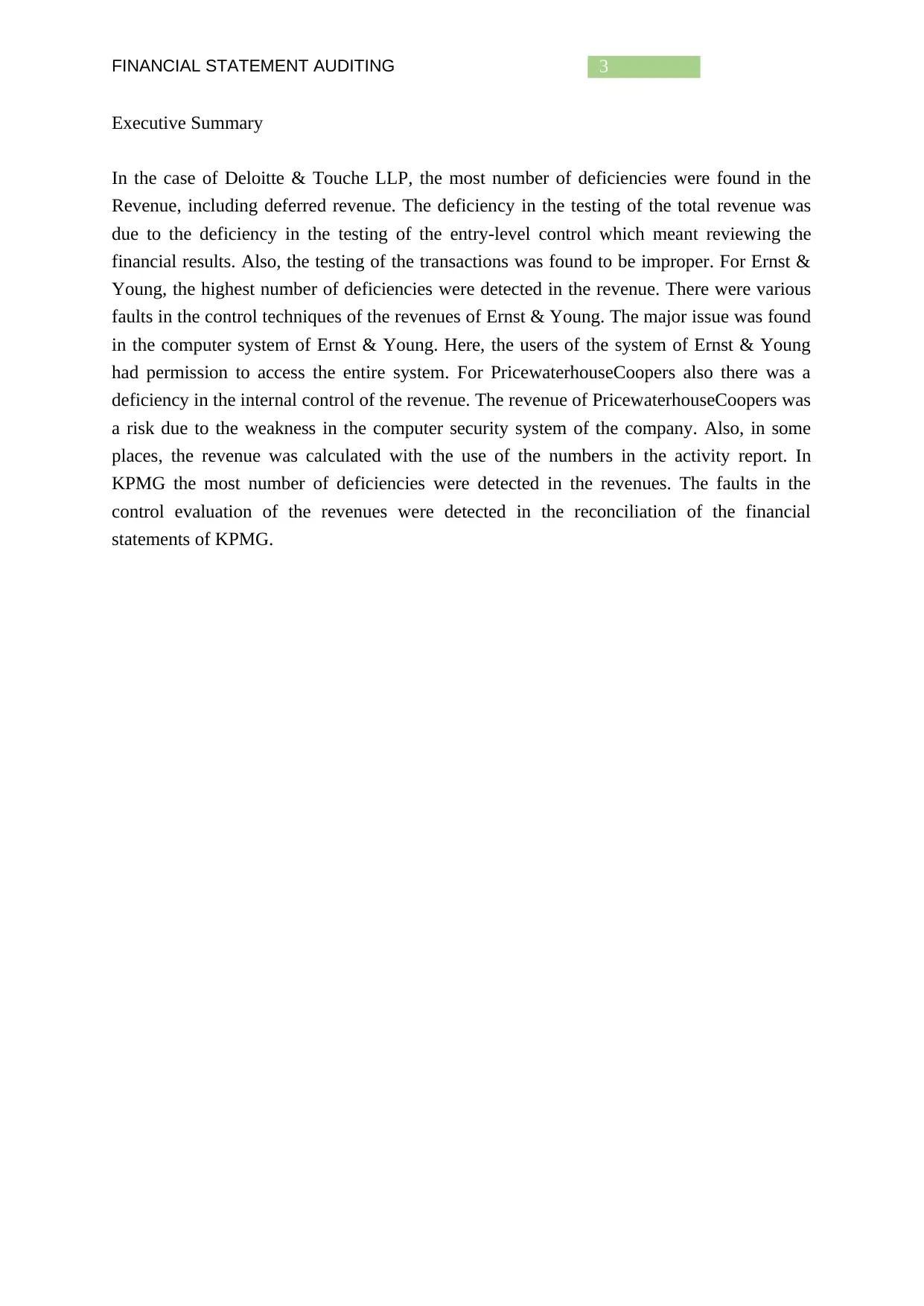
In the case of Deloitte & Touche LLP, the most number of deficiencies were found in the
Revenue, including deferred revenue. The deficiency in the testing of the total revenue was
due to the deficiency in the testing of the entry-level control which meant reviewing the
financial results. Also, the testing of the transactions was found to be improper. For Ernst &
Young, the highest number of deficiencies were detected in the revenue. There were various
faults in the control techniques of the revenues of Ernst & Young. The major issue was found
in the computer system of Ernst & Young. Here, the users of the system of Ernst & Young
had permission to access the entire system. For PricewaterhouseCoopers also there was a
deficiency in the internal control of the revenue. The revenue of PricewaterhouseCoopers was
a risk due to the weakness in the computer security system of the company. Also, in some
places, the revenue was calculated with the use of the numbers in the activity report. In
KPMG the most number of deficiencies were detected in the revenues. The faults in the
control evaluation of the revenues were detected in the reconciliation of the financial
statements of KPMG.
Document Page
3FINANCIAL STATEMENT AUDITING
Table of Contents
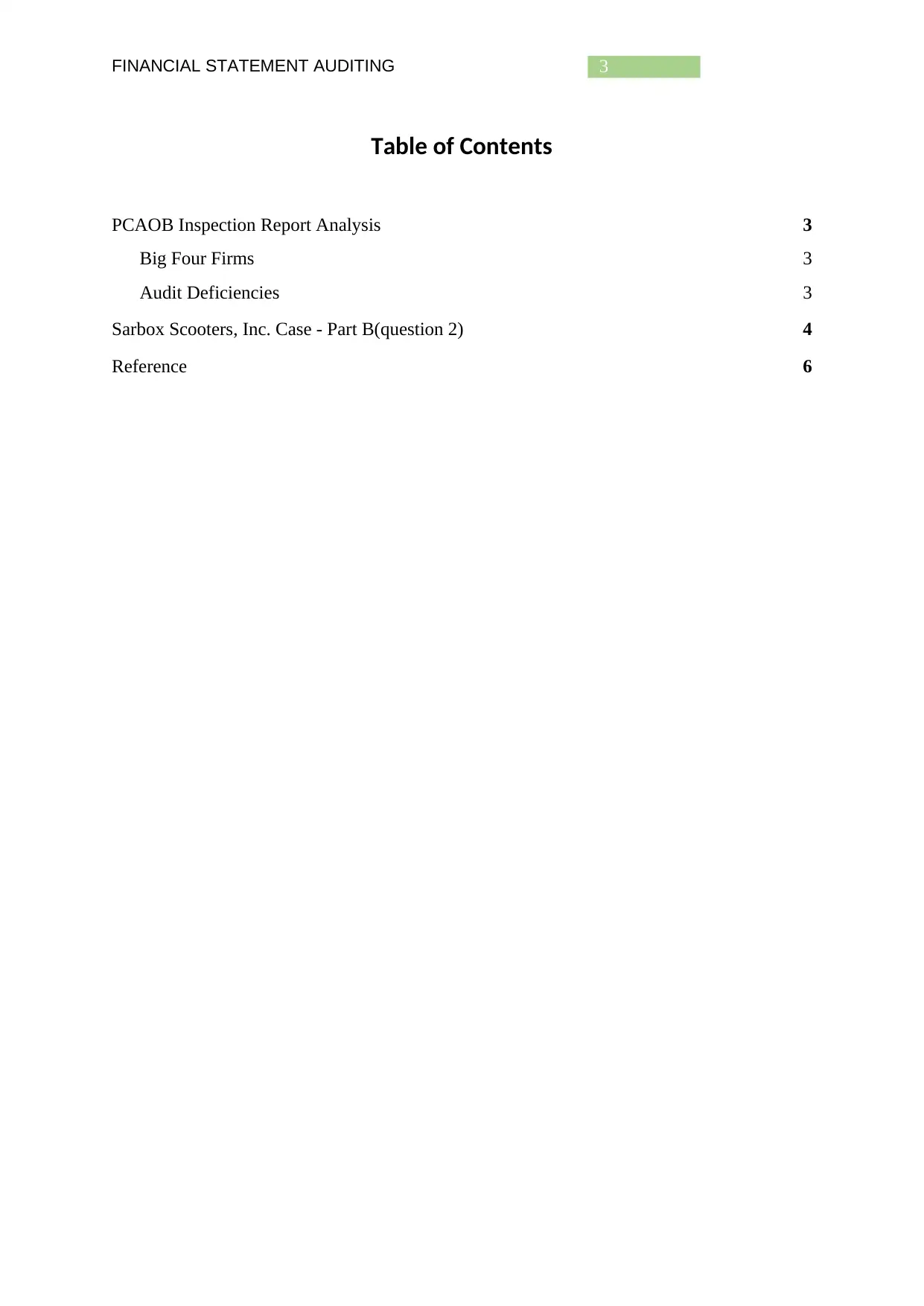
PCAOB Inspection Report Analysis 3
Big Four Firms 3
Audit Deficiencies 3
Sarbox Scooters, Inc. Case - Part B(question 2) 4
Reference 6
Document Page
3FINANCIAL STATEMENT AUDITING
PCAOB Inspection Report Analysis
Big Four Firms
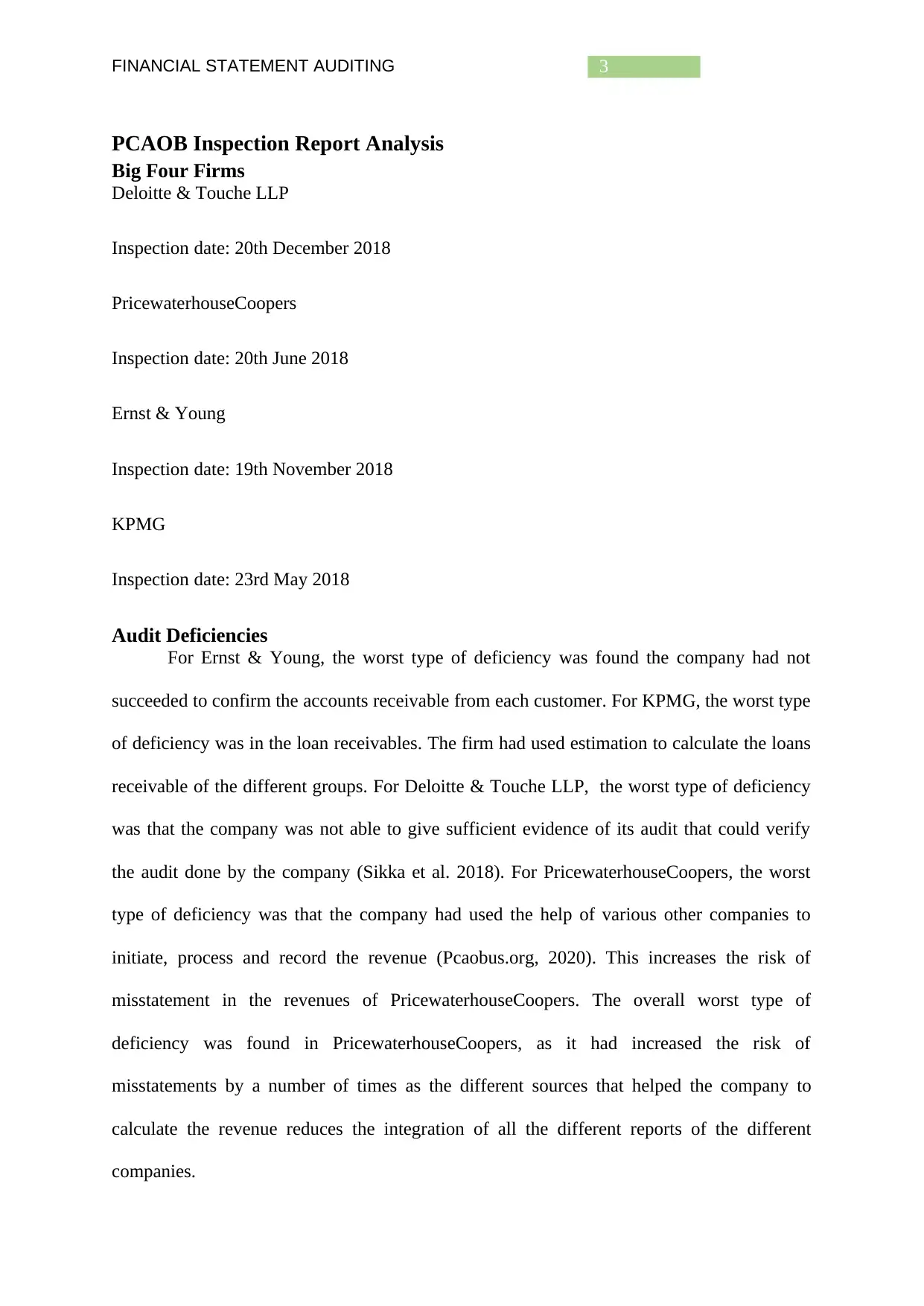
Deloitte & Touche LLP
Inspection date: 20th December 2018
PricewaterhouseCoopers
Inspection date: 20th June 2018
Ernst & Young
Inspection date: 19th November 2018
KPMG
Inspection date: 23rd May 2018
Audit Deficiencies
For Ernst & Young, the worst type of deficiency was found the company had not
succeeded to confirm the accounts receivable from each customer. For KPMG, the worst type
of deficiency was in the loan receivables. The firm had used estimation to calculate the loans
receivable of the different groups. For Deloitte & Touche LLP, the worst type of deficiency
was that the company was not able to give sufficient evidence of its audit that could verify
the audit done by the company (Sikka et al. 2018). For PricewaterhouseCoopers, the worst
type of deficiency was that the company had used the help of various other companies to
initiate, process and record the revenue (Pcaobus.org, 2020). This increases the risk of
misstatement in the revenues of PricewaterhouseCoopers. The overall worst type of
deficiency was found in PricewaterhouseCoopers, as it had increased the risk of
misstatements by a number of times as the different sources that helped the company to
calculate the revenue reduces the integration of all the different reports of the different
companies.
tabler-icon-diamond-filled.svg

Paraphrase This Document

Need a fresh take? Get an instant paraphrase of this document with our AI Paraphraser
Document Page
3FINANCIAL STATEMENT AUDITING
Sarbox Scooters, Inc. Case - Part B(question 2)
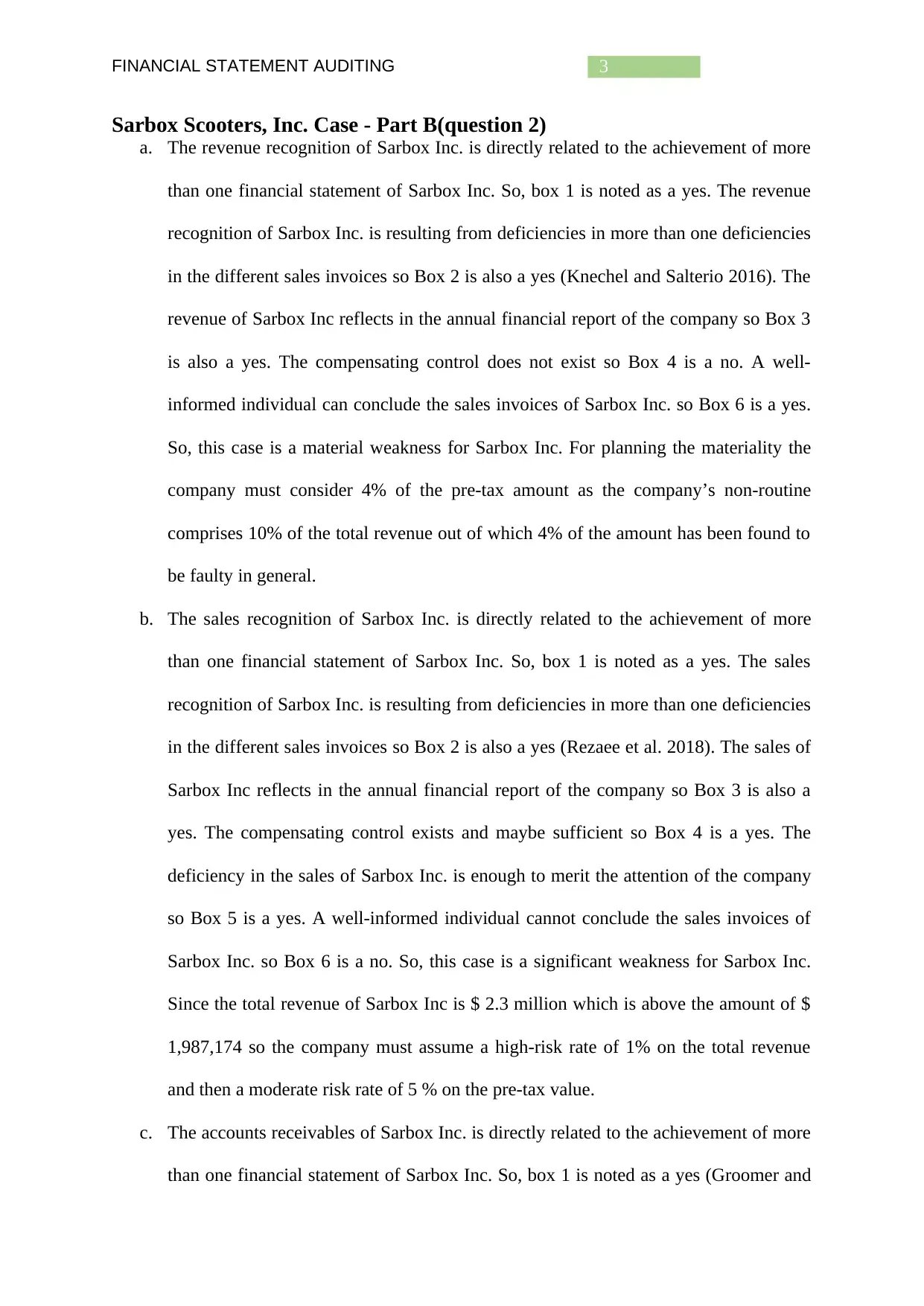
a. The revenue recognition of Sarbox Inc. is directly related to the achievement of more
than one financial statement of Sarbox Inc. So, box 1 is noted as a yes. The revenue
recognition of Sarbox Inc. is resulting from deficiencies in more than one deficiencies
in the different sales invoices so Box 2 is also a yes (Knechel and Salterio 2016). The
revenue of Sarbox Inc reflects in the annual financial report of the company so Box 3
is also a yes. The compensating control does not exist so Box 4 is a no. A well-
informed individual can conclude the sales invoices of Sarbox Inc. so Box 6 is a yes.
So, this case is a material weakness for Sarbox Inc. For planning the materiality the
company must consider 4% of the pre-tax amount as the company’s non-routine
comprises 10% of the total revenue out of which 4% of the amount has been found to
be faulty in general.
b. The sales recognition of Sarbox Inc. is directly related to the achievement of more
than one financial statement of Sarbox Inc. So, box 1 is noted as a yes. The sales
recognition of Sarbox Inc. is resulting from deficiencies in more than one deficiencies
in the different sales invoices so Box 2 is also a yes (Rezaee et al. 2018). The sales of
Sarbox Inc reflects in the annual financial report of the company so Box 3 is also a
yes. The compensating control exists and maybe sufficient so Box 4 is a yes. The
deficiency in the sales of Sarbox Inc. is enough to merit the attention of the company
so Box 5 is a yes. A well-informed individual cannot conclude the sales invoices of
Sarbox Inc. so Box 6 is a no. So, this case is a significant weakness for Sarbox Inc.
Since the total revenue of Sarbox Inc is $ 2.3 million which is above the amount of $
1,987,174 so the company must assume a high-risk rate of 1% on the total revenue
and then a moderate risk rate of 5 % on the pre-tax value.
c. The accounts receivables of Sarbox Inc. is directly related to the achievement of more
than one financial statement of Sarbox Inc. So, box 1 is noted as a yes (Groomer and
Document Page
3FINANCIAL STATEMENT AUDITING
Murthy 2018). The accounts receivables of Sarbox Inc. are resulting from deficiencies
in more than one deficiencies in the different left out payments of customers so Box 2
is also a yes. The accounts receivables of Sarbox Inc reflects in the annual financial
report of the company so Box 3 is also a yes. The compensating control exists and
maybe sufficient so Box 4 is a yes. The deficiency in the accounts receivables of
Sarbox Inc. is enough to merit the attention of the company so Box 5 is a yes (Adler
et al. 2018). A well-informed individual cannot conclude the whole accounts
receivables of Sarbox Inc. so Box 6 is a no. So, this case is a significant weakness for
Sarbox Inc. Since it is the peak season at Sarbox Inc. so it is not possible for the
company to authenticate many transactions which lead to misstatement so a high-risk
rate of 2 % must be assumed by the company on its total revenue.
Document Page
3FINANCIAL STATEMENT AUDITING
Reference
Pcaobus.org, 2020. Firm Inspection Reports. [online] Pcaobus.org. Available at:
<https://pcaobus.org/Inspections/Reports/Pages/default.aspx#k=> [Accessed 2 April 2020].
Knechel, W.R. and Salterio, S.E., 2016. Auditing: Assurance and risk. Taylor & Francis.
Rezaee, Z., Sharbatoghlie, A., Elam, R. and McMickle, P.L., 2018. Continuous Auditing:
Building Automated Auditing Capability1. Continuous Auditing: Theory and Application,
p.169.
Groomer, S.M. and Murthy, U.S., 2018. Continuous auditing of database applications: An
embedded audit module approach. Continuous Auditing, pp.105-124.
Adler, P., Falk, C., Friedler, S.A., Nix, T., Rybeck, G., Scheidegger, C., Smith, B. and
Venkatasubramanian, S., 2018. Auditing black-box models for indirect influence. Knowledge
and Information Systems, 54(1), pp.95-122.
Sikka, P., Haslam, C., Cooper, C., Haslam, J., Christensen, J., Driver, D.G. and Willmott, H.,
2018. Reforming the auditing industry. Report commissioned by the Shadow Chancellor of
the Exchequer, John McDonnell MP.
chevron_up_icon
1 out of 7
circle_padding
hide_on_mobile
zoom_out_icon
[object Object]