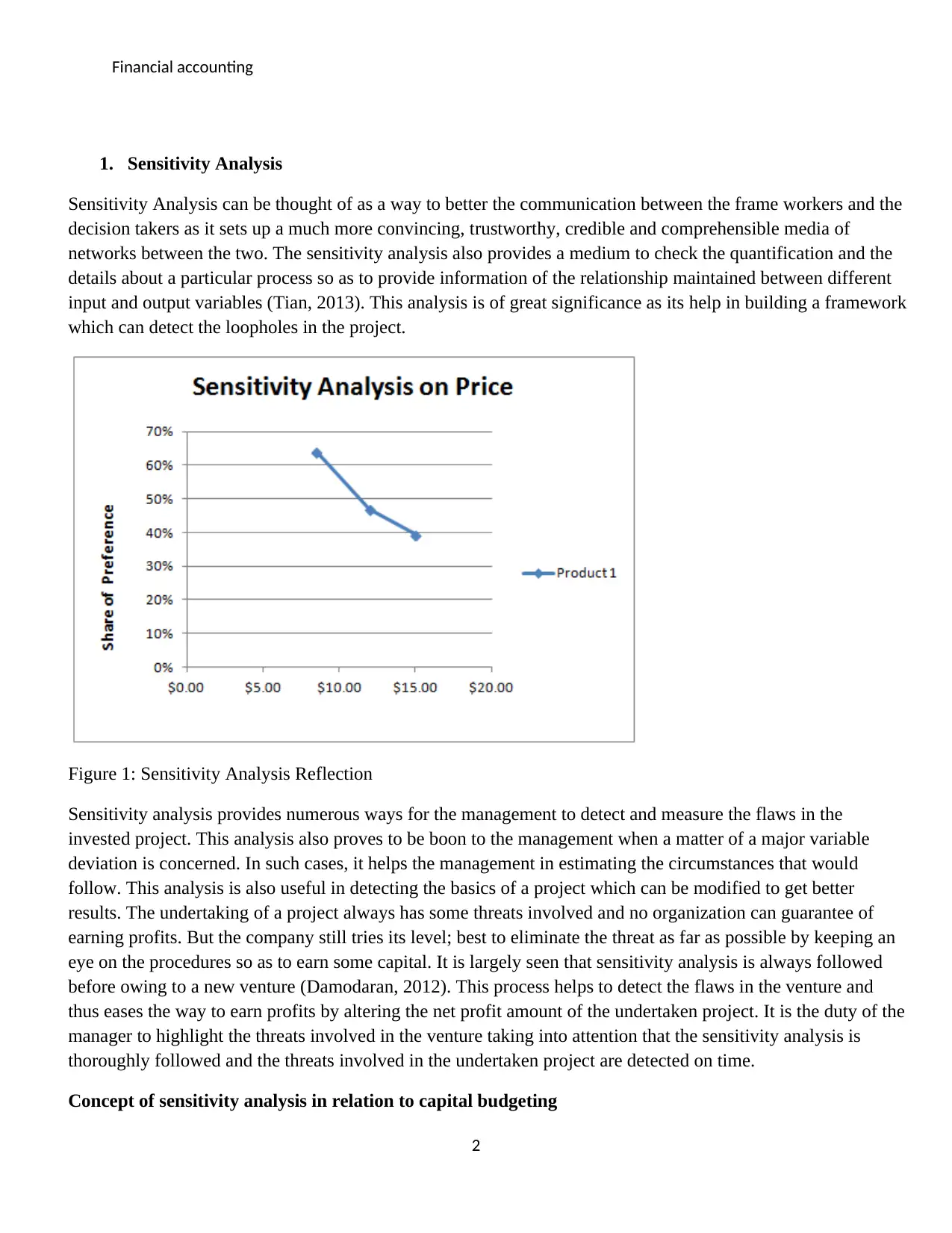
Corporate Financial Accounting: Analysis of Investment Techniques

Verified

Added on  2019/11/29

|8
|2618
|159
Report
AI Summary
This report provides a comprehensive overview of four key financial analysis techniques: sensitivity analysis, scenario analysis, break-even analysis, and simulation. Sensitivity analysis is presented as a tool for communication and detecting project flaws by examining the relationship between input and output variables, particularly in capital budgeting contexts with NPV and IRR. Scenario analysis is discussed as a method to assess the impact of different situations on project outcomes, aiding in risk assessment and decision-making, especially when evaluating investment opportunities and credit purchases. Break-even analysis is explained as a tool for determining the minimum sales needed to avoid losses and understanding the relationship between fixed and variable costs, supporting critical investment decisions. Finally, simulation is described as a statistical process that incorporates probability distributions and random numbers to assess risk and complexity in discounted cash flow analysis, offering a more comprehensive view than sensitivity and scenario analyses by assessing the effects of all variable combinations. The report emphasizes the application of these techniques in capital budgeting and corporate financial decision-making.

Document Page
CORPORATE FINANCIAL
ACCOUNTING
tabler-icon-diamond-filled.svg

Paraphrase This Document

Need a fresh take? Get an instant paraphrase of this document with our AI Paraphraser
Document Page
Financial accounting
1. Sensitivity Analysis
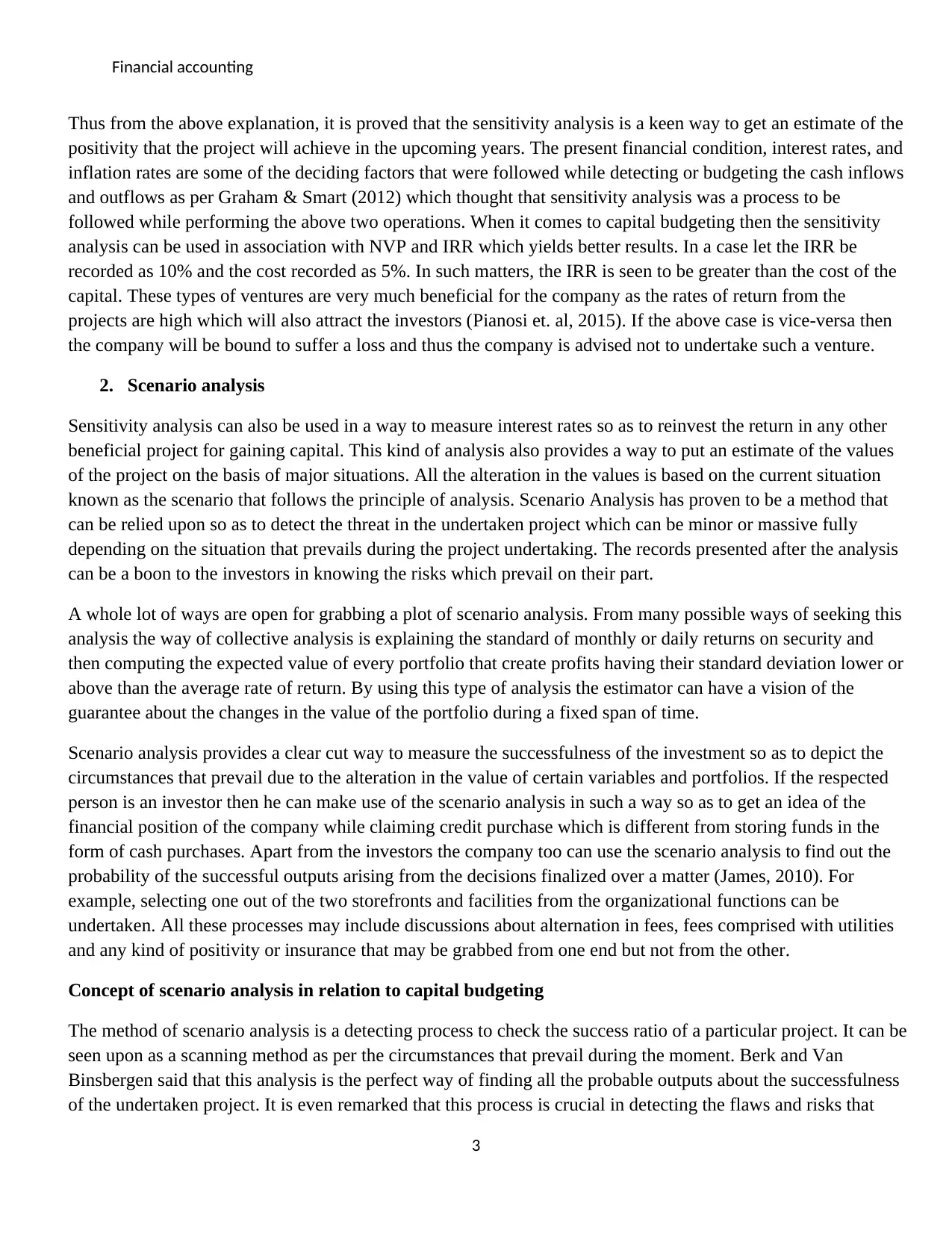
Sensitivity Analysis can be thought of as a way to better the communication between the frame workers and the
decision takers as it sets up a much more convincing, trustworthy, credible and comprehensible media of
networks between the two. The sensitivity analysis also provides a medium to check the quantification and the
details about a particular process so as to provide information of the relationship maintained between different
input and output variables (Tian, 2013). This analysis is of great significance as its help in building a framework
which can detect the loopholes in the project.
Figure 1: Sensitivity Analysis Reflection
Sensitivity analysis provides numerous ways for the management to detect and measure the flaws in the
invested project. This analysis also proves to be boon to the management when a matter of a major variable
deviation is concerned. In such cases, it helps the management in estimating the circumstances that would
follow. This analysis is also useful in detecting the basics of a project which can be modified to get better
results. The undertaking of a project always has some threats involved and no organization can guarantee of
earning profits. But the company still tries its level; best to eliminate the threat as far as possible by keeping an
eye on the procedures so as to earn some capital. It is largely seen that sensitivity analysis is always followed
before owing to a new venture (Damodaran, 2012). This process helps to detect the flaws in the venture and
thus eases the way to earn profits by altering the net profit amount of the undertaken project. It is the duty of the
manager to highlight the threats involved in the venture taking into attention that the sensitivity analysis is
thoroughly followed and the threats involved in the undertaken project are detected on time.
Concept of sensitivity analysis in relation to capital budgeting
2
Document Page
Financial accounting
Thus from the above explanation, it is proved that the sensitivity analysis is a keen way to get an estimate of the
positivity that the project will achieve in the upcoming years. The present financial condition, interest rates, and
inflation rates are some of the deciding factors that were followed while detecting or budgeting the cash inflows
and outflows as per Graham & Smart (2012) which thought that sensitivity analysis was a process to be
followed while performing the above two operations. When it comes to capital budgeting then the sensitivity
analysis can be used in association with NVP and IRR which yields better results. In a case let the IRR be
recorded as 10% and the cost recorded as 5%. In such matters, the IRR is seen to be greater than the cost of the
capital. These types of ventures are very much beneficial for the company as the rates of return from the
projects are high which will also attract the investors (Pianosi et. al, 2015). If the above case is vice-versa then
the company will be bound to suffer a loss and thus the company is advised not to undertake such a venture.
2. Scenario analysis
Sensitivity analysis can also be used in a way to measure interest rates so as to reinvest the return in any other
beneficial project for gaining capital. This kind of analysis also provides a way to put an estimate of the values
of the project on the basis of major situations. All the alteration in the values is based on the current situation
known as the scenario that follows the principle of analysis. Scenario Analysis has proven to be a method that
can be relied upon so as to detect the threat in the undertaken project which can be minor or massive fully
depending on the situation that prevails during the project undertaking. The records presented after the analysis
can be a boon to the investors in knowing the risks which prevail on their part.
A whole lot of ways are open for grabbing a plot of scenario analysis. From many possible ways of seeking this
analysis the way of collective analysis is explaining the standard of monthly or daily returns on security and
then computing the expected value of every portfolio that create profits having their standard deviation lower or
above than the average rate of return. By using this type of analysis the estimator can have a vision of the
guarantee about the changes in the value of the portfolio during a fixed span of time.
Scenario analysis provides a clear cut way to measure the successfulness of the investment so as to depict the
circumstances that prevail due to the alteration in the value of certain variables and portfolios. If the respected
person is an investor then he can make use of the scenario analysis in such a way so as to get an idea of the
financial position of the company while claiming credit purchase which is different from storing funds in the
form of cash purchases. Apart from the investors the company too can use the scenario analysis to find out the
probability of the successful outputs arising from the decisions finalized over a matter (James, 2010). For
example, selecting one out of the two storefronts and facilities from the organizational functions can be
undertaken. All these processes may include discussions about alternation in fees, fees comprised with utilities
and any kind of positivity or insurance that may be grabbed from one end but not from the other.
Concept of scenario analysis in relation to capital budgeting
The method of scenario analysis is a detecting process to check the success ratio of a particular project. It can be
seen upon as a scanning method as per the circumstances that prevail during the moment. Berk and Van
Binsbergen said that this analysis is the perfect way of finding all the probable outputs about the successfulness
of the undertaken project. It is even remarked that this process is crucial in detecting the flaws and risks that
3
Document Page
Financial accounting
prevail in the undertaken project. By using this process it is easy for the management to detect any of the
serious situations that arise during the project undertaking (Brigham & Daves, 2012). For example, the
Woolworths Limited during the expansion of their business always follows to conduct the scenario analysis so
as to detect any prevailing risk.
It is always important to follow the scenario analysis so that the flaws in the particular project can be detected.
The company can also be in a beneficial state if it keeps an eye on the rate of the NVP and also on the IRR
which is recorded during work so as to gain much more capital than expected. It is also very much necessary for
the company to keep a track of both NVP and IRR not just during the time of project undertaking but at
different times like inflation and also during the depression (James, 2010). Overall discussion proves that the
scenario analysis proves to be a boon which helps the organizat6ion to take faster and accurate decisions.
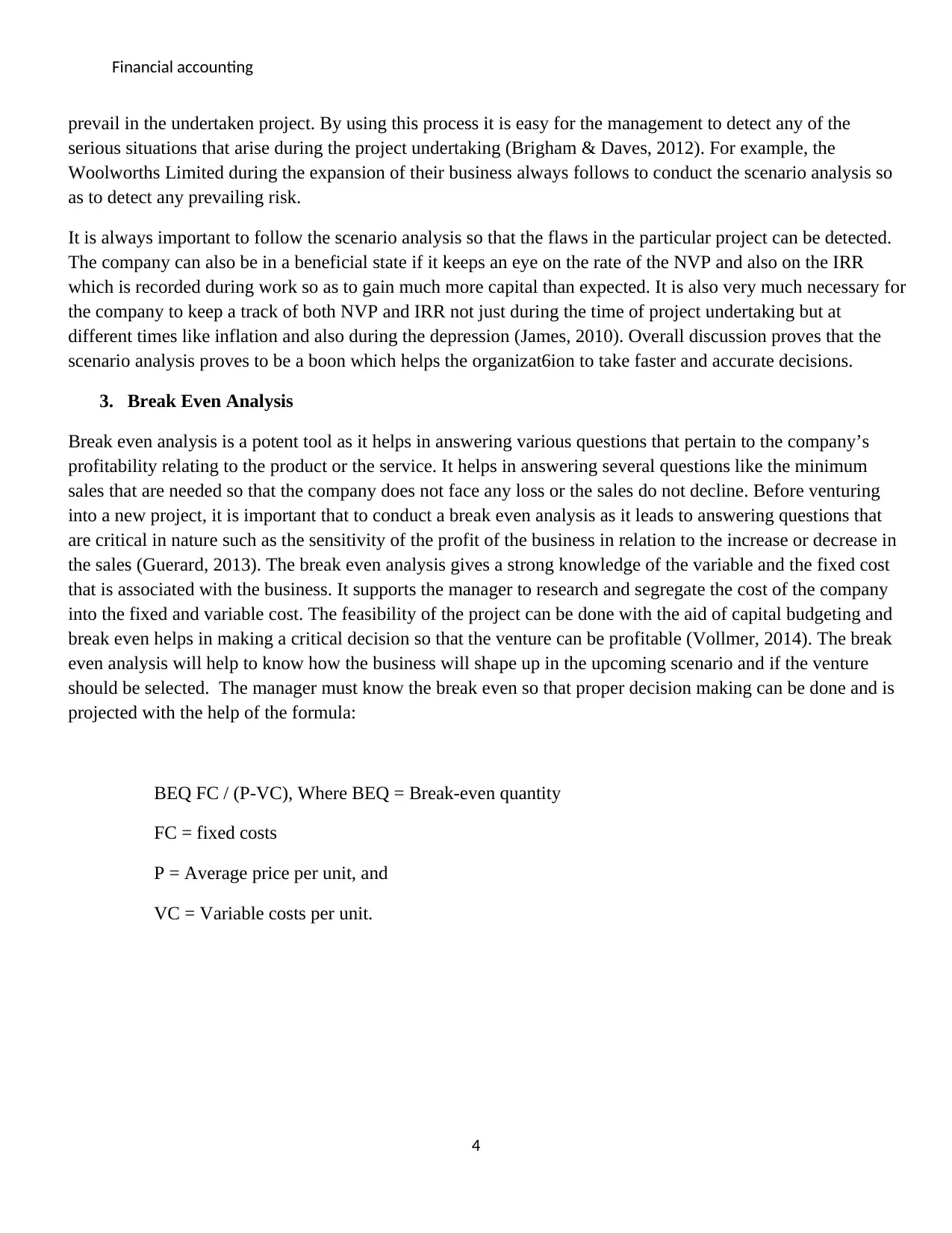
3. Break Even Analysis
Break even analysis is a potent tool as it helps in answering various questions that pertain to the company’s
profitability relating to the product or the service. It helps in answering several questions like the minimum
sales that are needed so that the company does not face any loss or the sales do not decline. Before venturing
into a new project, it is important that to conduct a break even analysis as it leads to answering questions that
are critical in nature such as the sensitivity of the profit of the business in relation to the increase or decrease in
the sales (Guerard, 2013). The break even analysis gives a strong knowledge of the variable and the fixed cost
that is associated with the business. It supports the manager to research and segregate the cost of the company
into the fixed and variable cost. The feasibility of the project can be done with the aid of capital budgeting and
break even helps in making a critical decision so that the venture can be profitable (Vollmer, 2014). The break
even analysis will help to know how the business will shape up in the upcoming scenario and if the venture
should be selected. The manager must know the break even so that proper decision making can be done and is
projected with the help of the formula:
BEQ FC / (P-VC), Where BEQ = Break-even quantity
FC = fixed costs
P = Average price per unit, and
VC = Variable costs per unit.
4
tabler-icon-diamond-filled.svg

Paraphrase This Document

Need a fresh take? Get an instant paraphrase of this document with our AI Paraphraser
Document Page
Financial accounting
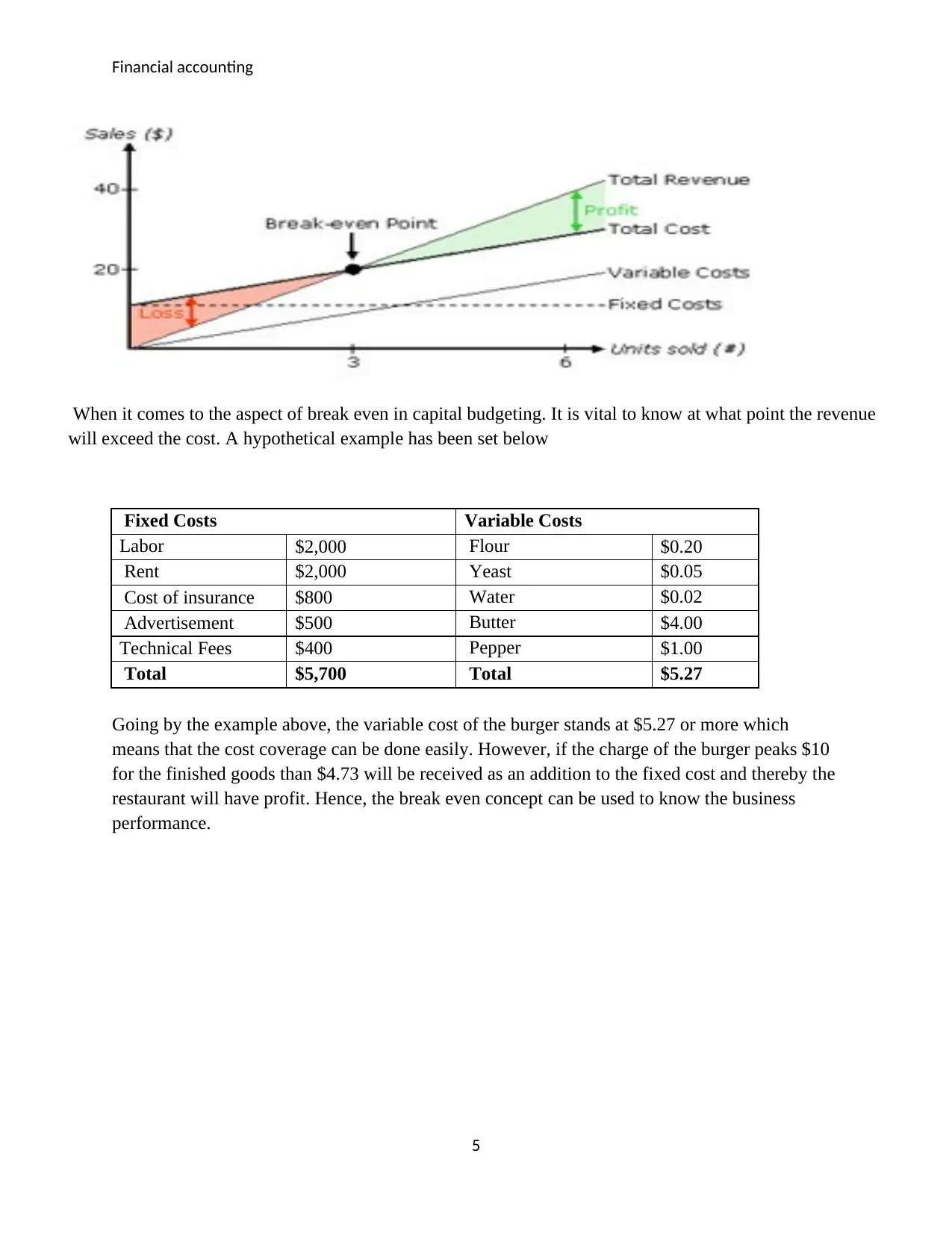
When it comes to the aspect of break even in capital budgeting. It is vital to know at what point the revenue
will exceed the cost. A hypothetical example has been set below
Fixed Costs Variable Costs
Labor $2,000 Flour $0.20
Rent $2,000 Yeast $0.05
Cost of insurance $800 Water $0.02
Advertisement $500 Butter $4.00
Technical Fees $400 Pepper $1.00
Total $5,700 Total $5.27
Going by the example above, the variable cost of the burger stands at $5.27 or more which
means that the cost coverage can be done easily. However, if the charge of the burger peaks $10
for the finished goods than $4.73 will be received as an addition to the fixed cost and thereby the
restaurant will have profit. Hence, the break even concept can be used to know the business
performance.
5
Document Page
Financial accounting
4. Simulation
It can be defined as a process that dwells on statistics and observes the probability distribution,
random numbers. Such is determined in advance so that the result that is risky in nature can be
known or traced. In this scenario, the manager puts to practice the elements of the cash flow in a
model based on mathematics and replicate the method various times (Wang et. al, 2016). Hence,
it is an effective mechanism that results in enhancement of the probability distribution of returns
that are highlighted. The method of development of random numbers and using the probability
distribution for the inflow of cash and outflow enables the managers to know the value for each
variable (Berk et.al, 2015). When the submission of the values happens then substitution of the
values happens into the model and provides the NPV. When the same mechanism is repeated
then the probability distribution of NVPB can be generated in an easy manner.
Simulation can be defined as a strong spreadsheet tool that helps the managers to know the risk
and the complexity that is involved in the discounted cash flow analysis. The main advantage of
the simulation appears in the case that the mechanism covers the shortfalls that are seen in
sensitivity and scenario analysis by assessing the effect of all variable combinations. The
utilization is mainly seen in the case of traditional capital budgeting because it considers the
form of sampling of repeated random from the distribution of probability that is based on the
cash flow to come to the different profile that is linked to the cash flow in the NPV of a project
for a specific plan (Brealey et. al, 2011) Simulation provides solidity to the real time decision
making by using the model that is linked to equations or any identity so that a better view of the
functioning can be gathered. This method is used by the managers as a mathematical equation
that finds the variables that are primary in nature that contains a vivid elucidation of the freedom
that finds the important primary variables and contains the description of the freedom that
appears between the variables and various time scenarios. This method is well directed to the
major variables and links to the data of the past. This is a vital aspect when it relates to the
process of decision making (Northington, 2011). This helps the managers to understand the
concept of risk return trade off rather depending on specific estimation. Therefore, simulation
helps the managers to come up with a real life scene and the same can be utilized to know the
project feasibility.
If a project has a probability of 98% success and IRR stands more than the capital it will appear
that the project is strong and contains minute chances of failure. On the other hand, when it is
involved in projects that are high yielding they are subjected to high risk and nothing appears
without a stake. Therefore, the probability of the NPV cannot reach 100% as a project that earns
the capital cost is riskier in nature (Parrino et. al, 2012). Hence, simulation can be used by the
managers to trace the prejudice of the project developer.
6
Document Page
Financial accounting
References
Berk, J., DeMarzo, P. & Stangeland, D 2015, Corporate Finance, Canadian Toronto: Pearson
Canada.
Brealey, R, Myers, S. & Allen, F 2011, Principles of corporate finance, New York: McGraw-
Hill/Irwin.
Brigham, E. & Daves, P 2012, Intermediate Financial Management , USA: Cengage
Damodaran, A 2012, Investment Valuation, New York: John Wiley & Sons.
Graham, J & Smart, S 2012, Introduction to corporate finance, Australia: South-Western
Cengage Learning.
Guerard, J. 2013, Introduction to financial forecasting in investment analysis, New York, NY:
Springer.
James P. D 2010, Topics in Capital Budgeting, viewed 7 September 2017
http://www.csun.edu/~jpd45767/303/8%20-%20Topics%20in%20Capital%20Budgeting.pdf
Northington, S 2011, Finance, New York, NY: Ferguson's.
Parrino, R, Kidwell, D. & Bates, T 2012, Fundamentals of corporate finance, Hoboken,
Pianosi, F., Sarrazin, F & Wagener, T 2015, ‘A matlab toolbox for global sensitivity analysis’,
Environmental Modelling & Software, vol. 70, pp.80-85.
Tian, W 2013, ‘A review of sensitivity analysis methods in building energy analysis’, Renewable
and Sustainable Energy Reviews, vol. 20, pp.411-419.
Vollmer, M 2014, A Beta-return Efficient Portfolio Optimisation Following the CAPM: An
Analysis of International Markets and Sectors. Springer.
Wang, C.P., Huang, H.H. & Hu, J.S 2016, ‘Reverse-Engineering and Real Options–Adjusted
CAPM in the Taiwan Stock Market’, Emerging Markets Finance and Trade, pp.1-18.
7
tabler-icon-diamond-filled.svg

Paraphrase This Document

Need a fresh take? Get an instant paraphrase of this document with our AI Paraphraser
Document Page
Financial accounting
8
chevron_up_icon
1 out of 8
circle_padding
hide_on_mobile
zoom_out_icon
[object Object]