International Finance and Banking: Spain's Economic Crisis Report
VerifiedAdded on 2023/01/17
|12
|3080
|38
Report
AI Summary
This report examines the financialisation of the Spanish economy and its contribution to the economic crisis. The study provides a background of the case, highlighting the period from 1980-2013 and the significant increase in financial liabilities compared to assets. It identifies key problems such as excessive indebtedness, the impact on the banking sector, and the government's inability to maintain sustainable economic growth due to ineffective monetary and fiscal policies. The report also discusses the shifts in trade dynamics, including the openness of trade and the cyclical occurrence of trade deficits. The recommendations involve improving resource allocation, enhancing the monitoring of economic factors, and promoting export-led growth through the implementation of innovative technologies. The conclusion emphasizes the need for improved resource utilization and effective government policies to mitigate financial crises and foster sustainable economic development.
Running head: International finance and banking- Financialisation and the economic crisis in
Spain
International finance and banking- Financialisation and the economic crisis in Spain
Name of the student
Student id:
Course id:
Course name:
Spain
International finance and banking- Financialisation and the economic crisis in Spain
Name of the student
Student id:
Course id:
Course name:

Paraphrase This Document
Need a fresh take? Get an instant paraphrase of this document with our AI Paraphraser
1International finance and banking- Financialisation and the economic crisis in Spain
Table of Contents
Introduction......................................................................................................................................2
Background of the case study..........................................................................................................2
Identification of the key problems...................................................................................................5
Recommendations............................................................................................................................6
Conclusion.......................................................................................................................................7
Reference list...................................................................................................................................8
Table of Contents
Introduction......................................................................................................................................2
Background of the case study..........................................................................................................2
Identification of the key problems...................................................................................................5
Recommendations............................................................................................................................6
Conclusion.......................................................................................................................................7
Reference list...................................................................................................................................8
2International finance and banking- Financialisation and the economic crisis in Spain
Introduction
In the global economic perspectives, the development of better understanding of financial
crisis will be important to identify the resource utilization. Through the incorporation of better
development of incorporation policies the economies like Spain will be looking forward to
increase the innovation in the policy renovation and through the utilization of better resource
development, the country will be willing to identify the development of the economic growth.
The study will be aiming to find the issues that are more prone to the development of better
economic growth for the Spanish economy. The main significance of the study will be to identify
the financial condition in the economy of Spain and how the government will be looking to
increase the development of economy through the monetary and fiscal policies. The study will be
aiming to indulge in the development of economic growth and prosperity in the Spanish
economy through the monetary and fiscal policies.
Background of the case study
Compared to the other developed countries, Spanish economy was financialized intensely
in the recent period. Considering the economy of Spain, the proxy for the financialisation is one
of the recent events that took place in Spain. During the time of 1980-1990, outstanding financial
phenomenon took place in Spain. The financial contribution of Spanish economy in the GDP
increased from 222 per cent to the 325 per cent of GDP (Hein, Detzer & Dodig, 2016). This is
one of the biggest factor because of the fact that the Spanish economy was contributing hugely to
the development of the GDP. The continuous improvement in the Spanish economy was clearly
visible. In the year 2002, the financial liabilities in the Spanish economy contributed to only
647% and the same thing increased to about 1006 percent in the year 2012 (Hein, Detzer &
Dodig, 2016). However, the consideration of the Spanish economy both the assets and liabilities
Introduction
In the global economic perspectives, the development of better understanding of financial
crisis will be important to identify the resource utilization. Through the incorporation of better
development of incorporation policies the economies like Spain will be looking forward to
increase the innovation in the policy renovation and through the utilization of better resource
development, the country will be willing to identify the development of the economic growth.
The study will be aiming to find the issues that are more prone to the development of better
economic growth for the Spanish economy. The main significance of the study will be to identify
the financial condition in the economy of Spain and how the government will be looking to
increase the development of economy through the monetary and fiscal policies. The study will be
aiming to indulge in the development of economic growth and prosperity in the Spanish
economy through the monetary and fiscal policies.
Background of the case study
Compared to the other developed countries, Spanish economy was financialized intensely
in the recent period. Considering the economy of Spain, the proxy for the financialisation is one
of the recent events that took place in Spain. During the time of 1980-1990, outstanding financial
phenomenon took place in Spain. The financial contribution of Spanish economy in the GDP
increased from 222 per cent to the 325 per cent of GDP (Hein, Detzer & Dodig, 2016). This is
one of the biggest factor because of the fact that the Spanish economy was contributing hugely to
the development of the GDP. The continuous improvement in the Spanish economy was clearly
visible. In the year 2002, the financial liabilities in the Spanish economy contributed to only
647% and the same thing increased to about 1006 percent in the year 2012 (Hein, Detzer &
Dodig, 2016). However, the consideration of the Spanish economy both the assets and liabilities
⊘ This is a preview!⊘
Do you want full access?
Subscribe today to unlock all pages.

Trusted by 1+ million students worldwide
3International finance and banking- Financialisation and the economic crisis in Spain
grew in a simultaneous way, through the liabilities grew faster than assets. Through the growth
of this debit balance against the rest of the world has witnessed the net financial assets. However,
the development of the net financial assets of the Spanish economy moved from -9.9% of GDP
in 1990 to -31.6% of GDP in 2000 and even to -95.5% in 2013 (Hein, Detzer & Dodig, 2016).
One of the major factor for such high economic crisis in Spain was mainly the huge amount of
indebtedness. However, the most sectors that are being highly affected by this economic crisis is
the banking sectors. On the other hand, through the development of mitigating process for such
economic crisis will be helpful for the economy to indulge in the development of the innovation
in the improvement of the banking sector. Through the development of the monetary policy in
developing economies like Spain will be able to achieve the resources that will definitely bring
in innovations in the banking operation (Hein, Detzer & Dodig, 2016). Due to the global
financial crisis in the year 2007, the increase in the financial liabilities in Spain was mainly due
to debts that was incurred by the private agents. In 2007, the mount of the debt increased to about
886% of the total GDP. The total liabilities from the households is rose from 43% to 89% of the
total GDP (Hein, Detzer & Dodig, 2016).
Since 1980, the Spanish economy has gone through three phases. The firsts phase was
from 1981-1993. During this period of time, the economy of Spain witnessed high economic
growth. However, in 2008, the total GDP of the Spanish Economy was gaining momentum. In
the year 2013, the GDP of the Spanish economy was about 6.7% lower than 2008 (Hein, Detzer
& Dodig, 2016). The household consumption of the final goods increased by huge margin. The
Spanish economy amounted to about 60.7% of total GDP in the 1980. However, the phase of
mid eighty was quite stable at around 57% of the GDP. The economy of Spain was having high
consumption on the final goods and services (Arslan
grew in a simultaneous way, through the liabilities grew faster than assets. Through the growth
of this debit balance against the rest of the world has witnessed the net financial assets. However,
the development of the net financial assets of the Spanish economy moved from -9.9% of GDP
in 1990 to -31.6% of GDP in 2000 and even to -95.5% in 2013 (Hein, Detzer & Dodig, 2016).
One of the major factor for such high economic crisis in Spain was mainly the huge amount of
indebtedness. However, the most sectors that are being highly affected by this economic crisis is
the banking sectors. On the other hand, through the development of mitigating process for such
economic crisis will be helpful for the economy to indulge in the development of the innovation
in the improvement of the banking sector. Through the development of the monetary policy in
developing economies like Spain will be able to achieve the resources that will definitely bring
in innovations in the banking operation (Hein, Detzer & Dodig, 2016). Due to the global
financial crisis in the year 2007, the increase in the financial liabilities in Spain was mainly due
to debts that was incurred by the private agents. In 2007, the mount of the debt increased to about
886% of the total GDP. The total liabilities from the households is rose from 43% to 89% of the
total GDP (Hein, Detzer & Dodig, 2016).
Since 1980, the Spanish economy has gone through three phases. The firsts phase was
from 1981-1993. During this period of time, the economy of Spain witnessed high economic
growth. However, in 2008, the total GDP of the Spanish Economy was gaining momentum. In
the year 2013, the GDP of the Spanish economy was about 6.7% lower than 2008 (Hein, Detzer
& Dodig, 2016). The household consumption of the final goods increased by huge margin. The
Spanish economy amounted to about 60.7% of total GDP in the 1980. However, the phase of
mid eighty was quite stable at around 57% of the GDP. The economy of Spain was having high
consumption on the final goods and services (Arslan
Paraphrase This Document
Need a fresh take? Get an instant paraphrase of this document with our AI Paraphraser
4International finance and banking- Financialisation and the economic crisis in Spain
2015. Through the incorporation of consumption of both private and public goods will enable the
development of the innovations in the economy. Through the resource utilization, the Spanish
economy was facing deep challenges in the allocation of resources. During the first phase of the
development, the consumption of goods increased no doubt and that increase definitely
highlighted the importance of better allocation of the resources that will definitely allow the
incorporation of better policy from the government end. It has been seen that in order to increase
the development of the resources and taking strong policies has given the economy of Spain to
increase the consumption of both privately and publicly manufactured goods. Gross capital
formation was one of the important aspect that has enabled the economy of Spain to flourish. In
the early 80s period, the GCF fell in both real terms and in % of GDP (Campos-Soria, Inchausti-
Sintes & Eugenio-Martin, 2015 . However, after 1985, the GCF started to rise and since then the
GCF is almost 20% of the GDP and between the periods of 1993-2007, the GCF reached the
margin of 30.9% of GDP. Responding to the crisis, the Spanish economy changed the direction
and dimension of the flow of trade. Responding to the situation of financial crisis, the economy
tried to focus mainly on the development of trade and commerce. During this period, the
openness of trade increase from 18.3% to 62.5% of the GDP. Through the exports of goods and
services was running in negative direction still the annual balance of goods amounted to -1.7%
GDP (Hein, Detzer & Dodig, 2016).
Due to the cyclical occurrence of the trade balance the economy of Spain the expansion
of the trade is highly correlated with the external trade deficits. The external trade deficit is
corrected by downward slopping of business cycle. On the other hand, through the improvement
in the investment that is being made, it is important to underline the importance of growth in
GDP. Through the utilization of better and effective level of the development of trade the
2015. Through the incorporation of consumption of both private and public goods will enable the
development of the innovations in the economy. Through the resource utilization, the Spanish
economy was facing deep challenges in the allocation of resources. During the first phase of the
development, the consumption of goods increased no doubt and that increase definitely
highlighted the importance of better allocation of the resources that will definitely allow the
incorporation of better policy from the government end. It has been seen that in order to increase
the development of the resources and taking strong policies has given the economy of Spain to
increase the consumption of both privately and publicly manufactured goods. Gross capital
formation was one of the important aspect that has enabled the economy of Spain to flourish. In
the early 80s period, the GCF fell in both real terms and in % of GDP (Campos-Soria, Inchausti-
Sintes & Eugenio-Martin, 2015 . However, after 1985, the GCF started to rise and since then the
GCF is almost 20% of the GDP and between the periods of 1993-2007, the GCF reached the
margin of 30.9% of GDP. Responding to the crisis, the Spanish economy changed the direction
and dimension of the flow of trade. Responding to the situation of financial crisis, the economy
tried to focus mainly on the development of trade and commerce. During this period, the
openness of trade increase from 18.3% to 62.5% of the GDP. Through the exports of goods and
services was running in negative direction still the annual balance of goods amounted to -1.7%
GDP (Hein, Detzer & Dodig, 2016).
Due to the cyclical occurrence of the trade balance the economy of Spain the expansion
of the trade is highly correlated with the external trade deficits. The external trade deficit is
corrected by downward slopping of business cycle. On the other hand, through the improvement
in the investment that is being made, it is important to underline the importance of growth in
GDP. Through the utilization of better and effective level of the development of trade the
5International finance and banking- Financialisation and the economic crisis in Spain
government aimed at keeping the economic growth intact so that the economy will be able to
identify the pros and cons.
government aimed at keeping the economic growth intact so that the economy will be able to
identify the pros and cons.
⊘ This is a preview!⊘
Do you want full access?
Subscribe today to unlock all pages.
Trusted by 1+ million students worldwide
6International finance and banking- Financialisation and the economic crisis in Spain
Identification of the key problems
The study is going to highlight the policy that has been taken by the economy of the
Spain while responding to the financial crisis that is being hit within the economy. The main
problem that has been identified in the study is that the government of the Spain is not being able
to hold on the development for a long period of time. In order to explain the model of economic
growth of Spain, important factors in the form of aggregate demand and real growth. In the
period of 1981-1993, economic growth of the GDP is highlighting the factor that economic
growth is going towards the negative sides. This is important in the sense that government has
not taken any kind of initiative to indulge in better policies and the country is not taking any step
to match the policies along with the development of better indulgent of better innovations in the
technology that will allow the country to increase the flow of trade in the country. It has been
seen that most of the policies are not aiming to increase the trade and commerce and have
refrained them from taking an advanced level of the policies so that the increase in the monetary
policy will help the economy.
On the other hand, it is important for the country to increase the resource utilization
technologies so that they can indulge better amount of productivity among the economy. This is
important in the sense that through the development of both capital and human resources. It is
important to increase both the resource so that they can increase the resource and can implement
positive technologies. Period of 2010-2013 claims that export is one of the important factor that
is actually taking the economy of the Spain towards the positive direction. It is important for the
country and the government to focus on the export led promotion and will be able to highlight
the implementation of better and innovative technologies that will not only allow the country to
increase the development of the trade and the GDP will increase. The innovation in the
Identification of the key problems
The study is going to highlight the policy that has been taken by the economy of the
Spain while responding to the financial crisis that is being hit within the economy. The main
problem that has been identified in the study is that the government of the Spain is not being able
to hold on the development for a long period of time. In order to explain the model of economic
growth of Spain, important factors in the form of aggregate demand and real growth. In the
period of 1981-1993, economic growth of the GDP is highlighting the factor that economic
growth is going towards the negative sides. This is important in the sense that government has
not taken any kind of initiative to indulge in better policies and the country is not taking any step
to match the policies along with the development of better indulgent of better innovations in the
technology that will allow the country to increase the flow of trade in the country. It has been
seen that most of the policies are not aiming to increase the trade and commerce and have
refrained them from taking an advanced level of the policies so that the increase in the monetary
policy will help the economy.
On the other hand, it is important for the country to increase the resource utilization
technologies so that they can indulge better amount of productivity among the economy. This is
important in the sense that through the development of both capital and human resources. It is
important to increase both the resource so that they can increase the resource and can implement
positive technologies. Period of 2010-2013 claims that export is one of the important factor that
is actually taking the economy of the Spain towards the positive direction. It is important for the
country and the government to focus on the export led promotion and will be able to highlight
the implementation of better and innovative technologies that will not only allow the country to
increase the development of the trade and the GDP will increase. The innovation in the
Paraphrase This Document
Need a fresh take? Get an instant paraphrase of this document with our AI Paraphraser
7International finance and banking- Financialisation and the economic crisis in Spain
technologies will be aiming to increase and the main problem is that in order to increase the
benefit of the country, the better resource allocation will be possible. The country is having huge
level of potentiality and the resources will be able to increase their production ability if they can
be used wisely. It is important for the government to increase the GDP growth rate and they will
be aiming to increase the potentiality of the economy. In order to increase the development of the
business, it is required to aim the key problems that will be aiming to increase the resource
distribution. The government failed to make any policy that is stable in nature. On the other
hand, the development of resource will require the implementation of better policies that will
definitely allow the economy to increase the resource utilization. They even did not give any
importance to the business cycles and the phases of the business cycles. In order to bring the
importance of the development of the resources, it will be important for the country to predict the
future of development of better initiates so that the financial crisis of the economy can be
minimized,
Recommendations
In order to indulge the development of the business, it is important for the economy to
develop the resource utilization and it is the responsibility of the government to increase the
resource utilization that will help in better allocation of resources. It is recommended that in
order to increase the long run growth and objectives it is important for the company to increase
the resource utilization that will indulge the long run objectives. It is important to understand the
resource development and how the resources are developing gaps. Moreover, the economy also
did not focused on monitoring the economy as they believed that economy is not depending on
any external factors. Through the development of better monitoring the study will be able to
identify the factors that will be able to market. In order to determine the factors of the economy it
technologies will be aiming to increase and the main problem is that in order to increase the
benefit of the country, the better resource allocation will be possible. The country is having huge
level of potentiality and the resources will be able to increase their production ability if they can
be used wisely. It is important for the government to increase the GDP growth rate and they will
be aiming to increase the potentiality of the economy. In order to increase the development of the
business, it is required to aim the key problems that will be aiming to increase the resource
distribution. The government failed to make any policy that is stable in nature. On the other
hand, the development of resource will require the implementation of better policies that will
definitely allow the economy to increase the resource utilization. They even did not give any
importance to the business cycles and the phases of the business cycles. In order to bring the
importance of the development of the resources, it will be important for the country to predict the
future of development of better initiates so that the financial crisis of the economy can be
minimized,
Recommendations
In order to indulge the development of the business, it is important for the economy to
develop the resource utilization and it is the responsibility of the government to increase the
resource utilization that will help in better allocation of resources. It is recommended that in
order to increase the long run growth and objectives it is important for the company to increase
the resource utilization that will indulge the long run objectives. It is important to understand the
resource development and how the resources are developing gaps. Moreover, the economy also
did not focused on monitoring the economy as they believed that economy is not depending on
any external factors. Through the development of better monitoring the study will be able to
identify the factors that will be able to market. In order to determine the factors of the economy it
8International finance and banking- Financialisation and the economic crisis in Spain
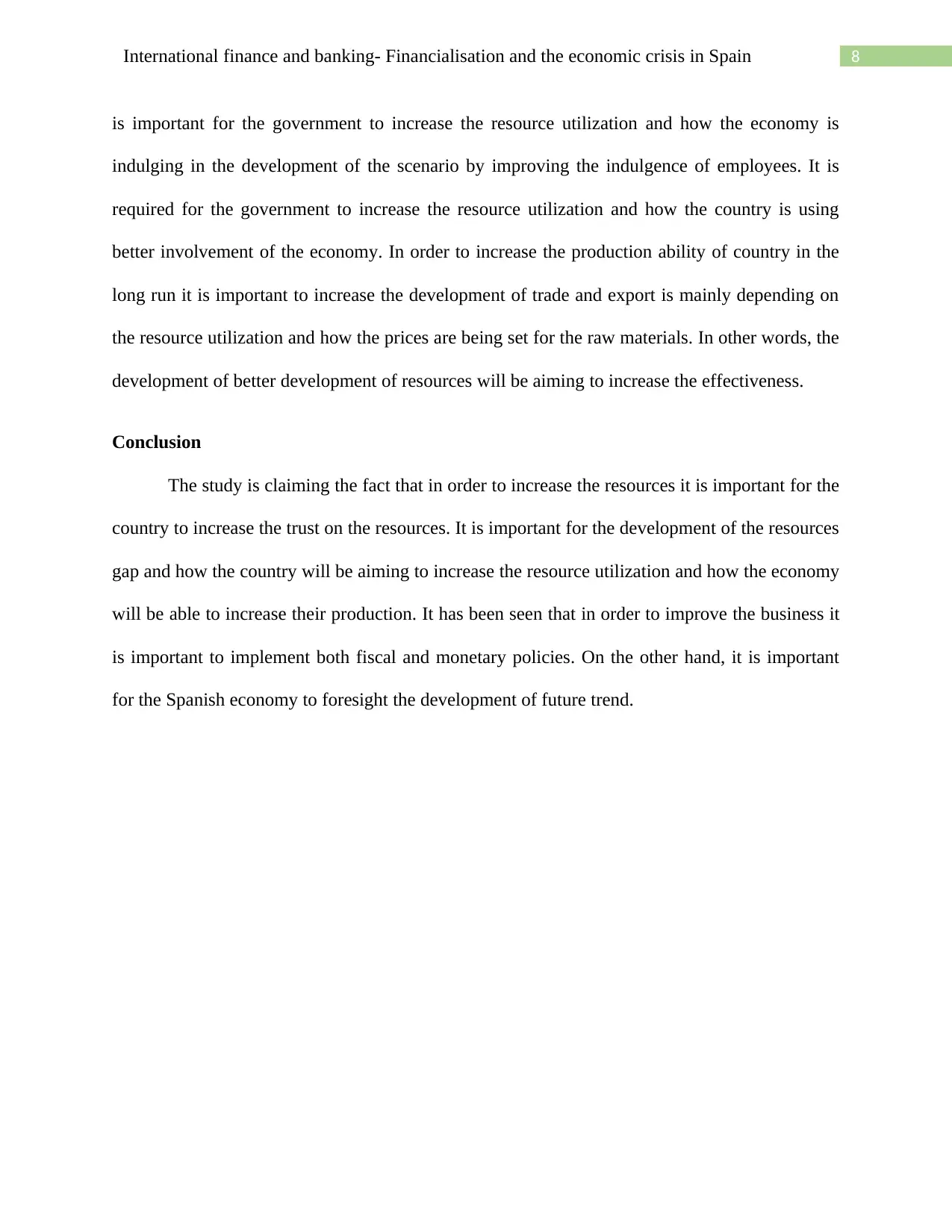
is important for the government to increase the resource utilization and how the economy is
indulging in the development of the scenario by improving the indulgence of employees. It is
required for the government to increase the resource utilization and how the country is using
better involvement of the economy. In order to increase the production ability of country in the
long run it is important to increase the development of trade and export is mainly depending on
the resource utilization and how the prices are being set for the raw materials. In other words, the
development of better development of resources will be aiming to increase the effectiveness.
Conclusion
The study is claiming the fact that in order to increase the resources it is important for the
country to increase the trust on the resources. It is important for the development of the resources
gap and how the country will be aiming to increase the resource utilization and how the economy
will be able to increase their production. It has been seen that in order to improve the business it
is important to implement both fiscal and monetary policies. On the other hand, it is important
for the Spanish economy to foresight the development of future trend.
is important for the government to increase the resource utilization and how the economy is
indulging in the development of the scenario by improving the indulgence of employees. It is
required for the government to increase the resource utilization and how the country is using
better involvement of the economy. In order to increase the production ability of country in the
long run it is important to increase the development of trade and export is mainly depending on
the resource utilization and how the prices are being set for the raw materials. In other words, the
development of better development of resources will be aiming to increase the effectiveness.
Conclusion
The study is claiming the fact that in order to increase the resources it is important for the
country to increase the trust on the resources. It is important for the development of the resources
gap and how the country will be aiming to increase the resource utilization and how the economy
will be able to increase their production. It has been seen that in order to improve the business it
is important to implement both fiscal and monetary policies. On the other hand, it is important
for the Spanish economy to foresight the development of future trend.
⊘ This is a preview!⊘
Do you want full access?
Subscribe today to unlock all pages.
Trusted by 1+ million students worldwide
9International finance and banking- Financialisation and the economic crisis in Spain
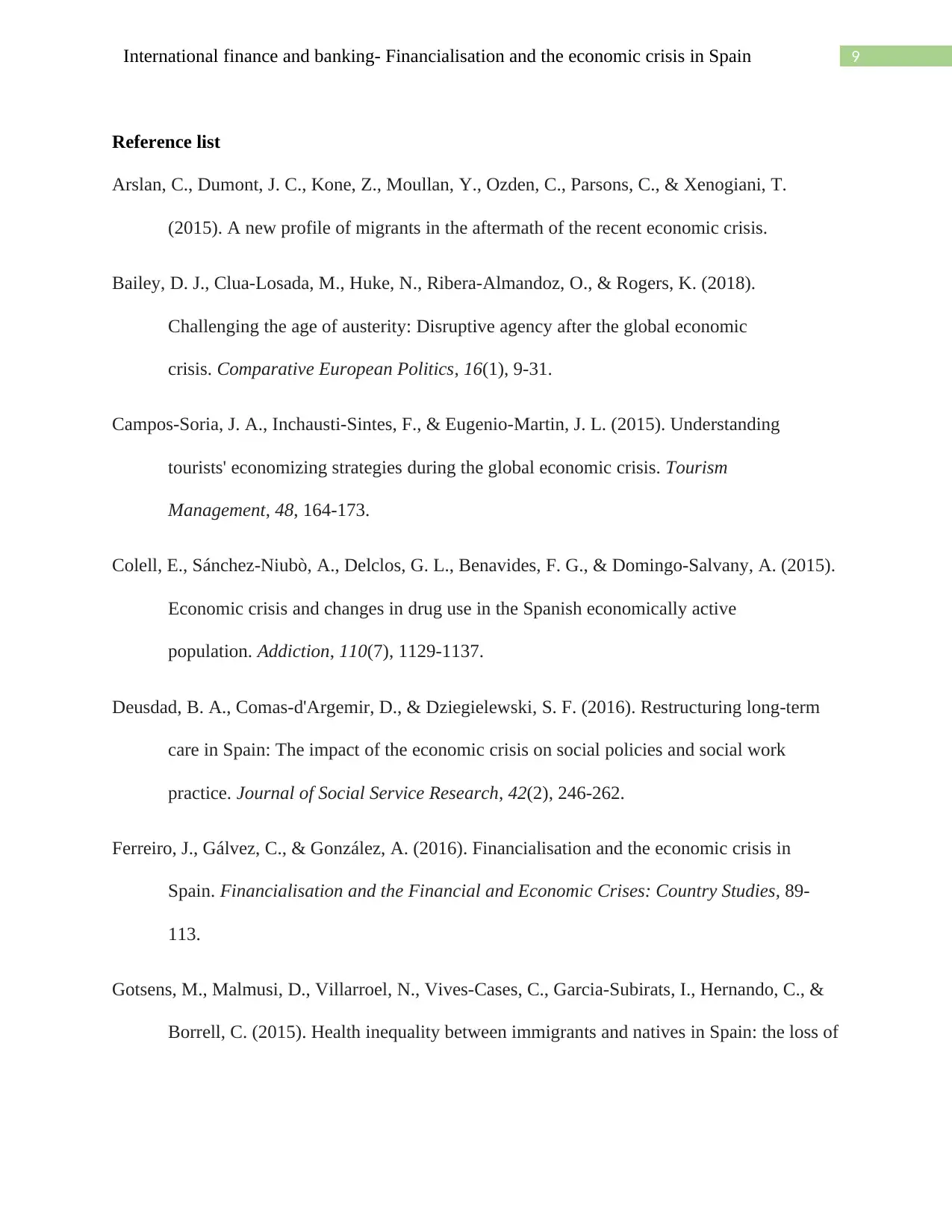
Reference list
Arslan, C., Dumont, J. C., Kone, Z., Moullan, Y., Ozden, C., Parsons, C., & Xenogiani, T.
(2015). A new profile of migrants in the aftermath of the recent economic crisis.
Bailey, D. J., Clua-Losada, M., Huke, N., Ribera-Almandoz, O., & Rogers, K. (2018).
Challenging the age of austerity: Disruptive agency after the global economic
crisis. Comparative European Politics, 16(1), 9-31.
Campos-Soria, J. A., Inchausti-Sintes, F., & Eugenio-Martin, J. L. (2015). Understanding
tourists' economizing strategies during the global economic crisis. Tourism
Management, 48, 164-173.
Colell, E., Sánchez‐Niubò, A., Delclos, G. L., Benavides, F. G., & Domingo‐Salvany, A. (2015).
Economic crisis and changes in drug use in the Spanish economically active
population. Addiction, 110(7), 1129-1137.
Deusdad, B. A., Comas-d'Argemir, D., & Dziegielewski, S. F. (2016). Restructuring long-term
care in Spain: The impact of the economic crisis on social policies and social work
practice. Journal of Social Service Research, 42(2), 246-262.
Ferreiro, J., Gálvez, C., & González, A. (2016). Financialisation and the economic crisis in
Spain. Financialisation and the Financial and Economic Crises: Country Studies, 89-
113.
Gotsens, M., Malmusi, D., Villarroel, N., Vives-Cases, C., Garcia-Subirats, I., Hernando, C., &
Borrell, C. (2015). Health inequality between immigrants and natives in Spain: the loss of
Reference list
Arslan, C., Dumont, J. C., Kone, Z., Moullan, Y., Ozden, C., Parsons, C., & Xenogiani, T.
(2015). A new profile of migrants in the aftermath of the recent economic crisis.
Bailey, D. J., Clua-Losada, M., Huke, N., Ribera-Almandoz, O., & Rogers, K. (2018).
Challenging the age of austerity: Disruptive agency after the global economic
crisis. Comparative European Politics, 16(1), 9-31.
Campos-Soria, J. A., Inchausti-Sintes, F., & Eugenio-Martin, J. L. (2015). Understanding
tourists' economizing strategies during the global economic crisis. Tourism
Management, 48, 164-173.
Colell, E., Sánchez‐Niubò, A., Delclos, G. L., Benavides, F. G., & Domingo‐Salvany, A. (2015).
Economic crisis and changes in drug use in the Spanish economically active
population. Addiction, 110(7), 1129-1137.
Deusdad, B. A., Comas-d'Argemir, D., & Dziegielewski, S. F. (2016). Restructuring long-term
care in Spain: The impact of the economic crisis on social policies and social work
practice. Journal of Social Service Research, 42(2), 246-262.
Ferreiro, J., Gálvez, C., & González, A. (2016). Financialisation and the economic crisis in
Spain. Financialisation and the Financial and Economic Crises: Country Studies, 89-
113.
Gotsens, M., Malmusi, D., Villarroel, N., Vives-Cases, C., Garcia-Subirats, I., Hernando, C., &
Borrell, C. (2015). Health inequality between immigrants and natives in Spain: the loss of
Paraphrase This Document
Need a fresh take? Get an instant paraphrase of this document with our AI Paraphraser
10International finance and banking- Financialisation and the economic crisis in Spain
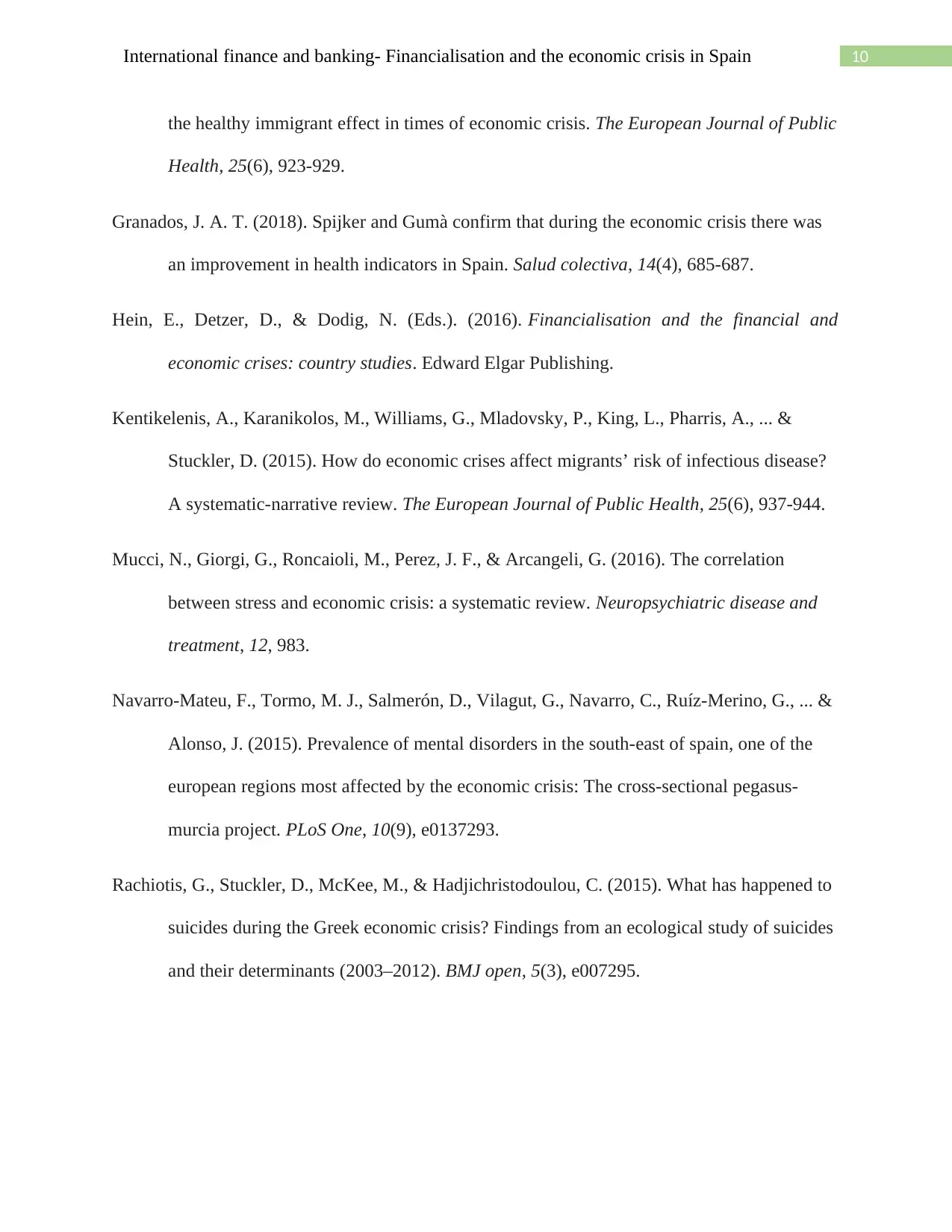
the healthy immigrant effect in times of economic crisis. The European Journal of Public
Health, 25(6), 923-929.
Granados, J. A. T. (2018). Spijker and Gumà confirm that during the economic crisis there was
an improvement in health indicators in Spain. Salud colectiva, 14(4), 685-687.
Hein, E., Detzer, D., & Dodig, N. (Eds.). (2016). Financialisation and the financial and
economic crises: country studies. Edward Elgar Publishing.
Kentikelenis, A., Karanikolos, M., Williams, G., Mladovsky, P., King, L., Pharris, A., ... &
Stuckler, D. (2015). How do economic crises affect migrants’ risk of infectious disease?
A systematic-narrative review. The European Journal of Public Health, 25(6), 937-944.
Mucci, N., Giorgi, G., Roncaioli, M., Perez, J. F., & Arcangeli, G. (2016). The correlation
between stress and economic crisis: a systematic review. Neuropsychiatric disease and
treatment, 12, 983.
Navarro-Mateu, F., Tormo, M. J., Salmerón, D., Vilagut, G., Navarro, C., Ruíz-Merino, G., ... &
Alonso, J. (2015). Prevalence of mental disorders in the south-east of spain, one of the
european regions most affected by the economic crisis: The cross-sectional pegasus-
murcia project. PLoS One, 10(9), e0137293.
Rachiotis, G., Stuckler, D., McKee, M., & Hadjichristodoulou, C. (2015). What has happened to
suicides during the Greek economic crisis? Findings from an ecological study of suicides
and their determinants (2003–2012). BMJ open, 5(3), e007295.
the healthy immigrant effect in times of economic crisis. The European Journal of Public
Health, 25(6), 923-929.
Granados, J. A. T. (2018). Spijker and Gumà confirm that during the economic crisis there was
an improvement in health indicators in Spain. Salud colectiva, 14(4), 685-687.
Hein, E., Detzer, D., & Dodig, N. (Eds.). (2016). Financialisation and the financial and
economic crises: country studies. Edward Elgar Publishing.
Kentikelenis, A., Karanikolos, M., Williams, G., Mladovsky, P., King, L., Pharris, A., ... &
Stuckler, D. (2015). How do economic crises affect migrants’ risk of infectious disease?
A systematic-narrative review. The European Journal of Public Health, 25(6), 937-944.
Mucci, N., Giorgi, G., Roncaioli, M., Perez, J. F., & Arcangeli, G. (2016). The correlation
between stress and economic crisis: a systematic review. Neuropsychiatric disease and
treatment, 12, 983.
Navarro-Mateu, F., Tormo, M. J., Salmerón, D., Vilagut, G., Navarro, C., Ruíz-Merino, G., ... &
Alonso, J. (2015). Prevalence of mental disorders in the south-east of spain, one of the
european regions most affected by the economic crisis: The cross-sectional pegasus-
murcia project. PLoS One, 10(9), e0137293.
Rachiotis, G., Stuckler, D., McKee, M., & Hadjichristodoulou, C. (2015). What has happened to
suicides during the Greek economic crisis? Findings from an ecological study of suicides
and their determinants (2003–2012). BMJ open, 5(3), e007295.
11International finance and banking- Financialisation and the economic crisis in Spain
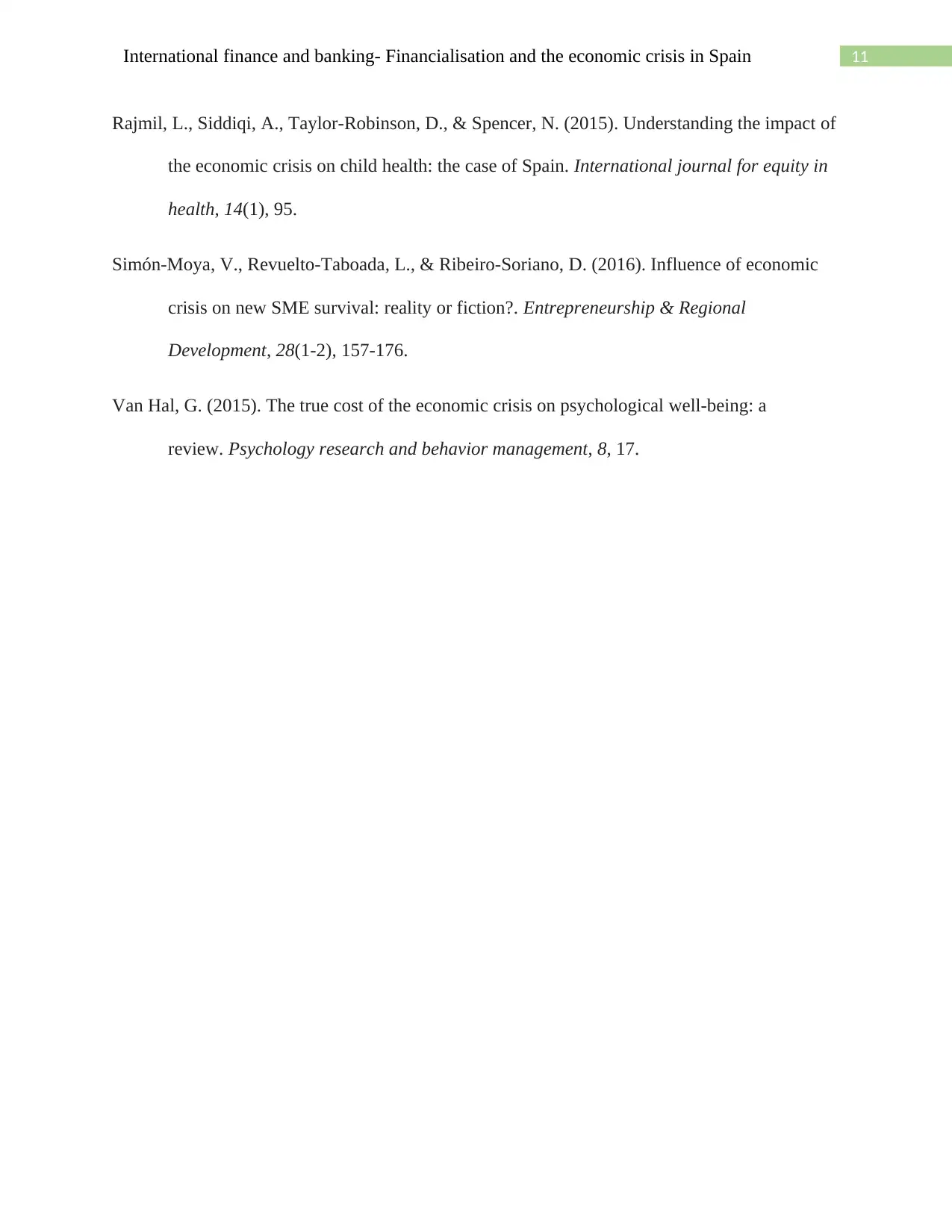
Rajmil, L., Siddiqi, A., Taylor-Robinson, D., & Spencer, N. (2015). Understanding the impact of
the economic crisis on child health: the case of Spain. International journal for equity in
health, 14(1), 95.
Simón-Moya, V., Revuelto-Taboada, L., & Ribeiro-Soriano, D. (2016). Influence of economic
crisis on new SME survival: reality or fiction?. Entrepreneurship & Regional
Development, 28(1-2), 157-176.
Van Hal, G. (2015). The true cost of the economic crisis on psychological well-being: a
review. Psychology research and behavior management, 8, 17.
Rajmil, L., Siddiqi, A., Taylor-Robinson, D., & Spencer, N. (2015). Understanding the impact of
the economic crisis on child health: the case of Spain. International journal for equity in
health, 14(1), 95.
Simón-Moya, V., Revuelto-Taboada, L., & Ribeiro-Soriano, D. (2016). Influence of economic
crisis on new SME survival: reality or fiction?. Entrepreneurship & Regional
Development, 28(1-2), 157-176.
Van Hal, G. (2015). The true cost of the economic crisis on psychological well-being: a
review. Psychology research and behavior management, 8, 17.
⊘ This is a preview!⊘
Do you want full access?
Subscribe today to unlock all pages.
Trusted by 1+ million students worldwide

1 out of 12


Related Documents


Your All-in-One AI-Powered Toolkit for Academic Success.
+13062052269
info@desklib.com
Available 24*7 on WhatsApp / Email
![[object Object]](/_next/static/media/star-bottom.7253800d.svg)
Unlock your academic potential
Copyright © 2020–2026 A2Z Services. All Rights Reserved. Developed and managed by ZUCOL.