Griffith University: Customer Loyalty in Fine Dining, Gender's Impact
VerifiedAdded on 2023/01/05
|26
|11552
|44
Report
AI Summary
This academic article, published in the Journal of Hospitality Marketing & Management, investigates customer loyalty within the context of fine-dining restaurants, specifically examining the moderating role of gender. The study explores the structural relationships among various factors, including food quality, staff service quality, restaurant image, customer satisfaction, and customer loyalty. The research indicates that both food quality and staff service quality significantly contribute to customer satisfaction and the perceived image of the restaurant. Moreover, restaurant image and customer satisfaction are strong predictors of customer loyalty. A key finding is that gender moderates five out of the six proposed relationships, highlighting its significant role in shaping customer perceptions and behaviors within the fine-dining environment. The article underscores the importance of understanding gender differences in the fine-dining experience to enhance customer loyalty and tailor services effectively. The study's implications are significant for restaurant management, emphasizing the need to consider gender-specific preferences in service design and marketing strategies to maximize customer satisfaction and retention. The research also provides insights into the broader economic impact of customer loyalty, especially in the luxury dining sector.
See discussions, stats, and author profiles for this publication at: https://www.researchgate.net/publication/268078434
Customer Loyalty with Fine Dining ---The Moderating Role of
Gender
Article in Journal of Hospitality Marketing & Management · May 2014
CITATIONS
0
READS
752
1 author:
Some of the authors of this publication are also working on these related projects:
Virtual Field Trips of Hospitality BusinessesView project
Emily Ma
University of Massachusetts Amherst
35PUBLICATIONS367CITATIONS
SEE PROFILE
All content following this page was uploaded by Emily Ma on 07 January 2015.
The user has requested enhancement of the downloaded file.
Customer Loyalty with Fine Dining ---The Moderating Role of
Gender
Article in Journal of Hospitality Marketing & Management · May 2014
CITATIONS
0
READS
752
1 author:
Some of the authors of this publication are also working on these related projects:
Virtual Field Trips of Hospitality BusinessesView project
Emily Ma
University of Massachusetts Amherst
35PUBLICATIONS367CITATIONS
SEE PROFILE
All content following this page was uploaded by Emily Ma on 07 January 2015.
The user has requested enhancement of the downloaded file.

Paraphrase This Document
Need a fresh take? Get an instant paraphrase of this document with our AI Paraphraser
This article was downloaded by: [Griffith University]
On: 07 January 2015, At: 15:08
Publisher: Routledge
Informa Ltd Registered in England and Wales Registered Number: 1072954 Registered
office: Mortimer House, 37-41 Mortimer Street, London W1T 3JH, UK
Click for updates
Journal of Hospitality Marketing &
Management
Publication details, including instructions for authors and
subscription information:
http://www.tandfonline.com/loi/whmm20
Customer Loyalty With Fine Dining: T
Moderating Role of Gender
Emily Ma
a, Hailin QU
b & Rasha Ali Eliwa
b
a Department of Tourism, Sport and Hotel Management, Griffith
University, Brisbane, Australia
b School of Hotel and Restaurant Administration, Oklahoma State
University, Stillwater, Oklahoma, USA
Accepted author version posted online: 16 Oct 2013.Published
online: 27 Mar 2014.
To cite this article: Emily Ma, Hailin QU & Rasha Ali Eliwa (2014) Customer Loyalty With Fine D
The Moderating Role of Gender, Journal of Hospitality Marketing & Management, 23:5, 513-535, D
10.1080/19368623.2013.835250
To link to this article: http://dx.doi.org/10.1080/19368623.2013.835250
PLEASE SCROLL DOWN FOR ARTICLE
Taylor & Francis makes every effort to ensure the accuracy of all the information (the
“Content”) contained in the publications on our platform. However, Taylor & Francis,
our agents, and our licensors make no representations or warranties whatsoever as to
the accuracy, completeness, or suitability for any purpose of the Content. Any opinions
and views expressed in this publication are the opinions and views of the authors,
and are not the views of or endorsed by Taylor & Francis. The accuracy of the Content
should not be relied upon and should be independently verified with primary sources
of information. Taylor and Francis shall not be liable for any losses, actions, claims,
proceedings, demands, costs, expenses, damages, and other liabilities whatsoever or
howsoever caused arising directly or indirectly in connection with, in relation to or arising
out of the use of the Content.
This article may be used for research, teaching, and private study purposes. Any
substantial or systematic reproduction, redistribution, reselling, loan, sub-licensing,
systematic supply, or distribution in any form to anyone is expressly forbidden. Terms &
On: 07 January 2015, At: 15:08
Publisher: Routledge
Informa Ltd Registered in England and Wales Registered Number: 1072954 Registered
office: Mortimer House, 37-41 Mortimer Street, London W1T 3JH, UK
Click for updates
Journal of Hospitality Marketing &
Management
Publication details, including instructions for authors and
subscription information:
http://www.tandfonline.com/loi/whmm20
Customer Loyalty With Fine Dining: T
Moderating Role of Gender
Emily Ma
a, Hailin QU
b & Rasha Ali Eliwa
b
a Department of Tourism, Sport and Hotel Management, Griffith
University, Brisbane, Australia
b School of Hotel and Restaurant Administration, Oklahoma State
University, Stillwater, Oklahoma, USA
Accepted author version posted online: 16 Oct 2013.Published
online: 27 Mar 2014.
To cite this article: Emily Ma, Hailin QU & Rasha Ali Eliwa (2014) Customer Loyalty With Fine D
The Moderating Role of Gender, Journal of Hospitality Marketing & Management, 23:5, 513-535, D
10.1080/19368623.2013.835250
To link to this article: http://dx.doi.org/10.1080/19368623.2013.835250
PLEASE SCROLL DOWN FOR ARTICLE
Taylor & Francis makes every effort to ensure the accuracy of all the information (the
“Content”) contained in the publications on our platform. However, Taylor & Francis,
our agents, and our licensors make no representations or warranties whatsoever as to
the accuracy, completeness, or suitability for any purpose of the Content. Any opinions
and views expressed in this publication are the opinions and views of the authors,
and are not the views of or endorsed by Taylor & Francis. The accuracy of the Content
should not be relied upon and should be independently verified with primary sources
of information. Taylor and Francis shall not be liable for any losses, actions, claims,
proceedings, demands, costs, expenses, damages, and other liabilities whatsoever or
howsoever caused arising directly or indirectly in connection with, in relation to or arising
out of the use of the Content.
This article may be used for research, teaching, and private study purposes. Any
substantial or systematic reproduction, redistribution, reselling, loan, sub-licensing,
systematic supply, or distribution in any form to anyone is expressly forbidden. Terms &

Conditions of access and use can be found at http://www.tandfonline.com/page/terms-
and-conditions
Downloaded by [Griffith University] at 15:08 07 January 2015
and-conditions
Downloaded by [Griffith University] at 15:08 07 January 2015
⊘ This is a preview!⊘
Do you want full access?
Subscribe today to unlock all pages.

Trusted by 1+ million students worldwide
Journal of Hospitality Marketing & Management, 23:513–535, 2014
Copyright © Taylor & Francis Group, LLC
ISSN: 1936-8623 print/1936-8631 online
DOI: 10.1080/19368623.2013.835250
Customer Loyalty With Fine Dining: The
Moderating Role of Gender
EMILY MA
Department of Tourism, Sport and Hotel Management, Griffith University, Brisbane, Australia
HAILIN QU and RASHA ALI ELIWA
School of Hotel and Restaurant Administration, Oklahoma State University,
Stillwater, Oklahoma, USA
Building customerloyalty is an important strategyfor the
success of fine-dining restaurants. Knowing individual customers’
differences,especially the distinction between male and female
customers in service quality and image perception, as well as sat-
isfaction and loyalty formation,is crucialto attractand retain
customers. This study examined the structural relationships among
food quality, staff service quality, image, customer satisfaction, and
loyalty in the context of fine-dining restaurants with a special focus
on gender’s moderating effects. The results showed that food quality
and staffservice quality both contributed to the customers’satis-
faction and perceived image of the restaurant.Restaurant image
and customer satisfaction explained a large variance in customer
loyalty.Gender moderated five outof the six proposed relation-
ships, which supported gender’s moderating role in the context of
fine-dining restaurants.
KEYWORDSgender,customerloyalty, fine-dining restaurant
image
INTRODUCTION
The restaurantindustry playsan importantrole in the U.S. economy.
The numberof restaurantsoutletshas reached 980,000 with revenue of
approximately660 billion (NationalRestaurantAssociation,2013).The
Address correspondence to Emily Ma,Business 2 (N72),0.72 Nathan Campus,Griffith
University, 170 Kessels Rd., Brisbane, Australia. E-mail: emily.ma@griffith.edu.au
513
Downloaded by [Griffith University] at 15:08 07 January 2015
Copyright © Taylor & Francis Group, LLC
ISSN: 1936-8623 print/1936-8631 online
DOI: 10.1080/19368623.2013.835250
Customer Loyalty With Fine Dining: The
Moderating Role of Gender
EMILY MA
Department of Tourism, Sport and Hotel Management, Griffith University, Brisbane, Australia
HAILIN QU and RASHA ALI ELIWA
School of Hotel and Restaurant Administration, Oklahoma State University,
Stillwater, Oklahoma, USA
Building customerloyalty is an important strategyfor the
success of fine-dining restaurants. Knowing individual customers’
differences,especially the distinction between male and female
customers in service quality and image perception, as well as sat-
isfaction and loyalty formation,is crucialto attractand retain
customers. This study examined the structural relationships among
food quality, staff service quality, image, customer satisfaction, and
loyalty in the context of fine-dining restaurants with a special focus
on gender’s moderating effects. The results showed that food quality
and staffservice quality both contributed to the customers’satis-
faction and perceived image of the restaurant.Restaurant image
and customer satisfaction explained a large variance in customer
loyalty.Gender moderated five outof the six proposed relation-
ships, which supported gender’s moderating role in the context of
fine-dining restaurants.
KEYWORDSgender,customerloyalty, fine-dining restaurant
image
INTRODUCTION
The restaurantindustry playsan importantrole in the U.S. economy.
The numberof restaurantsoutletshas reached 980,000 with revenue of
approximately660 billion (NationalRestaurantAssociation,2013).The
Address correspondence to Emily Ma,Business 2 (N72),0.72 Nathan Campus,Griffith
University, 170 Kessels Rd., Brisbane, Australia. E-mail: emily.ma@griffith.edu.au
513
Downloaded by [Griffith University] at 15:08 07 January 2015
Paraphrase This Document
Need a fresh take? Get an instant paraphrase of this document with our AI Paraphraser
514 E. Ma et al.
fine-dining segmenthas experienced steady growth in the past10 years
and now accounts for about10% ofthe totalindustry sales (Tlapa,Miller,
& Washington, 2011). Even during the time of the global financial crisis and
economic downturn, the fine dining sector’s performance was still strong and
is expect to retain its popularity (Ban,2012).The NationalRestaurant News
predicted that fine-dining restaurants would remain popular if they continue
to offer individuality, food quality, and a more casual setting (Thorn, 2014).
Fine-dining restaurants are defined as restaurants offering full table ser-
vices with an upscale food and beverage menu. These restaurants generally
have a more sophisticated décorand ambiance,the waitstaffis usually
highly trained and often wears more formal attire, and there is often a dress
code for patrons (Tlapa etal., 2011).Attracting and retaining customers is
a challenging task for fine-dining restaurants due to increased competition
in the foodservice industry (Mealey,2011).Fine-dining restaurants need to
offer customers not only the finest in food, but also the finest in service and
atmosphere. To gain a competitive advantage, a fine-dining restaurant has to
create a unique image thatis distinctly differentand higher end than other
restaurants.A favorable restaurantimage with a unique conceptinfluences
customers’ emotions and expectations regarding the service and food quality
(e.g.,Wall& Berry,2007).Further,a good fine-dining restaurant image will
help to build customer loyalty (Rosenbloom, 1981).
Customer loyalty is a criticalfactor for the continued success offine-
dining restaurants (Wall& Berry,2007).It is estimated thata 5% increase
in customerloyalty would lead to the profitincrease from 25% to 85%
(Heskett,Jones,Loveman,Sasser,& Schlesinger,1994).Restaurants could
increase sales through loyal customers mainly because of three reasons. First
of all, loyalcustomers are less price-sensitive.This is especially important
to fine-dining restaurants targeting the higherend of the market.Second,
loyal customers are willing to purchase more frequently and are more open
to try new products or services.Third,loyal customers are more likely to
spread positive word-of-mouth and bring in new customers (Reichheld &
Sasser,1990).In addition,the costof retaining loyalcustomers can be five
times as less than attracting new customers (Wills, 2009), thus greatly reduce
marketing cost (Tepeci, 1999). Reichheld and Sasser (1990) indicated that an
improvement of 5% in customer retention could lead to an increase of 25% to
75% in profit.Therefore,creating customer loyalty has become the ultimate
goal for many restaurants (Eakuru & Mat, 2008; Oliver, 1997).
The relationships among food and service quality,restaurantimage,
customer satisfaction and loyalty have been a research focus in the restau-
rantcontext(e.g.,Hurst,1970;Moser,1987;Meyers,1991;Wall& Berry,
2007;Ha & Jang,2010).However,there has been surprisingly little focus
on gender differences/similarities in the fine dining experiences.There has
been little research attention paid to theoreticalquestions abouthow male
and female customers perceive the aspects ofthe dining experiences and
Downloaded by [Griffith University] at 15:08 07 January 2015
fine-dining segmenthas experienced steady growth in the past10 years
and now accounts for about10% ofthe totalindustry sales (Tlapa,Miller,
& Washington, 2011). Even during the time of the global financial crisis and
economic downturn, the fine dining sector’s performance was still strong and
is expect to retain its popularity (Ban,2012).The NationalRestaurant News
predicted that fine-dining restaurants would remain popular if they continue
to offer individuality, food quality, and a more casual setting (Thorn, 2014).
Fine-dining restaurants are defined as restaurants offering full table ser-
vices with an upscale food and beverage menu. These restaurants generally
have a more sophisticated décorand ambiance,the waitstaffis usually
highly trained and often wears more formal attire, and there is often a dress
code for patrons (Tlapa etal., 2011).Attracting and retaining customers is
a challenging task for fine-dining restaurants due to increased competition
in the foodservice industry (Mealey,2011).Fine-dining restaurants need to
offer customers not only the finest in food, but also the finest in service and
atmosphere. To gain a competitive advantage, a fine-dining restaurant has to
create a unique image thatis distinctly differentand higher end than other
restaurants.A favorable restaurantimage with a unique conceptinfluences
customers’ emotions and expectations regarding the service and food quality
(e.g.,Wall& Berry,2007).Further,a good fine-dining restaurant image will
help to build customer loyalty (Rosenbloom, 1981).
Customer loyalty is a criticalfactor for the continued success offine-
dining restaurants (Wall& Berry,2007).It is estimated thata 5% increase
in customerloyalty would lead to the profitincrease from 25% to 85%
(Heskett,Jones,Loveman,Sasser,& Schlesinger,1994).Restaurants could
increase sales through loyal customers mainly because of three reasons. First
of all, loyalcustomers are less price-sensitive.This is especially important
to fine-dining restaurants targeting the higherend of the market.Second,
loyal customers are willing to purchase more frequently and are more open
to try new products or services.Third,loyal customers are more likely to
spread positive word-of-mouth and bring in new customers (Reichheld &
Sasser,1990).In addition,the costof retaining loyalcustomers can be five
times as less than attracting new customers (Wills, 2009), thus greatly reduce
marketing cost (Tepeci, 1999). Reichheld and Sasser (1990) indicated that an
improvement of 5% in customer retention could lead to an increase of 25% to
75% in profit.Therefore,creating customer loyalty has become the ultimate
goal for many restaurants (Eakuru & Mat, 2008; Oliver, 1997).
The relationships among food and service quality,restaurantimage,
customer satisfaction and loyalty have been a research focus in the restau-
rantcontext(e.g.,Hurst,1970;Moser,1987;Meyers,1991;Wall& Berry,
2007;Ha & Jang,2010).However,there has been surprisingly little focus
on gender differences/similarities in the fine dining experiences.There has
been little research attention paid to theoreticalquestions abouthow male
and female customers perceive the aspects ofthe dining experiences and
Downloaded by [Griffith University] at 15:08 07 January 2015
Gender Difference in Fine Dining Loyalty 515
how gendermoderates the structuralrelationships among the previously
identifiedconstructs thatlead to customersatisfaction and loyalty,such as
food quality (e.g., Qu, 1997; Ha & Jang, 2010), service quality (e.g., Tu, Lin,
& Chang, 2011) and image (e.g., Ryu, Lee, & Kim, 2012).
Gender difference has been an importantresearch theme in many dis-
ciplines,such as biochemistry,neurobiology,physiology and psychology.
There are profound differences between men and women in terms of their
emotional and psychological needs, and the way they perceive and react to
the environmentand incidents (http://www.gendermatters.org.au).From a
practical perspective, knowing gender difference in a macro sense, is impor-
tant in the formulation of country economic and social policies and strategies
while in a micro sense is essentialfor the success ofany given business
(Mitchell& Vassos,1998).In restaurantcontexts,a lack of understanding
of gender differences would lead to problems in both productand service
design (Schall,2003).In addition,more women can now afford to pay for
fine dining experiences thatwere once reserved formen.According to a
recentreport,women controlmore than 60% ofall personalwealth in the
United States and by 2028,the average American woman is expected to
earn more than the average American male. In addition, women have much
stronger spending power than men.Women accountfor $7 trillion in con-
sumer and business spending, which is 85% of all consumer purchases (She
Economy Website,2013).In addition women are more willing to spend in
luxury goods and services including fine dining sectors.
Knowing gender differences in the fine-dining restaurant context would
fulfillboth theoreticaland practicalneeds.The study would contribute to a
better understanding of male and female customers’ perception and behavior
differences in the restaurant contexts. It will also help the industry to have a
better understanding on customers’need and provide suitable products and
services.Therefore,the purpose of this study is to examine if the different
genders would have differentperceptions on fine-dining experiences and
if gendermoderates the structuralrelationships among food quality,staff
service quality,restaurantimage,customersatisfaction,and loyalty in the
context of the fine-dining restaurant.
LITERATURE REVIEW
Key Antecedents of Customer Satisfaction and Loyalty
Customerloyalty in restaurants is defined as the customer’s inclination to
patronize a given restaurantrepeatedly during a specified period oftime
(Enis & Gordon, 1970).It has both a behaviorand an attitude dimen-
sion (Kandampully & Suhartanto,2000).The behavior dimension refers to
repeated dinning behavior (Bowen & Shoemaker, 1998), while the attitudinal
dimension refers to customers’ intentions to repurchase and to recommend a
Downloaded by [Griffith University] at 15:08 07 January 2015
how gendermoderates the structuralrelationships among the previously
identifiedconstructs thatlead to customersatisfaction and loyalty,such as
food quality (e.g., Qu, 1997; Ha & Jang, 2010), service quality (e.g., Tu, Lin,
& Chang, 2011) and image (e.g., Ryu, Lee, & Kim, 2012).
Gender difference has been an importantresearch theme in many dis-
ciplines,such as biochemistry,neurobiology,physiology and psychology.
There are profound differences between men and women in terms of their
emotional and psychological needs, and the way they perceive and react to
the environmentand incidents (http://www.gendermatters.org.au).From a
practical perspective, knowing gender difference in a macro sense, is impor-
tant in the formulation of country economic and social policies and strategies
while in a micro sense is essentialfor the success ofany given business
(Mitchell& Vassos,1998).In restaurantcontexts,a lack of understanding
of gender differences would lead to problems in both productand service
design (Schall,2003).In addition,more women can now afford to pay for
fine dining experiences thatwere once reserved formen.According to a
recentreport,women controlmore than 60% ofall personalwealth in the
United States and by 2028,the average American woman is expected to
earn more than the average American male. In addition, women have much
stronger spending power than men.Women accountfor $7 trillion in con-
sumer and business spending, which is 85% of all consumer purchases (She
Economy Website,2013).In addition women are more willing to spend in
luxury goods and services including fine dining sectors.
Knowing gender differences in the fine-dining restaurant context would
fulfillboth theoreticaland practicalneeds.The study would contribute to a
better understanding of male and female customers’ perception and behavior
differences in the restaurant contexts. It will also help the industry to have a
better understanding on customers’need and provide suitable products and
services.Therefore,the purpose of this study is to examine if the different
genders would have differentperceptions on fine-dining experiences and
if gendermoderates the structuralrelationships among food quality,staff
service quality,restaurantimage,customersatisfaction,and loyalty in the
context of the fine-dining restaurant.
LITERATURE REVIEW
Key Antecedents of Customer Satisfaction and Loyalty
Customerloyalty in restaurants is defined as the customer’s inclination to
patronize a given restaurantrepeatedly during a specified period oftime
(Enis & Gordon, 1970).It has both a behaviorand an attitude dimen-
sion (Kandampully & Suhartanto,2000).The behavior dimension refers to
repeated dinning behavior (Bowen & Shoemaker, 1998), while the attitudinal
dimension refers to customers’ intentions to repurchase and to recommend a
Downloaded by [Griffith University] at 15:08 07 January 2015
⊘ This is a preview!⊘
Do you want full access?
Subscribe today to unlock all pages.
Trusted by 1+ million students worldwide
516 E. Ma et al.
restaurant. The latter indicators are considered as good predictors of a loyal
customer (e.g., Getty & Thompson, 1994; Ryu et al., 2012).
In the restaurant context, several factors have been suggested as impor-
tant antecedents of customer satisfaction and loyalty, including the quality of
food, service quality of employees and restaurant image and customer satis-
faction (e.g., Qu, 1998; Mattila, 2001; Kandampully & Suhartanto, 2000; Ha &
Jang, 2010; Ryu et al., 2012). Generally speaking, good food and service lead
to customer satisfaction,which contributes to customer loyalty.Restaurant
image also plays an importantrole in customer loyalty formation (Cöner &
Güngör, 2002). We discuss these relationships in detail next.
Food Quality, Customer Satisfaction, and Restaurant Image
Food quality has been identified as one ofthe mostimportantfactors for
restaurants (Qu,1998;Ma,Qu, & Njite,2011;Ha & Jang,2010).Its impor-
tance can even outweigh otheraspects ofa dining experience,including
environmentand service attributes.Customers evaluate the quality offood
from various aspects,such as portion size,temperature,taste (Qu,1998),
menu variety, and nutrition (Kivela, Inbakaran, & Reece, 1999). Food quality
is an importantfactor in creating customer satisfaction (Mattila,2001) and
it also contributes to customer loyalty formation through satisfaction (e.g.,
Clark & Wood, 1999). Therefore, we propose,
H1: Food quality has a significant positive impact on customers’overall
satisfaction.
In addition,food and menu also carries partof a restaurant’s image.
A restaurant’s image can be defined as the overall attitude toward the restau-
rant, based on customers’ perceptions of relevant restaurant attributes (Doyle
& Fenwick, 1975; James, Durand, & Dreves, 1976; Ryu et al., 2012). A favor-
able restaurantimage with a unique concepthelps create a competitive
advantage thatis not easily duplicated by otherrestaurants.A restau-
rantimage is reflected notonly from its design and decoration butalso
from the menu and food (Korgaonkar,Lund,& Price,1985;Kandampully
& Suhartanto,2000).Kandampully and Suhartanto (200)suggested that
image has two dimensions: image attributes and image holistic. The specific
attributes of image could be operationalized or measured from the location,
physicalattributes design,price,and quality ofproducts and services pro-
vided,while the holistic dimension ofimage could be operationalized as
customers’overall perception of the atmosphere and reputation. The quality
of image delivered by food would impactcustomers’overallperception of
the restaurant image. Consequently:
H2: Food quality hasa significantpositive impacton a restaurant’s
image.
Downloaded by [Griffith University] at 15:08 07 January 2015
restaurant. The latter indicators are considered as good predictors of a loyal
customer (e.g., Getty & Thompson, 1994; Ryu et al., 2012).
In the restaurant context, several factors have been suggested as impor-
tant antecedents of customer satisfaction and loyalty, including the quality of
food, service quality of employees and restaurant image and customer satis-
faction (e.g., Qu, 1998; Mattila, 2001; Kandampully & Suhartanto, 2000; Ha &
Jang, 2010; Ryu et al., 2012). Generally speaking, good food and service lead
to customer satisfaction,which contributes to customer loyalty.Restaurant
image also plays an importantrole in customer loyalty formation (Cöner &
Güngör, 2002). We discuss these relationships in detail next.
Food Quality, Customer Satisfaction, and Restaurant Image
Food quality has been identified as one ofthe mostimportantfactors for
restaurants (Qu,1998;Ma,Qu, & Njite,2011;Ha & Jang,2010).Its impor-
tance can even outweigh otheraspects ofa dining experience,including
environmentand service attributes.Customers evaluate the quality offood
from various aspects,such as portion size,temperature,taste (Qu,1998),
menu variety, and nutrition (Kivela, Inbakaran, & Reece, 1999). Food quality
is an importantfactor in creating customer satisfaction (Mattila,2001) and
it also contributes to customer loyalty formation through satisfaction (e.g.,
Clark & Wood, 1999). Therefore, we propose,
H1: Food quality has a significant positive impact on customers’overall
satisfaction.
In addition,food and menu also carries partof a restaurant’s image.
A restaurant’s image can be defined as the overall attitude toward the restau-
rant, based on customers’ perceptions of relevant restaurant attributes (Doyle
& Fenwick, 1975; James, Durand, & Dreves, 1976; Ryu et al., 2012). A favor-
able restaurantimage with a unique concepthelps create a competitive
advantage thatis not easily duplicated by otherrestaurants.A restau-
rantimage is reflected notonly from its design and decoration butalso
from the menu and food (Korgaonkar,Lund,& Price,1985;Kandampully
& Suhartanto,2000).Kandampully and Suhartanto (200)suggested that
image has two dimensions: image attributes and image holistic. The specific
attributes of image could be operationalized or measured from the location,
physicalattributes design,price,and quality ofproducts and services pro-
vided,while the holistic dimension ofimage could be operationalized as
customers’overall perception of the atmosphere and reputation. The quality
of image delivered by food would impactcustomers’overallperception of
the restaurant image. Consequently:
H2: Food quality hasa significantpositive impacton a restaurant’s
image.
Downloaded by [Griffith University] at 15:08 07 January 2015
Paraphrase This Document
Need a fresh take? Get an instant paraphrase of this document with our AI Paraphraser
Gender Difference in Fine Dining Loyalty 517
Employee Service, Customer Satisfaction, and Restaurant Image
Employees’service performance is anotherimportantcomponentof cus-
tomers’dining experiences(Wall& Berry,2007;Ha & Jang, 2010).The
attitude and behavior of the service staff influence customers’formation and
appraisal of service quality. Restaurant employees need to display assurance
through professional service skills, responsible attitudes and empathy toward
customers in order to win customers’trustand create customer satisfaction
(Parasuraman, Zeithaml, & Berry, 1985). Further, the quality of relationships
between customers and front line employees can strongly contribute to the
customers’loyalty as wellthrough satisfied service experiences (Ha & Jang,
2010), hence:
H3: Service quality has a significant positive impact on customers’ overall
satisfaction.
Further, restaurant employees also represent, to a great extent, a restau-
rant’simage through professionalgrooming and services.It can also be
reflected from employees’service performance (Kandampully & Suhartanto,
2000):
H4: Service quality has a significantpositive impacton a restaurant’s
image.
Customer Satisfaction, Restaurant Image, and Loyalty
Customer satisfaction and loyalty has been an importantresearch theme in
the hospitality and tourism discipline (e.g., Parasuraman et al., 1988; Chaston
1994;Luk & Layton,2002).According to the expectancy-disconfirmation
model (Oliver, 1980),customersatisfactionis a comparisonbetween
customers’perceived serviceperformanceand preholdingexpectation.
Customerswill only feel satisfied when service performance meetsor
exceeds expectation, otherwise dissatisfaction occurs.
Creating customersatisfaction is one ofthe mostimportantgoals for
restaurantbecause itis a majorprerequisite ofcustomerloyalty (Tepeci,
1999).Customer loyalty refers to the desire to reuse the productor service
of the same provider (An & Noh, 2009). It has a behavior dimension and an
attitude dimension (Kandampully & Suhartanto, 2000). The behavior dimen-
sion refers to repeated purchase behavior (Bowen & Shoemaker, 1998) while
the attitudinaldimension refers to customers’intentions to repurchase and
to recommend.The latter indicators are considered as good predictors of a
loyal customer (Getty & Thompson, 1994).
It has been welldocumented thathigh levels ofcustomer satisfaction
lead to high levels of customerloyalty and a greaterwillingnessto
recommend the service (e.g.,Danaher& Mattsson,1998;Soriano,2002).
Downloaded by [Griffith University] at 15:08 07 January 2015
Employee Service, Customer Satisfaction, and Restaurant Image
Employees’service performance is anotherimportantcomponentof cus-
tomers’dining experiences(Wall& Berry,2007;Ha & Jang, 2010).The
attitude and behavior of the service staff influence customers’formation and
appraisal of service quality. Restaurant employees need to display assurance
through professional service skills, responsible attitudes and empathy toward
customers in order to win customers’trustand create customer satisfaction
(Parasuraman, Zeithaml, & Berry, 1985). Further, the quality of relationships
between customers and front line employees can strongly contribute to the
customers’loyalty as wellthrough satisfied service experiences (Ha & Jang,
2010), hence:
H3: Service quality has a significant positive impact on customers’ overall
satisfaction.
Further, restaurant employees also represent, to a great extent, a restau-
rant’simage through professionalgrooming and services.It can also be
reflected from employees’service performance (Kandampully & Suhartanto,
2000):
H4: Service quality has a significantpositive impacton a restaurant’s
image.
Customer Satisfaction, Restaurant Image, and Loyalty
Customer satisfaction and loyalty has been an importantresearch theme in
the hospitality and tourism discipline (e.g., Parasuraman et al., 1988; Chaston
1994;Luk & Layton,2002).According to the expectancy-disconfirmation
model (Oliver, 1980),customersatisfactionis a comparisonbetween
customers’perceived serviceperformanceand preholdingexpectation.
Customerswill only feel satisfied when service performance meetsor
exceeds expectation, otherwise dissatisfaction occurs.
Creating customersatisfaction is one ofthe mostimportantgoals for
restaurantbecause itis a majorprerequisite ofcustomerloyalty (Tepeci,
1999).Customer loyalty refers to the desire to reuse the productor service
of the same provider (An & Noh, 2009). It has a behavior dimension and an
attitude dimension (Kandampully & Suhartanto, 2000). The behavior dimen-
sion refers to repeated purchase behavior (Bowen & Shoemaker, 1998) while
the attitudinaldimension refers to customers’intentions to repurchase and
to recommend.The latter indicators are considered as good predictors of a
loyal customer (Getty & Thompson, 1994).
It has been welldocumented thathigh levels ofcustomer satisfaction
lead to high levels of customerloyalty and a greaterwillingnessto
recommend the service (e.g.,Danaher& Mattsson,1998;Soriano,2002).
Downloaded by [Griffith University] at 15:08 07 January 2015
518 E. Ma et al.
Zenithal,Berry,and Parasuraman (1993) indicated that repeated dining and
positive word ofmouth is a resultof customersatisfaction with the ser-
vice provider.A high levelof satisfaction increases repeatpatronage and
improves the marketreputation ofthe service provider(Kandampully &
Suhartanto,2000).In the foodservice sector,customersatisfaction leads
to positive behavioralintentions such as repurchase orreturn patronage
(Almanza,Jaffe,& Lin,1994;Johns & Tyas,1996).We propose,in the fine
dining sector,
H5: Customers’overallsatisfaction has a significantpositive impacton
customers’loyalty.
Image literature suggests thatcustomers’perception ofthe image is a
strong force in explaining restaurant patronage behaviors,such as attitudes,
purchase intentions, frequency of purchase and loyalty (Oh, 1995; Ha & Jang,
2010). Therefore, the image of a restaurant can directly influence customers’
loyalty formation.From a strategic pointof view customerloyalty would
become more meaningfulwhen itis related to the fine-dining restaurant’s
image (Rosenbloom, 1981), consequently:
H6: Restaurants’image has a significantpositive impacton customers’
loyalty.
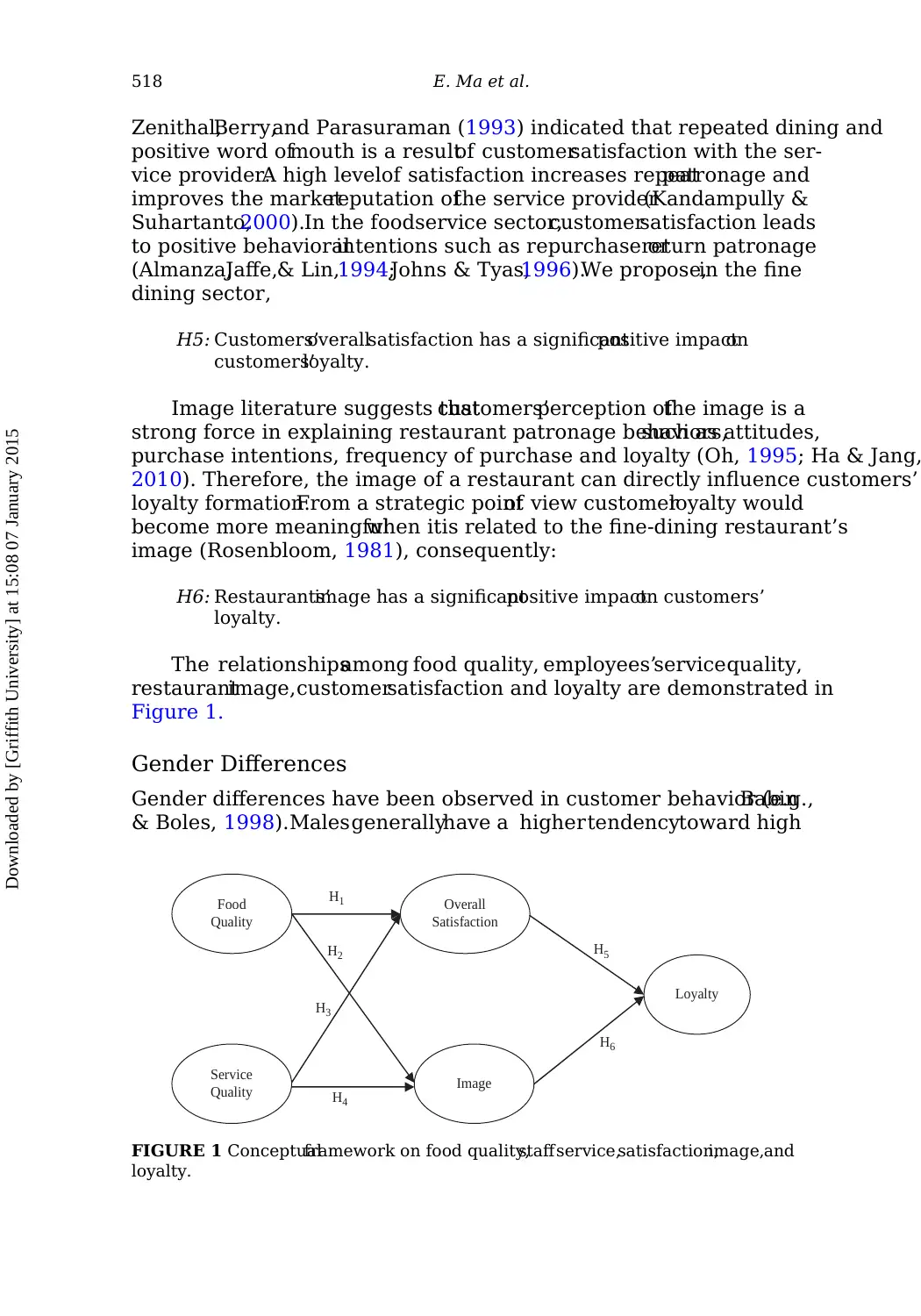
The relationshipsamong food quality, employees’servicequality,
restaurantimage,customersatisfaction and loyalty are demonstrated in
Figure 1.
Gender Differences
Gender differences have been observed in customer behavior (e.g.,Babin
& Boles, 1998).Malesgenerallyhave a highertendencytoward high
H 4
H 3
H2
H6
H5
Food
Quality
Overall
Satisfaction
Image
Loyalty
H 1
Service
Quality
FIGURE 1 Conceptualframework on food quality,staffservice,satisfaction,image,and
loyalty.
Downloaded by [Griffith University] at 15:08 07 January 2015
Zenithal,Berry,and Parasuraman (1993) indicated that repeated dining and
positive word ofmouth is a resultof customersatisfaction with the ser-
vice provider.A high levelof satisfaction increases repeatpatronage and
improves the marketreputation ofthe service provider(Kandampully &
Suhartanto,2000).In the foodservice sector,customersatisfaction leads
to positive behavioralintentions such as repurchase orreturn patronage
(Almanza,Jaffe,& Lin,1994;Johns & Tyas,1996).We propose,in the fine
dining sector,
H5: Customers’overallsatisfaction has a significantpositive impacton
customers’loyalty.
Image literature suggests thatcustomers’perception ofthe image is a
strong force in explaining restaurant patronage behaviors,such as attitudes,
purchase intentions, frequency of purchase and loyalty (Oh, 1995; Ha & Jang,
2010). Therefore, the image of a restaurant can directly influence customers’
loyalty formation.From a strategic pointof view customerloyalty would
become more meaningfulwhen itis related to the fine-dining restaurant’s
image (Rosenbloom, 1981), consequently:
H6: Restaurants’image has a significantpositive impacton customers’
loyalty.
The relationshipsamong food quality, employees’servicequality,
restaurantimage,customersatisfaction and loyalty are demonstrated in
Figure 1.
Gender Differences
Gender differences have been observed in customer behavior (e.g.,Babin
& Boles, 1998).Malesgenerallyhave a highertendencytoward high
H 4
H 3
H2
H6
H5
Food
Quality
Overall
Satisfaction
Image
Loyalty
H 1
Service
Quality
FIGURE 1 Conceptualframework on food quality,staffservice,satisfaction,image,and
loyalty.
Downloaded by [Griffith University] at 15:08 07 January 2015
⊘ This is a preview!⊘
Do you want full access?
Subscribe today to unlock all pages.
Trusted by 1+ million students worldwide
Gender Difference in Fine Dining Loyalty 519
assertiveness,task-mastery,and individualism,while femalesare more
concerned aboutpeople, devotion,and compliance (Pulkkinen,1996).
Schifferstein (2006) found that women rated the importance of all modalities
(such as vision) significantly higher than men.The attitude and perception
differences ofmale and female customers towards fine dining have been
observed in our daily life for long. Alex and Elizabeth Lluch (2010, p. 90), in
one of their best sellers, described how women and men look at fine-dining
experiences differently: “Women consider spending money on cocktails and
fine food as a great experience, an investment in one’s relationship . . . men
think itis a waste ofmoney,because you don’town anything when itis
over.”
Despite gender difference’s popularity in other commercial setting, very
little research attention has been paid to gender’s difference in the dining
experience,particularly in the fine dining segment.How gender influences
customers’perception on the dining experiences and whether gender mod-
erates the relationships among the influentialfactors is stillnot clear.The
following sectionsreviewed the relationshipsamong key antecedentsof
customer satisfaction and loyalty with a special focus on gender’s influence.
When evaluating service encountersmale customersare more goal-
oriented and female customersare more socially oriented (Iacobucci&
Ostrom, 1993) and gender differences were observed in customer satisfaction
and loyalty.According to the American Customer Satisfaction Survey Index
(Bryant, 1995), female customers show higher levels of customer satisfaction
than male customers in general.This may be due to the factthatfemales
have more communalconcerns and a higher need for affiliation and foster-
ing of harmonious relationships with others (Carlson,1972).Due to these
differences,female customers,according to Argyle and Henderson (1984),
generally provide higher performance ratings than their male counterparts.
In the ethnic restaurantsector,Ma et al. (2011)also confirmed that
female customers expressed significantly higher levels of satisfaction on three
dimensions ofrestaurantperformance,including hours ofoperation,ser-
vice accuracy and employees’altruism toward one another.In the context
of holiday travel,single female customers showed the highestsatisfaction
level,followed by couples,while single males showed the lowestlevelof
satisfaction (Kaufman & Upchurch, 2007). Hence, we propose:
H7: Female customers would provide higherratings on food quality,
service quality,image,overallsatisfaction,and loyalty than male
customers.
Moderating Function of the Gender
Gender difference in food quality evaluation was observed in the context of
the ethnic restaurant.Female customers generally have higher requirements
for mostattributes offood quality than male customers,especially in the
Downloaded by [Griffith University] at 15:08 07 January 2015
assertiveness,task-mastery,and individualism,while femalesare more
concerned aboutpeople, devotion,and compliance (Pulkkinen,1996).
Schifferstein (2006) found that women rated the importance of all modalities
(such as vision) significantly higher than men.The attitude and perception
differences ofmale and female customers towards fine dining have been
observed in our daily life for long. Alex and Elizabeth Lluch (2010, p. 90), in
one of their best sellers, described how women and men look at fine-dining
experiences differently: “Women consider spending money on cocktails and
fine food as a great experience, an investment in one’s relationship . . . men
think itis a waste ofmoney,because you don’town anything when itis
over.”
Despite gender difference’s popularity in other commercial setting, very
little research attention has been paid to gender’s difference in the dining
experience,particularly in the fine dining segment.How gender influences
customers’perception on the dining experiences and whether gender mod-
erates the relationships among the influentialfactors is stillnot clear.The
following sectionsreviewed the relationshipsamong key antecedentsof
customer satisfaction and loyalty with a special focus on gender’s influence.
When evaluating service encountersmale customersare more goal-
oriented and female customersare more socially oriented (Iacobucci&
Ostrom, 1993) and gender differences were observed in customer satisfaction
and loyalty.According to the American Customer Satisfaction Survey Index
(Bryant, 1995), female customers show higher levels of customer satisfaction
than male customers in general.This may be due to the factthatfemales
have more communalconcerns and a higher need for affiliation and foster-
ing of harmonious relationships with others (Carlson,1972).Due to these
differences,female customers,according to Argyle and Henderson (1984),
generally provide higher performance ratings than their male counterparts.
In the ethnic restaurantsector,Ma et al. (2011)also confirmed that
female customers expressed significantly higher levels of satisfaction on three
dimensions ofrestaurantperformance,including hours ofoperation,ser-
vice accuracy and employees’altruism toward one another.In the context
of holiday travel,single female customers showed the highestsatisfaction
level,followed by couples,while single males showed the lowestlevelof
satisfaction (Kaufman & Upchurch, 2007). Hence, we propose:
H7: Female customers would provide higherratings on food quality,
service quality,image,overallsatisfaction,and loyalty than male
customers.
Moderating Function of the Gender
Gender difference in food quality evaluation was observed in the context of
the ethnic restaurant.Female customers generally have higher requirements
for mostattributes offood quality than male customers,especially in the
Downloaded by [Griffith University] at 15:08 07 January 2015
Paraphrase This Document
Need a fresh take? Get an instant paraphrase of this document with our AI Paraphraser
520 E. Ma et al.
aspects of food taste,presentation and menu variety,while male customers
placed more emphasis on food portion (Ma etal.,2011;Qu, 1997).Hence,
we propose:
H8: Gender would moderate the relationship between food quality and
customers’overallsatisfaction,with a stronger relationship among
female customers than male customers.
Food carries partof the image ofthe restaurant(Korgaonkaret al.,
1985). However, how gender moderates the relationship between food qual-
ity and restaurantimage is stillunknown.Due to the scarcity ofliterature,
we propose:
H9: Gender would moderate the relationship between food quality and
restaurant image.
Research on gender’sinfluence on staffservice evaluation revealed
mixed findings.Ndhlovu and Senguder (2002) found no significantdiffer-
ence between male and female customers’perceptions toward hotelstaff
service. However, Iacobucci and Ostrom (1993) found that female customers
relied more on interpersonalaspects of a service encounter compared with
male customers when evaluating service and forming satisfaction.We infer
this may be due to the fact that females have more communal concerns and
higher needs for affiliation and fostering harmonious relationships with oth-
ers (Carlson,1972).Peter and Olson’s (1999) study also agreed that females
were more sensitive to relationalaspects of a service encounter than males.
Hence we propose:
H10: Gendermoderates the relationship between service quality and
customers’overallsatisfaction,with a stronger relationship among
female customers than male customers.
Further,since restaurantemployees also representa restaurant’s image
through theirservice performance (Kandampully & Suhartanto,2000) and
female customersrely more on the interpersonalaspectof the services
when forming perceptions and evaluations (Iacobucci& Ostrom,1993),we
propose:
H11: Gendermoderates the relationship between service quality and
restaurantimage,with a strongerrelationship among female cus-
tomers than male customers.
Yildirim and Baskaya (2007) found thatfemale customers placed sig-
nificantimportance on various dimensions ofrestaurantimage,including
well-planned,spaciousseatingand a tidy, calm, quiet, and pleasant
Downloaded by [Griffith University] at 15:08 07 January 2015
aspects of food taste,presentation and menu variety,while male customers
placed more emphasis on food portion (Ma etal.,2011;Qu, 1997).Hence,
we propose:
H8: Gender would moderate the relationship between food quality and
customers’overallsatisfaction,with a stronger relationship among
female customers than male customers.
Food carries partof the image ofthe restaurant(Korgaonkaret al.,
1985). However, how gender moderates the relationship between food qual-
ity and restaurantimage is stillunknown.Due to the scarcity ofliterature,
we propose:
H9: Gender would moderate the relationship between food quality and
restaurant image.
Research on gender’sinfluence on staffservice evaluation revealed
mixed findings.Ndhlovu and Senguder (2002) found no significantdiffer-
ence between male and female customers’perceptions toward hotelstaff
service. However, Iacobucci and Ostrom (1993) found that female customers
relied more on interpersonalaspects of a service encounter compared with
male customers when evaluating service and forming satisfaction.We infer
this may be due to the fact that females have more communal concerns and
higher needs for affiliation and fostering harmonious relationships with oth-
ers (Carlson,1972).Peter and Olson’s (1999) study also agreed that females
were more sensitive to relationalaspects of a service encounter than males.
Hence we propose:
H10: Gendermoderates the relationship between service quality and
customers’overallsatisfaction,with a stronger relationship among
female customers than male customers.
Further,since restaurantemployees also representa restaurant’s image
through theirservice performance (Kandampully & Suhartanto,2000) and
female customersrely more on the interpersonalaspectof the services
when forming perceptions and evaluations (Iacobucci& Ostrom,1993),we
propose:
H11: Gendermoderates the relationship between service quality and
restaurantimage,with a strongerrelationship among female cus-
tomers than male customers.
Yildirim and Baskaya (2007) found thatfemale customers placed sig-
nificantimportance on various dimensions ofrestaurantimage,including
well-planned,spaciousseatingand a tidy, calm, quiet, and pleasant
Downloaded by [Griffith University] at 15:08 07 January 2015
Gender Difference in Fine Dining Loyalty 521
atmosphere.Considering the importantrole thatimage played in customer
loyalty (Oh, 1995; Ha & Jang, 2010), we propose:
H12: Gendermoderates the relationship between a restaurant’s image
and customerloyalty,with a strongerrelationship among female
customers than male customers.
In terms ofgender’s influence on the relationship between customer
satisfaction and loyalty, Ranganathan, Seo, and Babad (2006) found that sat-
isfied male customers are also more likely to switch mobile services than
satisfied female customers (Ranganathan et al., 2006). Hence we propose, in
the fine-dining restaurant segment:
H13: Gender moderates the relationship between customers’overall sat-
isfaction and loyalty,with a strongerrelationship among female
customers than male customers.
RESEARCH METHODOLOGY
Measurement Development
Structure of the Questionnaire. A self-administrated questionnaire was
developed based on previous research,and was comprised ofthree sec-
tions.Section 1 collected information on customers’dining behaviors,such
as frequency of dining and reasons for choosing the fine-dining restaurant.
Section 3 collected customers’demographic information,including gender,
age group and etc.
Section 2 collected information on customers’perception ofdifferent
aspects ofthe dining experience and theiroverallappraisalof the dining
experience.Food quality wasmeasured using three itemsadapted from
Rataree (2003),and Leong,Kim,and Ham (2002);staffservice quality was
measured using fouritemsadapted from Tsang and Qu (2000);restau-
rantimage was measured using five items adapted from Kandampully and
Suhartanto (2000).Specifically,four statements covering the menu,décor,
food and price were used to measure the attributes dimension ofimage
and one statement asking customers’perception of the overallambiance of
the restaurant was used to measure the holistic dimension of the restaurant
image (Kandampully & Suhartanto, 2000). Customers’ overall satisfaction was
measured by using one item adapted from Qu (1997). Customer loyalty was
measured by using four items adapted from Oh (1995) and Ryu et al. (2012).
A 7-point, Likert-type scale (1 = strongly disagree to 7 = strongly agree) was
used in this section.
Pilot Test. A pilottestwith 25 conveniently selected samples was con-
ducted.The values of the Cronbach’s alphas for the constructs ranged from
0.780 to .923,greaterthan the threshold values of0.7 (Hair,Andwerson,
Downloaded by [Griffith University] at 15:08 07 January 2015
atmosphere.Considering the importantrole thatimage played in customer
loyalty (Oh, 1995; Ha & Jang, 2010), we propose:
H12: Gendermoderates the relationship between a restaurant’s image
and customerloyalty,with a strongerrelationship among female
customers than male customers.
In terms ofgender’s influence on the relationship between customer
satisfaction and loyalty, Ranganathan, Seo, and Babad (2006) found that sat-
isfied male customers are also more likely to switch mobile services than
satisfied female customers (Ranganathan et al., 2006). Hence we propose, in
the fine-dining restaurant segment:
H13: Gender moderates the relationship between customers’overall sat-
isfaction and loyalty,with a strongerrelationship among female
customers than male customers.
RESEARCH METHODOLOGY
Measurement Development
Structure of the Questionnaire. A self-administrated questionnaire was
developed based on previous research,and was comprised ofthree sec-
tions.Section 1 collected information on customers’dining behaviors,such
as frequency of dining and reasons for choosing the fine-dining restaurant.
Section 3 collected customers’demographic information,including gender,
age group and etc.
Section 2 collected information on customers’perception ofdifferent
aspects ofthe dining experience and theiroverallappraisalof the dining
experience.Food quality wasmeasured using three itemsadapted from
Rataree (2003),and Leong,Kim,and Ham (2002);staffservice quality was
measured using fouritemsadapted from Tsang and Qu (2000);restau-
rantimage was measured using five items adapted from Kandampully and
Suhartanto (2000).Specifically,four statements covering the menu,décor,
food and price were used to measure the attributes dimension ofimage
and one statement asking customers’perception of the overallambiance of
the restaurant was used to measure the holistic dimension of the restaurant
image (Kandampully & Suhartanto, 2000). Customers’ overall satisfaction was
measured by using one item adapted from Qu (1997). Customer loyalty was
measured by using four items adapted from Oh (1995) and Ryu et al. (2012).
A 7-point, Likert-type scale (1 = strongly disagree to 7 = strongly agree) was
used in this section.
Pilot Test. A pilottestwith 25 conveniently selected samples was con-
ducted.The values of the Cronbach’s alphas for the constructs ranged from
0.780 to .923,greaterthan the threshold values of0.7 (Hair,Andwerson,
Downloaded by [Griffith University] at 15:08 07 January 2015
⊘ This is a preview!⊘
Do you want full access?
Subscribe today to unlock all pages.
Trusted by 1+ million students worldwide

1 out of 26


Your All-in-One AI-Powered Toolkit for Academic Success.
+13062052269
info@desklib.com
Available 24*7 on WhatsApp / Email
![[object Object]](/_next/static/media/star-bottom.7253800d.svg)
Unlock your academic potential
Copyright © 2020–2026 A2Z Services. All Rights Reserved. Developed and managed by ZUCOL.