Finesse Consulting Business Capstone Project: Issues and Solutions
VerifiedAdded on 2023/06/04
|9
|2844
|221
Report
AI Summary
This report provides an in-depth analysis of the issues affecting Finesse Consulting, a recruitment consulting firm. The report identifies three key problems: payment of dues, issues with follow-up activities, and poor terms of business. The causes of these issues are attributed to a lack of formal agreements, such as signed consent forms from candidates, and ineffective follow-up strategies. The report explores alternative solutions, including the implementation of consent forms, development of a robust follow-up policy, and the use of a reverse engineering process. A decision criteria matrix is used to evaluate the alternatives, leading to the recommendation of a combined approach: implementing consent forms and a sound follow-up policy. The report details the implementation and implications of these recommendations, emphasizing the ease of implementation and the potential for improved payment rates and overall business performance. The report is based on the Finesse Consulting background video and business case, along with additional research on the recruitment consulting industry.

FINESSE CONSULTING BUSINESS CAPSTONE PROJECT
Name
Course
Date
Name
Course
Date

Paraphrase This Document
Need a fresh take? Get an instant paraphrase of this document with our AI Paraphraser
1
Executive Summary
The purpose of this report is to bring into perspective issues, the causes of the issues
affecting Finesse Consulting. It also brings into perspective a recommendation on alternatives to
be adopted in order to overcome the issues brought into perspective. The report also provides a
decision criterion that is to be adopted when making consideration on whether to adopt or reject
a given alternative. Recommended solutions are also brought into perspective based on the
combination of best alternatives which are derived from the decision criteria. Implementation
and analysis of recommendations are also tackled in the report. In developing this report,
information was acquired by watching the Finesse Consulting Background information video
and the Finesse Consulting Business Case. More information was also obtained from various
sources that contain information regarding the operation and factors affecting recruitment
consulting companies and firms. There are three issues that are brought into perspective and
discussed extensively in this report. These issues include issues relating to payment of dues,
issues relating to following up activities, and poor terms of business. The causes of these issues
have been identified to be the mutual connection between businesses and the aspect of not
obtaining signatures from candidates as prove of representation. The report brings into a
perspective alternative that can be used to solve this issues. These alternatives include the
signing of consent forms by candidates as prove of representation, the development and adoption
of a sound follow up strategy and key consideration on the reverse engineering process. The
recommendations bring into perspective the benefits that Finesse Consulting will derive from the
adoption of either alternative.
Issues
The first issue that Finesse Consulting is having is related to payment of dues. The
indicator of this issue is related to the fact that after linking up a candidate with a client and
advocating for direct contact between the client and the candidate, the invoice for this process is
still outstanding. In this Finesse consulting has issues with payment due to the fact that the client
company does not acknowledge its role in seeking placement for the candidate1.
1. Mahoney, Joe. 2010. Management Consultancy. OUP Oxford.
Executive Summary
The purpose of this report is to bring into perspective issues, the causes of the issues
affecting Finesse Consulting. It also brings into perspective a recommendation on alternatives to
be adopted in order to overcome the issues brought into perspective. The report also provides a
decision criterion that is to be adopted when making consideration on whether to adopt or reject
a given alternative. Recommended solutions are also brought into perspective based on the
combination of best alternatives which are derived from the decision criteria. Implementation
and analysis of recommendations are also tackled in the report. In developing this report,
information was acquired by watching the Finesse Consulting Background information video
and the Finesse Consulting Business Case. More information was also obtained from various
sources that contain information regarding the operation and factors affecting recruitment
consulting companies and firms. There are three issues that are brought into perspective and
discussed extensively in this report. These issues include issues relating to payment of dues,
issues relating to following up activities, and poor terms of business. The causes of these issues
have been identified to be the mutual connection between businesses and the aspect of not
obtaining signatures from candidates as prove of representation. The report brings into a
perspective alternative that can be used to solve this issues. These alternatives include the
signing of consent forms by candidates as prove of representation, the development and adoption
of a sound follow up strategy and key consideration on the reverse engineering process. The
recommendations bring into perspective the benefits that Finesse Consulting will derive from the
adoption of either alternative.
Issues
The first issue that Finesse Consulting is having is related to payment of dues. The
indicator of this issue is related to the fact that after linking up a candidate with a client and
advocating for direct contact between the client and the candidate, the invoice for this process is
still outstanding. In this Finesse consulting has issues with payment due to the fact that the client
company does not acknowledge its role in seeking placement for the candidate1.
1. Mahoney, Joe. 2010. Management Consultancy. OUP Oxford.
2
The second issue that finesse Consulting is facing is related to follow up activities2 in
regard to client responses. The company has not put in place mechanisms to guide the follow-up
candidate placement with Client Company. It is due to this reason that the firm decides to opt for
direct contact with the placement company when no response is received in regard to an
application for placement of a candidate in a client company. In advocating for the direct contact,
Finesse Consulting takes into consideration the aspect of the candidate being known to the client
not taking into consideration the implications of this relationship on the firm’s activities and
remuneration which essentially brings into a perspective negation of representation3.
The third issue that Finesse consulting is facing is in relation to poor terms of business4.
This issue is brought into perspective by the fact that Finesse consulting had good terms of
service with one business that is Path whereas they also had poor working terms of service with
another that is Brisbane Business. This is contrary to the information provided from the
background information whereas the chief executive officer of Finesse consultancy is depicted as
an individual that believes in developing sound terms of business between employees,
candidates, and clients.
Causes
The cause for the first issue is that Finesse Consulting did not have a solid way of
convincing the client company of their role in enabling the candidate to secure a position in the
company. The consulting firm that is Finesse Consulting facilitated most of the processes that are
the interview processes, the assessments, and obtained references for the candidate. Regardless
of the role, they played they did not have sufficient evidence to prove their role in enabling the
2. Brown, Jane Newell , and Ann Swain. 2012. The Professional Recruiter's Handbook:
Delivering Excellence in Recruitment Practice. Kogan Page Publishers.
3. Watson, Anne . 2010. The Definitive Job Book: Rules from the Recruitment Insiders.
John Wiley & Sons.
4. Swain, Ann . 2009. The Professional Recruiter's Handbook: Delivering Excellence in
Recruitment Practice. Kogan Page Publishers.
The second issue that finesse Consulting is facing is related to follow up activities2 in
regard to client responses. The company has not put in place mechanisms to guide the follow-up
candidate placement with Client Company. It is due to this reason that the firm decides to opt for
direct contact with the placement company when no response is received in regard to an
application for placement of a candidate in a client company. In advocating for the direct contact,
Finesse Consulting takes into consideration the aspect of the candidate being known to the client
not taking into consideration the implications of this relationship on the firm’s activities and
remuneration which essentially brings into a perspective negation of representation3.
The third issue that Finesse consulting is facing is in relation to poor terms of business4.
This issue is brought into perspective by the fact that Finesse consulting had good terms of
service with one business that is Path whereas they also had poor working terms of service with
another that is Brisbane Business. This is contrary to the information provided from the
background information whereas the chief executive officer of Finesse consultancy is depicted as
an individual that believes in developing sound terms of business between employees,
candidates, and clients.
Causes
The cause for the first issue is that Finesse Consulting did not have a solid way of
convincing the client company of their role in enabling the candidate to secure a position in the
company. The consulting firm that is Finesse Consulting facilitated most of the processes that are
the interview processes, the assessments, and obtained references for the candidate. Regardless
of the role, they played they did not have sufficient evidence to prove their role in enabling the
2. Brown, Jane Newell , and Ann Swain. 2012. The Professional Recruiter's Handbook:
Delivering Excellence in Recruitment Practice. Kogan Page Publishers.
3. Watson, Anne . 2010. The Definitive Job Book: Rules from the Recruitment Insiders.
John Wiley & Sons.
4. Swain, Ann . 2009. The Professional Recruiter's Handbook: Delivering Excellence in
Recruitment Practice. Kogan Page Publishers.
⊘ This is a preview!⊘
Do you want full access?
Subscribe today to unlock all pages.

Trusted by 1+ million students worldwide
3
candidate to secure a position5 in the Brisbane business. This is brought into perspective that the
firm had no signature of the candidate to show approval that he was being represented by the
Finesse. Therefore proving the essence of being remunerated is futile.
The second issue was caused by the fact that Finesse Consulting did not have a sound
follow up policy. When they failed to receive a response from the client in regard to placement
of the candidate, advising the client to make direct contact was not to be an option taking into
consideration the aspect of the candidate being known to the business6. To add unto that the
businesses in question had mutual connections. The firm had to be aware that such individuals
had connections with directors and the directors had connections too, and therefore they were
bound to participate in ensuring that the client obtained a position in the business and as a result
negating the efforts of Finesse Consulting.
The third issue was caused by the fact that Finesse Consulting had not been engaged by
the Brisbane business to facilitate any activity initially and therefore they had not developed any
sound terms of business. Finesse did not even know if the company had a requirement in any
position so that they could conduct a reverse marketing process. They considered that there was
no need to reverse engineer the candidate due to the fact that he was known to the business.
Alternatives
The first alternative is to ensure that the company develops a policy that ensures that each
candidate signs a consent form to act as a proof of representation. Obtaining candidate signatures
is essential in ensuring that no question in regards to representation arises7. In this scenario,
Finesse Consulting’s invoice would not have been outstanding as the signature of the candidate
5. Nathan, James . 2014. Recruiting to Win: A Truly Commercial Introduction to the
World of Recruitment. Lulu.com.
6. Thompson, Vince, David Russo, Rusty Rueff, Hank Stringer, Cathy Fyock, and Martha
Finney. 2013. Find (and Keep) Top Talent for Your Business (Collection). FT Press.
7. Compton. 2009. Effective Recruitment and Selection Practices. CCH Australia Limited.
candidate to secure a position5 in the Brisbane business. This is brought into perspective that the
firm had no signature of the candidate to show approval that he was being represented by the
Finesse. Therefore proving the essence of being remunerated is futile.
The second issue was caused by the fact that Finesse Consulting did not have a sound
follow up policy. When they failed to receive a response from the client in regard to placement
of the candidate, advising the client to make direct contact was not to be an option taking into
consideration the aspect of the candidate being known to the business6. To add unto that the
businesses in question had mutual connections. The firm had to be aware that such individuals
had connections with directors and the directors had connections too, and therefore they were
bound to participate in ensuring that the client obtained a position in the business and as a result
negating the efforts of Finesse Consulting.
The third issue was caused by the fact that Finesse Consulting had not been engaged by
the Brisbane business to facilitate any activity initially and therefore they had not developed any
sound terms of business. Finesse did not even know if the company had a requirement in any
position so that they could conduct a reverse marketing process. They considered that there was
no need to reverse engineer the candidate due to the fact that he was known to the business.
Alternatives
The first alternative is to ensure that the company develops a policy that ensures that each
candidate signs a consent form to act as a proof of representation. Obtaining candidate signatures
is essential in ensuring that no question in regards to representation arises7. In this scenario,
Finesse Consulting’s invoice would not have been outstanding as the signature of the candidate
5. Nathan, James . 2014. Recruiting to Win: A Truly Commercial Introduction to the
World of Recruitment. Lulu.com.
6. Thompson, Vince, David Russo, Rusty Rueff, Hank Stringer, Cathy Fyock, and Martha
Finney. 2013. Find (and Keep) Top Talent for Your Business (Collection). FT Press.
7. Compton. 2009. Effective Recruitment and Selection Practices. CCH Australia Limited.
Paraphrase This Document
Need a fresh take? Get an instant paraphrase of this document with our AI Paraphraser
4
on the consent forms would outweigh the word of mouth of the directors and Finesse
Consulting’s invoice would not be outstanding. Bringing into perspective the signing of consent
forms brings into perspective a particular level of formality and transparency in the activities of
Finesse Consulting.
The second alternative is the development and utilization of a sound follow up policy8.
Sending a candidate who has requested your assistance to make direct contact with a client is
unacceptable. It paints an image of inability to the client company. Therefore Finesse Consulting
should make efforts to develop a sound system to follow up a situation where the client company
has been silent for too long concerning candidate placement. Like in the Finesse scenario the
follow-up policy would have brought into perspective an active role of the firm in obtaining a
placement position for the company, and it would not negate its participation9 as the candidate
making direct contact to the client company did.
The third alternative brings into perspective the candidate reverse engineering process10.
When the idea was brought into action, it had a solid reason for the same, and therefore its
application should not be biased it should be applied to all candidates. However, the approach
should be modified to accommodate the concept of individuals known to the company. This
would help regulate the extent to which the candidates and the client companies interact11 and
create boundaries between the role of the client company, the candidate, and Finesse Consulting.
Decision Criteria
8. Newton, Richard . 2012. The Management Consultant: Mastering the Art of
Consultancy. Pearson UK.
9. Baaij, Marc . 2013. An Introduction to Management Consultancy. SAGE.
10. Adler, Lou . 2013. Hire With Your Head: Using Performance-Based Hiring to Build
Great Teams. John Wiley & Sons.
11. Elvy. 2016. How to Become a Consultant. Springer.
on the consent forms would outweigh the word of mouth of the directors and Finesse
Consulting’s invoice would not be outstanding. Bringing into perspective the signing of consent
forms brings into perspective a particular level of formality and transparency in the activities of
Finesse Consulting.
The second alternative is the development and utilization of a sound follow up policy8.
Sending a candidate who has requested your assistance to make direct contact with a client is
unacceptable. It paints an image of inability to the client company. Therefore Finesse Consulting
should make efforts to develop a sound system to follow up a situation where the client company
has been silent for too long concerning candidate placement. Like in the Finesse scenario the
follow-up policy would have brought into perspective an active role of the firm in obtaining a
placement position for the company, and it would not negate its participation9 as the candidate
making direct contact to the client company did.
The third alternative brings into perspective the candidate reverse engineering process10.
When the idea was brought into action, it had a solid reason for the same, and therefore its
application should not be biased it should be applied to all candidates. However, the approach
should be modified to accommodate the concept of individuals known to the company. This
would help regulate the extent to which the candidates and the client companies interact11 and
create boundaries between the role of the client company, the candidate, and Finesse Consulting.
Decision Criteria
8. Newton, Richard . 2012. The Management Consultant: Mastering the Art of
Consultancy. Pearson UK.
9. Baaij, Marc . 2013. An Introduction to Management Consultancy. SAGE.
10. Adler, Lou . 2013. Hire With Your Head: Using Performance-Based Hiring to Build
Great Teams. John Wiley & Sons.
11. Elvy. 2016. How to Become a Consultant. Springer.
5
Alternative 1 Alternative 2 Alternative 3
Decision
criteria
Weight
%
Yes
1
Maybe
1/2
No
0
Yes
1
Maybe
1/2
No
0
Yes
1
Maybe
1/2
No
0
Costs
(Decrease)
20 Maybe (10) No (0) No (0)
Chance of
payment
(Increase)
25 Yes (25) Maybe (12.5) Maybe (12.5)
Reputation 20 Yes (20) Yes (20) Yes (20)
Universalism 5 Yes (5) Maybe (2.5) Maybe (2.5)
Productivity 15 Maybe (7.5) Yes (15) Yes (15)
Implementation
(simple)
15 Yes (15) Maybe (7.5) No (0)
Total 100 82.5 57.5 50
Recommended Solutions
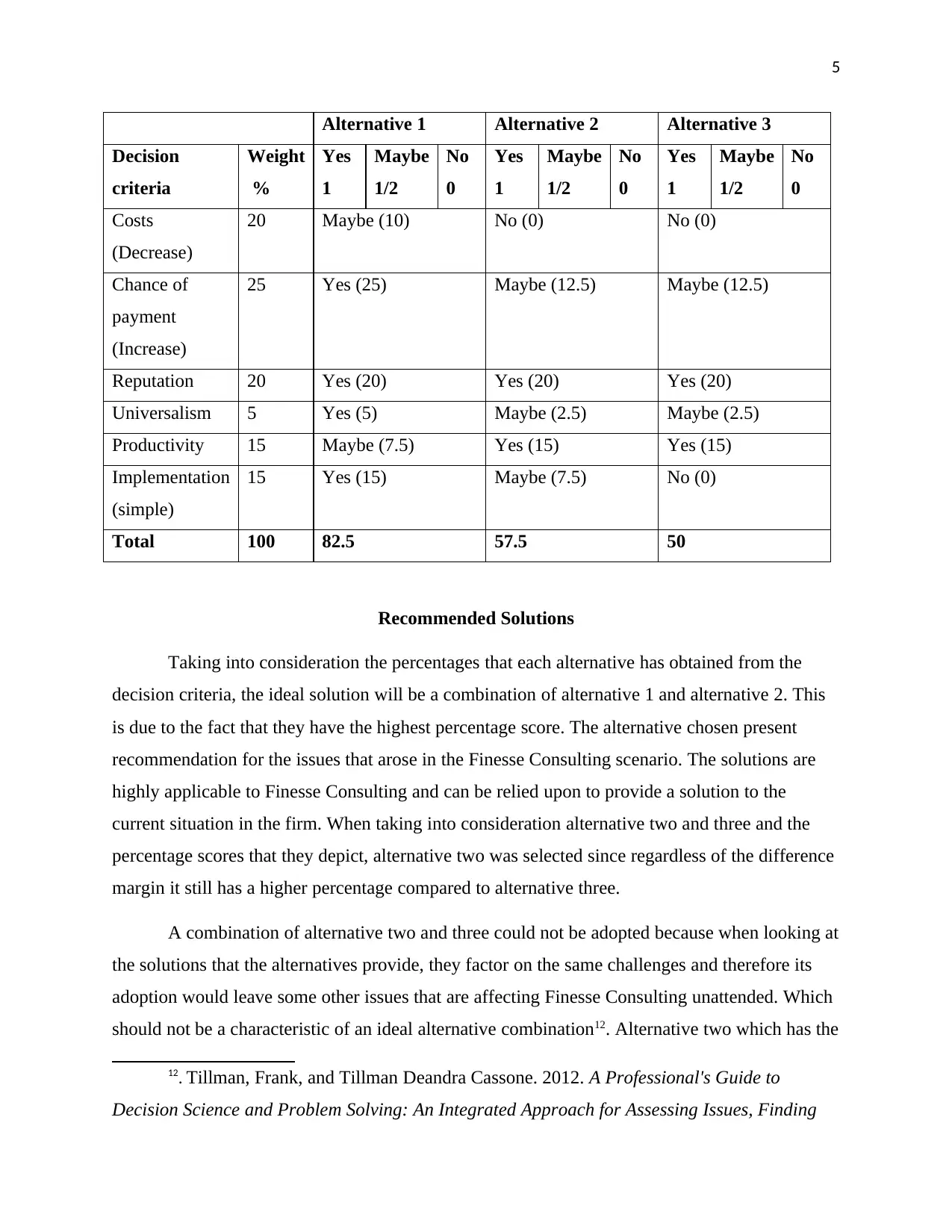
Taking into consideration the percentages that each alternative has obtained from the
decision criteria, the ideal solution will be a combination of alternative 1 and alternative 2. This
is due to the fact that they have the highest percentage score. The alternative chosen present
recommendation for the issues that arose in the Finesse Consulting scenario. The solutions are
highly applicable to Finesse Consulting and can be relied upon to provide a solution to the
current situation in the firm. When taking into consideration alternative two and three and the
percentage scores that they depict, alternative two was selected since regardless of the difference
margin it still has a higher percentage compared to alternative three.
A combination of alternative two and three could not be adopted because when looking at
the solutions that the alternatives provide, they factor on the same challenges and therefore its
adoption would leave some other issues that are affecting Finesse Consulting unattended. Which
should not be a characteristic of an ideal alternative combination12. Alternative two which has the
12. Tillman, Frank, and Tillman Deandra Cassone. 2012. A Professional's Guide to
Decision Science and Problem Solving: An Integrated Approach for Assessing Issues, Finding
Alternative 1 Alternative 2 Alternative 3
Decision
criteria
Weight
%
Yes
1
Maybe
1/2
No
0
Yes
1
Maybe
1/2
No
0
Yes
1
Maybe
1/2
No
0
Costs
(Decrease)
20 Maybe (10) No (0) No (0)
Chance of
payment
(Increase)
25 Yes (25) Maybe (12.5) Maybe (12.5)
Reputation 20 Yes (20) Yes (20) Yes (20)
Universalism 5 Yes (5) Maybe (2.5) Maybe (2.5)
Productivity 15 Maybe (7.5) Yes (15) Yes (15)
Implementation
(simple)
15 Yes (15) Maybe (7.5) No (0)
Total 100 82.5 57.5 50
Recommended Solutions
Taking into consideration the percentages that each alternative has obtained from the
decision criteria, the ideal solution will be a combination of alternative 1 and alternative 2. This
is due to the fact that they have the highest percentage score. The alternative chosen present
recommendation for the issues that arose in the Finesse Consulting scenario. The solutions are
highly applicable to Finesse Consulting and can be relied upon to provide a solution to the
current situation in the firm. When taking into consideration alternative two and three and the
percentage scores that they depict, alternative two was selected since regardless of the difference
margin it still has a higher percentage compared to alternative three.
A combination of alternative two and three could not be adopted because when looking at
the solutions that the alternatives provide, they factor on the same challenges and therefore its
adoption would leave some other issues that are affecting Finesse Consulting unattended. Which
should not be a characteristic of an ideal alternative combination12. Alternative two which has the
12. Tillman, Frank, and Tillman Deandra Cassone. 2012. A Professional's Guide to
Decision Science and Problem Solving: An Integrated Approach for Assessing Issues, Finding
⊘ This is a preview!⊘
Do you want full access?
Subscribe today to unlock all pages.
Trusted by 1+ million students worldwide
6
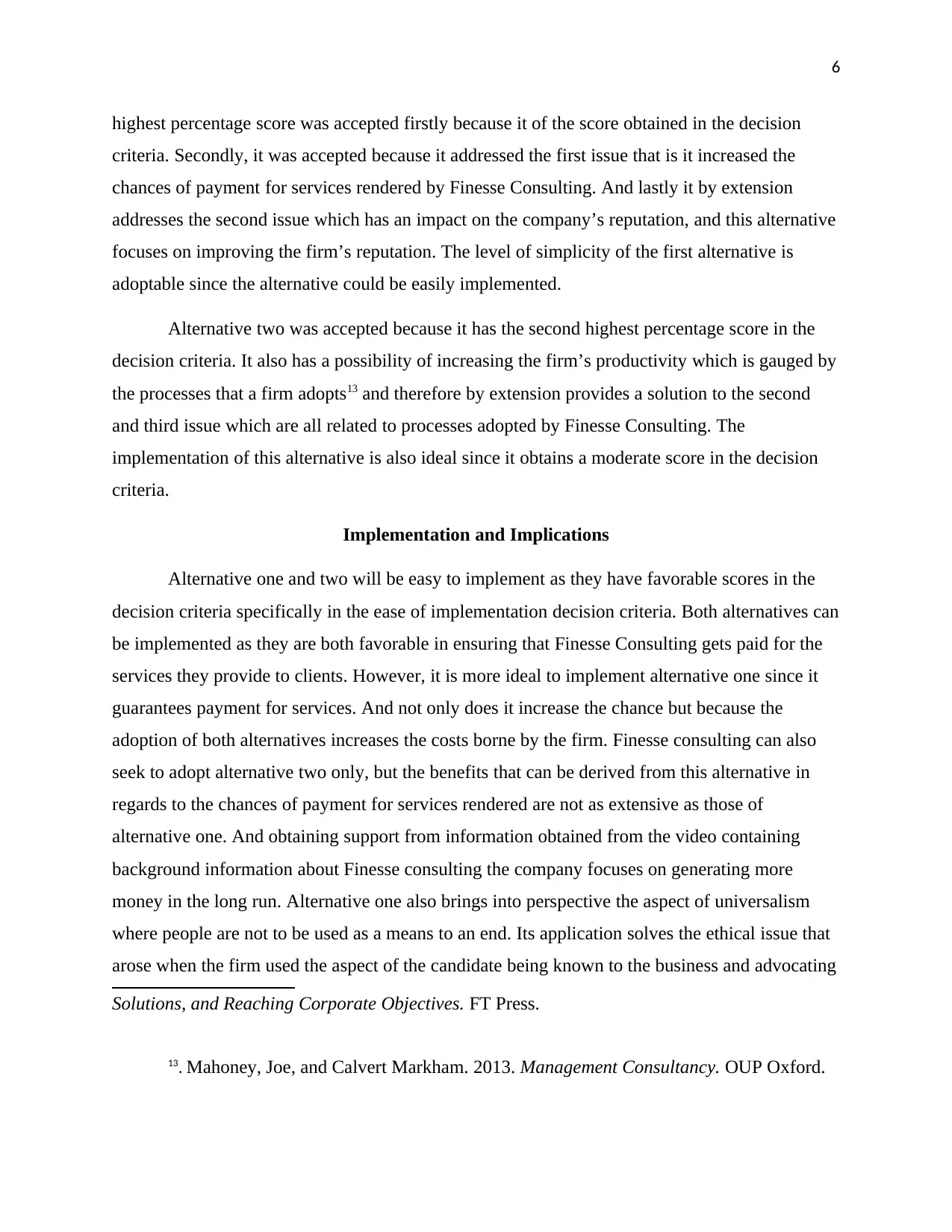
highest percentage score was accepted firstly because it of the score obtained in the decision
criteria. Secondly, it was accepted because it addressed the first issue that is it increased the
chances of payment for services rendered by Finesse Consulting. And lastly it by extension
addresses the second issue which has an impact on the company’s reputation, and this alternative
focuses on improving the firm’s reputation. The level of simplicity of the first alternative is
adoptable since the alternative could be easily implemented.
Alternative two was accepted because it has the second highest percentage score in the
decision criteria. It also has a possibility of increasing the firm’s productivity which is gauged by
the processes that a firm adopts13 and therefore by extension provides a solution to the second
and third issue which are all related to processes adopted by Finesse Consulting. The
implementation of this alternative is also ideal since it obtains a moderate score in the decision
criteria.
Implementation and Implications
Alternative one and two will be easy to implement as they have favorable scores in the
decision criteria specifically in the ease of implementation decision criteria. Both alternatives can
be implemented as they are both favorable in ensuring that Finesse Consulting gets paid for the
services they provide to clients. However, it is more ideal to implement alternative one since it
guarantees payment for services. And not only does it increase the chance but because the
adoption of both alternatives increases the costs borne by the firm. Finesse consulting can also
seek to adopt alternative two only, but the benefits that can be derived from this alternative in
regards to the chances of payment for services rendered are not as extensive as those of
alternative one. And obtaining support from information obtained from the video containing
background information about Finesse consulting the company focuses on generating more
money in the long run. Alternative one also brings into perspective the aspect of universalism
where people are not to be used as a means to an end. Its application solves the ethical issue that
arose when the firm used the aspect of the candidate being known to the business and advocating
Solutions, and Reaching Corporate Objectives. FT Press.
13. Mahoney, Joe, and Calvert Markham. 2013. Management Consultancy. OUP Oxford.
highest percentage score was accepted firstly because it of the score obtained in the decision
criteria. Secondly, it was accepted because it addressed the first issue that is it increased the
chances of payment for services rendered by Finesse Consulting. And lastly it by extension
addresses the second issue which has an impact on the company’s reputation, and this alternative
focuses on improving the firm’s reputation. The level of simplicity of the first alternative is
adoptable since the alternative could be easily implemented.
Alternative two was accepted because it has the second highest percentage score in the
decision criteria. It also has a possibility of increasing the firm’s productivity which is gauged by
the processes that a firm adopts13 and therefore by extension provides a solution to the second
and third issue which are all related to processes adopted by Finesse Consulting. The
implementation of this alternative is also ideal since it obtains a moderate score in the decision
criteria.
Implementation and Implications
Alternative one and two will be easy to implement as they have favorable scores in the
decision criteria specifically in the ease of implementation decision criteria. Both alternatives can
be implemented as they are both favorable in ensuring that Finesse Consulting gets paid for the
services they provide to clients. However, it is more ideal to implement alternative one since it
guarantees payment for services. And not only does it increase the chance but because the
adoption of both alternatives increases the costs borne by the firm. Finesse consulting can also
seek to adopt alternative two only, but the benefits that can be derived from this alternative in
regards to the chances of payment for services rendered are not as extensive as those of
alternative one. And obtaining support from information obtained from the video containing
background information about Finesse consulting the company focuses on generating more
money in the long run. Alternative one also brings into perspective the aspect of universalism
where people are not to be used as a means to an end. Its application solves the ethical issue that
arose when the firm used the aspect of the candidate being known to the business and advocating
Solutions, and Reaching Corporate Objectives. FT Press.
13. Mahoney, Joe, and Calvert Markham. 2013. Management Consultancy. OUP Oxford.
Paraphrase This Document
Need a fresh take? Get an instant paraphrase of this document with our AI Paraphraser
7
for direct contact in order to obtain placement and in the long run expecting to be paid for the
same.
The adoption and implementation of alternative two are based on the productivity and
reputation of Finesse Consulting. Alternative two focuses on improving processes relating to
following up activities on feedback from the client companies in regard to client placement.
Having a sound system brings into perspective the ability of the firm to operate formally in the
market taking into consideration ethical issues which include not taking advantage of
relationships of candidates with the client companies. Which by implication is what an individual
could perceive from the approach adopted by Finesse Consulting, although this may not have
been the case. The adoption of alternative two also increases the productivity of the firm. By so
doing Finesse Consulting will be able to derive more results from the activities they are involved
in.
Alternative three is not under consideration for implementation since it has the lowest
score in the decision criteria. However, if it were to be considered for implementation, it has
advantages that Finesse Consulting can accrue. The level of benefits that the firm can accrue
relating to the chance of payment for services rendered is more of the same as those that are
accrued in alternative two. Its impact on Finesse Consulting is similar to that of the alternative
one and two. However, when the alternative is adopted and implemented its impact on
productivity individually surpasses that of the alternative one.
Bibliography
Adler, Lou . 2013. Hire With Your Head: Using Performance-Based Hiring to Build Great
Teams. John Wiley & Sons.
Baaij, Marc . 2013. An Introduction to Management Consultancy. SAGE.
Brown, Jane Newell , and Ann Swain. 2012. The Professional Recruiter's Handbook: Delivering
Excellence in Recruitment Practice. Kogan Page Publishers.
Compton. 2009. Effective Recruitment and Selection Practices. CCH Australia Limited.
Elvy. 2016. How to Become a Consultant. Springer.
for direct contact in order to obtain placement and in the long run expecting to be paid for the
same.
The adoption and implementation of alternative two are based on the productivity and
reputation of Finesse Consulting. Alternative two focuses on improving processes relating to
following up activities on feedback from the client companies in regard to client placement.
Having a sound system brings into perspective the ability of the firm to operate formally in the
market taking into consideration ethical issues which include not taking advantage of
relationships of candidates with the client companies. Which by implication is what an individual
could perceive from the approach adopted by Finesse Consulting, although this may not have
been the case. The adoption of alternative two also increases the productivity of the firm. By so
doing Finesse Consulting will be able to derive more results from the activities they are involved
in.
Alternative three is not under consideration for implementation since it has the lowest
score in the decision criteria. However, if it were to be considered for implementation, it has
advantages that Finesse Consulting can accrue. The level of benefits that the firm can accrue
relating to the chance of payment for services rendered is more of the same as those that are
accrued in alternative two. Its impact on Finesse Consulting is similar to that of the alternative
one and two. However, when the alternative is adopted and implemented its impact on
productivity individually surpasses that of the alternative one.
Bibliography
Adler, Lou . 2013. Hire With Your Head: Using Performance-Based Hiring to Build Great
Teams. John Wiley & Sons.
Baaij, Marc . 2013. An Introduction to Management Consultancy. SAGE.
Brown, Jane Newell , and Ann Swain. 2012. The Professional Recruiter's Handbook: Delivering
Excellence in Recruitment Practice. Kogan Page Publishers.
Compton. 2009. Effective Recruitment and Selection Practices. CCH Australia Limited.
Elvy. 2016. How to Become a Consultant. Springer.
8
Mahoney, Joe. 2010. Management Consultancy. OUP Oxford.
Mahoney, Joe, and Calvert Markham. 2013. Management Consultancy. OUP Oxford.
Nathan, James . 2014. Recruiting to Win: A Truly Commercial Introduction to the World of
Recruitment. Lulu.com.
Newton, Richard . 2012. The Management Consultant: Mastering the Art of Consultancy.
Pearson UK.
Swain, Ann . 2009. The Professional Recruiter's Handbook: Delivering Excellence in
Recruitment Practice. Kogan Page Publishers.
Thompson, Vince, David Russo, Rusty Rueff, Hank Stringer, Cathy Fyock, and Martha Finney.
2013. Find (and Keep) Top Talent for Your Business (Collection). FT Press.
Tillman, Frank, and Tillman Deandra Cassone. 2012. A Professional's Guide to Decision Science
and Problem Solving: An Integrated Approach for Assessing Issues, Finding Solutions,
and Reaching Corporate Objectives. FT Press.
Watson, Anne . 2010. The Definitive Job Book: Rules from the Recruitment Insiders. John Wiley
& Sons.
Mahoney, Joe. 2010. Management Consultancy. OUP Oxford.
Mahoney, Joe, and Calvert Markham. 2013. Management Consultancy. OUP Oxford.
Nathan, James . 2014. Recruiting to Win: A Truly Commercial Introduction to the World of
Recruitment. Lulu.com.
Newton, Richard . 2012. The Management Consultant: Mastering the Art of Consultancy.
Pearson UK.
Swain, Ann . 2009. The Professional Recruiter's Handbook: Delivering Excellence in
Recruitment Practice. Kogan Page Publishers.
Thompson, Vince, David Russo, Rusty Rueff, Hank Stringer, Cathy Fyock, and Martha Finney.
2013. Find (and Keep) Top Talent for Your Business (Collection). FT Press.
Tillman, Frank, and Tillman Deandra Cassone. 2012. A Professional's Guide to Decision Science
and Problem Solving: An Integrated Approach for Assessing Issues, Finding Solutions,
and Reaching Corporate Objectives. FT Press.
Watson, Anne . 2010. The Definitive Job Book: Rules from the Recruitment Insiders. John Wiley
& Sons.
⊘ This is a preview!⊘
Do you want full access?
Subscribe today to unlock all pages.
Trusted by 1+ million students worldwide

1 out of 9


Your All-in-One AI-Powered Toolkit for Academic Success.
+13062052269
info@desklib.com
Available 24*7 on WhatsApp / Email
![[object Object]](/_next/static/media/star-bottom.7253800d.svg)
Unlock your academic potential
Copyright © 2020–2026 A2Z Services. All Rights Reserved. Developed and managed by ZUCOL.