CFA Fire Risk Management: Addressing Issues with Practical Solutions

Verified

Added on  2023/03/23

|10
|1248
|37
Report
AI Summary
This report identifies key issues within the Country Fire Authority (CFA) related to fire risk management, including a lack of knowledge sharing among its 56,000 volunteers due to cultural differences and a poorly functioning digital knowledge management platform. Further problems include poor communication both horizontally and vertically, weak change management, and restrictive privacy policies hindering the use of historical data. The report suggests three primary tools to address these challenges: an organization-wide communication system to foster better knowledge sharing and cultural understanding, a change management system to align employees with organizational changes, and Knowledge Management System (KMS) training for all staff and volunteers to improve access to and management of knowledge bases. The implementation plan involves phased meetings, continual project development, and a value statement emphasizing enhanced employee performance to better serve clients. The rationale behind these tools is to enable CFA to effectively address its core issues, with a costing budget provided for the first phase of implementation.
Document Page
FIRE RISK
MANAGEMENT
tabler-icon-diamond-filled.svg

Paraphrase This Document

Need a fresh take? Get an instant paraphrase of this document with our AI Paraphraser
Document Page
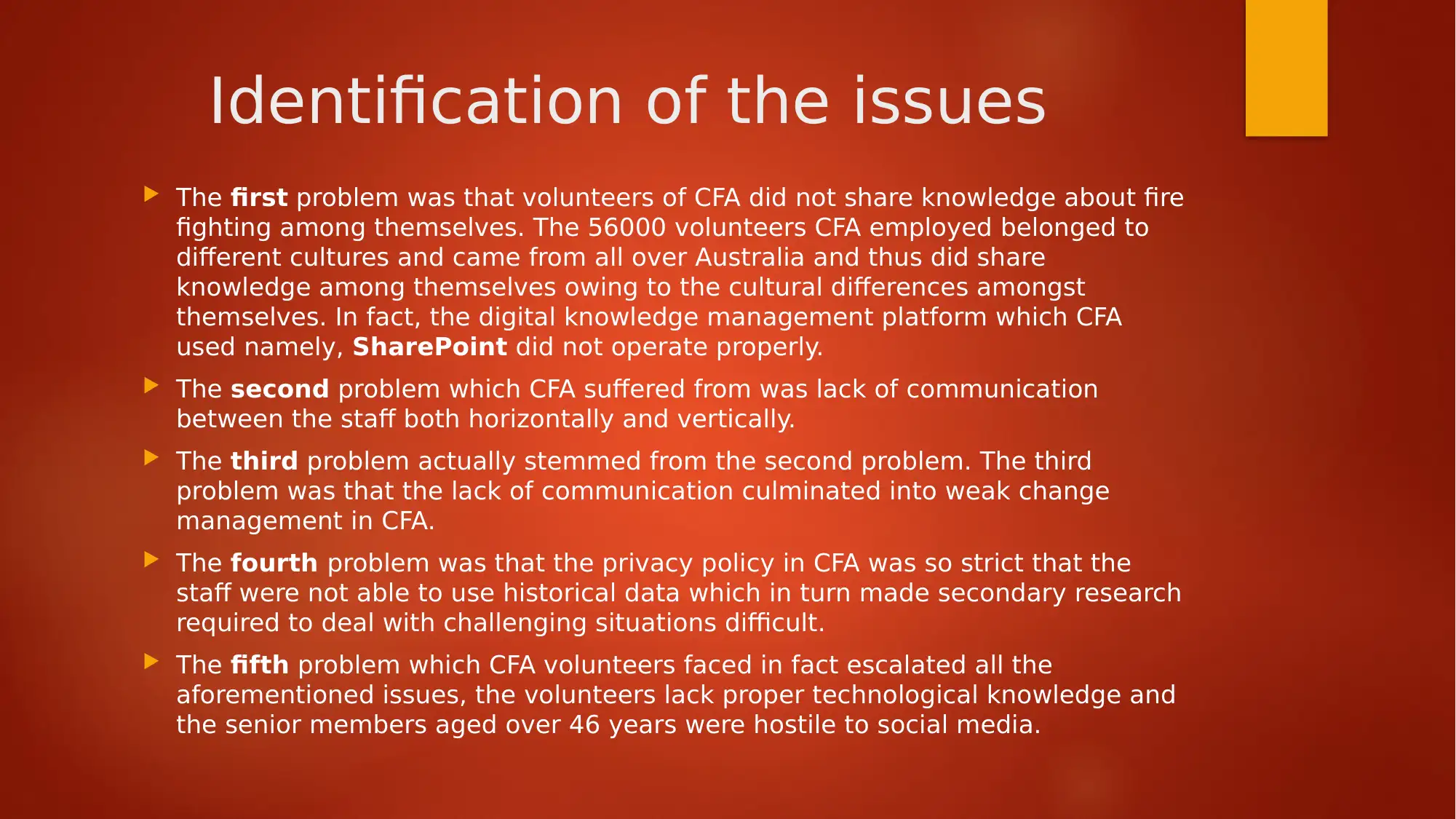
Identification of the issues
The first problem was that volunteers of CFA did not share knowledge about fire
fighting among themselves. The 56000 volunteers CFA employed belonged to
different cultures and came from all over Australia and thus did share
knowledge among themselves owing to the cultural differences amongst
themselves. In fact, the digital knowledge management platform which CFA
used namely, SharePoint did not operate properly.
The second problem which CFA suffered from was lack of communication
between the staff both horizontally and vertically.
The third problem actually stemmed from the second problem. The third
problem was that the lack of communication culminated into weak change
management in CFA.
The fourth problem was that the privacy policy in CFA was so strict that the
staff were not able to use historical data which in turn made secondary research
required to deal with challenging situations difficult.
The fifth problem which CFA volunteers faced in fact escalated all the
aforementioned issues, the volunteers lack proper technological knowledge and
the senior members aged over 46 years were hostile to social media.
Document Page
Suggested tools (step 2)
(Reccomendations)
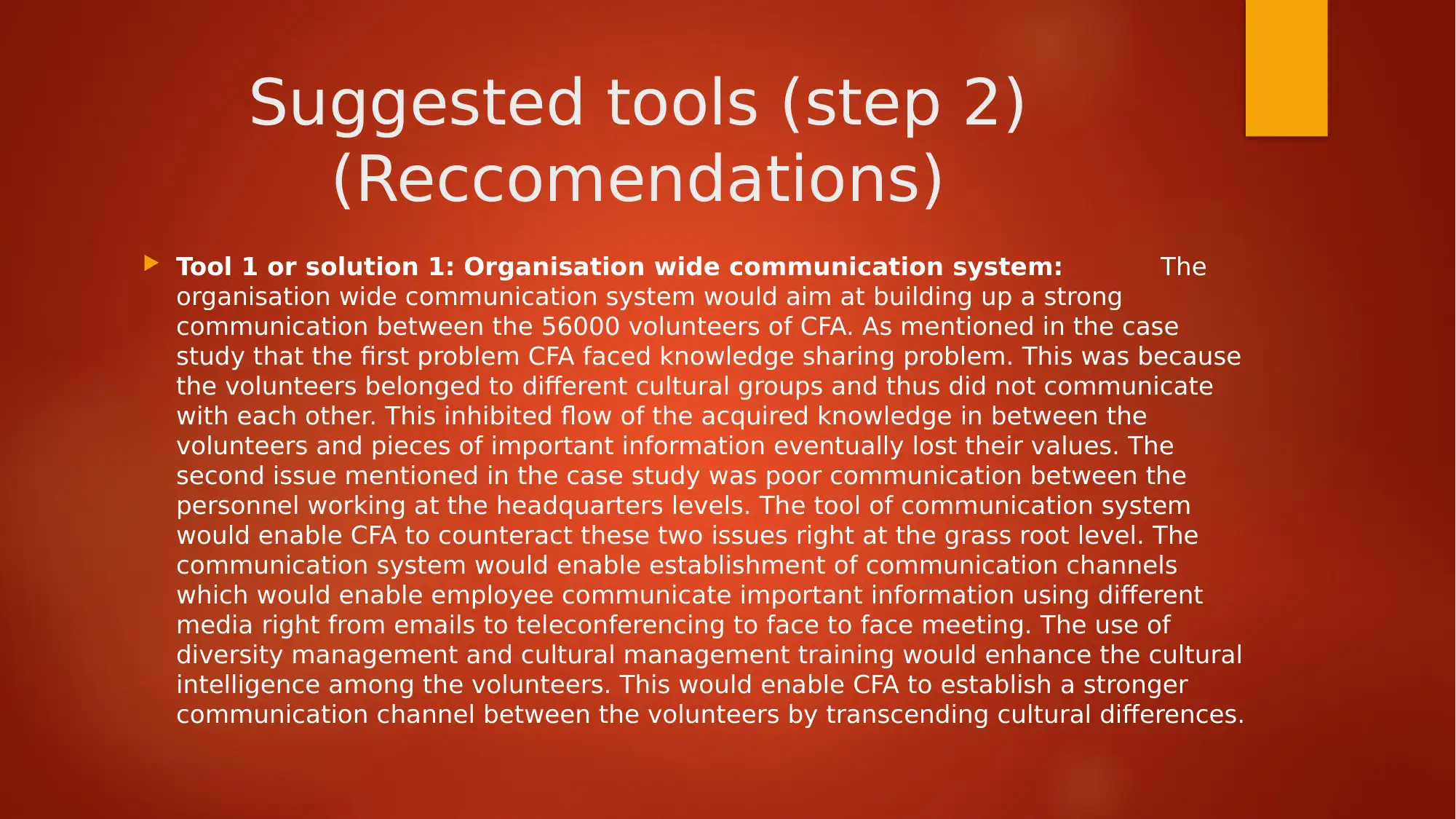
Tool 1 or solution 1: Organisation wide communication system: The
organisation wide communication system would aim at building up a strong
communication between the 56000 volunteers of CFA. As mentioned in the case
study that the first problem CFA faced knowledge sharing problem. This was because
the volunteers belonged to different cultural groups and thus did not communicate
with each other. This inhibited flow of the acquired knowledge in between the
volunteers and pieces of important information eventually lost their values. The
second issue mentioned in the case study was poor communication between the
personnel working at the headquarters levels. The tool of communication system
would enable CFA to counteract these two issues right at the grass root level. The
communication system would enable establishment of communication channels
which would enable employee communicate important information using different
media right from emails to teleconferencing to face to face meeting. The use of
diversity management and cultural management training would enhance the cultural
intelligence among the volunteers. This would enable CFA to establish a stronger
communication channel between the volunteers by transcending cultural differences.
Document Page
Suggested tools (step 2)
(Reccomendations)contd..
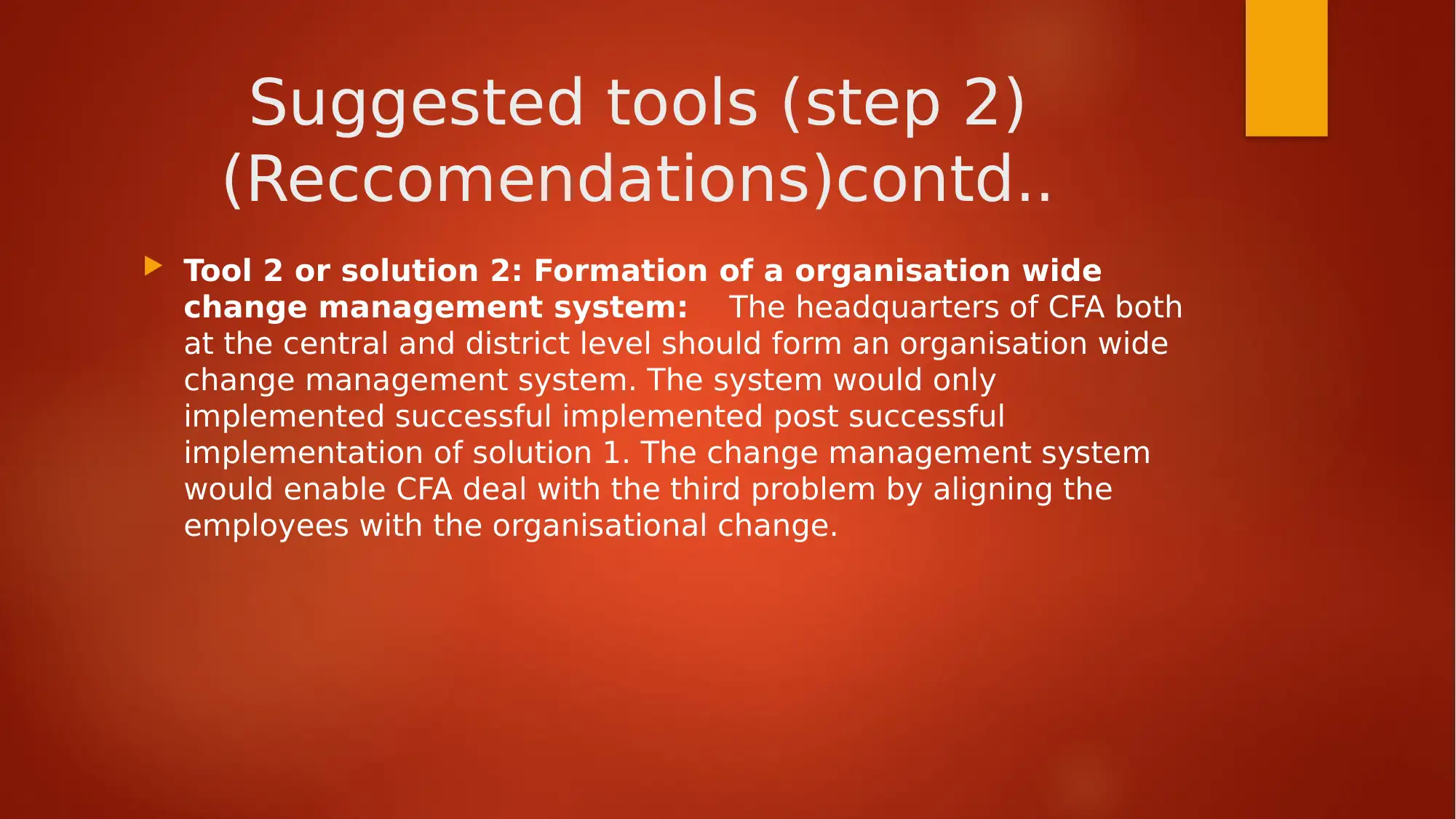
Tool 2 or solution 2: Formation of a organisation wide
change management system: The headquarters of CFA both
at the central and district level should form an organisation wide
change management system. The system would only
implemented successful implemented post successful
implementation of solution 1. The change management system
would enable CFA deal with the third problem by aligning the
employees with the organisational change.
tabler-icon-diamond-filled.svg

Paraphrase This Document

Need a fresh take? Get an instant paraphrase of this document with our AI Paraphraser
Document Page
Suggested tools (step 2)
(Reccomendations)contd..
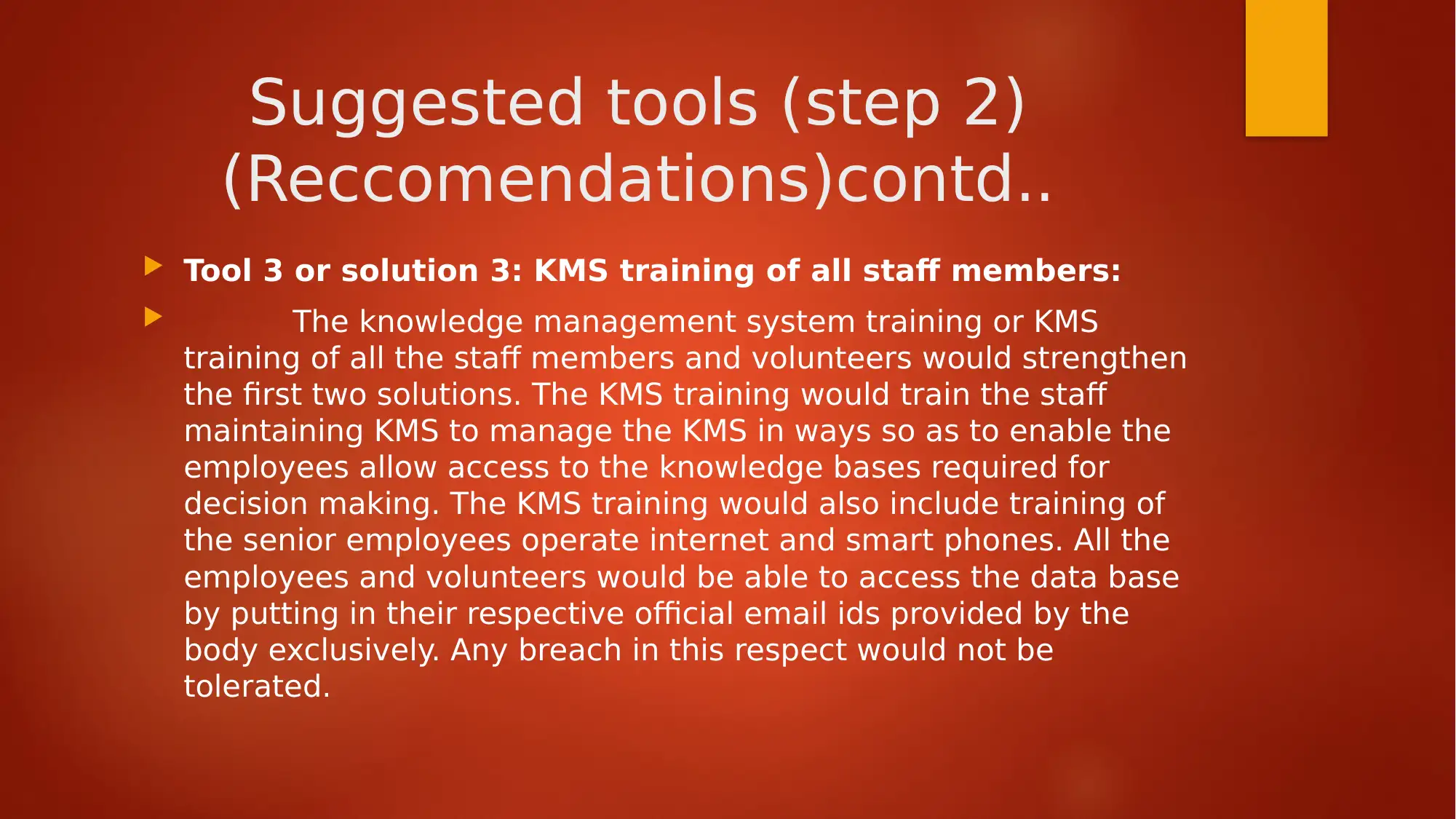
Tool 3 or solution 3: KMS training of all staff members:
The knowledge management system training or KMS
training of all the staff members and volunteers would strengthen
the first two solutions. The KMS training would train the staff
maintaining KMS to manage the KMS in ways so as to enable the
employees allow access to the knowledge bases required for
decision making. The KMS training would also include training of
the senior employees operate internet and smart phones. All the
employees and volunteers would be able to access the data base
by putting in their respective official email ids provided by the
body exclusively. Any breach in this respect would not be
tolerated.
Document Page
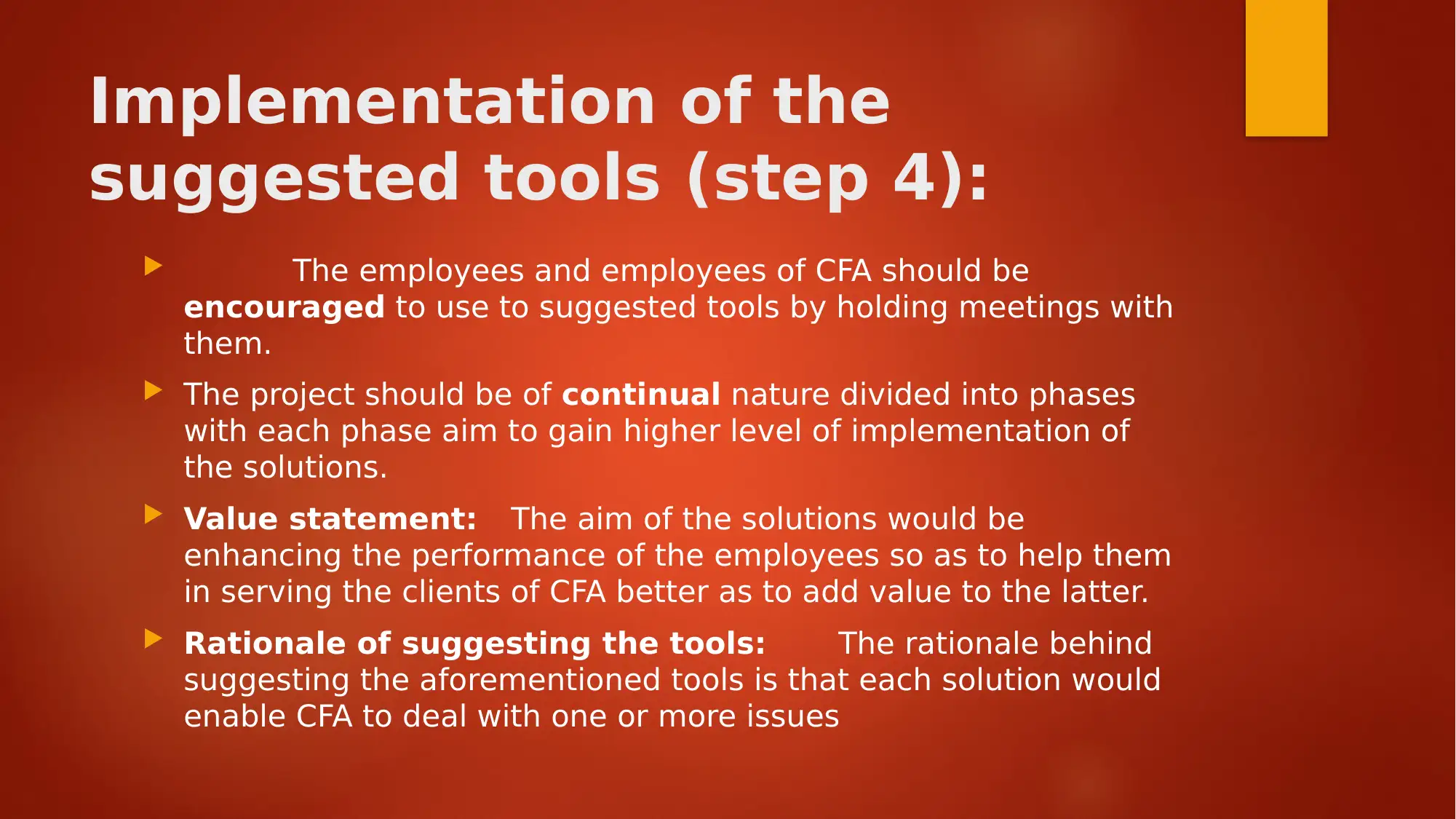
Implementation of the
suggested tools (step 4):
The employees and employees of CFA should be
encouraged to use to suggested tools by holding meetings with
them.
The project should be of continual nature divided into phases
with each phase aim to gain higher level of implementation of
the solutions.
Value statement: The aim of the solutions would be
enhancing the performance of the employees so as to help them
in serving the clients of CFA better as to add value to the latter.
Rationale of suggesting the tools: The rationale behind
suggesting the aforementioned tools is that each solution would
enable CFA to deal with one or more issues
Document Page
Action plan
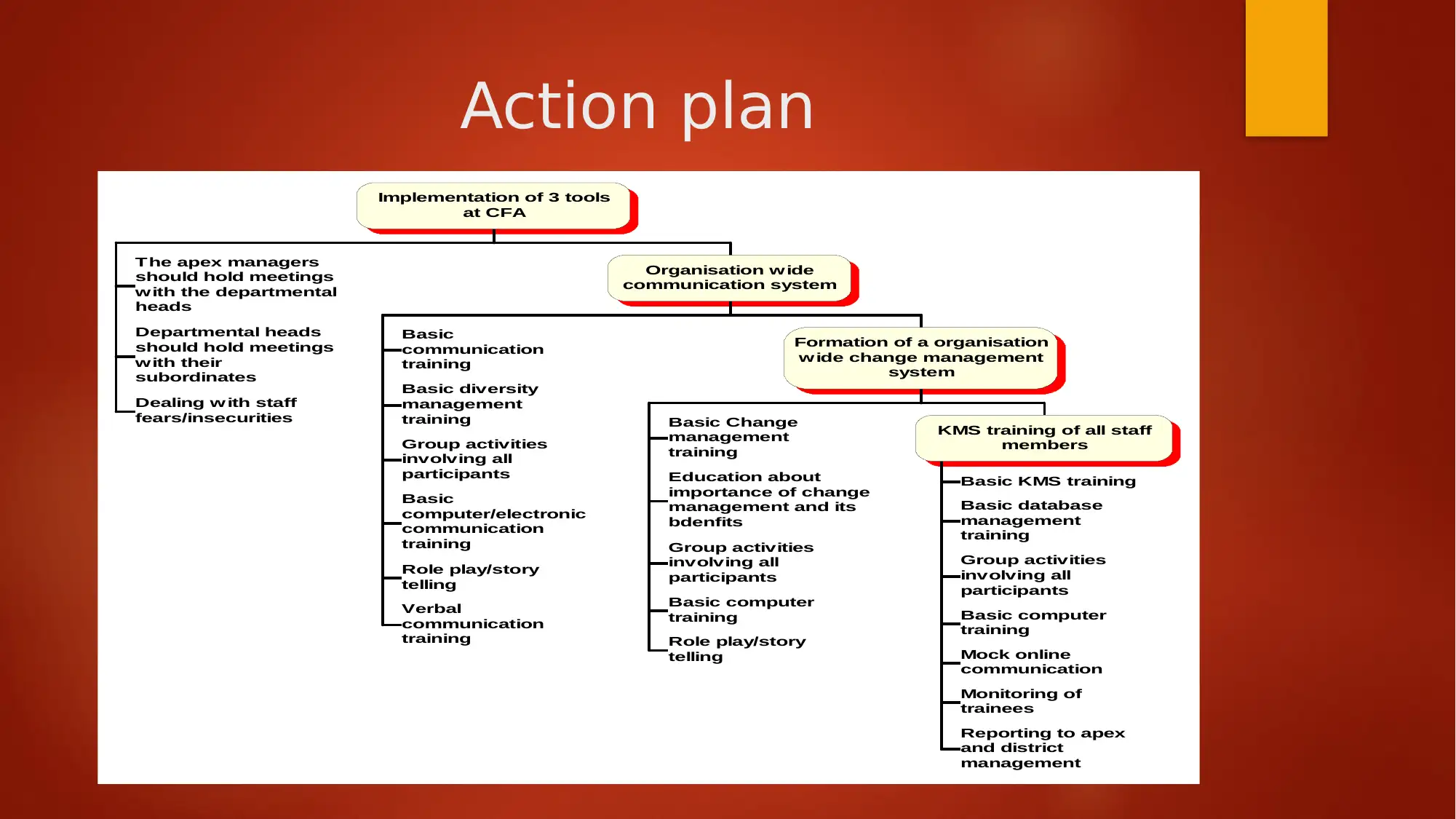
Implementation of 3 tools
at CFA
The apex managers
should hold meetings
with the departmental
heads
Departmental heads
should hold meetings
with their
subordinates
Dealing with staff
fears/insecurities
Organisation wide
communication system
Basic
communication
training
Basic diversity
management
training
Group activities
involving all
participants
Basic
computer/electronic
communication
training
Role play/story
telling
Verbal
communication
training
Formation of a organisation
wide change management
system
Basic Change
management
training
Education about
importance of change
management and its
bdenfits
Group activities
involving all
participants
Basic computer
training
Role play/story
telling
KMS training of all staff
members
Basic KMS training
Basic database
management
training
Group activities
involving all
participants
Basic computer
training
Mock online
communication
Monitoring of
trainees
Reporting to apex
and district
management
tabler-icon-diamond-filled.svg

Paraphrase This Document

Need a fresh take? Get an instant paraphrase of this document with our AI Paraphraser
Document Page
Costing
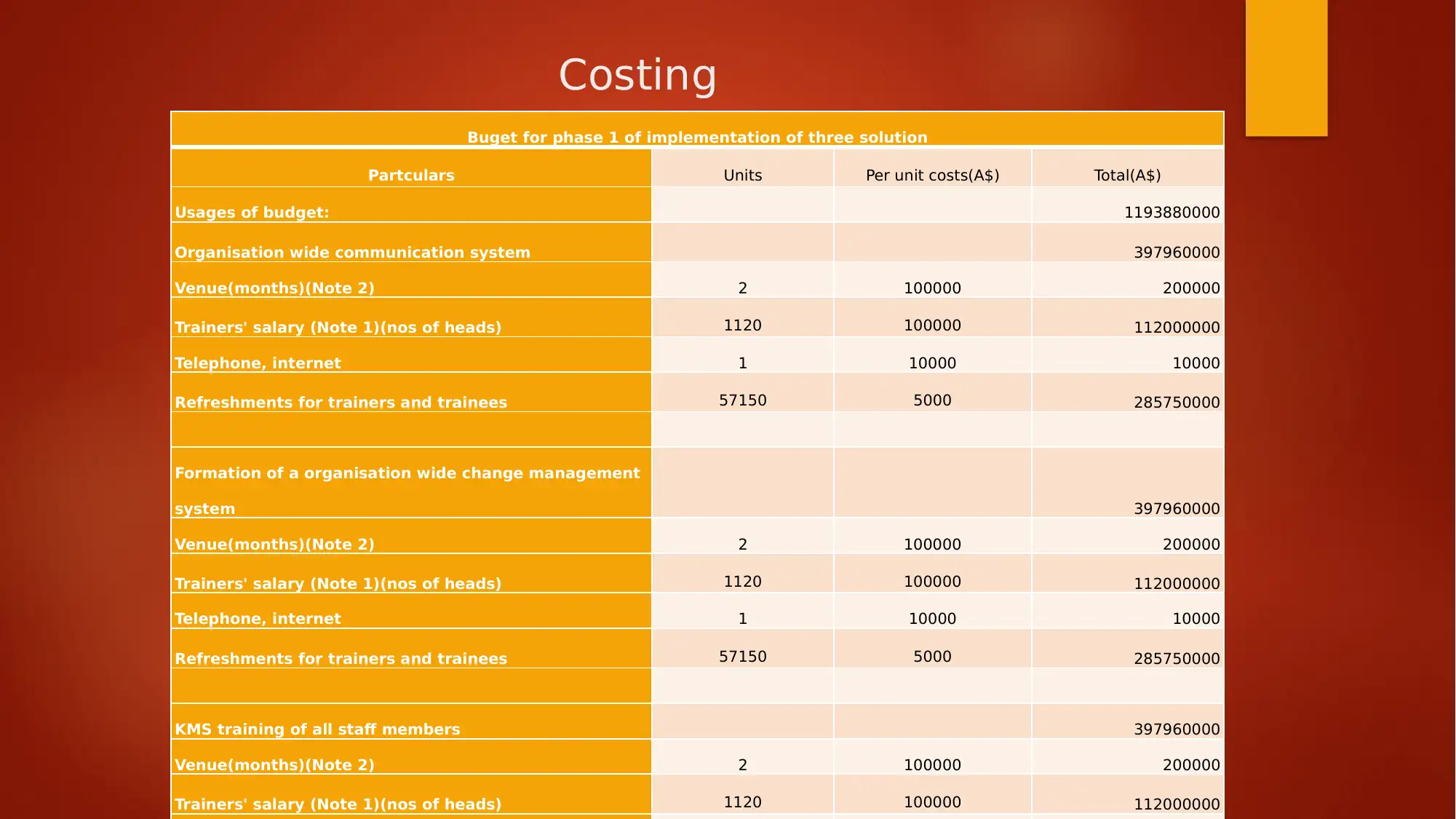
Buget for phase 1 of implementation of three solution
Partculars Units Per unit costs(A$) Total(A$)
Usages of budget: 1193880000
Organisation wide communication system 397960000
Venue(months)(Note 2) 2 100000 200000
Trainers' salary (Note 1)(nos of heads) 1120 100000 112000000
Telephone, internet 1 10000 10000
Refreshments for trainers and trainees 57150 5000 285750000
Formation of a organisation wide change management
system 397960000
Venue(months)(Note 2) 2 100000 200000
Trainers' salary (Note 1)(nos of heads) 1120 100000 112000000
Telephone, internet 1 10000 10000
Refreshments for trainers and trainees 57150 5000 285750000
KMS training of all staff members 397960000
Venue(months)(Note 2) 2 100000 200000
Trainers' salary (Note 1)(nos of heads) 1120 100000 112000000
Document Page
References
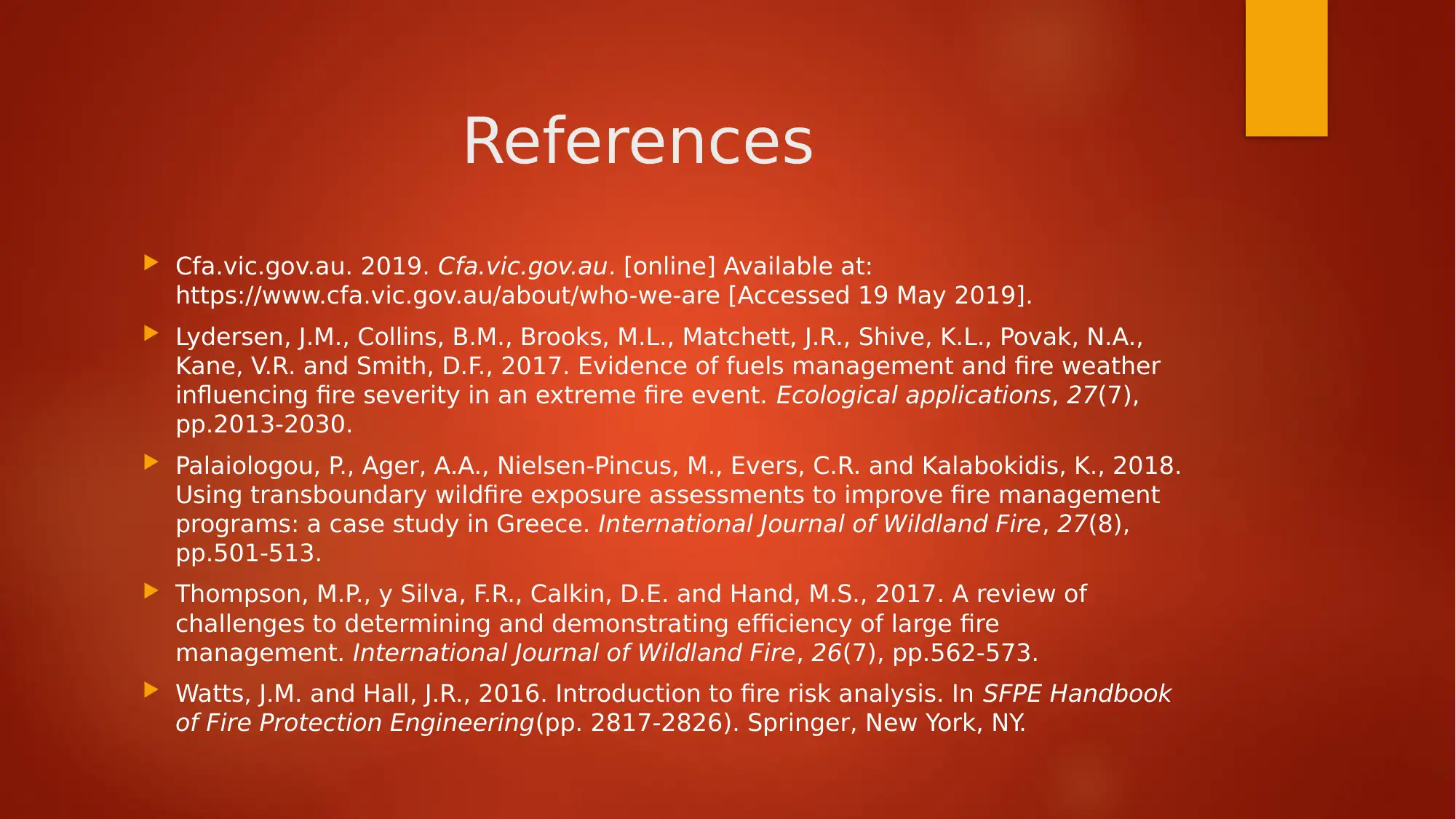
Cfa.vic.gov.au. 2019. Cfa.vic.gov.au. [online] Available at:
https://www.cfa.vic.gov.au/about/who-we-are [Accessed 19 May 2019].
Lydersen, J.M., Collins, B.M., Brooks, M.L., Matchett, J.R., Shive, K.L., Povak, N.A.,
Kane, V.R. and Smith, D.F., 2017. Evidence of fuels management and fire weather
influencing fire severity in an extreme fire event. Ecological applications, 27(7),
pp.2013-2030.
Palaiologou, P., Ager, A.A., Nielsen-Pincus, M., Evers, C.R. and Kalabokidis, K., 2018.
Using transboundary wildfire exposure assessments to improve fire management
programs: a case study in Greece. International Journal of Wildland Fire, 27(8),
pp.501-513.
Thompson, M.P., y Silva, F.R., Calkin, D.E. and Hand, M.S., 2017. A review of
challenges to determining and demonstrating efficiency of large fire
management. International Journal of Wildland Fire, 26(7), pp.562-573.
Watts, J.M. and Hall, J.R., 2016. Introduction to fire risk analysis. In SFPE Handbook
of Fire Protection Engineering(pp. 2817-2826). Springer, New York, NY.
Document Page
Thank You
chevron_up_icon
1 out of 10
circle_padding
hide_on_mobile
zoom_out_icon
[object Object]