Literature Review: Smoke Control Strategies in High Rise Buildings

Verified

Added on  2023/06/15

|6
|1357
|263
Literature Review
AI Summary
This literature review explores various studies on smoke control strategies in high-rise buildings, focusing on challenges in evacuation, smoke movement mechanisms, and control strategies. Key factors influencing smoke movement include temperature, weather conditions, and mechanical air-handling systems. Effective smoke control strategies involve compartmentalization, air supply management, and the use of vertical smoke shafts. The review also considers the impact of HVAC systems and the importance of integrating sensor readings for controlling exit points. Mathematical models and simulations are discussed, highlighting the importance of factors like shaft size and structural flexibility in smoke dispersion. Desklib offers additional resources, including solved assignments and past papers, for further study on this topic.
Document Page
University of Central Lancashire
School of Engineering
PROJECT REPORT for Fire Science (MSc) Dissertation
(FV4900/FV4901)
Research Title
Strategies of Smoke Control System in High Rise Buildings
Literature Review
LITERATURE REVIEW
Name
Student Number
Email Address
Submission Date
tabler-icon-diamond-filled.svg

Paraphrase This Document

Need a fresh take? Get an instant paraphrase of this document with our AI Paraphraser
Document Page
There are various studies that have been carried out in the recent past to illustrate and predict
different smoke patterns and control in high rise buildings. Some of the findings by different
authors include:
1. Public Education Journal (2018)
In this journal, the authors opine that high-rise buildings, unlike low-rise, present
significant challenges in fire safety especially in evacuating people during emergency.
The long distances impede fast movement out of the building. Besides, due to the
cumulative effect of great number of people travelling over great distances during
evacuation, the exits and egress are normally jammed causing further loss and damage.
There is often greater casualty in high rise buildings. However, according to Guire and
Tamura (1971), there are mechanisms that facilitate smoke movements in high-rise
buildings.
2. Guire and Tamura (1971)
According to the authors, the three most critical factors in smoke movements include:
temperature, weather conditions and mechanical air-handling system. Notably, higher
temperatures often make smoke to be more kinetically excited and as a result the speed of
propagation increases tremendously. Mostly smoke control is compartmentalized such
that it is confined in a chamber to minimize the effects of fire spread to other sections.
However, according to the authors, this has often been ineffective as smoke still find its
way through these openings.
Guire and Tamura (1971) stated ...”Even with a quite small pressure differential smoke
flow would be much significant over large sections in record time”. Another mechanism
Document Page
of smoke control that is discussed by the authors is molecular diffusion. This normally
disperses the gaseous compounds within the building hence minimizing the risks of
smoke spread. Besides, stack action ensures that even after gas stops expanding (volume
increasing tenfold), smoke would still flow out. Secondly, some mechanical air handling
systems have been known to contribute to acceleration of smoke movements. Since the
system controls both inlet and outlet air, it can easily aid smoke migration. Besides, the
HVAC ducts are additional smoke paths to the upper deck of the building. However, the
authors suggest that to accurately determine the effects of the three factors, the smoke
movement can be measured by utilizing three models of the same building. Model
number one will comprise investigation of temperature effects only, model 2 will focus
on wind actions only and model 3 will be based on the mechanical air handling unit.
However, in a nutshell, according to the author, the rate of air leakage and rate of smoke
movement in high rise buildings depend on the leakage points within the building. The
author reveals that compartmentalization greatly assists in smoke movements and control
as it prevents smoke flow outs. Fire is allowed to occur in one of the rooms which are
normally made smoke leak proof in seconds. Normally, smoke leaving one space to
another get diluted with the available air on its path and this facilitates its movement to
the next available space.
3. Yuan et al (2014) dwelt on the control strategies and their findings include:
The rate of air supply is a major factor in smoke control. Besides, how the air is supplied
also plays a major role. From the simulation results, the temperature at the fire room exit
is greatly reduced by moderating air supply quantity as too large a supply will complicate
the smoke-push effort to the exit area. Additionally, effect of HVAC on smoke
Document Page
propagation and room evacuation was examined. From the results, the author realized
that turning on HVAC and smoke exhaust system simultaneously can never delay smoke
propagation whereas delaying smoke propagation is brought about by the turning on air
supply and smoke exhaust system of another room (without fire) hence delaying
propagation especially in corridors. Therefore, based on the findings, effective isolation
and eventual containment of smoke movement can be achieved by controlling door
controllers, air supply system and smoke exhaust system. Besides, control must integrate
sensor readings so as to control the exit points such as doors. However, control is often
limited by factors such as scale of building in question, weather conditions, natural air
supply and smoke exhaust system capacity.
4. Zhang et al (2014)
Zhang et al (2014) made very candid observation on the effect of the vertical smoke
shafts on smoke movements within the building. The authors disclose that vertical shafts
(be it the stairwells, the lift containers or other vertical chimneys) greatly contribute to
the smoke movement as it facilitates what Guire and Tamura (1971) termed the stack
effect. They discuss that during transition of smoke from room to room, deck to deck,
there is often a driving force established as a result of pressure differential. It should be
noted that often the smoke is at elevated temperatures and dense so as to reduce visibility.
As a result, the elevated temperatures make it to develop more pressures while the inside
of the shafts could be at much lower temperature hence the pressurization of smoke
movement such that it is sacked in during propagation.
Now, suppose the shafts are directed to the next available rooms and exit points are on
the shaft, then smoke is propagated easily to the upper portion of the building in seconds.
tabler-icon-diamond-filled.svg

Paraphrase This Document

Need a fresh take? Get an instant paraphrase of this document with our AI Paraphraser
Document Page
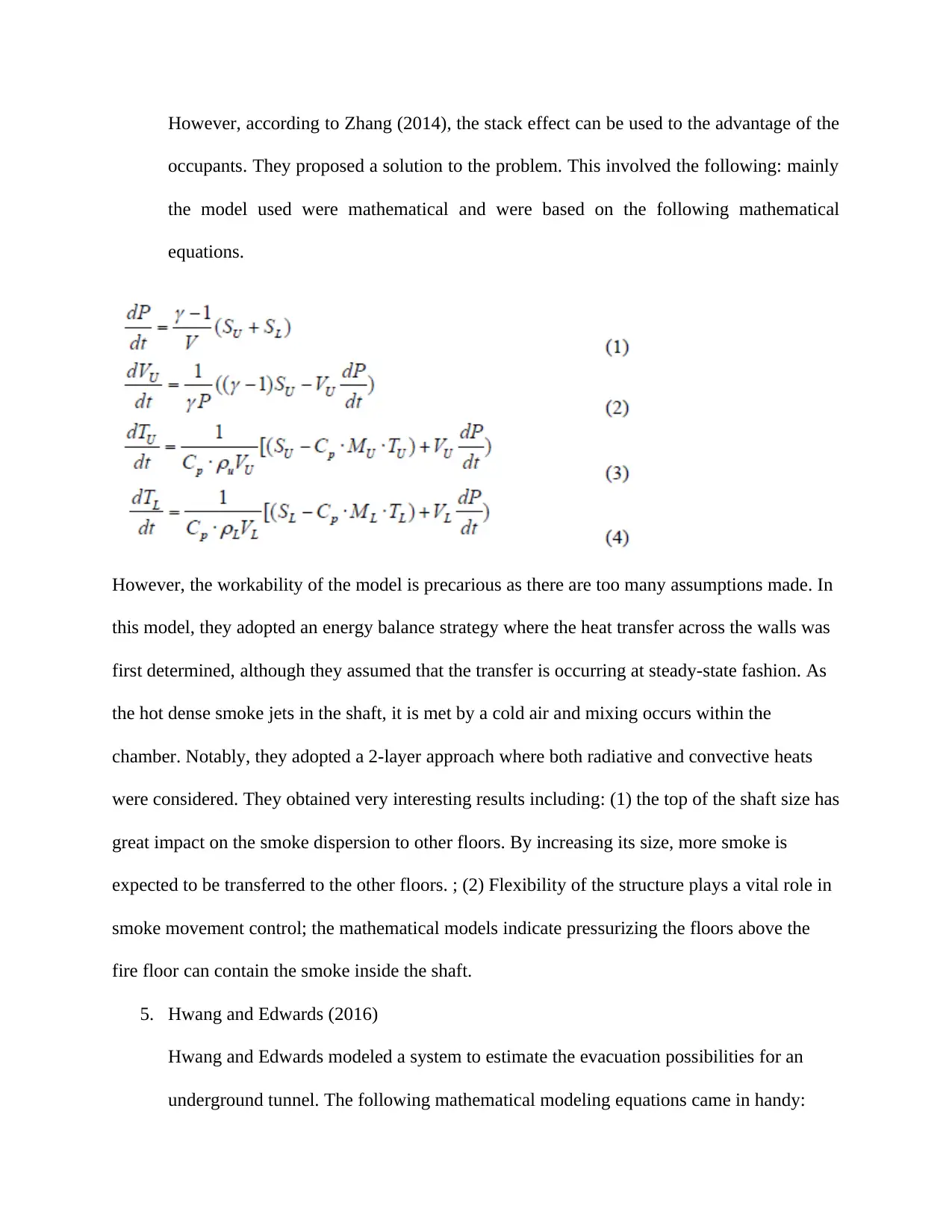
However, according to Zhang (2014), the stack effect can be used to the advantage of the
occupants. They proposed a solution to the problem. This involved the following: mainly
the model used were mathematical and were based on the following mathematical
equations.
However, the workability of the model is precarious as there are too many assumptions made. In
this model, they adopted an energy balance strategy where the heat transfer across the walls was
first determined, although they assumed that the transfer is occurring at steady-state fashion. As
the hot dense smoke jets in the shaft, it is met by a cold air and mixing occurs within the
chamber. Notably, they adopted a 2-layer approach where both radiative and convective heats
were considered. They obtained very interesting results including: (1) the top of the shaft size has
great impact on the smoke dispersion to other floors. By increasing its size, more smoke is
expected to be transferred to the other floors. ; (2) Flexibility of the structure plays a vital role in
smoke movement control; the mathematical models indicate pressurizing the floors above the
fire floor can contain the smoke inside the shaft.
5. Hwang and Edwards (2016)
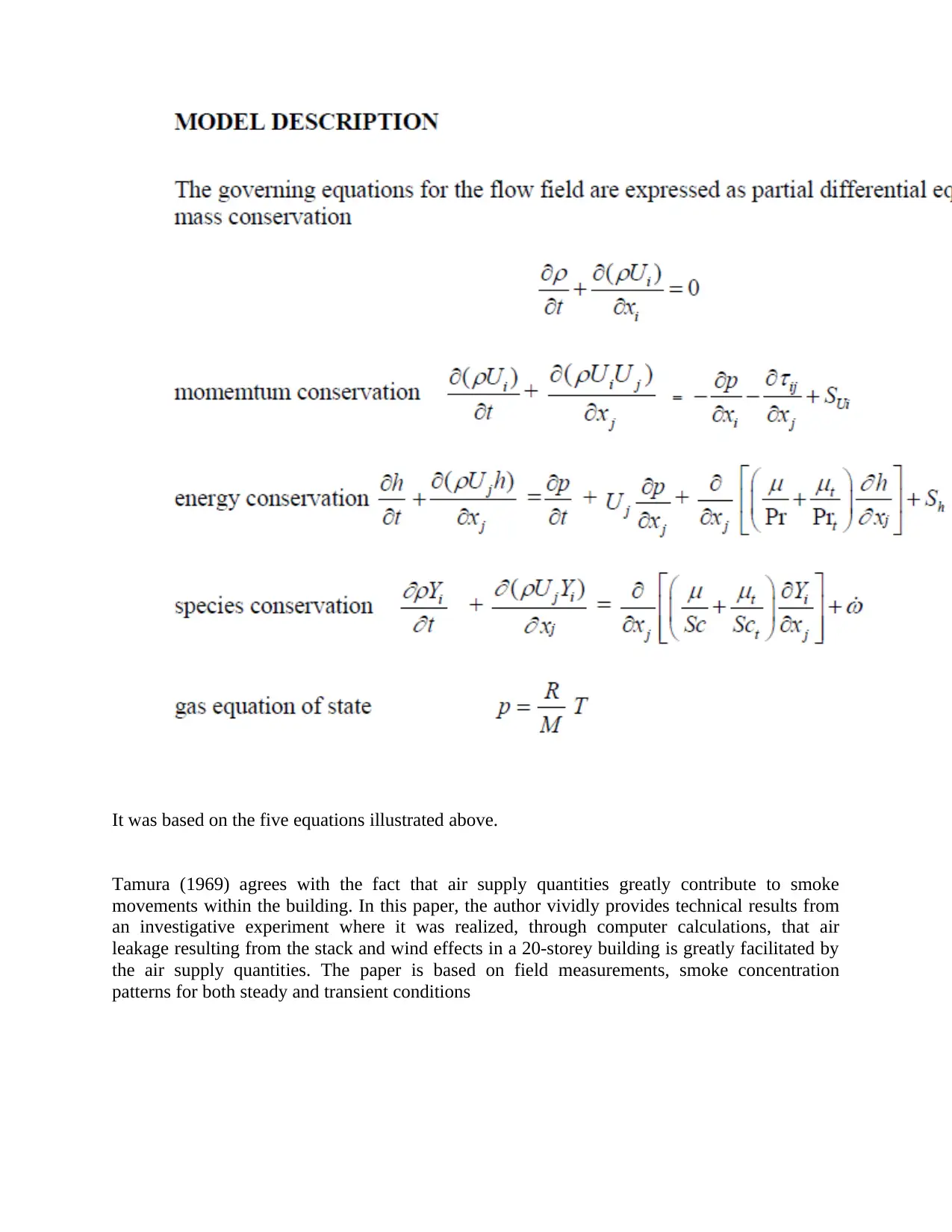
Hwang and Edwards modeled a system to estimate the evacuation possibilities for an
underground tunnel. The following mathematical modeling equations came in handy:
Document Page
It was based on the five equations illustrated above.
Tamura (1969) agrees with the fact that air supply quantities greatly contribute to smoke
movements within the building. In this paper, the author vividly provides technical results from
an investigative experiment where it was realized, through computer calculations, that air
leakage resulting from the stack and wind effects in a 20-storey building is greatly facilitated by
the air supply quantities. The paper is based on field measurements, smoke concentration
patterns for both steady and transient conditions
chevron_up_icon
1 out of 6
circle_padding
hide_on_mobile
zoom_out_icon
[object Object]