Cultural Closeness: A Key Strategy for Internationalizing Businesses
VerifiedAdded on 2023/04/21
|8
|2061
|59
Essay
AI Summary
This essay explores the strategic importance of expanding into culturally close markets for internationalizing firms. It emphasizes that firms planning to go global should initially focus on markets with similar cultural contexts to gain experience and develop necessary resources. Expanding in culturally close countries allows companies to learn essential marketing and business strategies, understand diverse cultures, build trust, and mitigate risks associated with unfamiliar foreign markets. By first succeeding in these markets, firms can gain valuable experience, build confidence, and refine their approaches before venturing into more distant and culturally different regions. The essay also highlights the significance of intercultural understanding, effective marketing strategies, and competitive positioning for firms to achieve sustainable success in international markets.

Running Head: EXPANSION OF INTERNATIONALIZING FIRMS
Expansion Of Internationalising Firm
Name Of The Student
Name Of The Author
Author Note
Expansion Of Internationalising Firm
Name Of The Student
Name Of The Author
Author Note
Paraphrase This Document
Need a fresh take? Get an instant paraphrase of this document with our AI Paraphraser

1EXPANSION OF INTERNATIONALISING FIRMS
It is almost the plans of all firms of the world to expand in other countries so that
become known as internationally known firms. Before however they start to expand
internationally, its important for them to expand in culturally close countries so that they can
be more experienced and develop the resources necessary for them to successfully
internationalize themselves. This would help the companies to learn various marketing and
business strategies for them to grow in future. The more experience that the company gains
by working together in the culturally close countries, the more they will be able to earn profit
and they more they will be prepared when they finally expand into foreign markets in Europe,
USA and other territories. Moreover, expanding to the markets of culturally close countries
gives the companies an advantage in the fact that these companies gain exposure to the
cultures of those various countries. Knowing the cultures of these countries will help these
firms and businesses to grow and gain good markets and profits in these countries. They can
use these experiences then to gain more target customer bases in those countries and earn
profits from those countries itself. It is only by earning significant experience and profits
from the markets of these countries that these firms can gain significant confidence needed
for them to expand in other countries. As different countries, would have different cultures, it
is necessary for these firms to understand each culture to clearly learn what would be the
needs of the customers that they would be targeting in the markets of those countries. The
aim of this essay is to find out why it is important for internationalizing firms to expand to
culturally close markets.
According to Lim.Y (2017), it is probably well known that almost all business firms
want to expand abroad so that they become known internationally. Being known
internationally means that will be able to invest more time in understanding foreign markets
and understand the needs and demands of the customers of those markets. Culturally close
It is almost the plans of all firms of the world to expand in other countries so that
become known as internationally known firms. Before however they start to expand
internationally, its important for them to expand in culturally close countries so that they can
be more experienced and develop the resources necessary for them to successfully
internationalize themselves. This would help the companies to learn various marketing and
business strategies for them to grow in future. The more experience that the company gains
by working together in the culturally close countries, the more they will be able to earn profit
and they more they will be prepared when they finally expand into foreign markets in Europe,
USA and other territories. Moreover, expanding to the markets of culturally close countries
gives the companies an advantage in the fact that these companies gain exposure to the
cultures of those various countries. Knowing the cultures of these countries will help these
firms and businesses to grow and gain good markets and profits in these countries. They can
use these experiences then to gain more target customer bases in those countries and earn
profits from those countries itself. It is only by earning significant experience and profits
from the markets of these countries that these firms can gain significant confidence needed
for them to expand in other countries. As different countries, would have different cultures, it
is necessary for these firms to understand each culture to clearly learn what would be the
needs of the customers that they would be targeting in the markets of those countries. The
aim of this essay is to find out why it is important for internationalizing firms to expand to
culturally close markets.
According to Lim.Y (2017), it is probably well known that almost all business firms
want to expand abroad so that they become known internationally. Being known
internationally means that will be able to invest more time in understanding foreign markets
and understand the needs and demands of the customers of those markets. Culturally close

2EXPANSION OF INTERNATIONALISING FIRMS
markets have marketing atmospheres that help in these small firms gaining relevant
experiences. As these firms gain relevant experience, they can use these experiences to their
profit when they finally expand abroad. Moreover, countries with the same cultures are
instrumental to small firms because the target customers have many things in common which
can lead to the same types of demands of the target audience. Thus, the firms can cater to the
same types of public and their demands in the market. When these firms finally expand
abroad, they can use the valueable experiences that they have learned in the culturally close
countries to gain more customers in the marketplace. It is also said that the multinational
companies tend to work with countries of various cultures so that they can work together with
various countries and earning major profits in the country and abroad. One of the ways by
which firms can grow in the markets of culturally close countries is that they must understand
one another’s culture so that they can build up mutual trust between each other which would
help top strengthen the business ties between them. It is important for them to follow the
strategies which would allow them to exist in the foreign markets. Other factors that states to
the expansion of the companies in the countries include exchange of the products between the
two nations which can create strong business relations between them. Management sections
of the firms can work together to form strong bond between different countries of the same
culture which can help them gain valueable customers that will be satisfied by the type of
products sold by the company.
Firms should not try to expand abroad at the very beginning as these might lead to
huge problems which can be detrimental for that firm. According to They can face various
problems ranging from intercultural and other major issues, the most important of which can
include racial problems. These problems can lead to the company suffering huge loses in the
market, tensions among the management and the employees and also other major problems
like not getting enough customers in the marketplace. All these can be detrimental to the
markets have marketing atmospheres that help in these small firms gaining relevant
experiences. As these firms gain relevant experience, they can use these experiences to their
profit when they finally expand abroad. Moreover, countries with the same cultures are
instrumental to small firms because the target customers have many things in common which
can lead to the same types of demands of the target audience. Thus, the firms can cater to the
same types of public and their demands in the market. When these firms finally expand
abroad, they can use the valueable experiences that they have learned in the culturally close
countries to gain more customers in the marketplace. It is also said that the multinational
companies tend to work with countries of various cultures so that they can work together with
various countries and earning major profits in the country and abroad. One of the ways by
which firms can grow in the markets of culturally close countries is that they must understand
one another’s culture so that they can build up mutual trust between each other which would
help top strengthen the business ties between them. It is important for them to follow the
strategies which would allow them to exist in the foreign markets. Other factors that states to
the expansion of the companies in the countries include exchange of the products between the
two nations which can create strong business relations between them. Management sections
of the firms can work together to form strong bond between different countries of the same
culture which can help them gain valueable customers that will be satisfied by the type of
products sold by the company.
Firms should not try to expand abroad at the very beginning as these might lead to
huge problems which can be detrimental for that firm. According to They can face various
problems ranging from intercultural and other major issues, the most important of which can
include racial problems. These problems can lead to the company suffering huge loses in the
market, tensions among the management and the employees and also other major problems
like not getting enough customers in the marketplace. All these can be detrimental to the
⊘ This is a preview!⊘
Do you want full access?
Subscribe today to unlock all pages.

Trusted by 1+ million students worldwide

3EXPANSION OF INTERNATIONALISING FIRMS
company in the sense that they might be forced to withdraw from the foreign markets which
is not at all a good sign for the company. The firms need to take various steps to ensure that
the company stays safe and secured once it reaches the foreign markets. One of which
includes gaining as much experience as possible for formulating effective marketing
strategies so that the company enjoys a profitable position in the marketplace. Another step
includes working with intercultural countries so that the team can include representatives
from various parts of the world. This would help the firm and its marketing teams to
understand the culture of different countries so that the team members can co-exist with each
other. This would help the team to earn great profits in the marketplace. Some other types of
measures that can help the company to earn the benefits of the marketplace is understanding
the culture. This can be helpful to the company as it can help the company to overcome
market obstacles as understanding the culture can help them to understand the type of
demand that the target customer has in the marketplace. Per a research by senior executives in
Canadian firms, it was found that the small firms that expanded into international markets
needs to have strong marketing and intercultural skills in order to survive in the marketplace.
Trade activities can also be increased if small firms learn significant marketing strategies of
how trade can be effectively carried out between various companies in the market. It can
also help them to gain an additional competitive advantage in the marketplace . Some are of
the opinion that that effective marketing strategies can only be successful to the firms since
they can successfully internationalize themselves in the market and can become successful in
very less time.
According to Casilas.J.C (2013), therefore, from the above essay, it can be concluded
that that it is very essential for a particular firm to expand to the countries that are culturally
close to each other. This is because that countries of close cultures can gain valueable
experiences to the firm on how to cooperate with various cultures so that they can perform
company in the sense that they might be forced to withdraw from the foreign markets which
is not at all a good sign for the company. The firms need to take various steps to ensure that
the company stays safe and secured once it reaches the foreign markets. One of which
includes gaining as much experience as possible for formulating effective marketing
strategies so that the company enjoys a profitable position in the marketplace. Another step
includes working with intercultural countries so that the team can include representatives
from various parts of the world. This would help the firm and its marketing teams to
understand the culture of different countries so that the team members can co-exist with each
other. This would help the team to earn great profits in the marketplace. Some other types of
measures that can help the company to earn the benefits of the marketplace is understanding
the culture. This can be helpful to the company as it can help the company to overcome
market obstacles as understanding the culture can help them to understand the type of
demand that the target customer has in the marketplace. Per a research by senior executives in
Canadian firms, it was found that the small firms that expanded into international markets
needs to have strong marketing and intercultural skills in order to survive in the marketplace.
Trade activities can also be increased if small firms learn significant marketing strategies of
how trade can be effectively carried out between various companies in the market. It can
also help them to gain an additional competitive advantage in the marketplace . Some are of
the opinion that that effective marketing strategies can only be successful to the firms since
they can successfully internationalize themselves in the market and can become successful in
very less time.
According to Casilas.J.C (2013), therefore, from the above essay, it can be concluded
that that it is very essential for a particular firm to expand to the countries that are culturally
close to each other. This is because that countries of close cultures can gain valueable
experiences to the firm on how to cooperate with various cultures so that they can perform
Paraphrase This Document
Need a fresh take? Get an instant paraphrase of this document with our AI Paraphraser

4EXPANSION OF INTERNATIONALISING FIRMS
better while expanding to the foreign markets. This will help the company to learn from any
mistakes that they might have made which might help them to learn from their mistakes that
will be valueable to them in the future. However, it is also important that the companies
consist of teams that include intercultural team members which would help them to
understand each other’s culture and would help them to understand the demands of the target
audience in the particular market. This would help the trade to function properly in the
market. The companies must also function properly to ensure that they enjoy competitive
positions in the marketplace. However, if they do not follow the above principles effectively,
they are bound to run into great troubles.
According to Shenkar.O (2014), the firms always should think about how they can
start expanding into the culturally close market countries as they should need to be as
different from each other as possible. This would help the firm to gain valuable marketing
strategies that would allow them to know about what their competitors in the market are
thinking about and how they can improve their services so that they can stay ahead of their
competitors in the marketplace. According to Lim.Y (2015), the firms also needs to think
about how they can place their products at a cheaper rate so that the customers in both the
local and international markets gets interested in their products and buy their products which
will result in them earning great profits in the marketplace. The firms also need to make sure
that they must keep their customers loyal to themselves at all costs which might turn out to be
harmful for them if they cannot hold the customers for a long time. Other than this, there
might be other factors that affect local firms while they try to expand in international
locations like the location where they are setting up their shop. If the location is not in a
popular area, then it might turn out to be problematic for their business. Customer’s choice
also contribute in the company’s business strategies. The company must make sure that they
are selling the products which the customers want to buy. If the customer does not the
better while expanding to the foreign markets. This will help the company to learn from any
mistakes that they might have made which might help them to learn from their mistakes that
will be valueable to them in the future. However, it is also important that the companies
consist of teams that include intercultural team members which would help them to
understand each other’s culture and would help them to understand the demands of the target
audience in the particular market. This would help the trade to function properly in the
market. The companies must also function properly to ensure that they enjoy competitive
positions in the marketplace. However, if they do not follow the above principles effectively,
they are bound to run into great troubles.
According to Shenkar.O (2014), the firms always should think about how they can
start expanding into the culturally close market countries as they should need to be as
different from each other as possible. This would help the firm to gain valuable marketing
strategies that would allow them to know about what their competitors in the market are
thinking about and how they can improve their services so that they can stay ahead of their
competitors in the marketplace. According to Lim.Y (2015), the firms also needs to think
about how they can place their products at a cheaper rate so that the customers in both the
local and international markets gets interested in their products and buy their products which
will result in them earning great profits in the marketplace. The firms also need to make sure
that they must keep their customers loyal to themselves at all costs which might turn out to be
harmful for them if they cannot hold the customers for a long time. Other than this, there
might be other factors that affect local firms while they try to expand in international
locations like the location where they are setting up their shop. If the location is not in a
popular area, then it might turn out to be problematic for their business. Customer’s choice
also contribute in the company’s business strategies. The company must make sure that they
are selling the products which the customers want to buy. If the customer does not the

5EXPANSION OF INTERNATIONALISING FIRMS
products that the firms are selling, then that can lead to a disadvantageous position for the
firm as they might suffer loss to their competitors in the marketplace. Lastly, the firms also
needs to make sure who they are dealing with. All these factors, if followed right, can
contribute to the firms being successful in the international markets where they expand.
products that the firms are selling, then that can lead to a disadvantageous position for the
firm as they might suffer loss to their competitors in the marketplace. Lastly, the firms also
needs to make sure who they are dealing with. All these factors, if followed right, can
contribute to the firms being successful in the international markets where they expand.
⊘ This is a preview!⊘
Do you want full access?
Subscribe today to unlock all pages.

Trusted by 1+ million students worldwide

6EXPANSION OF INTERNATIONALISING FIRMS
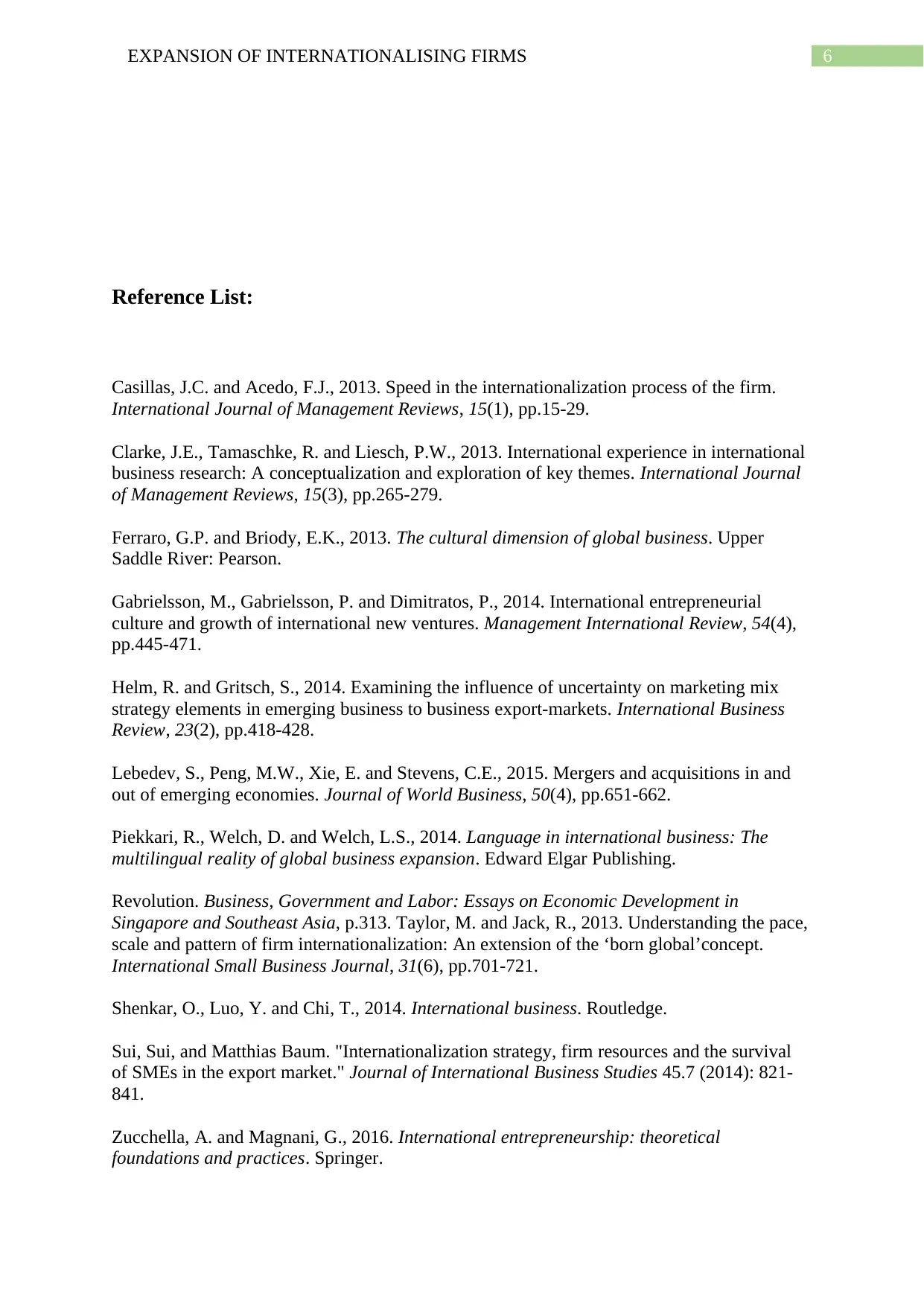
Reference List:
Casillas, J.C. and Acedo, F.J., 2013. Speed in the internationalization process of the firm.
International Journal of Management Reviews, 15(1), pp.15-29.
Clarke, J.E., Tamaschke, R. and Liesch, P.W., 2013. International experience in international
business research: A conceptualization and exploration of key themes. International Journal
of Management Reviews, 15(3), pp.265-279.
Ferraro, G.P. and Briody, E.K., 2013. The cultural dimension of global business. Upper
Saddle River: Pearson.
Gabrielsson, M., Gabrielsson, P. and Dimitratos, P., 2014. International entrepreneurial
culture and growth of international new ventures. Management International Review, 54(4),
pp.445-471.
Helm, R. and Gritsch, S., 2014. Examining the influence of uncertainty on marketing mix
strategy elements in emerging business to business export-markets. International Business
Review, 23(2), pp.418-428.
Lebedev, S., Peng, M.W., Xie, E. and Stevens, C.E., 2015. Mergers and acquisitions in and
out of emerging economies. Journal of World Business, 50(4), pp.651-662.
Piekkari, R., Welch, D. and Welch, L.S., 2014. Language in international business: The
multilingual reality of global business expansion. Edward Elgar Publishing.
Revolution. Business, Government and Labor: Essays on Economic Development in
Singapore and Southeast Asia, p.313. Taylor, M. and Jack, R., 2013. Understanding the pace,
scale and pattern of firm internationalization: An extension of the ‘born global’concept.
International Small Business Journal, 31(6), pp.701-721.
Shenkar, O., Luo, Y. and Chi, T., 2014. International business. Routledge.
Sui, Sui, and Matthias Baum. "Internationalization strategy, firm resources and the survival
of SMEs in the export market." Journal of International Business Studies 45.7 (2014): 821-
841.
Zucchella, A. and Magnani, G., 2016. International entrepreneurship: theoretical
foundations and practices. Springer.
Reference List:
Casillas, J.C. and Acedo, F.J., 2013. Speed in the internationalization process of the firm.
International Journal of Management Reviews, 15(1), pp.15-29.
Clarke, J.E., Tamaschke, R. and Liesch, P.W., 2013. International experience in international
business research: A conceptualization and exploration of key themes. International Journal
of Management Reviews, 15(3), pp.265-279.
Ferraro, G.P. and Briody, E.K., 2013. The cultural dimension of global business. Upper
Saddle River: Pearson.
Gabrielsson, M., Gabrielsson, P. and Dimitratos, P., 2014. International entrepreneurial
culture and growth of international new ventures. Management International Review, 54(4),
pp.445-471.
Helm, R. and Gritsch, S., 2014. Examining the influence of uncertainty on marketing mix
strategy elements in emerging business to business export-markets. International Business
Review, 23(2), pp.418-428.
Lebedev, S., Peng, M.W., Xie, E. and Stevens, C.E., 2015. Mergers and acquisitions in and
out of emerging economies. Journal of World Business, 50(4), pp.651-662.
Piekkari, R., Welch, D. and Welch, L.S., 2014. Language in international business: The
multilingual reality of global business expansion. Edward Elgar Publishing.
Revolution. Business, Government and Labor: Essays on Economic Development in
Singapore and Southeast Asia, p.313. Taylor, M. and Jack, R., 2013. Understanding the pace,
scale and pattern of firm internationalization: An extension of the ‘born global’concept.
International Small Business Journal, 31(6), pp.701-721.
Shenkar, O., Luo, Y. and Chi, T., 2014. International business. Routledge.
Sui, Sui, and Matthias Baum. "Internationalization strategy, firm resources and the survival
of SMEs in the export market." Journal of International Business Studies 45.7 (2014): 821-
841.
Zucchella, A. and Magnani, G., 2016. International entrepreneurship: theoretical
foundations and practices. Springer.
Paraphrase This Document
Need a fresh take? Get an instant paraphrase of this document with our AI Paraphraser

7EXPANSION OF INTERNATIONALISING FIRMS
Lim, L.Y., 2017. Southeast Asian Chinese business: Past success, recent crisis and future
1 out of 8
Related Documents
Your All-in-One AI-Powered Toolkit for Academic Success.
+13062052269
info@desklib.com
Available 24*7 on WhatsApp / Email
Unlock your academic potential
Copyright © 2020–2025 A2Z Services. All Rights Reserved. Developed and managed by ZUCOL.