Systems Approach for Managing Complexity: First Equilease Analysis
VerifiedAdded on 2023/04/25
|26
|6522
|494
Report
AI Summary
This report provides a comprehensive analysis of First Equilease, a Kuwait-based equipment leasing company, focusing on the complexities it faces in managing its operations, particularly concerning legal and financial implications, and equipment responsibility across different Middle Eastern countries. The analysis employs various tools such as Hard Systems Methodology (HSM), SWOT analysis, Logo frame, BECM, and stakeholder analysis to dissect the problems and propose solutions. The report identifies key issues, including the diverse legal systems, responsibility for equipment wear and tear, and financial implications, with a detailed examination of the challenges associated with equipment responsibility. Stakeholder perspectives are considered, and ethical considerations are outlined. The report concludes with recommended solutions based on the HSM analysis, emphasizing the need for unified policies and improved digital and analytical capabilities to enhance operational efficiency and reduce complexity. The document also reflects on the lessons learned and the problems encountered during the project.

Running head: SYSTEMS APPROACH FOR MANAGING COMPLEXITY
Systems Approach for Managing Complexity
Name of the Student
Name of the University
Author Note
Systems Approach for Managing Complexity
Name of the Student
Name of the University
Author Note

Paraphrase This Document
Need a fresh take? Get an instant paraphrase of this document with our AI Paraphraser
1SYSTEMS APPROACH FOR MANAGING COMPLEXITY
Table of Contents
Q1. Tutor Report: First Equilease Company..............................................................................2
1.1 Background of the Case Study.........................................................................................2
1.2 Departments in the organization......................................................................................3
1.3 Description of the Problem Situation...............................................................................4
1.3.1 Complex situation and problems in First Equilease..................................................4
1.3.2 One complex issue....................................................................................................5
1.4 View of the Stakeholders.................................................................................................6
1.5 Ethicality Statement.........................................................................................................6
Q2. Analysis of the Case............................................................................................................7
2.1 HSM analysis...................................................................................................................7
2.2 SWOT analysis.................................................................................................................9
2.3 Logo frame.....................................................................................................................11
2.4 BECM............................................................................................................................11
2.5 Stakeholder Analysis......................................................................................................13
2.6 Explanation of the problem............................................................................................14
2.7 Understanding of the complexity...................................................................................15
2.8 Conceptual Mapping......................................................................................................16
Q3. Client Report.....................................................................................................................16
3.1 Definition of the Problem...............................................................................................16
3.2 Probable Solutions.........................................................................................................17
3.3 System Thinking and probable solution.........................................................................17
3.4 Recommended solution based on HSM.........................................................................17
Q4. Weekly and General Summary.........................................................................................18
4.1 Weekly Summary: Learned lessons and Skills..............................................................18
4.2 General Summary: Problems faced while doing the project..........................................19
4.3 Solving the problems......................................................................................................22
References................................................................................................................................23
Table of Contents
Q1. Tutor Report: First Equilease Company..............................................................................2
1.1 Background of the Case Study.........................................................................................2
1.2 Departments in the organization......................................................................................3
1.3 Description of the Problem Situation...............................................................................4
1.3.1 Complex situation and problems in First Equilease..................................................4
1.3.2 One complex issue....................................................................................................5
1.4 View of the Stakeholders.................................................................................................6
1.5 Ethicality Statement.........................................................................................................6
Q2. Analysis of the Case............................................................................................................7
2.1 HSM analysis...................................................................................................................7
2.2 SWOT analysis.................................................................................................................9
2.3 Logo frame.....................................................................................................................11
2.4 BECM............................................................................................................................11
2.5 Stakeholder Analysis......................................................................................................13
2.6 Explanation of the problem............................................................................................14
2.7 Understanding of the complexity...................................................................................15
2.8 Conceptual Mapping......................................................................................................16
Q3. Client Report.....................................................................................................................16
3.1 Definition of the Problem...............................................................................................16
3.2 Probable Solutions.........................................................................................................17
3.3 System Thinking and probable solution.........................................................................17
3.4 Recommended solution based on HSM.........................................................................17
Q4. Weekly and General Summary.........................................................................................18
4.1 Weekly Summary: Learned lessons and Skills..............................................................18
4.2 General Summary: Problems faced while doing the project..........................................19
4.3 Solving the problems......................................................................................................22
References................................................................................................................................23
2SYSTEMS APPROACH FOR MANAGING COMPLEXITY
Q1. Tutor Report: First Equilease Company
1.1 Background of the Case Study
The organization of First Equilease is an organization based in Kuwait, and it was
established in the year 2005. They mostly indulge in the leasing of equipment focusing on the
regions of Middle East. This particular organization is mostly known for its solutions that the
customers have pointed out to be trend-setting and innovative at the same time. The approach
that the organization follows throughout in their business is centred around the customers
solely. They are known to maintain proper ethical standards and are absolutely focused on the
sustainability of the organization having a sense of responsibility for the clients and the
environment at the same time through their services. The research had brought about several
surprises for the organization of First Equilease where the economies begin in around 8
billion to 10 billion for asset under management or AUM. The expected efficiency of this
organisation was found to be absent within these organisations and it was seen that this
economies of scale across finance human resources, operations and compliance was found it
every step within the organisation (Sainati, Brookes and Locatelli 2017). It was found that
especially in private equity the large firms are much less efficient than the small and medium-
sized organisations when it was calculated for the efficiency in private equity.
This complexity has been a growing problem within the industry and it is seen that
due to the feeling of this particular complexity management issue is resulting in buyout of
firms. The private equity industry has now been expanding in measuring in many ways in the
past 30 years and the problems have become much more complex in the recent times (Pinto
2017). It was found that the solutions have how to be having their own challenges adding to
inefficiency in expanding cost considerable and inhibiting scalability.
Q1. Tutor Report: First Equilease Company
1.1 Background of the Case Study
The organization of First Equilease is an organization based in Kuwait, and it was
established in the year 2005. They mostly indulge in the leasing of equipment focusing on the
regions of Middle East. This particular organization is mostly known for its solutions that the
customers have pointed out to be trend-setting and innovative at the same time. The approach
that the organization follows throughout in their business is centred around the customers
solely. They are known to maintain proper ethical standards and are absolutely focused on the
sustainability of the organization having a sense of responsibility for the clients and the
environment at the same time through their services. The research had brought about several
surprises for the organization of First Equilease where the economies begin in around 8
billion to 10 billion for asset under management or AUM. The expected efficiency of this
organisation was found to be absent within these organisations and it was seen that this
economies of scale across finance human resources, operations and compliance was found it
every step within the organisation (Sainati, Brookes and Locatelli 2017). It was found that
especially in private equity the large firms are much less efficient than the small and medium-
sized organisations when it was calculated for the efficiency in private equity.
This complexity has been a growing problem within the industry and it is seen that
due to the feeling of this particular complexity management issue is resulting in buyout of
firms. The private equity industry has now been expanding in measuring in many ways in the
past 30 years and the problems have become much more complex in the recent times (Pinto
2017). It was found that the solutions have how to be having their own challenges adding to
inefficiency in expanding cost considerable and inhibiting scalability.
⊘ This is a preview!⊘
Do you want full access?
Subscribe today to unlock all pages.

Trusted by 1+ million students worldwide
3SYSTEMS APPROACH FOR MANAGING COMPLEXITY
1.2 Departments in the organization
There are various departments within the organization of First Equilease that enable
the use of the services of the organization for various purposes to their customers. These
departments, based on which the organization provides services to their customers can be
listed as follows:
Financial/Capital Lease: This particular department ensures that the
customer can retain the equipment after the completion of their use. This is the
way by which the flexibility of the services is retained.
Operating/True Lease: This department is the best possible way for the
customers who would like to lease the equipment they require for only for a
short period of time for a specific period of an ongoing project. This
department provides the best possible solution to the customers who require
the equipment for a short period of time at the lowest possible prices without
any residual risk of end of lease term.
Sales and Leaseback: This department helps the customer who has owned the
equipment already would like to free up capital tied up in the equipment for
use in business expansion.
Hire Purchase Lease: This department allows the customers to use the
equipment for a shorter period of time with the exchange of regular payments.
Short-Term Rental: This department provides the scope to the customers to
rent the equipment without having to deal with the maintenance or operation
of the equipment.
Tracking of equipment: This department creates a specific service to the
clients with the help of providing them with effective tracking of the
1.2 Departments in the organization
There are various departments within the organization of First Equilease that enable
the use of the services of the organization for various purposes to their customers. These
departments, based on which the organization provides services to their customers can be
listed as follows:
Financial/Capital Lease: This particular department ensures that the
customer can retain the equipment after the completion of their use. This is the
way by which the flexibility of the services is retained.
Operating/True Lease: This department is the best possible way for the
customers who would like to lease the equipment they require for only for a
short period of time for a specific period of an ongoing project. This
department provides the best possible solution to the customers who require
the equipment for a short period of time at the lowest possible prices without
any residual risk of end of lease term.
Sales and Leaseback: This department helps the customer who has owned the
equipment already would like to free up capital tied up in the equipment for
use in business expansion.
Hire Purchase Lease: This department allows the customers to use the
equipment for a shorter period of time with the exchange of regular payments.
Short-Term Rental: This department provides the scope to the customers to
rent the equipment without having to deal with the maintenance or operation
of the equipment.
Tracking of equipment: This department creates a specific service to the
clients with the help of providing them with effective tracking of the
Paraphrase This Document
Need a fresh take? Get an instant paraphrase of this document with our AI Paraphraser
4SYSTEMS APPROACH FOR MANAGING COMPLEXITY
equipment that they have rented or leased to enable better utilization of the
equipment to the customer.
1.3 Description of the Problem Situation
The problem with the organization of First Equilease has been the management of
complexity within the projects that they have been taken in and the way in which the
economy is handled within these organisations. In this particular case dealt with the
organisation of First Equilease, it has been found that the private equity firms and the
managers of the private market admin slowly turning to digital tools for improving the
complexity within the business that results to buyouts of the company (Stowell 2017). This
particular report will look about in specific parts within the organisation that has been
increasingly complex while handling a project and managing it. This is also addressed the
problems regarding that digital and analytical capabilities of the organisation that primarily
focuses on improving the operational efficiency and at the same time tries to reduce the
complexity that has been increasing within the organisation.
1.3.1 Complex situation and problems in First Equilease
There have been various identified problems that may lead to complexity within
handling the projects for the organization. Being an organization dedicated to lease or rent the
construction equipment as a service to the other companies based in Kuwait, there are several
issues that needs to be identified to make sure that the complex problems within the projects
and the business is detected and appropriate measures are taking against them. Following
would be 3 of these identified problems. One of these problems would be elaborated further
about their causes and effects or their complex situations along with the opinion of the 3
stakeholders about the issues:
equipment that they have rented or leased to enable better utilization of the
equipment to the customer.
1.3 Description of the Problem Situation
The problem with the organization of First Equilease has been the management of
complexity within the projects that they have been taken in and the way in which the
economy is handled within these organisations. In this particular case dealt with the
organisation of First Equilease, it has been found that the private equity firms and the
managers of the private market admin slowly turning to digital tools for improving the
complexity within the business that results to buyouts of the company (Stowell 2017). This
particular report will look about in specific parts within the organisation that has been
increasingly complex while handling a project and managing it. This is also addressed the
problems regarding that digital and analytical capabilities of the organisation that primarily
focuses on improving the operational efficiency and at the same time tries to reduce the
complexity that has been increasing within the organisation.
1.3.1 Complex situation and problems in First Equilease
There have been various identified problems that may lead to complexity within
handling the projects for the organization. Being an organization dedicated to lease or rent the
construction equipment as a service to the other companies based in Kuwait, there are several
issues that needs to be identified to make sure that the complex problems within the projects
and the business is detected and appropriate measures are taking against them. Following
would be 3 of these identified problems. One of these problems would be elaborated further
about their causes and effects or their complex situations along with the opinion of the 3
stakeholders about the issues:
5SYSTEMS APPROACH FOR MANAGING COMPLEXITY
1. Laws Governing the Operation of the Leases and their ever changing
nature: Leases are mostly identified to be following two specific kinds of
broad categories. One of them is capital leases and the other one is known as
operating leases. Where the former is designed for the facilitation of the
ownership, where on the other hand the latter is used for the rental agreements
and the options to buy them at the end of the lease. However, since the
organization is based in Kuwait and leases their equipment to people focusing
mostly on the Middle Eastern customers, there are possibilities that the
organization might face issues regarding the varied laws that govern the lease
operation laws from one country to another.
2. Responsibility of the equipment: There is a possibility that the equipment
can suffer excessive wear and tear which the customers might not want to take
responsibility about. This is also regarded as a potential issue that might cause
severe problems and complexity for the organization.
3. Financial Implications: There is taxation and renting issues that can lead to
severe complexity issues in the organization, leading to financial
disinformation and improper handling of the finances. This requires a financial
manager to handle the issues.
1.3.2 One complex issue
One of the most complex issues that are identified amongst the three issues
discovered is the responsibility of the equipment, which often is found to be the most
complex problem. There are various ways by which the equipment under lease or rent can be
found to be falling vulnerable to wear and tear. For this, it is found that the organizations
have rented the equipment do not wish to take responsibility of the damages to the
1. Laws Governing the Operation of the Leases and their ever changing
nature: Leases are mostly identified to be following two specific kinds of
broad categories. One of them is capital leases and the other one is known as
operating leases. Where the former is designed for the facilitation of the
ownership, where on the other hand the latter is used for the rental agreements
and the options to buy them at the end of the lease. However, since the
organization is based in Kuwait and leases their equipment to people focusing
mostly on the Middle Eastern customers, there are possibilities that the
organization might face issues regarding the varied laws that govern the lease
operation laws from one country to another.
2. Responsibility of the equipment: There is a possibility that the equipment
can suffer excessive wear and tear which the customers might not want to take
responsibility about. This is also regarded as a potential issue that might cause
severe problems and complexity for the organization.
3. Financial Implications: There is taxation and renting issues that can lead to
severe complexity issues in the organization, leading to financial
disinformation and improper handling of the finances. This requires a financial
manager to handle the issues.
1.3.2 One complex issue
One of the most complex issues that are identified amongst the three issues
discovered is the responsibility of the equipment, which often is found to be the most
complex problem. There are various ways by which the equipment under lease or rent can be
found to be falling vulnerable to wear and tear. For this, it is found that the organizations
have rented the equipment do not wish to take responsibility of the damages to the
⊘ This is a preview!⊘
Do you want full access?
Subscribe today to unlock all pages.
Trusted by 1+ million students worldwide
6SYSTEMS APPROACH FOR MANAGING COMPLEXITY
equipment. This is a burden to the organization that needs to be taken care of within the
organization. This can also be regarded as a complex problem since it is often found that the
impact or effect that it has on the organization can be influencing the financial department
and can also be found to be having an impact on the inventory management department.
1.4 View of the Stakeholders
The stakeholders often view the complexities in the handling of the project
complexities from different perspectives. Every stakeholder involved within the project for
the organisation of First Equilease, could be affected by this complexity within the project
and the issues directly or indirectly view the vulnerabilities and issues from various
perspectives given their involvement within the organisation. The people who would be
affected the most are the organisation itself and further they cannot provide the appropriate
services to the customers. From the executive within the company to everybody involved
within 8 including the end users, which are the customers can be regarded as stakeholders and
these problems effects of the stakeholders in different ways.
1.5 Ethicality Statement
The ethicality statement in this particular management of complexity within the
project would set out the ethical aspirations that the organisation would implement in their
aspiration of working with the other organisations and releasing them equipment. For this
particular reason that company would like to state that there would be absolutely ethical in
terms of their releasing of equipment to other organisation all over Middle East providing
them the required equipment without avoiding any legislative terms of the country in which
the organisation has been residing in.
equipment. This is a burden to the organization that needs to be taken care of within the
organization. This can also be regarded as a complex problem since it is often found that the
impact or effect that it has on the organization can be influencing the financial department
and can also be found to be having an impact on the inventory management department.
1.4 View of the Stakeholders
The stakeholders often view the complexities in the handling of the project
complexities from different perspectives. Every stakeholder involved within the project for
the organisation of First Equilease, could be affected by this complexity within the project
and the issues directly or indirectly view the vulnerabilities and issues from various
perspectives given their involvement within the organisation. The people who would be
affected the most are the organisation itself and further they cannot provide the appropriate
services to the customers. From the executive within the company to everybody involved
within 8 including the end users, which are the customers can be regarded as stakeholders and
these problems effects of the stakeholders in different ways.
1.5 Ethicality Statement
The ethicality statement in this particular management of complexity within the
project would set out the ethical aspirations that the organisation would implement in their
aspiration of working with the other organisations and releasing them equipment. For this
particular reason that company would like to state that there would be absolutely ethical in
terms of their releasing of equipment to other organisation all over Middle East providing
them the required equipment without avoiding any legislative terms of the country in which
the organisation has been residing in.
Paraphrase This Document
Need a fresh take? Get an instant paraphrase of this document with our AI Paraphraser
7SYSTEMS APPROACH FOR MANAGING COMPLEXITY
Along with that the company would like to specify their customers that they would
have all specified documentation and paper work that will effectively define all the terms and
conditions that the organisation has set for leaving the equipment and handling their and here
at the same time during the usage and would also like to ensure that customers that only after
they have completely resolved and accepted the terms and conditions of the organisation they
would be able to receive their services (Eriksson, Larsson and Pesämaa 2017). None of the
provided services would be available without any documentation process and the acceptance
of both the parties.
Q2. Analysis of the Case
The analysis would be based on 5 basic tools that would analyse First Equilease and it
service of lending equipment to other organization as their services and expanded over the
number of legal entities that this organisation creates for housing that products, operations
and assets (Lam and Law 2016). The analysis would include HSM method, SWOT analysis,
Logo frame, BECM and Stakeholder Analysis.
2.1 HSM analysis
The HSM analysis or the Hard Systems method analysis understands that the problem
is not a general case, rather than this case is has special issues that deals with the problems
that equipment leasing organizations deal with in specific cases where they organizations that
First Equilease is dealing with is established in countries outside Kuwait. This analyses and
states the fact that the organization needs to develop unified policies to keep on with the
operations of the organization. These would be done by analysing the below mentioned
activities in the project:
Along with that the company would like to specify their customers that they would
have all specified documentation and paper work that will effectively define all the terms and
conditions that the organisation has set for leaving the equipment and handling their and here
at the same time during the usage and would also like to ensure that customers that only after
they have completely resolved and accepted the terms and conditions of the organisation they
would be able to receive their services (Eriksson, Larsson and Pesämaa 2017). None of the
provided services would be available without any documentation process and the acceptance
of both the parties.
Q2. Analysis of the Case
The analysis would be based on 5 basic tools that would analyse First Equilease and it
service of lending equipment to other organization as their services and expanded over the
number of legal entities that this organisation creates for housing that products, operations
and assets (Lam and Law 2016). The analysis would include HSM method, SWOT analysis,
Logo frame, BECM and Stakeholder Analysis.
2.1 HSM analysis
The HSM analysis or the Hard Systems method analysis understands that the problem
is not a general case, rather than this case is has special issues that deals with the problems
that equipment leasing organizations deal with in specific cases where they organizations that
First Equilease is dealing with is established in countries outside Kuwait. This analyses and
states the fact that the organization needs to develop unified policies to keep on with the
operations of the organization. These would be done by analysing the below mentioned
activities in the project:
8SYSTEMS APPROACH FOR MANAGING COMPLEXITY
Problem/Opportunity (diversity of legal systems): The problem regarding the
management of this project deals with the diversity of the legal and taxation system in which
the company functions out of the country that it is established in.
Implementation (Legislative and Taxation Policy): The possible solution to this
problem deals with the implementation of a new legislation and taxation policy to be
implemented within the organizational policy.
Choice: Two choices can be considered for achieving a solution for the problem that
has been identified: 1. To carry on the project within country 2. To carry on the project
outside the country
Option Testing: Both of the options are tested to find out the possible inferred
solution to the problem that is found out to be developing other options preferred as well.
Developing Options: Trying both these options, there was a possibility of another
option developed, which was developing a unified policy so that the company can operate
both within the country and outside the country.
Measuring Performances: Measuring the performances are required to find out how
the developed option is working right now.
Defining Objectives: The objectives are to be defined after finding out the
performance measurement.
Analysing Situation: The situation is to be analysed to find out the feasibility of the
developed option, so that it could be easily put up with how the situation needs to be handled.
Problem/Opportunity (diversity of legal systems): The problem regarding the
management of this project deals with the diversity of the legal and taxation system in which
the company functions out of the country that it is established in.
Implementation (Legislative and Taxation Policy): The possible solution to this
problem deals with the implementation of a new legislation and taxation policy to be
implemented within the organizational policy.
Choice: Two choices can be considered for achieving a solution for the problem that
has been identified: 1. To carry on the project within country 2. To carry on the project
outside the country
Option Testing: Both of the options are tested to find out the possible inferred
solution to the problem that is found out to be developing other options preferred as well.
Developing Options: Trying both these options, there was a possibility of another
option developed, which was developing a unified policy so that the company can operate
both within the country and outside the country.
Measuring Performances: Measuring the performances are required to find out how
the developed option is working right now.
Defining Objectives: The objectives are to be defined after finding out the
performance measurement.
Analysing Situation: The situation is to be analysed to find out the feasibility of the
developed option, so that it could be easily put up with how the situation needs to be handled.
⊘ This is a preview!⊘
Do you want full access?
Subscribe today to unlock all pages.
Trusted by 1+ million students worldwide
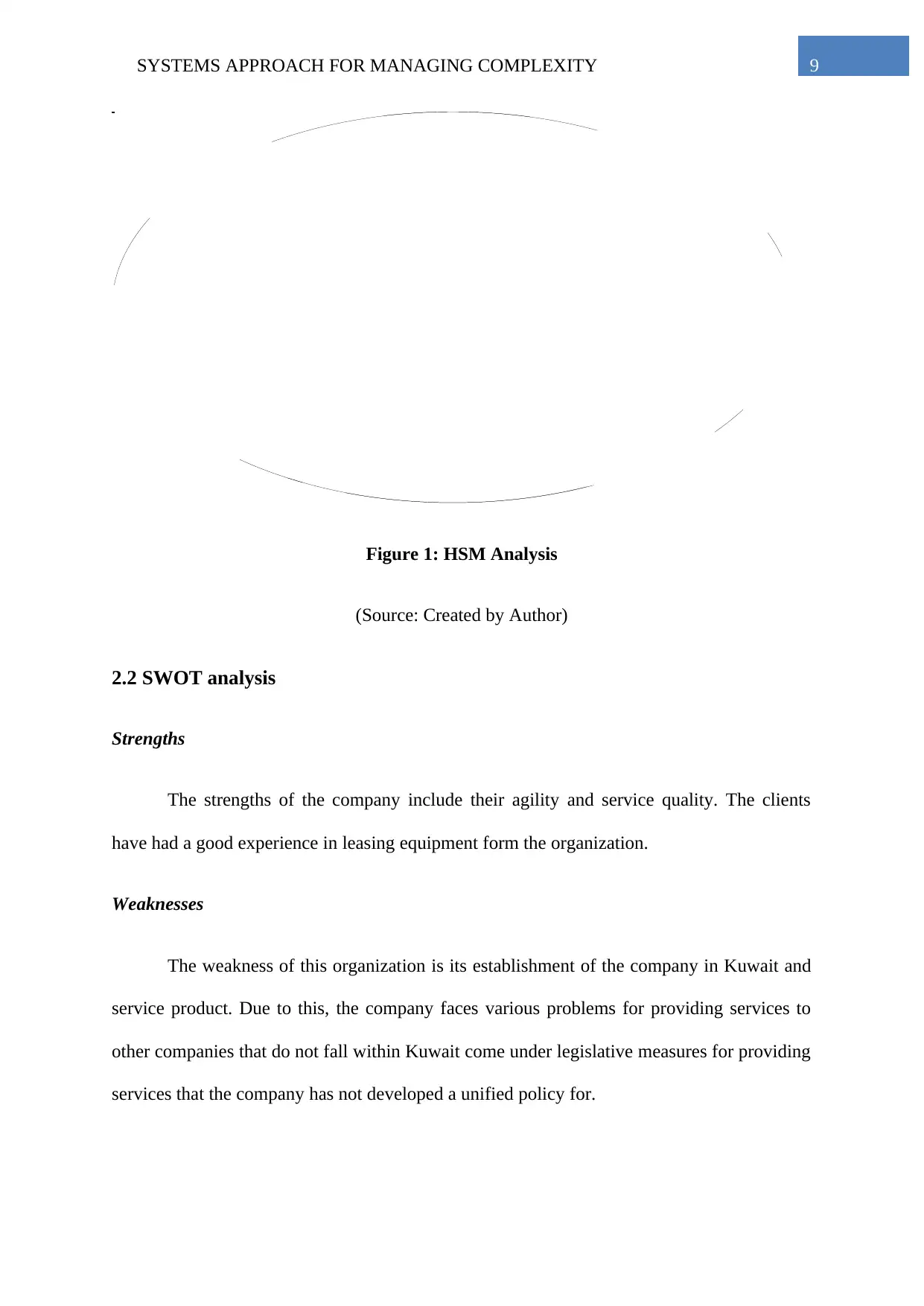
9SYSTEMS APPROACH FOR MANAGING COMPLEXITY
Figure 1: HSM Analysis
(Source: Created by Author)
2.2 SWOT analysis
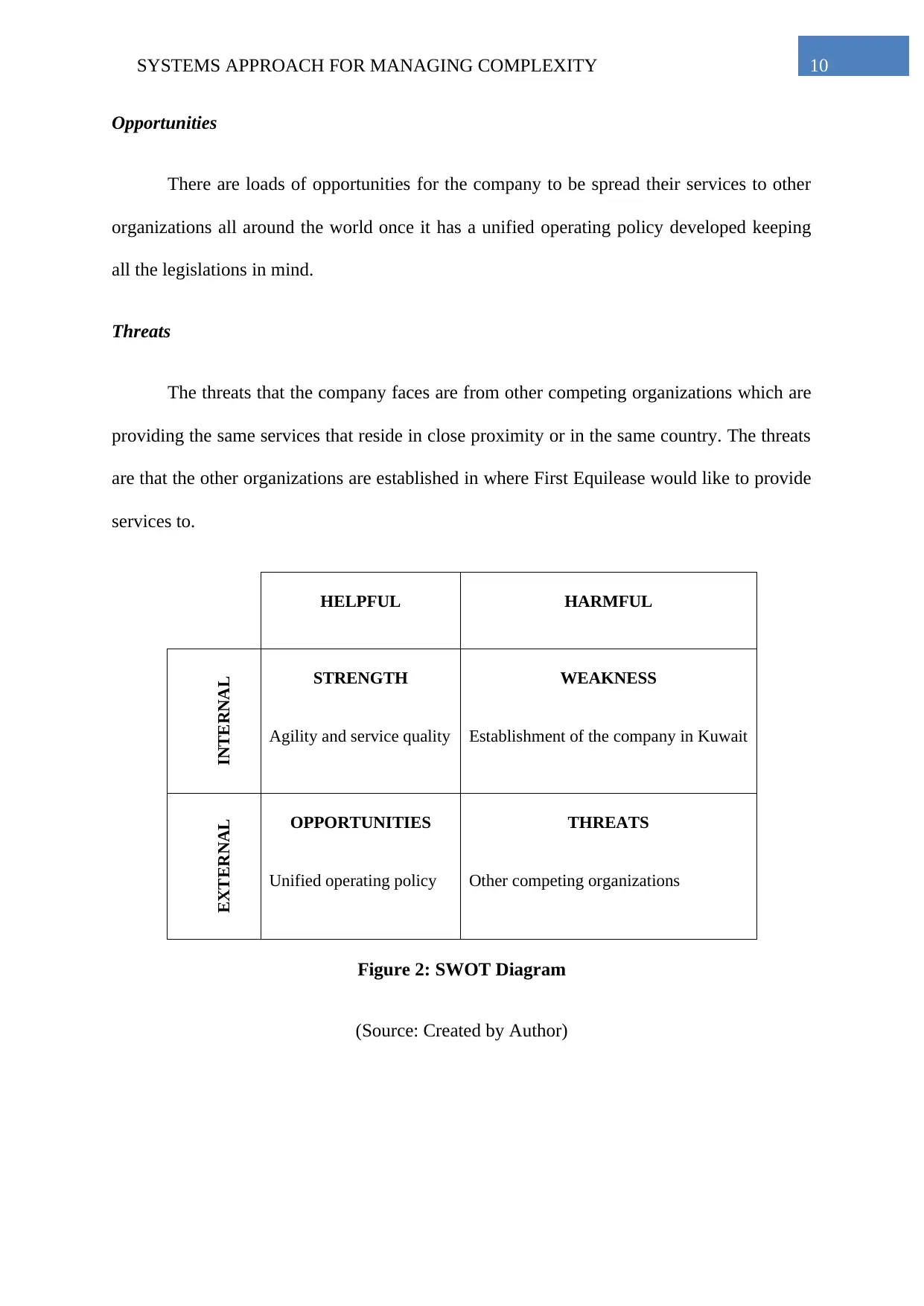
Strengths
The strengths of the company include their agility and service quality. The clients
have had a good experience in leasing equipment form the organization.
Weaknesses
The weakness of this organization is its establishment of the company in Kuwait and
service product. Due to this, the company faces various problems for providing services to
other companies that do not fall within Kuwait come under legislative measures for providing
services that the company has not developed a unified policy for.
Proble m/Opp ortunity(diver sityofle galsystem s) Implem entati on(Legisl ativean dTaxati onPolicy ) Choice -1.Wit hinCou ntry
2.Out sideCo untryOption Testin g
Develo pingO ptions
Measu ringPerfor mancesDefini ngObjec tives
Analys ingSitu ation
Figure 1: HSM Analysis
(Source: Created by Author)
2.2 SWOT analysis
Strengths
The strengths of the company include their agility and service quality. The clients
have had a good experience in leasing equipment form the organization.
Weaknesses
The weakness of this organization is its establishment of the company in Kuwait and
service product. Due to this, the company faces various problems for providing services to
other companies that do not fall within Kuwait come under legislative measures for providing
services that the company has not developed a unified policy for.
Proble m/Opp ortunity(diver sityofle galsystem s) Implem entati on(Legisl ativean dTaxati onPolicy ) Choice -1.Wit hinCou ntry
2.Out sideCo untryOption Testin g
Develo pingO ptions
Measu ringPerfor mancesDefini ngObjec tives
Analys ingSitu ation
Paraphrase This Document
Need a fresh take? Get an instant paraphrase of this document with our AI Paraphraser
10SYSTEMS APPROACH FOR MANAGING COMPLEXITY
Opportunities
There are loads of opportunities for the company to be spread their services to other
organizations all around the world once it has a unified operating policy developed keeping
all the legislations in mind.
Threats
The threats that the company faces are from other competing organizations which are
providing the same services that reside in close proximity or in the same country. The threats
are that the other organizations are established in where First Equilease would like to provide
services to.
HELPFUL HARMFUL
INTERNAL
ORIGIN STRENGTH
Agility and service quality
WEAKNESS
Establishment of the company in Kuwait
EXTERNAL
ORIGIN OPPORTUNITIES
Unified operating policy
THREATS
Other competing organizations
Figure 2: SWOT Diagram
(Source: Created by Author)
Opportunities
There are loads of opportunities for the company to be spread their services to other
organizations all around the world once it has a unified operating policy developed keeping
all the legislations in mind.
Threats
The threats that the company faces are from other competing organizations which are
providing the same services that reside in close proximity or in the same country. The threats
are that the other organizations are established in where First Equilease would like to provide
services to.
HELPFUL HARMFUL
INTERNAL
ORIGIN STRENGTH
Agility and service quality
WEAKNESS
Establishment of the company in Kuwait
EXTERNAL
ORIGIN OPPORTUNITIES
Unified operating policy
THREATS
Other competing organizations
Figure 2: SWOT Diagram
(Source: Created by Author)
11SYSTEMS APPROACH FOR MANAGING COMPLEXITY
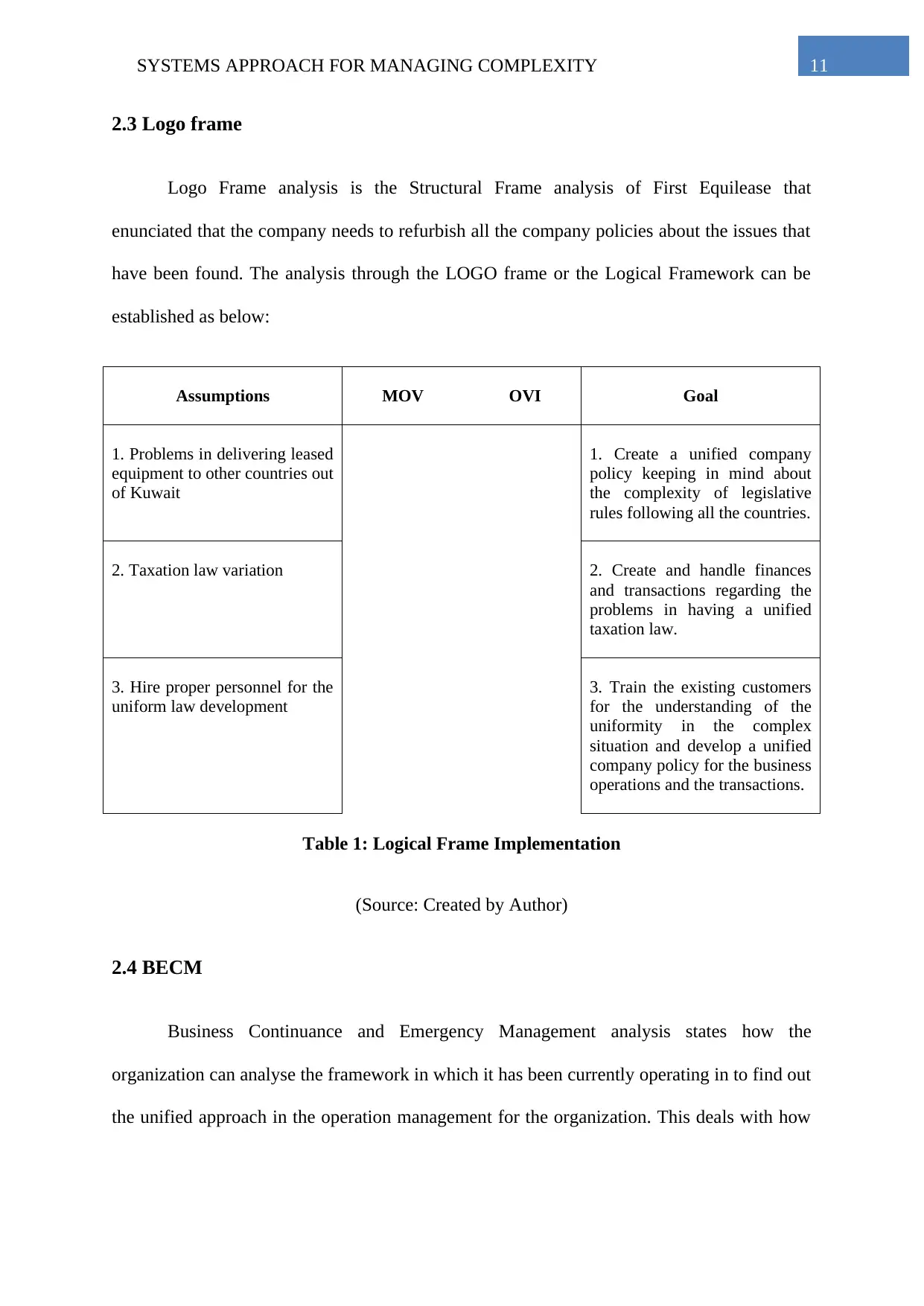
2.3 Logo frame
Logo Frame analysis is the Structural Frame analysis of First Equilease that
enunciated that the company needs to refurbish all the company policies about the issues that
have been found. The analysis through the LOGO frame or the Logical Framework can be
established as below:
Assumptions MOV OVI Goal
1. Problems in delivering leased
equipment to other countries out
of Kuwait
1. Create a unified company
policy keeping in mind about
the complexity of legislative
rules following all the countries.
2. Taxation law variation 2. Create and handle finances
and transactions regarding the
problems in having a unified
taxation law.
3. Hire proper personnel for the
uniform law development
3. Train the existing customers
for the understanding of the
uniformity in the complex
situation and develop a unified
company policy for the business
operations and the transactions.
Table 1: Logical Frame Implementation
(Source: Created by Author)
2.4 BECM
Business Continuance and Emergency Management analysis states how the
organization can analyse the framework in which it has been currently operating in to find out
the unified approach in the operation management for the organization. This deals with how
2.3 Logo frame
Logo Frame analysis is the Structural Frame analysis of First Equilease that
enunciated that the company needs to refurbish all the company policies about the issues that
have been found. The analysis through the LOGO frame or the Logical Framework can be
established as below:
Assumptions MOV OVI Goal
1. Problems in delivering leased
equipment to other countries out
of Kuwait
1. Create a unified company
policy keeping in mind about
the complexity of legislative
rules following all the countries.
2. Taxation law variation 2. Create and handle finances
and transactions regarding the
problems in having a unified
taxation law.
3. Hire proper personnel for the
uniform law development
3. Train the existing customers
for the understanding of the
uniformity in the complex
situation and develop a unified
company policy for the business
operations and the transactions.
Table 1: Logical Frame Implementation
(Source: Created by Author)
2.4 BECM
Business Continuance and Emergency Management analysis states how the
organization can analyse the framework in which it has been currently operating in to find out
the unified approach in the operation management for the organization. This deals with how
⊘ This is a preview!⊘
Do you want full access?
Subscribe today to unlock all pages.
Trusted by 1+ million students worldwide

1 out of 26


Related Documents


Your All-in-One AI-Powered Toolkit for Academic Success.
+13062052269
info@desklib.com
Available 24*7 on WhatsApp / Email
![[object Object]](/_next/static/media/star-bottom.7253800d.svg)
Unlock your academic potential
Copyright © 2020–2026 A2Z Services. All Rights Reserved. Developed and managed by ZUCOL.