Analyzing the Impact of the India Act on First Nations Governance

Verified

Added on  2022/08/23

|7
|1157
|21
Essay
AI Summary
This essay examines the India Act of 1876, a federal law in Canada, and its profound impact on the lives and governance of First Nations people. The essay begins by outlining the historical context, purpose, and implementation of the Act, highlighting its role in shaping the relationship between the Canadian government and Indigenous communities. It then delves into the Act's effects on First Nations governance, including the imposition of elected band governance systems, the limitations on voting rights, and the disruption of traditional governance structures. The essay further analyzes the loopholes and shortcomings of the Act, such as its failure to address traditional leadership methods and the perpetuation of nepotism. It also discusses changes made to the Act, such as Bill C-31, which aimed to address gender discrimination. The essay concludes by emphasizing the need for policy makers to consider the subsidiarity principle and for First Nations to pursue policy regimes that protect their rights and interests. The essay draws upon the provided research materials to support its claims and provides a comprehensive overview of the India Act's impact on First Nations.
Document Page
Running head: INDIA ACT
INDIA ACT
Name of the Student
Name of the University
Author Note
tabler-icon-diamond-filled.svg

Paraphrase This Document

Need a fresh take? Get an instant paraphrase of this document with our AI Paraphraser
Document Page
INDIA ACT
Abstract
The primary aim of the essay is to discuss the implementation of India Act and how it
affected the life of the aboriginal people as well as the First Nations. The paper further talks
about how the Act came into execution and why was it devised as well as implemented. Then
the paper goes on to discuss the impact of the Act on the First Nations and the loopholes
present in the Act. Finally the paper discusses some of the revised policies within the Act that
was earlier considered to be unjust and unfair and also lays down some recommendations for
the First Nations.
Document Page
INDIA ACT
Table of Contents
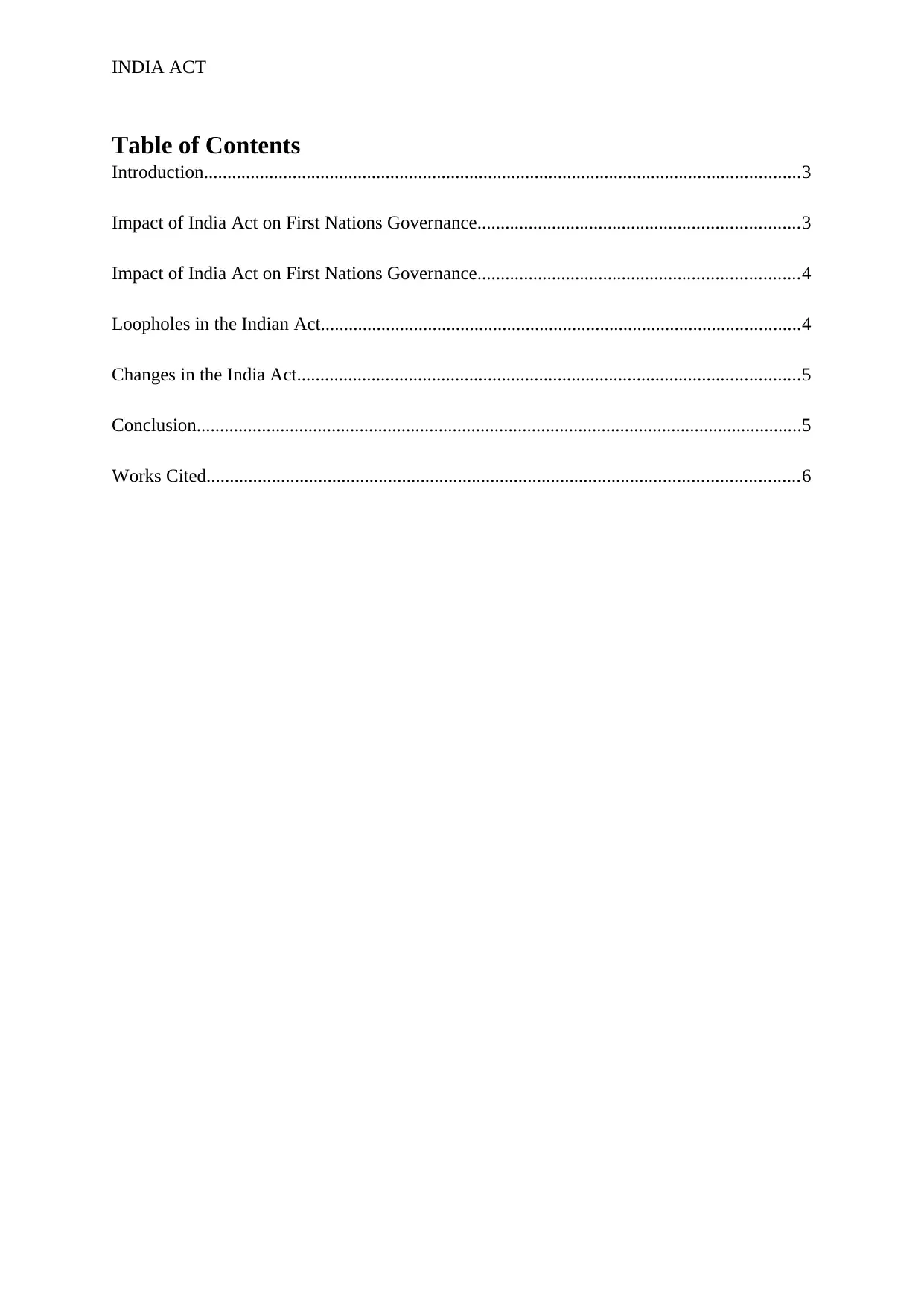
Introduction................................................................................................................................3
Impact of India Act on First Nations Governance.....................................................................3
Impact of India Act on First Nations Governance.....................................................................4
Loopholes in the Indian Act.......................................................................................................4
Changes in the India Act............................................................................................................5
Conclusion..................................................................................................................................5
Works Cited...............................................................................................................................6
Document Page
INDIA ACT
Introduction
The India Act of 1876 is a federal law of Canada where the federal government were
granted exclusive rights to create a legislation in regard to the status of India, Indian bands as
well as reserves (Kelm, Mary and Smith). India Act of 1867 had a purpose. As Canada was
created in 1867 it was the responsibility of the federal government to look after the affairs of
the aborigines. Therefore, the India Act that was implemented in 1876 amended as well as
governed almost all the aspects of the life of the aborigines that consisted of Indian resources,
education band administration and others (Kelm, Mary and Smith). The primary aim of the
paper if to discuss the impact of Indian Act 1876.
Impact of India Act on First Nations Governance
North America was previously governed by independent as well as self-governing
Indigenous nations along with their own culture, language as well as law and government.
The First Nations had two forms of political organisations (Poucette). First was based on
rank, hierarchy as well as status and the other was based on egalitarianism. The First Nations
considered family as an essential aspect of their life on the basis of which they organized
their government as well as institutions (Poucette). Gradually disagreements started mounting
where the colonial government realized that leaders of the First nations started resisting and
that none of the First Nations wanted to be enfranchised. Therefore the Indian Act of 1876
came into being that pursued assimilation and also removed the authority that was there for
the First Nations (Poucette). Furthermore, the act gave power to the federal authority to
practice control over every nation. The Indian Act further forced the First Nations to give
away their traditional governance and follow the system of elected band governance that was
followed by the foreign nations (Poucette).
tabler-icon-diamond-filled.svg

Paraphrase This Document

Need a fresh take? Get an instant paraphrase of this document with our AI Paraphraser
Document Page
INDIA ACT
Impact of India Act on First Nations Governance
Due to the India Act there were also changes in the election provisions. The latter
meant that the member nations could only advice and hold their leaders responsible twice a
year. The India Act therefore, did not offer much democracy to the people as their voting
rights were limited (Morden). The India Act not only defines the institutional relationship
between Canada as well as the First Nations but also looks after the multiple elements that are
both complementary as well as contradictory, claims regarding lands and the relations of the
provincial First Nations that do not come under the India Act (Alcantara). The Indian Affairs
had been transformed from military authority to a civilian one and from then on it underwent
many changes from being diplomatic to maintaining good relationship and furthermore, using
the bureaucratic machine to bring the First Nations under the governance (Morden). One of
the key functions of the India Act was conferring the policy decisions to selected leaders of
the First Nations that the state of Canada wishes to maintain relations with. After the act was
passed the heath of the indigenous people started deteriorating (Morden). Many people were
dispossessed from their lands, traditional economies were affected and the traditional foods
that helped in their sustenance were now compromising with their immune system.
Loopholes in the Indian Act
Though the Indian Act was imposed it failed to deal with the traditional methods of
choosing a leader of personal preference. The system of election transformed family-centered
leadership from system of consensus that had previously guaranteed equality to all the people
but in reality it was confined to only big clans who decided on the votes.to protect their
power many leaders favoured favoritism where support and rewards were only given to
relatives (Morden). The Act was criticized by a number of people for being paternalistic and
had also created an unjust system with excessive cost that was considered to be
uneconomical.
Document Page
INDIA ACT
Changes in the India Act
Previously the status of Indian woman within the act was not good. For instance if an
Indian woman married a non-Indian then she had to give up her Indian citizenship. Therefore
the federal government decided to stop this gender discrimination and by passing Bill C-31
that allowed woman who had lost their status to marriage to regain their status (Morden).
Even the matrimonial property would be given to men and no amendments has been made in
this law.
Conclusion
Therefore to conclude it is the responsibility of the policy makers to consider
subsidiarity principle so that it will help them in transforming some of the provisions within
the Indian Act. The First Nations too should opt for a policy regime instead of being forced to
accept the national solution. Though India Act was imposed to benefit the First Nations it did
more harm to it with its conservative policies.
Document Page
INDIA ACT
Works Cited
Alcantara, Christopher. Alcantara, C., 2008. Aboriginal Policy Reform And The Subsidiarity
Principle: A Case Study Of The Division Of Matrimonial Real Property On Canadian
Indian Reserves. 2Nd Ed. Blackwell, Pp.317-332.. 2nd ed., Blackwell, 2008, pp. 317-
332.
Kelm, Mary-Ellen, and Keith D. Smith. Talking Back to the Indian Act: Critical Readings in
Settler Colonial Histories. University of Toronto Press, 2018.
Morden, Michael. Theorizing The Resilience Of The Indian Act. Blackwell, 2016.
Poucette, Terry Lynn. Spinning Wheels: Surmounting The Indian Act’S Impact On
Traditional Indigenous Governance. 4th ed., Blackwell, 2018, pp. 499-522.
chevron_up_icon
1 out of 7
circle_padding
hide_on_mobile
zoom_out_icon
[object Object]