Understanding First-Year University Students' Expectations & Needs
VerifiedAdded on 2023/06/11
|9
|1710
|299
Report
AI Summary
This report delves into the expectations and challenges faced by first-year university students, examining the gap between their pre-conceived notions and the realities of university life. It highlights the importance of self-management and motivation for students, addressing common issues such as feeling out of place and difficulty in forming new relationships. The report also discusses the significance of aligning student expectations with their experiences to improve engagement and reduce attrition rates. It emphasizes the need for universities to provide comprehensive support systems, address attrition concerns, and offer personalized guidance to students based on their specific needs and online access patterns. Ultimately, the report advocates for a balanced academic and non-academic environment to ensure equal opportunities for all students, regardless of their backgrounds, and calls for further research to integrate student expectations with genuine performance indicators.
Running head: WORKING WITH COMMUNITY
Working with Community
Name of Student:
Name of University:
Author’s Note:
Working with Community
Name of Student:
Name of University:
Author’s Note:
Paraphrase This Document
Need a fresh take? Get an instant paraphrase of this document with our AI Paraphraser

1WORKING WITH COMMUNITY
Executive Summary:
The shift from high school to that of university is bound to be difficult and it is commonly
perceived that often students are unprepared for the change. It has also been seen that there is a
major gap between the first year students’ expectations and the life realities on the campus of the
universities. The aim of this report is to understand the opinions of the students and their myriad
expectations in the first year of university.
Executive Summary:
The shift from high school to that of university is bound to be difficult and it is commonly
perceived that often students are unprepared for the change. It has also been seen that there is a
major gap between the first year students’ expectations and the life realities on the campus of the
universities. The aim of this report is to understand the opinions of the students and their myriad
expectations in the first year of university.

2WORKING WITH COMMUNITY
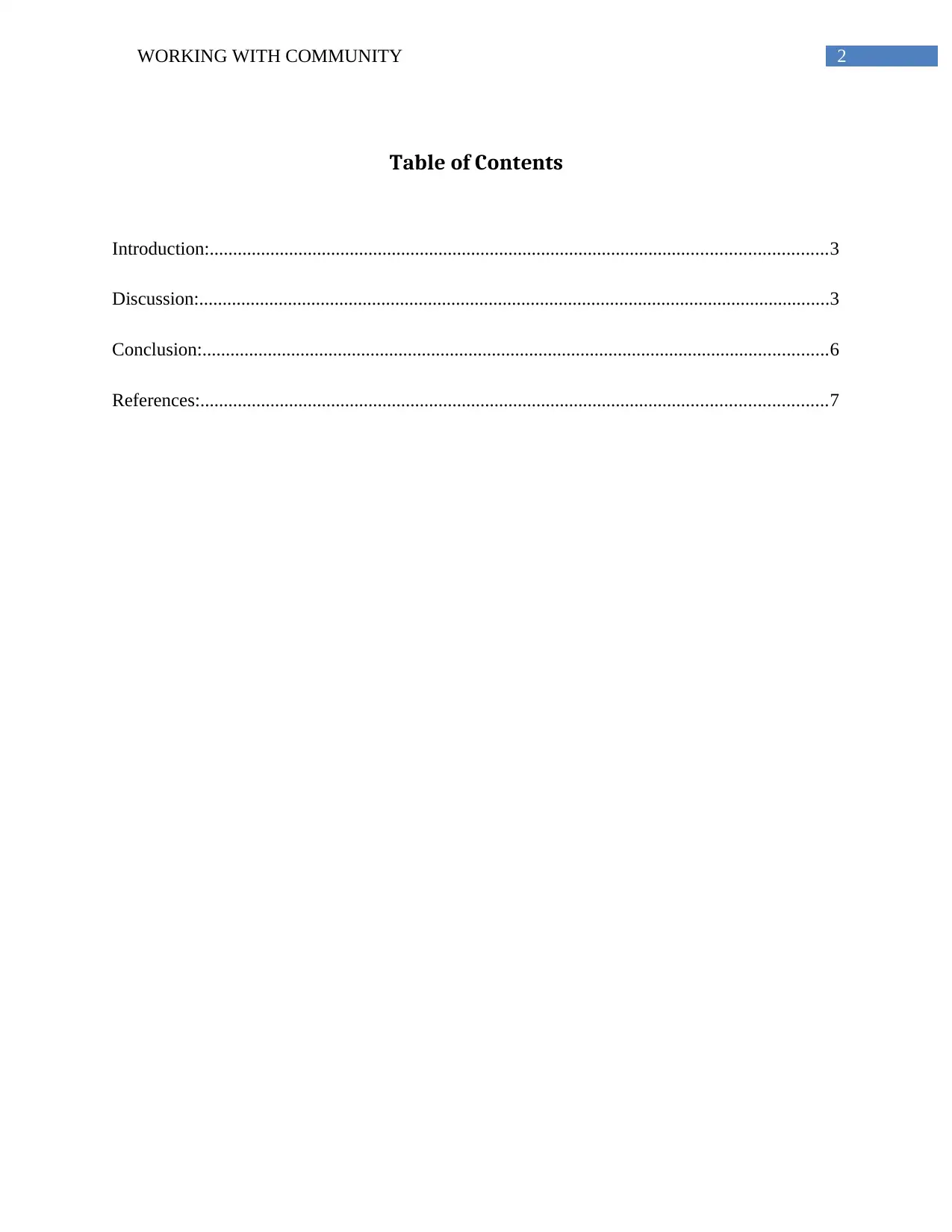
Table of Contents
Introduction:....................................................................................................................................3
Discussion:.......................................................................................................................................3
Conclusion:......................................................................................................................................6
References:......................................................................................................................................7
Table of Contents
Introduction:....................................................................................................................................3
Discussion:.......................................................................................................................................3
Conclusion:......................................................................................................................................6
References:......................................................................................................................................7
⊘ This is a preview!⊘
Do you want full access?
Subscribe today to unlock all pages.

Trusted by 1+ million students worldwide

3WORKING WITH COMMUNITY
Introduction:
Shifting from high school to university is bound to be difficult and it is commonly
perceived that often students are unprepared for the change. It has also been seen that there is a
major gap between the first year students expectations and the life realities on the campus of the
universities. It is crucial for the students to understand that self-management and self motivation
are crucial and they themselves have to be responsible for their own learning and time
management. It often happens that students have to take care of several challenges in their
respective universities. Joining university for an initial time frame can lead to the fact that the
students might feel out of place, they might also consider the problems of meeting up newer
people. Understanding the expectations of the students in their universities are crucial because
they have a significant effect on the successful transition of students and also their engagement
with their respective universities (Scutter et al., 2011).
Discussion:
Right after school, beginning as a first year student of a university can be a daunting
experience. This can also become a huge adjustment for the students. It is also seen that certain
students adjust easily and thrive. On the other hand there are certain other students who cannot
cope with the changing circumstances and often think of leaving. In case the experiences of the
students are similar to the expectations, they can gel well with their surroundings and deal with
the changing scenario. In case the experiences are vastly different and do not match the
expectations at all, the students struggle with their day to day lives and can under-perform or
might drop out completely as well (Brinkworth et al., 2009).
Introduction:
Shifting from high school to university is bound to be difficult and it is commonly
perceived that often students are unprepared for the change. It has also been seen that there is a
major gap between the first year students expectations and the life realities on the campus of the
universities. It is crucial for the students to understand that self-management and self motivation
are crucial and they themselves have to be responsible for their own learning and time
management. It often happens that students have to take care of several challenges in their
respective universities. Joining university for an initial time frame can lead to the fact that the
students might feel out of place, they might also consider the problems of meeting up newer
people. Understanding the expectations of the students in their universities are crucial because
they have a significant effect on the successful transition of students and also their engagement
with their respective universities (Scutter et al., 2011).
Discussion:
Right after school, beginning as a first year student of a university can be a daunting
experience. This can also become a huge adjustment for the students. It is also seen that certain
students adjust easily and thrive. On the other hand there are certain other students who cannot
cope with the changing circumstances and often think of leaving. In case the experiences of the
students are similar to the expectations, they can gel well with their surroundings and deal with
the changing scenario. In case the experiences are vastly different and do not match the
expectations at all, the students struggle with their day to day lives and can under-perform or
might drop out completely as well (Brinkworth et al., 2009).
Paraphrase This Document
Need a fresh take? Get an instant paraphrase of this document with our AI Paraphraser

4WORKING WITH COMMUNITY
It is common for first year students to come from diverse backgrounds. They are also
likely to possess different academic as well as social skills. There are people who make several
big life adjustments which include the decision of staying away from their respective homes.
Despite the fact that students come from different backgrounds, the only thing which is similar to
among all students is their capability to come to their university to learn. The curriculum of the
first year students is the major focus of their learning experience. The foundation or institution
needs to control the situations, the students need to access and see to it that the students are
entitled to the relevance. There needs to be a proper control to the way in which the situation is
accessed. It is desirable that the university adopts the procedures which are comprehensive,
integrated and coordinated. There needs to be situations where the challenges in the university
need to be addressed (Hassel & Ridout, 2017).
Another situation which needs to be encouraged in this particular situation is that of the
rate of attrition. This rate varies from state to state and also from university to university.
Therefore there needs to be a proper protection regarding the rate of attrition. This also varies but
their needs to be a proper control on the attrition rate. It is a severe issue in case of universities
because of the reason that their image is bound to suffer if the students drop out from the
universities. It is seen that the rate of attrition is the highest in the first year and is almost double
in comparison to the other years. The official attrition statistics show that the students have a
chance of leaving after discovering where the actual interests lie. However the statistics do not
properly cover all the situations or the reasons for the students leaving their university after the
first year (Penn-Edwards & Donnison, 2014).
Another negative or unfortunate reality for a significant proportion of around one-third of
students is at the time when move forth in a tough journey from the familiar to the unfamiliar to
It is common for first year students to come from diverse backgrounds. They are also
likely to possess different academic as well as social skills. There are people who make several
big life adjustments which include the decision of staying away from their respective homes.
Despite the fact that students come from different backgrounds, the only thing which is similar to
among all students is their capability to come to their university to learn. The curriculum of the
first year students is the major focus of their learning experience. The foundation or institution
needs to control the situations, the students need to access and see to it that the students are
entitled to the relevance. There needs to be a proper control to the way in which the situation is
accessed. It is desirable that the university adopts the procedures which are comprehensive,
integrated and coordinated. There needs to be situations where the challenges in the university
need to be addressed (Hassel & Ridout, 2017).
Another situation which needs to be encouraged in this particular situation is that of the
rate of attrition. This rate varies from state to state and also from university to university.
Therefore there needs to be a proper protection regarding the rate of attrition. This also varies but
their needs to be a proper control on the attrition rate. It is a severe issue in case of universities
because of the reason that their image is bound to suffer if the students drop out from the
universities. It is seen that the rate of attrition is the highest in the first year and is almost double
in comparison to the other years. The official attrition statistics show that the students have a
chance of leaving after discovering where the actual interests lie. However the statistics do not
properly cover all the situations or the reasons for the students leaving their university after the
first year (Penn-Edwards & Donnison, 2014).
Another negative or unfortunate reality for a significant proportion of around one-third of
students is at the time when move forth in a tough journey from the familiar to the unfamiliar to

5WORKING WITH COMMUNITY
as well as undecipherable situations. There have been certain instances of research which have
shown that the students consider the issue of leaving for several complex reasons as there is a
lack of clarity regarding the facts which are required for success, limited amount of engagement
as well as the mismatch of expectations. Often it also happens that students have pre-conceived
notions or unrealistic expectations towards the other members of their family (Trautwein &
Bosse, 2017).
It is therefore desirable that students not only need to adjust to the general and specific
cultures but it is necessary for the institutions also to ensure that there is a proper balance
between the academic and non-academic situations. This provides students have an equal
opportunity to be successful irrespective of their backgrounds. It can clearly be said that the issue
of attrition is morally indefensible and hugely wasteful. The official statistics of attrition do not
explain the noteworthy percentage of the students who depart without being considered initially
(Scutter et al., 2011).
The unfortunate instance which needs to be defined in this case is that of the challenges
of leaving due to complex as well as inter-related reasons. The overall perceptions of course and
quality of teaching, lack of clarity and also the situations of success. It is very hard for the
students who do not have anyone in their homes or in their social networks.
It is possible to examine the patters of the students online access for the anticipation and
mediation of the first year obstacles. It is seen that the school leavers are also uncertain about
their course or about their career choices. The time of the classes can be utilized for the purpose
of advising or for career exploration.
as well as undecipherable situations. There have been certain instances of research which have
shown that the students consider the issue of leaving for several complex reasons as there is a
lack of clarity regarding the facts which are required for success, limited amount of engagement
as well as the mismatch of expectations. Often it also happens that students have pre-conceived
notions or unrealistic expectations towards the other members of their family (Trautwein &
Bosse, 2017).
It is therefore desirable that students not only need to adjust to the general and specific
cultures but it is necessary for the institutions also to ensure that there is a proper balance
between the academic and non-academic situations. This provides students have an equal
opportunity to be successful irrespective of their backgrounds. It can clearly be said that the issue
of attrition is morally indefensible and hugely wasteful. The official statistics of attrition do not
explain the noteworthy percentage of the students who depart without being considered initially
(Scutter et al., 2011).
The unfortunate instance which needs to be defined in this case is that of the challenges
of leaving due to complex as well as inter-related reasons. The overall perceptions of course and
quality of teaching, lack of clarity and also the situations of success. It is very hard for the
students who do not have anyone in their homes or in their social networks.
It is possible to examine the patters of the students online access for the anticipation and
mediation of the first year obstacles. It is seen that the school leavers are also uncertain about
their course or about their career choices. The time of the classes can be utilized for the purpose
of advising or for career exploration.
⊘ This is a preview!⊘
Do you want full access?
Subscribe today to unlock all pages.

Trusted by 1+ million students worldwide

6WORKING WITH COMMUNITY
By the utilization of the analytics techniques it is possible to examine the patterns of the
online access of the students to the sources of the university and before it becomes late for the
students to drop out. There can be the utilization of class time for advising on specific courses.
The needs of the students need to be provided at specific times according to their specific needs.
After a proper study on the needs of the students it has been seen that the expectations of the
students regarding receiving of information, high feedback levels, constant admission to the
lecturers, study percentage which they expect to do and their responsibilities of learning have
been mentioned as those areas which do not meet up the expectations of the students (Trautwein
& Bosse, 2017).
Conclusion:
There have been several discussions and research conducted on the topics or issues which
the students consider to be responsible for impacting their university experience. The majority of
responses have pointed to the fact that the students consider attending lectures and development
of relationships with the respective lecturers. It can be stated without any doubt that the idea of
higher education is enormously crucial and life altering for majority of the students. There is not
only financial investment involved but also emotions along with sufficient amount of time and
effort. Therefore the students need to make the major use of their university experience. The
active as well as self governing role played by the students need to be maintained in their
university lives. The variability in the ideas of the lecturers and the students makes it difficult to
suitably access the ideas of learning as well as tutoring. Therefore it is required that the research
further integrates the expectations of the students regarding the factors which can impact their
success with the genuine performance.
By the utilization of the analytics techniques it is possible to examine the patterns of the
online access of the students to the sources of the university and before it becomes late for the
students to drop out. There can be the utilization of class time for advising on specific courses.
The needs of the students need to be provided at specific times according to their specific needs.
After a proper study on the needs of the students it has been seen that the expectations of the
students regarding receiving of information, high feedback levels, constant admission to the
lecturers, study percentage which they expect to do and their responsibilities of learning have
been mentioned as those areas which do not meet up the expectations of the students (Trautwein
& Bosse, 2017).
Conclusion:
There have been several discussions and research conducted on the topics or issues which
the students consider to be responsible for impacting their university experience. The majority of
responses have pointed to the fact that the students consider attending lectures and development
of relationships with the respective lecturers. It can be stated without any doubt that the idea of
higher education is enormously crucial and life altering for majority of the students. There is not
only financial investment involved but also emotions along with sufficient amount of time and
effort. Therefore the students need to make the major use of their university experience. The
active as well as self governing role played by the students need to be maintained in their
university lives. The variability in the ideas of the lecturers and the students makes it difficult to
suitably access the ideas of learning as well as tutoring. Therefore it is required that the research
further integrates the expectations of the students regarding the factors which can impact their
success with the genuine performance.
Paraphrase This Document
Need a fresh take? Get an instant paraphrase of this document with our AI Paraphraser

7WORKING WITH COMMUNITY

8WORKING WITH COMMUNITY
References:
Brinkworth, R., McCann, B., Matthews, C., & Nordström, K. (2009). First year expectations and
experiences: Student and teacher perspectives. Higher Education, 58(2), 157-173.
Hassel, S., & Ridout, N. (2017). An Investigation of first-year students’ and lecturers’
expectations of university education. Frontiers in psychology, 8, 2218.
Penn-Edwards, S., & Donnison, S. (2014). A fourth generation approach to transition in the first
year in higher education: First year in higher education community of practice
(FYHECoP). The International Journal of the First Year in Higher Education, 5(1), 31
Scutter, S. D., Palmer, E., Luzeckyl, A., da Silva, K. B., & Brinkworth, R. (2011). What do
commencing undergraduate students expect from first year university?. The International
Journal of the First Year in Higher Education, 2(1), 8.
Trautwein, C., & Bosse, E. (2017). The first year in higher education—critical requirements
from the student perspective. Higher Education, 73(3), 371-387..
References:
Brinkworth, R., McCann, B., Matthews, C., & Nordström, K. (2009). First year expectations and
experiences: Student and teacher perspectives. Higher Education, 58(2), 157-173.
Hassel, S., & Ridout, N. (2017). An Investigation of first-year students’ and lecturers’
expectations of university education. Frontiers in psychology, 8, 2218.
Penn-Edwards, S., & Donnison, S. (2014). A fourth generation approach to transition in the first
year in higher education: First year in higher education community of practice
(FYHECoP). The International Journal of the First Year in Higher Education, 5(1), 31
Scutter, S. D., Palmer, E., Luzeckyl, A., da Silva, K. B., & Brinkworth, R. (2011). What do
commencing undergraduate students expect from first year university?. The International
Journal of the First Year in Higher Education, 2(1), 8.
Trautwein, C., & Bosse, E. (2017). The first year in higher education—critical requirements
from the student perspective. Higher Education, 73(3), 371-387..
⊘ This is a preview!⊘
Do you want full access?
Subscribe today to unlock all pages.

Trusted by 1+ million students worldwide
1 out of 9
Related Documents
Your All-in-One AI-Powered Toolkit for Academic Success.
+13062052269
info@desklib.com
Available 24*7 on WhatsApp / Email
Unlock your academic potential
Copyright © 2020–2026 A2Z Services. All Rights Reserved. Developed and managed by ZUCOL.