Impact of Fiscal Policy After the 1987 Stock Market Crash
VerifiedAdded on 2022/09/12
|6
|1252
|21
Report
AI Summary
This report examines the fiscal policy responses of the United States government to the 1987 stock market crash, also known as Black Monday. The analysis focuses on the economic impact of the crash, which triggered a recessionary period and affected financial markets worldwide. The report details the specific fiscal measures undertaken by the US government, including tax cuts and increased government spending, to stabilize the economy. The study highlights the contraction in the unemployment rate, despite the economic downturn. The report also addresses the contradictions behind the causes of the crash, which includes the tax bill introduced by the United States House Committee on Ways and Means and the unexpected high trade deficit figures. The report emphasizes the importance of fiscal stimulus in mitigating the recessionary environment and the government's efforts to revive the economy through these policies. The conclusion summarizes the effectiveness of these policies and their long-term implications on the economy.
Running head: FISCAL POLICY AFTER THE STOCK MARKET CRASH OF 1987
Fiscal Policy after the Stock Market Crash of 1987
Name of the Student
Name of the University
Author note
Fiscal Policy after the Stock Market Crash of 1987
Name of the Student
Name of the University
Author note
Paraphrase This Document
Need a fresh take? Get an instant paraphrase of this document with our AI Paraphraser

1FISCAL POLICY AFTER THE STOCK MARKET CRASH OF 1987
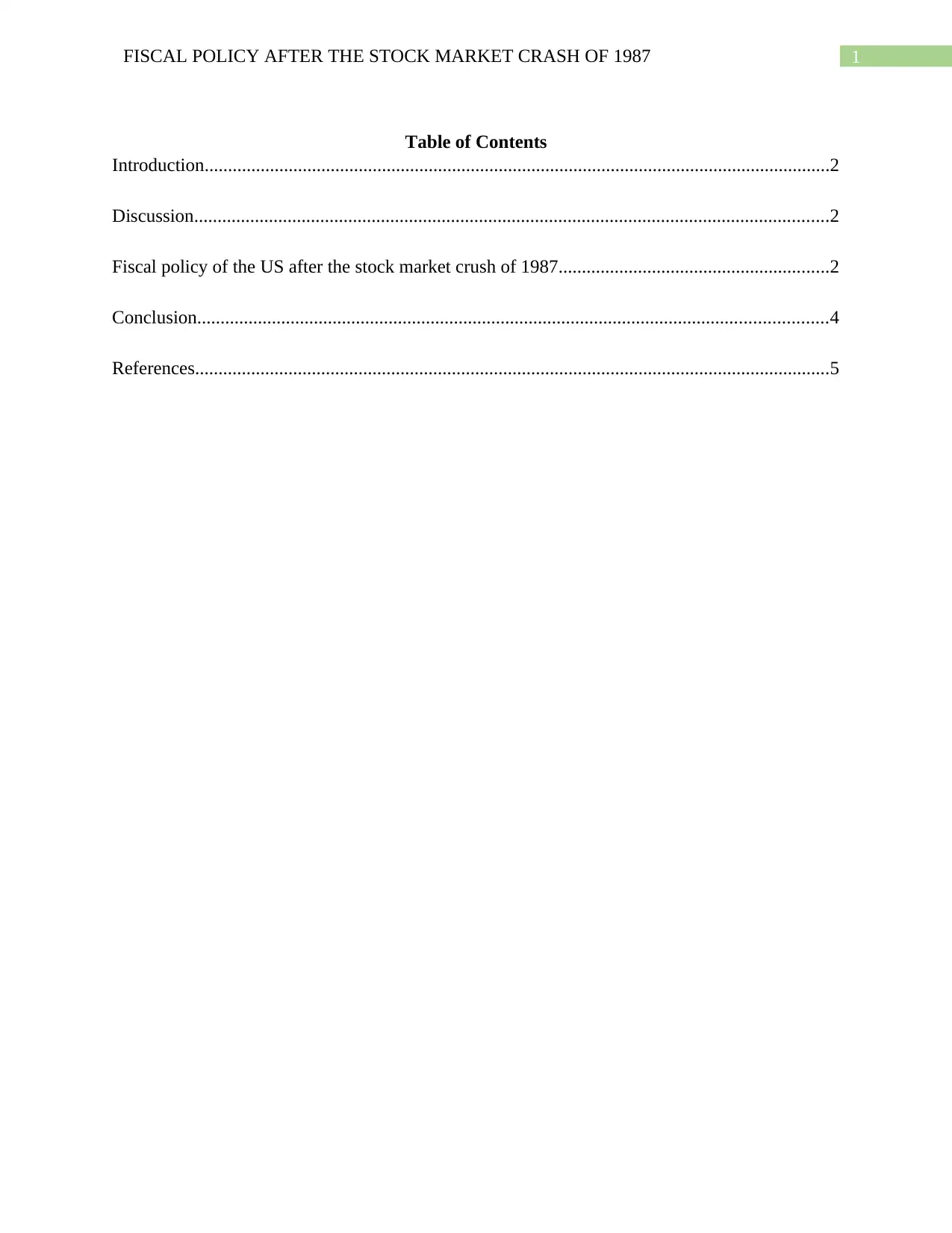
Table of Contents
Introduction......................................................................................................................................2
Discussion........................................................................................................................................2
Fiscal policy of the US after the stock market crush of 1987..........................................................2
Conclusion.......................................................................................................................................4
References........................................................................................................................................5
Table of Contents
Introduction......................................................................................................................................2
Discussion........................................................................................................................................2
Fiscal policy of the US after the stock market crush of 1987..........................................................2
Conclusion.......................................................................................................................................4
References........................................................................................................................................5

2FISCAL POLICY AFTER THE STOCK MARKET CRASH OF 1987
Introduction
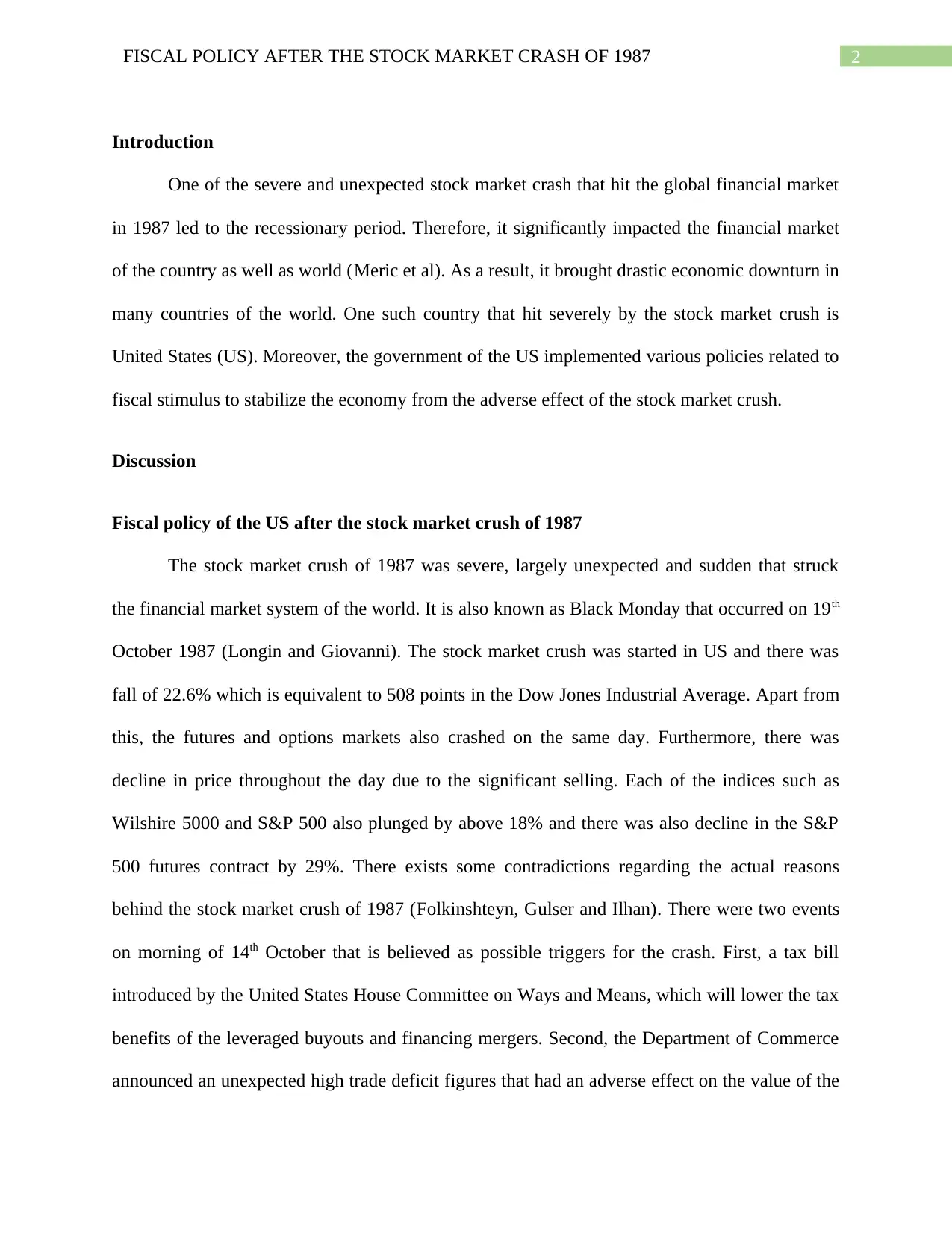
One of the severe and unexpected stock market crash that hit the global financial market
in 1987 led to the recessionary period. Therefore, it significantly impacted the financial market
of the country as well as world (Meric et al). As a result, it brought drastic economic downturn in
many countries of the world. One such country that hit severely by the stock market crush is
United States (US). Moreover, the government of the US implemented various policies related to
fiscal stimulus to stabilize the economy from the adverse effect of the stock market crush.
Discussion
Fiscal policy of the US after the stock market crush of 1987
The stock market crush of 1987 was severe, largely unexpected and sudden that struck
the financial market system of the world. It is also known as Black Monday that occurred on 19th
October 1987 (Longin and Giovanni). The stock market crush was started in US and there was
fall of 22.6% which is equivalent to 508 points in the Dow Jones Industrial Average. Apart from
this, the futures and options markets also crashed on the same day. Furthermore, there was
decline in price throughout the day due to the significant selling. Each of the indices such as
Wilshire 5000 and S&P 500 also plunged by above 18% and there was also decline in the S&P
500 futures contract by 29%. There exists some contradictions regarding the actual reasons
behind the stock market crush of 1987 (Folkinshteyn, Gulser and Ilhan). There were two events
on morning of 14th October that is believed as possible triggers for the crash. First, a tax bill
introduced by the United States House Committee on Ways and Means, which will lower the tax
benefits of the leveraged buyouts and financing mergers. Second, the Department of Commerce
announced an unexpected high trade deficit figures that had an adverse effect on the value of the
Introduction
One of the severe and unexpected stock market crash that hit the global financial market
in 1987 led to the recessionary period. Therefore, it significantly impacted the financial market
of the country as well as world (Meric et al). As a result, it brought drastic economic downturn in
many countries of the world. One such country that hit severely by the stock market crush is
United States (US). Moreover, the government of the US implemented various policies related to
fiscal stimulus to stabilize the economy from the adverse effect of the stock market crush.
Discussion
Fiscal policy of the US after the stock market crush of 1987
The stock market crush of 1987 was severe, largely unexpected and sudden that struck
the financial market system of the world. It is also known as Black Monday that occurred on 19th
October 1987 (Longin and Giovanni). The stock market crush was started in US and there was
fall of 22.6% which is equivalent to 508 points in the Dow Jones Industrial Average. Apart from
this, the futures and options markets also crashed on the same day. Furthermore, there was
decline in price throughout the day due to the significant selling. Each of the indices such as
Wilshire 5000 and S&P 500 also plunged by above 18% and there was also decline in the S&P
500 futures contract by 29%. There exists some contradictions regarding the actual reasons
behind the stock market crush of 1987 (Folkinshteyn, Gulser and Ilhan). There were two events
on morning of 14th October that is believed as possible triggers for the crash. First, a tax bill
introduced by the United States House Committee on Ways and Means, which will lower the tax
benefits of the leveraged buyouts and financing mergers. Second, the Department of Commerce
announced an unexpected high trade deficit figures that had an adverse effect on the value of the
⊘ This is a preview!⊘
Do you want full access?
Subscribe today to unlock all pages.

Trusted by 1+ million students worldwide

3FISCAL POLICY AFTER THE STOCK MARKET CRASH OF 1987
US dollars along with scaling up interest rates and scaling down the stock prices. In contrast, it is
caused by the too much indebtedness that led to the general mindset of the investors of stock
market crush.
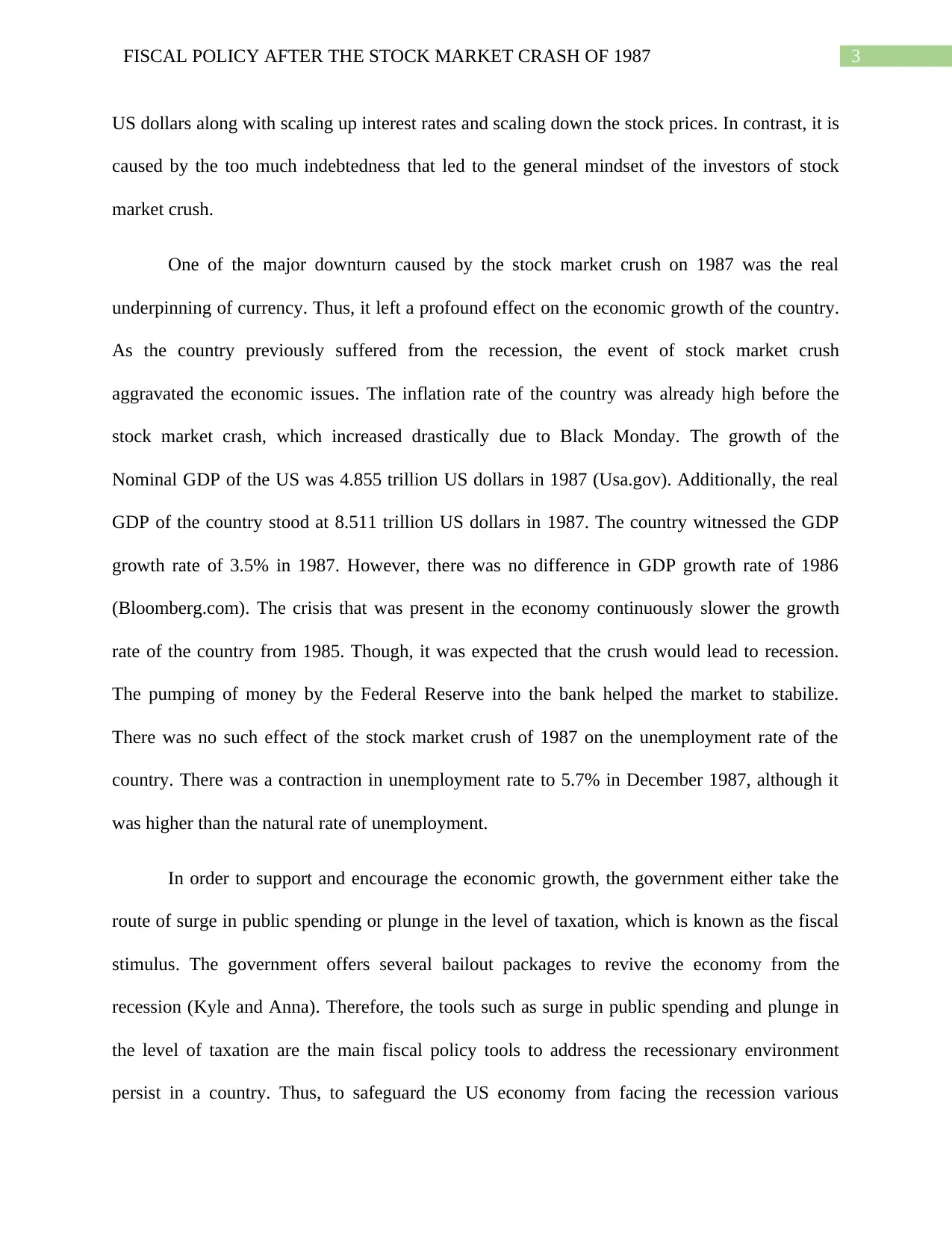
One of the major downturn caused by the stock market crush on 1987 was the real
underpinning of currency. Thus, it left a profound effect on the economic growth of the country.
As the country previously suffered from the recession, the event of stock market crush
aggravated the economic issues. The inflation rate of the country was already high before the
stock market crash, which increased drastically due to Black Monday. The growth of the
Nominal GDP of the US was 4.855 trillion US dollars in 1987 (Usa.gov). Additionally, the real
GDP of the country stood at 8.511 trillion US dollars in 1987. The country witnessed the GDP
growth rate of 3.5% in 1987. However, there was no difference in GDP growth rate of 1986
(Bloomberg.com). The crisis that was present in the economy continuously slower the growth
rate of the country from 1985. Though, it was expected that the crush would lead to recession.
The pumping of money by the Federal Reserve into the bank helped the market to stabilize.
There was no such effect of the stock market crush of 1987 on the unemployment rate of the
country. There was a contraction in unemployment rate to 5.7% in December 1987, although it
was higher than the natural rate of unemployment.
In order to support and encourage the economic growth, the government either take the
route of surge in public spending or plunge in the level of taxation, which is known as the fiscal
stimulus. The government offers several bailout packages to revive the economy from the
recession (Kyle and Anna). Therefore, the tools such as surge in public spending and plunge in
the level of taxation are the main fiscal policy tools to address the recessionary environment
persist in a country. Thus, to safeguard the US economy from facing the recession various
US dollars along with scaling up interest rates and scaling down the stock prices. In contrast, it is
caused by the too much indebtedness that led to the general mindset of the investors of stock
market crush.
One of the major downturn caused by the stock market crush on 1987 was the real
underpinning of currency. Thus, it left a profound effect on the economic growth of the country.
As the country previously suffered from the recession, the event of stock market crush
aggravated the economic issues. The inflation rate of the country was already high before the
stock market crash, which increased drastically due to Black Monday. The growth of the
Nominal GDP of the US was 4.855 trillion US dollars in 1987 (Usa.gov). Additionally, the real
GDP of the country stood at 8.511 trillion US dollars in 1987. The country witnessed the GDP
growth rate of 3.5% in 1987. However, there was no difference in GDP growth rate of 1986
(Bloomberg.com). The crisis that was present in the economy continuously slower the growth
rate of the country from 1985. Though, it was expected that the crush would lead to recession.
The pumping of money by the Federal Reserve into the bank helped the market to stabilize.
There was no such effect of the stock market crush of 1987 on the unemployment rate of the
country. There was a contraction in unemployment rate to 5.7% in December 1987, although it
was higher than the natural rate of unemployment.
In order to support and encourage the economic growth, the government either take the
route of surge in public spending or plunge in the level of taxation, which is known as the fiscal
stimulus. The government offers several bailout packages to revive the economy from the
recession (Kyle and Anna). Therefore, the tools such as surge in public spending and plunge in
the level of taxation are the main fiscal policy tools to address the recessionary environment
persist in a country. Thus, to safeguard the US economy from facing the recession various
Paraphrase This Document
Need a fresh take? Get an instant paraphrase of this document with our AI Paraphraser

4FISCAL POLICY AFTER THE STOCK MARKET CRASH OF 1987
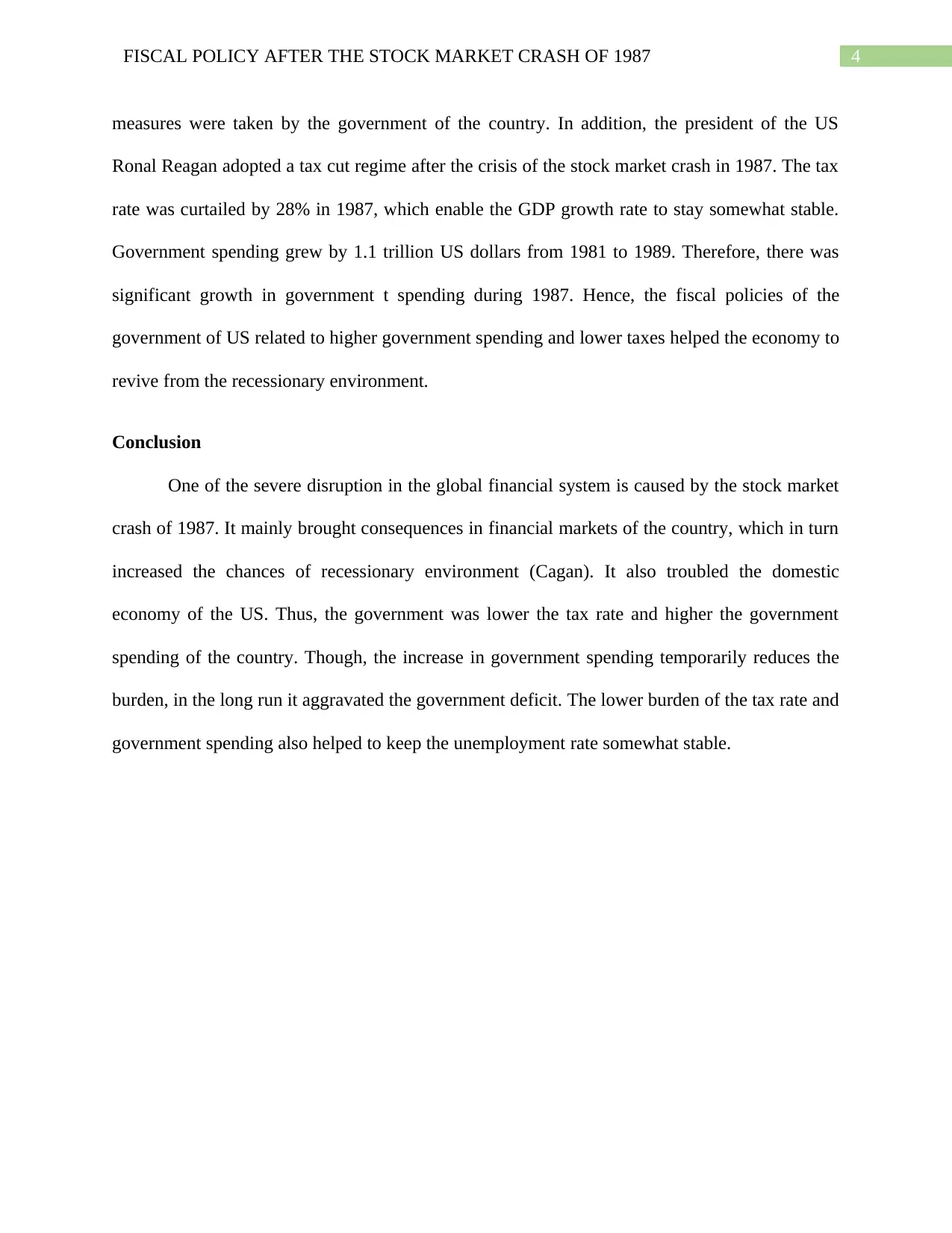
measures were taken by the government of the country. In addition, the president of the US
Ronal Reagan adopted a tax cut regime after the crisis of the stock market crash in 1987. The tax
rate was curtailed by 28% in 1987, which enable the GDP growth rate to stay somewhat stable.
Government spending grew by 1.1 trillion US dollars from 1981 to 1989. Therefore, there was
significant growth in government t spending during 1987. Hence, the fiscal policies of the
government of US related to higher government spending and lower taxes helped the economy to
revive from the recessionary environment.
Conclusion
One of the severe disruption in the global financial system is caused by the stock market
crash of 1987. It mainly brought consequences in financial markets of the country, which in turn
increased the chances of recessionary environment (Cagan). It also troubled the domestic
economy of the US. Thus, the government was lower the tax rate and higher the government
spending of the country. Though, the increase in government spending temporarily reduces the
burden, in the long run it aggravated the government deficit. The lower burden of the tax rate and
government spending also helped to keep the unemployment rate somewhat stable.
measures were taken by the government of the country. In addition, the president of the US
Ronal Reagan adopted a tax cut regime after the crisis of the stock market crash in 1987. The tax
rate was curtailed by 28% in 1987, which enable the GDP growth rate to stay somewhat stable.
Government spending grew by 1.1 trillion US dollars from 1981 to 1989. Therefore, there was
significant growth in government t spending during 1987. Hence, the fiscal policies of the
government of US related to higher government spending and lower taxes helped the economy to
revive from the recessionary environment.
Conclusion
One of the severe disruption in the global financial system is caused by the stock market
crash of 1987. It mainly brought consequences in financial markets of the country, which in turn
increased the chances of recessionary environment (Cagan). It also troubled the domestic
economy of the US. Thus, the government was lower the tax rate and higher the government
spending of the country. Though, the increase in government spending temporarily reduces the
burden, in the long run it aggravated the government deficit. The lower burden of the tax rate and
government spending also helped to keep the unemployment rate somewhat stable.

5FISCAL POLICY AFTER THE STOCK MARKET CRASH OF 1987
References
Bloomberg.com Bloomberg - Are you a robot?. [online] Available at:
https://www.bloomberg.com/news/videos/2016-09-23/the-lasting-impact-of-the-1987-
stock-market-crash.
Cagan, Phillip. "The 1987 stock market crash and the wealth effect." Analyzing Modern Business
Cycles: Essays Honoring. Routledge, 2017. 249-260.
Folkinshteyn, Daniel, Gulser Meric, and Ilhan Meric. "Investor reaction in stock market crashes
and post-crash market reversals." The International Journal of Business and Finance
Research 9.5 (2015): 57-70.
Kyle, Albert S., and Anna A. Obizhaeva. "Large bets and stock market crashes." Anna A., Large
Bets and Stock Market Crashes.
Longin, François, and Giovanni Pagliardi. "Tail relation between return and volume in the US
stock market: An analysis based on extreme value theory." Economics Letters 145
(2016): 252-254.
Meric, Ilhan, et al. "Co-Movements Of US And European Stock Markets Before And After The
2008 Gloal Stock Market Crash." Studies in Business and Economics 10.2 (2015): 83-98.
Usa.gov. Official Guide to Government Information and Services | USAGov. [online] Available
at: https://www.usa.gov/.
References
Bloomberg.com Bloomberg - Are you a robot?. [online] Available at:
https://www.bloomberg.com/news/videos/2016-09-23/the-lasting-impact-of-the-1987-
stock-market-crash.
Cagan, Phillip. "The 1987 stock market crash and the wealth effect." Analyzing Modern Business
Cycles: Essays Honoring. Routledge, 2017. 249-260.
Folkinshteyn, Daniel, Gulser Meric, and Ilhan Meric. "Investor reaction in stock market crashes
and post-crash market reversals." The International Journal of Business and Finance
Research 9.5 (2015): 57-70.
Kyle, Albert S., and Anna A. Obizhaeva. "Large bets and stock market crashes." Anna A., Large
Bets and Stock Market Crashes.
Longin, François, and Giovanni Pagliardi. "Tail relation between return and volume in the US
stock market: An analysis based on extreme value theory." Economics Letters 145
(2016): 252-254.
Meric, Ilhan, et al. "Co-Movements Of US And European Stock Markets Before And After The
2008 Gloal Stock Market Crash." Studies in Business and Economics 10.2 (2015): 83-98.
Usa.gov. Official Guide to Government Information and Services | USAGov. [online] Available
at: https://www.usa.gov/.
⊘ This is a preview!⊘
Do you want full access?
Subscribe today to unlock all pages.

Trusted by 1+ million students worldwide
1 out of 6
Related Documents
Your All-in-One AI-Powered Toolkit for Academic Success.
+13062052269
info@desklib.com
Available 24*7 on WhatsApp / Email
Unlock your academic potential
Copyright © 2020–2026 A2Z Services. All Rights Reserved. Developed and managed by ZUCOL.