Examining the Flexibility of Legal Rules and the Rule of Law Doctrine
VerifiedAdded on 2021/04/17
|10
|3187
|116
Essay
AI Summary
This essay provides a comprehensive examination of the concept of flexibility within the legal framework, focusing on its significance in relation to the rule of law doctrine. It begins by defining flexibility and exploring its various interpretations, including its role as an inherent characteristic of legal rules, an attribute of law application, and a distinguishing feature of common law. The essay delves into the tension between flexibility and legal certainty, analyzing how flexible rules impact predictability and equal application of law. It also discusses legal indeterminacy, the views of American realists and critical legal studies, and the perspectives of H.L.A. Hart, ultimately arguing for the need to balance flexibility with the requirements of legal certainty under the rule of law. The essay concludes by emphasizing the doctrinal context of flexibility and its implications for the delivery of just decisions within the legal system.
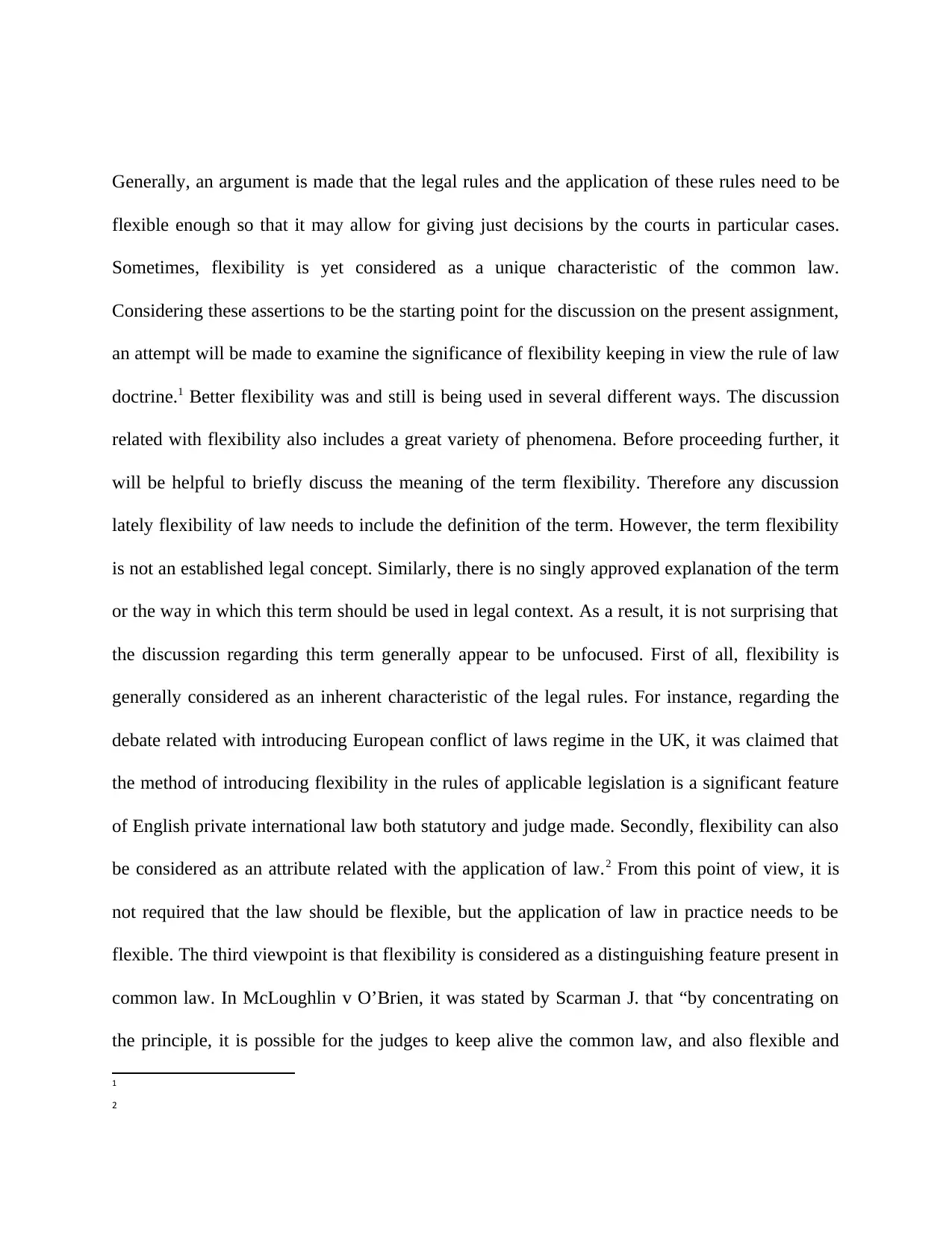
Generally, an argument is made that the legal rules and the application of these rules need to be
flexible enough so that it may allow for giving just decisions by the courts in particular cases.
Sometimes, flexibility is yet considered as a unique characteristic of the common law.
Considering these assertions to be the starting point for the discussion on the present assignment,
an attempt will be made to examine the significance of flexibility keeping in view the rule of law
doctrine.1 Better flexibility was and still is being used in several different ways. The discussion
related with flexibility also includes a great variety of phenomena. Before proceeding further, it
will be helpful to briefly discuss the meaning of the term flexibility. Therefore any discussion
lately flexibility of law needs to include the definition of the term. However, the term flexibility
is not an established legal concept. Similarly, there is no singly approved explanation of the term
or the way in which this term should be used in legal context. As a result, it is not surprising that
the discussion regarding this term generally appear to be unfocused. First of all, flexibility is
generally considered as an inherent characteristic of the legal rules. For instance, regarding the
debate related with introducing European conflict of laws regime in the UK, it was claimed that
the method of introducing flexibility in the rules of applicable legislation is a significant feature
of English private international law both statutory and judge made. Secondly, flexibility can also
be considered as an attribute related with the application of law.2 From this point of view, it is
not required that the law should be flexible, but the application of law in practice needs to be
flexible. The third viewpoint is that flexibility is considered as a distinguishing feature present in
common law. In McLoughlin v O’Brien, it was stated by Scarman J. that “by concentrating on
the principle, it is possible for the judges to keep alive the common law, and also flexible and
1
2
flexible enough so that it may allow for giving just decisions by the courts in particular cases.
Sometimes, flexibility is yet considered as a unique characteristic of the common law.
Considering these assertions to be the starting point for the discussion on the present assignment,
an attempt will be made to examine the significance of flexibility keeping in view the rule of law
doctrine.1 Better flexibility was and still is being used in several different ways. The discussion
related with flexibility also includes a great variety of phenomena. Before proceeding further, it
will be helpful to briefly discuss the meaning of the term flexibility. Therefore any discussion
lately flexibility of law needs to include the definition of the term. However, the term flexibility
is not an established legal concept. Similarly, there is no singly approved explanation of the term
or the way in which this term should be used in legal context. As a result, it is not surprising that
the discussion regarding this term generally appear to be unfocused. First of all, flexibility is
generally considered as an inherent characteristic of the legal rules. For instance, regarding the
debate related with introducing European conflict of laws regime in the UK, it was claimed that
the method of introducing flexibility in the rules of applicable legislation is a significant feature
of English private international law both statutory and judge made. Secondly, flexibility can also
be considered as an attribute related with the application of law.2 From this point of view, it is
not required that the law should be flexible, but the application of law in practice needs to be
flexible. The third viewpoint is that flexibility is considered as a distinguishing feature present in
common law. In McLoughlin v O’Brien, it was stated by Scarman J. that “by concentrating on
the principle, it is possible for the judges to keep alive the common law, and also flexible and
1
2

Paraphrase This Document
Need a fresh take? Get an instant paraphrase of this document with our AI Paraphraser
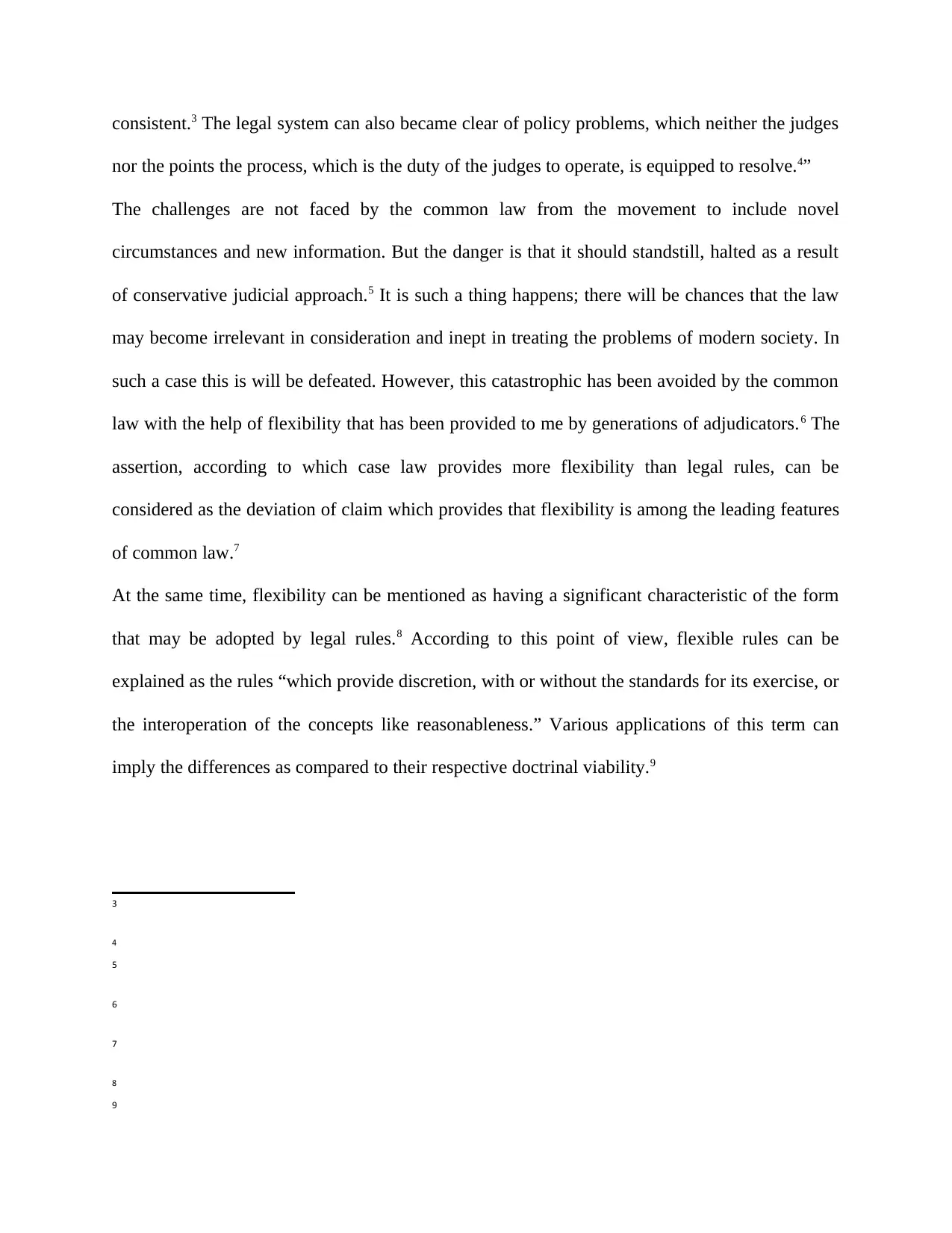
consistent.3 The legal system can also became clear of policy problems, which neither the judges
nor the points the process, which is the duty of the judges to operate, is equipped to resolve.4”
The challenges are not faced by the common law from the movement to include novel
circumstances and new information. But the danger is that it should standstill, halted as a result
of conservative judicial approach.5 It is such a thing happens; there will be chances that the law
may become irrelevant in consideration and inept in treating the problems of modern society. In
such a case this is will be defeated. However, this catastrophic has been avoided by the common
law with the help of flexibility that has been provided to me by generations of adjudicators.6 The
assertion, according to which case law provides more flexibility than legal rules, can be
considered as the deviation of claim which provides that flexibility is among the leading features
of common law.7
At the same time, flexibility can be mentioned as having a significant characteristic of the form
that may be adopted by legal rules.8 According to this point of view, flexible rules can be
explained as the rules “which provide discretion, with or without the standards for its exercise, or
the interoperation of the concepts like reasonableness.” Various applications of this term can
imply the differences as compared to their respective doctrinal viability.9
3
4
5
6
7
8
9
nor the points the process, which is the duty of the judges to operate, is equipped to resolve.4”
The challenges are not faced by the common law from the movement to include novel
circumstances and new information. But the danger is that it should standstill, halted as a result
of conservative judicial approach.5 It is such a thing happens; there will be chances that the law
may become irrelevant in consideration and inept in treating the problems of modern society. In
such a case this is will be defeated. However, this catastrophic has been avoided by the common
law with the help of flexibility that has been provided to me by generations of adjudicators.6 The
assertion, according to which case law provides more flexibility than legal rules, can be
considered as the deviation of claim which provides that flexibility is among the leading features
of common law.7
At the same time, flexibility can be mentioned as having a significant characteristic of the form
that may be adopted by legal rules.8 According to this point of view, flexible rules can be
explained as the rules “which provide discretion, with or without the standards for its exercise, or
the interoperation of the concepts like reasonableness.” Various applications of this term can
imply the differences as compared to their respective doctrinal viability.9
3
4
5
6
7
8
9
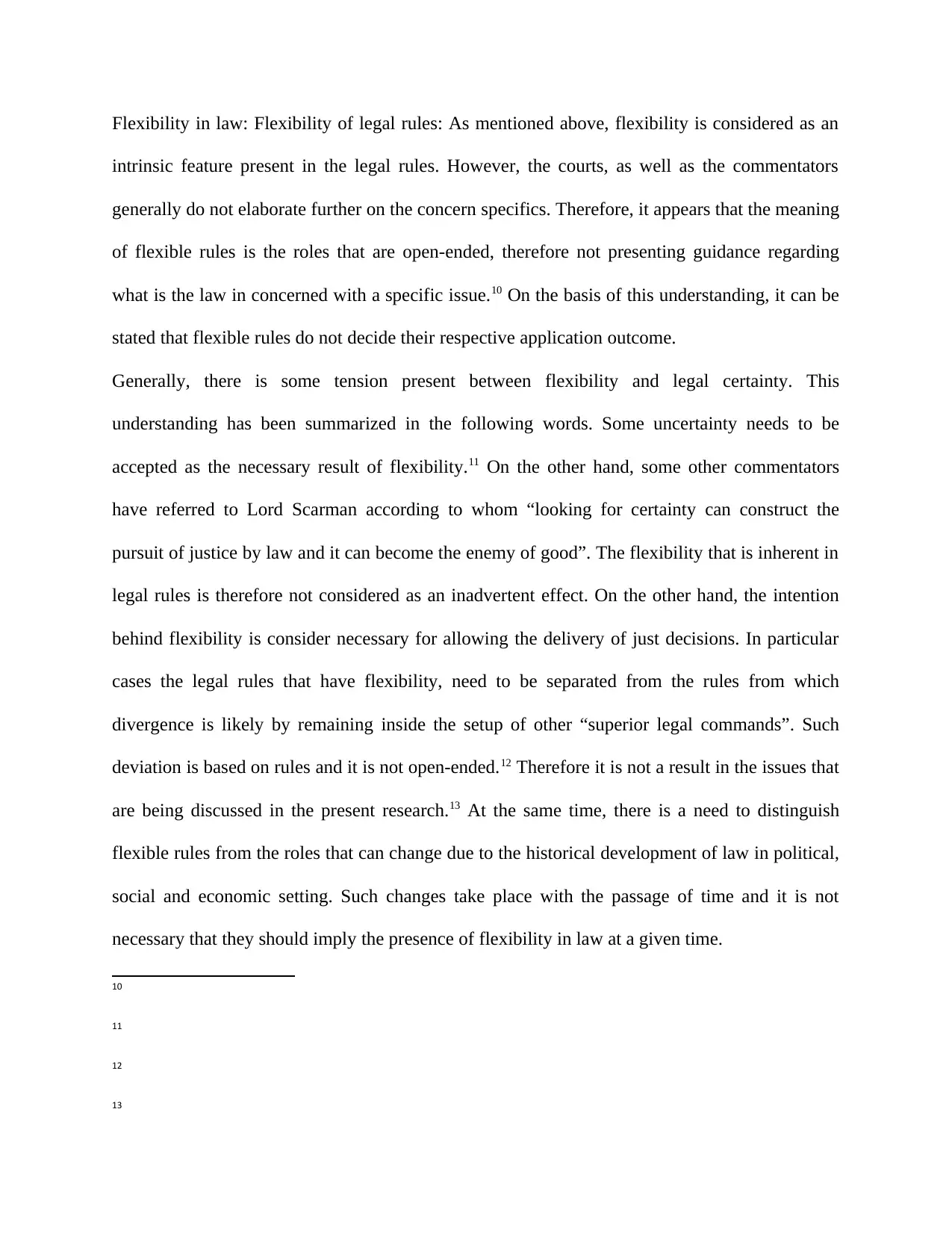
Flexibility in law: Flexibility of legal rules: As mentioned above, flexibility is considered as an
intrinsic feature present in the legal rules. However, the courts, as well as the commentators
generally do not elaborate further on the concern specifics. Therefore, it appears that the meaning
of flexible rules is the roles that are open-ended, therefore not presenting guidance regarding
what is the law in concerned with a specific issue.10 On the basis of this understanding, it can be
stated that flexible rules do not decide their respective application outcome.
Generally, there is some tension present between flexibility and legal certainty. This
understanding has been summarized in the following words. Some uncertainty needs to be
accepted as the necessary result of flexibility.11 On the other hand, some other commentators
have referred to Lord Scarman according to whom “looking for certainty can construct the
pursuit of justice by law and it can become the enemy of good”. The flexibility that is inherent in
legal rules is therefore not considered as an inadvertent effect. On the other hand, the intention
behind flexibility is consider necessary for allowing the delivery of just decisions. In particular
cases the legal rules that have flexibility, need to be separated from the rules from which
divergence is likely by remaining inside the setup of other “superior legal commands”. Such
deviation is based on rules and it is not open-ended.12 Therefore it is not a result in the issues that
are being discussed in the present research.13 At the same time, there is a need to distinguish
flexible rules from the roles that can change due to the historical development of law in political,
social and economic setting. Such changes take place with the passage of time and it is not
necessary that they should imply the presence of flexibility in law at a given time.
10
11
12
13
intrinsic feature present in the legal rules. However, the courts, as well as the commentators
generally do not elaborate further on the concern specifics. Therefore, it appears that the meaning
of flexible rules is the roles that are open-ended, therefore not presenting guidance regarding
what is the law in concerned with a specific issue.10 On the basis of this understanding, it can be
stated that flexible rules do not decide their respective application outcome.
Generally, there is some tension present between flexibility and legal certainty. This
understanding has been summarized in the following words. Some uncertainty needs to be
accepted as the necessary result of flexibility.11 On the other hand, some other commentators
have referred to Lord Scarman according to whom “looking for certainty can construct the
pursuit of justice by law and it can become the enemy of good”. The flexibility that is inherent in
legal rules is therefore not considered as an inadvertent effect. On the other hand, the intention
behind flexibility is consider necessary for allowing the delivery of just decisions. In particular
cases the legal rules that have flexibility, need to be separated from the rules from which
divergence is likely by remaining inside the setup of other “superior legal commands”. Such
deviation is based on rules and it is not open-ended.12 Therefore it is not a result in the issues that
are being discussed in the present research.13 At the same time, there is a need to distinguish
flexible rules from the roles that can change due to the historical development of law in political,
social and economic setting. Such changes take place with the passage of time and it is not
necessary that they should imply the presence of flexibility in law at a given time.
10
11
12
13
⊘ This is a preview!⊘
Do you want full access?
Subscribe today to unlock all pages.

Trusted by 1+ million students worldwide
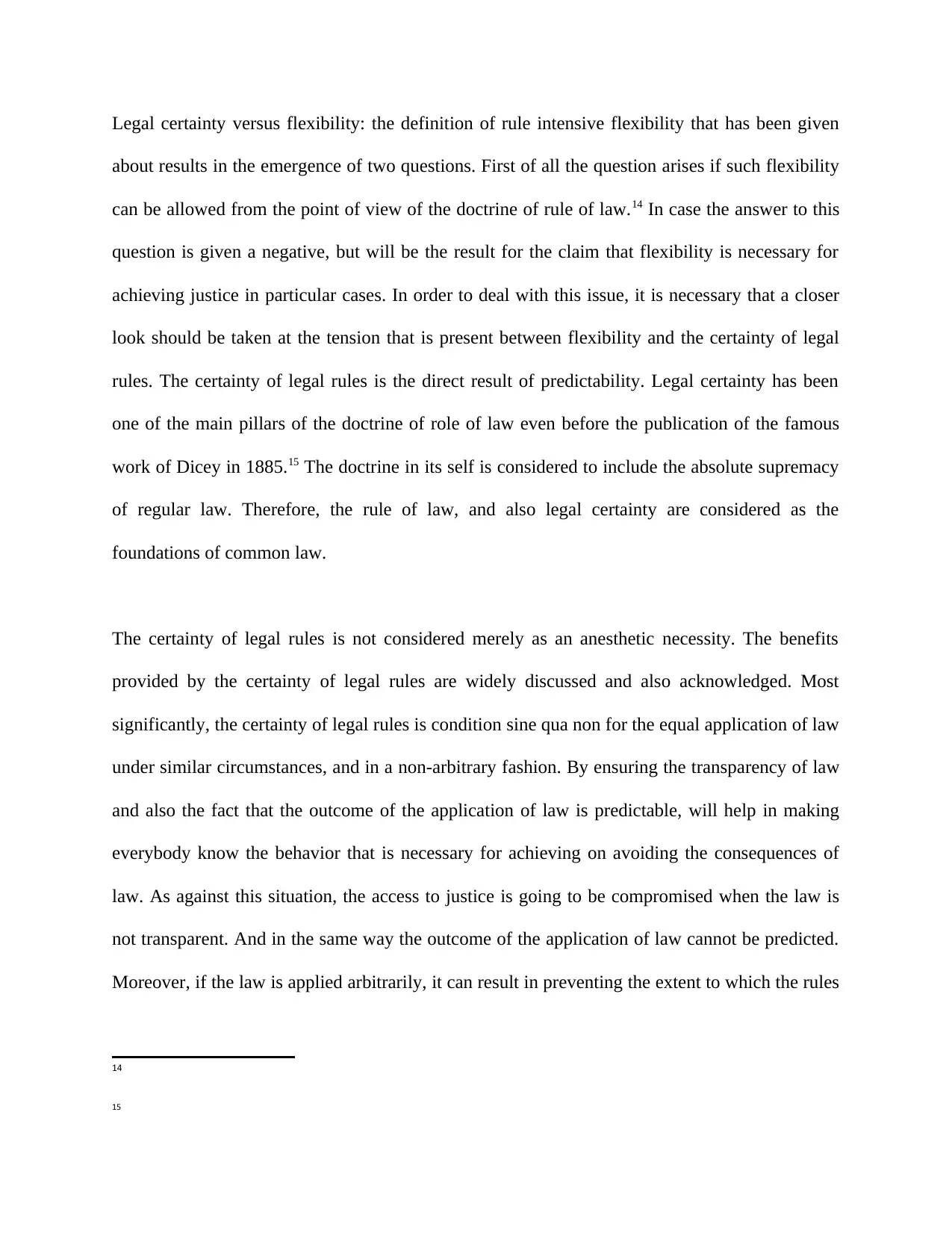
Legal certainty versus flexibility: the definition of rule intensive flexibility that has been given
about results in the emergence of two questions. First of all the question arises if such flexibility
can be allowed from the point of view of the doctrine of rule of law.14 In case the answer to this
question is given a negative, but will be the result for the claim that flexibility is necessary for
achieving justice in particular cases. In order to deal with this issue, it is necessary that a closer
look should be taken at the tension that is present between flexibility and the certainty of legal
rules. The certainty of legal rules is the direct result of predictability. Legal certainty has been
one of the main pillars of the doctrine of role of law even before the publication of the famous
work of Dicey in 1885.15 The doctrine in its self is considered to include the absolute supremacy
of regular law. Therefore, the rule of law, and also legal certainty are considered as the
foundations of common law.
The certainty of legal rules is not considered merely as an anesthetic necessity. The benefits
provided by the certainty of legal rules are widely discussed and also acknowledged. Most
significantly, the certainty of legal rules is condition sine qua non for the equal application of law
under similar circumstances, and in a non-arbitrary fashion. By ensuring the transparency of law
and also the fact that the outcome of the application of law is predictable, will help in making
everybody know the behavior that is necessary for achieving on avoiding the consequences of
law. As against this situation, the access to justice is going to be compromised when the law is
not transparent. And in the same way the outcome of the application of law cannot be predicted.
Moreover, if the law is applied arbitrarily, it can result in preventing the extent to which the rules
14
15
about results in the emergence of two questions. First of all the question arises if such flexibility
can be allowed from the point of view of the doctrine of rule of law.14 In case the answer to this
question is given a negative, but will be the result for the claim that flexibility is necessary for
achieving justice in particular cases. In order to deal with this issue, it is necessary that a closer
look should be taken at the tension that is present between flexibility and the certainty of legal
rules. The certainty of legal rules is the direct result of predictability. Legal certainty has been
one of the main pillars of the doctrine of role of law even before the publication of the famous
work of Dicey in 1885.15 The doctrine in its self is considered to include the absolute supremacy
of regular law. Therefore, the rule of law, and also legal certainty are considered as the
foundations of common law.
The certainty of legal rules is not considered merely as an anesthetic necessity. The benefits
provided by the certainty of legal rules are widely discussed and also acknowledged. Most
significantly, the certainty of legal rules is condition sine qua non for the equal application of law
under similar circumstances, and in a non-arbitrary fashion. By ensuring the transparency of law
and also the fact that the outcome of the application of law is predictable, will help in making
everybody know the behavior that is necessary for achieving on avoiding the consequences of
law. As against this situation, the access to justice is going to be compromised when the law is
not transparent. And in the same way the outcome of the application of law cannot be predicted.
Moreover, if the law is applied arbitrarily, it can result in preventing the extent to which the rules
14
15
Paraphrase This Document
Need a fresh take? Get an instant paraphrase of this document with our AI Paraphraser
and their application remains predictable or in other words the extent of the certainty of law.16
Many commentators have stated in this regard that the effect of legal certainty is to avoid
disputes, and it also decreases expenses and results in increasing profits.
Keeping in view the fact that these rules of law feature rule intrinsic constituents does not appear
to be allowable. As mentioned earlier, the flexible rules are open-ended in the sense that they do
not required a specific outcome of the application of rules. Hence, predictability cannot be
achieved by flexible rules. Therefore, it can also be stated that rule inherent flexibility and
certainty of legal rules are not compatible with each other. As a result, flexible rules ought not to
be present in a system of law that is based on the doctrine of rule of law. In some countries like
England and flexible rules can even be declared as unconstitutional as the Constitution itself is
based on the doctrine of rule of law. As a result, the claim that law allows for flexible rules, and
at the same time the rule based on the rule of law has to be considered as being contradictio in
adjecto.
However the conclusions based on these lines can detect only if the doctrine of rule of law is still
valid as mentioned in earlier paragraphs. At the same time, it also needs to be taken note of that
despite common understanding. As mentioned earlier, the doctrine of legal certainty as to face
criticism for some time. With a view to establish a transparent basis for discussing rule intrinsic
flexibility, the arguments that have been made in this concern had to be revisited.17 “Even if the
underlying concepts ambiguous and deceptively complex”, it needs to be stressed upon that it is
not the purpose of the present work to dismantle such ambiguity and complexity. On the other
16
17
Many commentators have stated in this regard that the effect of legal certainty is to avoid
disputes, and it also decreases expenses and results in increasing profits.
Keeping in view the fact that these rules of law feature rule intrinsic constituents does not appear
to be allowable. As mentioned earlier, the flexible rules are open-ended in the sense that they do
not required a specific outcome of the application of rules. Hence, predictability cannot be
achieved by flexible rules. Therefore, it can also be stated that rule inherent flexibility and
certainty of legal rules are not compatible with each other. As a result, flexible rules ought not to
be present in a system of law that is based on the doctrine of rule of law. In some countries like
England and flexible rules can even be declared as unconstitutional as the Constitution itself is
based on the doctrine of rule of law. As a result, the claim that law allows for flexible rules, and
at the same time the rule based on the rule of law has to be considered as being contradictio in
adjecto.
However the conclusions based on these lines can detect only if the doctrine of rule of law is still
valid as mentioned in earlier paragraphs. At the same time, it also needs to be taken note of that
despite common understanding. As mentioned earlier, the doctrine of legal certainty as to face
criticism for some time. With a view to establish a transparent basis for discussing rule intrinsic
flexibility, the arguments that have been made in this concern had to be revisited.17 “Even if the
underlying concepts ambiguous and deceptively complex”, it needs to be stressed upon that it is
not the purpose of the present work to dismantle such ambiguity and complexity. On the other
16
17
hand, the main purpose of this work is to expose the doctrinal context depending on flexibility of
the rules.18
The debates related with the practicality of the doctrine of legal certainty are also intimately
associated with the subject of ‘legal indeterminacy’. It was the major theme of American realist
movement that took place in the first half of the earlier century. The realists stated that the rules
are necessarily vague. Moreover, due to the reason that each legal arrangement comprises of
opposing rules, the judges need to select the rules that need to be given priority. Depending on
these decisions, it is possible that the judges may arrive at contradicting outcomes.
On the other hand, it has been argued by critical legal studies (CLS) on similar lines on the
grounds that the law is a result of political determinants. They provide that as a result, the judges
have to make decisions that are not decided by the law, but instead based on political choice.
Moreover, the choice is affected by contradictory principles. It has been pointed out that it is not
necessary to be the result of legal indeterminacy. Similarly, legal indeterminacy does not in itself
imply any political purpose of law. On the other hand, CLS has made efforts to notice the
probable indeterminacy of law to “delegate current legal order by undercutting the own
conception of the order as to why it is legitimate”.
H.L.A. Hart has acknowledged the probable uncertainty of law was referred to him by open
texture of the rules. He stated that, "whichever device legislation were president is selected for
communicating the standards of behavior. However smoothly, they have been working over the
great mass of ordinary cases, these will at some point face questions regarding the application".19
However, this is not being considered by Hart as the real problem due to the reason that in view
of large number of deciding cases, there is very minute uncertainty. Generally the head-note is
18
19
the rules.18
The debates related with the practicality of the doctrine of legal certainty are also intimately
associated with the subject of ‘legal indeterminacy’. It was the major theme of American realist
movement that took place in the first half of the earlier century. The realists stated that the rules
are necessarily vague. Moreover, due to the reason that each legal arrangement comprises of
opposing rules, the judges need to select the rules that need to be given priority. Depending on
these decisions, it is possible that the judges may arrive at contradicting outcomes.
On the other hand, it has been argued by critical legal studies (CLS) on similar lines on the
grounds that the law is a result of political determinants. They provide that as a result, the judges
have to make decisions that are not decided by the law, but instead based on political choice.
Moreover, the choice is affected by contradictory principles. It has been pointed out that it is not
necessary to be the result of legal indeterminacy. Similarly, legal indeterminacy does not in itself
imply any political purpose of law. On the other hand, CLS has made efforts to notice the
probable indeterminacy of law to “delegate current legal order by undercutting the own
conception of the order as to why it is legitimate”.
H.L.A. Hart has acknowledged the probable uncertainty of law was referred to him by open
texture of the rules. He stated that, "whichever device legislation were president is selected for
communicating the standards of behavior. However smoothly, they have been working over the
great mass of ordinary cases, these will at some point face questions regarding the application".19
However, this is not being considered by Hart as the real problem due to the reason that in view
of large number of deciding cases, there is very minute uncertainty. Generally the head-note is
18
19
⊘ This is a preview!⊘
Do you want full access?
Subscribe today to unlock all pages.
Trusted by 1+ million students worldwide
quick enough. Such an approach may appear to be practical. But it is not very useful when it
comes to having a systemic discussion related with doctrinal questions, because this approach
leaves many issues unexplained. Hart had gone a step further, and considered the open texture of
the legal rules as an advantage instead of being a disadvantage due to reason that it allows the
reasonable interpretation of rules at the time of their application to particular situations and two
different types of problems that were not foreseen by their authors or could not be foreseen by
them. In this way, this viewpoint provides that the flexibility of rules is apparently an automatic
consequence of rule, but it is not clear how it corresponds with the requirement of legal certainty
present in case of the rule of law.20
In this regard, some other commentators have pointed out towards the fact that the judges will
not be in a position to fulfill the requirements of legal certainty in such a case. This viewpoint
mentions that the doctrine of rule of law finds its basis in the real understanding of an
impeccable judge. It has been stated in this context that a regulatory idea for the judges should be
that they want to do justice. Therefore, they are only going to accommodate a desire to endorse
the legal decisions that have been determined by interest positions, ideological biases, political
attitudes or other external factors. In this regard some other commentators have included the fact
that evaluating criteria that is relevant for an answer to a specific legal question or the alternative
answer is, that may be available can be incommensurable therefore resulting in an impossibility
to make objective determination.21 To this statement, Dworkin has responded, claiming that it is
not proved that there are cases of incommensurability. At the same time, it is also worth
mentioning that it is simply presupposed while the doctrine of growth law that decision can be
made on the grounds of all things to be considered. The claim of incommensurability may
20
21
comes to having a systemic discussion related with doctrinal questions, because this approach
leaves many issues unexplained. Hart had gone a step further, and considered the open texture of
the legal rules as an advantage instead of being a disadvantage due to reason that it allows the
reasonable interpretation of rules at the time of their application to particular situations and two
different types of problems that were not foreseen by their authors or could not be foreseen by
them. In this way, this viewpoint provides that the flexibility of rules is apparently an automatic
consequence of rule, but it is not clear how it corresponds with the requirement of legal certainty
present in case of the rule of law.20
In this regard, some other commentators have pointed out towards the fact that the judges will
not be in a position to fulfill the requirements of legal certainty in such a case. This viewpoint
mentions that the doctrine of rule of law finds its basis in the real understanding of an
impeccable judge. It has been stated in this context that a regulatory idea for the judges should be
that they want to do justice. Therefore, they are only going to accommodate a desire to endorse
the legal decisions that have been determined by interest positions, ideological biases, political
attitudes or other external factors. In this regard some other commentators have included the fact
that evaluating criteria that is relevant for an answer to a specific legal question or the alternative
answer is, that may be available can be incommensurable therefore resulting in an impossibility
to make objective determination.21 To this statement, Dworkin has responded, claiming that it is
not proved that there are cases of incommensurability. At the same time, it is also worth
mentioning that it is simply presupposed while the doctrine of growth law that decision can be
made on the grounds of all things to be considered. The claim of incommensurability may
20
21
Paraphrase This Document
Need a fresh take? Get an instant paraphrase of this document with our AI Paraphraser
describe the problems related with application of law in action. However it cannot challenge the
rule of law in the form of an ideal.22
On the basis of the above mentioned the discussion, it can be stated that legal certainty as
required by the doctrine of rule of law is still necessary for being considered while exploring the
legal significance of flexibility in rules of law. The issue that is present in such a case is if there
is any room for the flexibility of rules in a legal system based on rule of law. In other words, it
can be stated that a person is required to contemplate if the coexistence of flexibility and legal
certainty is possible. As mentioned above, it is unfortunate that the need for flexibility and
augments based on the claims of flexibility are generally not supported by extensive explanations
related with the relationship that exists between the doctrine of rule of law and flexibility. The
presence of the contradiction between flexibility and the rule of law therefore is generally not
even acknowledged. As against this position, it appears that the claims of flexibility are made
whenever it appears that they can assist in a particular cause, without the need for deeper
reflection. The efforts that have been made to overcome the dichotomy present between
flexibility and rule of law is very rare and can also be described as tacit. There are several
authors who have made efforts to bypass this problem by laying stress in different degrees of
flexibility and legal certainty. An example is the case then it has been claimed that some amount
of certainty, predictability and fairness are necessary, even if there is a flexible regime,
comprising substantive rules.23
At this point, it also needs to be mentioned that the reference to the different degrees of
flexibility is misleading. The reason is that the relationship that exists between flexibility and
legal certainty is mutually exclusive. Either legal certainty exists or rule inherent flexibility is
22
23
rule of law in the form of an ideal.22
On the basis of the above mentioned the discussion, it can be stated that legal certainty as
required by the doctrine of rule of law is still necessary for being considered while exploring the
legal significance of flexibility in rules of law. The issue that is present in such a case is if there
is any room for the flexibility of rules in a legal system based on rule of law. In other words, it
can be stated that a person is required to contemplate if the coexistence of flexibility and legal
certainty is possible. As mentioned above, it is unfortunate that the need for flexibility and
augments based on the claims of flexibility are generally not supported by extensive explanations
related with the relationship that exists between the doctrine of rule of law and flexibility. The
presence of the contradiction between flexibility and the rule of law therefore is generally not
even acknowledged. As against this position, it appears that the claims of flexibility are made
whenever it appears that they can assist in a particular cause, without the need for deeper
reflection. The efforts that have been made to overcome the dichotomy present between
flexibility and rule of law is very rare and can also be described as tacit. There are several
authors who have made efforts to bypass this problem by laying stress in different degrees of
flexibility and legal certainty. An example is the case then it has been claimed that some amount
of certainty, predictability and fairness are necessary, even if there is a flexible regime,
comprising substantive rules.23
At this point, it also needs to be mentioned that the reference to the different degrees of
flexibility is misleading. The reason is that the relationship that exists between flexibility and
legal certainty is mutually exclusive. Either legal certainty exists or rule inherent flexibility is
22
23
present. Therefore it is logically not possible to allow the existence of both. The reason is that
legal certainty will disappear in all the cases when the tiniest element of flexibility is introduced.
In the same way, in practice, allowing various degrees of flexibility will need the quantification
of these degrees of flexibility that can be allowed. Hence, such quantification will not be possible
practically. Therefore it can be stated that the generally stated tension that exists between legal
certainty and flexibility is not simply present. In fact, it is not possible to exist. The legal rules
can be either flexible or they can provide for certainty. Therefore, it can be stated that the rule
inherent flexibility is only an oxymoron.24
In this way, there are certain commentators who have directly or indirectly pointed out towards
the fact that flexibility can be a feature of judicial practice or in other words, the application of
law. Therefore it is important to consider if the flexible application of law can be justified from
the point of view of the doctrine of rule of law. As a result of the above conclusions, way has
been paved for a straightforward reply. If, as mentioned above, there cannot be a proper rule
allowing for flexibility, then there cannot be the flexible application of law. The reason is that
flexible application of a legal rule will necessarily imply that there is a deviation from the rule,
because the ruling itself does not provide for the way in which that rule has been applied. The
courts applying the rules in a flexible manner will therefore will not be in a position to apply the
rules as they have been mentioned. Or in other words, the courts will fail to abide by the law as a
result of such application.
In the end, it can be stated that although the term is generally used in legal discourse, but there is
no widely accepted definition of flexibility. As compared to this position, the term flexibility has
been used in several different ways and in context of different aspects, generally without
providing evidence of its existence and in many cases without much reflection. However, the
24
legal certainty will disappear in all the cases when the tiniest element of flexibility is introduced.
In the same way, in practice, allowing various degrees of flexibility will need the quantification
of these degrees of flexibility that can be allowed. Hence, such quantification will not be possible
practically. Therefore it can be stated that the generally stated tension that exists between legal
certainty and flexibility is not simply present. In fact, it is not possible to exist. The legal rules
can be either flexible or they can provide for certainty. Therefore, it can be stated that the rule
inherent flexibility is only an oxymoron.24
In this way, there are certain commentators who have directly or indirectly pointed out towards
the fact that flexibility can be a feature of judicial practice or in other words, the application of
law. Therefore it is important to consider if the flexible application of law can be justified from
the point of view of the doctrine of rule of law. As a result of the above conclusions, way has
been paved for a straightforward reply. If, as mentioned above, there cannot be a proper rule
allowing for flexibility, then there cannot be the flexible application of law. The reason is that
flexible application of a legal rule will necessarily imply that there is a deviation from the rule,
because the ruling itself does not provide for the way in which that rule has been applied. The
courts applying the rules in a flexible manner will therefore will not be in a position to apply the
rules as they have been mentioned. Or in other words, the courts will fail to abide by the law as a
result of such application.
In the end, it can be stated that although the term is generally used in legal discourse, but there is
no widely accepted definition of flexibility. As compared to this position, the term flexibility has
been used in several different ways and in context of different aspects, generally without
providing evidence of its existence and in many cases without much reflection. However, the
24
⊘ This is a preview!⊘
Do you want full access?
Subscribe today to unlock all pages.
Trusted by 1+ million students worldwide

main purpose of the present work was to draw attention towards the limits of flexibility that have
been imposed as a result of the doctrine of rule of law.
been imposed as a result of the doctrine of rule of law.

1 out of 10


Related Documents


Your All-in-One AI-Powered Toolkit for Academic Success.
+13062052269
info@desklib.com
Available 24*7 on WhatsApp / Email
![[object Object]](/_next/static/media/star-bottom.7253800d.svg)
Unlock your academic potential
Copyright © 2020–2026 A2Z Services. All Rights Reserved. Developed and managed by ZUCOL.