Flexible Work's Influence on Sustainability: A Business Analysis
VerifiedAdded on 2019/10/01
|19
|4106
|33
Report
AI Summary
This report, focusing on the critical role of flexible working conditions in fostering sustainable businesses, begins with an introduction highlighting the significance of employee satisfaction and engagement. It then presents a critical literature review, examining the benefits of flexible work arrangements, including variable work hours, home working, and part-time options, while also acknowledging potential challenges. The theoretical framework, based on job satisfaction theories such as Maslow's hierarchy of needs and Herzberg's motivator-hygiene theory, is used to evaluate the project. The research methodology employs an interpretivism philosophy and a deductive approach, collecting primary data through surveys and interviews to assess the impact of flexible working conditions on employee performance and business sustainability. The study aims to provide organizations with strategies to retain talent and achieve long-term goals, emphasizing the importance of work-life balance and employee well-being in the context of a changing business environment.

[Company name] [Company address]

Paraphrase This Document
Need a fresh take? Get an instant paraphrase of this document with our AI Paraphraser
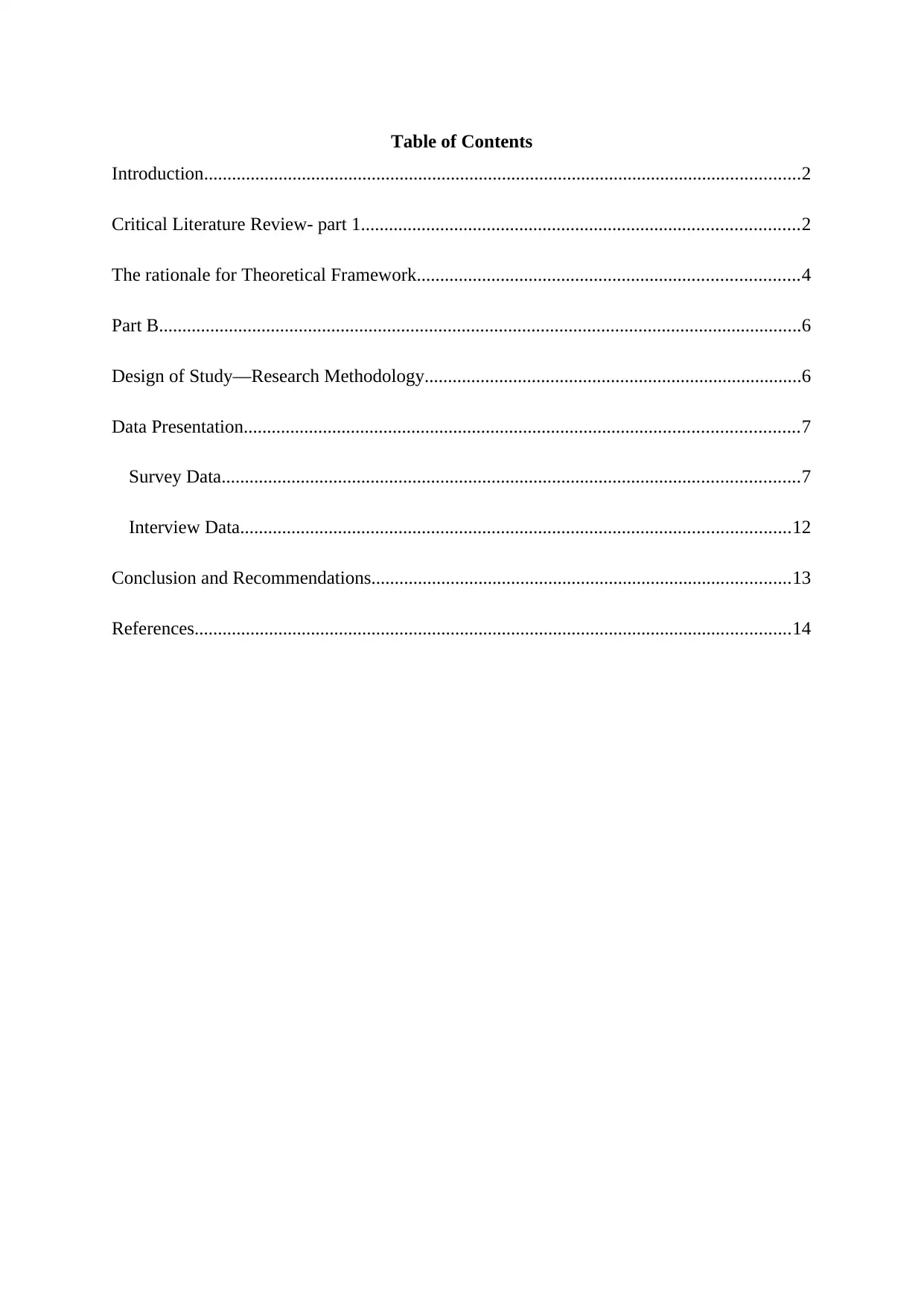
Table of Contents
Introduction................................................................................................................................2
Critical Literature Review- part 1..............................................................................................2
The rationale for Theoretical Framework..................................................................................4
Part B..........................................................................................................................................6
Design of Study—Research Methodology.................................................................................6
Data Presentation.......................................................................................................................7
Survey Data............................................................................................................................7
Interview Data......................................................................................................................12
Conclusion and Recommendations..........................................................................................13
References................................................................................................................................14
Introduction................................................................................................................................2
Critical Literature Review- part 1..............................................................................................2
The rationale for Theoretical Framework..................................................................................4
Part B..........................................................................................................................................6
Design of Study—Research Methodology.................................................................................6
Data Presentation.......................................................................................................................7
Survey Data............................................................................................................................7
Interview Data......................................................................................................................12
Conclusion and Recommendations..........................................................................................13
References................................................................................................................................14
Topic: The role of flexible working conditions on sustainable businesses
Faculty of Business and Society
Part A: Critical Literature Review including identification of a suitable theoretical framework
that will be used to evaluate the project in Part B
Introduction
The problem or the issue which has been analyzed in the project relate to the importance of
flexible working conditions for sustainability of businesses. The employees are an important
asset of organizations which determines the success of any venture. Their level of satisfaction
and engagement with the company helps in the achievement of goals and ensure long term
success(Mital, 2010). Therefore the employees must be provided with higher flexibility in
their work to improve their performance and also positively motivate them for long term
performance.
The situation discussed in the project has been experienced by me in my workplace. The level
of flexibility allowed by our employees helps to improve the performance and also engage
effectively with the goals and objectives of the organization. Therefore the aims and the
objectives of the study include the following:
Identification of employee satisfaction related to flexible work conditions and the
benefits in the context of sustainability.
The research or the study conducted in the paper is important as it will help the organizations
provide better work conditions to the employees and also influence their performance for
long term operations of the organization. The findings of the research can be used by the
companies, to implement a strategy for retaining talent through which the goals and
objectives can be achieved.
Critical Literature Review- part 1
Several studies have been conducted to understand the importance of flexible work
environment to motivate the employees towards better performance. The findings from these
studies indicate that the employees are looking for job positions and opportunities which
provide them flexible work conditions. These employees have needs related to engagement in
their social and personal life.
Faculty of Business and Society
Part A: Critical Literature Review including identification of a suitable theoretical framework
that will be used to evaluate the project in Part B
Introduction
The problem or the issue which has been analyzed in the project relate to the importance of
flexible working conditions for sustainability of businesses. The employees are an important
asset of organizations which determines the success of any venture. Their level of satisfaction
and engagement with the company helps in the achievement of goals and ensure long term
success(Mital, 2010). Therefore the employees must be provided with higher flexibility in
their work to improve their performance and also positively motivate them for long term
performance.
The situation discussed in the project has been experienced by me in my workplace. The level
of flexibility allowed by our employees helps to improve the performance and also engage
effectively with the goals and objectives of the organization. Therefore the aims and the
objectives of the study include the following:
Identification of employee satisfaction related to flexible work conditions and the
benefits in the context of sustainability.
The research or the study conducted in the paper is important as it will help the organizations
provide better work conditions to the employees and also influence their performance for
long term operations of the organization. The findings of the research can be used by the
companies, to implement a strategy for retaining talent through which the goals and
objectives can be achieved.
Critical Literature Review- part 1
Several studies have been conducted to understand the importance of flexible work
environment to motivate the employees towards better performance. The findings from these
studies indicate that the employees are looking for job positions and opportunities which
provide them flexible work conditions. These employees have needs related to engagement in
their social and personal life.
⊘ This is a preview!⊘
Do you want full access?
Subscribe today to unlock all pages.

Trusted by 1+ million students worldwide
Some of the studies have been conducted to understand the changing context of work. There
are a set of new opportunities and challenges which are faced by the employees of a
company(Klindžić and Marić, 2019). The use of advanced technologies, the rapid rate of
globalization, change in demographics and development of new societal values require that
the work environment of the employees also change to include these aspects. The change in
the business environment has increased the need for flexible work conditions.
Some of the experts in the field also view that flexibility is important for both large and small
organizations. This flexibility may include flexible work arrangements, informal negotiations,
etc. The evidence indicates that several companies have started providing flexible work
arrangement to the employees. These include variable work hours, dual roles, home working,
part-time works, job shares, etc. In one of the reports published by Confederation of British
Industry that around 90% of the companies in the United Kingdom offer one of the flexible
working arrangement to its employees (ter Hoeven and van Zoonen, 2015).
However, some of the views even hold a contradictory view. There are companies which
have not adopted flexible work arrangement with the fear of losing their competitiveness.
Therefore many research and studies have been conducted to establish the tangible benefits to
the organizations for the adoption of flexible work options. The traditional models of work
are no longer effective in the globalized, technologically advanced environment.
The pioneers of sustainability in the work environment indicate that the integration of plant,
people and profit for the long term continuity of the operations. The aspect of sustainability
includes social, environmental and economic dimensions, which suggest the adoption of new
work arrangements. There is a need to innovate and manage change for which the companies
should adopt new activities and work arrangements. The limitation of the traditional work
environment is strict spatial and temporal boundaries. As the external business environment,
is changing the needs of the employees are also evolving(KARAKAŞ and SAHİN, 2017).
There are some of the significant changing trends which suggest higher flexible work
practices. Some of these trends are, increase in women workforce, individualism in
organizations, growth in the number of a lean organization, blurring of the boundaries
between home and work, and growth in the international trade relations.
As indicated by the researcher, Marler, and Lamber 2008, the availability of the flexible work
arrangements represents employer-provided benefits which motivate the employees towards
better performance. It includes a set of off-site options and works time options, which provide
are a set of new opportunities and challenges which are faced by the employees of a
company(Klindžić and Marić, 2019). The use of advanced technologies, the rapid rate of
globalization, change in demographics and development of new societal values require that
the work environment of the employees also change to include these aspects. The change in
the business environment has increased the need for flexible work conditions.
Some of the experts in the field also view that flexibility is important for both large and small
organizations. This flexibility may include flexible work arrangements, informal negotiations,
etc. The evidence indicates that several companies have started providing flexible work
arrangement to the employees. These include variable work hours, dual roles, home working,
part-time works, job shares, etc. In one of the reports published by Confederation of British
Industry that around 90% of the companies in the United Kingdom offer one of the flexible
working arrangement to its employees (ter Hoeven and van Zoonen, 2015).
However, some of the views even hold a contradictory view. There are companies which
have not adopted flexible work arrangement with the fear of losing their competitiveness.
Therefore many research and studies have been conducted to establish the tangible benefits to
the organizations for the adoption of flexible work options. The traditional models of work
are no longer effective in the globalized, technologically advanced environment.
The pioneers of sustainability in the work environment indicate that the integration of plant,
people and profit for the long term continuity of the operations. The aspect of sustainability
includes social, environmental and economic dimensions, which suggest the adoption of new
work arrangements. There is a need to innovate and manage change for which the companies
should adopt new activities and work arrangements. The limitation of the traditional work
environment is strict spatial and temporal boundaries. As the external business environment,
is changing the needs of the employees are also evolving(KARAKAŞ and SAHİN, 2017).
There are some of the significant changing trends which suggest higher flexible work
practices. Some of these trends are, increase in women workforce, individualism in
organizations, growth in the number of a lean organization, blurring of the boundaries
between home and work, and growth in the international trade relations.
As indicated by the researcher, Marler, and Lamber 2008, the availability of the flexible work
arrangements represents employer-provided benefits which motivate the employees towards
better performance. It includes a set of off-site options and works time options, which provide
Paraphrase This Document
Need a fresh take? Get an instant paraphrase of this document with our AI Paraphraser
employees with a higher level of management for completing the work. They can balance
their work and life, and manage family and friends. There are global organizations which
work 24X7 and provide employees with more satisfactory work-life balance.
Two of the important concepts of flexibility which are used by most of the companies
include, place flexibility and temporal flexibility. Some also use various combinations of
temporal and place flexibility. These are known to provide benefit to the employer and the
employees. The benefits related to flexible work options have already been experienced and
recognized by many companies around the world.
There are some studies which indicate that the implementation of the flexible work
arrangements is not always easy. There are certain challenges related to the re-designing of
the workplace to allow employees to use flexible work options. One of the major benefits is
the improved performance of the employees towards the long term goals of the organization.
When the employees are satisfied, it becomes easy for the companies to retain the talent and
long term sustainability of the operations.
The researcher has also been successful to establish a positive correlation between the
flexible work options and the performance of the employees.
The theoretical framework which will be used to evaluate the project in part B includes job
satisfaction theories (Evans and Davis, 2015). These theories are related to human motivation
models. Some of the most widely used and prominent theories include Maslow's need
hierarchy theory, motivator-hygiene theory, and Herzberg theory.
The rationale for Theoretical Framework
The theoretical framework which has been selected for evaluation of the project is relevant
for the research in the following ways:
Importance of job satisfaction- Job satisfaction is one of the important areas in
organizational psychology which helps to determine the performance of the
employees for long term operations of the organization. Several experts have provided
their context and definition of job satisfaction. Most of them include the affective
feeling of the employees, towards his job. These feelings are towards the job in
general or towards the specific aspect, as the work environment, payor colleagues.
Apart from this, the outcome of their work also helps to identify the level of
their work and life, and manage family and friends. There are global organizations which
work 24X7 and provide employees with more satisfactory work-life balance.
Two of the important concepts of flexibility which are used by most of the companies
include, place flexibility and temporal flexibility. Some also use various combinations of
temporal and place flexibility. These are known to provide benefit to the employer and the
employees. The benefits related to flexible work options have already been experienced and
recognized by many companies around the world.
There are some studies which indicate that the implementation of the flexible work
arrangements is not always easy. There are certain challenges related to the re-designing of
the workplace to allow employees to use flexible work options. One of the major benefits is
the improved performance of the employees towards the long term goals of the organization.
When the employees are satisfied, it becomes easy for the companies to retain the talent and
long term sustainability of the operations.
The researcher has also been successful to establish a positive correlation between the
flexible work options and the performance of the employees.
The theoretical framework which will be used to evaluate the project in part B includes job
satisfaction theories (Evans and Davis, 2015). These theories are related to human motivation
models. Some of the most widely used and prominent theories include Maslow's need
hierarchy theory, motivator-hygiene theory, and Herzberg theory.
The rationale for Theoretical Framework
The theoretical framework which has been selected for evaluation of the project is relevant
for the research in the following ways:
Importance of job satisfaction- Job satisfaction is one of the important areas in
organizational psychology which helps to determine the performance of the
employees for long term operations of the organization. Several experts have provided
their context and definition of job satisfaction. Most of them include the affective
feeling of the employees, towards his job. These feelings are towards the job in
general or towards the specific aspect, as the work environment, payor colleagues.
Apart from this, the outcome of their work also helps to identify the level of
satisfaction from the job. Some of the studies identify a positive correlation between
the level of job satisfaction and the performance level of the employees.
The positive relation between job satisfaction and performance- Most of the job
satisfaction theories indicate a positive relationship between the level of satisfaction
and the performance of the employees. This positive correlation provides important
implications for the manager and human resource department to influence the
performance of the employees.
It will be used to analyze the project in the following manner:
Analysis of the hierarchy of needs to identify the need for job satisfaction, related to the
flexibility of work conditions. There are different needs related to the job, like job security,
financial compensation which affect the performance of the employees. When the employees
have fulfilled their need for job satisfaction, they experience a feeling that they belong to a
workplace (Brescoll, Glass and Sedlovskaya, 2013). These can be built in several ways
through work flexibility or the positive relationship with the manager and co-workers. Thus
the need for self-actualization will be analyzed which is related to the improvement in
performance for long term sustainability of the organization.
The empirical support and evidence related to the impact of workplace flexibility on
performance of the employees will be analyzed to understand how such aspects affect the
long term sustainability of the organization.
Another model of human motivation includes motivator- hygiene theory. Working conditions
come under hygiene factors, which directly affect job satisfaction. The hygiene and the
motivational factors are two set of independent factors which are used by the managers and
the leaders in the organization to influence the performance of the employees.
The model of Herzberg theory will also be used, to understand how the flexible work
arrangements help to improve the satisfaction of the employees and motivate them to perform
better for long term competitiveness of the company.
the level of job satisfaction and the performance level of the employees.
The positive relation between job satisfaction and performance- Most of the job
satisfaction theories indicate a positive relationship between the level of satisfaction
and the performance of the employees. This positive correlation provides important
implications for the manager and human resource department to influence the
performance of the employees.
It will be used to analyze the project in the following manner:
Analysis of the hierarchy of needs to identify the need for job satisfaction, related to the
flexibility of work conditions. There are different needs related to the job, like job security,
financial compensation which affect the performance of the employees. When the employees
have fulfilled their need for job satisfaction, they experience a feeling that they belong to a
workplace (Brescoll, Glass and Sedlovskaya, 2013). These can be built in several ways
through work flexibility or the positive relationship with the manager and co-workers. Thus
the need for self-actualization will be analyzed which is related to the improvement in
performance for long term sustainability of the organization.
The empirical support and evidence related to the impact of workplace flexibility on
performance of the employees will be analyzed to understand how such aspects affect the
long term sustainability of the organization.
Another model of human motivation includes motivator- hygiene theory. Working conditions
come under hygiene factors, which directly affect job satisfaction. The hygiene and the
motivational factors are two set of independent factors which are used by the managers and
the leaders in the organization to influence the performance of the employees.
The model of Herzberg theory will also be used, to understand how the flexible work
arrangements help to improve the satisfaction of the employees and motivate them to perform
better for long term competitiveness of the company.
⊘ This is a preview!⊘
Do you want full access?
Subscribe today to unlock all pages.
Trusted by 1+ million students worldwide
Part B
Design of Study—Research Methodology
The research methodology is described as a systematic plan to conduct the study (Kumar,
2019). It includes research philosophy, approach, strategy, and data collection techniques.
The current section deals with a discussion on the methodology of the current research.
The current research is conducted using interpretivism philosophy. Interpretivism helps the
researchers to access reality through social constructions such as shared meanings, language
and construction (Silverman, 2016). In this research, the effectiveness of flexible working
hours in a sustainable business environment is evaluated. Hence, the use of interpretivism
philosophy is the most suitable as it enables the researcher to interpret the reality using
human interest. Interpretivism enables the researcher to collect subjective primary data which
allows them to get an in-depth insight into the research issue (Quinlan et al., 2019). It is one
of the strengths of philosophy. Interpretivism also enables the researcher to consider the
perspectives of individuals during data collection. As an effect, highly valid data is collected
from participants. The high validity is another strength of interpretivism philosophy.
However, the data collected using interpretivism philosophy lacks generalization which is a
weakness of this philosophy.
The deductive approach is used in this research. The deductive approach enables the
researcher to modify existing theories by testing the casual relationships between concepts
and variables (Taylor et al., ). In this case, the researcher does not need to develop any new
theory. Instead, the relationship between working hour flexibility and sustainable business
environment needs to be tested. The deductive research helps the researchers to quantify data.
Quantitative data reduces the risk of ambiguity. So, enhanced clarity is the strength of
deductive research. The deductive research does not test the initial premises and considers
that those are correct. It is a weakness of this approach as it might affect the accuracy of the
study.
In this research, the primary data will be collected using survey and interview. The survey
collects quantitative data whereas the interview collects qualitative data (Flick, 2015). The
survey research enables the researcher to collect a large amount of data in a time-efficient
manner. The cost -efficiency, high generalizability, reliability and versatility are the strengths
of survey data (Fletcher, 2017). However, the data collected from the survey lacks depth and
Design of Study—Research Methodology
The research methodology is described as a systematic plan to conduct the study (Kumar,
2019). It includes research philosophy, approach, strategy, and data collection techniques.
The current section deals with a discussion on the methodology of the current research.
The current research is conducted using interpretivism philosophy. Interpretivism helps the
researchers to access reality through social constructions such as shared meanings, language
and construction (Silverman, 2016). In this research, the effectiveness of flexible working
hours in a sustainable business environment is evaluated. Hence, the use of interpretivism
philosophy is the most suitable as it enables the researcher to interpret the reality using
human interest. Interpretivism enables the researcher to collect subjective primary data which
allows them to get an in-depth insight into the research issue (Quinlan et al., 2019). It is one
of the strengths of philosophy. Interpretivism also enables the researcher to consider the
perspectives of individuals during data collection. As an effect, highly valid data is collected
from participants. The high validity is another strength of interpretivism philosophy.
However, the data collected using interpretivism philosophy lacks generalization which is a
weakness of this philosophy.
The deductive approach is used in this research. The deductive approach enables the
researcher to modify existing theories by testing the casual relationships between concepts
and variables (Taylor et al., ). In this case, the researcher does not need to develop any new
theory. Instead, the relationship between working hour flexibility and sustainable business
environment needs to be tested. The deductive research helps the researchers to quantify data.
Quantitative data reduces the risk of ambiguity. So, enhanced clarity is the strength of
deductive research. The deductive research does not test the initial premises and considers
that those are correct. It is a weakness of this approach as it might affect the accuracy of the
study.
In this research, the primary data will be collected using survey and interview. The survey
collects quantitative data whereas the interview collects qualitative data (Flick, 2015). The
survey research enables the researcher to collect a large amount of data in a time-efficient
manner. The cost -efficiency, high generalizability, reliability and versatility are the strengths
of survey data (Fletcher, 2017). However, the data collected from the survey lacks depth and
Paraphrase This Document
Need a fresh take? Get an instant paraphrase of this document with our AI Paraphraser
it is a weakness of this method. The interviews, on the contrary, facilitate the researcher to
investigate the issue in depth. Discovering important insights through analysis is the strength
of the research. However, the interview is time-consuming, which is a weakness of the study.
The survey is conducted among 50 employees of the workplace and the interview is done
among 3 line managers.
The employees are selected using simple random sampling. The data collected using simple
random sampling are free from any bias and so, they represent the issue accurately (Bresler
and Stake, 2017). High accuracy is the strength of simple random sampling. However,
creating a large sample with a simple random technique is time-consuming. So, the lack of
time-efficiency is a weakness of this research. The interview participants are selected using
purposive sampling. The data collected using purposive sampling has high validity as the
participants are based on specific characteristics suitable for meeting research goals
(Humphries, 2017). High validity is the strength of the data in this case. However, the data
can be biased and so, the accuracy might be compromised using this technique.
The survey data is analyzed numerically and presented using graphs. The visual presentations
are easy to interpret. The numerical analysis highlights important facts and trends from the
collected data (Ledford and Gast, 2018). It is the strength of this approach. However, the
numerical analysis also provides limited outcomes which are a weakness.
The interview data is analyzed using narrative analysis and presented using texts. The
narrative approach provides the researcher with the flexibility to identify new aspects of the
issue (Alvesson and Sköldberg, 2017). Accuracy of the data analyzed through a narrative
approach also depends on the skills of the narrator. Extensive reliance on the skills of the
narrator is a weakness of the approach.
Data Presentation
Survey Data
1. How many years you are working in this organization?
investigate the issue in depth. Discovering important insights through analysis is the strength
of the research. However, the interview is time-consuming, which is a weakness of the study.
The survey is conducted among 50 employees of the workplace and the interview is done
among 3 line managers.
The employees are selected using simple random sampling. The data collected using simple
random sampling are free from any bias and so, they represent the issue accurately (Bresler
and Stake, 2017). High accuracy is the strength of simple random sampling. However,
creating a large sample with a simple random technique is time-consuming. So, the lack of
time-efficiency is a weakness of this research. The interview participants are selected using
purposive sampling. The data collected using purposive sampling has high validity as the
participants are based on specific characteristics suitable for meeting research goals
(Humphries, 2017). High validity is the strength of the data in this case. However, the data
can be biased and so, the accuracy might be compromised using this technique.
The survey data is analyzed numerically and presented using graphs. The visual presentations
are easy to interpret. The numerical analysis highlights important facts and trends from the
collected data (Ledford and Gast, 2018). It is the strength of this approach. However, the
numerical analysis also provides limited outcomes which are a weakness.
The interview data is analyzed using narrative analysis and presented using texts. The
narrative approach provides the researcher with the flexibility to identify new aspects of the
issue (Alvesson and Sköldberg, 2017). Accuracy of the data analyzed through a narrative
approach also depends on the skills of the narrator. Extensive reliance on the skills of the
narrator is a weakness of the approach.
Data Presentation
Survey Data
1. How many years you are working in this organization?
6
20
40
20
14
>7 years
5-7 years
3-5 years
1-3 years
<1 year
Figure 1: Tenure to work
The data indicates that the largest portion of staffs has working experience of 3-5 years in this
organization. However, the sample also includes new as well as highly experienced staffs. It
indicates that the collected data is heterogeneous.
2. Do you have flexible working Condition at the workplace?
66
34
Yes
No
Figure 2: Responses to Flexible Working Condition
The data indicates that a major portion of the employees gets a flexible working hour at the
workplace. It indicates that the organization emphasizes on providing the employees with
flexible working condition.
20
40
20
14
>7 years
5-7 years
3-5 years
1-3 years
<1 year
Figure 1: Tenure to work
The data indicates that the largest portion of staffs has working experience of 3-5 years in this
organization. However, the sample also includes new as well as highly experienced staffs. It
indicates that the collected data is heterogeneous.
2. Do you have flexible working Condition at the workplace?
66
34
Yes
No
Figure 2: Responses to Flexible Working Condition
The data indicates that a major portion of the employees gets a flexible working hour at the
workplace. It indicates that the organization emphasizes on providing the employees with
flexible working condition.
⊘ This is a preview!⊘
Do you want full access?
Subscribe today to unlock all pages.
Trusted by 1+ million students worldwide
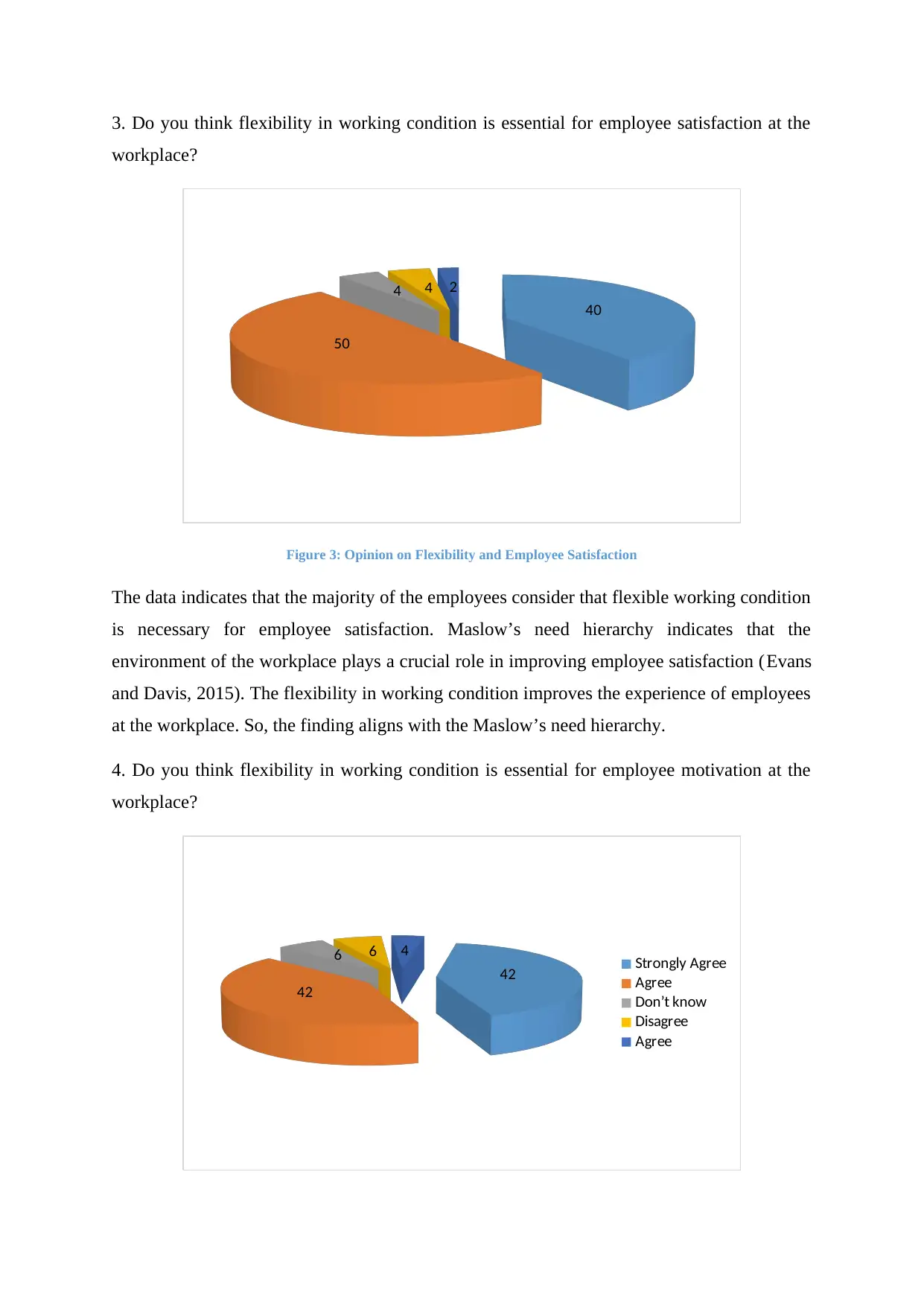
3. Do you think flexibility in working condition is essential for employee satisfaction at the
workplace?
40
50
4 4 2
Figure 3: Opinion on Flexibility and Employee Satisfaction
The data indicates that the majority of the employees consider that flexible working condition
is necessary for employee satisfaction. Maslow’s need hierarchy indicates that the
environment of the workplace plays a crucial role in improving employee satisfaction (Evans
and Davis, 2015). The flexibility in working condition improves the experience of employees
at the workplace. So, the finding aligns with the Maslow’s need hierarchy.
4. Do you think flexibility in working condition is essential for employee motivation at the
workplace?
42
42
6 6 4 Strongly Agree
Agree
Don’t know
Disagree
Agree
workplace?
40
50
4 4 2
Figure 3: Opinion on Flexibility and Employee Satisfaction
The data indicates that the majority of the employees consider that flexible working condition
is necessary for employee satisfaction. Maslow’s need hierarchy indicates that the
environment of the workplace plays a crucial role in improving employee satisfaction (Evans
and Davis, 2015). The flexibility in working condition improves the experience of employees
at the workplace. So, the finding aligns with the Maslow’s need hierarchy.
4. Do you think flexibility in working condition is essential for employee motivation at the
workplace?
42
42
6 6 4 Strongly Agree
Agree
Don’t know
Disagree
Agree
Paraphrase This Document
Need a fresh take? Get an instant paraphrase of this document with our AI Paraphraser
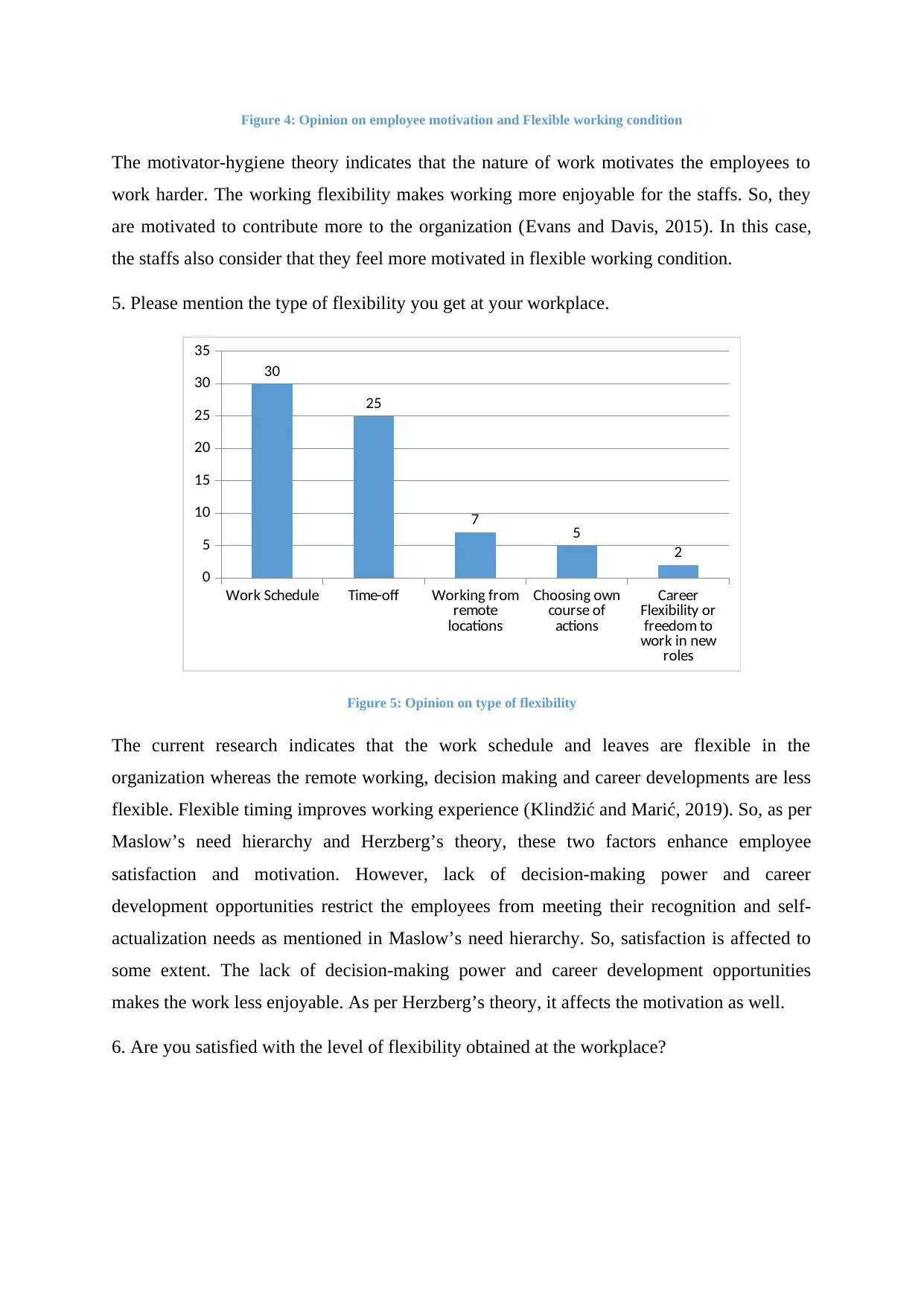
Figure 4: Opinion on employee motivation and Flexible working condition
The motivator-hygiene theory indicates that the nature of work motivates the employees to
work harder. The working flexibility makes working more enjoyable for the staffs. So, they
are motivated to contribute more to the organization (Evans and Davis, 2015). In this case,
the staffs also consider that they feel more motivated in flexible working condition.
5. Please mention the type of flexibility you get at your workplace.
Work Schedule Time-off Working from
remote
locations
Choosing own
course of
actions
Career
Flexibility or
freedom to
work in new
roles
0
5
10
15
20
25
30
35
30
25
7 5
2
Figure 5: Opinion on type of flexibility
The current research indicates that the work schedule and leaves are flexible in the
organization whereas the remote working, decision making and career developments are less
flexible. Flexible timing improves working experience (Klindžić and Marić, 2019). So, as per
Maslow’s need hierarchy and Herzberg’s theory, these two factors enhance employee
satisfaction and motivation. However, lack of decision-making power and career
development opportunities restrict the employees from meeting their recognition and self-
actualization needs as mentioned in Maslow’s need hierarchy. So, satisfaction is affected to
some extent. The lack of decision-making power and career development opportunities
makes the work less enjoyable. As per Herzberg’s theory, it affects the motivation as well.
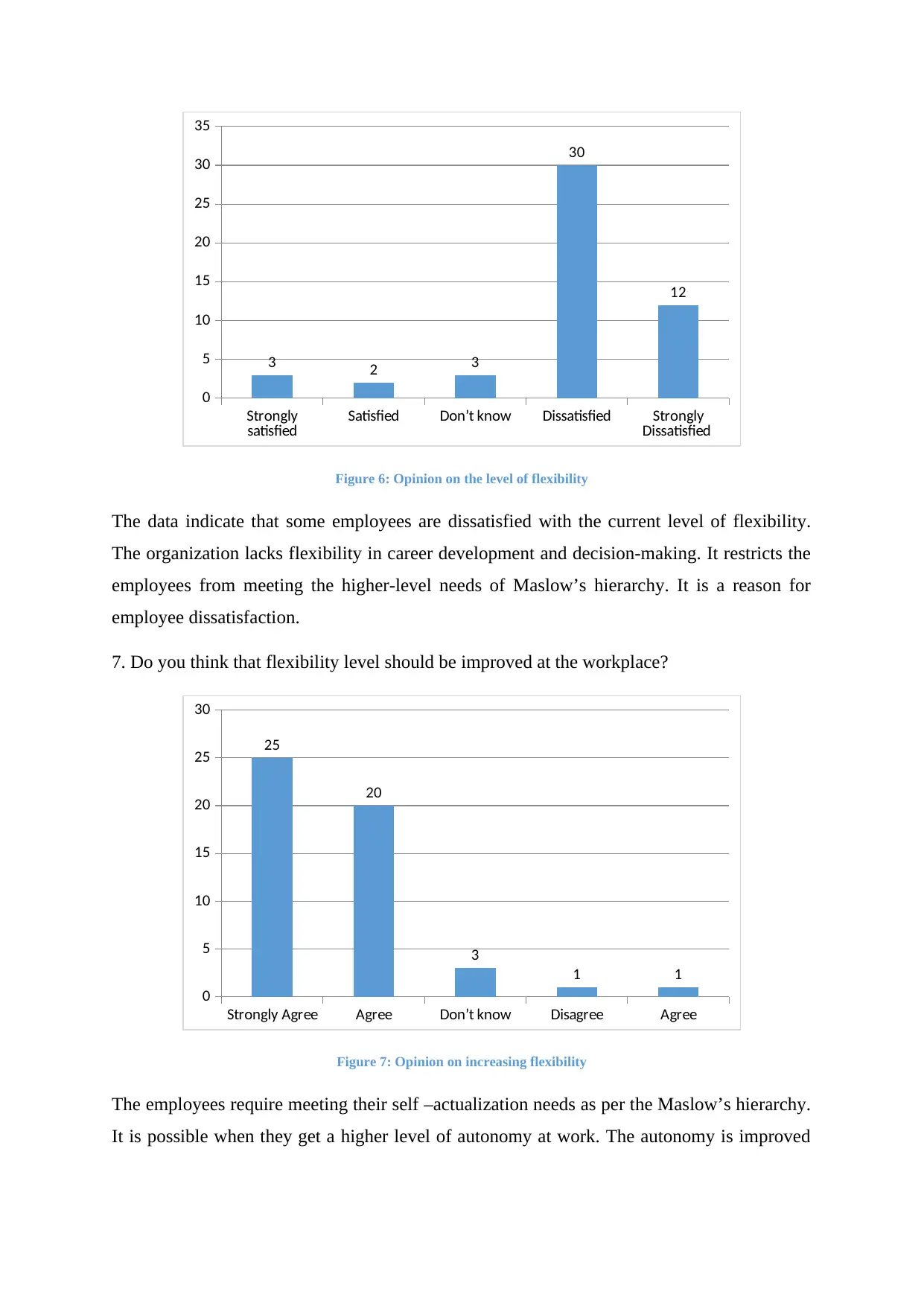
6. Are you satisfied with the level of flexibility obtained at the workplace?
The motivator-hygiene theory indicates that the nature of work motivates the employees to
work harder. The working flexibility makes working more enjoyable for the staffs. So, they
are motivated to contribute more to the organization (Evans and Davis, 2015). In this case,
the staffs also consider that they feel more motivated in flexible working condition.
5. Please mention the type of flexibility you get at your workplace.
Work Schedule Time-off Working from
remote
locations
Choosing own
course of
actions
Career
Flexibility or
freedom to
work in new
roles
0
5
10
15
20
25
30
35
30
25
7 5
2
Figure 5: Opinion on type of flexibility
The current research indicates that the work schedule and leaves are flexible in the
organization whereas the remote working, decision making and career developments are less
flexible. Flexible timing improves working experience (Klindžić and Marić, 2019). So, as per
Maslow’s need hierarchy and Herzberg’s theory, these two factors enhance employee
satisfaction and motivation. However, lack of decision-making power and career
development opportunities restrict the employees from meeting their recognition and self-
actualization needs as mentioned in Maslow’s need hierarchy. So, satisfaction is affected to
some extent. The lack of decision-making power and career development opportunities
makes the work less enjoyable. As per Herzberg’s theory, it affects the motivation as well.
6. Are you satisfied with the level of flexibility obtained at the workplace?
Strongly
satisfied Satisfied Don’t know Dissatisfied Strongly
Dissatisfied
0
5
10
15
20
25
30
35
3 2 3
30
12
Figure 6: Opinion on the level of flexibility
The data indicate that some employees are dissatisfied with the current level of flexibility.
The organization lacks flexibility in career development and decision-making. It restricts the
employees from meeting the higher-level needs of Maslow’s hierarchy. It is a reason for
employee dissatisfaction.
7. Do you think that flexibility level should be improved at the workplace?
Strongly Agree Agree Don’t know Disagree Agree
0
5
10
15
20
25
30
25
20
3
1 1
Figure 7: Opinion on increasing flexibility
The employees require meeting their self –actualization needs as per the Maslow’s hierarchy.
It is possible when they get a higher level of autonomy at work. The autonomy is improved
satisfied Satisfied Don’t know Dissatisfied Strongly
Dissatisfied
0
5
10
15
20
25
30
35
3 2 3
30
12
Figure 6: Opinion on the level of flexibility
The data indicate that some employees are dissatisfied with the current level of flexibility.
The organization lacks flexibility in career development and decision-making. It restricts the
employees from meeting the higher-level needs of Maslow’s hierarchy. It is a reason for
employee dissatisfaction.
7. Do you think that flexibility level should be improved at the workplace?
Strongly Agree Agree Don’t know Disagree Agree
0
5
10
15
20
25
30
25
20
3
1 1
Figure 7: Opinion on increasing flexibility
The employees require meeting their self –actualization needs as per the Maslow’s hierarchy.
It is possible when they get a higher level of autonomy at work. The autonomy is improved
⊘ This is a preview!⊘
Do you want full access?
Subscribe today to unlock all pages.
Trusted by 1+ million students worldwide

1 out of 19


Related Documents


Your All-in-One AI-Powered Toolkit for Academic Success.
+13062052269
info@desklib.com
Available 24*7 on WhatsApp / Email
![[object Object]](/_next/static/media/star-bottom.7253800d.svg)
Unlock your academic potential
Copyright © 2020–2026 A2Z Services. All Rights Reserved. Developed and managed by ZUCOL.