Queensland Floodwater Campaign: A Marketing Case Study Analysis

Verified

Added on  2021/02/19

|10
|1409
|96
Case Study
AI Summary
This case study analyzes the Queensland floodwater campaign, which aimed to change drivers' perceptions of driving in floodwaters. The study examines the engagement of affective and cognitive components in the campaign, exploring how the government used various methods, including social media, to raise awareness and influence driver behavior. It highlights the strategies employed to address the attitude-behavior gap, where people may have a positive attitude towards safety but fail to act accordingly. The analysis covers tactics such as public awareness events, campaigns in offices and schools, and the implementation of penalties to encourage safer driving practices. The case study concludes that social media plays a crucial role in changing public behavior and that a combination of strategies is effective in minimizing the gap between attitudes and actions.
Document Page
Case Study 2
tabler-icon-diamond-filled.svg

Paraphrase This Document

Need a fresh take? Get an instant paraphrase of this document with our AI Paraphraser
Document Page
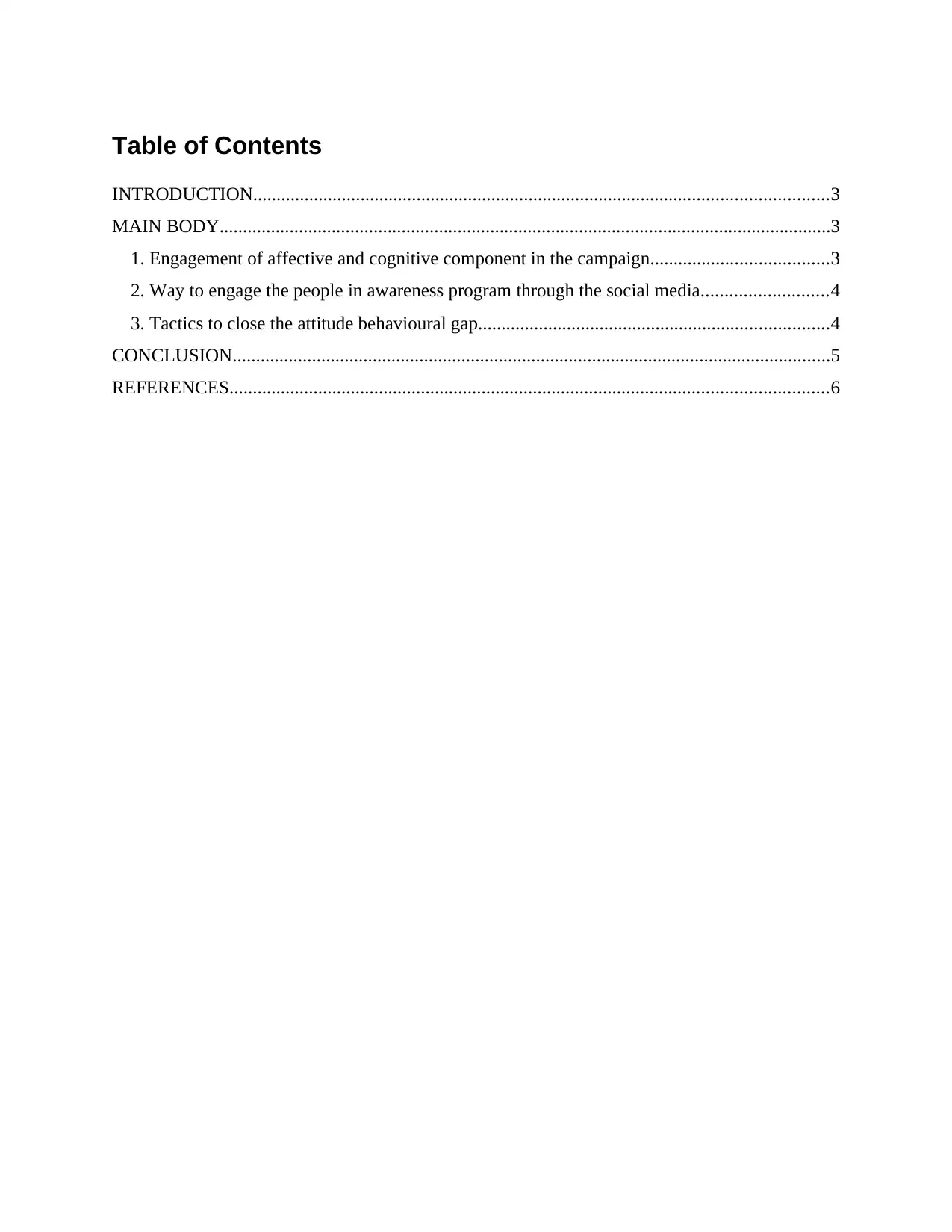
Table of Contents
INTRODUCTION...........................................................................................................................3
MAIN BODY...................................................................................................................................3
1. Engagement of affective and cognitive component in the campaign......................................3
2. Way to engage the people in awareness program through the social media...........................4
3. Tactics to close the attitude behavioural gap...........................................................................4
CONCLUSION................................................................................................................................5
REFERENCES................................................................................................................................6
Document Page
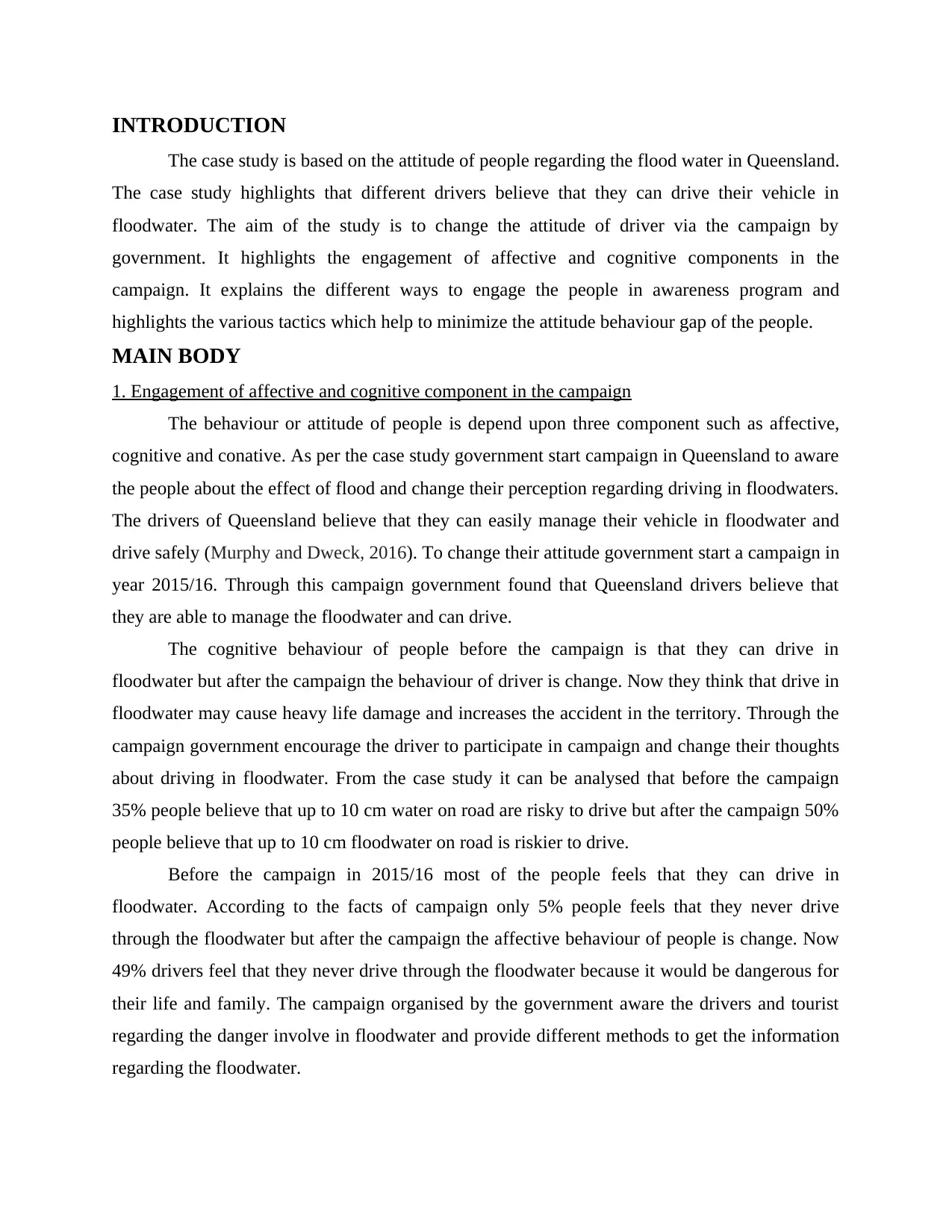
INTRODUCTION
The case study is based on the attitude of people regarding the flood water in Queensland.
The case study highlights that different drivers believe that they can drive their vehicle in
floodwater. The aim of the study is to change the attitude of driver via the campaign by
government. It highlights the engagement of affective and cognitive components in the
campaign. It explains the different ways to engage the people in awareness program and
highlights the various tactics which help to minimize the attitude behaviour gap of the people.
MAIN BODY
1. Engagement of affective and cognitive component in the campaign
The behaviour or attitude of people is depend upon three component such as affective,
cognitive and conative. As per the case study government start campaign in Queensland to aware
the people about the effect of flood and change their perception regarding driving in floodwaters.
The drivers of Queensland believe that they can easily manage their vehicle in floodwater and
drive safely (Murphy and Dweck, 2016). To change their attitude government start a campaign in
year 2015/16. Through this campaign government found that Queensland drivers believe that
they are able to manage the floodwater and can drive.
The cognitive behaviour of people before the campaign is that they can drive in
floodwater but after the campaign the behaviour of driver is change. Now they think that drive in
floodwater may cause heavy life damage and increases the accident in the territory. Through the
campaign government encourage the driver to participate in campaign and change their thoughts
about driving in floodwater. From the case study it can be analysed that before the campaign
35% people believe that up to 10 cm water on road are risky to drive but after the campaign 50%
people believe that up to 10 cm floodwater on road is riskier to drive.
Before the campaign in 2015/16 most of the people feels that they can drive in
floodwater. According to the facts of campaign only 5% people feels that they never drive
through the floodwater but after the campaign the affective behaviour of people is change. Now
49% drivers feel that they never drive through the floodwater because it would be dangerous for
their life and family. The campaign organised by the government aware the drivers and tourist
regarding the danger involve in floodwater and provide different methods to get the information
regarding the floodwater.
Document Page
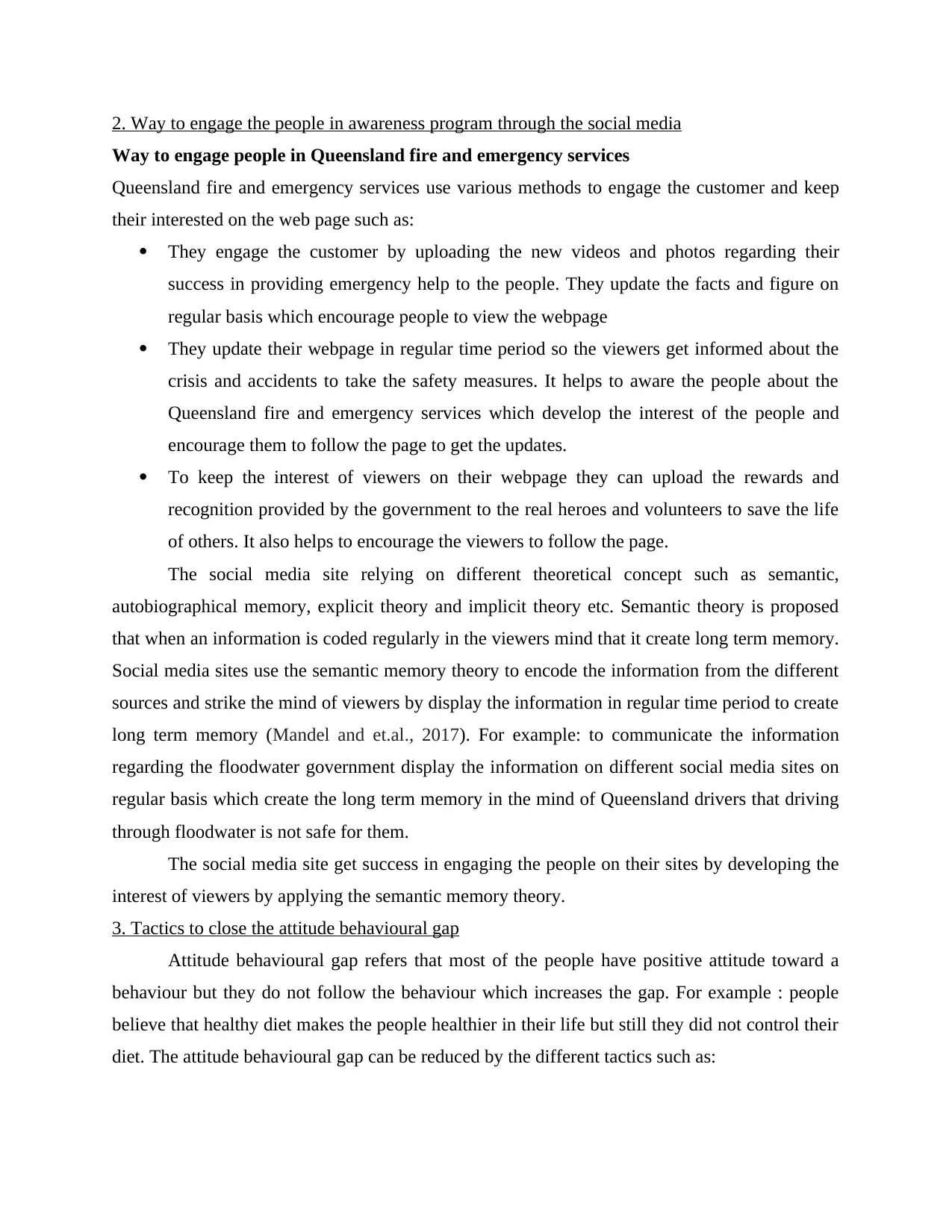
2. Way to engage the people in awareness program through the social media
Way to engage people in Queensland fire and emergency services
Queensland fire and emergency services use various methods to engage the customer and keep
their interested on the web page such as:
They engage the customer by uploading the new videos and photos regarding their
success in providing emergency help to the people. They update the facts and figure on
regular basis which encourage people to view the webpage
They update their webpage in regular time period so the viewers get informed about the
crisis and accidents to take the safety measures. It helps to aware the people about the
Queensland fire and emergency services which develop the interest of the people and
encourage them to follow the page to get the updates.
To keep the interest of viewers on their webpage they can upload the rewards and
recognition provided by the government to the real heroes and volunteers to save the life
of others. It also helps to encourage the viewers to follow the page.
The social media site relying on different theoretical concept such as semantic,
autobiographical memory, explicit theory and implicit theory etc. Semantic theory is proposed
that when an information is coded regularly in the viewers mind that it create long term memory.
Social media sites use the semantic memory theory to encode the information from the different
sources and strike the mind of viewers by display the information in regular time period to create
long term memory (Mandel and et.al., 2017). For example: to communicate the information
regarding the floodwater government display the information on different social media sites on
regular basis which create the long term memory in the mind of Queensland drivers that driving
through floodwater is not safe for them.
The social media site get success in engaging the people on their sites by developing the
interest of viewers by applying the semantic memory theory.
3. Tactics to close the attitude behavioural gap
Attitude behavioural gap refers that most of the people have positive attitude toward a
behaviour but they do not follow the behaviour which increases the gap. For example : people
believe that healthy diet makes the people healthier in their life but still they did not control their
diet. The attitude behavioural gap can be reduced by the different tactics such as:
tabler-icon-diamond-filled.svg

Paraphrase This Document

Need a fresh take? Get an instant paraphrase of this document with our AI Paraphraser
Document Page
Aware people : To minimize the attitude behaviour gap they can organize such events
which aware the people about the situation and also with the consequences. It helps them
to get more knowledge about the impact of driving through the floodwater because it not
only increase the accident but also spread carious diseases in territory (Hofacker,
Malthouse and Sultan, 2016). To reduce the gap they can present the facts and figures on
newspapers.
Organise campaign in offices : they can organise the campaign in offices to inspire and
motivate them that they have to take the safety measures like select the alternative ways
and media to minimize the attitude behaviour gap.
Organise events in schools : In modern era the behaviour of parents is influenced by the
Children (Echegaray and Hansstein, 2017). By organising events in schools they
influence and aware the children about the consequences of driving in floodwater which
ultimately influence the parents to make the habit of following the behaviour to do not
drive through floodwater.
Set punishment : To minimize the attitude behaviour gap they can set punishment or
penalty to follow the particular behaviour. For example : everyone believe that drive
through floodwater is not safe but still they use this. So by setting punishment they can
force the drivers to develop the habit of using alternative ways to drive which ultimately
reduces the attitude behaviour gap (Martí-Parreño, Seguí-Masand Seguí-Mas, 2016).
CONCLUSION
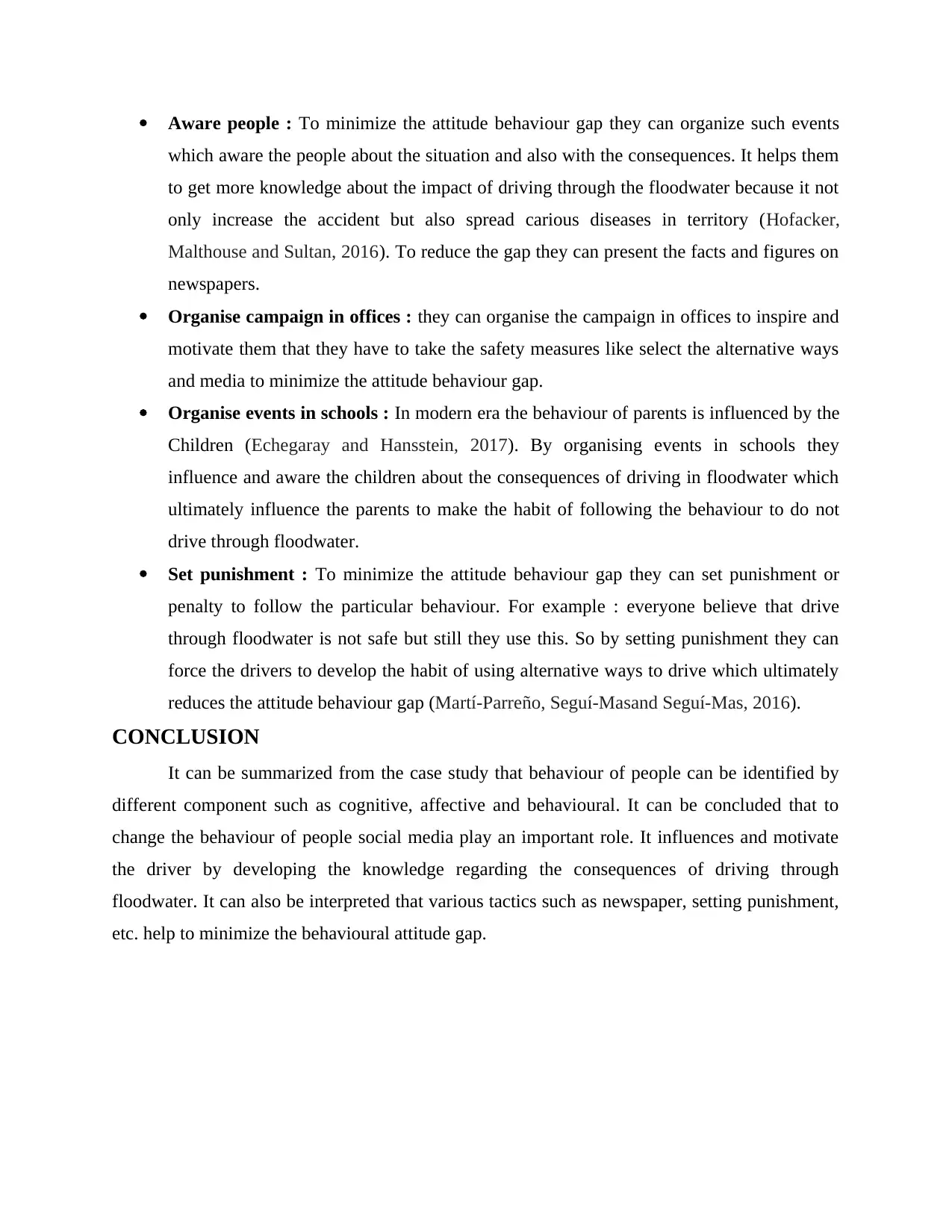
It can be summarized from the case study that behaviour of people can be identified by
different component such as cognitive, affective and behavioural. It can be concluded that to
change the behaviour of people social media play an important role. It influences and motivate
the driver by developing the knowledge regarding the consequences of driving through
floodwater. It can also be interpreted that various tactics such as newspaper, setting punishment,
etc. help to minimize the behavioural attitude gap.
Document Page
REFERENCES
Books and Journals
Echegaray, F. and Hansstein, F.V., 2017. Assessing the intention-behavior gap in electronic
waste recycling: the case of Brazil. Journal of Cleaner Production, 142. pp.180-190.
Hofacker, C.F., Malthouse, E.C. and Sultan, F., 2016. Big data and consumer behavior:
Imminent opportunities. Journal of Consumer Marketing, 33(2). pp.89-97.
Mandel, N., and et.al., 2017. The compensatory consumer behavior model: How self-
discrepancies drive consumer behavior. Journal of Consumer Psychology, 27(1).
pp.133-146.
Martí-Parreño, J., Seguí-Mas, D. and Seguí-Mas, E., 2016. Teachers’ attitude towards and
actual use of gamification. Procedia-Social and Behavioral Sciences, 228. pp.682-688.
Murphy, M.C. and Dweck, C.S., 2016. Mindsets shape consumer behavior. Journal of
Consumer Psychology, 26(1). pp.127-136.
Document Page
tabler-icon-diamond-filled.svg

Paraphrase This Document

Need a fresh take? Get an instant paraphrase of this document with our AI Paraphraser
Document Page
Document Page
Document Page
chevron_up_icon
1 out of 10
circle_padding
hide_on_mobile
zoom_out_icon
[object Object]