ENRP20001: 3-D Floodway Design Methodology Presentation T1 2018

Verified

Added on  2023/06/07

|18
|1105
|245
Presentation
AI Summary
This presentation details a 3-D floodway design methodology, addressing the challenges of extreme weather and public safety. It covers the problem statement, objectives, literature review, and design methodology, incorporating dimensional analysis and 3-D design modeling. The presentation delves into open channel flow characteristics, hydraulic shocks, frictional factors, and the Froude number. It includes a theory model, algorithm procedure, and design of experiment using a Gantt chart. The model features a trapezoidal channel cross-section for efficient flow, with calculations for dimensions, wetted perimeter, hydraulic radius, and average velocity using Manning's equation. The presentation concludes by comparing sluice gate and free fall over-fall cases, highlighting the impact on velocity and referencing relevant studies.
Document Page
3-D FLOODWAY DESIGN
METHODOLOGY PRESENTATION
Flow Channel Development
tabler-icon-diamond-filled.svg

Paraphrase This Document

Need a fresh take? Get an instant paraphrase of this document with our AI Paraphraser
Document Page
INTRODUCTION
Problem Statement and Objectives
Major challenge with floodways is that they are often affected by
extreme weather change such as heavy downpour.
Public safety is therefore at risk
Economic significance of such structures also diminishes
Hence aim is to develop a more structurally resilient
infrastructure that would serve the public in a safe fashion
Document Page
Background
Structural resilience in critical infrastructure such as
floodways is essential as it greatly contributes to public safety
and institutional confidence (Javernick, Redolfi, and Bertoldi,
2018)
Extreme climatic change may alter the normal functioning of
these structures
Design engineers must look at the entire design architecture to
ensure resilience is restored especially in extreme weather
conditions
The biggest concern in major cities is the rapid urbanization
Document Page
AIM
The project aims at establishing more
efficient and effective flood control structure
to improve public safety
It is assumed that the flow is open channel
hence various factors at play
Dimensional analysis and 3-D design
modeling
is utilized
tabler-icon-diamond-filled.svg

Paraphrase This Document

Need a fresh take? Get an instant paraphrase of this document with our AI Paraphraser
Document Page
LITERATURE REVIEW
According to Lokuge et al (2014), floodway
damage is mainly due to large boulders on
the channel bed.
Categorization of the damage include:
-Washout
-high water damage
-Rock structure damage (the latter is more
pronounced in most floodway channels
Document Page
METHODOLOGY OF DESIGN
Problem Solving
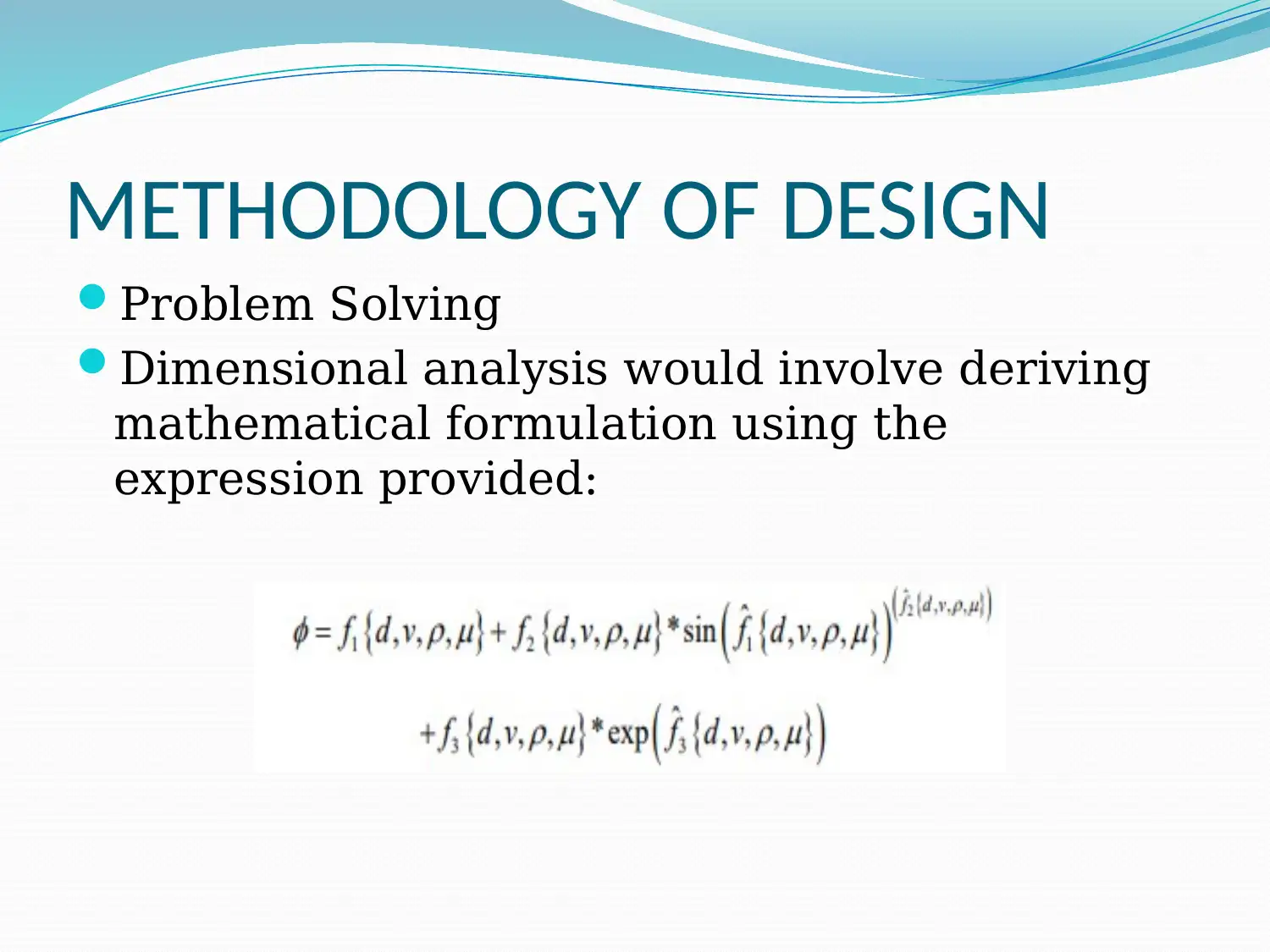
Dimensional analysis would involve deriving
mathematical formulation using the
expression provided:
Document Page
In Designing the channel
Parameters involved include: coefficient of
friction, density of flowing water, size of
channel and velocity of flowing water
tabler-icon-diamond-filled.svg

Paraphrase This Document

Need a fresh take? Get an instant paraphrase of this document with our AI Paraphraser
Document Page
Design Considerations
Open channel flow characteristics in
floodway design involves:
Considering hydraulic shocks for impact
loading and scouring
The frictional factor along the channel
The flow is also described using Froude
Number such that turbulent regimes are
distinct from streamline flow
Document Page
Theory Model
To consider the components of Dimensional
Analysis : Viscosity, frequency, velocity
Sluice gate verses sharp crested weir
comparison
Flow characteristics
The developed floodway is trapezoidal in cross
section
Document Page
Algorithm
Procedure Description
Firstly, I assume the flow s constant along the channel hence the following governing equation (based on energy and
mass conservation) to describe the various profiles given the conditions (Defna, and Bxo No “page”):
Dy/dx= 1/cos ϕ {(So-Sf)+ αV2/gAxdA/dx}/1-F2…(1)
Where F s Froude number given by F= {αV2/gD cos ϕ}1/2
To find the water profile y, can integrate equations 1 wth respect to x (n other words depth to vary with the
horizontal distance)
y= ∫ 1/cos ϕ {(So-Sf)+ αV2/gAxdA/dx}/1-F2dx…(2)
But since consider a prismatic channel, equation (2) bolts down to:
y= ∫ 1/cos ϕ {(So-Sf)/1-F2dx…(3)
Equation (3) which is further written as:
Dy/dx= (So-n2Q2/A2R4/3)/ 1-F2 … (4)
Now, using equation (4) above and the fact that the channel is trapezoidal, can undertake various calculations to
arrive at the profile:
The trapezoidal section:
tabler-icon-diamond-filled.svg

Paraphrase This Document

Need a fresh take? Get an instant paraphrase of this document with our AI Paraphraser
Document Page
Design of Experiment
Use of Gantt Chart for planning purpose
The experiment to be performed would be
time-based such that the extremity of the
condition is varied in steps until the
demolition state is attained
This would be repeated for three differently
designed floodways to check on structural
resiliency
Document Page
THE MODEL
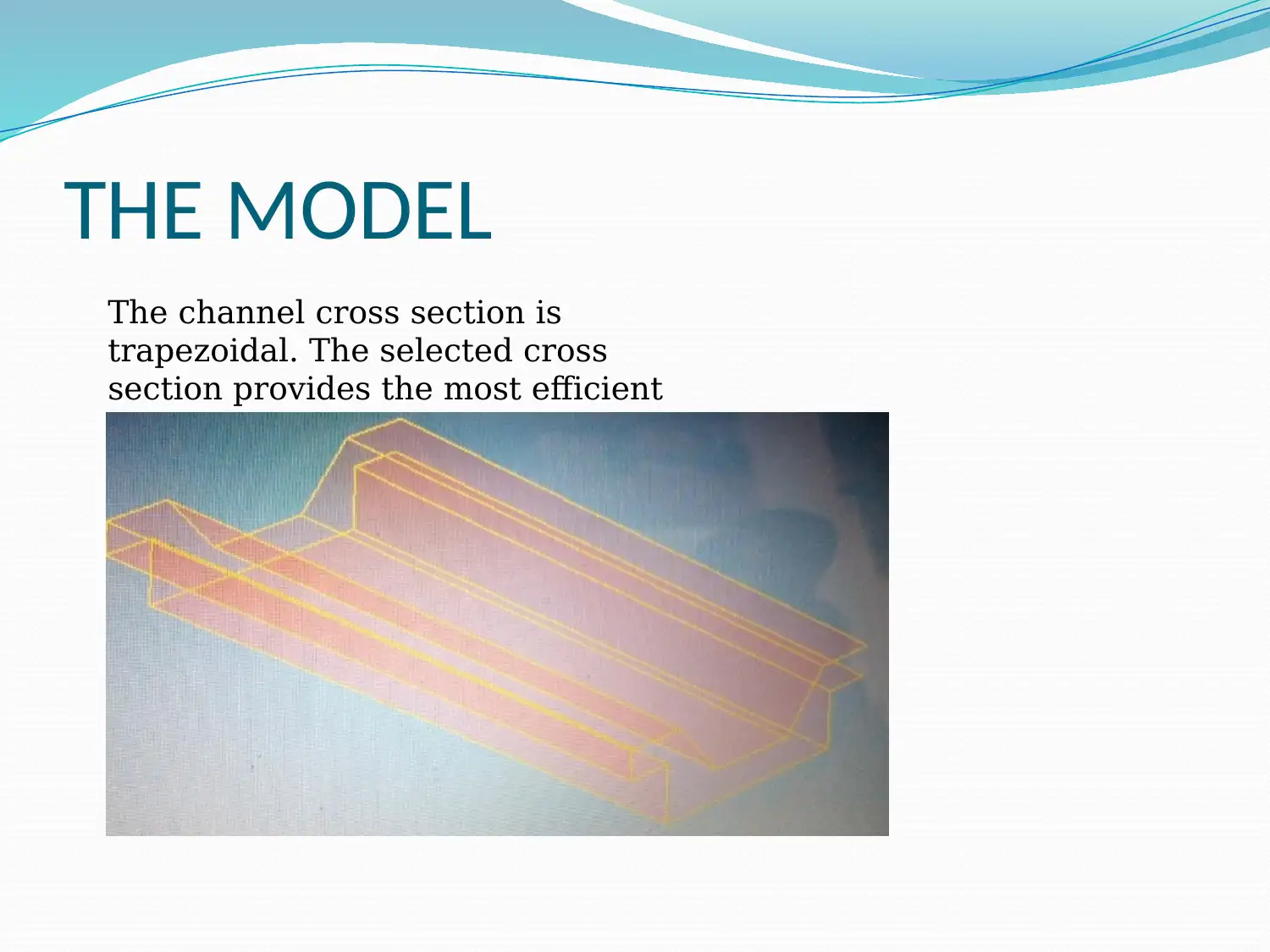
The channel cross section is
trapezoidal. The selected cross
section provides the most efficient
flow rate regime.
chevron_up_icon
1 out of 18
circle_padding
hide_on_mobile
zoom_out_icon
[object Object]