Literature Review: Flyash's Effect on Concrete Moisture Transport
VerifiedAdded on 2022/09/17
|15
|3825
|31
Literature Review
AI Summary
This literature review examines the influence of flyash addition on the moisture transport properties of concrete. It explores the relationship between water-cement ratio and porosity, highlighting how flyash affects this relationship by reducing porosity due to its ability to absorb water and fill voids. The review then discusses sorptivity, permeability, and workability, showing that flyash generally reduces sorptivity and permeability while increasing workability. Studies cited demonstrate that the fineness of flyash particles minimizes voids and reduces the need for water. The findings show that flyash-cement concrete exhibits improved resistance to water absorption and penetration, which are key factors for concrete durability. The review emphasizes the importance of appropriate mix design when incorporating flyash to achieve desired performance characteristics in concrete applications.
Influence of Flyash Addition on Moisture Transport Properties of Concrete 1
INFLUENCE OF FLYASH ADDITION ON MOISTURE TRANSPORT PROPERTIES OF
CONCRETE
Name
Course
Professor
University
City/state
Date
INFLUENCE OF FLYASH ADDITION ON MOISTURE TRANSPORT PROPERTIES OF
CONCRETE
Name
Course
Professor
University
City/state
Date

Paraphrase This Document
Need a fresh take? Get an instant paraphrase of this document with our AI Paraphraser
Influence of Flyash Addition on Moisture Transport Properties of Concrete 2
Influence of Flyash Addition on Moisture Transport Properties of Concrete
LITERATURE REVIEW
Relationship between water-cement ratio and porosity
Water-cement ratio is a very important parameter affecting various properties of concrete,
including porosity. There are different water-cement ratios that can be used to manufacture
concrete (usually ranging between 0.3 and 0.8), and each one is suitable for a different concrete
application. By definition, porosity is the air voids present in concrete through which water can
move. This is a moisture transport property that influences compressive strength and durability
of concrete. Typically, an increase in water-cement ratio results to an increase in porosity of
conventional concrete. This is because presence of excess water produces a dilute concrete paste
with more pores. The cement particles and aggregates absorb the excess water, creating separate
water channels that result to bleeding on the concrete surface. When this happens, weak zones
get created in the concrete, resulting to shrinkage and cracks. However, this phenomenon is
different in flyash-cement concrete. According to a study by Abdou & Abuseda (2016), an
increase in water-cement ratio results to a decrease in porosity of concrete with silica fume
additive. Silica is also referred to as silicon dioxide and one of the main components of flyash is
silicon dioxide. For this reason, the influence of water-cement ratio on silica-cement concrete is
assumed to be the same as that on flyash-cement concrete.
In their study, Abdou & Abuseda found that an increase in silica content resulted to an
increase in water demand. This is mainly because of the increase surface area of silica particles.
The researchers used a helium porosimeter to measure porosity of tested concrete specimens.
They found that the small particles of silica pack efficiently between cement particles thus
Influence of Flyash Addition on Moisture Transport Properties of Concrete
LITERATURE REVIEW
Relationship between water-cement ratio and porosity
Water-cement ratio is a very important parameter affecting various properties of concrete,
including porosity. There are different water-cement ratios that can be used to manufacture
concrete (usually ranging between 0.3 and 0.8), and each one is suitable for a different concrete
application. By definition, porosity is the air voids present in concrete through which water can
move. This is a moisture transport property that influences compressive strength and durability
of concrete. Typically, an increase in water-cement ratio results to an increase in porosity of
conventional concrete. This is because presence of excess water produces a dilute concrete paste
with more pores. The cement particles and aggregates absorb the excess water, creating separate
water channels that result to bleeding on the concrete surface. When this happens, weak zones
get created in the concrete, resulting to shrinkage and cracks. However, this phenomenon is
different in flyash-cement concrete. According to a study by Abdou & Abuseda (2016), an
increase in water-cement ratio results to a decrease in porosity of concrete with silica fume
additive. Silica is also referred to as silicon dioxide and one of the main components of flyash is
silicon dioxide. For this reason, the influence of water-cement ratio on silica-cement concrete is
assumed to be the same as that on flyash-cement concrete.
In their study, Abdou & Abuseda found that an increase in silica content resulted to an
increase in water demand. This is mainly because of the increase surface area of silica particles.
The researchers used a helium porosimeter to measure porosity of tested concrete specimens.
They found that the small particles of silica pack efficiently between cement particles thus
Influence of Flyash Addition on Moisture Transport Properties of Concrete 3
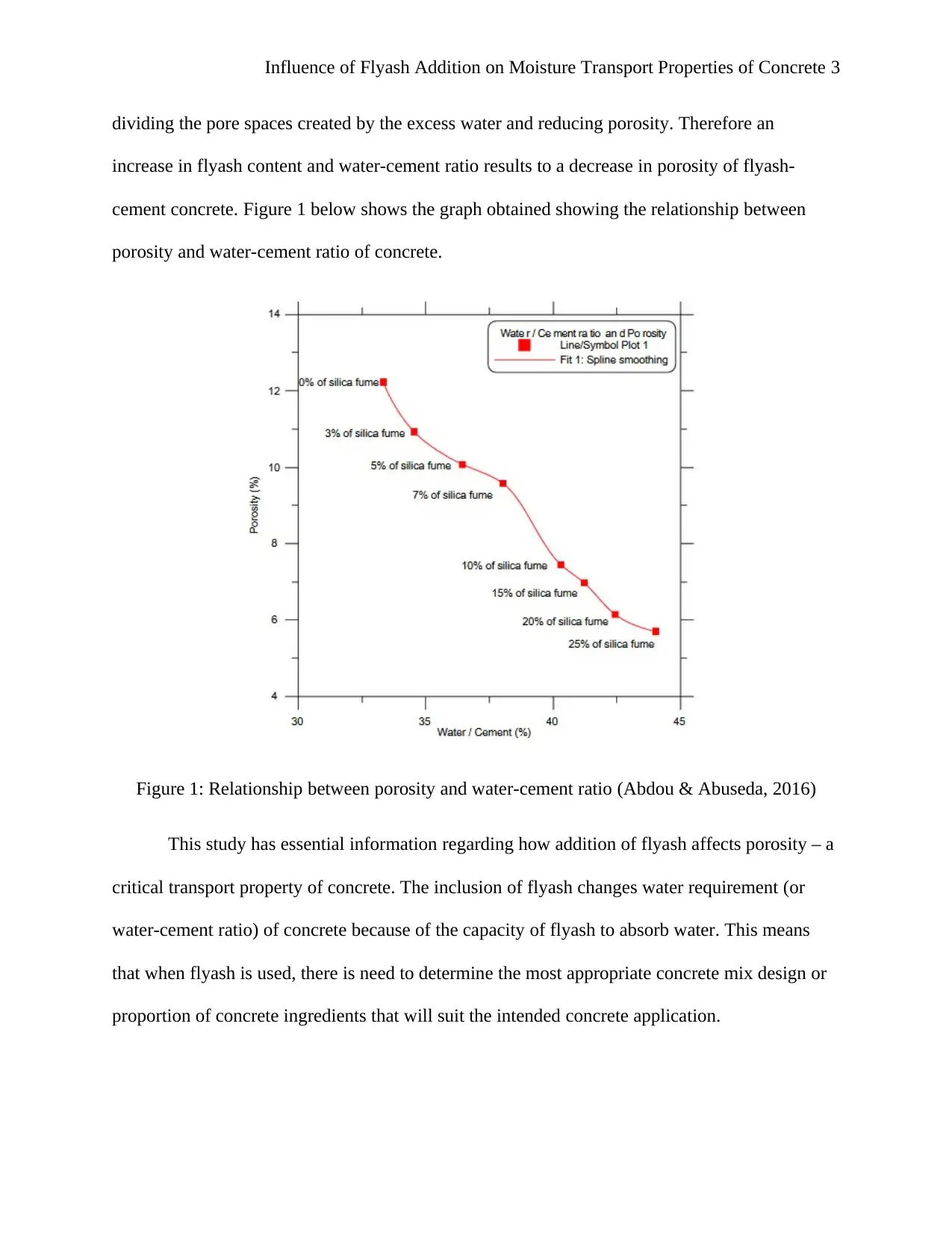
dividing the pore spaces created by the excess water and reducing porosity. Therefore an
increase in flyash content and water-cement ratio results to a decrease in porosity of flyash-
cement concrete. Figure 1 below shows the graph obtained showing the relationship between
porosity and water-cement ratio of concrete.
Figure 1: Relationship between porosity and water-cement ratio (Abdou & Abuseda, 2016)
This study has essential information regarding how addition of flyash affects porosity – a
critical transport property of concrete. The inclusion of flyash changes water requirement (or
water-cement ratio) of concrete because of the capacity of flyash to absorb water. This means
that when flyash is used, there is need to determine the most appropriate concrete mix design or
proportion of concrete ingredients that will suit the intended concrete application.
dividing the pore spaces created by the excess water and reducing porosity. Therefore an
increase in flyash content and water-cement ratio results to a decrease in porosity of flyash-
cement concrete. Figure 1 below shows the graph obtained showing the relationship between
porosity and water-cement ratio of concrete.
Figure 1: Relationship between porosity and water-cement ratio (Abdou & Abuseda, 2016)
This study has essential information regarding how addition of flyash affects porosity – a
critical transport property of concrete. The inclusion of flyash changes water requirement (or
water-cement ratio) of concrete because of the capacity of flyash to absorb water. This means
that when flyash is used, there is need to determine the most appropriate concrete mix design or
proportion of concrete ingredients that will suit the intended concrete application.
⊘ This is a preview!⊘
Do you want full access?
Subscribe today to unlock all pages.

Trusted by 1+ million students worldwide
Influence of Flyash Addition on Moisture Transport Properties of Concrete 4
Kumar (2010) conducted a study to examine chloride transport and water flow through
unsaturated concrete. He observed that movement of chlorides and moisture in concrete is the
major deterioration mechanism of concrete in the long term, followed by applied load. Therefore
understanding how moisture and chlorides move in concrete can help to design and build
stronger and durable concrete structures. The researcher performed several laboratory tests on
concrete specimens of different water-cement ratios. One of the key findings from the study was
that water-cement ratio (or degree of water saturation) is a key parameter affecting chloride
penetration in concrete (direct proportional correlation). Other findings were: an increase in
water-cement ratio resulted to an increase in concrete’s hydraulic conductivity, an increase in
degree of water saturation resulted to an increase in relative humidity of concrete, and a decrease
in degree of saturation resulted to a decrease in relative diffusion coefficient.
Sorptivity
Sorptivity is a measure of concrete’s ability to absorb or resist absorption of water and
other fluids. When concrete has a high sorptivity value, it means that it has higher resistance to
water absorption. This moisture transport property has a significant influence on the compressive
strength and durability of concrete. Saha (2018) conducted a study to examine the effect of
partial replacement of class F flyash on concrete’s durability properties. The properties
investigated included compressive strength, sorptivity, drying shrinkage, permeability, chloride
penetration and distribution of microstructure. The researcher measured sorptivity in accordance
with ASTM 1585 (standard test method for measurement of rate of absorption of water by
hydraulic-cement concretes). The results obtained showed that there was a gradual decrease in
sorptivity of concrete with the addition of flyash content. This is due to the fineness of flyash
particles, which has a larger specific surface area (430 m2/kg) than that of cement (360 m2/kg).
Kumar (2010) conducted a study to examine chloride transport and water flow through
unsaturated concrete. He observed that movement of chlorides and moisture in concrete is the
major deterioration mechanism of concrete in the long term, followed by applied load. Therefore
understanding how moisture and chlorides move in concrete can help to design and build
stronger and durable concrete structures. The researcher performed several laboratory tests on
concrete specimens of different water-cement ratios. One of the key findings from the study was
that water-cement ratio (or degree of water saturation) is a key parameter affecting chloride
penetration in concrete (direct proportional correlation). Other findings were: an increase in
water-cement ratio resulted to an increase in concrete’s hydraulic conductivity, an increase in
degree of water saturation resulted to an increase in relative humidity of concrete, and a decrease
in degree of saturation resulted to a decrease in relative diffusion coefficient.
Sorptivity
Sorptivity is a measure of concrete’s ability to absorb or resist absorption of water and
other fluids. When concrete has a high sorptivity value, it means that it has higher resistance to
water absorption. This moisture transport property has a significant influence on the compressive
strength and durability of concrete. Saha (2018) conducted a study to examine the effect of
partial replacement of class F flyash on concrete’s durability properties. The properties
investigated included compressive strength, sorptivity, drying shrinkage, permeability, chloride
penetration and distribution of microstructure. The researcher measured sorptivity in accordance
with ASTM 1585 (standard test method for measurement of rate of absorption of water by
hydraulic-cement concretes). The results obtained showed that there was a gradual decrease in
sorptivity of concrete with the addition of flyash content. This is due to the fineness of flyash
particles, which has a larger specific surface area (430 m2/kg) than that of cement (360 m2/kg).
Paraphrase This Document
Need a fresh take? Get an instant paraphrase of this document with our AI Paraphraser
Influence of Flyash Addition on Moisture Transport Properties of Concrete 5
The fineness enables the flyash to minimize the thickness of transition zone between aggregates
and binder (flyash and cement) thus reducing total voids content, porosity and sorptivity of
concrete. Additionally, results from the study showed that sorptivity of concrete reduced with
age. With longer curing period, the binders in concrete get sufficient time to hydrate thus
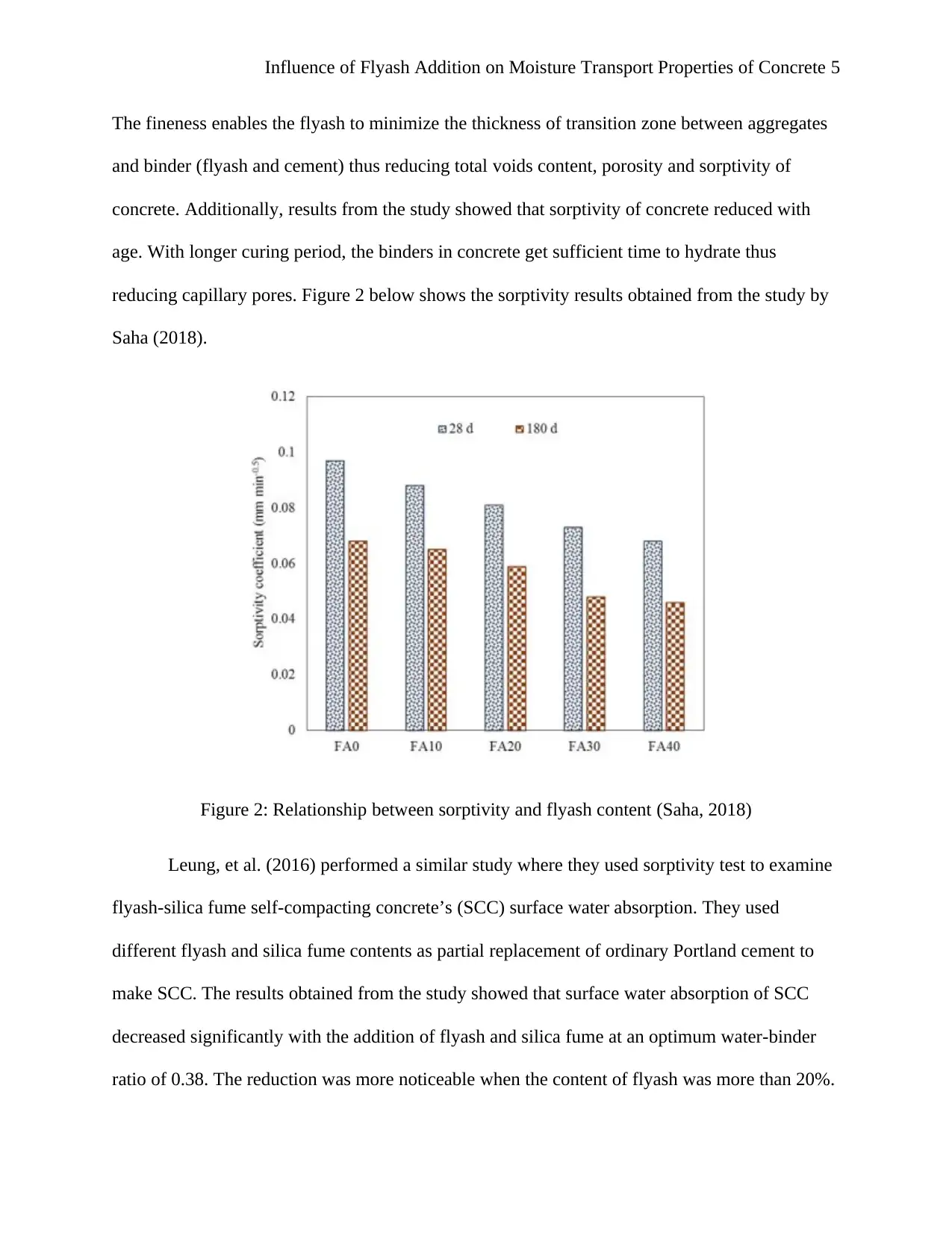
reducing capillary pores. Figure 2 below shows the sorptivity results obtained from the study by
Saha (2018).
Figure 2: Relationship between sorptivity and flyash content (Saha, 2018)
Leung, et al. (2016) performed a similar study where they used sorptivity test to examine
flyash-silica fume self-compacting concrete’s (SCC) surface water absorption. They used
different flyash and silica fume contents as partial replacement of ordinary Portland cement to
make SCC. The results obtained from the study showed that surface water absorption of SCC
decreased significantly with the addition of flyash and silica fume at an optimum water-binder
ratio of 0.38. The reduction was more noticeable when the content of flyash was more than 20%.
The fineness enables the flyash to minimize the thickness of transition zone between aggregates
and binder (flyash and cement) thus reducing total voids content, porosity and sorptivity of
concrete. Additionally, results from the study showed that sorptivity of concrete reduced with
age. With longer curing period, the binders in concrete get sufficient time to hydrate thus
reducing capillary pores. Figure 2 below shows the sorptivity results obtained from the study by
Saha (2018).
Figure 2: Relationship between sorptivity and flyash content (Saha, 2018)
Leung, et al. (2016) performed a similar study where they used sorptivity test to examine
flyash-silica fume self-compacting concrete’s (SCC) surface water absorption. They used
different flyash and silica fume contents as partial replacement of ordinary Portland cement to
make SCC. The results obtained from the study showed that surface water absorption of SCC
decreased significantly with the addition of flyash and silica fume at an optimum water-binder
ratio of 0.38. The reduction was more noticeable when the content of flyash was more than 20%.
Influence of Flyash Addition on Moisture Transport Properties of Concrete 6
The results in this study are similar to those from the previous study by Saha. In both studies, the
proportion of concrete ingredients (concrete mix design) affects sorptivity of the concrete. This is
because different values of sorptivity were recorded at varied water/cement ratio and flyash
content. Therefore it is important to determine the most appropriate mix design so as to reduce
sorptivity to the desired level. Most importantly is that addition of flyash reduces sorptivity of
concrete because the flyash has a larger surface area that is able to fill voids and absorb any
excess water present in the concrete. In both studies, there was no obvious relationship
established between compressive strength and sorptivity of concrete. Therefore there is need to
conduct more research in the future to establish if there is any relationship between compressive
strength and sorptivity of concrete.
Permeability
Permeability is the rate at which water can penetrate through concrete. This is one of the
moisture transport properties that have an impact on the strength and deterioration of concrete.
Hardened concrete should have very low permeability so as to prevent entry or movement of
water that can deteriorate the strength of concrete. Addition of flyash in concrete reduces water
requirement (water/cement ratio) for a particular slump. For example, if flyash content is used to
replace 20% of total cementitious material, the water requirement will be decreased by about
10%. The decrease in water requirement when flyash is used reduces the permeability of
concrete. The reduction in water requirement together with extra cementitious substances
decreases concrete’s pore interconnectivity thus reducing permeability. This reduced
permeability improve the resistance of concrete to different kinds of deterioration and also
improves its durability. Muthaiyan & Thirumala (2017) investigated the effect of replacing
cement and fine aggregates with class C flyash on different properties of the formed concrete at a
The results in this study are similar to those from the previous study by Saha. In both studies, the
proportion of concrete ingredients (concrete mix design) affects sorptivity of the concrete. This is
because different values of sorptivity were recorded at varied water/cement ratio and flyash
content. Therefore it is important to determine the most appropriate mix design so as to reduce
sorptivity to the desired level. Most importantly is that addition of flyash reduces sorptivity of
concrete because the flyash has a larger surface area that is able to fill voids and absorb any
excess water present in the concrete. In both studies, there was no obvious relationship
established between compressive strength and sorptivity of concrete. Therefore there is need to
conduct more research in the future to establish if there is any relationship between compressive
strength and sorptivity of concrete.
Permeability
Permeability is the rate at which water can penetrate through concrete. This is one of the
moisture transport properties that have an impact on the strength and deterioration of concrete.
Hardened concrete should have very low permeability so as to prevent entry or movement of
water that can deteriorate the strength of concrete. Addition of flyash in concrete reduces water
requirement (water/cement ratio) for a particular slump. For example, if flyash content is used to
replace 20% of total cementitious material, the water requirement will be decreased by about
10%. The decrease in water requirement when flyash is used reduces the permeability of
concrete. The reduction in water requirement together with extra cementitious substances
decreases concrete’s pore interconnectivity thus reducing permeability. This reduced
permeability improve the resistance of concrete to different kinds of deterioration and also
improves its durability. Muthaiyan & Thirumala (2017) investigated the effect of replacing
cement and fine aggregates with class C flyash on different properties of the formed concrete at a
⊘ This is a preview!⊘
Do you want full access?
Subscribe today to unlock all pages.
Trusted by 1+ million students worldwide
Influence of Flyash Addition on Moisture Transport Properties of Concrete 7
constant water-cement ratio of 0.3. They used falling head method to measure permeability of
concrete. The results from the study revealed that permeability of flyash-cement concrete
decreased in the range of 1.093 cm/s and 0.354 cm/s depending on the amount of flyash added.
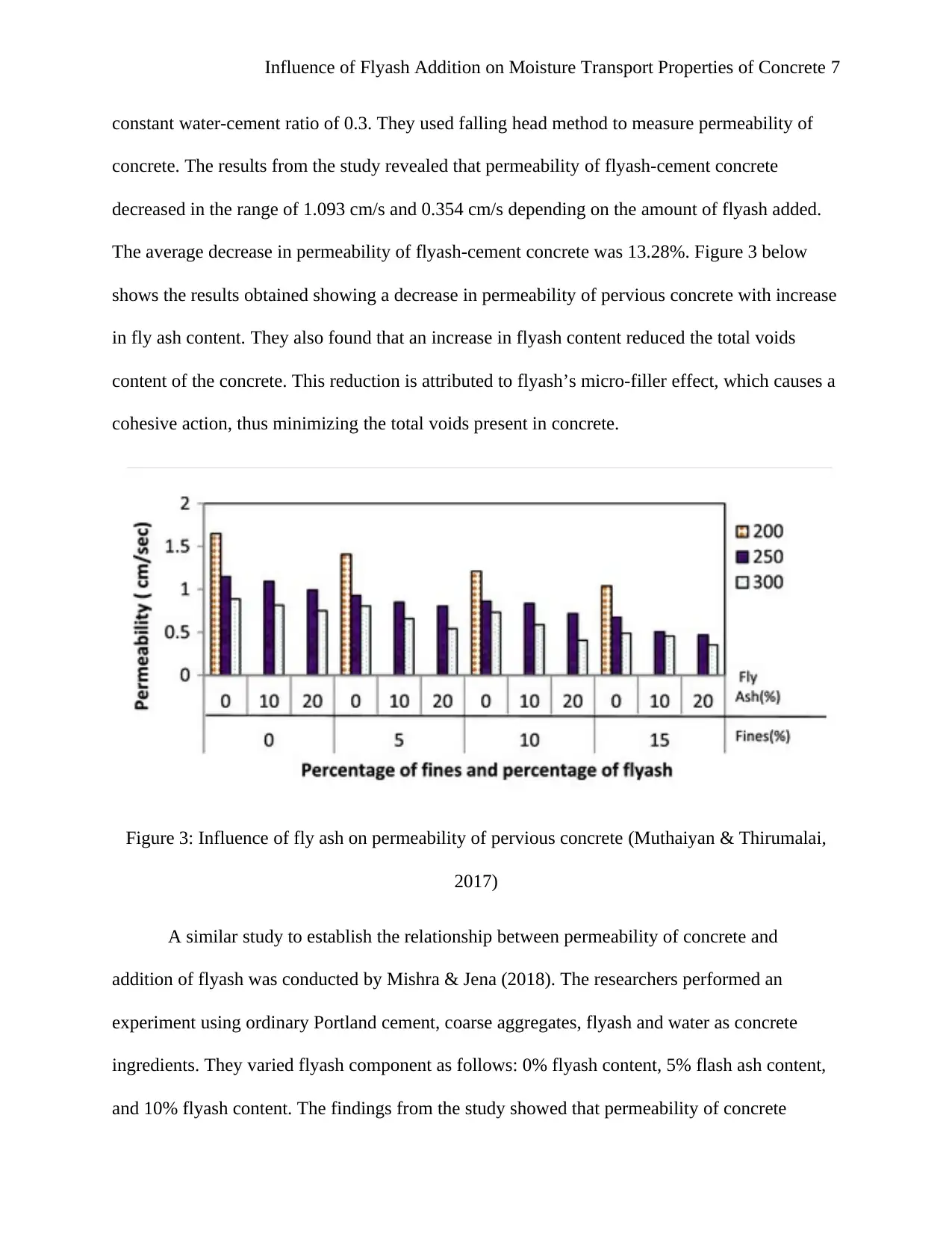
The average decrease in permeability of flyash-cement concrete was 13.28%. Figure 3 below
shows the results obtained showing a decrease in permeability of pervious concrete with increase
in fly ash content. They also found that an increase in flyash content reduced the total voids
content of the concrete. This reduction is attributed to flyash’s micro-filler effect, which causes a
cohesive action, thus minimizing the total voids present in concrete.
Figure 3: Influence of fly ash on permeability of pervious concrete (Muthaiyan & Thirumalai,
2017)
A similar study to establish the relationship between permeability of concrete and
addition of flyash was conducted by Mishra & Jena (2018). The researchers performed an
experiment using ordinary Portland cement, coarse aggregates, flyash and water as concrete
ingredients. They varied flyash component as follows: 0% flyash content, 5% flash ash content,
and 10% flyash content. The findings from the study showed that permeability of concrete
constant water-cement ratio of 0.3. They used falling head method to measure permeability of
concrete. The results from the study revealed that permeability of flyash-cement concrete
decreased in the range of 1.093 cm/s and 0.354 cm/s depending on the amount of flyash added.
The average decrease in permeability of flyash-cement concrete was 13.28%. Figure 3 below
shows the results obtained showing a decrease in permeability of pervious concrete with increase
in fly ash content. They also found that an increase in flyash content reduced the total voids
content of the concrete. This reduction is attributed to flyash’s micro-filler effect, which causes a
cohesive action, thus minimizing the total voids present in concrete.
Figure 3: Influence of fly ash on permeability of pervious concrete (Muthaiyan & Thirumalai,
2017)
A similar study to establish the relationship between permeability of concrete and
addition of flyash was conducted by Mishra & Jena (2018). The researchers performed an
experiment using ordinary Portland cement, coarse aggregates, flyash and water as concrete
ingredients. They varied flyash component as follows: 0% flyash content, 5% flash ash content,
and 10% flyash content. The findings from the study showed that permeability of concrete
Paraphrase This Document
Need a fresh take? Get an instant paraphrase of this document with our AI Paraphraser
Influence of Flyash Addition on Moisture Transport Properties of Concrete 8
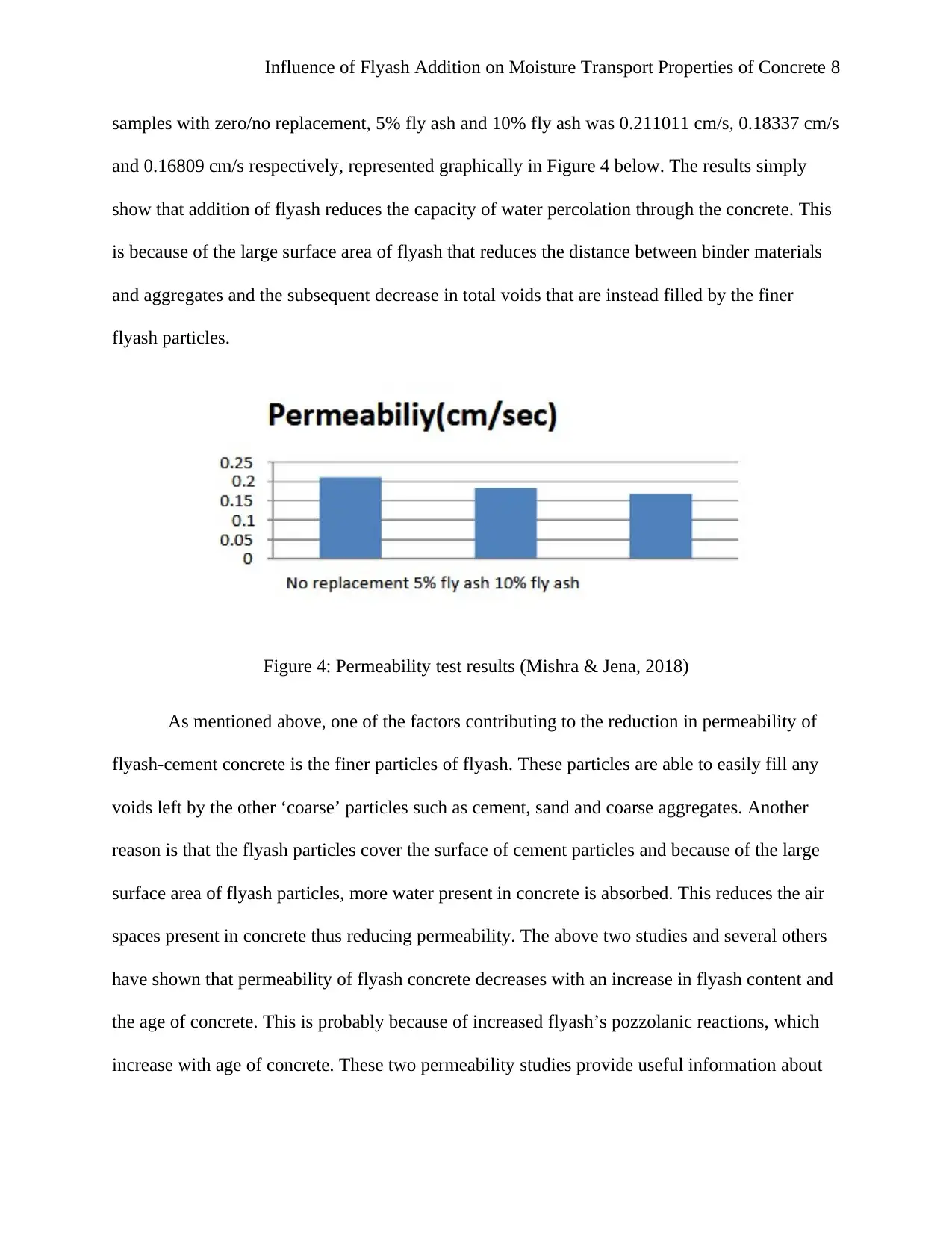
samples with zero/no replacement, 5% fly ash and 10% fly ash was 0.211011 cm/s, 0.18337 cm/s
and 0.16809 cm/s respectively, represented graphically in Figure 4 below. The results simply
show that addition of flyash reduces the capacity of water percolation through the concrete. This
is because of the large surface area of flyash that reduces the distance between binder materials
and aggregates and the subsequent decrease in total voids that are instead filled by the finer
flyash particles.
Figure 4: Permeability test results (Mishra & Jena, 2018)
As mentioned above, one of the factors contributing to the reduction in permeability of
flyash-cement concrete is the finer particles of flyash. These particles are able to easily fill any
voids left by the other ‘coarse’ particles such as cement, sand and coarse aggregates. Another
reason is that the flyash particles cover the surface of cement particles and because of the large
surface area of flyash particles, more water present in concrete is absorbed. This reduces the air
spaces present in concrete thus reducing permeability. The above two studies and several others
have shown that permeability of flyash concrete decreases with an increase in flyash content and
the age of concrete. This is probably because of increased flyash’s pozzolanic reactions, which
increase with age of concrete. These two permeability studies provide useful information about
samples with zero/no replacement, 5% fly ash and 10% fly ash was 0.211011 cm/s, 0.18337 cm/s
and 0.16809 cm/s respectively, represented graphically in Figure 4 below. The results simply
show that addition of flyash reduces the capacity of water percolation through the concrete. This
is because of the large surface area of flyash that reduces the distance between binder materials
and aggregates and the subsequent decrease in total voids that are instead filled by the finer
flyash particles.
Figure 4: Permeability test results (Mishra & Jena, 2018)
As mentioned above, one of the factors contributing to the reduction in permeability of
flyash-cement concrete is the finer particles of flyash. These particles are able to easily fill any
voids left by the other ‘coarse’ particles such as cement, sand and coarse aggregates. Another
reason is that the flyash particles cover the surface of cement particles and because of the large
surface area of flyash particles, more water present in concrete is absorbed. This reduces the air
spaces present in concrete thus reducing permeability. The above two studies and several others
have shown that permeability of flyash concrete decreases with an increase in flyash content and
the age of concrete. This is probably because of increased flyash’s pozzolanic reactions, which
increase with age of concrete. These two permeability studies provide useful information about
Influence of Flyash Addition on Moisture Transport Properties of Concrete 9
the effect that flyash content has on the total voids content and permeability of flyash-cement
concrete. Therefore they are useful sources for the current study.
Workability
Workability is a moisture transport property of concrete that determines the ease of fresh
concrete mixing, placement, consolidation and finishing, which have an impact of the ultimate
properties of hardened concrete, including strength and durability. Addition of fly ash changes
the paste volume resulting to scaling of the mixture so as to attain the desired yield stress. The
fly ash reduces segregation, increases stability and improves workability of fresh concrete. This
is attributed to fly ash particles’ spherical shape that improves the cementitious materials’
packing density. Marthong & Agrawal (2012) carried out a study to investigate the effect of
flyash additive on concrete properties. The researchers prepared mortar cubes, beam specimens
and concrete cubes using different proportions of cement and flyash (0%, 10%, 20%, 30% and
40%) and subjected them to different tests.
After completing their experimental investigations, they found that the workability of
flyash-cement concrete was higher than that of cement-only concrete. This is because of the
increase in paste volume, which results to an increase in cohesion and plasticity of concrete.
When flyash is added to concrete, its particles coat the cement and aggregate particles and
lubricate them making it easier for them to flow. The flyash particles’ spherical shape also
decreases the friction at the interface of the aggregate paste to create ball bearings that provide a
lubricant effect at the contact point of the aggregates. This effect also improves pumpability of
concrete through creation of frictional losses. Therefore, use of flyash can help to improve
workability of concrete thus making it easier to mix, place, consolidate/compact and finish
concrete. This also has a direct influence on the compressive strength of concrete because the
the effect that flyash content has on the total voids content and permeability of flyash-cement
concrete. Therefore they are useful sources for the current study.
Workability
Workability is a moisture transport property of concrete that determines the ease of fresh
concrete mixing, placement, consolidation and finishing, which have an impact of the ultimate
properties of hardened concrete, including strength and durability. Addition of fly ash changes
the paste volume resulting to scaling of the mixture so as to attain the desired yield stress. The
fly ash reduces segregation, increases stability and improves workability of fresh concrete. This
is attributed to fly ash particles’ spherical shape that improves the cementitious materials’
packing density. Marthong & Agrawal (2012) carried out a study to investigate the effect of
flyash additive on concrete properties. The researchers prepared mortar cubes, beam specimens
and concrete cubes using different proportions of cement and flyash (0%, 10%, 20%, 30% and
40%) and subjected them to different tests.
After completing their experimental investigations, they found that the workability of
flyash-cement concrete was higher than that of cement-only concrete. This is because of the
increase in paste volume, which results to an increase in cohesion and plasticity of concrete.
When flyash is added to concrete, its particles coat the cement and aggregate particles and
lubricate them making it easier for them to flow. The flyash particles’ spherical shape also
decreases the friction at the interface of the aggregate paste to create ball bearings that provide a
lubricant effect at the contact point of the aggregates. This effect also improves pumpability of
concrete through creation of frictional losses. Therefore, use of flyash can help to improve
workability of concrete thus making it easier to mix, place, consolidate/compact and finish
concrete. This also has a direct influence on the compressive strength of concrete because the
⊘ This is a preview!⊘
Do you want full access?
Subscribe today to unlock all pages.
Trusted by 1+ million students worldwide
Influence of Flyash Addition on Moisture Transport Properties of Concrete 10
desired ultimate strength of concrete can only be achieved if the concrete is properly mixed,
placed and consolidated.
Another study to examine the effect of flyash on the workability of concrete was done by
Parasuraman, et al. (2011). In this study, ordinary Portland cement used to make masonry mortar
was replaced with 0-50% by weight of flyash. A water-binder ratio of 0.5 and sand-binder ratio
of 3 were used. The properties that were tested by the researchers included compressive strength,
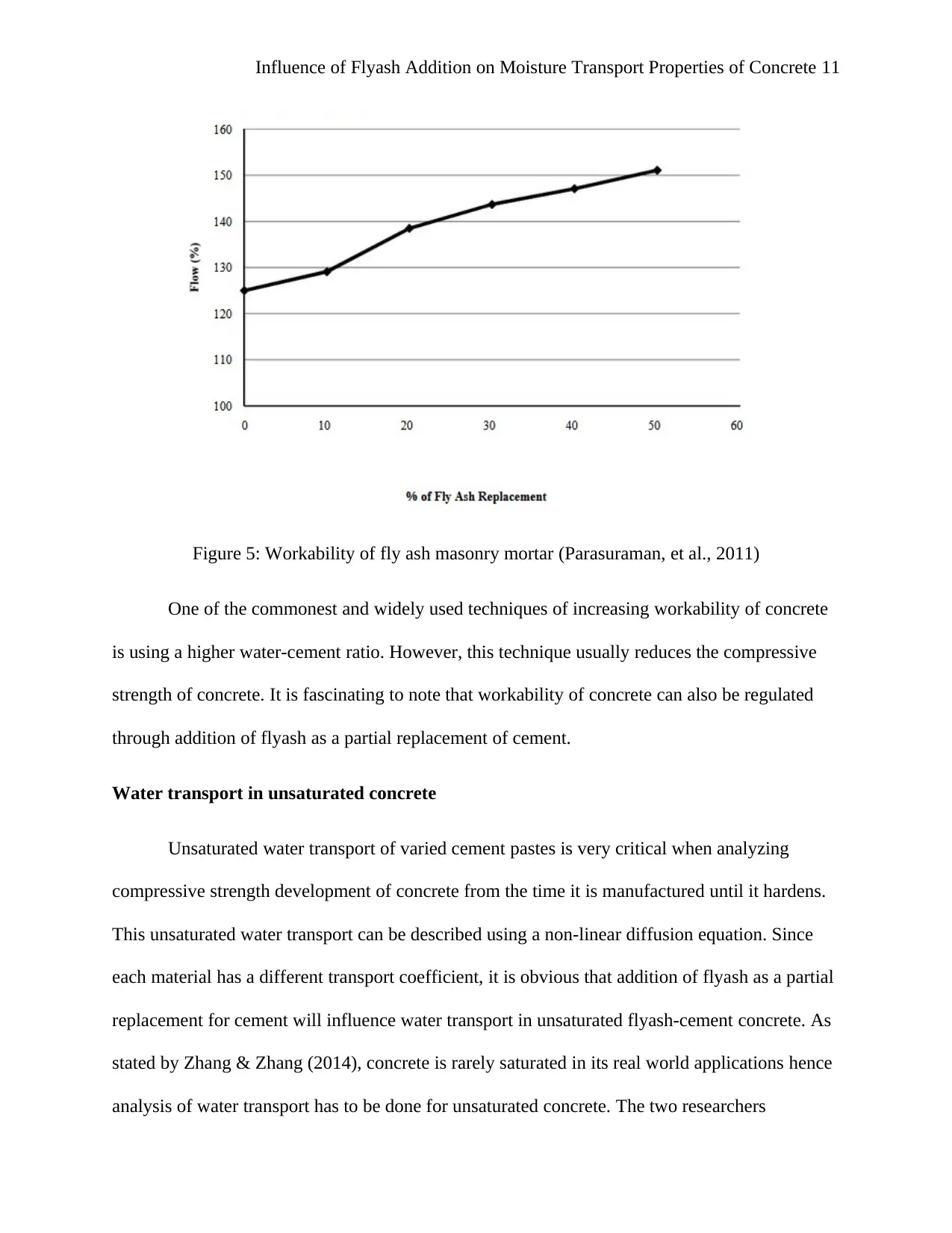
workability and resistance to sulphate attack. The test results showed that workability of flyash-
cement masonry mortar increased significantly with increase in flyash content, as shown in
Figure 5 below. Similar to previous findings, the increase in workability was as a result of the
glassy surface and spherical shape of the fly ash particles, which is technically known as ball-
bearing effect. Another main contribution to the increased workability is the electrical charges
that cause adsorption of finer fly ash particles on the cement particles surface. When cement
particles’ surface become adequately covered with flyash particles, the former become
deflocculated, causing a reduction in water requirement for a particular workability.
desired ultimate strength of concrete can only be achieved if the concrete is properly mixed,
placed and consolidated.
Another study to examine the effect of flyash on the workability of concrete was done by
Parasuraman, et al. (2011). In this study, ordinary Portland cement used to make masonry mortar
was replaced with 0-50% by weight of flyash. A water-binder ratio of 0.5 and sand-binder ratio
of 3 were used. The properties that were tested by the researchers included compressive strength,
workability and resistance to sulphate attack. The test results showed that workability of flyash-
cement masonry mortar increased significantly with increase in flyash content, as shown in
Figure 5 below. Similar to previous findings, the increase in workability was as a result of the
glassy surface and spherical shape of the fly ash particles, which is technically known as ball-
bearing effect. Another main contribution to the increased workability is the electrical charges
that cause adsorption of finer fly ash particles on the cement particles surface. When cement
particles’ surface become adequately covered with flyash particles, the former become
deflocculated, causing a reduction in water requirement for a particular workability.
Paraphrase This Document
Need a fresh take? Get an instant paraphrase of this document with our AI Paraphraser
Influence of Flyash Addition on Moisture Transport Properties of Concrete 11
Figure 5: Workability of fly ash masonry mortar (Parasuraman, et al., 2011)
One of the commonest and widely used techniques of increasing workability of concrete
is using a higher water-cement ratio. However, this technique usually reduces the compressive
strength of concrete. It is fascinating to note that workability of concrete can also be regulated
through addition of flyash as a partial replacement of cement.
Water transport in unsaturated concrete
Unsaturated water transport of varied cement pastes is very critical when analyzing
compressive strength development of concrete from the time it is manufactured until it hardens.
This unsaturated water transport can be described using a non-linear diffusion equation. Since
each material has a different transport coefficient, it is obvious that addition of flyash as a partial
replacement for cement will influence water transport in unsaturated flyash-cement concrete. As
stated by Zhang & Zhang (2014), concrete is rarely saturated in its real world applications hence
analysis of water transport has to be done for unsaturated concrete. The two researchers
Figure 5: Workability of fly ash masonry mortar (Parasuraman, et al., 2011)
One of the commonest and widely used techniques of increasing workability of concrete
is using a higher water-cement ratio. However, this technique usually reduces the compressive
strength of concrete. It is fascinating to note that workability of concrete can also be regulated
through addition of flyash as a partial replacement of cement.
Water transport in unsaturated concrete
Unsaturated water transport of varied cement pastes is very critical when analyzing
compressive strength development of concrete from the time it is manufactured until it hardens.
This unsaturated water transport can be described using a non-linear diffusion equation. Since
each material has a different transport coefficient, it is obvious that addition of flyash as a partial
replacement for cement will influence water transport in unsaturated flyash-cement concrete. As
stated by Zhang & Zhang (2014), concrete is rarely saturated in its real world applications hence
analysis of water transport has to be done for unsaturated concrete. The two researchers
Influence of Flyash Addition on Moisture Transport Properties of Concrete 12
developed different models and used several experimental methods to investigate transport
characteristics in unsaturated cementitious materials. They made cement mortar with 0% and
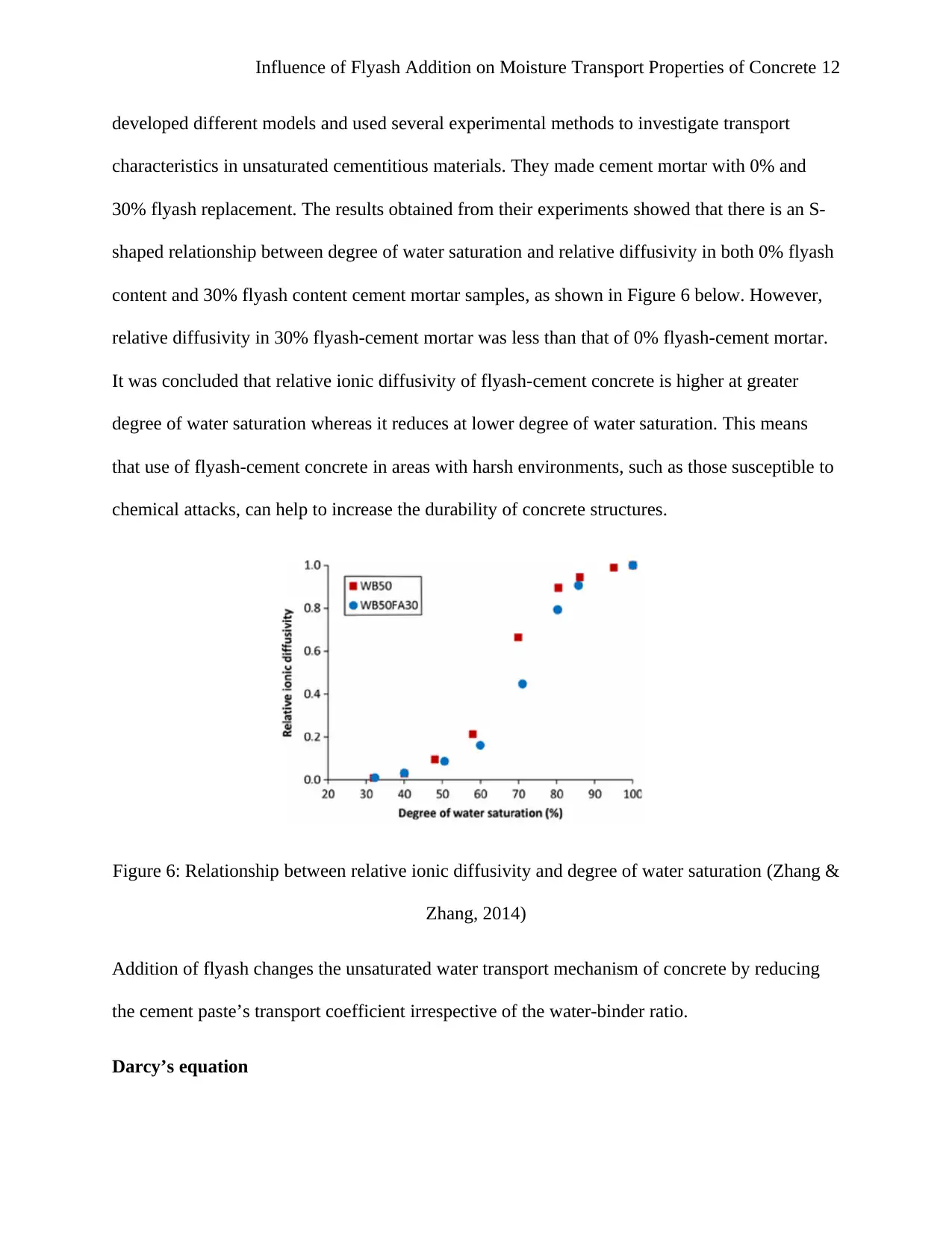
30% flyash replacement. The results obtained from their experiments showed that there is an S-
shaped relationship between degree of water saturation and relative diffusivity in both 0% flyash
content and 30% flyash content cement mortar samples, as shown in Figure 6 below. However,
relative diffusivity in 30% flyash-cement mortar was less than that of 0% flyash-cement mortar.
It was concluded that relative ionic diffusivity of flyash-cement concrete is higher at greater
degree of water saturation whereas it reduces at lower degree of water saturation. This means
that use of flyash-cement concrete in areas with harsh environments, such as those susceptible to
chemical attacks, can help to increase the durability of concrete structures.
Figure 6: Relationship between relative ionic diffusivity and degree of water saturation (Zhang &
Zhang, 2014)
Addition of flyash changes the unsaturated water transport mechanism of concrete by reducing
the cement paste’s transport coefficient irrespective of the water-binder ratio.
Darcy’s equation
developed different models and used several experimental methods to investigate transport
characteristics in unsaturated cementitious materials. They made cement mortar with 0% and
30% flyash replacement. The results obtained from their experiments showed that there is an S-
shaped relationship between degree of water saturation and relative diffusivity in both 0% flyash
content and 30% flyash content cement mortar samples, as shown in Figure 6 below. However,
relative diffusivity in 30% flyash-cement mortar was less than that of 0% flyash-cement mortar.
It was concluded that relative ionic diffusivity of flyash-cement concrete is higher at greater
degree of water saturation whereas it reduces at lower degree of water saturation. This means
that use of flyash-cement concrete in areas with harsh environments, such as those susceptible to
chemical attacks, can help to increase the durability of concrete structures.
Figure 6: Relationship between relative ionic diffusivity and degree of water saturation (Zhang &
Zhang, 2014)
Addition of flyash changes the unsaturated water transport mechanism of concrete by reducing
the cement paste’s transport coefficient irrespective of the water-binder ratio.
Darcy’s equation
⊘ This is a preview!⊘
Do you want full access?
Subscribe today to unlock all pages.
Trusted by 1+ million students worldwide

1 out of 15


Related Documents


Your All-in-One AI-Powered Toolkit for Academic Success.
+13062052269
info@desklib.com
Available 24*7 on WhatsApp / Email
![[object Object]](/_next/static/media/star-bottom.7253800d.svg)
Unlock your academic potential
Copyright © 2020–2026 A2Z Services. All Rights Reserved. Developed and managed by ZUCOL.