FNS40217 Certificate IV: Accounting & Budgeting Assessment
VerifiedAdded on 2023/05/31
|46
|10474
|359
Homework Assignment
AI Summary
This assignment solution covers key areas of accounting and budgeting, including preparing an adjusted trial balance, income statement, balance sheet, and statement of cash flows. It also includes financial statement analysis using ratios such as gross profit rate, net profit rate, current ratio, liquid ratio, inventory turnover rate, and average collection period. The analysis provides insights into a company's profitability, business activity, and liquidity, along with recommendations for improvement.
T-1.8.1
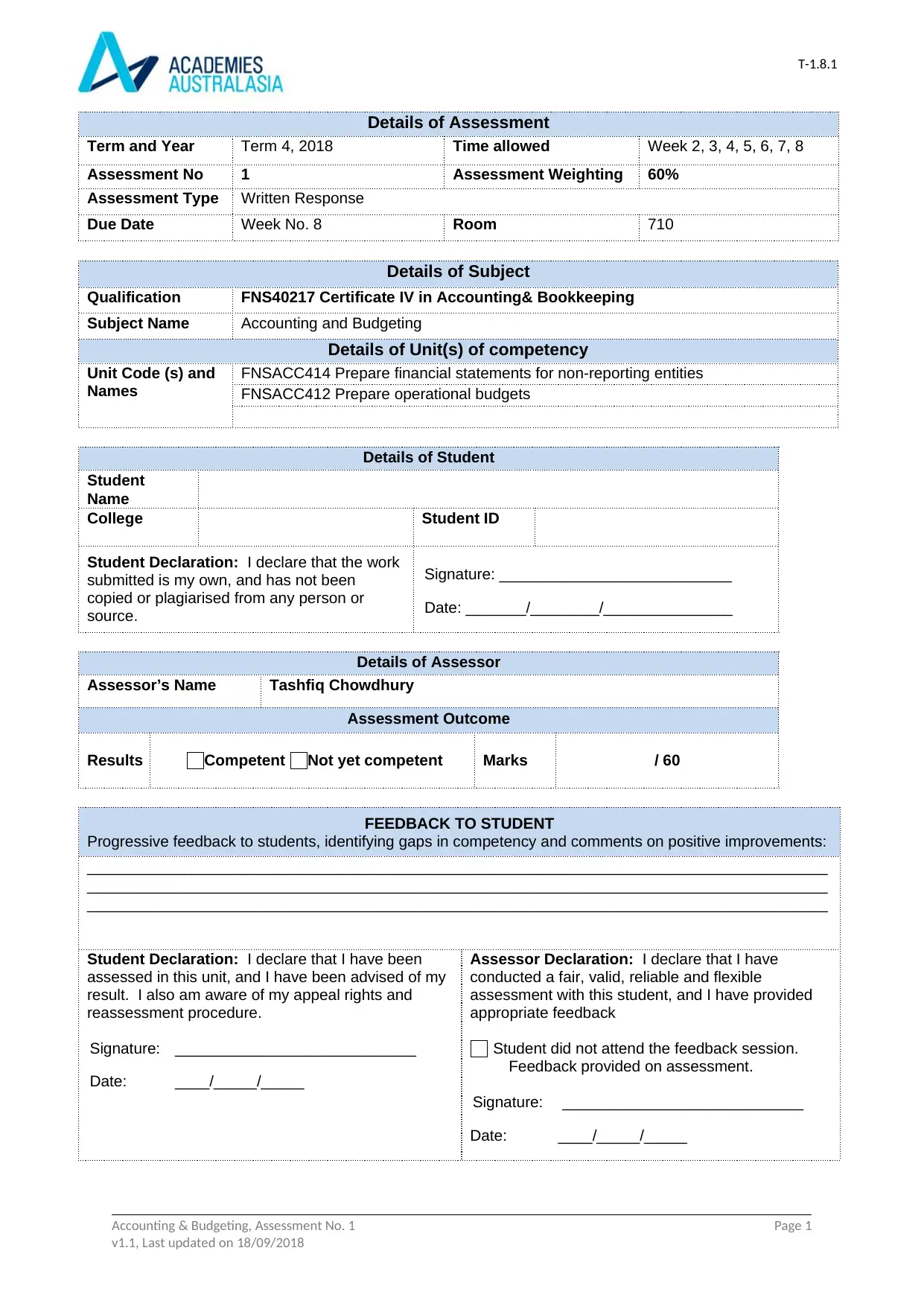
Details of Assessment
Term and Year Term 4, 2018 Time allowed Week 2, 3, 4, 5, 6, 7, 8
Assessment No 1 Assessment Weighting 60%
Assessment Type Written Response
Due Date Week No. 8 Room 710
Details of Subject
Qualification FNS40217 Certificate IV in Accounting& Bookkeeping
Subject Name Accounting and Budgeting
Details of Unit(s) of competency
Unit Code (s) and
Names
FNSACC414 Prepare financial statements for non-reporting entities
FNSACC412 Prepare operational budgets
Details of Student
Student
Name
College Student ID
Student Declaration: I declare that the work
submitted is my own, and has not been
copied or plagiarised from any person or
source.
Signature: ___________________________
Date: _______/________/_______________
Details of Assessor
Assessor’s Name Tashfiq Chowdhury
Assessment Outcome
Results Competent Not yet competent Marks / 60
FEEDBACK TO STUDENT
Progressive feedback to students, identifying gaps in competency and comments on positive improvements:
______________________________________________________________________________________
______________________________________________________________________________________
______________________________________________________________________________________
Student Declaration: I declare that I have been
assessed in this unit, and I have been advised of my
result. I also am aware of my appeal rights and
reassessment procedure.
Signature: ____________________________
Date: ____/_____/_____
Assessor Declaration: I declare that I have
conducted a fair, valid, reliable and flexible
assessment with this student, and I have provided
appropriate feedback
Student did not attend the feedback session.
Feedback provided on assessment.
Signature: ____________________________
Date: ____/_____/_____
Accounting & Budgeting, Assessment No. 1 Page 1
v1.1, Last updated on 18/09/2018
Details of Assessment
Term and Year Term 4, 2018 Time allowed Week 2, 3, 4, 5, 6, 7, 8
Assessment No 1 Assessment Weighting 60%
Assessment Type Written Response
Due Date Week No. 8 Room 710
Details of Subject
Qualification FNS40217 Certificate IV in Accounting& Bookkeeping
Subject Name Accounting and Budgeting
Details of Unit(s) of competency
Unit Code (s) and
Names
FNSACC414 Prepare financial statements for non-reporting entities
FNSACC412 Prepare operational budgets
Details of Student
Student
Name
College Student ID
Student Declaration: I declare that the work
submitted is my own, and has not been
copied or plagiarised from any person or
source.
Signature: ___________________________
Date: _______/________/_______________
Details of Assessor
Assessor’s Name Tashfiq Chowdhury
Assessment Outcome
Results Competent Not yet competent Marks / 60
FEEDBACK TO STUDENT
Progressive feedback to students, identifying gaps in competency and comments on positive improvements:
______________________________________________________________________________________
______________________________________________________________________________________
______________________________________________________________________________________
Student Declaration: I declare that I have been
assessed in this unit, and I have been advised of my
result. I also am aware of my appeal rights and
reassessment procedure.
Signature: ____________________________
Date: ____/_____/_____
Assessor Declaration: I declare that I have
conducted a fair, valid, reliable and flexible
assessment with this student, and I have provided
appropriate feedback
Student did not attend the feedback session.
Feedback provided on assessment.
Signature: ____________________________
Date: ____/_____/_____
Accounting & Budgeting, Assessment No. 1 Page 1
v1.1, Last updated on 18/09/2018

Paraphrase This Document
Need a fresh take? Get an instant paraphrase of this document with our AI Paraphraser
T-1.8.1
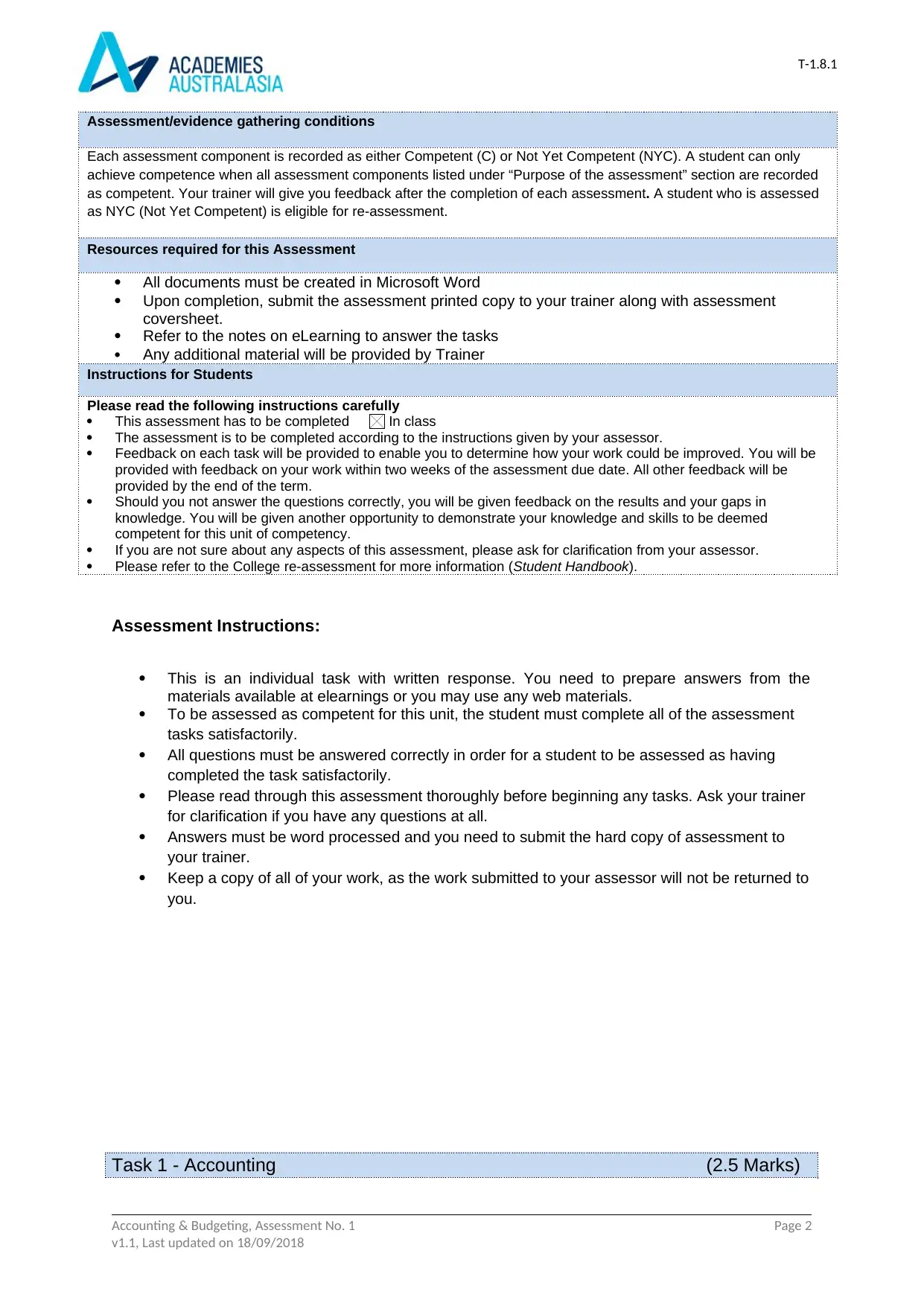
Assessment/evidence gathering conditions
Each assessment component is recorded as either Competent (C) or Not Yet Competent (NYC). A student can only
achieve competence when all assessment components listed under “Purpose of the assessment” section are recorded
as competent. Your trainer will give you feedback after the completion of each assessment. A student who is assessed
as NYC (Not Yet Competent) is eligible for re-assessment.
Resources required for this Assessment
All documents must be created in Microsoft Word
Upon completion, submit the assessment printed copy to your trainer along with assessment
coversheet.
Refer to the notes on eLearning to answer the tasks
Any additional material will be provided by Trainer
Instructions for Students
Please read the following instructions carefully
This assessment has to be completed In class
The assessment is to be completed according to the instructions given by your assessor.
Feedback on each task will be provided to enable you to determine how your work could be improved. You will be
provided with feedback on your work within two weeks of the assessment due date. All other feedback will be
provided by the end of the term.
Should you not answer the questions correctly, you will be given feedback on the results and your gaps in
knowledge. You will be given another opportunity to demonstrate your knowledge and skills to be deemed
competent for this unit of competency.
If you are not sure about any aspects of this assessment, please ask for clarification from your assessor.
Please refer to the College re-assessment for more information (Student Handbook).
Assessment Instructions:
This is an individual task with written response. You need to prepare answers from the
materials available at elearnings or you may use any web materials.
To be assessed as competent for this unit, the student must complete all of the assessment
tasks satisfactorily.
All questions must be answered correctly in order for a student to be assessed as having
completed the task satisfactorily.
Please read through this assessment thoroughly before beginning any tasks. Ask your trainer
for clarification if you have any questions at all.
Answers must be word processed and you need to submit the hard copy of assessment to
your trainer.
Keep a copy of all of your work, as the work submitted to your assessor will not be returned to
you.
Task 1 - Accounting (2.5 Marks)
Accounting & Budgeting, Assessment No. 1 Page 2
v1.1, Last updated on 18/09/2018
Assessment/evidence gathering conditions
Each assessment component is recorded as either Competent (C) or Not Yet Competent (NYC). A student can only
achieve competence when all assessment components listed under “Purpose of the assessment” section are recorded
as competent. Your trainer will give you feedback after the completion of each assessment. A student who is assessed
as NYC (Not Yet Competent) is eligible for re-assessment.
Resources required for this Assessment
All documents must be created in Microsoft Word
Upon completion, submit the assessment printed copy to your trainer along with assessment
coversheet.
Refer to the notes on eLearning to answer the tasks
Any additional material will be provided by Trainer
Instructions for Students
Please read the following instructions carefully
This assessment has to be completed In class
The assessment is to be completed according to the instructions given by your assessor.
Feedback on each task will be provided to enable you to determine how your work could be improved. You will be
provided with feedback on your work within two weeks of the assessment due date. All other feedback will be
provided by the end of the term.
Should you not answer the questions correctly, you will be given feedback on the results and your gaps in
knowledge. You will be given another opportunity to demonstrate your knowledge and skills to be deemed
competent for this unit of competency.
If you are not sure about any aspects of this assessment, please ask for clarification from your assessor.
Please refer to the College re-assessment for more information (Student Handbook).
Assessment Instructions:
This is an individual task with written response. You need to prepare answers from the
materials available at elearnings or you may use any web materials.
To be assessed as competent for this unit, the student must complete all of the assessment
tasks satisfactorily.
All questions must be answered correctly in order for a student to be assessed as having
completed the task satisfactorily.
Please read through this assessment thoroughly before beginning any tasks. Ask your trainer
for clarification if you have any questions at all.
Answers must be word processed and you need to submit the hard copy of assessment to
your trainer.
Keep a copy of all of your work, as the work submitted to your assessor will not be returned to
you.
Task 1 - Accounting (2.5 Marks)
Accounting & Budgeting, Assessment No. 1 Page 2
v1.1, Last updated on 18/09/2018
T-1.8.1
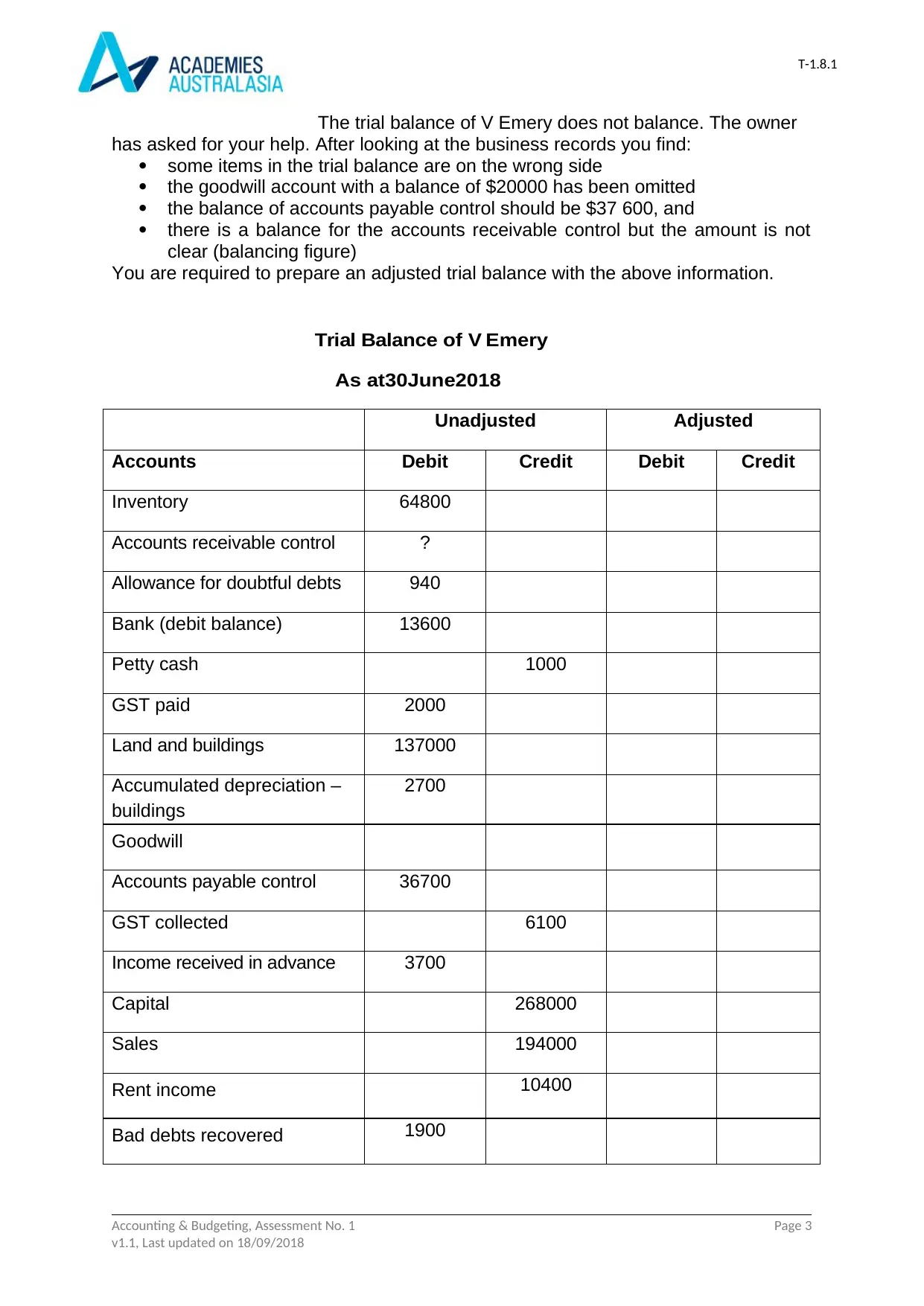
The trial balance of V Emery does not balance. The owner
has asked for your help. After looking at the business records you find:
some items in the trial balance are on the wrong side
the goodwill account with a balance of $20000 has been omitted
the balance of accounts payable control should be $37 600, and
there is a balance for the accounts receivable control but the amount is not
clear (balancing figure)
You are required to prepare an adjusted trial balance with the above information.
Trial Balance of V Emery
As at30June2018
Unadjusted Adjusted
Accounts Debit Credit Debit Credit
Inventory 64800
Accounts receivable control ?
Allowance for doubtful debts 940
Bank (debit balance) 13600
Petty cash 1000
GST paid 2000
Land and buildings 137000
Accumulated depreciation –
buildings
2700
Goodwill
Accounts payable control 36700
GST collected 6100
Income received in advance 3700
Capital 268000
Sales 194000
Rent income 10400
Bad debts recovered 1900
Accounting & Budgeting, Assessment No. 1 Page 3
v1.1, Last updated on 18/09/2018
The trial balance of V Emery does not balance. The owner
has asked for your help. After looking at the business records you find:
some items in the trial balance are on the wrong side
the goodwill account with a balance of $20000 has been omitted
the balance of accounts payable control should be $37 600, and
there is a balance for the accounts receivable control but the amount is not
clear (balancing figure)
You are required to prepare an adjusted trial balance with the above information.
Trial Balance of V Emery
As at30June2018
Unadjusted Adjusted
Accounts Debit Credit Debit Credit
Inventory 64800
Accounts receivable control ?
Allowance for doubtful debts 940
Bank (debit balance) 13600
Petty cash 1000
GST paid 2000
Land and buildings 137000
Accumulated depreciation –
buildings
2700
Goodwill
Accounts payable control 36700
GST collected 6100
Income received in advance 3700
Capital 268000
Sales 194000
Rent income 10400
Bad debts recovered 1900
Accounting & Budgeting, Assessment No. 1 Page 3
v1.1, Last updated on 18/09/2018
⊘ This is a preview!⊘
Do you want full access?
Subscribe today to unlock all pages.

Trusted by 1+ million students worldwide
T-1.8.1
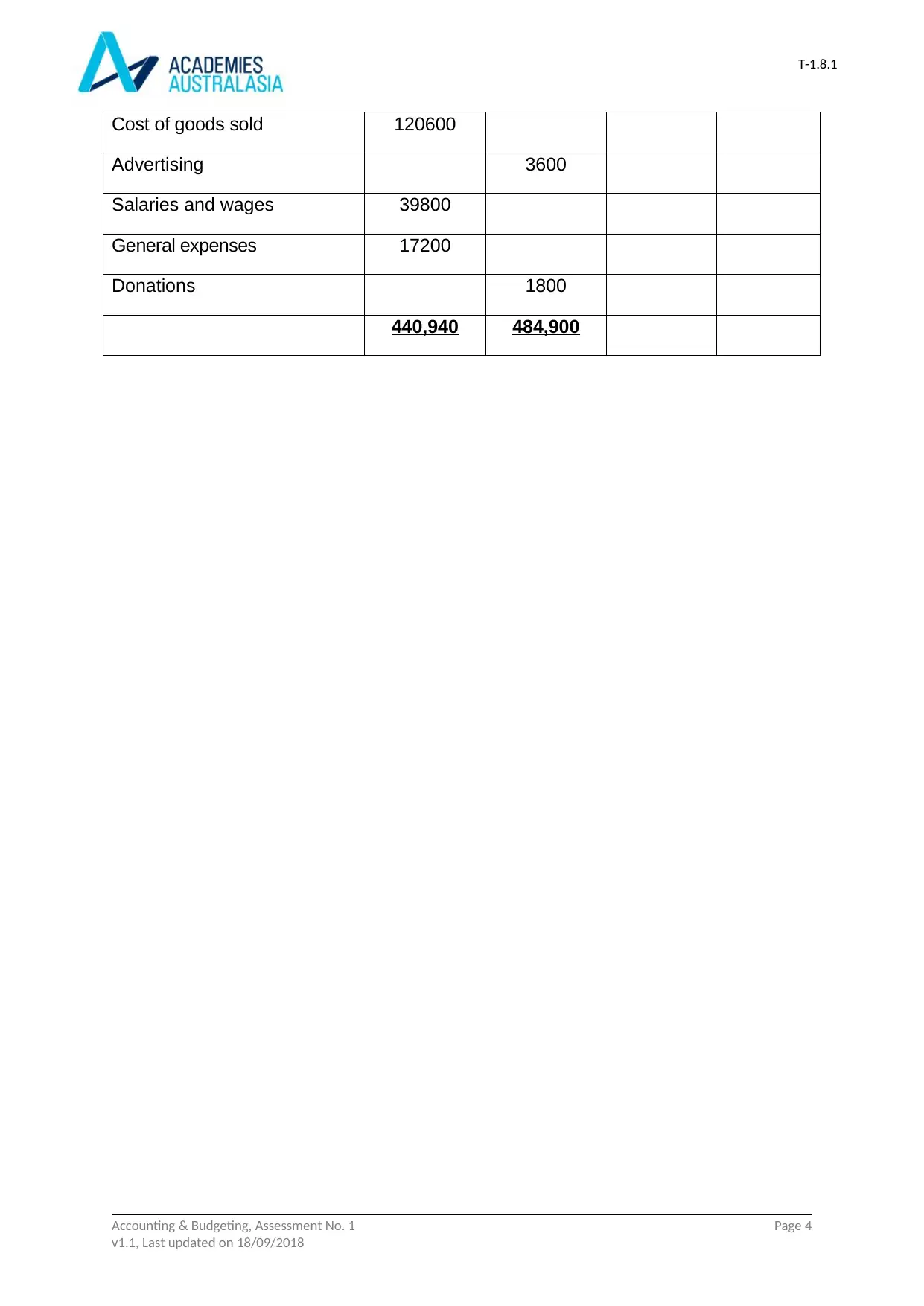
Cost of goods sold 120600
Advertising 3600
Salaries and wages 39800
General expenses 17200
Donations 1800
440,940 484,900
Accounting & Budgeting, Assessment No. 1 Page 4
v1.1, Last updated on 18/09/2018
Cost of goods sold 120600
Advertising 3600
Salaries and wages 39800
General expenses 17200
Donations 1800
440,940 484,900
Accounting & Budgeting, Assessment No. 1 Page 4
v1.1, Last updated on 18/09/2018
Paraphrase This Document
Need a fresh take? Get an instant paraphrase of this document with our AI Paraphraser
T-1.8.1
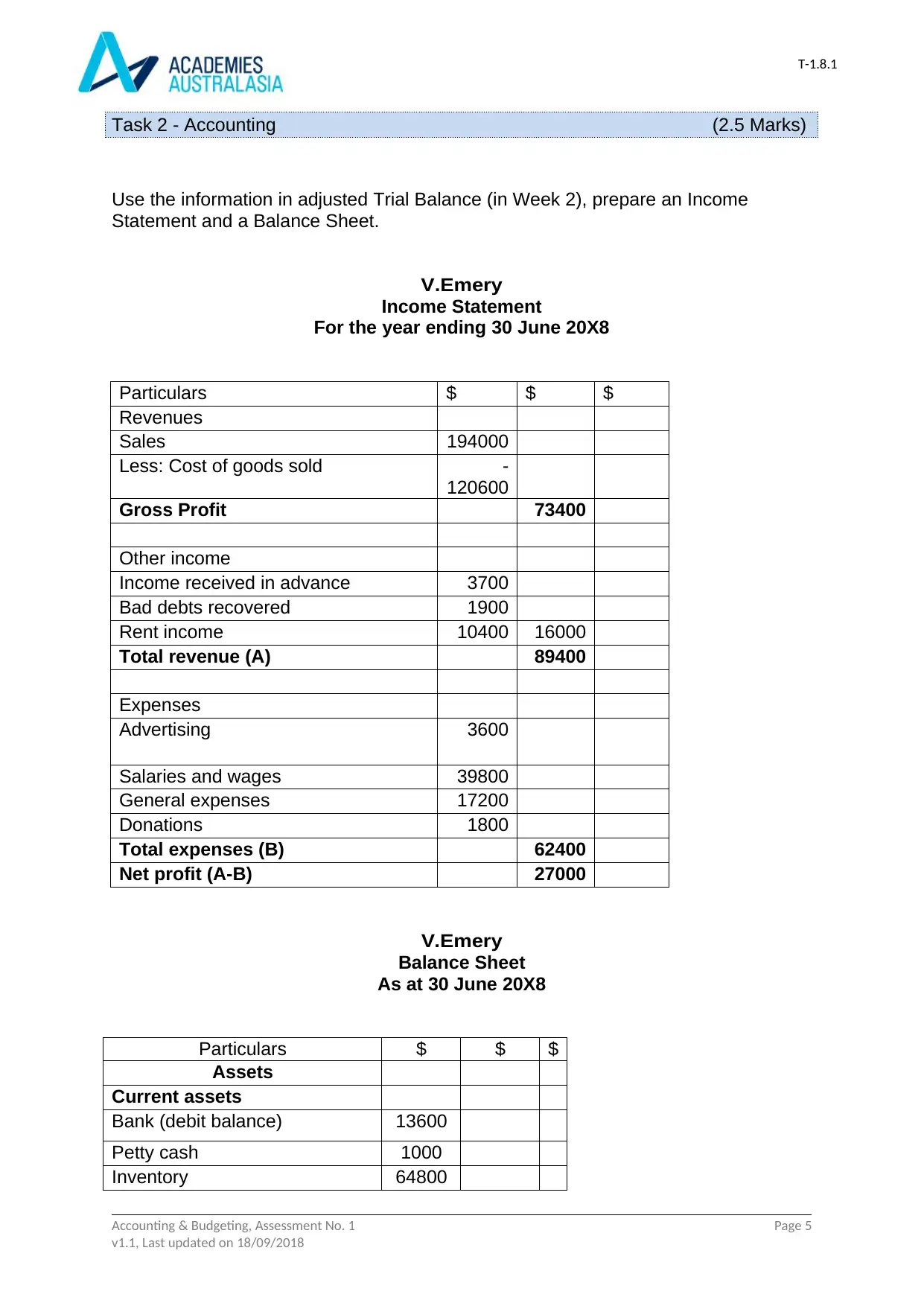
Task 2 - Accounting (2.5 Marks)
Use the information in adjusted Trial Balance (in Week 2), prepare an Income
Statement and a Balance Sheet.
V.Emery
Income Statement
For the year ending 30 June 20X8
Particulars $ $ $
Revenues
Sales 194000
Less: Cost of goods sold -
120600
Gross Profit 73400
Other income
Income received in advance 3700
Bad debts recovered 1900
Rent income 10400 16000
Total revenue (A) 89400
Expenses
Advertising 3600
Salaries and wages 39800
General expenses 17200
Donations 1800
Total expenses (B) 62400
Net profit (A-B) 27000
V.Emery
Balance Sheet
As at 30 June 20X8
Particulars $ $ $
Assets
Current assets
Bank (debit balance) 13600
Petty cash 1000
Inventory 64800
Accounting & Budgeting, Assessment No. 1 Page 5
v1.1, Last updated on 18/09/2018
Task 2 - Accounting (2.5 Marks)
Use the information in adjusted Trial Balance (in Week 2), prepare an Income
Statement and a Balance Sheet.
V.Emery
Income Statement
For the year ending 30 June 20X8
Particulars $ $ $
Revenues
Sales 194000
Less: Cost of goods sold -
120600
Gross Profit 73400
Other income
Income received in advance 3700
Bad debts recovered 1900
Rent income 10400 16000
Total revenue (A) 89400
Expenses
Advertising 3600
Salaries and wages 39800
General expenses 17200
Donations 1800
Total expenses (B) 62400
Net profit (A-B) 27000
V.Emery
Balance Sheet
As at 30 June 20X8
Particulars $ $ $
Assets
Current assets
Bank (debit balance) 13600
Petty cash 1000
Inventory 64800
Accounting & Budgeting, Assessment No. 1 Page 5
v1.1, Last updated on 18/09/2018
T-1.8.1
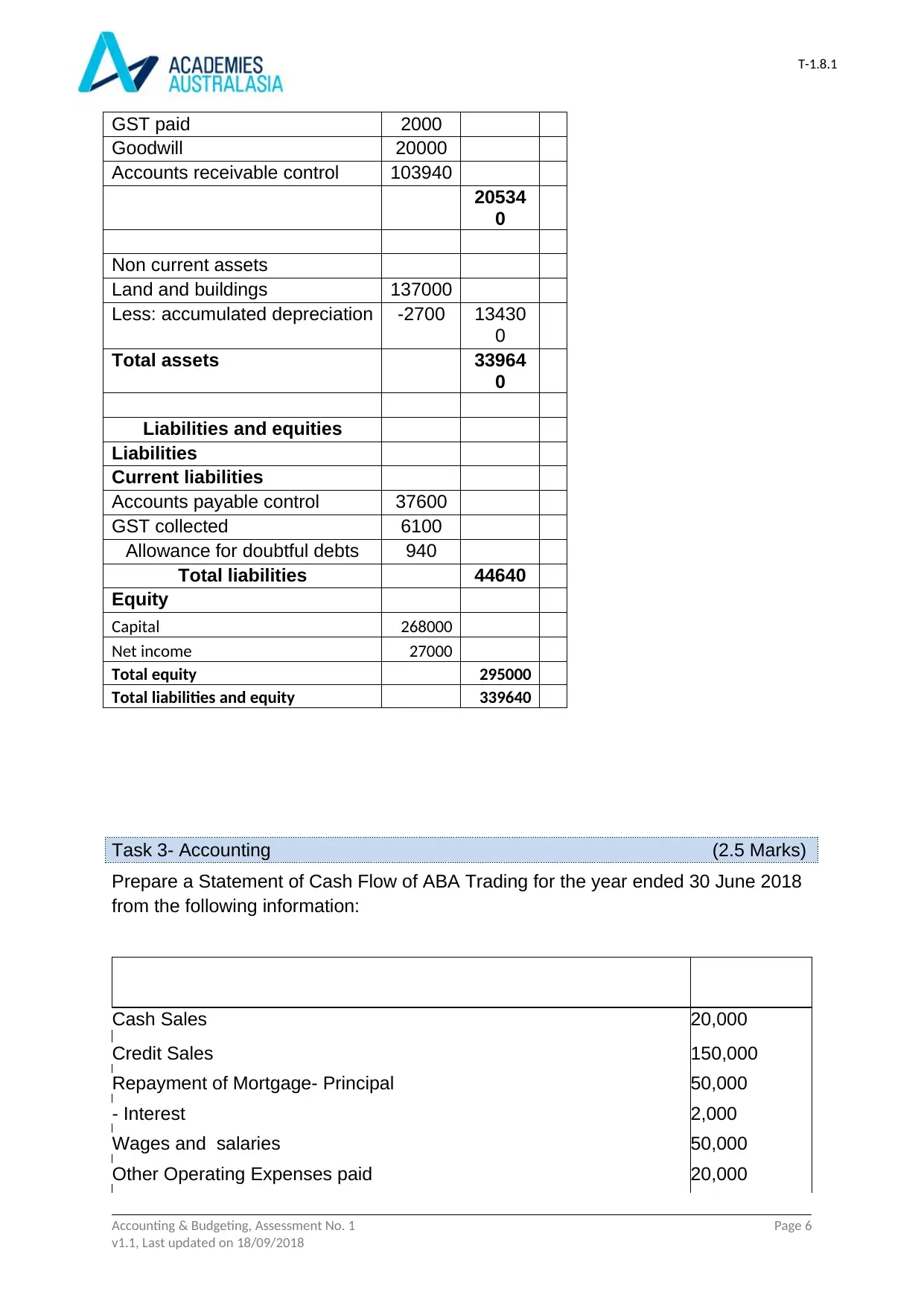
GST paid 2000
Goodwill 20000
Accounts receivable control 103940
20534
0
Non current assets
Land and buildings 137000
Less: accumulated depreciation -2700 13430
0
Total assets 33964
0
Liabilities and equities
Liabilities
Current liabilities
Accounts payable control 37600
GST collected 6100
Allowance for doubtful debts 940
Total liabilities 44640
Equity
Capital 268000
Net income 27000
Total equity 295000
Total liabilities and equity 339640
Task 3- Accounting (2.5 Marks)
Prepare a Statement of Cash Flow of ABA Trading for the year ended 30 June 2018
from the following information:
Cash Sales 20,000
Credit Sales 150,000
Repayment of Mortgage- Principal 50,000
- Interest 2,000
Wages and salaries 50,000
Other Operating Expenses paid 20,000
Accounting & Budgeting, Assessment No. 1 Page 6
v1.1, Last updated on 18/09/2018
GST paid 2000
Goodwill 20000
Accounts receivable control 103940
20534
0
Non current assets
Land and buildings 137000
Less: accumulated depreciation -2700 13430
0
Total assets 33964
0
Liabilities and equities
Liabilities
Current liabilities
Accounts payable control 37600
GST collected 6100
Allowance for doubtful debts 940
Total liabilities 44640
Equity
Capital 268000
Net income 27000
Total equity 295000
Total liabilities and equity 339640
Task 3- Accounting (2.5 Marks)
Prepare a Statement of Cash Flow of ABA Trading for the year ended 30 June 2018
from the following information:
Cash Sales 20,000
Credit Sales 150,000
Repayment of Mortgage- Principal 50,000
- Interest 2,000
Wages and salaries 50,000
Other Operating Expenses paid 20,000
Accounting & Budgeting, Assessment No. 1 Page 6
v1.1, Last updated on 18/09/2018
⊘ This is a preview!⊘
Do you want full access?
Subscribe today to unlock all pages.
Trusted by 1+ million students worldwide
T-1.8.1
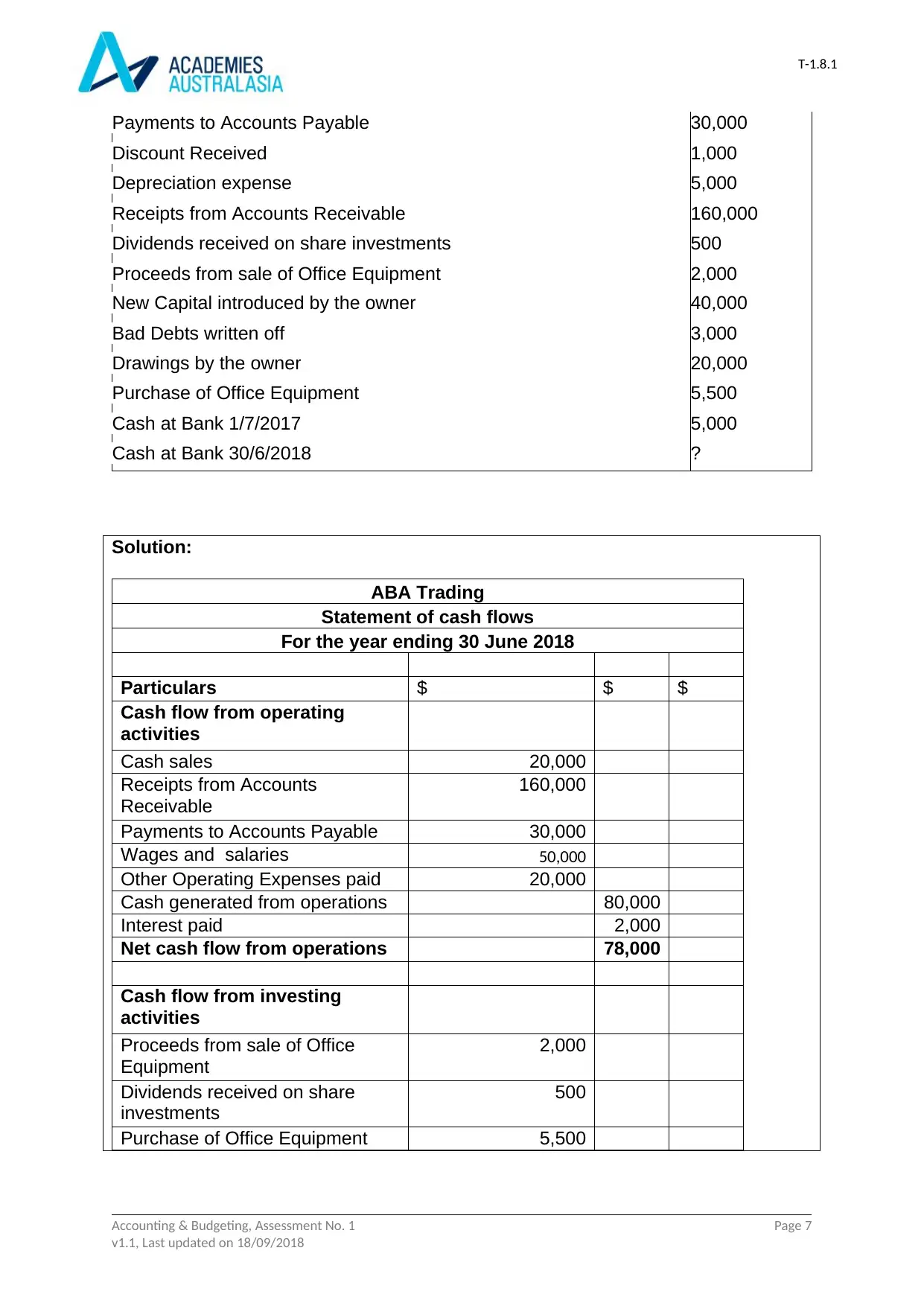
Payments to Accounts Payable 30,000
Discount Received 1,000
Depreciation expense 5,000
Receipts from Accounts Receivable 160,000
Dividends received on share investments 500
Proceeds from sale of Office Equipment 2,000
New Capital introduced by the owner 40,000
Bad Debts written off 3,000
Drawings by the owner 20,000
Purchase of Office Equipment 5,500
Cash at Bank 1/7/2017 5,000
Cash at Bank 30/6/2018 ?
Solution:
ABA Trading
Statement of cash flows
For the year ending 30 June 2018
Particulars $ $ $
Cash flow from operating
activities
Cash sales 20,000
Receipts from Accounts
Receivable
160,000
Payments to Accounts Payable 30,000
Wages and salaries 50,000
Other Operating Expenses paid 20,000
Cash generated from operations 80,000
Interest paid 2,000
Net cash flow from operations 78,000
Cash flow from investing
activities
Proceeds from sale of Office
Equipment
2,000
Dividends received on share
investments
500
Purchase of Office Equipment 5,500
Accounting & Budgeting, Assessment No. 1 Page 7
v1.1, Last updated on 18/09/2018
Payments to Accounts Payable 30,000
Discount Received 1,000
Depreciation expense 5,000
Receipts from Accounts Receivable 160,000
Dividends received on share investments 500
Proceeds from sale of Office Equipment 2,000
New Capital introduced by the owner 40,000
Bad Debts written off 3,000
Drawings by the owner 20,000
Purchase of Office Equipment 5,500
Cash at Bank 1/7/2017 5,000
Cash at Bank 30/6/2018 ?
Solution:
ABA Trading
Statement of cash flows
For the year ending 30 June 2018
Particulars $ $ $
Cash flow from operating
activities
Cash sales 20,000
Receipts from Accounts
Receivable
160,000
Payments to Accounts Payable 30,000
Wages and salaries 50,000
Other Operating Expenses paid 20,000
Cash generated from operations 80,000
Interest paid 2,000
Net cash flow from operations 78,000
Cash flow from investing
activities
Proceeds from sale of Office
Equipment
2,000
Dividends received on share
investments
500
Purchase of Office Equipment 5,500
Accounting & Budgeting, Assessment No. 1 Page 7
v1.1, Last updated on 18/09/2018
Paraphrase This Document
Need a fresh take? Get an instant paraphrase of this document with our AI Paraphraser
T-1.8.1
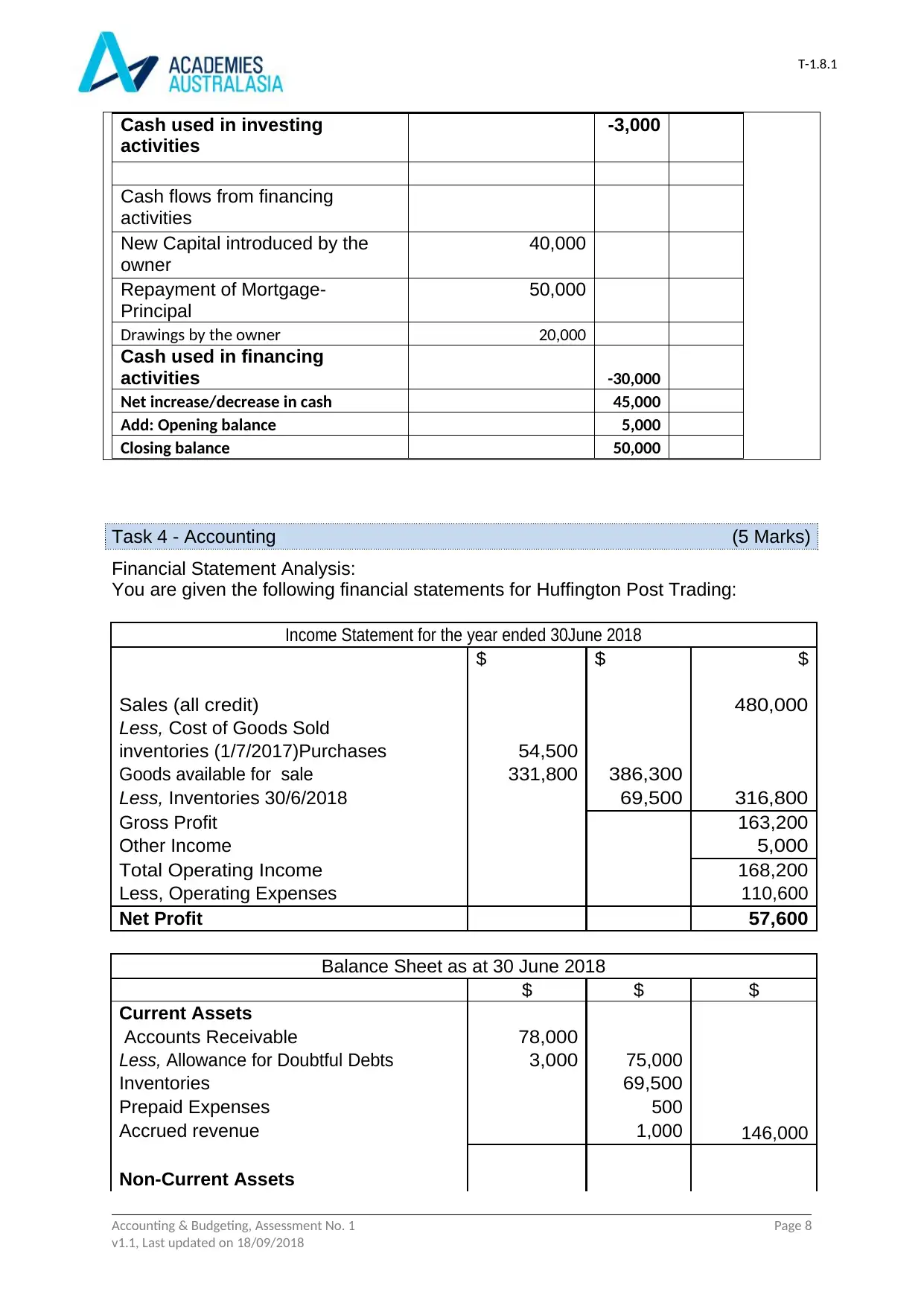
Cash used in investing
activities
-3,000
Cash flows from financing
activities
New Capital introduced by the
owner
40,000
Repayment of Mortgage-
Principal
50,000
Drawings by the owner 20,000
Cash used in financing
activities -30,000
Net increase/decrease in cash 45,000
Add: Opening balance 5,000
Closing balance 50,000
Task 4 - Accounting (5 Marks)
Financial Statement Analysis:
You are given the following financial statements for Huffington Post Trading:
Income Statement for the year ended 30June 2018
$ $ $
Sales (all credit) 480,000
Less, Cost of Goods Sold
inventories (1/7/2017)Purchases 54,500
Goods available for sale 331,800 386,300
Less, Inventories 30/6/2018 69,500 316,800
Gross Profit 163,200
Other Income 5,000
Total Operating Income 168,200
Less, Operating Expenses 110,600
Net Profit 57,600
Balance Sheet as at 30 June 2018
$ $ $
Current Assets
Accounts Receivable 78,000
Less, Allowance for Doubtful Debts 3,000 75,000
Inventories 69,500
Prepaid Expenses 500
Accrued revenue 1,000 146,000
Non-Current Assets
Accounting & Budgeting, Assessment No. 1 Page 8
v1.1, Last updated on 18/09/2018
Cash used in investing
activities
-3,000
Cash flows from financing
activities
New Capital introduced by the
owner
40,000
Repayment of Mortgage-
Principal
50,000
Drawings by the owner 20,000
Cash used in financing
activities -30,000
Net increase/decrease in cash 45,000
Add: Opening balance 5,000
Closing balance 50,000
Task 4 - Accounting (5 Marks)
Financial Statement Analysis:
You are given the following financial statements for Huffington Post Trading:
Income Statement for the year ended 30June 2018
$ $ $
Sales (all credit) 480,000
Less, Cost of Goods Sold
inventories (1/7/2017)Purchases 54,500
Goods available for sale 331,800 386,300
Less, Inventories 30/6/2018 69,500 316,800
Gross Profit 163,200
Other Income 5,000
Total Operating Income 168,200
Less, Operating Expenses 110,600
Net Profit 57,600
Balance Sheet as at 30 June 2018
$ $ $
Current Assets
Accounts Receivable 78,000
Less, Allowance for Doubtful Debts 3,000 75,000
Inventories 69,500
Prepaid Expenses 500
Accrued revenue 1,000 146,000
Non-Current Assets
Accounting & Budgeting, Assessment No. 1 Page 8
v1.1, Last updated on 18/09/2018
T-1.8.1
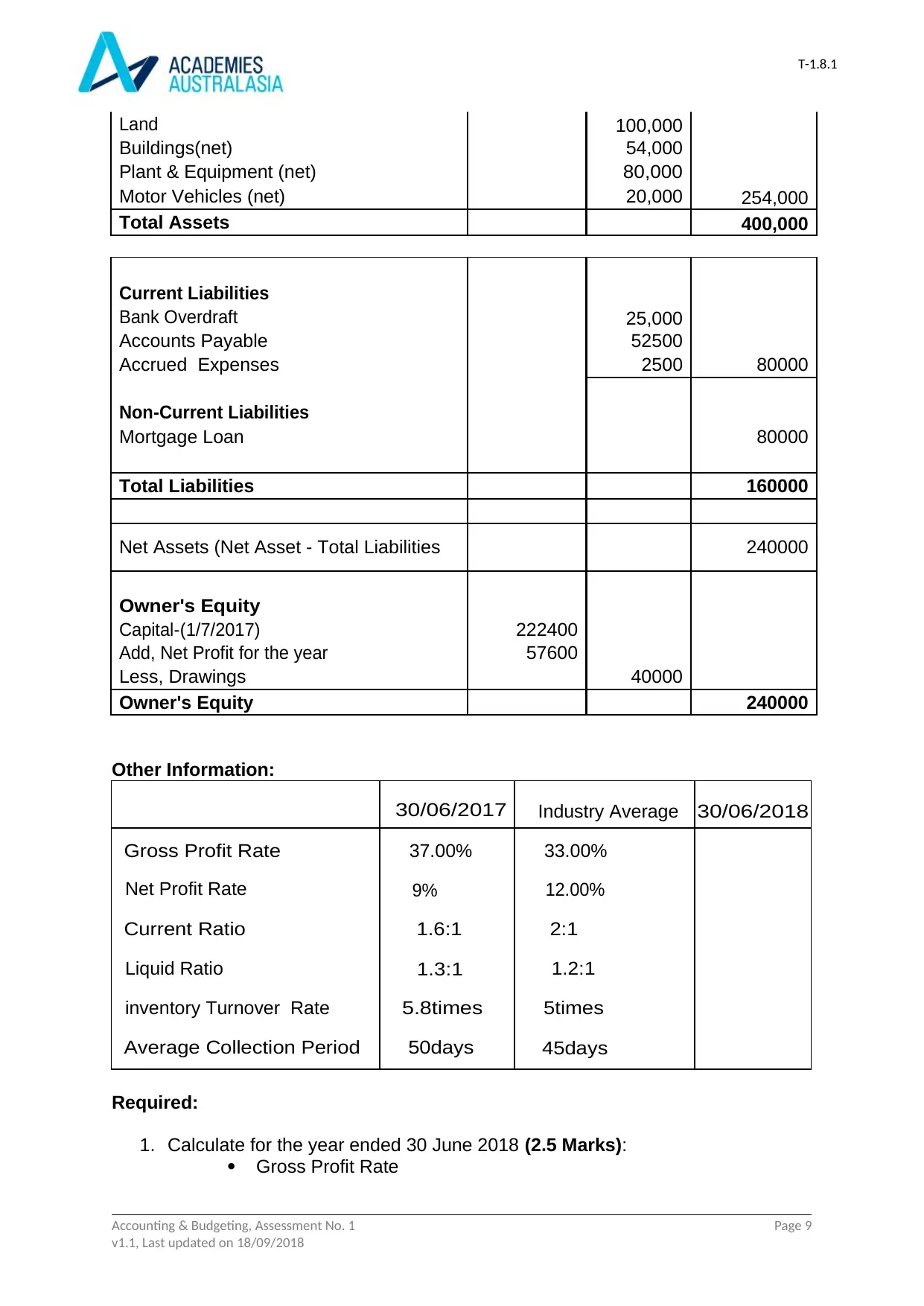
Land 100,000
Buildings(net) 54,000
Plant & Equipment (net) 80,000
Motor Vehicles (net) 20,000 254,000
Total Assets 400,000
Current Liabilities
Bank Overdraft 25,000
Accounts Payable 52500
Accrued Expenses 2500 80000
Non-Current Liabilities
Mortgage Loan 80000
Total Liabilities 160000
Net Assets (Net Asset - Total Liabilities 240000
Owner's Equity
Capital-(1/7/2017) 222400
Add, Net Profit for the year 57600
Less, Drawings 40000
Owner's Equity 240000
Other Information:
30/06/2017 Industry Average 30/06/2018
Gross Profit Rate 37.00% 33.00%
Net Profit Rate 9% 12.00%
Current Ratio 1.6:1 2:1
Liquid Ratio 1.3:1 1.2:1
inventory Turnover Rate 5.8times 5times
Average Collection Period 50days 45days
Required:
1. Calculate for the year ended 30 June 2018 (2.5 Marks):
Gross Profit Rate
Accounting & Budgeting, Assessment No. 1 Page 9
v1.1, Last updated on 18/09/2018
Land 100,000
Buildings(net) 54,000
Plant & Equipment (net) 80,000
Motor Vehicles (net) 20,000 254,000
Total Assets 400,000
Current Liabilities
Bank Overdraft 25,000
Accounts Payable 52500
Accrued Expenses 2500 80000
Non-Current Liabilities
Mortgage Loan 80000
Total Liabilities 160000
Net Assets (Net Asset - Total Liabilities 240000
Owner's Equity
Capital-(1/7/2017) 222400
Add, Net Profit for the year 57600
Less, Drawings 40000
Owner's Equity 240000
Other Information:
30/06/2017 Industry Average 30/06/2018
Gross Profit Rate 37.00% 33.00%
Net Profit Rate 9% 12.00%
Current Ratio 1.6:1 2:1
Liquid Ratio 1.3:1 1.2:1
inventory Turnover Rate 5.8times 5times
Average Collection Period 50days 45days
Required:
1. Calculate for the year ended 30 June 2018 (2.5 Marks):
Gross Profit Rate
Accounting & Budgeting, Assessment No. 1 Page 9
v1.1, Last updated on 18/09/2018
⊘ This is a preview!⊘
Do you want full access?
Subscribe today to unlock all pages.
Trusted by 1+ million students worldwide
T-1.8.1
Net Profit Rate
Current Ratio
Liquid Ratio
Inventory Turnover Rate
Average Collection Period
2. Based on the ratios you have calculated and the other information given,
comment briefly on each of the following for Bowman's business (1.5 Marks):
Profitability
Business Activity
Liquidity
3. Advise the company of possible reasons for any unsatisfactory situations that
exist in relation to the business and suggest actions that may be taken to
improve them. (1 Mark)
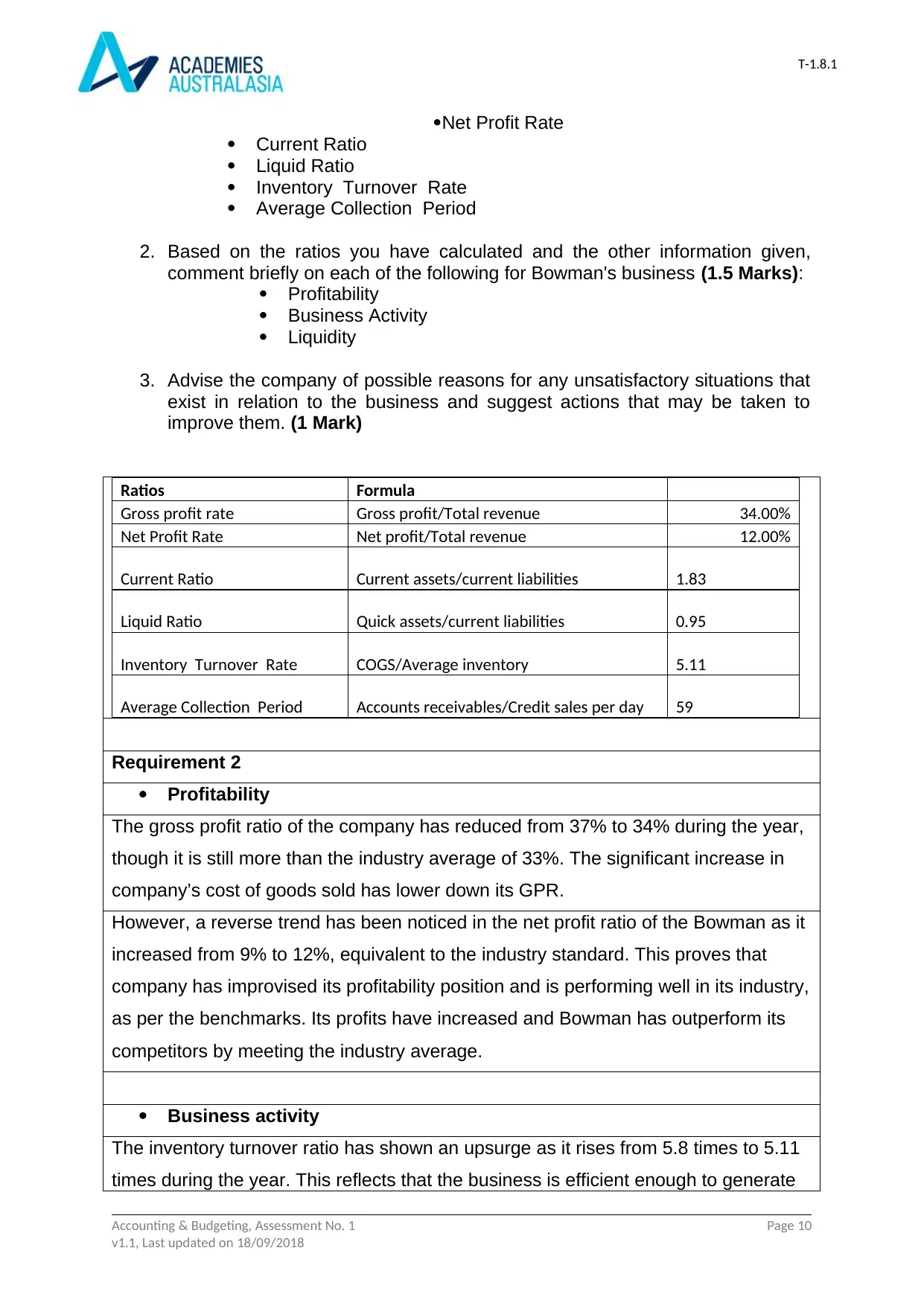
Ratios Formula
Gross profit rate Gross profit/Total revenue 34.00%
Net Profit Rate Net profit/Total revenue 12.00%
Current Ratio Current assets/current liabilities 1.83
Liquid Ratio Quick assets/current liabilities 0.95
Inventory Turnover Rate COGS/Average inventory 5.11
Average Collection Period Accounts receivables/Credit sales per day 59
Requirement 2
Profitability
The gross profit ratio of the company has reduced from 37% to 34% during the year,
though it is still more than the industry average of 33%. The significant increase in
company’s cost of goods sold has lower down its GPR.
However, a reverse trend has been noticed in the net profit ratio of the Bowman as it
increased from 9% to 12%, equivalent to the industry standard. This proves that
company has improvised its profitability position and is performing well in its industry,
as per the benchmarks. Its profits have increased and Bowman has outperform its
competitors by meeting the industry average.
Business activity
The inventory turnover ratio has shown an upsurge as it rises from 5.8 times to 5.11
times during the year. This reflects that the business is efficient enough to generate
Accounting & Budgeting, Assessment No. 1 Page 10
v1.1, Last updated on 18/09/2018
Net Profit Rate
Current Ratio
Liquid Ratio
Inventory Turnover Rate
Average Collection Period
2. Based on the ratios you have calculated and the other information given,
comment briefly on each of the following for Bowman's business (1.5 Marks):
Profitability
Business Activity
Liquidity
3. Advise the company of possible reasons for any unsatisfactory situations that
exist in relation to the business and suggest actions that may be taken to
improve them. (1 Mark)
Ratios Formula
Gross profit rate Gross profit/Total revenue 34.00%
Net Profit Rate Net profit/Total revenue 12.00%
Current Ratio Current assets/current liabilities 1.83
Liquid Ratio Quick assets/current liabilities 0.95
Inventory Turnover Rate COGS/Average inventory 5.11
Average Collection Period Accounts receivables/Credit sales per day 59
Requirement 2
Profitability
The gross profit ratio of the company has reduced from 37% to 34% during the year,
though it is still more than the industry average of 33%. The significant increase in
company’s cost of goods sold has lower down its GPR.
However, a reverse trend has been noticed in the net profit ratio of the Bowman as it
increased from 9% to 12%, equivalent to the industry standard. This proves that
company has improvised its profitability position and is performing well in its industry,
as per the benchmarks. Its profits have increased and Bowman has outperform its
competitors by meeting the industry average.
Business activity
The inventory turnover ratio has shown an upsurge as it rises from 5.8 times to 5.11
times during the year. This reflects that the business is efficient enough to generate
Accounting & Budgeting, Assessment No. 1 Page 10
v1.1, Last updated on 18/09/2018
Paraphrase This Document
Need a fresh take? Get an instant paraphrase of this document with our AI Paraphraser
T-1.8.1
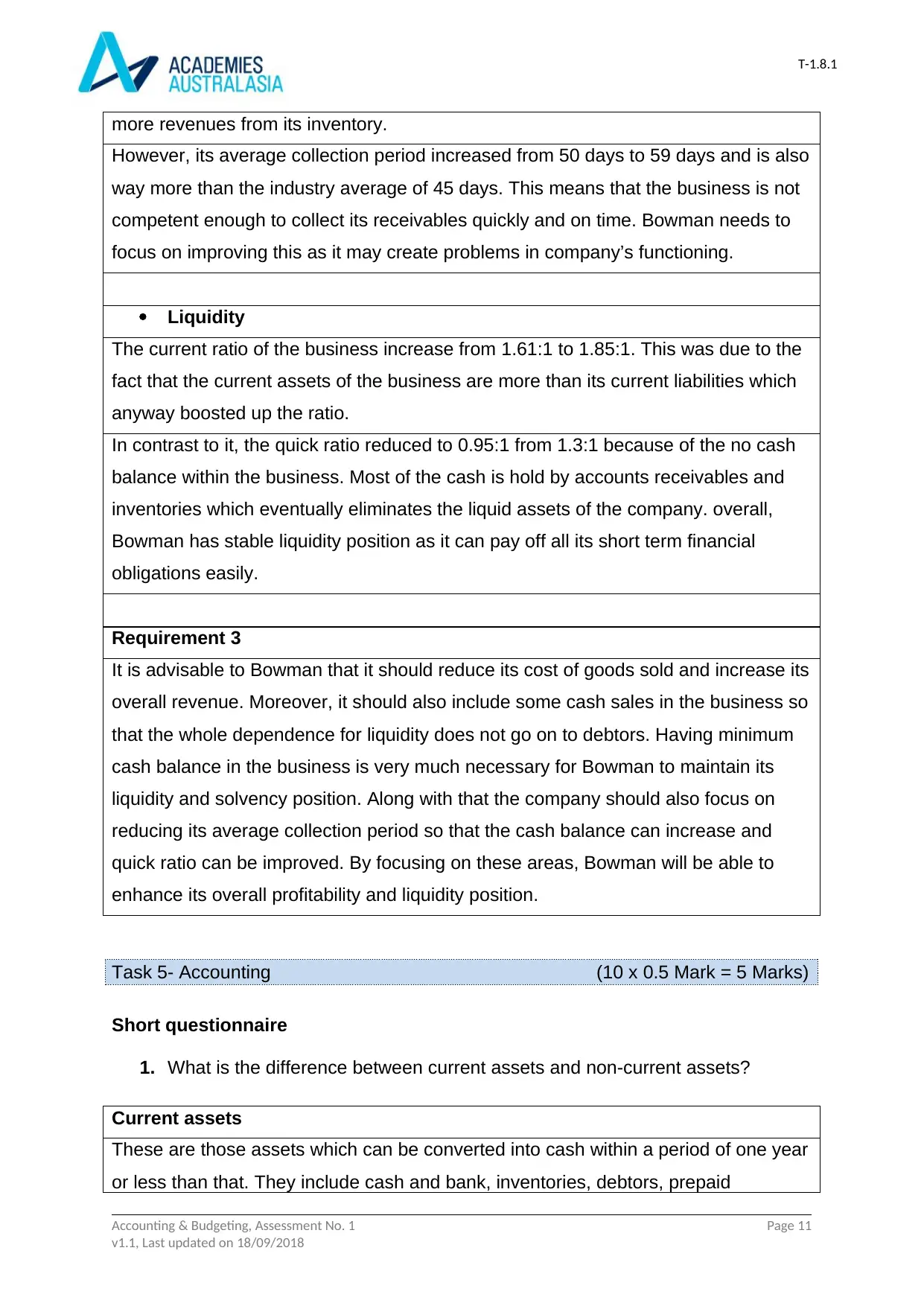
more revenues from its inventory.
However, its average collection period increased from 50 days to 59 days and is also
way more than the industry average of 45 days. This means that the business is not
competent enough to collect its receivables quickly and on time. Bowman needs to
focus on improving this as it may create problems in company’s functioning.
Liquidity
The current ratio of the business increase from 1.61:1 to 1.85:1. This was due to the
fact that the current assets of the business are more than its current liabilities which
anyway boosted up the ratio.
In contrast to it, the quick ratio reduced to 0.95:1 from 1.3:1 because of the no cash
balance within the business. Most of the cash is hold by accounts receivables and
inventories which eventually eliminates the liquid assets of the company. overall,
Bowman has stable liquidity position as it can pay off all its short term financial
obligations easily.
Requirement 3
It is advisable to Bowman that it should reduce its cost of goods sold and increase its
overall revenue. Moreover, it should also include some cash sales in the business so
that the whole dependence for liquidity does not go on to debtors. Having minimum
cash balance in the business is very much necessary for Bowman to maintain its
liquidity and solvency position. Along with that the company should also focus on
reducing its average collection period so that the cash balance can increase and
quick ratio can be improved. By focusing on these areas, Bowman will be able to
enhance its overall profitability and liquidity position.
Task 5- Accounting (10 x 0.5 Mark = 5 Marks)
Short questionnaire
1. What is the difference between current assets and non-current assets?
Current assets
These are those assets which can be converted into cash within a period of one year
or less than that. They include cash and bank, inventories, debtors, prepaid
Accounting & Budgeting, Assessment No. 1 Page 11
v1.1, Last updated on 18/09/2018
more revenues from its inventory.
However, its average collection period increased from 50 days to 59 days and is also
way more than the industry average of 45 days. This means that the business is not
competent enough to collect its receivables quickly and on time. Bowman needs to
focus on improving this as it may create problems in company’s functioning.
Liquidity
The current ratio of the business increase from 1.61:1 to 1.85:1. This was due to the
fact that the current assets of the business are more than its current liabilities which
anyway boosted up the ratio.
In contrast to it, the quick ratio reduced to 0.95:1 from 1.3:1 because of the no cash
balance within the business. Most of the cash is hold by accounts receivables and
inventories which eventually eliminates the liquid assets of the company. overall,
Bowman has stable liquidity position as it can pay off all its short term financial
obligations easily.
Requirement 3
It is advisable to Bowman that it should reduce its cost of goods sold and increase its
overall revenue. Moreover, it should also include some cash sales in the business so
that the whole dependence for liquidity does not go on to debtors. Having minimum
cash balance in the business is very much necessary for Bowman to maintain its
liquidity and solvency position. Along with that the company should also focus on
reducing its average collection period so that the cash balance can increase and
quick ratio can be improved. By focusing on these areas, Bowman will be able to
enhance its overall profitability and liquidity position.
Task 5- Accounting (10 x 0.5 Mark = 5 Marks)
Short questionnaire
1. What is the difference between current assets and non-current assets?
Current assets
These are those assets which can be converted into cash within a period of one year
or less than that. They include cash and bank, inventories, debtors, prepaid
Accounting & Budgeting, Assessment No. 1 Page 11
v1.1, Last updated on 18/09/2018
T-1.8.1
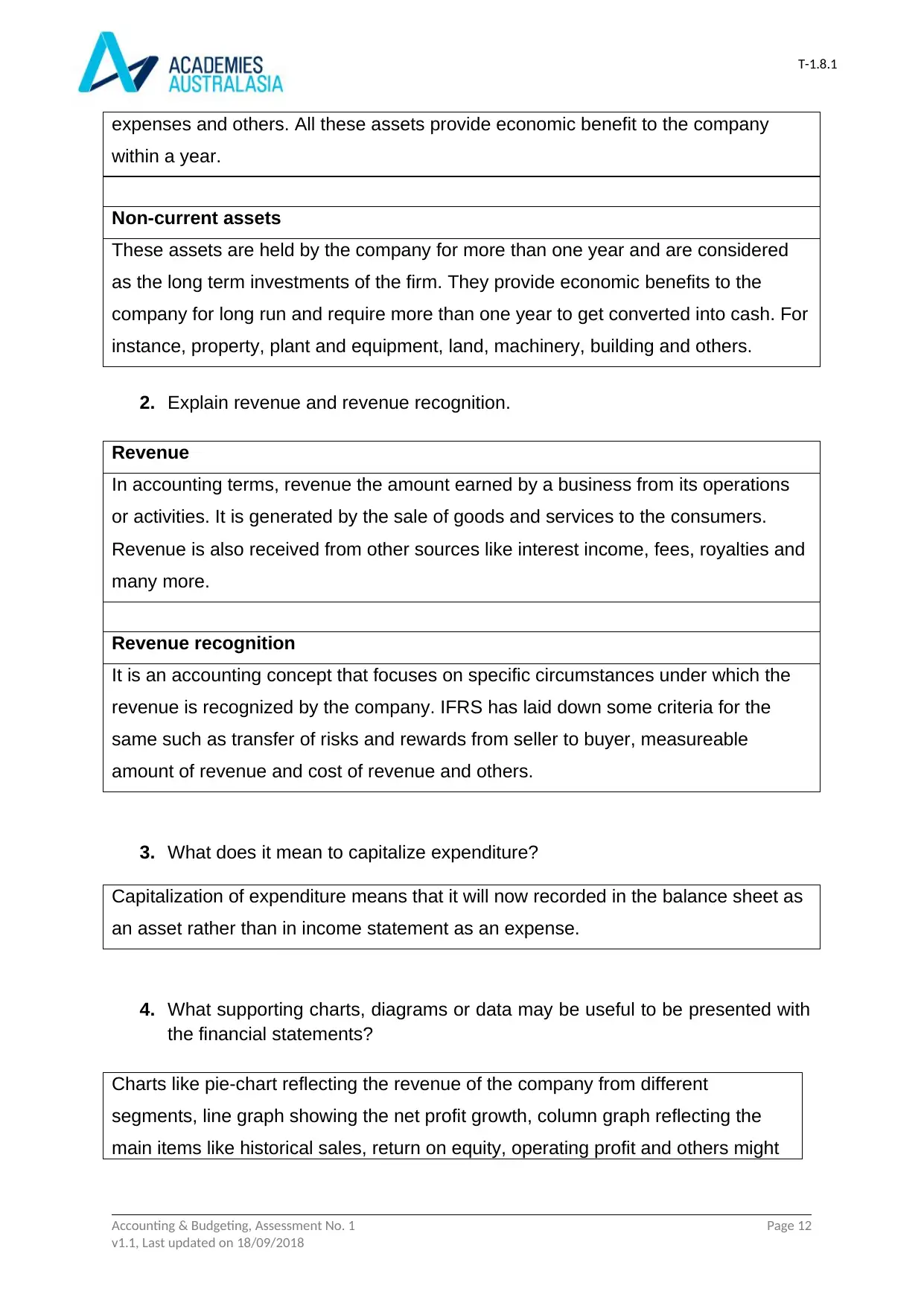
expenses and others. All these assets provide economic benefit to the company
within a year.
Non-current assets
These assets are held by the company for more than one year and are considered
as the long term investments of the firm. They provide economic benefits to the
company for long run and require more than one year to get converted into cash. For
instance, property, plant and equipment, land, machinery, building and others.
2. Explain revenue and revenue recognition.
Revenue
In accounting terms, revenue the amount earned by a business from its operations
or activities. It is generated by the sale of goods and services to the consumers.
Revenue is also received from other sources like interest income, fees, royalties and
many more.
Revenue recognition
It is an accounting concept that focuses on specific circumstances under which the
revenue is recognized by the company. IFRS has laid down some criteria for the
same such as transfer of risks and rewards from seller to buyer, measureable
amount of revenue and cost of revenue and others.
3. What does it mean to capitalize expenditure?
Capitalization of expenditure means that it will now recorded in the balance sheet as
an asset rather than in income statement as an expense.
4. What supporting charts, diagrams or data may be useful to be presented with
the financial statements?
Charts like pie-chart reflecting the revenue of the company from different
segments, line graph showing the net profit growth, column graph reflecting the
main items like historical sales, return on equity, operating profit and others might
Accounting & Budgeting, Assessment No. 1 Page 12
v1.1, Last updated on 18/09/2018
expenses and others. All these assets provide economic benefit to the company
within a year.
Non-current assets
These assets are held by the company for more than one year and are considered
as the long term investments of the firm. They provide economic benefits to the
company for long run and require more than one year to get converted into cash. For
instance, property, plant and equipment, land, machinery, building and others.
2. Explain revenue and revenue recognition.
Revenue
In accounting terms, revenue the amount earned by a business from its operations
or activities. It is generated by the sale of goods and services to the consumers.
Revenue is also received from other sources like interest income, fees, royalties and
many more.
Revenue recognition
It is an accounting concept that focuses on specific circumstances under which the
revenue is recognized by the company. IFRS has laid down some criteria for the
same such as transfer of risks and rewards from seller to buyer, measureable
amount of revenue and cost of revenue and others.
3. What does it mean to capitalize expenditure?
Capitalization of expenditure means that it will now recorded in the balance sheet as
an asset rather than in income statement as an expense.
4. What supporting charts, diagrams or data may be useful to be presented with
the financial statements?
Charts like pie-chart reflecting the revenue of the company from different
segments, line graph showing the net profit growth, column graph reflecting the
main items like historical sales, return on equity, operating profit and others might
Accounting & Budgeting, Assessment No. 1 Page 12
v1.1, Last updated on 18/09/2018
⊘ This is a preview!⊘
Do you want full access?
Subscribe today to unlock all pages.
Trusted by 1+ million students worldwide

1 out of 46


Related Documents


Your All-in-One AI-Powered Toolkit for Academic Success.
+13062052269
info@desklib.com
Available 24*7 on WhatsApp / Email
![[object Object]](/_next/static/media/star-bottom.7253800d.svg)
Unlock your academic potential
Copyright © 2020–2026 A2Z Services. All Rights Reserved. Developed and managed by ZUCOL.