FNSACC408 - Business Systems: Bookkeeper Induction Guide and Tasks
VerifiedAdded on 2022/11/13
|10
|3100
|304
Portfolio
AI Summary
This portfolio assignment presents a comprehensive bookkeeper induction guide, designed to assist new bookkeepers in understanding their roles and responsibilities within an organization. The guide details the functions of bookkeeping, including maintaining books of accounts, managing payroll, and preparing financial records using various software like Sage, Xero, Excel, and MYOB. It outlines the roles of other staff members, such as accounting professionals and tax advisors, emphasizing the importance of adhering to accounting standards, ethical codes, and relevant legislation like the Goods and Services Tax Act, Privacy Act, and Corporations Act. The guide also explores internal and external support pathways, including financial accountants, the TPB, ASIC, and the tax office, and covers legislation, regulations, industry standards, and organizational requirements. Furthermore, it addresses finance code of practice, ethical guidelines, activities outside the bookkeeper's scope, necessary tasks, available publications, communication, and reporting requirements, as well as performance review and management processes. The document also provides insights into the software programs utilized, access restrictions, and other resources available to bookkeepers.
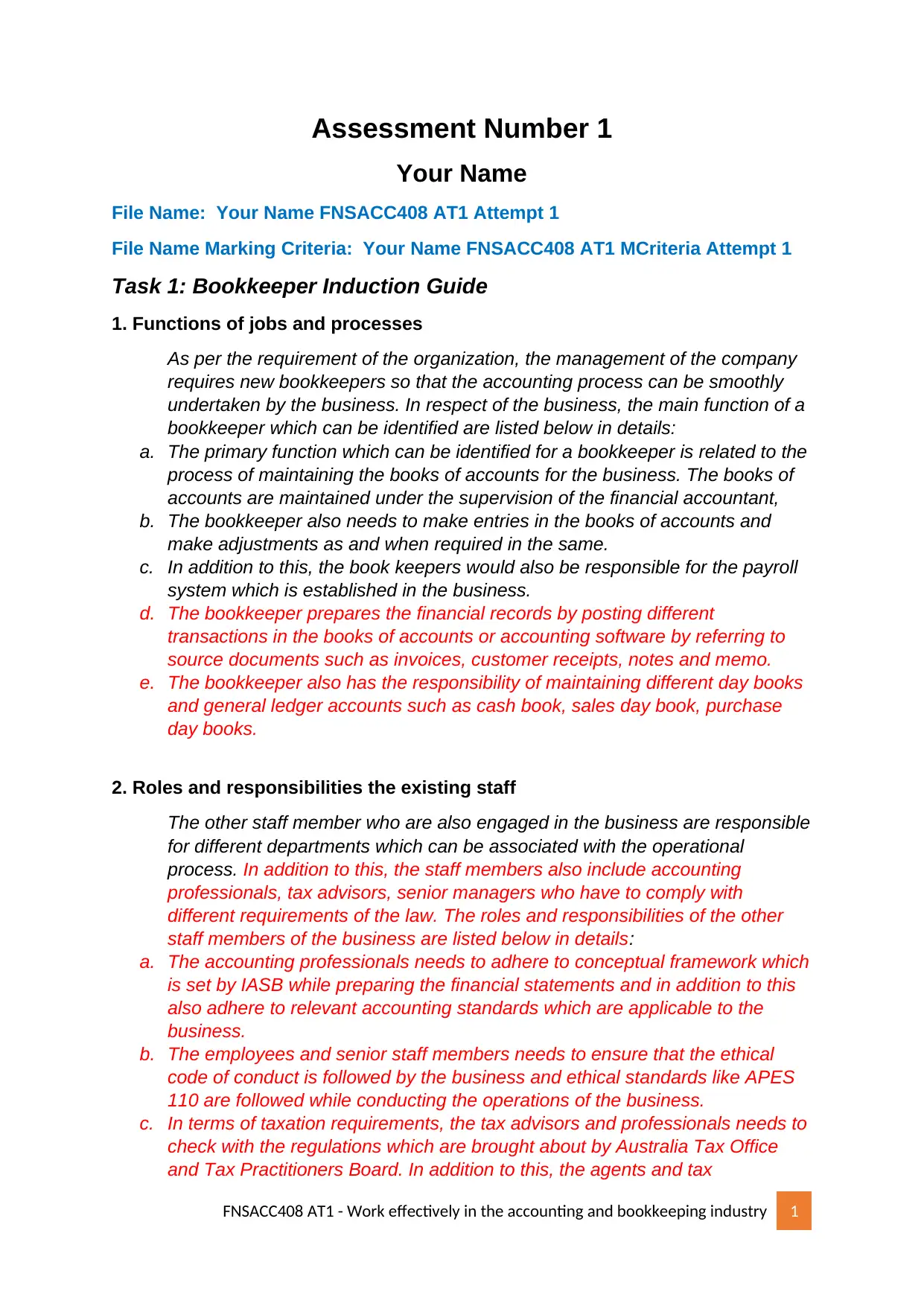
Assessment Number 1
Your Name
File Name: Your Name FNSACC408 AT1 Attempt 1
File Name Marking Criteria: Your Name FNSACC408 AT1 MCriteria Attempt 1
Task 1: Bookkeeper Induction Guide
1. Functions of jobs and processes
As per the requirement of the organization, the management of the company
requires new bookkeepers so that the accounting process can be smoothly
undertaken by the business. In respect of the business, the main function of a
bookkeeper which can be identified are listed below in details:
a. The primary function which can be identified for a bookkeeper is related to the
process of maintaining the books of accounts for the business. The books of
accounts are maintained under the supervision of the financial accountant,
b. The bookkeeper also needs to make entries in the books of accounts and
make adjustments as and when required in the same.
c. In addition to this, the book keepers would also be responsible for the payroll
system which is established in the business.
d. The bookkeeper prepares the financial records by posting different
transactions in the books of accounts or accounting software by referring to
source documents such as invoices, customer receipts, notes and memo.
e. The bookkeeper also has the responsibility of maintaining different day books
and general ledger accounts such as cash book, sales day book, purchase
day books.
2. Roles and responsibilities the existing staff
The other staff member who are also engaged in the business are responsible
for different departments which can be associated with the operational
process. In addition to this, the staff members also include accounting
professionals, tax advisors, senior managers who have to comply with
different requirements of the law. The roles and responsibilities of the other
staff members of the business are listed below in details:
a. The accounting professionals needs to adhere to conceptual framework which
is set by IASB while preparing the financial statements and in addition to this
also adhere to relevant accounting standards which are applicable to the
business.
b. The employees and senior staff members needs to ensure that the ethical
code of conduct is followed by the business and ethical standards like APES
110 are followed while conducting the operations of the business.
c. In terms of taxation requirements, the tax advisors and professionals needs to
check with the regulations which are brought about by Australia Tax Office
and Tax Practitioners Board. In addition to this, the agents and tax
FNSACC408 AT1 - Work effectively in the accounting and bookkeeping industry 1
Your Name
File Name: Your Name FNSACC408 AT1 Attempt 1
File Name Marking Criteria: Your Name FNSACC408 AT1 MCriteria Attempt 1
Task 1: Bookkeeper Induction Guide
1. Functions of jobs and processes
As per the requirement of the organization, the management of the company
requires new bookkeepers so that the accounting process can be smoothly
undertaken by the business. In respect of the business, the main function of a
bookkeeper which can be identified are listed below in details:
a. The primary function which can be identified for a bookkeeper is related to the
process of maintaining the books of accounts for the business. The books of
accounts are maintained under the supervision of the financial accountant,
b. The bookkeeper also needs to make entries in the books of accounts and
make adjustments as and when required in the same.
c. In addition to this, the book keepers would also be responsible for the payroll
system which is established in the business.
d. The bookkeeper prepares the financial records by posting different
transactions in the books of accounts or accounting software by referring to
source documents such as invoices, customer receipts, notes and memo.
e. The bookkeeper also has the responsibility of maintaining different day books
and general ledger accounts such as cash book, sales day book, purchase
day books.
2. Roles and responsibilities the existing staff
The other staff member who are also engaged in the business are responsible
for different departments which can be associated with the operational
process. In addition to this, the staff members also include accounting
professionals, tax advisors, senior managers who have to comply with
different requirements of the law. The roles and responsibilities of the other
staff members of the business are listed below in details:
a. The accounting professionals needs to adhere to conceptual framework which
is set by IASB while preparing the financial statements and in addition to this
also adhere to relevant accounting standards which are applicable to the
business.
b. The employees and senior staff members needs to ensure that the ethical
code of conduct is followed by the business and ethical standards like APES
110 are followed while conducting the operations of the business.
c. In terms of taxation requirements, the tax advisors and professionals needs to
check with the regulations which are brought about by Australia Tax Office
and Tax Practitioners Board. In addition to this, the agents and tax
FNSACC408 AT1 - Work effectively in the accounting and bookkeeping industry 1

Paraphrase This Document
Need a fresh take? Get an instant paraphrase of this document with our AI Paraphraser
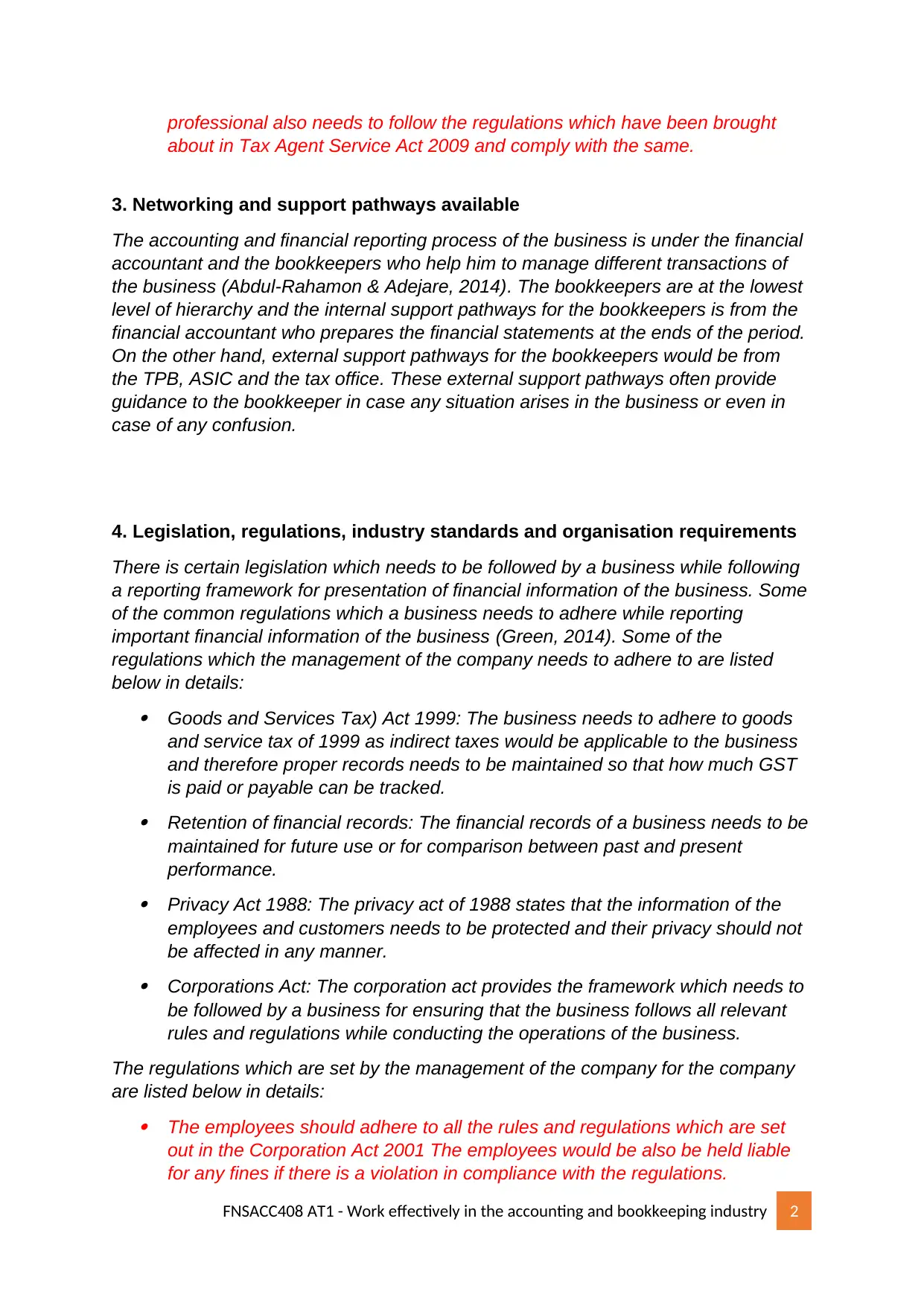
professional also needs to follow the regulations which have been brought
about in Tax Agent Service Act 2009 and comply with the same.
3. Networking and support pathways available
The accounting and financial reporting process of the business is under the financial
accountant and the bookkeepers who help him to manage different transactions of
the business (Abdul-Rahamon & Adejare, 2014). The bookkeepers are at the lowest
level of hierarchy and the internal support pathways for the bookkeepers is from the
financial accountant who prepares the financial statements at the ends of the period.
On the other hand, external support pathways for the bookkeepers would be from
the TPB, ASIC and the tax office. These external support pathways often provide
guidance to the bookkeeper in case any situation arises in the business or even in
case of any confusion.
4. Legislation, regulations, industry standards and organisation requirements
There is certain legislation which needs to be followed by a business while following
a reporting framework for presentation of financial information of the business. Some
of the common regulations which a business needs to adhere while reporting
important financial information of the business (Green, 2014). Some of the
regulations which the management of the company needs to adhere to are listed
below in details: Goods and Services Tax) Act 1999: The business needs to adhere to goods
and service tax of 1999 as indirect taxes would be applicable to the business
and therefore proper records needs to be maintained so that how much GST
is paid or payable can be tracked. Retention of financial records: The financial records of a business needs to be
maintained for future use or for comparison between past and present
performance. Privacy Act 1988: The privacy act of 1988 states that the information of the
employees and customers needs to be protected and their privacy should not
be affected in any manner. Corporations Act: The corporation act provides the framework which needs to
be followed by a business for ensuring that the business follows all relevant
rules and regulations while conducting the operations of the business.
The regulations which are set by the management of the company for the company
are listed below in details: The employees should adhere to all the rules and regulations which are set
out in the Corporation Act 2001 The employees would be also be held liable
for any fines if there is a violation in compliance with the regulations.
FNSACC408 AT1 - Work effectively in the accounting and bookkeeping industry 2
about in Tax Agent Service Act 2009 and comply with the same.
3. Networking and support pathways available
The accounting and financial reporting process of the business is under the financial
accountant and the bookkeepers who help him to manage different transactions of
the business (Abdul-Rahamon & Adejare, 2014). The bookkeepers are at the lowest
level of hierarchy and the internal support pathways for the bookkeepers is from the
financial accountant who prepares the financial statements at the ends of the period.
On the other hand, external support pathways for the bookkeepers would be from
the TPB, ASIC and the tax office. These external support pathways often provide
guidance to the bookkeeper in case any situation arises in the business or even in
case of any confusion.
4. Legislation, regulations, industry standards and organisation requirements
There is certain legislation which needs to be followed by a business while following
a reporting framework for presentation of financial information of the business. Some
of the common regulations which a business needs to adhere while reporting
important financial information of the business (Green, 2014). Some of the
regulations which the management of the company needs to adhere to are listed
below in details: Goods and Services Tax) Act 1999: The business needs to adhere to goods
and service tax of 1999 as indirect taxes would be applicable to the business
and therefore proper records needs to be maintained so that how much GST
is paid or payable can be tracked. Retention of financial records: The financial records of a business needs to be
maintained for future use or for comparison between past and present
performance. Privacy Act 1988: The privacy act of 1988 states that the information of the
employees and customers needs to be protected and their privacy should not
be affected in any manner. Corporations Act: The corporation act provides the framework which needs to
be followed by a business for ensuring that the business follows all relevant
rules and regulations while conducting the operations of the business.
The regulations which are set by the management of the company for the company
are listed below in details: The employees should adhere to all the rules and regulations which are set
out in the Corporation Act 2001 The employees would be also be held liable
for any fines if there is a violation in compliance with the regulations.
FNSACC408 AT1 - Work effectively in the accounting and bookkeeping industry 2
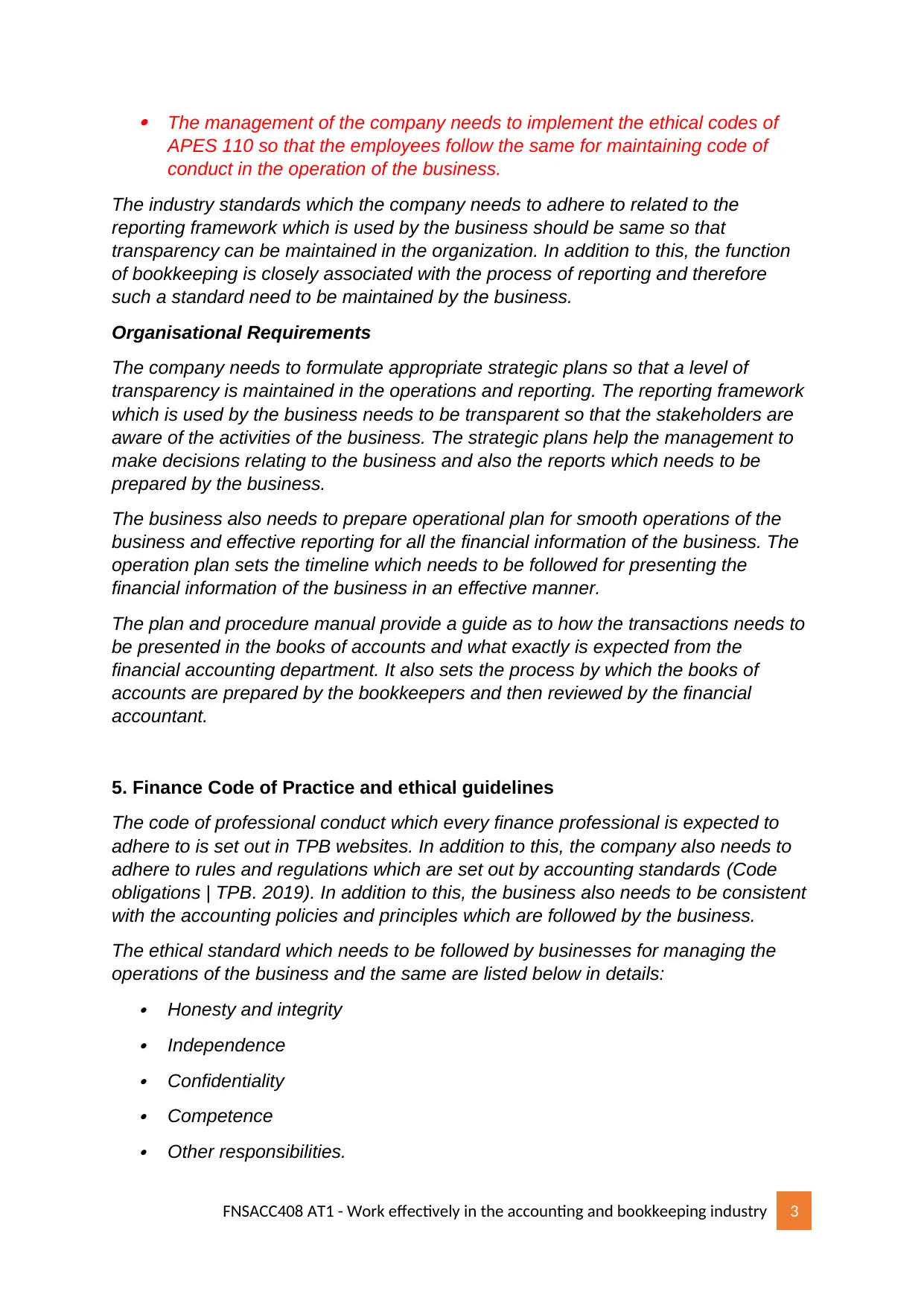
The management of the company needs to implement the ethical codes of
APES 110 so that the employees follow the same for maintaining code of
conduct in the operation of the business.
The industry standards which the company needs to adhere to related to the
reporting framework which is used by the business should be same so that
transparency can be maintained in the organization. In addition to this, the function
of bookkeeping is closely associated with the process of reporting and therefore
such a standard need to be maintained by the business.
Organisational Requirements
The company needs to formulate appropriate strategic plans so that a level of
transparency is maintained in the operations and reporting. The reporting framework
which is used by the business needs to be transparent so that the stakeholders are
aware of the activities of the business. The strategic plans help the management to
make decisions relating to the business and also the reports which needs to be
prepared by the business.
The business also needs to prepare operational plan for smooth operations of the
business and effective reporting for all the financial information of the business. The
operation plan sets the timeline which needs to be followed for presenting the
financial information of the business in an effective manner.
The plan and procedure manual provide a guide as to how the transactions needs to
be presented in the books of accounts and what exactly is expected from the
financial accounting department. It also sets the process by which the books of
accounts are prepared by the bookkeepers and then reviewed by the financial
accountant.
5. Finance Code of Practice and ethical guidelines
The code of professional conduct which every finance professional is expected to
adhere to is set out in TPB websites. In addition to this, the company also needs to
adhere to rules and regulations which are set out by accounting standards (Code
obligations | TPB. 2019). In addition to this, the business also needs to be consistent
with the accounting policies and principles which are followed by the business.
The ethical standard which needs to be followed by businesses for managing the
operations of the business and the same are listed below in details: Honesty and integrity Independence Confidentiality Competence Other responsibilities.
FNSACC408 AT1 - Work effectively in the accounting and bookkeeping industry 3
APES 110 so that the employees follow the same for maintaining code of
conduct in the operation of the business.
The industry standards which the company needs to adhere to related to the
reporting framework which is used by the business should be same so that
transparency can be maintained in the organization. In addition to this, the function
of bookkeeping is closely associated with the process of reporting and therefore
such a standard need to be maintained by the business.
Organisational Requirements
The company needs to formulate appropriate strategic plans so that a level of
transparency is maintained in the operations and reporting. The reporting framework
which is used by the business needs to be transparent so that the stakeholders are
aware of the activities of the business. The strategic plans help the management to
make decisions relating to the business and also the reports which needs to be
prepared by the business.
The business also needs to prepare operational plan for smooth operations of the
business and effective reporting for all the financial information of the business. The
operation plan sets the timeline which needs to be followed for presenting the
financial information of the business in an effective manner.
The plan and procedure manual provide a guide as to how the transactions needs to
be presented in the books of accounts and what exactly is expected from the
financial accounting department. It also sets the process by which the books of
accounts are prepared by the bookkeepers and then reviewed by the financial
accountant.
5. Finance Code of Practice and ethical guidelines
The code of professional conduct which every finance professional is expected to
adhere to is set out in TPB websites. In addition to this, the company also needs to
adhere to rules and regulations which are set out by accounting standards (Code
obligations | TPB. 2019). In addition to this, the business also needs to be consistent
with the accounting policies and principles which are followed by the business.
The ethical standard which needs to be followed by businesses for managing the
operations of the business and the same are listed below in details: Honesty and integrity Independence Confidentiality Competence Other responsibilities.
FNSACC408 AT1 - Work effectively in the accounting and bookkeeping industry 3
⊘ This is a preview!⊘
Do you want full access?
Subscribe today to unlock all pages.

Trusted by 1+ million students worldwide
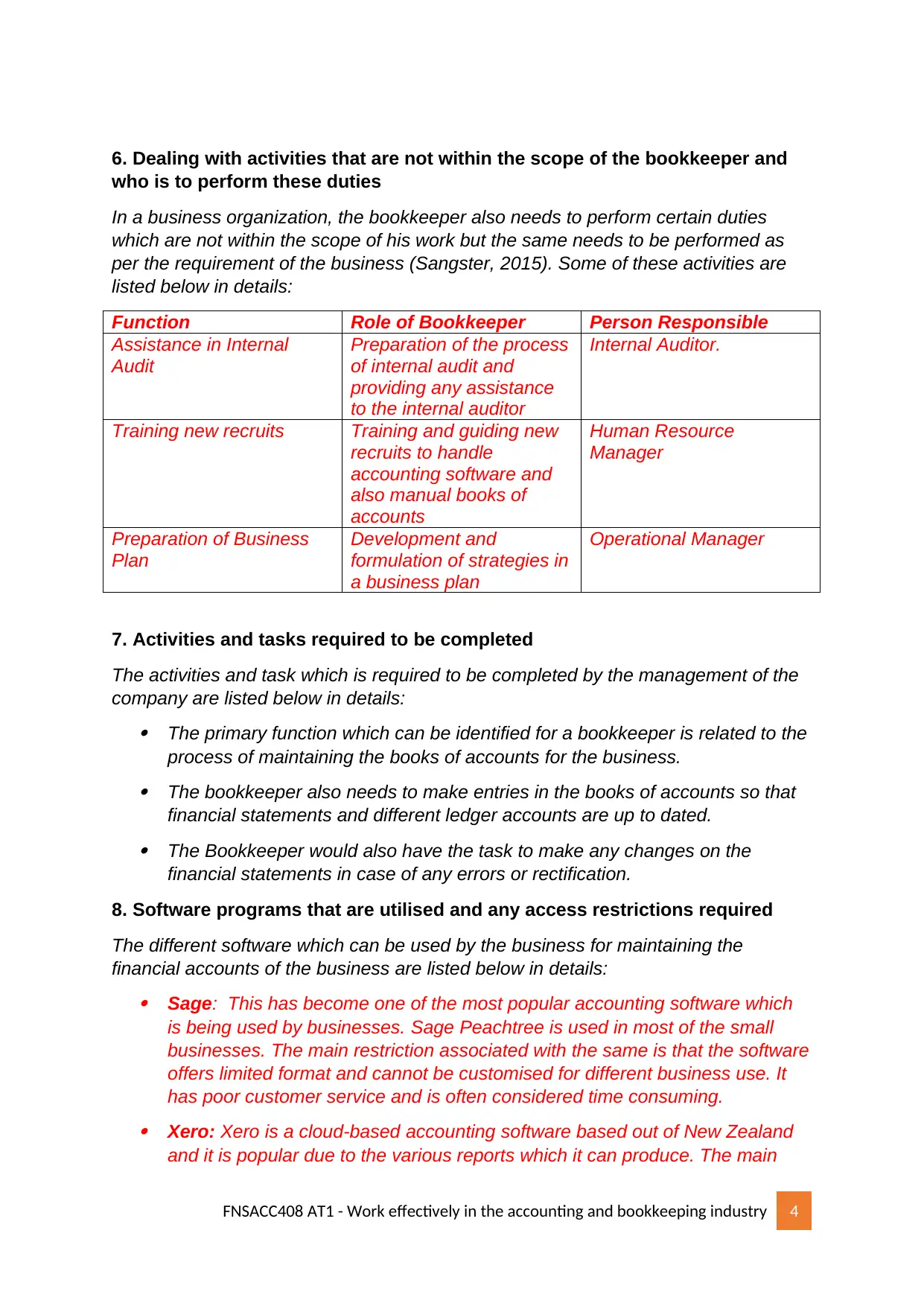
6. Dealing with activities that are not within the scope of the bookkeeper and
who is to perform these duties
In a business organization, the bookkeeper also needs to perform certain duties
which are not within the scope of his work but the same needs to be performed as
per the requirement of the business (Sangster, 2015). Some of these activities are
listed below in details:
Function Role of Bookkeeper Person Responsible
Assistance in Internal
Audit
Preparation of the process
of internal audit and
providing any assistance
to the internal auditor
Internal Auditor.
Training new recruits Training and guiding new
recruits to handle
accounting software and
also manual books of
accounts
Human Resource
Manager
Preparation of Business
Plan
Development and
formulation of strategies in
a business plan
Operational Manager
7. Activities and tasks required to be completed
The activities and task which is required to be completed by the management of the
company are listed below in details: The primary function which can be identified for a bookkeeper is related to the
process of maintaining the books of accounts for the business. The bookkeeper also needs to make entries in the books of accounts so that
financial statements and different ledger accounts are up to dated. The Bookkeeper would also have the task to make any changes on the
financial statements in case of any errors or rectification.
8. Software programs that are utilised and any access restrictions required
The different software which can be used by the business for maintaining the
financial accounts of the business are listed below in details: Sage: This has become one of the most popular accounting software which
is being used by businesses. Sage Peachtree is used in most of the small
businesses. The main restriction associated with the same is that the software
offers limited format and cannot be customised for different business use. It
has poor customer service and is often considered time consuming. Xero: Xero is a cloud-based accounting software based out of New Zealand
and it is popular due to the various reports which it can produce. The main
FNSACC408 AT1 - Work effectively in the accounting and bookkeeping industry 4
who is to perform these duties
In a business organization, the bookkeeper also needs to perform certain duties
which are not within the scope of his work but the same needs to be performed as
per the requirement of the business (Sangster, 2015). Some of these activities are
listed below in details:
Function Role of Bookkeeper Person Responsible
Assistance in Internal
Audit
Preparation of the process
of internal audit and
providing any assistance
to the internal auditor
Internal Auditor.
Training new recruits Training and guiding new
recruits to handle
accounting software and
also manual books of
accounts
Human Resource
Manager
Preparation of Business
Plan
Development and
formulation of strategies in
a business plan
Operational Manager
7. Activities and tasks required to be completed
The activities and task which is required to be completed by the management of the
company are listed below in details: The primary function which can be identified for a bookkeeper is related to the
process of maintaining the books of accounts for the business. The bookkeeper also needs to make entries in the books of accounts so that
financial statements and different ledger accounts are up to dated. The Bookkeeper would also have the task to make any changes on the
financial statements in case of any errors or rectification.
8. Software programs that are utilised and any access restrictions required
The different software which can be used by the business for maintaining the
financial accounts of the business are listed below in details: Sage: This has become one of the most popular accounting software which
is being used by businesses. Sage Peachtree is used in most of the small
businesses. The main restriction associated with the same is that the software
offers limited format and cannot be customised for different business use. It
has poor customer service and is often considered time consuming. Xero: Xero is a cloud-based accounting software based out of New Zealand
and it is popular due to the various reports which it can produce. The main
FNSACC408 AT1 - Work effectively in the accounting and bookkeeping industry 4
Paraphrase This Document
Need a fresh take? Get an instant paraphrase of this document with our AI Paraphraser
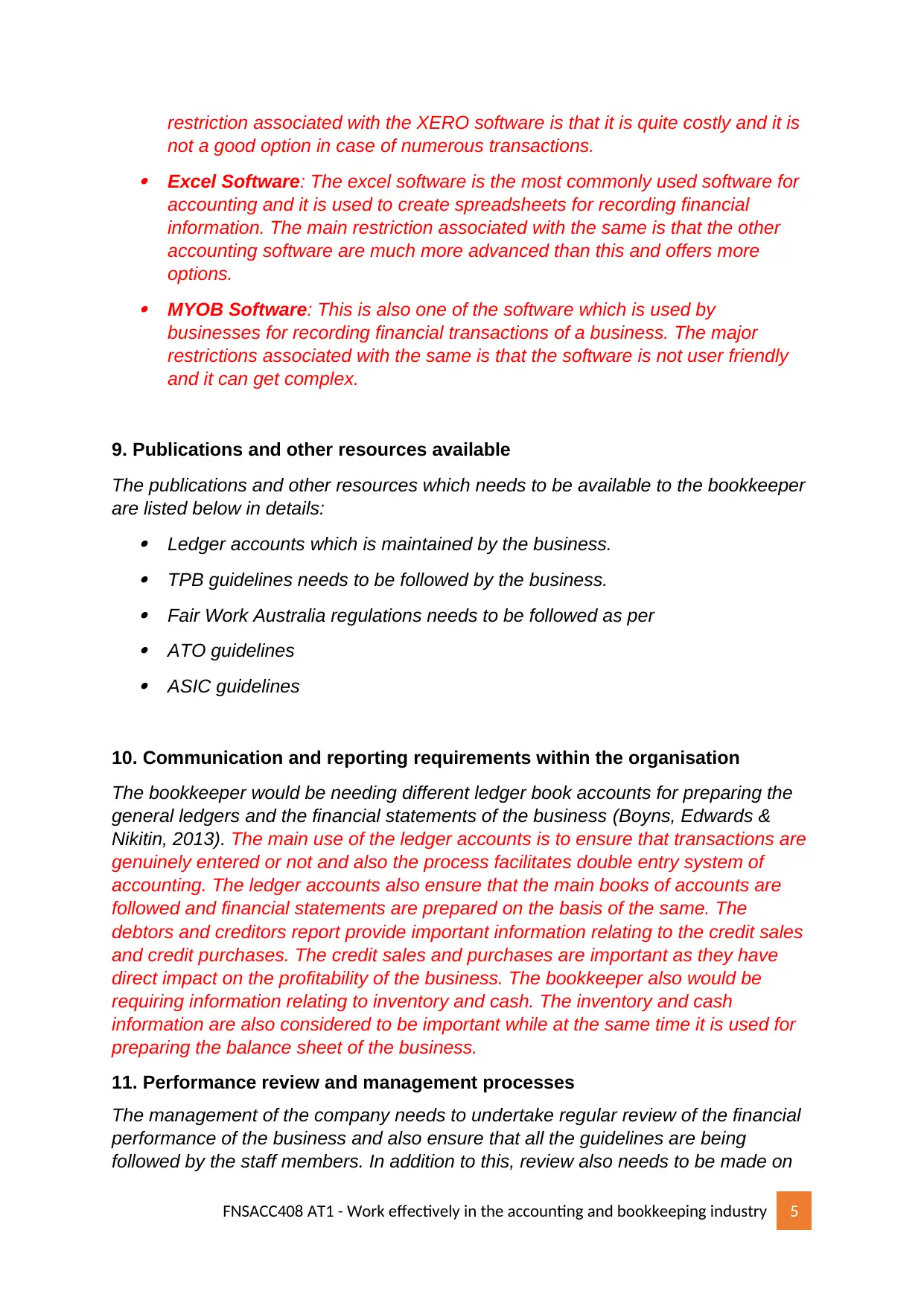
restriction associated with the XERO software is that it is quite costly and it is
not a good option in case of numerous transactions. Excel Software: The excel software is the most commonly used software for
accounting and it is used to create spreadsheets for recording financial
information. The main restriction associated with the same is that the other
accounting software are much more advanced than this and offers more
options. MYOB Software: This is also one of the software which is used by
businesses for recording financial transactions of a business. The major
restrictions associated with the same is that the software is not user friendly
and it can get complex.
9. Publications and other resources available
The publications and other resources which needs to be available to the bookkeeper
are listed below in details: Ledger accounts which is maintained by the business. TPB guidelines needs to be followed by the business. Fair Work Australia regulations needs to be followed as per ATO guidelines ASIC guidelines
10. Communication and reporting requirements within the organisation
The bookkeeper would be needing different ledger book accounts for preparing the
general ledgers and the financial statements of the business (Boyns, Edwards &
Nikitin, 2013). The main use of the ledger accounts is to ensure that transactions are
genuinely entered or not and also the process facilitates double entry system of
accounting. The ledger accounts also ensure that the main books of accounts are
followed and financial statements are prepared on the basis of the same. The
debtors and creditors report provide important information relating to the credit sales
and credit purchases. The credit sales and purchases are important as they have
direct impact on the profitability of the business. The bookkeeper also would be
requiring information relating to inventory and cash. The inventory and cash
information are also considered to be important while at the same time it is used for
preparing the balance sheet of the business.
11. Performance review and management processes
The management of the company needs to undertake regular review of the financial
performance of the business and also ensure that all the guidelines are being
followed by the staff members. In addition to this, review also needs to be made on
FNSACC408 AT1 - Work effectively in the accounting and bookkeeping industry 5
not a good option in case of numerous transactions. Excel Software: The excel software is the most commonly used software for
accounting and it is used to create spreadsheets for recording financial
information. The main restriction associated with the same is that the other
accounting software are much more advanced than this and offers more
options. MYOB Software: This is also one of the software which is used by
businesses for recording financial transactions of a business. The major
restrictions associated with the same is that the software is not user friendly
and it can get complex.
9. Publications and other resources available
The publications and other resources which needs to be available to the bookkeeper
are listed below in details: Ledger accounts which is maintained by the business. TPB guidelines needs to be followed by the business. Fair Work Australia regulations needs to be followed as per ATO guidelines ASIC guidelines
10. Communication and reporting requirements within the organisation
The bookkeeper would be needing different ledger book accounts for preparing the
general ledgers and the financial statements of the business (Boyns, Edwards &
Nikitin, 2013). The main use of the ledger accounts is to ensure that transactions are
genuinely entered or not and also the process facilitates double entry system of
accounting. The ledger accounts also ensure that the main books of accounts are
followed and financial statements are prepared on the basis of the same. The
debtors and creditors report provide important information relating to the credit sales
and credit purchases. The credit sales and purchases are important as they have
direct impact on the profitability of the business. The bookkeeper also would be
requiring information relating to inventory and cash. The inventory and cash
information are also considered to be important while at the same time it is used for
preparing the balance sheet of the business.
11. Performance review and management processes
The management of the company needs to undertake regular review of the financial
performance of the business and also ensure that all the guidelines are being
followed by the staff members. In addition to this, review also needs to be made on
FNSACC408 AT1 - Work effectively in the accounting and bookkeeping industry 5
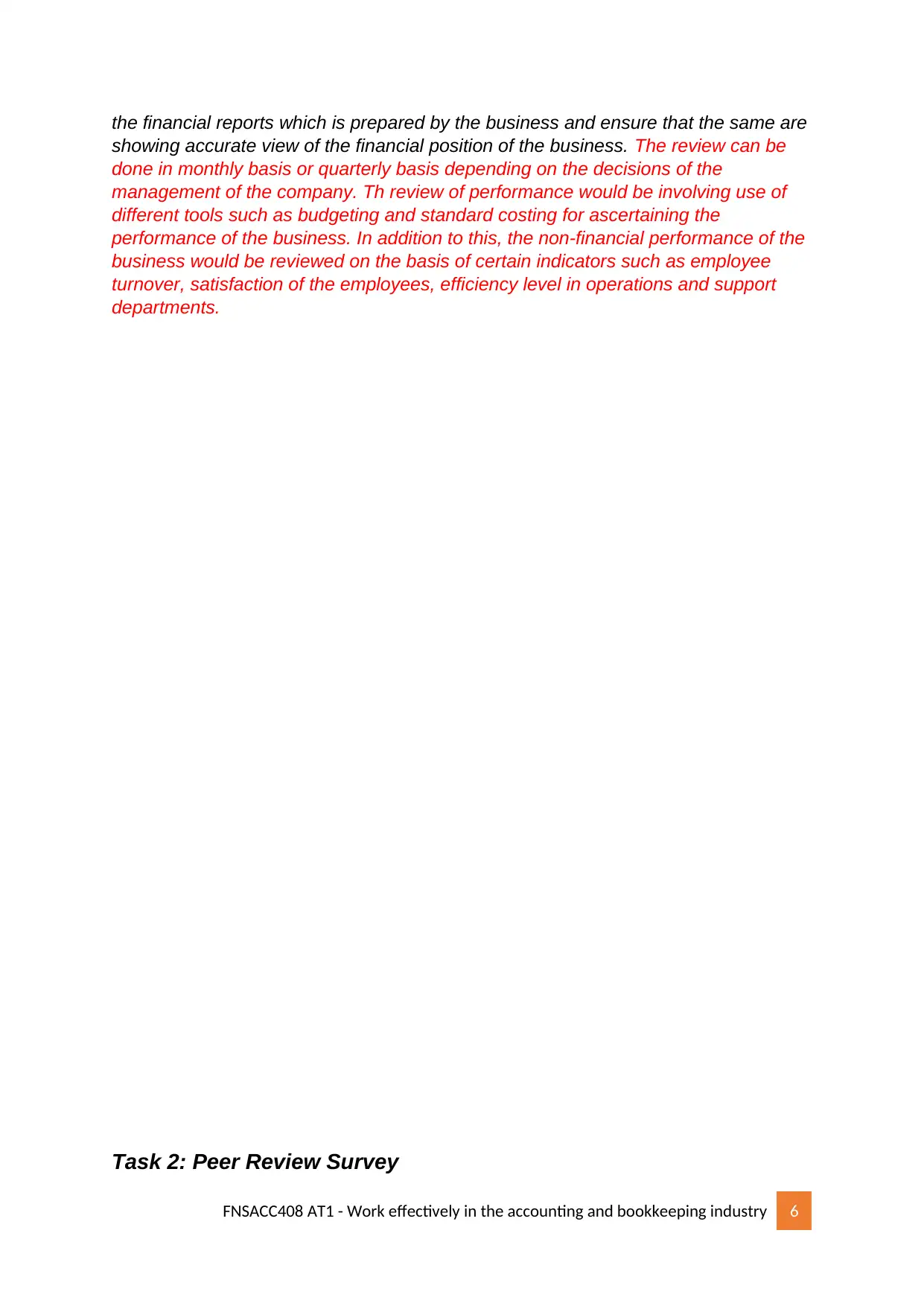
the financial reports which is prepared by the business and ensure that the same are
showing accurate view of the financial position of the business. The review can be
done in monthly basis or quarterly basis depending on the decisions of the
management of the company. Th review of performance would be involving use of
different tools such as budgeting and standard costing for ascertaining the
performance of the business. In addition to this, the non-financial performance of the
business would be reviewed on the basis of certain indicators such as employee
turnover, satisfaction of the employees, efficiency level in operations and support
departments.
Task 2: Peer Review Survey
FNSACC408 AT1 - Work effectively in the accounting and bookkeeping industry 6
showing accurate view of the financial position of the business. The review can be
done in monthly basis or quarterly basis depending on the decisions of the
management of the company. Th review of performance would be involving use of
different tools such as budgeting and standard costing for ascertaining the
performance of the business. In addition to this, the non-financial performance of the
business would be reviewed on the basis of certain indicators such as employee
turnover, satisfaction of the employees, efficiency level in operations and support
departments.
Task 2: Peer Review Survey
FNSACC408 AT1 - Work effectively in the accounting and bookkeeping industry 6
⊘ This is a preview!⊘
Do you want full access?
Subscribe today to unlock all pages.
Trusted by 1+ million students worldwide
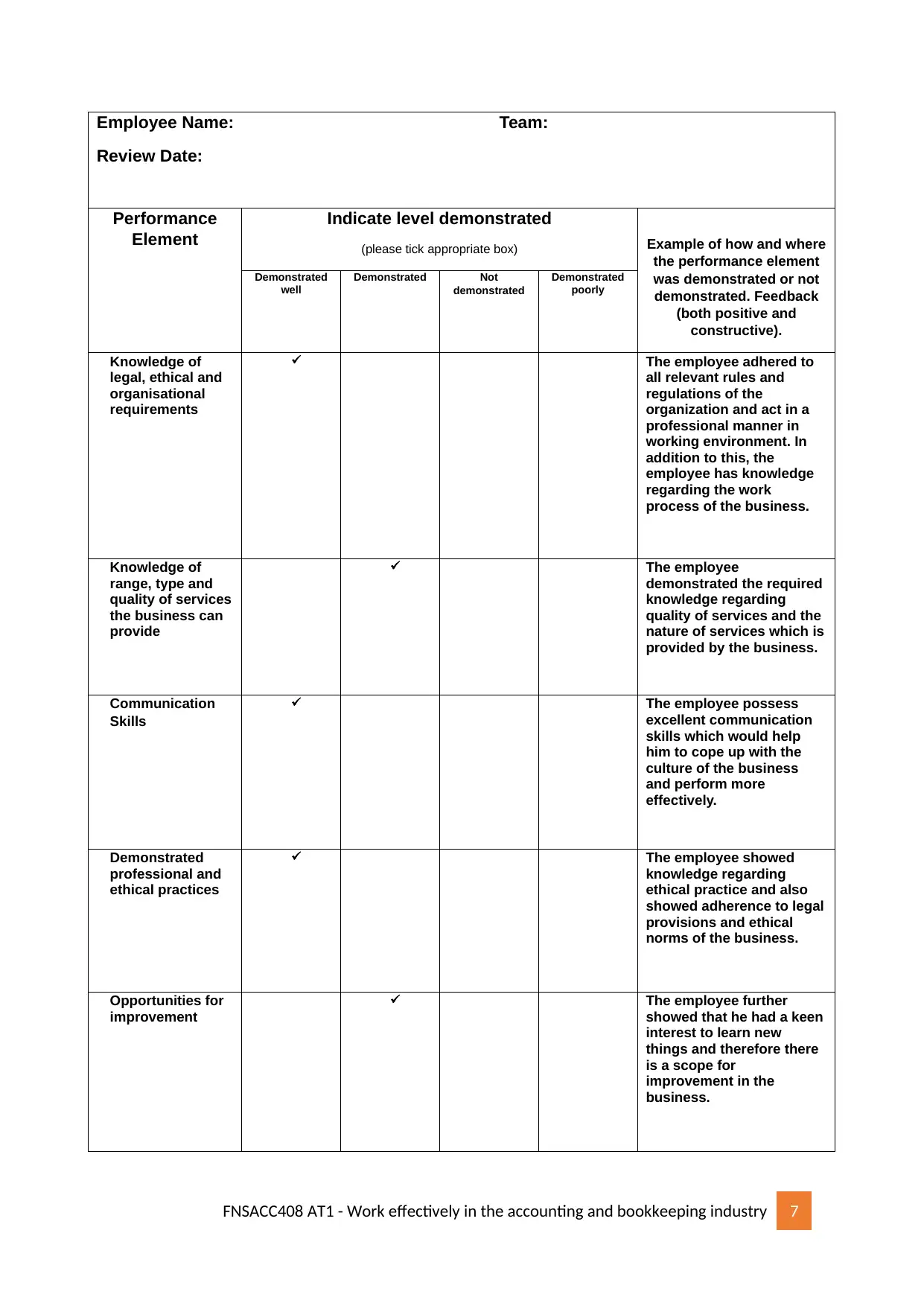
Employee Name: Team:
Review Date:
Performance
Element
Indicate level demonstrated
(please tick appropriate box) Example of how and where
the performance element
was demonstrated or not
demonstrated. Feedback
(both positive and
constructive).
Demonstrated
well
Demonstrated Not
demonstrated
Demonstrated
poorly
Knowledge of
legal, ethical and
organisational
requirements
The employee adhered to
all relevant rules and
regulations of the
organization and act in a
professional manner in
working environment. In
addition to this, the
employee has knowledge
regarding the work
process of the business.
Knowledge of
range, type and
quality of services
the business can
provide
The employee
demonstrated the required
knowledge regarding
quality of services and the
nature of services which is
provided by the business.
Communication
Skills
The employee possess
excellent communication
skills which would help
him to cope up with the
culture of the business
and perform more
effectively.
Demonstrated
professional and
ethical practices
The employee showed
knowledge regarding
ethical practice and also
showed adherence to legal
provisions and ethical
norms of the business.
Opportunities for
improvement
The employee further
showed that he had a keen
interest to learn new
things and therefore there
is a scope for
improvement in the
business.
FNSACC408 AT1 - Work effectively in the accounting and bookkeeping industry 7
Review Date:
Performance
Element
Indicate level demonstrated
(please tick appropriate box) Example of how and where
the performance element
was demonstrated or not
demonstrated. Feedback
(both positive and
constructive).
Demonstrated
well
Demonstrated Not
demonstrated
Demonstrated
poorly
Knowledge of
legal, ethical and
organisational
requirements
The employee adhered to
all relevant rules and
regulations of the
organization and act in a
professional manner in
working environment. In
addition to this, the
employee has knowledge
regarding the work
process of the business.
Knowledge of
range, type and
quality of services
the business can
provide
The employee
demonstrated the required
knowledge regarding
quality of services and the
nature of services which is
provided by the business.
Communication
Skills
The employee possess
excellent communication
skills which would help
him to cope up with the
culture of the business
and perform more
effectively.
Demonstrated
professional and
ethical practices
The employee showed
knowledge regarding
ethical practice and also
showed adherence to legal
provisions and ethical
norms of the business.
Opportunities for
improvement
The employee further
showed that he had a keen
interest to learn new
things and therefore there
is a scope for
improvement in the
business.
FNSACC408 AT1 - Work effectively in the accounting and bookkeeping industry 7
Paraphrase This Document
Need a fresh take? Get an instant paraphrase of this document with our AI Paraphraser
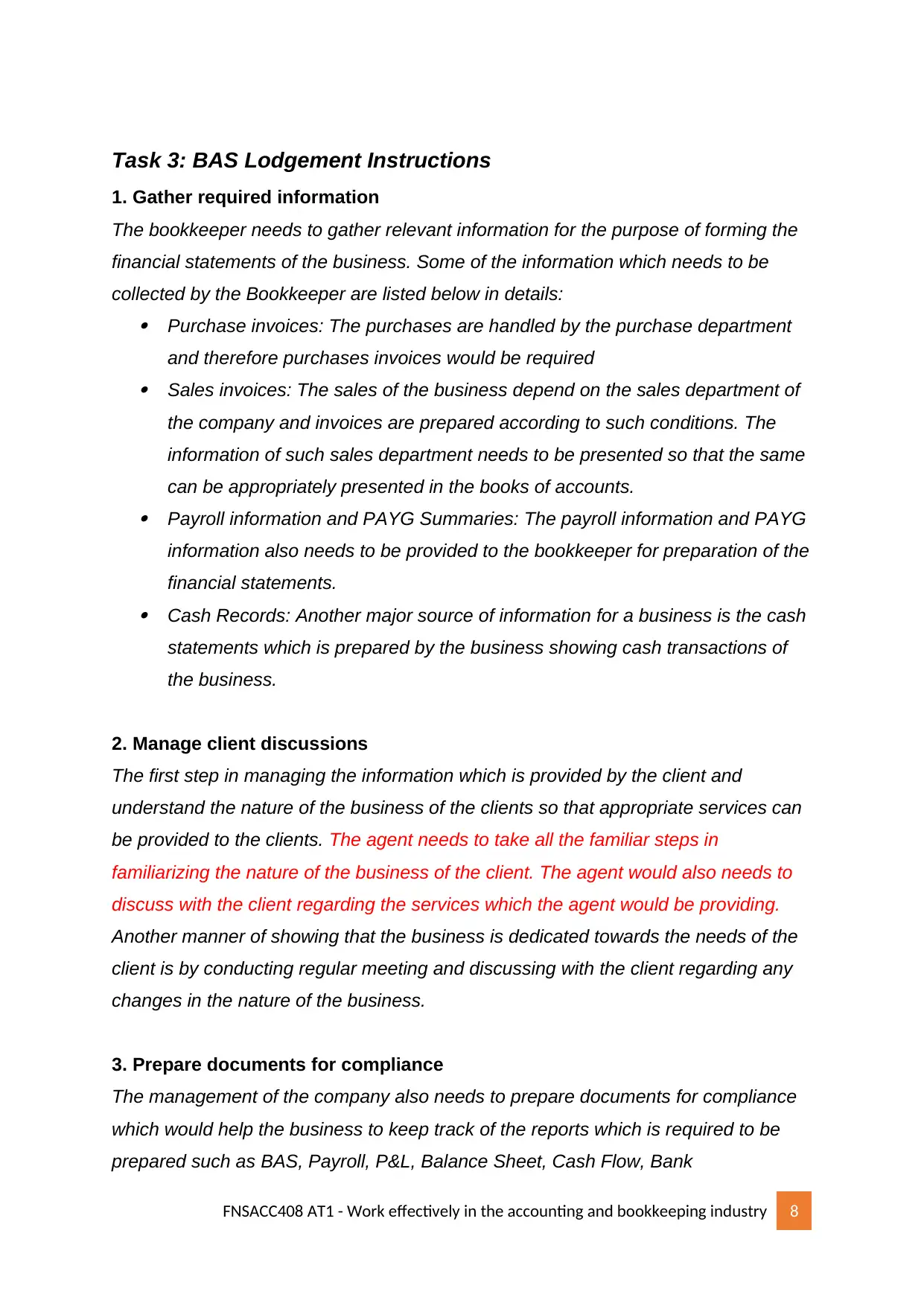
Task 3: BAS Lodgement Instructions
1. Gather required information
The bookkeeper needs to gather relevant information for the purpose of forming the
financial statements of the business. Some of the information which needs to be
collected by the Bookkeeper are listed below in details: Purchase invoices: The purchases are handled by the purchase department
and therefore purchases invoices would be required Sales invoices: The sales of the business depend on the sales department of
the company and invoices are prepared according to such conditions. The
information of such sales department needs to be presented so that the same
can be appropriately presented in the books of accounts. Payroll information and PAYG Summaries: The payroll information and PAYG
information also needs to be provided to the bookkeeper for preparation of the
financial statements. Cash Records: Another major source of information for a business is the cash
statements which is prepared by the business showing cash transactions of
the business.
2. Manage client discussions
The first step in managing the information which is provided by the client and
understand the nature of the business of the clients so that appropriate services can
be provided to the clients. The agent needs to take all the familiar steps in
familiarizing the nature of the business of the client. The agent would also needs to
discuss with the client regarding the services which the agent would be providing.
Another manner of showing that the business is dedicated towards the needs of the
client is by conducting regular meeting and discussing with the client regarding any
changes in the nature of the business.
3. Prepare documents for compliance
The management of the company also needs to prepare documents for compliance
which would help the business to keep track of the reports which is required to be
prepared such as BAS, Payroll, P&L, Balance Sheet, Cash Flow, Bank
FNSACC408 AT1 - Work effectively in the accounting and bookkeeping industry 8
1. Gather required information
The bookkeeper needs to gather relevant information for the purpose of forming the
financial statements of the business. Some of the information which needs to be
collected by the Bookkeeper are listed below in details: Purchase invoices: The purchases are handled by the purchase department
and therefore purchases invoices would be required Sales invoices: The sales of the business depend on the sales department of
the company and invoices are prepared according to such conditions. The
information of such sales department needs to be presented so that the same
can be appropriately presented in the books of accounts. Payroll information and PAYG Summaries: The payroll information and PAYG
information also needs to be provided to the bookkeeper for preparation of the
financial statements. Cash Records: Another major source of information for a business is the cash
statements which is prepared by the business showing cash transactions of
the business.
2. Manage client discussions
The first step in managing the information which is provided by the client and
understand the nature of the business of the clients so that appropriate services can
be provided to the clients. The agent needs to take all the familiar steps in
familiarizing the nature of the business of the client. The agent would also needs to
discuss with the client regarding the services which the agent would be providing.
Another manner of showing that the business is dedicated towards the needs of the
client is by conducting regular meeting and discussing with the client regarding any
changes in the nature of the business.
3. Prepare documents for compliance
The management of the company also needs to prepare documents for compliance
which would help the business to keep track of the reports which is required to be
prepared such as BAS, Payroll, P&L, Balance Sheet, Cash Flow, Bank
FNSACC408 AT1 - Work effectively in the accounting and bookkeeping industry 8
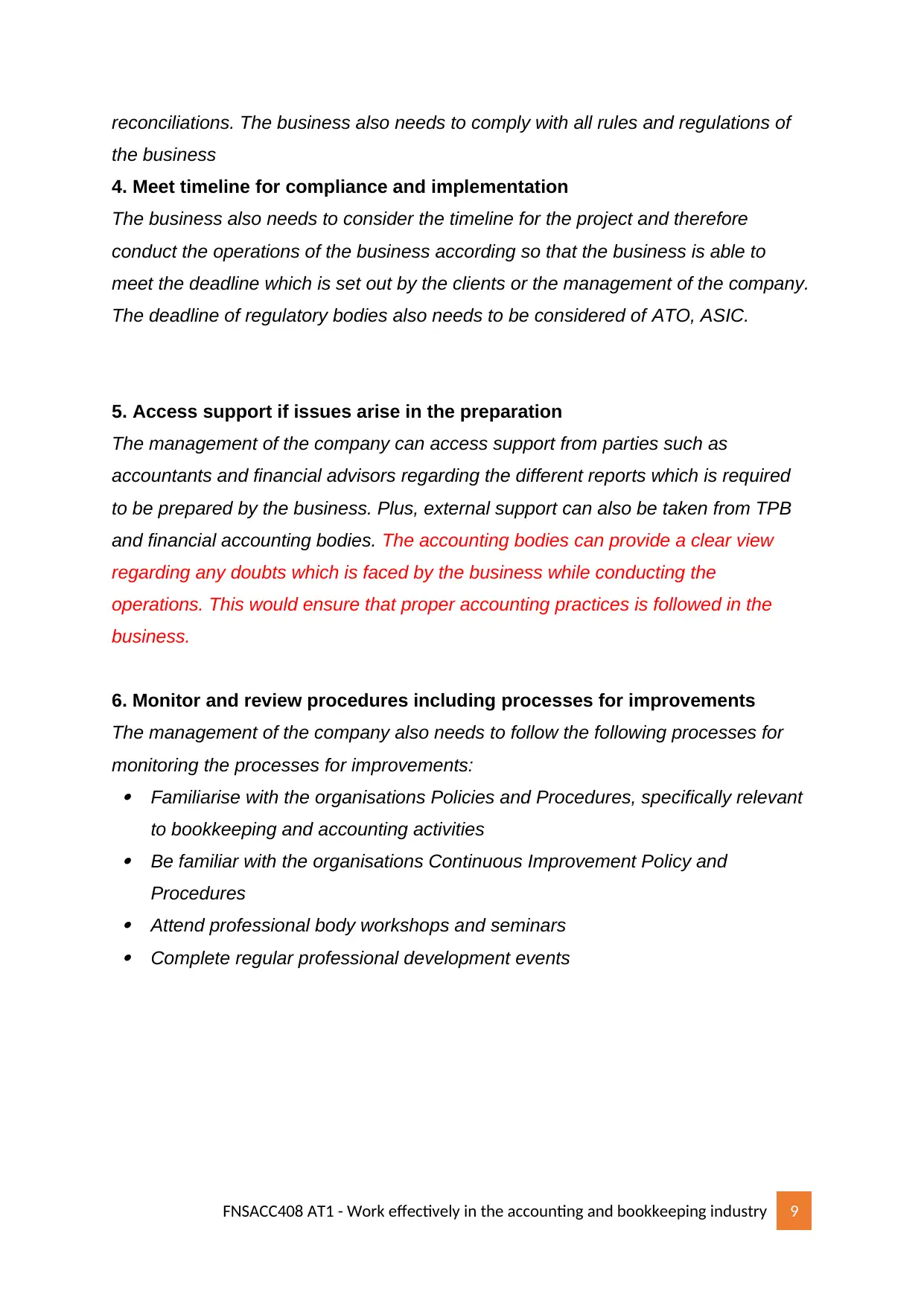
reconciliations. The business also needs to comply with all rules and regulations of
the business
4. Meet timeline for compliance and implementation
The business also needs to consider the timeline for the project and therefore
conduct the operations of the business according so that the business is able to
meet the deadline which is set out by the clients or the management of the company.
The deadline of regulatory bodies also needs to be considered of ATO, ASIC.
5. Access support if issues arise in the preparation
The management of the company can access support from parties such as
accountants and financial advisors regarding the different reports which is required
to be prepared by the business. Plus, external support can also be taken from TPB
and financial accounting bodies. The accounting bodies can provide a clear view
regarding any doubts which is faced by the business while conducting the
operations. This would ensure that proper accounting practices is followed in the
business.
6. Monitor and review procedures including processes for improvements
The management of the company also needs to follow the following processes for
monitoring the processes for improvements: Familiarise with the organisations Policies and Procedures, specifically relevant
to bookkeeping and accounting activities Be familiar with the organisations Continuous Improvement Policy and
Procedures Attend professional body workshops and seminars Complete regular professional development events
FNSACC408 AT1 - Work effectively in the accounting and bookkeeping industry 9
the business
4. Meet timeline for compliance and implementation
The business also needs to consider the timeline for the project and therefore
conduct the operations of the business according so that the business is able to
meet the deadline which is set out by the clients or the management of the company.
The deadline of regulatory bodies also needs to be considered of ATO, ASIC.
5. Access support if issues arise in the preparation
The management of the company can access support from parties such as
accountants and financial advisors regarding the different reports which is required
to be prepared by the business. Plus, external support can also be taken from TPB
and financial accounting bodies. The accounting bodies can provide a clear view
regarding any doubts which is faced by the business while conducting the
operations. This would ensure that proper accounting practices is followed in the
business.
6. Monitor and review procedures including processes for improvements
The management of the company also needs to follow the following processes for
monitoring the processes for improvements: Familiarise with the organisations Policies and Procedures, specifically relevant
to bookkeeping and accounting activities Be familiar with the organisations Continuous Improvement Policy and
Procedures Attend professional body workshops and seminars Complete regular professional development events
FNSACC408 AT1 - Work effectively in the accounting and bookkeeping industry 9
⊘ This is a preview!⊘
Do you want full access?
Subscribe today to unlock all pages.
Trusted by 1+ million students worldwide
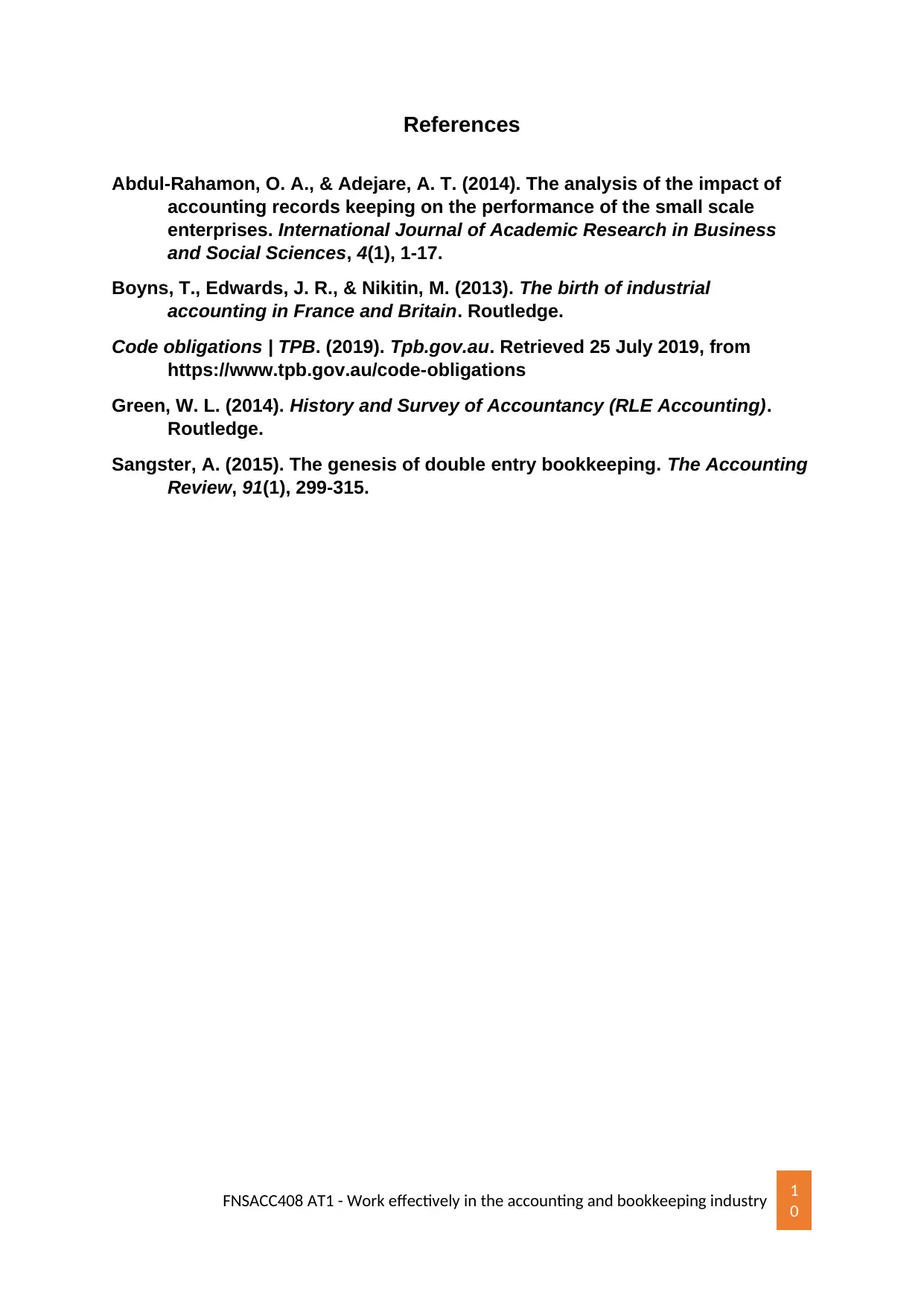
References
Abdul-Rahamon, O. A., & Adejare, A. T. (2014). The analysis of the impact of
accounting records keeping on the performance of the small scale
enterprises. International Journal of Academic Research in Business
and Social Sciences, 4(1), 1-17.
Boyns, T., Edwards, J. R., & Nikitin, M. (2013). The birth of industrial
accounting in France and Britain. Routledge.
Code obligations | TPB. (2019). Tpb.gov.au. Retrieved 25 July 2019, from
https://www.tpb.gov.au/code-obligations
Green, W. L. (2014). History and Survey of Accountancy (RLE Accounting).
Routledge.
Sangster, A. (2015). The genesis of double entry bookkeeping. The Accounting
Review, 91(1), 299-315.
FNSACC408 AT1 - Work effectively in the accounting and bookkeeping industry 1
0
Abdul-Rahamon, O. A., & Adejare, A. T. (2014). The analysis of the impact of
accounting records keeping on the performance of the small scale
enterprises. International Journal of Academic Research in Business
and Social Sciences, 4(1), 1-17.
Boyns, T., Edwards, J. R., & Nikitin, M. (2013). The birth of industrial
accounting in France and Britain. Routledge.
Code obligations | TPB. (2019). Tpb.gov.au. Retrieved 25 July 2019, from
https://www.tpb.gov.au/code-obligations
Green, W. L. (2014). History and Survey of Accountancy (RLE Accounting).
Routledge.
Sangster, A. (2015). The genesis of double entry bookkeeping. The Accounting
Review, 91(1), 299-315.
FNSACC408 AT1 - Work effectively in the accounting and bookkeeping industry 1
0

1 out of 10


Related Documents


Your All-in-One AI-Powered Toolkit for Academic Success.
+13062052269
info@desklib.com
Available 24*7 on WhatsApp / Email
![[object Object]](/_next/static/media/star-bottom.7253800d.svg)
Unlock your academic potential
Copyright © 2020–2026 A2Z Services. All Rights Reserved. Developed and managed by ZUCOL.