FNSACC412: Prepare Operational Budgets - Assessment 3 with Template
VerifiedAdded on 2023/06/10
|12
|1437
|397
Homework Assignment
AI Summary
This document provides a comprehensive solution to FNSACC412 Assessment 3, which focuses on preparing operational budgets. The solution includes detailed explanations and calculations for various tasks, including incremental budgeting, activity-based budgeting, and zero-based budgeting. It covers the preparation of a Cost of Goods Sold budget, a Purchases Budget, an Income Statement Budget, and a Balance Sheet Budget. Furthermore, the solution includes a Cash Receipts Budget, a Cash Payments Budget, and a Cash Budget Summary. It also addresses flexible budgeting and performance reporting, with a comparison of budget to actual figures. The document concludes with references to relevant academic sources. Desklib is a valuable resource for students seeking similar solved assignments and study materials.
FNSACC412: Prepare operational budgets:
Assessment 3 Template
LA023597
Name Insert name here
Use your “tab” key to move from cell to cell
Student number Insert TAFE ID here
1 FNSACC412 Ed 2, June 2018
Assessment 3 Template
LA023597
Name Insert name here
Use your “tab” key to move from cell to cell
Student number Insert TAFE ID here
1 FNSACC412 Ed 2, June 2018
Paraphrase This Document
Need a fresh take? Get an instant paraphrase of this document with our AI Paraphraser

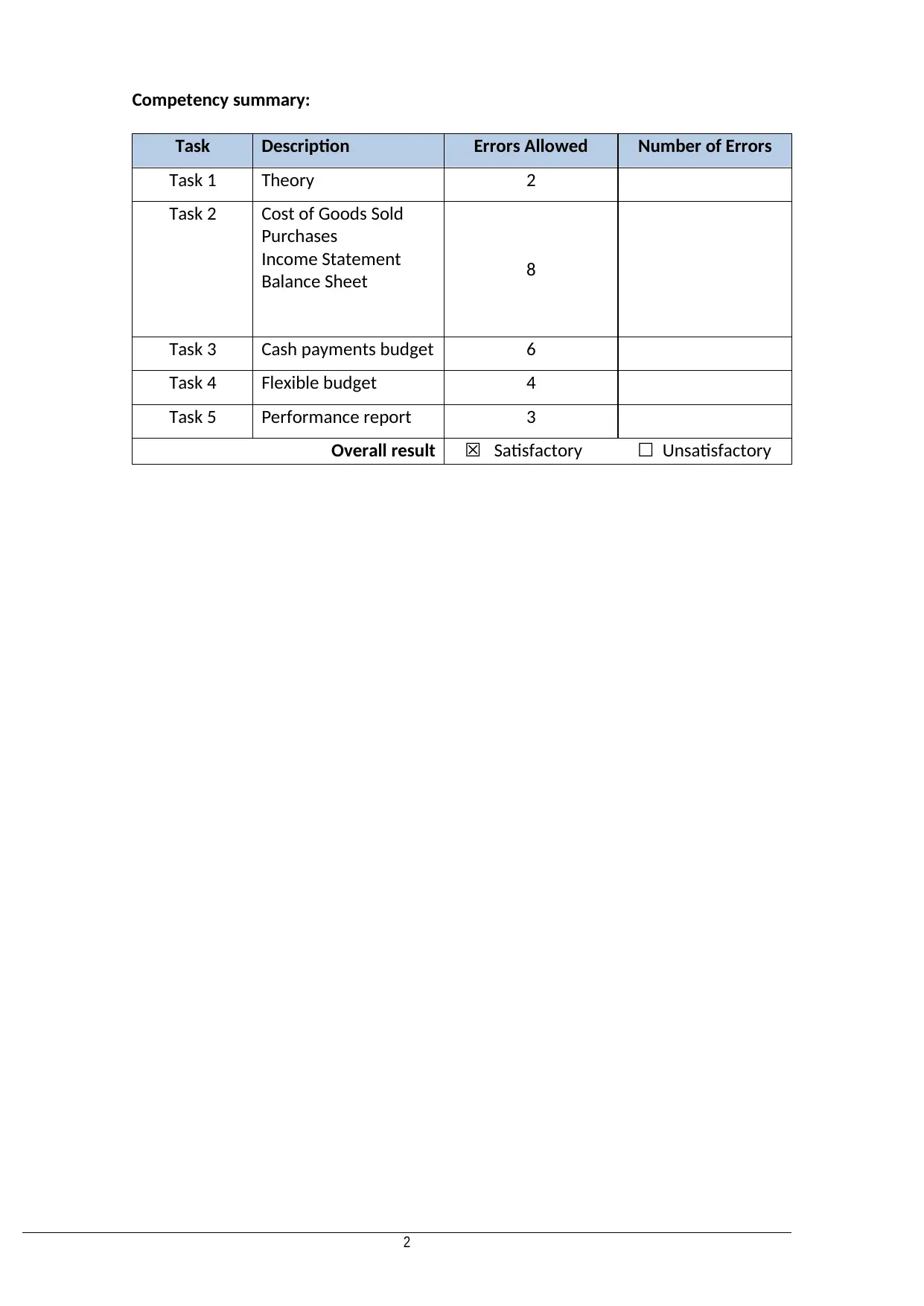
Competency summary:
Task Description Errors Allowed Number of Errors
Task 1 Theory 2
Task 2 Cost of Goods Sold
Purchases
Income Statement
Balance Sheet 8
Task 3 Cash payments budget 6
Task 4 Flexible budget 4
Task 5 Performance report 3
Overall result ☒ Satisfactory ☐ Unsatisfactory
2
Task Description Errors Allowed Number of Errors
Task 1 Theory 2
Task 2 Cost of Goods Sold
Purchases
Income Statement
Balance Sheet 8
Task 3 Cash payments budget 6
Task 4 Flexible budget 4
Task 5 Performance report 3
Overall result ☒ Satisfactory ☐ Unsatisfactory
2

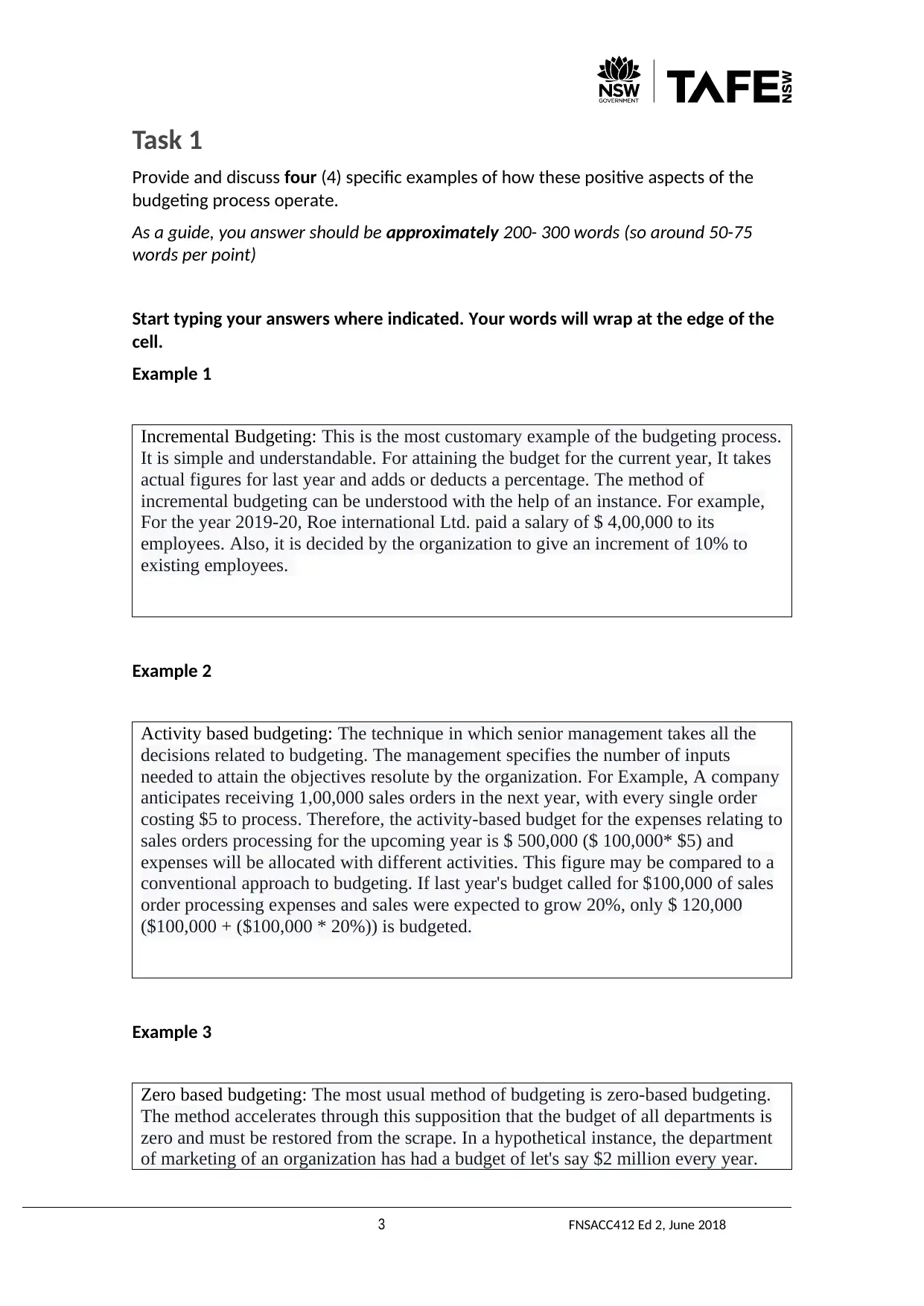
Task 1
Provide and discuss four (4) specific examples of how these positive aspects of the
budgeting process operate.
As a guide, you answer should be approximately 200- 300 words (so around 50-75
words per point)
Start typing your answers where indicated. Your words will wrap at the edge of the
cell.
Example 1
Incremental Budgeting: This is the most customary example of the budgeting process.
It is simple and understandable. For attaining the budget for the current year, It takes
actual figures for last year and adds or deducts a percentage. The method of
incremental budgeting can be understood with the help of an instance. For example,
For the year 2019-20, Roe international Ltd. paid a salary of $ 4,00,000 to its
employees. Also, it is decided by the organization to give an increment of 10% to
existing employees.
Example 2
Activity based budgeting: The technique in which senior management takes all the
decisions related to budgeting. The management specifies the number of inputs
needed to attain the objectives resolute by the organization. For Example, A company
anticipates receiving 1,00,000 sales orders in the next year, with every single order
costing $5 to process. Therefore, the activity-based budget for the expenses relating to
sales orders processing for the upcoming year is $ 500,000 ($ 100,000* $5) and
expenses will be allocated with different activities. This figure may be compared to a
conventional approach to budgeting. If last year's budget called for $100,000 of sales
order processing expenses and sales were expected to grow 20%, only $ 120,000
($100,000 + ($100,000 * 20%)) is budgeted.
Example 3
Zero based budgeting: The most usual method of budgeting is zero-based budgeting.
The method accelerates through this supposition that the budget of all departments is
zero and must be restored from the scrape. In a hypothetical instance, the department
of marketing of an organization has had a budget of let's say $2 million every year.
3 FNSACC412 Ed 2, June 2018
Provide and discuss four (4) specific examples of how these positive aspects of the
budgeting process operate.
As a guide, you answer should be approximately 200- 300 words (so around 50-75
words per point)
Start typing your answers where indicated. Your words will wrap at the edge of the
cell.
Example 1
Incremental Budgeting: This is the most customary example of the budgeting process.
It is simple and understandable. For attaining the budget for the current year, It takes
actual figures for last year and adds or deducts a percentage. The method of
incremental budgeting can be understood with the help of an instance. For example,
For the year 2019-20, Roe international Ltd. paid a salary of $ 4,00,000 to its
employees. Also, it is decided by the organization to give an increment of 10% to
existing employees.
Example 2
Activity based budgeting: The technique in which senior management takes all the
decisions related to budgeting. The management specifies the number of inputs
needed to attain the objectives resolute by the organization. For Example, A company
anticipates receiving 1,00,000 sales orders in the next year, with every single order
costing $5 to process. Therefore, the activity-based budget for the expenses relating to
sales orders processing for the upcoming year is $ 500,000 ($ 100,000* $5) and
expenses will be allocated with different activities. This figure may be compared to a
conventional approach to budgeting. If last year's budget called for $100,000 of sales
order processing expenses and sales were expected to grow 20%, only $ 120,000
($100,000 + ($100,000 * 20%)) is budgeted.
Example 3
Zero based budgeting: The most usual method of budgeting is zero-based budgeting.
The method accelerates through this supposition that the budget of all departments is
zero and must be restored from the scrape. In a hypothetical instance, the department
of marketing of an organization has had a budget of let's say $2 million every year.
3 FNSACC412 Ed 2, June 2018
⊘ This is a preview!⊘
Do you want full access?
Subscribe today to unlock all pages.

Trusted by 1+ million students worldwide

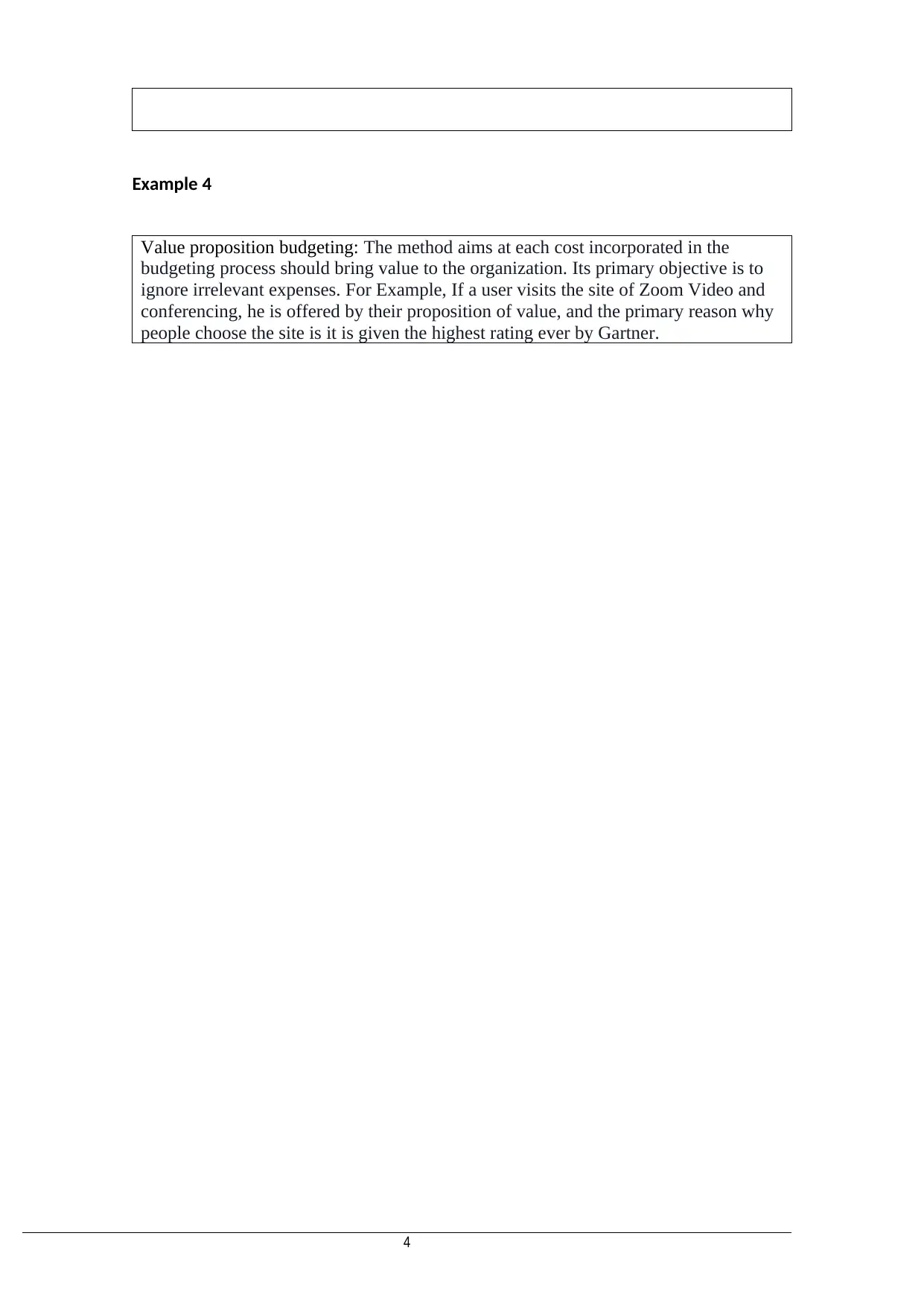
Example 4
Value proposition budgeting: The method aims at each cost incorporated in the
budgeting process should bring value to the organization. Its primary objective is to
ignore irrelevant expenses. For Example, If a user visits the site of Zoom Video and
conferencing, he is offered by their proposition of value, and the primary reason why
people choose the site is it is given the highest rating ever by Gartner.
4
Value proposition budgeting: The method aims at each cost incorporated in the
budgeting process should bring value to the organization. Its primary objective is to
ignore irrelevant expenses. For Example, If a user visits the site of Zoom Video and
conferencing, he is offered by their proposition of value, and the primary reason why
people choose the site is it is given the highest rating ever by Gartner.
4
Paraphrase This Document
Need a fresh take? Get an instant paraphrase of this document with our AI Paraphraser

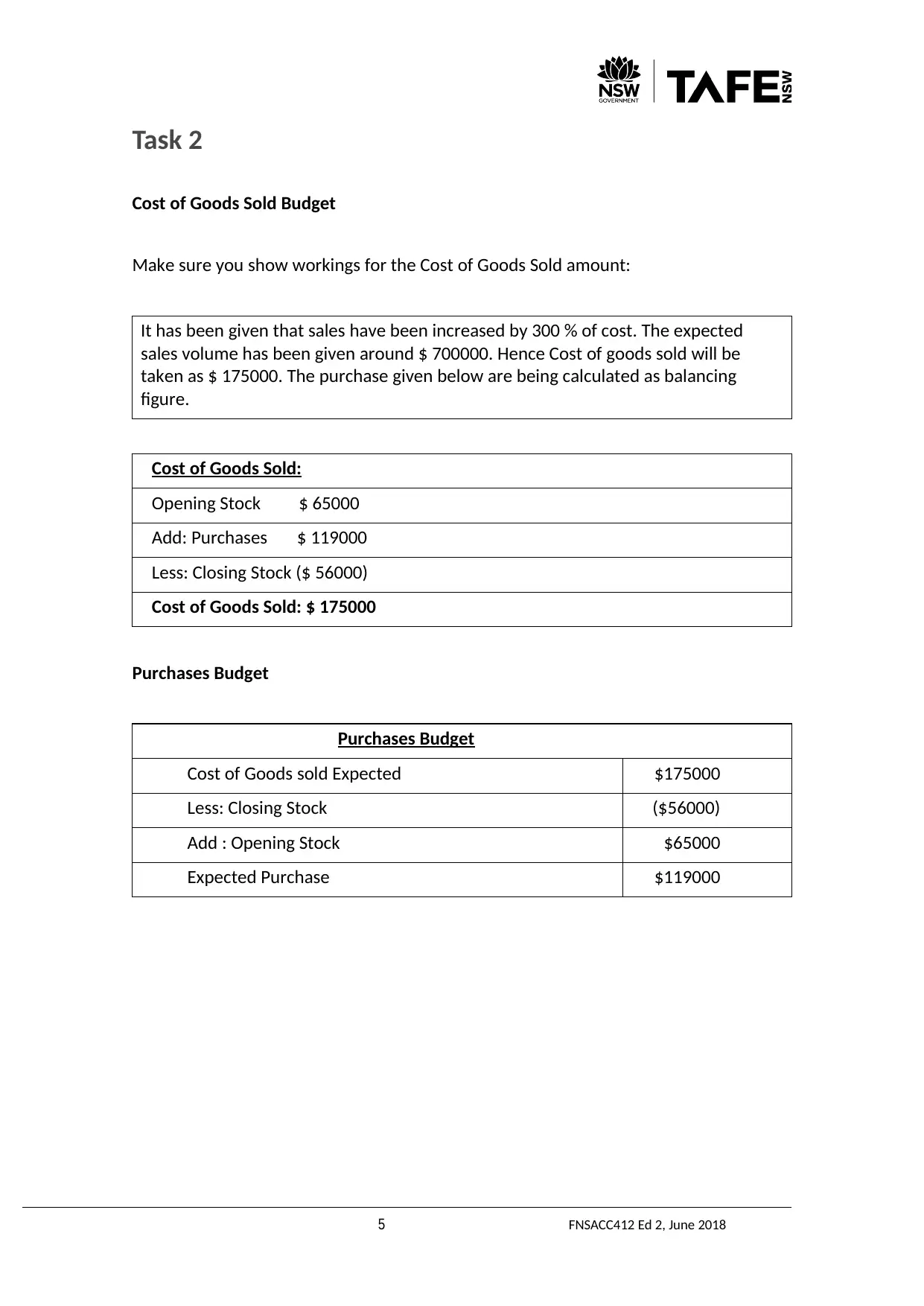
Task 2
Cost of Goods Sold Budget
Make sure you show workings for the Cost of Goods Sold amount:
It has been given that sales have been increased by 300 % of cost. The expected
sales volume has been given around $ 700000. Hence Cost of goods sold will be
taken as $ 175000. The purchase given below are being calculated as balancing
figure.
Cost of Goods Sold:
Opening Stock $ 65000
Add: Purchases $ 119000
Less: Closing Stock ($ 56000)
Cost of Goods Sold: $ 175000
Purchases Budget
Purchases Budget
Cost of Goods sold Expected $175000
Less: Closing Stock ($56000)
Add : Opening Stock $65000
Expected Purchase $119000
5 FNSACC412 Ed 2, June 2018
Cost of Goods Sold Budget
Make sure you show workings for the Cost of Goods Sold amount:
It has been given that sales have been increased by 300 % of cost. The expected
sales volume has been given around $ 700000. Hence Cost of goods sold will be
taken as $ 175000. The purchase given below are being calculated as balancing
figure.
Cost of Goods Sold:
Opening Stock $ 65000
Add: Purchases $ 119000
Less: Closing Stock ($ 56000)
Cost of Goods Sold: $ 175000
Purchases Budget
Purchases Budget
Cost of Goods sold Expected $175000
Less: Closing Stock ($56000)
Add : Opening Stock $65000
Expected Purchase $119000
5 FNSACC412 Ed 2, June 2018

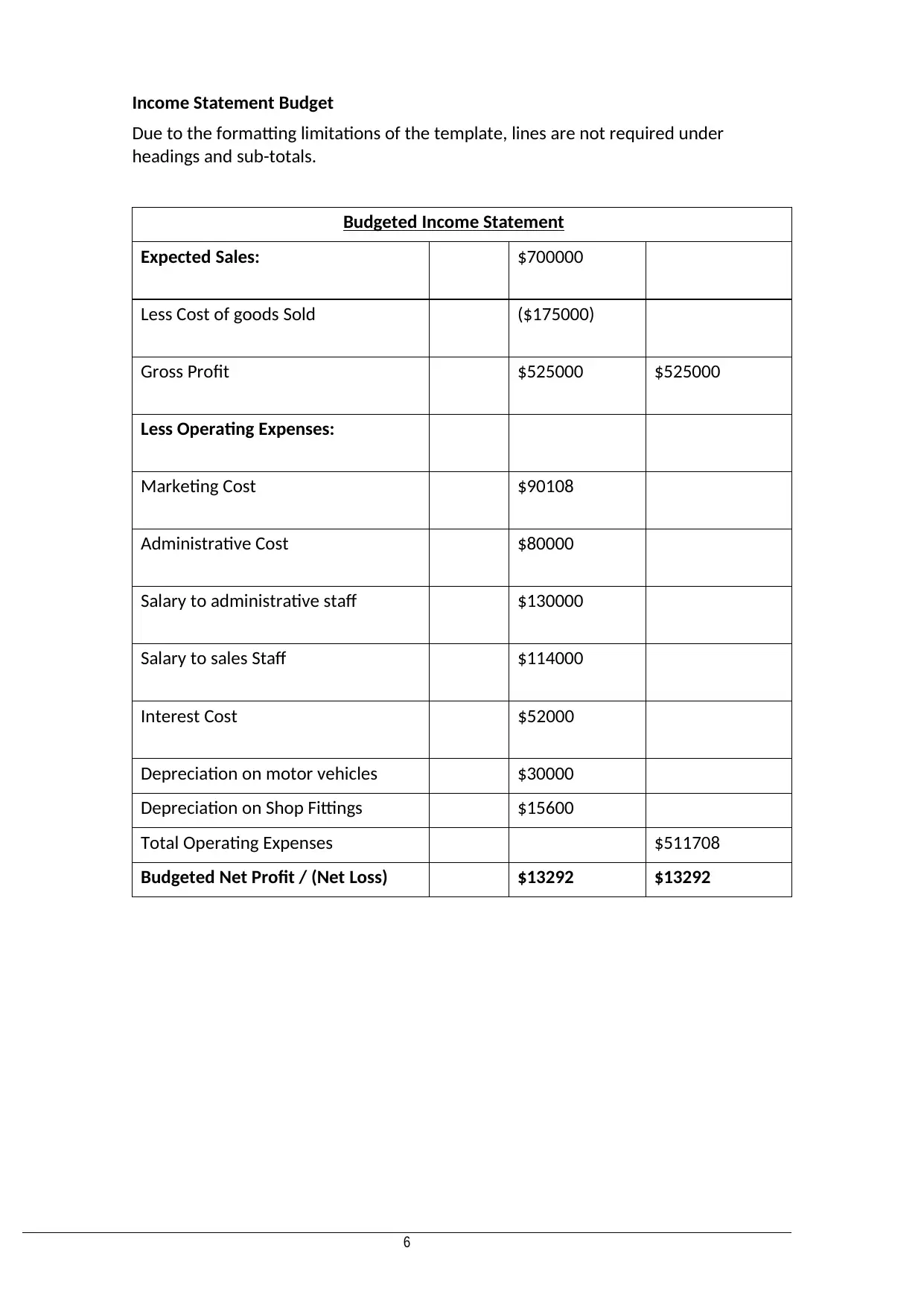
Income Statement Budget
Due to the formatting limitations of the template, lines are not required under
headings and sub-totals.
Budgeted Income Statement
Expected Sales: $700000
Less Cost of goods Sold ($175000)
Gross Profit $525000 $525000
Less Operating Expenses:
Marketing Cost $90108
Administrative Cost $80000
Salary to administrative staff $130000
Salary to sales Staff $114000
Interest Cost $52000
Depreciation on motor vehicles $30000
Depreciation on Shop Fittings $15600
Total Operating Expenses $511708
Budgeted Net Profit / (Net Loss) $13292 $13292
6
Due to the formatting limitations of the template, lines are not required under
headings and sub-totals.
Budgeted Income Statement
Expected Sales: $700000
Less Cost of goods Sold ($175000)
Gross Profit $525000 $525000
Less Operating Expenses:
Marketing Cost $90108
Administrative Cost $80000
Salary to administrative staff $130000
Salary to sales Staff $114000
Interest Cost $52000
Depreciation on motor vehicles $30000
Depreciation on Shop Fittings $15600
Total Operating Expenses $511708
Budgeted Net Profit / (Net Loss) $13292 $13292
6
⊘ This is a preview!⊘
Do you want full access?
Subscribe today to unlock all pages.

Trusted by 1+ million students worldwide

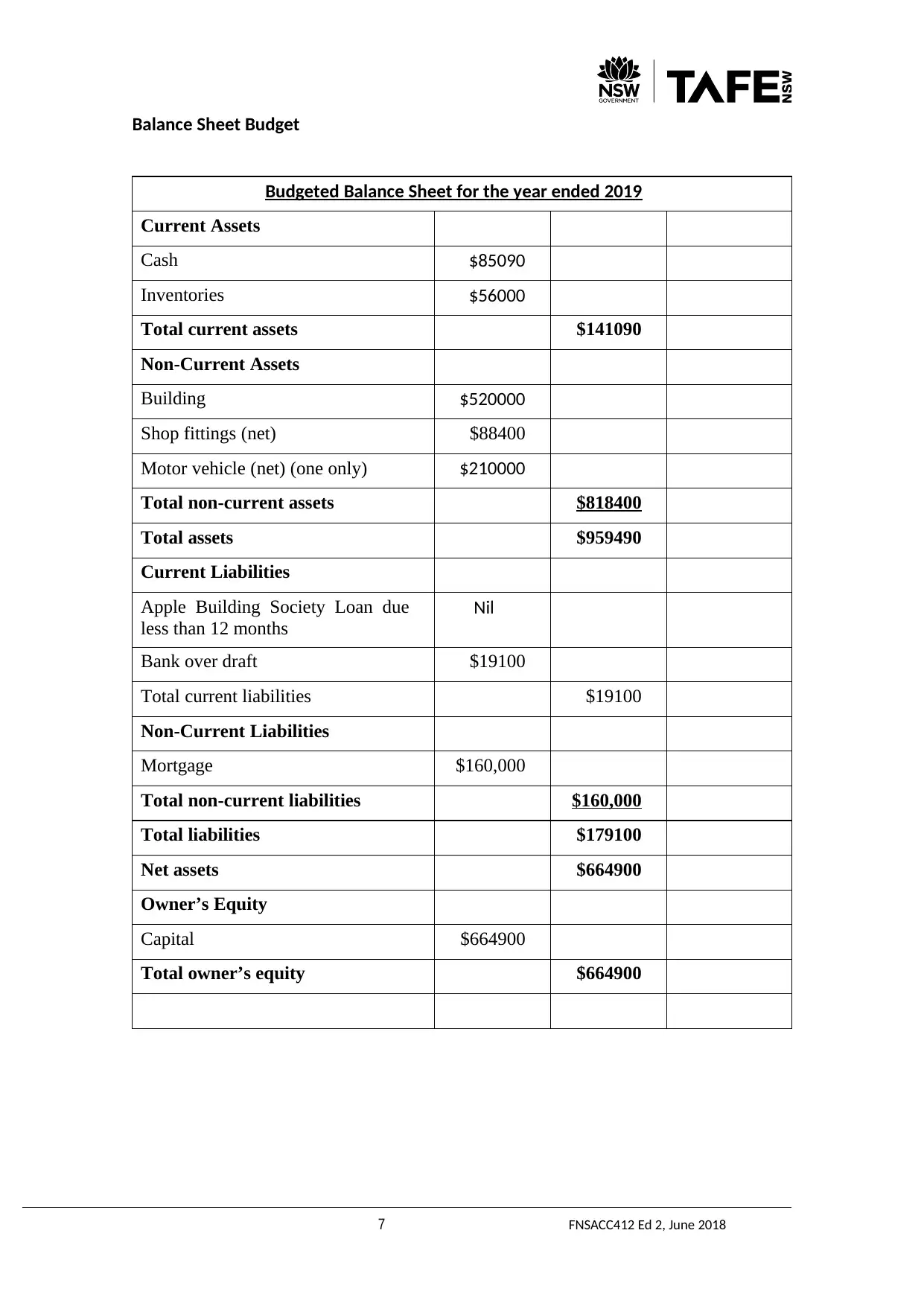
Balance Sheet Budget
Budgeted Balance Sheet for the year ended 2019
Current Assets
Cash $85090
Inventories $56000
Total current assets $141090
Non-Current Assets
Building $520000
Shop fittings (net) $88400
Motor vehicle (net) (one only) $210000
Total non-current assets $818400
Total assets $959490
Current Liabilities
Apple Building Society Loan due
less than 12 months
Nil
Bank over draft $19100
Total current liabilities $19100
Non-Current Liabilities
Mortgage $160,000
Total non-current liabilities $160,000
Total liabilities $179100
Net assets $664900
Owner’s Equity
Capital $664900
Total owner’s equity $664900
7 FNSACC412 Ed 2, June 2018
Budgeted Balance Sheet for the year ended 2019
Current Assets
Cash $85090
Inventories $56000
Total current assets $141090
Non-Current Assets
Building $520000
Shop fittings (net) $88400
Motor vehicle (net) (one only) $210000
Total non-current assets $818400
Total assets $959490
Current Liabilities
Apple Building Society Loan due
less than 12 months
Nil
Bank over draft $19100
Total current liabilities $19100
Non-Current Liabilities
Mortgage $160,000
Total non-current liabilities $160,000
Total liabilities $179100
Net assets $664900
Owner’s Equity
Capital $664900
Total owner’s equity $664900
7 FNSACC412 Ed 2, June 2018
Paraphrase This Document
Need a fresh take? Get an instant paraphrase of this document with our AI Paraphraser

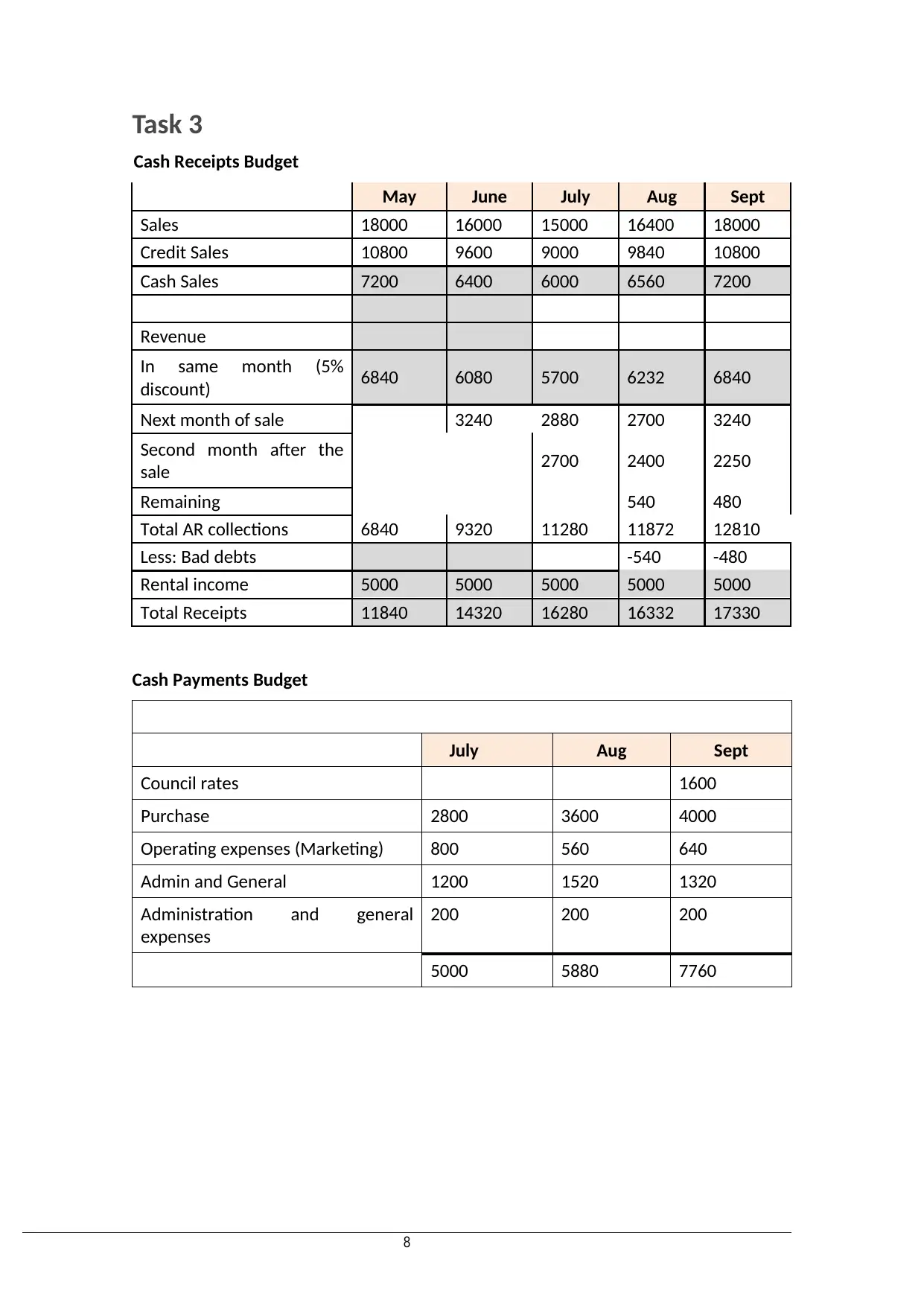
Task 3
Cash Receipts Budget
May June July Aug Sept
Sales 18000 16000 15000 16400 18000
Credit Sales 10800 9600 9000 9840 10800
Cash Sales 7200 6400 6000 6560 7200
Revenue
In same month (5%
discount) 6840 6080 5700 6232 6840
Next month of sale 3240 2880 2700 3240
Second month after the
sale 2700 2400 2250
Remaining 540 480
Total AR collections 6840 9320 11280 11872 12810
Less: Bad debts -540 -480
Rental income 5000 5000 5000 5000 5000
Total Receipts 11840 14320 16280 16332 17330
Cash Payments Budget
July Aug Sept
Council rates 1600
Purchase 2800 3600 4000
Operating expenses (Marketing) 800 560 640
Admin and General 1200 1520 1320
Administration and general
expenses
200 200 200
5000 5880 7760
8
Cash Receipts Budget
May June July Aug Sept
Sales 18000 16000 15000 16400 18000
Credit Sales 10800 9600 9000 9840 10800
Cash Sales 7200 6400 6000 6560 7200
Revenue
In same month (5%
discount) 6840 6080 5700 6232 6840
Next month of sale 3240 2880 2700 3240
Second month after the
sale 2700 2400 2250
Remaining 540 480
Total AR collections 6840 9320 11280 11872 12810
Less: Bad debts -540 -480
Rental income 5000 5000 5000 5000 5000
Total Receipts 11840 14320 16280 16332 17330
Cash Payments Budget
July Aug Sept
Council rates 1600
Purchase 2800 3600 4000
Operating expenses (Marketing) 800 560 640
Admin and General 1200 1520 1320
Administration and general
expenses
200 200 200
5000 5880 7760
8

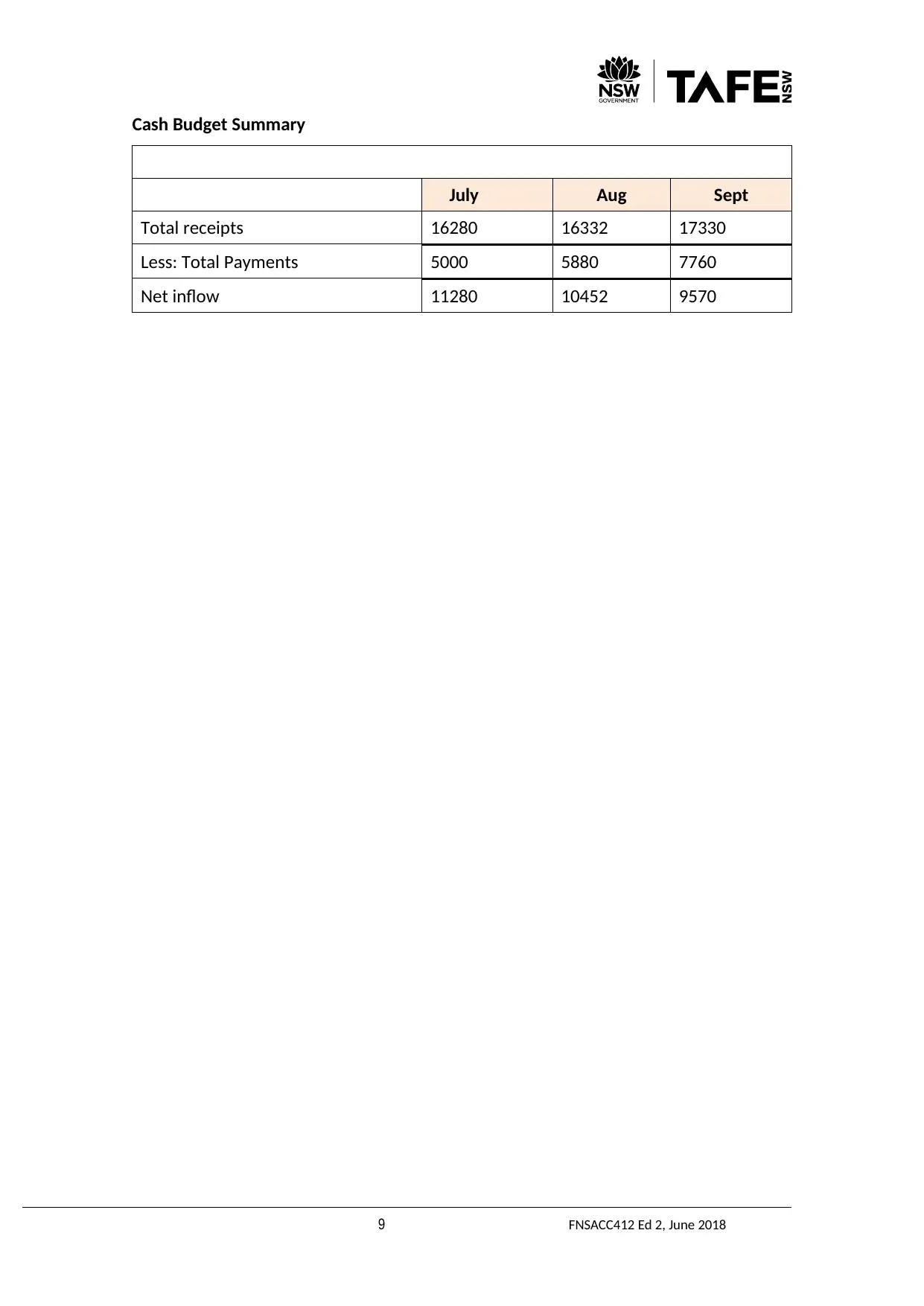
Cash Budget Summary
July Aug Sept
Total receipts 16280 16332 17330
Less: Total Payments 5000 5880 7760
Net inflow 11280 10452 9570
9 FNSACC412 Ed 2, June 2018
July Aug Sept
Total receipts 16280 16332 17330
Less: Total Payments 5000 5880 7760
Net inflow 11280 10452 9570
9 FNSACC412 Ed 2, June 2018
⊘ This is a preview!⊘
Do you want full access?
Subscribe today to unlock all pages.

Trusted by 1+ million students worldwide

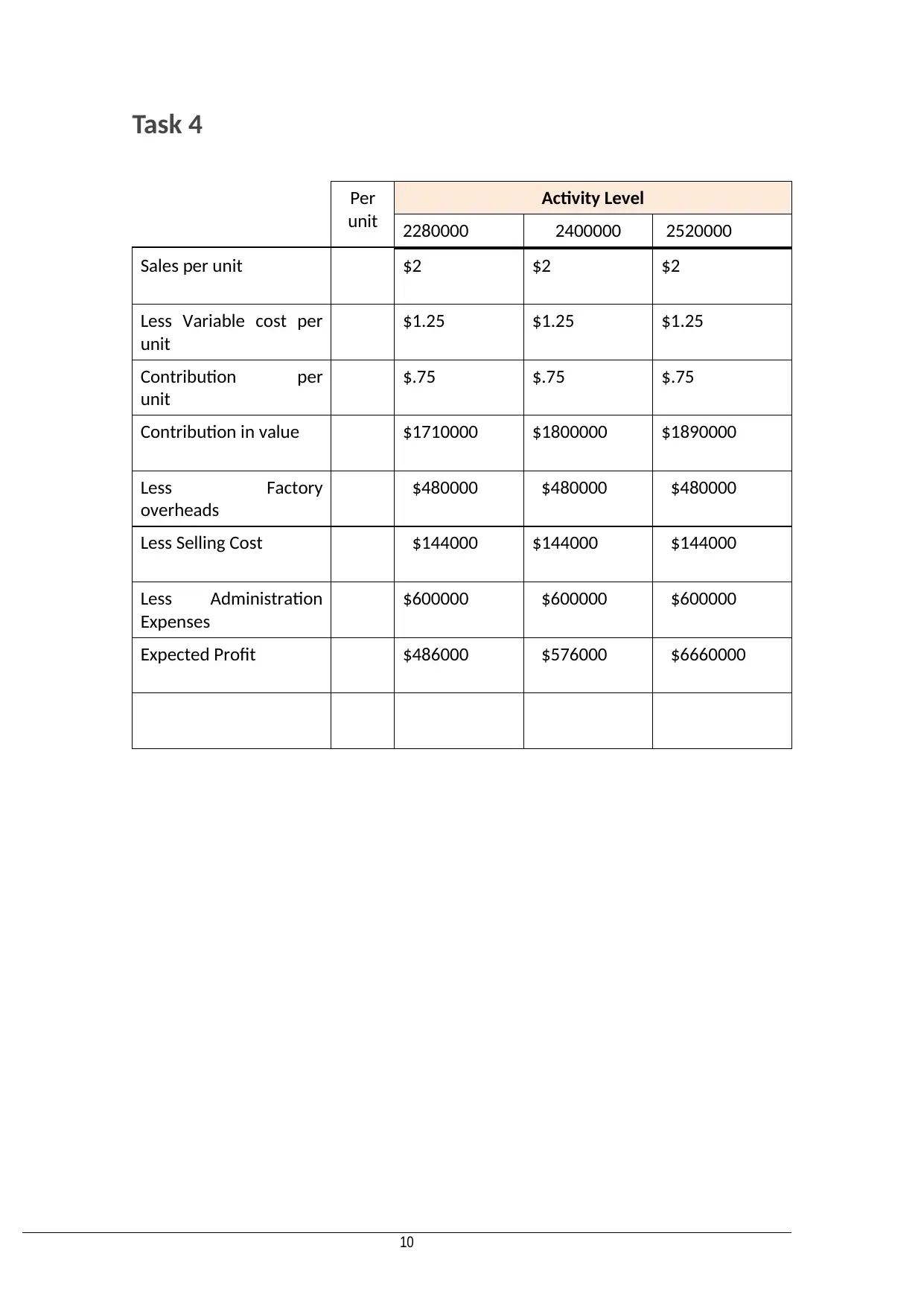
Task 4
Per
unit
Activity Level
2280000 2400000 2520000
Sales per unit $2 $2 $2
Less Variable cost per
unit
$1.25 $1.25 $1.25
Contribution per
unit
$.75 $.75 $.75
Contribution in value $1710000 $1800000 $1890000
Less Factory
overheads
$480000 $480000 $480000
Less Selling Cost $144000 $144000 $144000
Less Administration
Expenses
$600000 $600000 $600000
Expected Profit $486000 $576000 $6660000
10
Per
unit
Activity Level
2280000 2400000 2520000
Sales per unit $2 $2 $2
Less Variable cost per
unit
$1.25 $1.25 $1.25
Contribution per
unit
$.75 $.75 $.75
Contribution in value $1710000 $1800000 $1890000
Less Factory
overheads
$480000 $480000 $480000
Less Selling Cost $144000 $144000 $144000
Less Administration
Expenses
$600000 $600000 $600000
Expected Profit $486000 $576000 $6660000
10
Paraphrase This Document
Need a fresh take? Get an instant paraphrase of this document with our AI Paraphraser

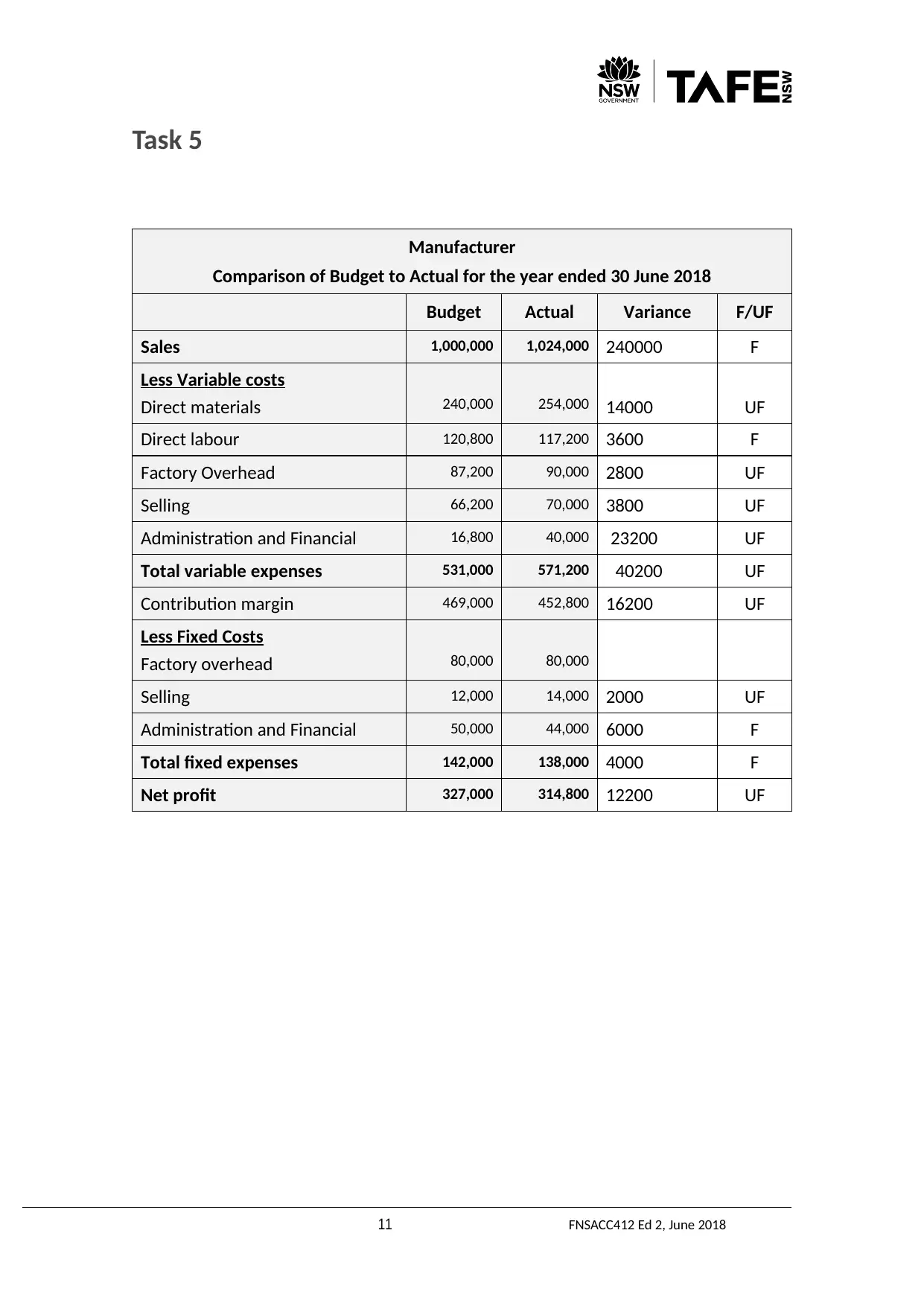
Task 5
Manufacturer
Comparison of Budget to Actual for the year ended 30 June 2018
Budget Actual Variance F/UF
Sales 1,000,000 1,024,000 240000 F
Less Variable costs
Direct materials 240,000 254,000 14000 UF
Direct labour 120,800 117,200 3600 F
Factory Overhead 87,200 90,000 2800 UF
Selling 66,200 70,000 3800 UF
Administration and Financial 16,800 40,000 23200 UF
Total variable expenses 531,000 571,200 40200 UF
Contribution margin 469,000 452,800 16200 UF
Less Fixed Costs
Factory overhead 80,000 80,000
Selling 12,000 14,000 2000 UF
Administration and Financial 50,000 44,000 6000 F
Total fixed expenses 142,000 138,000 4000 F
Net profit 327,000 314,800 12200 UF
11 FNSACC412 Ed 2, June 2018
Manufacturer
Comparison of Budget to Actual for the year ended 30 June 2018
Budget Actual Variance F/UF
Sales 1,000,000 1,024,000 240000 F
Less Variable costs
Direct materials 240,000 254,000 14000 UF
Direct labour 120,800 117,200 3600 F
Factory Overhead 87,200 90,000 2800 UF
Selling 66,200 70,000 3800 UF
Administration and Financial 16,800 40,000 23200 UF
Total variable expenses 531,000 571,200 40200 UF
Contribution margin 469,000 452,800 16200 UF
Less Fixed Costs
Factory overhead 80,000 80,000
Selling 12,000 14,000 2000 UF
Administration and Financial 50,000 44,000 6000 F
Total fixed expenses 142,000 138,000 4000 F
Net profit 327,000 314,800 12200 UF
11 FNSACC412 Ed 2, June 2018

REFERENCES
Nartey, E., Aboagye-Otchere, F.K. and Simpson, S.N.Y., 2020. The contingency effects
of supply chain integration on management control system design and
operational performance of hospitals in Ghana. Journal of Accounting in
Emerging Economies.
Baker, G., 2019. The energy equation: Unlocking the hidden power of energy in
business. John Wiley & Sons.
Solak, S. and Zhuo, Y., 2020. Optimal policies for information sharing in information
system security. European Journal of Operational Research, 284(3), pp.934-
950.
Ellett, T., Stipeck, C.J. and Pérez, D., 2020. Residence Life and Housing Services: Why
Mid‐Level Managers Are Integral to a Department's Success. New Directions
for Higher Education, 2020(189), pp.71-86.
Üstüner, Y. and Yavuz, N., 2018. Turkey’s public administration today: An overview
and appraisal. International Journal of Public Administration, 41(10), pp.820-
831.
12
Nartey, E., Aboagye-Otchere, F.K. and Simpson, S.N.Y., 2020. The contingency effects
of supply chain integration on management control system design and
operational performance of hospitals in Ghana. Journal of Accounting in
Emerging Economies.
Baker, G., 2019. The energy equation: Unlocking the hidden power of energy in
business. John Wiley & Sons.
Solak, S. and Zhuo, Y., 2020. Optimal policies for information sharing in information
system security. European Journal of Operational Research, 284(3), pp.934-
950.
Ellett, T., Stipeck, C.J. and Pérez, D., 2020. Residence Life and Housing Services: Why
Mid‐Level Managers Are Integral to a Department's Success. New Directions
for Higher Education, 2020(189), pp.71-86.
Üstüner, Y. and Yavuz, N., 2018. Turkey’s public administration today: An overview
and appraisal. International Journal of Public Administration, 41(10), pp.820-
831.
12
⊘ This is a preview!⊘
Do you want full access?
Subscribe today to unlock all pages.

Trusted by 1+ million students worldwide
1 out of 12
Related Documents
Your All-in-One AI-Powered Toolkit for Academic Success.
+13062052269
info@desklib.com
Available 24*7 on WhatsApp / Email
Unlock your academic potential
Copyright © 2020–2025 A2Z Services. All Rights Reserved. Developed and managed by ZUCOL.