FNSACC602 Auditing and Reporting: Financial Systems Audit Portfolio
VerifiedAdded on 2023/04/26
|18
|4988
|361
Portfolio
AI Summary
This portfolio presents a comprehensive assessment of auditing and reporting on financial systems and records, aligning with the FNSACC602 unit of competency. It addresses statutory requirements, client objectives, and obligations, reviewing client activities and procedures to establish familiarity with systems and guide audit methodologies. The portfolio develops financial audit methodologies to identify significant audit features and establish criteria for conducting audits in accordance with professional auditing standards. It identifies audit financial data sources, creates audit lines of enquiry, assesses client financial business characteristics, and identifies internal control procedures for financial transactions. Furthermore, the portfolio establishes timeframes, allocates personnel, reviews resource use, identifies strengths and weaknesses in controls, evaluates evidence on financial systems, tests management assertions, and verifies financial statements. The final output includes documenting financial operational functions, ensuring format consistency, and formulating financial audit opinions with recommendations, all adhering to established formats and professional auditing standards. Desklib offers a wide range of solved assignments and past papers for students.
T-1.8.1
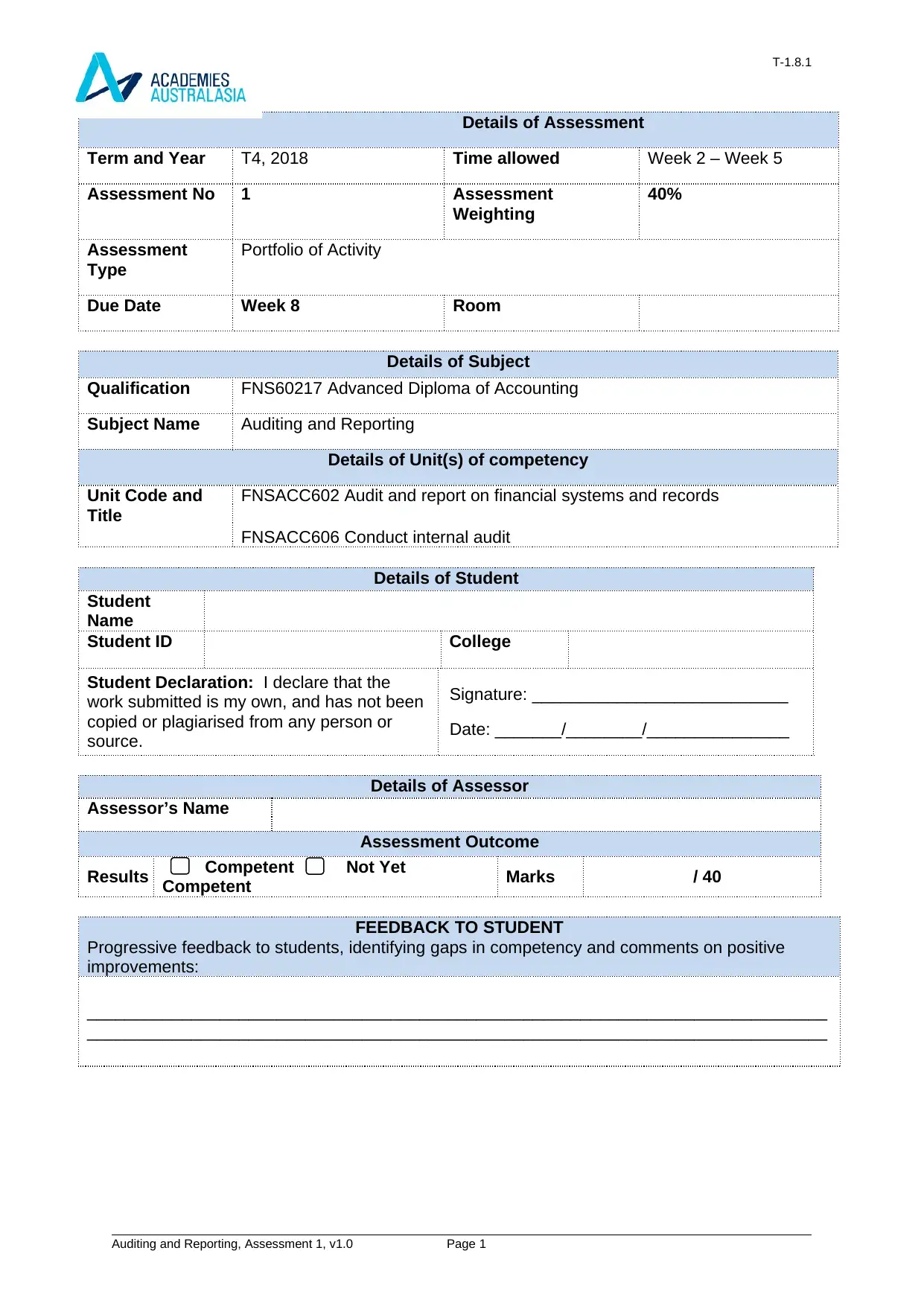
Details of Assessment
Term and Year T4, 2018 Time allowed Week 2 – Week 5
Assessment No 1 Assessment
Weighting
40%
Assessment
Type
Portfolio of Activity
Due Date Week 8 Room
Details of Subject
Qualification FNS60217 Advanced Diploma of Accounting
Subject Name Auditing and Reporting
Details of Unit(s) of competency
Unit Code and
Title
FNSACC602 Audit and report on financial systems and records
FNSACC606 Conduct internal audit
Details of Student
Student
Name
Student ID College
Student Declaration: I declare that the
work submitted is my own, and has not been
copied or plagiarised from any person or
source.
Signature: ___________________________
Date: _______/________/_______________
Details of Assessor
Assessor’s Name
Assessment Outcome
Results Competent Not Yet
Competent Marks / 40
FEEDBACK TO STUDENT
Progressive feedback to students, identifying gaps in competency and comments on positive
improvements:
______________________________________________________________________________
______________________________________________________________________________
Auditing and Reporting, Assessment 1, v1.0 Page 1
Details of Assessment
Term and Year T4, 2018 Time allowed Week 2 – Week 5
Assessment No 1 Assessment
Weighting
40%
Assessment
Type
Portfolio of Activity
Due Date Week 8 Room
Details of Subject
Qualification FNS60217 Advanced Diploma of Accounting
Subject Name Auditing and Reporting
Details of Unit(s) of competency
Unit Code and
Title
FNSACC602 Audit and report on financial systems and records
FNSACC606 Conduct internal audit
Details of Student
Student
Name
Student ID College
Student Declaration: I declare that the
work submitted is my own, and has not been
copied or plagiarised from any person or
source.
Signature: ___________________________
Date: _______/________/_______________
Details of Assessor
Assessor’s Name
Assessment Outcome
Results Competent Not Yet
Competent Marks / 40
FEEDBACK TO STUDENT
Progressive feedback to students, identifying gaps in competency and comments on positive
improvements:
______________________________________________________________________________
______________________________________________________________________________
Auditing and Reporting, Assessment 1, v1.0 Page 1

Paraphrase This Document
Need a fresh take? Get an instant paraphrase of this document with our AI Paraphraser
T-1.8.1
Student Declaration:
I declare that I have been assessed in this unit,
and I have been advised of my result. I also am
aware of my appeal rights and reassessment
procedure.
Signature: ____________________________
Date: ____/_____/ 2018
Assessor Declaration: I declare that I have
conducted a fair, valid, reliable and flexible
assessment with this student, and I have
provided appropriate feedback
Student did not attend the feedback
session.
Feedback provided on assessment.
Signature: ____________________________
Date: ____/ / 2018
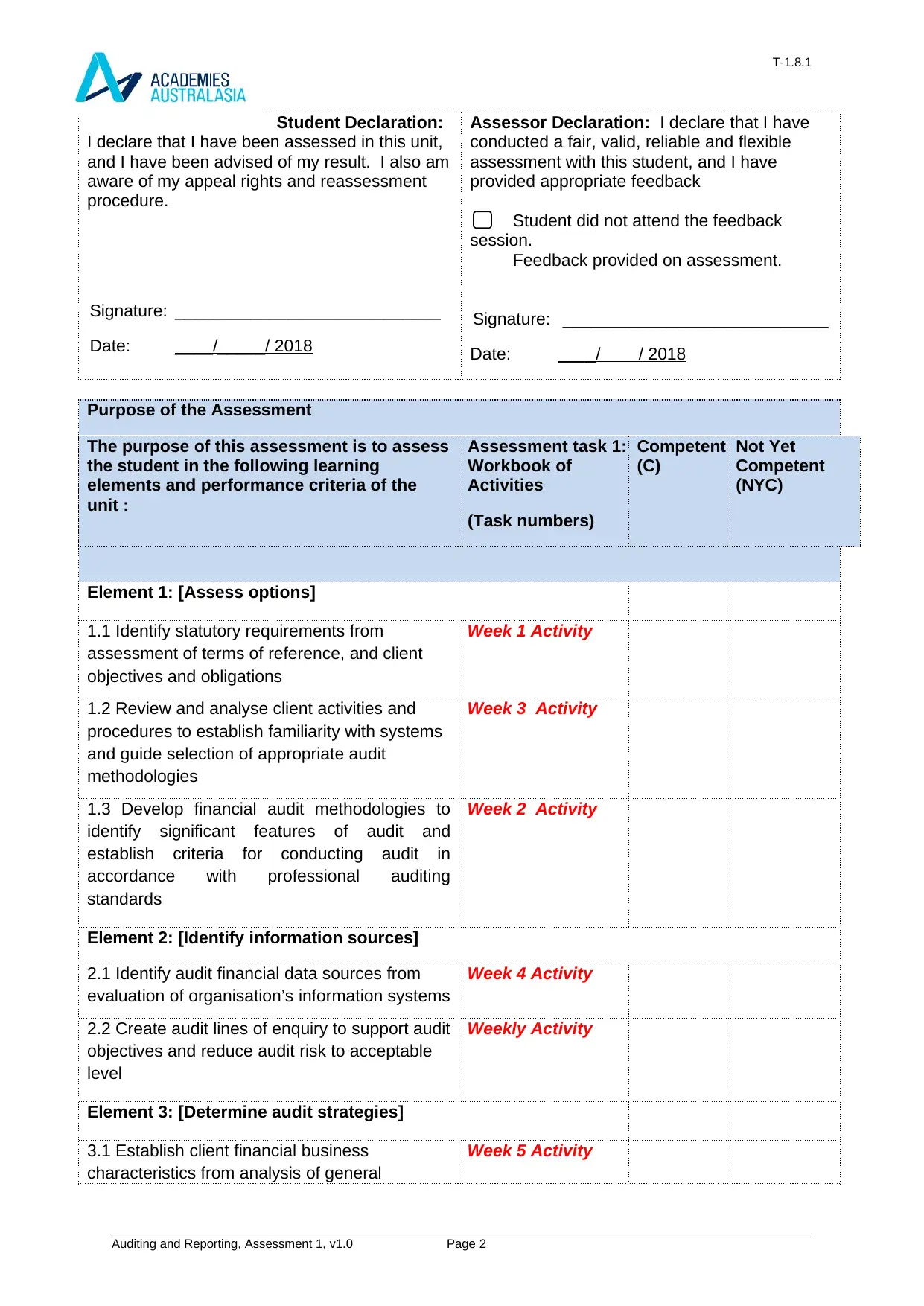
Purpose of the Assessment
Element 1: [Assess options]
1.1 Identify statutory requirements from
assessment of terms of reference, and client
objectives and obligations
Week 1 Activity
1.2 Review and analyse client activities and
procedures to establish familiarity with systems
and guide selection of appropriate audit
methodologies
Week 3 Activity
1.3 Develop financial audit methodologies to
identify significant features of audit and
establish criteria for conducting audit in
accordance with professional auditing
standards
Week 2 Activity
Element 2: [Identify information sources]
2.1 Identify audit financial data sources from
evaluation of organisation’s information systems
Week 4 Activity
2.2 Create audit lines of enquiry to support audit
objectives and reduce audit risk to acceptable
level
Weekly Activity
Element 3: [Determine audit strategies]
3.1 Establish client financial business
characteristics from analysis of general
Week 5 Activity
Auditing and Reporting, Assessment 1, v1.0 Page 2
The purpose of this assessment is to assess
the student in the following learning
elements and performance criteria of the
unit :
Assessment task 1:
Workbook of
Activities
(Task numbers)
Competent
(C)
Not Yet
Competent
(NYC)
Student Declaration:
I declare that I have been assessed in this unit,
and I have been advised of my result. I also am
aware of my appeal rights and reassessment
procedure.
Signature: ____________________________
Date: ____/_____/ 2018
Assessor Declaration: I declare that I have
conducted a fair, valid, reliable and flexible
assessment with this student, and I have
provided appropriate feedback
Student did not attend the feedback
session.
Feedback provided on assessment.
Signature: ____________________________
Date: ____/ / 2018
Purpose of the Assessment
Element 1: [Assess options]
1.1 Identify statutory requirements from
assessment of terms of reference, and client
objectives and obligations
Week 1 Activity
1.2 Review and analyse client activities and
procedures to establish familiarity with systems
and guide selection of appropriate audit
methodologies
Week 3 Activity
1.3 Develop financial audit methodologies to
identify significant features of audit and
establish criteria for conducting audit in
accordance with professional auditing
standards
Week 2 Activity
Element 2: [Identify information sources]
2.1 Identify audit financial data sources from
evaluation of organisation’s information systems
Week 4 Activity
2.2 Create audit lines of enquiry to support audit
objectives and reduce audit risk to acceptable
level
Weekly Activity
Element 3: [Determine audit strategies]
3.1 Establish client financial business
characteristics from analysis of general
Week 5 Activity
Auditing and Reporting, Assessment 1, v1.0 Page 2
The purpose of this assessment is to assess
the student in the following learning
elements and performance criteria of the
unit :
Assessment task 1:
Workbook of
Activities
(Task numbers)
Competent
(C)
Not Yet
Competent
(NYC)
T-1.8.1
economy, industry and
client’s provided information
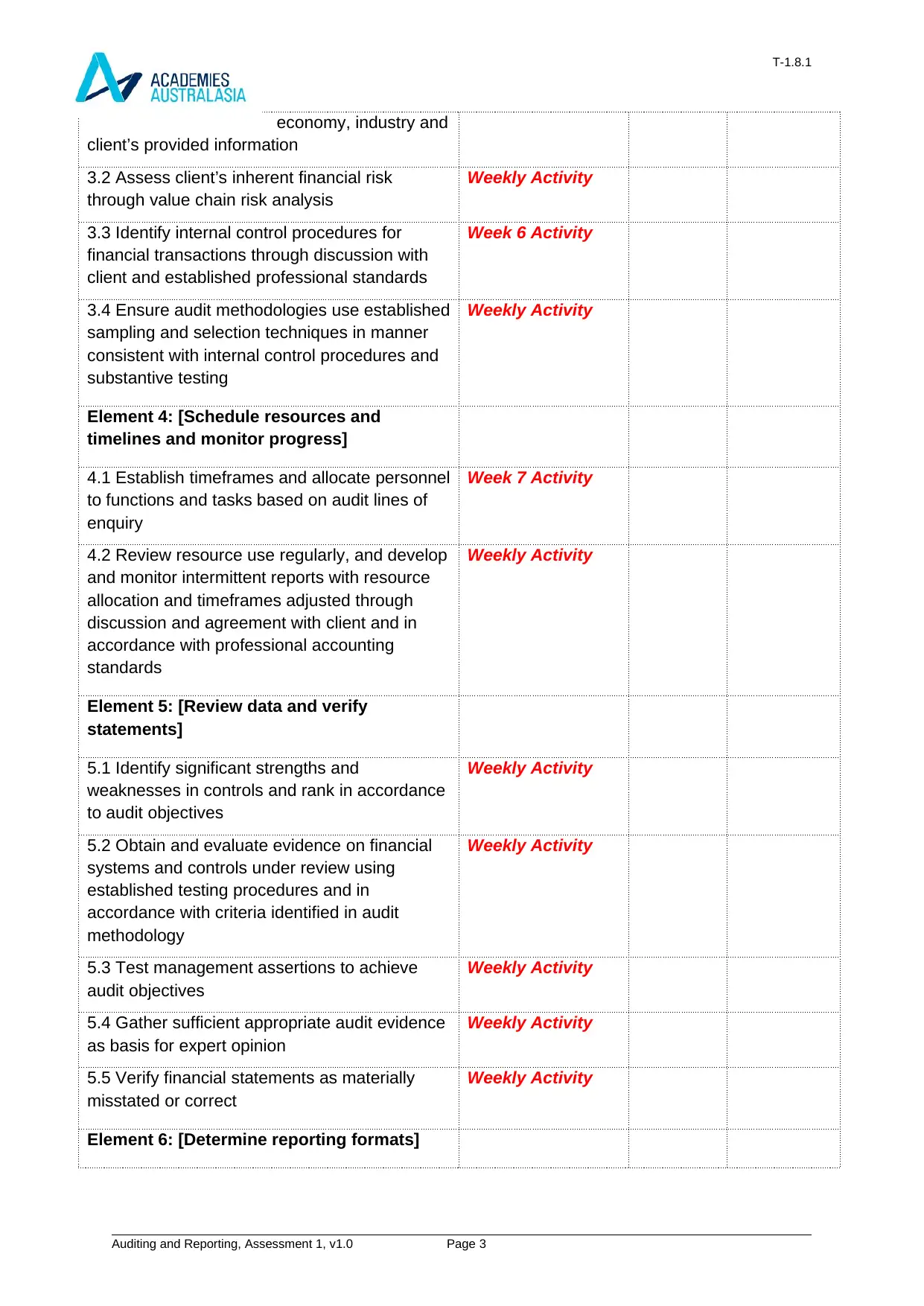
3.2 Assess client’s inherent financial risk
through value chain risk analysis
Weekly Activity
3.3 Identify internal control procedures for
financial transactions through discussion with
client and established professional standards
Week 6 Activity
3.4 Ensure audit methodologies use established
sampling and selection techniques in manner
consistent with internal control procedures and
substantive testing
Weekly Activity
Element 4: [Schedule resources and
timelines and monitor progress]
4.1 Establish timeframes and allocate personnel
to functions and tasks based on audit lines of
enquiry
Week 7 Activity
4.2 Review resource use regularly, and develop
and monitor intermittent reports with resource
allocation and timeframes adjusted through
discussion and agreement with client and in
accordance with professional accounting
standards
Weekly Activity
Element 5: [Review data and verify
statements]
5.1 Identify significant strengths and
weaknesses in controls and rank in accordance
to audit objectives
Weekly Activity
5.2 Obtain and evaluate evidence on financial
systems and controls under review using
established testing procedures and in
accordance with criteria identified in audit
methodology
Weekly Activity
5.3 Test management assertions to achieve
audit objectives
Weekly Activity
5.4 Gather sufficient appropriate audit evidence
as basis for expert opinion
Weekly Activity
5.5 Verify financial statements as materially
misstated or correct
Weekly Activity
Element 6: [Determine reporting formats]
Auditing and Reporting, Assessment 1, v1.0 Page 3
economy, industry and
client’s provided information
3.2 Assess client’s inherent financial risk
through value chain risk analysis
Weekly Activity
3.3 Identify internal control procedures for
financial transactions through discussion with
client and established professional standards
Week 6 Activity
3.4 Ensure audit methodologies use established
sampling and selection techniques in manner
consistent with internal control procedures and
substantive testing
Weekly Activity
Element 4: [Schedule resources and
timelines and monitor progress]
4.1 Establish timeframes and allocate personnel
to functions and tasks based on audit lines of
enquiry
Week 7 Activity
4.2 Review resource use regularly, and develop
and monitor intermittent reports with resource
allocation and timeframes adjusted through
discussion and agreement with client and in
accordance with professional accounting
standards
Weekly Activity
Element 5: [Review data and verify
statements]
5.1 Identify significant strengths and
weaknesses in controls and rank in accordance
to audit objectives
Weekly Activity
5.2 Obtain and evaluate evidence on financial
systems and controls under review using
established testing procedures and in
accordance with criteria identified in audit
methodology
Weekly Activity
5.3 Test management assertions to achieve
audit objectives
Weekly Activity
5.4 Gather sufficient appropriate audit evidence
as basis for expert opinion
Weekly Activity
5.5 Verify financial statements as materially
misstated or correct
Weekly Activity
Element 6: [Determine reporting formats]
Auditing and Reporting, Assessment 1, v1.0 Page 3
⊘ This is a preview!⊘
Do you want full access?
Subscribe today to unlock all pages.

Trusted by 1+ million students worldwide
T-1.8.1
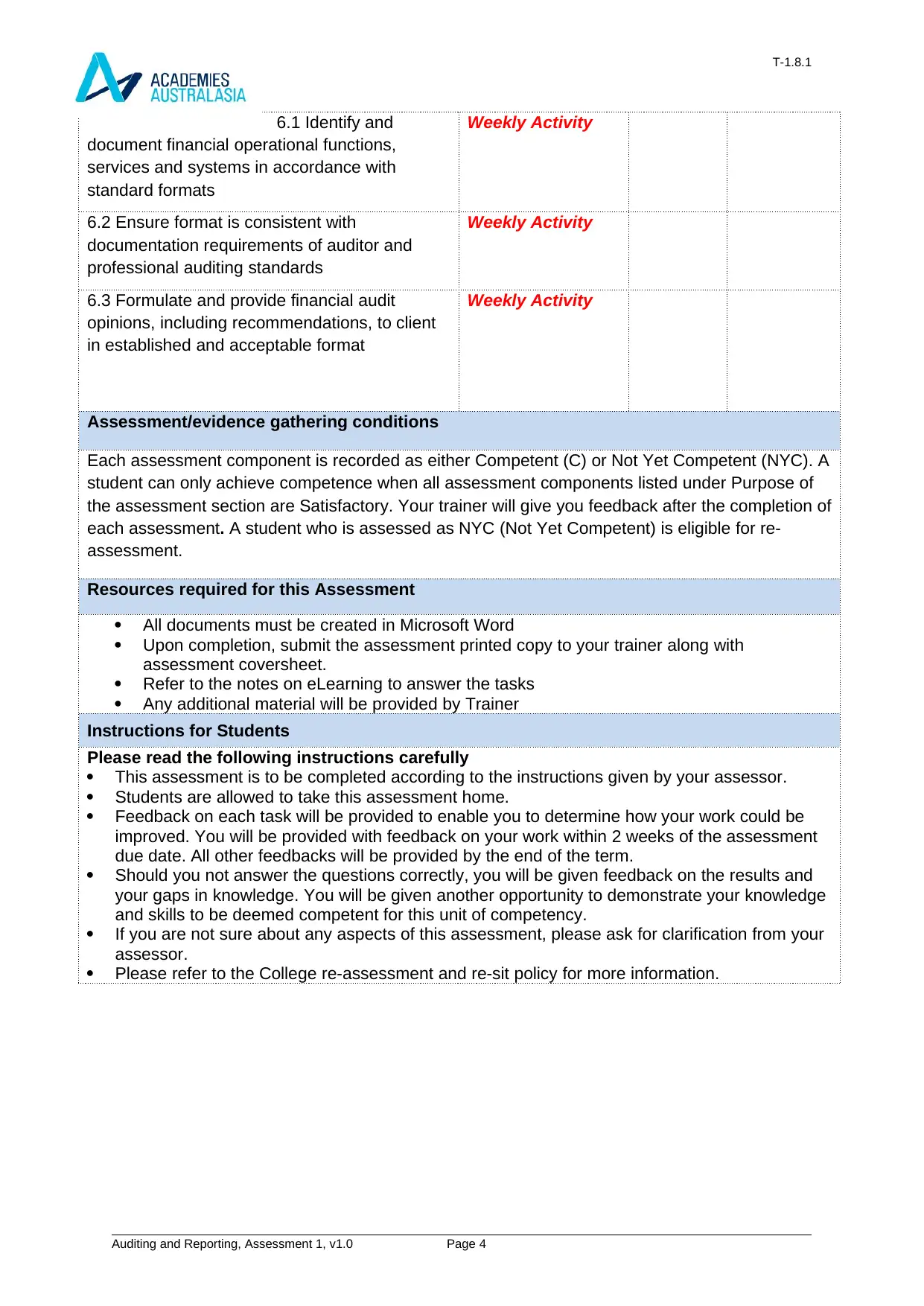
6.1 Identify and
document financial operational functions,
services and systems in accordance with
standard formats
Weekly Activity
6.2 Ensure format is consistent with
documentation requirements of auditor and
professional auditing standards
Weekly Activity
6.3 Formulate and provide financial audit
opinions, including recommendations, to client
in established and acceptable format
Weekly Activity
Assessment/evidence gathering conditions
Each assessment component is recorded as either Competent (C) or Not Yet Competent (NYC). A
student can only achieve competence when all assessment components listed under Purpose of
the assessment section are Satisfactory. Your trainer will give you feedback after the completion of
each assessment. A student who is assessed as NYC (Not Yet Competent) is eligible for re-
assessment.
Resources required for this Assessment
All documents must be created in Microsoft Word
Upon completion, submit the assessment printed copy to your trainer along with
assessment coversheet.
Refer to the notes on eLearning to answer the tasks
Any additional material will be provided by Trainer
Instructions for Students
Please read the following instructions carefully
This assessment is to be completed according to the instructions given by your assessor.
Students are allowed to take this assessment home.
Feedback on each task will be provided to enable you to determine how your work could be
improved. You will be provided with feedback on your work within 2 weeks of the assessment
due date. All other feedbacks will be provided by the end of the term.
Should you not answer the questions correctly, you will be given feedback on the results and
your gaps in knowledge. You will be given another opportunity to demonstrate your knowledge
and skills to be deemed competent for this unit of competency.
If you are not sure about any aspects of this assessment, please ask for clarification from your
assessor.
Please refer to the College re-assessment and re-sit policy for more information.
Auditing and Reporting, Assessment 1, v1.0 Page 4
6.1 Identify and
document financial operational functions,
services and systems in accordance with
standard formats
Weekly Activity
6.2 Ensure format is consistent with
documentation requirements of auditor and
professional auditing standards
Weekly Activity
6.3 Formulate and provide financial audit
opinions, including recommendations, to client
in established and acceptable format
Weekly Activity
Assessment/evidence gathering conditions
Each assessment component is recorded as either Competent (C) or Not Yet Competent (NYC). A
student can only achieve competence when all assessment components listed under Purpose of
the assessment section are Satisfactory. Your trainer will give you feedback after the completion of
each assessment. A student who is assessed as NYC (Not Yet Competent) is eligible for re-
assessment.
Resources required for this Assessment
All documents must be created in Microsoft Word
Upon completion, submit the assessment printed copy to your trainer along with
assessment coversheet.
Refer to the notes on eLearning to answer the tasks
Any additional material will be provided by Trainer
Instructions for Students
Please read the following instructions carefully
This assessment is to be completed according to the instructions given by your assessor.
Students are allowed to take this assessment home.
Feedback on each task will be provided to enable you to determine how your work could be
improved. You will be provided with feedback on your work within 2 weeks of the assessment
due date. All other feedbacks will be provided by the end of the term.
Should you not answer the questions correctly, you will be given feedback on the results and
your gaps in knowledge. You will be given another opportunity to demonstrate your knowledge
and skills to be deemed competent for this unit of competency.
If you are not sure about any aspects of this assessment, please ask for clarification from your
assessor.
Please refer to the College re-assessment and re-sit policy for more information.
Auditing and Reporting, Assessment 1, v1.0 Page 4
Paraphrase This Document
Need a fresh take? Get an instant paraphrase of this document with our AI Paraphraser
T-1.8.1
Class Activity Portfolio Total Marks - 40
WEEK-1-CLASS ACTIVITY
1. Distinguish between Australian auditing standards and Australian accounting standards,
and give two examples of each.
Solution:
Australian auditing standards
The auditing standards are generally set guidelines for the commonness of all practising
auditors in Australia. These standards abide to all appropriate ethical requirements that pertains
to audit plan and service. Example is the Auditing Standard ASA101 is based on compliance.
Auditing Standards like Auditing standard ASA 200 overview objectives of the independence of
auditors alongside the conduct of auditors in accordance with Australian Auditing Standards
Australian accounting standards are specific rules for accounting for transactions occurring
Accounting standards are the standards generally set as guidelines for the commonness
of all practising accounting recording and record keeping in Australia. The compliance with
Australian Accounting Standards by profit seeking entities results in compliance with
IFRS……… any of the AASBs.
Assignment
Consumers Union is a non-profit organisation that provides information and counsel on
consumer goods and services. A major part of its function is the testing of different brands of
consumer products that are purchased on the open market and then reporting the results of
the tests in Consumer Reports, a monthly publication. Examples of the types of products it
tests are motor vehicles, residential air-conditioners, canned tuna and jeans.
a. In what ways are the services provided by Consumers Union similar to assurance
services provided by public accounting firms?
Auditing and Reporting, Assessment 1, v1.0 Page 5
Class Activity Portfolio Total Marks - 40
WEEK-1-CLASS ACTIVITY
1. Distinguish between Australian auditing standards and Australian accounting standards,
and give two examples of each.
Solution:
Australian auditing standards
The auditing standards are generally set guidelines for the commonness of all practising
auditors in Australia. These standards abide to all appropriate ethical requirements that pertains
to audit plan and service. Example is the Auditing Standard ASA101 is based on compliance.
Auditing Standards like Auditing standard ASA 200 overview objectives of the independence of
auditors alongside the conduct of auditors in accordance with Australian Auditing Standards
Australian accounting standards are specific rules for accounting for transactions occurring
Accounting standards are the standards generally set as guidelines for the commonness
of all practising accounting recording and record keeping in Australia. The compliance with
Australian Accounting Standards by profit seeking entities results in compliance with
IFRS……… any of the AASBs.
Assignment
Consumers Union is a non-profit organisation that provides information and counsel on
consumer goods and services. A major part of its function is the testing of different brands of
consumer products that are purchased on the open market and then reporting the results of
the tests in Consumer Reports, a monthly publication. Examples of the types of products it
tests are motor vehicles, residential air-conditioners, canned tuna and jeans.
a. In what ways are the services provided by Consumers Union similar to assurance
services provided by public accounting firms?
Auditing and Reporting, Assessment 1, v1.0 Page 5
T-1.8.1
b. Compare the concept of information risk introduced with the
information risk problem faced by a buyer of a motor vehicle.
c. Compare the four causes of information risk faced by users of financial statements as
discussed with those faced by a buyer of a motor vehicle.
d. Compare the three ways that users of financial statements can reduce information risk
with the ways available to a buyer of a motor vehicle.
Solution
(a) The services provided by Consumers Union are very similar to assurance services
provided by CPA firms. The services provided by Consumers Union and assurance
services provided by CPA firms are designed to improve the quality of information for
decision makers. CPAs are valued for their independence, and the reports provided
by Consumers Union are valued because Consumers Union is independent of the
products tested.
(b)
The concepts of information risk for the buyer of an automobile and for
the user of financial statements are essentially the same. They are both
concerned with the problem of unreliable information being provided. In the
case of the auditor, the user is concerned about unreliable information being
provided in the financial statements. The buyer of an automobile is likely to be
concerned about the manufacturer or dealer providing unreliable information.
(c) The four causes of information risk are essentially the same for a buyer of a motor
vehicle and a user of financial statements:
1. Remoteness of information:
Remoteness of information It is difficult for a user to obtain much information about
either an automobile manufacturer or the automobile itself without incurring considerable
cost. The automobile buyer does have the advantage of possibly knowing other users who
are satisfied or dissatisfied with a similar automobile.
2. Biases and motives of provider:
Biases and motives of provider, here is a conflict between the
Auditing and Reporting, Assessment 1, v1.0 Page 6
b. Compare the concept of information risk introduced with the
information risk problem faced by a buyer of a motor vehicle.
c. Compare the four causes of information risk faced by users of financial statements as
discussed with those faced by a buyer of a motor vehicle.
d. Compare the three ways that users of financial statements can reduce information risk
with the ways available to a buyer of a motor vehicle.
Solution
(a) The services provided by Consumers Union are very similar to assurance services
provided by CPA firms. The services provided by Consumers Union and assurance
services provided by CPA firms are designed to improve the quality of information for
decision makers. CPAs are valued for their independence, and the reports provided
by Consumers Union are valued because Consumers Union is independent of the
products tested.
(b)
The concepts of information risk for the buyer of an automobile and for
the user of financial statements are essentially the same. They are both
concerned with the problem of unreliable information being provided. In the
case of the auditor, the user is concerned about unreliable information being
provided in the financial statements. The buyer of an automobile is likely to be
concerned about the manufacturer or dealer providing unreliable information.
(c) The four causes of information risk are essentially the same for a buyer of a motor
vehicle and a user of financial statements:
1. Remoteness of information:
Remoteness of information It is difficult for a user to obtain much information about
either an automobile manufacturer or the automobile itself without incurring considerable
cost. The automobile buyer does have the advantage of possibly knowing other users who
are satisfied or dissatisfied with a similar automobile.
2. Biases and motives of provider:
Biases and motives of provider, here is a conflict between the
Auditing and Reporting, Assessment 1, v1.0 Page 6
⊘ This is a preview!⊘
Do you want full access?
Subscribe today to unlock all pages.
Trusted by 1+ million students worldwide
T-1.8.1
automobile buyer and the manufacturer. The buyer wants to buy a
high quality product at minimum cost whereas the seller wants to
maximize the selling price and quantity sold.
3. Voluminous data:
Voluminous data is a large amount of available information
about automobiles that users might like to have in order to evaluate an
automobile. Either that information is not available or too costly to
obtain.
4. Complex exchange transactions:
For Complex exchange transactions, the acquisition of an automobile is expensive
and certainly a complex decision because of all the components that go into making a good
automobile and choosing between a large numbers of alternatives.
The three ways users of financial statements and buyers of motor vehicles reduce
information risk are also similar:
1. User verifies information him or herself:
User verifies information himself or herself- this can be
obtained by driving different automobiles, examining the specifications
of the automobiles, talking to other users and doing research in
various magazines.
Auditing and Reporting, Assessment 1, v1.0 Page 7
automobile buyer and the manufacturer. The buyer wants to buy a
high quality product at minimum cost whereas the seller wants to
maximize the selling price and quantity sold.
3. Voluminous data:
Voluminous data is a large amount of available information
about automobiles that users might like to have in order to evaluate an
automobile. Either that information is not available or too costly to
obtain.
4. Complex exchange transactions:
For Complex exchange transactions, the acquisition of an automobile is expensive
and certainly a complex decision because of all the components that go into making a good
automobile and choosing between a large numbers of alternatives.
The three ways users of financial statements and buyers of motor vehicles reduce
information risk are also similar:
1. User verifies information him or herself:
User verifies information himself or herself- this can be
obtained by driving different automobiles, examining the specifications
of the automobiles, talking to other users and doing research in
various magazines.
Auditing and Reporting, Assessment 1, v1.0 Page 7
Paraphrase This Document
Need a fresh take? Get an instant paraphrase of this document with our AI Paraphraser
T-1.8.1
2. User shares information risk with management:
Here, the manufacturer of a product has a responsibility to meet its warranties and to
provide a reasonable product. The buyer of an automobile can return the automobile for
correction of defects. In some cases a refund may be obtained.
3. Examine the information prepared by Consumer Reports:
This is similar to an audit in the sense that independent information is provided by an
independent party. The information provided by Consumer Reports is comparable to that
provided by a CPA firm that audited financial statements.
WEEK-2-CLASS ACTIVITY
1. Explain the role of auditing in corporate governance.
Auditing and Reporting, Assessment 1, v1.0 Page 8
2. User shares information risk with management:
Here, the manufacturer of a product has a responsibility to meet its warranties and to
provide a reasonable product. The buyer of an automobile can return the automobile for
correction of defects. In some cases a refund may be obtained.
3. Examine the information prepared by Consumer Reports:
This is similar to an audit in the sense that independent information is provided by an
independent party. The information provided by Consumer Reports is comparable to that
provided by a CPA firm that audited financial statements.
WEEK-2-CLASS ACTIVITY
1. Explain the role of auditing in corporate governance.
Auditing and Reporting, Assessment 1, v1.0 Page 8
T-1.8.1
-Protecting the interests of shareholders- external audition reports are
conducted independent of the company’s influence. External auditors report the state of a
company's finance and attest to the validity of financial reports that may have been released
alongside ensuring that the board receives accurate and reliable information
-Promoting accountability-They can introduce measures and policies designed to compel
accountability in the workplace as well as having capacity to recommend penalties for
officers who manipulate financial statements by inflating figures or cooking accounting
numbers
-conducting period risk assessment- auditors promote corporate governance as they review
the security measures that a company has in place against corporate fraud or corruption. In
addition to assessing potential risks, auditors also analyze the overall risk tolerance of the
company as well as the efforts the company has made toward mitigating risks.
-Strong Relationship with Regulators maintained-auditors evaluate the organization of a
company for compliance with regulations. Regulators are also more likely to trust company
disclosures after an auditor attests to them.
-Enhance crisis management- this because they assist in developing efficient crisis-
management plans to be used in the event of allegations of fraud or corruption.
2. After accepting an engagement, an audit firm discovers that the client’s industry is
more technical than it had realized and that it is not competent in certain areas of the
operation. What are the firm’s options?
-One of the firms option is to hire qualified personnel, conduct training for them alongsise
very proper supervision.
-They can also follow the standards of profession strictly.
-They should also maintain maintain confidence relations
-They also have an option to seek legal counsel
3. Each of the following situations involves a possible violation of the relevant ethical
rules or legal obligations. For each one, state any applicable ethical rules and
Corporations Act provisions and whether it is a violation.
Auditing and Reporting, Assessment 1, v1.0 Page 9
-Protecting the interests of shareholders- external audition reports are
conducted independent of the company’s influence. External auditors report the state of a
company's finance and attest to the validity of financial reports that may have been released
alongside ensuring that the board receives accurate and reliable information
-Promoting accountability-They can introduce measures and policies designed to compel
accountability in the workplace as well as having capacity to recommend penalties for
officers who manipulate financial statements by inflating figures or cooking accounting
numbers
-conducting period risk assessment- auditors promote corporate governance as they review
the security measures that a company has in place against corporate fraud or corruption. In
addition to assessing potential risks, auditors also analyze the overall risk tolerance of the
company as well as the efforts the company has made toward mitigating risks.
-Strong Relationship with Regulators maintained-auditors evaluate the organization of a
company for compliance with regulations. Regulators are also more likely to trust company
disclosures after an auditor attests to them.
-Enhance crisis management- this because they assist in developing efficient crisis-
management plans to be used in the event of allegations of fraud or corruption.
2. After accepting an engagement, an audit firm discovers that the client’s industry is
more technical than it had realized and that it is not competent in certain areas of the
operation. What are the firm’s options?
-One of the firms option is to hire qualified personnel, conduct training for them alongsise
very proper supervision.
-They can also follow the standards of profession strictly.
-They should also maintain maintain confidence relations
-They also have an option to seek legal counsel
3. Each of the following situations involves a possible violation of the relevant ethical
rules or legal obligations. For each one, state any applicable ethical rules and
Corporations Act provisions and whether it is a violation.
Auditing and Reporting, Assessment 1, v1.0 Page 9
⊘ This is a preview!⊘
Do you want full access?
Subscribe today to unlock all pages.
Trusted by 1+ million students worldwide
T-1.8.1
a. A client requests assistance of J. Shik, a chartered accountant, in
the installation of a computer system for maintaining production records. Shik has no
experience in this type of work and no knowledge of the client’s production records, so he
obtains assistance from a computer consultant. The consultant is not in the practice of public
accounting, but Shik is confident of his professional skills. Because of the highly technical
nature of the work, Shik is not able to review the consultant’s work.
Solution
A member in a public practice cannot disclose client Information. If this is violated,
there is a Violation of Rule 301suggested that the company hire the consultant directly.
b. Five small Sydney public accounting firms have become involved in an information project
by taking part in an inter-firm working paper review program. Under the program, each firm
designates two partners to review the working papers, including the tax returns and the
financial statements of another public accounting firm taking part in the program. At the end
of each review, the auditors who prepared the working papers and the reviewers have a
conference to discuss the strengths and weaknesses of the audit. They do not obtain
authorisation from the client before the review takes place.
Solution
A member in an organization that is certified by state law can practice public Accounting.
If this is violated, there is a Violation of Rule 505.
c. Shirley Morris, a public accountant, applies to Apple & George, public accountants, for a
permanent job as a senior auditor. Morris informs Apple & George that she works for another
public accounting firm in the same city but will not permit them to contact her present
employer. Apple & George hire Morris without contacting the other public accounting firm.
Solution
If existing loan, no violation, if loan does not exist, then it is a Violation of Rule 101
because it is a new loan.
d. Bill Wendal, a chartered accountant, sets up a casualty and fire insurance agency to
complement his auditing and tax services. He does not use his own name on anything
pertaining to the insurance agency and has a highly competent manager, Sandra Jones,
who runs it. Wendal often requests that Jones review the adequacy of a client’s insurance
Auditing and Reporting, Assessment 1, v1.0 Page 10
a. A client requests assistance of J. Shik, a chartered accountant, in
the installation of a computer system for maintaining production records. Shik has no
experience in this type of work and no knowledge of the client’s production records, so he
obtains assistance from a computer consultant. The consultant is not in the practice of public
accounting, but Shik is confident of his professional skills. Because of the highly technical
nature of the work, Shik is not able to review the consultant’s work.
Solution
A member in a public practice cannot disclose client Information. If this is violated,
there is a Violation of Rule 301suggested that the company hire the consultant directly.
b. Five small Sydney public accounting firms have become involved in an information project
by taking part in an inter-firm working paper review program. Under the program, each firm
designates two partners to review the working papers, including the tax returns and the
financial statements of another public accounting firm taking part in the program. At the end
of each review, the auditors who prepared the working papers and the reviewers have a
conference to discuss the strengths and weaknesses of the audit. They do not obtain
authorisation from the client before the review takes place.
Solution
A member in an organization that is certified by state law can practice public Accounting.
If this is violated, there is a Violation of Rule 505.
c. Shirley Morris, a public accountant, applies to Apple & George, public accountants, for a
permanent job as a senior auditor. Morris informs Apple & George that she works for another
public accounting firm in the same city but will not permit them to contact her present
employer. Apple & George hire Morris without contacting the other public accounting firm.
Solution
If existing loan, no violation, if loan does not exist, then it is a Violation of Rule 101
because it is a new loan.
d. Bill Wendal, a chartered accountant, sets up a casualty and fire insurance agency to
complement his auditing and tax services. He does not use his own name on anything
pertaining to the insurance agency and has a highly competent manager, Sandra Jones,
who runs it. Wendal often requests that Jones review the adequacy of a client’s insurance
Auditing and Reporting, Assessment 1, v1.0 Page 10
Paraphrase This Document
Need a fresh take? Get an instant paraphrase of this document with our AI Paraphraser
T-1.8.1
with management if it seems underinsured. He feels that he provides a
valuable service to clients by informing them when they are underinsured.
Solution
No Violation
4. The following relate to auditors’ independence.
a
b
C
d
f
a. Why is independence so essential for auditors?
The primary reason for the auditor’s independency is so that the audit opinion will not be
influenced by any relationship between the auditors and the client company. Independence is
essential for auditor because a user of financials statements need a better view of a CPA’s fairness of
financial statements. An audit functions value will be considered nothing if users knew that the auditors
weren’t independent. The auditors are expected to give an unbiased and honest professional
opinion on the financial statements to the shareholders.
b. Compare the importance of independence of auditors with that of other professionals, such as
solicitors.
Independence is not required for most professions because most other professions represent clients and
offer services to assist clients. Some professions are doctors, lawyers or solitators, and dentists.
Audit independence is the auditor’s ability to take an unbiased viewpoint in the performance of
professional services whereas other professions like solicitor independence is whether they are able to
act in their client's best interest without fear of interference.
The auditors independence is at standalone basis distanced from the client whereas for solicitors’
independence, both of the individual solicitor as practitioner, and the regulation of lawyers collectively
Lack of auditors’ independence can lead to corruption practices and vices whereas luck of solicitors’
independence can facilitate criminal activities by whenever they failing to maintain their independence.
Auditing and Reporting, Assessment 1, v1.0 Page 11
with management if it seems underinsured. He feels that he provides a
valuable service to clients by informing them when they are underinsured.
Solution
No Violation
4. The following relate to auditors’ independence.
a
b
C
d
f
a. Why is independence so essential for auditors?
The primary reason for the auditor’s independency is so that the audit opinion will not be
influenced by any relationship between the auditors and the client company. Independence is
essential for auditor because a user of financials statements need a better view of a CPA’s fairness of
financial statements. An audit functions value will be considered nothing if users knew that the auditors
weren’t independent. The auditors are expected to give an unbiased and honest professional
opinion on the financial statements to the shareholders.
b. Compare the importance of independence of auditors with that of other professionals, such as
solicitors.
Independence is not required for most professions because most other professions represent clients and
offer services to assist clients. Some professions are doctors, lawyers or solitators, and dentists.
Audit independence is the auditor’s ability to take an unbiased viewpoint in the performance of
professional services whereas other professions like solicitor independence is whether they are able to
act in their client's best interest without fear of interference.
The auditors independence is at standalone basis distanced from the client whereas for solicitors’
independence, both of the individual solicitor as practitioner, and the regulation of lawyers collectively
Lack of auditors’ independence can lead to corruption practices and vices whereas luck of solicitors’
independence can facilitate criminal activities by whenever they failing to maintain their independence.
Auditing and Reporting, Assessment 1, v1.0 Page 11
T-1.8.1
c. Explain the difference between independence in appearance and in fact.
Independence in appearance is how independent the auditor appears to outside people like clients
and users of financial statements. Independence of mind is how independent the auditor is during an
engagement. An example of this can be if a person was walking down the street and they saw a person
that he/she knew that owed him/her money drop money on the floor. If the person picked up the money
and decided to keep it because the other owed that person money, this would violate independence of
appearance. If the person decide to give it back then it would not violate independence of appearance by
the person might not feel it’s the right decision.
d. Assume that a partner of a public accounting firm owns 200 shares in a large client. The
ownership is an insignificant part of his total wealth.
(1) Has he violated the Code of Professional Conduct?
He has violated the Code of Professional Conduct because rule 101 prohibits any direct
ownership to a partner or a shareholder.
(2) Explain whether the ownership is likely to affect the partner’s independence of mind.
The ownership is small; therefore it is unlikely that the partner will have any impact on
evaluating financial statements. It shouldn’t affect the partner’s independence of mind.
(3) Explain the reason for the strict requirements about stock ownership in the rules of
conduct.
Strict requirements eliminate controversy between the line of material and immaterial ownership,
and it shows others the importance of independence when it comes to auditors therefore improving the
reputation of the profession.
1. He has not violikely to affect the partner's independence in fact.
3. Ownership of material shareholdings could affect the appearance of independence and therefore
Auditing and Reporting, Assessment 1, v1.0 Page 12
c. Explain the difference between independence in appearance and in fact.
Independence in appearance is how independent the auditor appears to outside people like clients
and users of financial statements. Independence of mind is how independent the auditor is during an
engagement. An example of this can be if a person was walking down the street and they saw a person
that he/she knew that owed him/her money drop money on the floor. If the person picked up the money
and decided to keep it because the other owed that person money, this would violate independence of
appearance. If the person decide to give it back then it would not violate independence of appearance by
the person might not feel it’s the right decision.
d. Assume that a partner of a public accounting firm owns 200 shares in a large client. The
ownership is an insignificant part of his total wealth.
(1) Has he violated the Code of Professional Conduct?
He has violated the Code of Professional Conduct because rule 101 prohibits any direct
ownership to a partner or a shareholder.
(2) Explain whether the ownership is likely to affect the partner’s independence of mind.
The ownership is small; therefore it is unlikely that the partner will have any impact on
evaluating financial statements. It shouldn’t affect the partner’s independence of mind.
(3) Explain the reason for the strict requirements about stock ownership in the rules of
conduct.
Strict requirements eliminate controversy between the line of material and immaterial ownership,
and it shows others the importance of independence when it comes to auditors therefore improving the
reputation of the profession.
1. He has not violikely to affect the partner's independence in fact.
3. Ownership of material shareholdings could affect the appearance of independence and therefore
Auditing and Reporting, Assessment 1, v1.0 Page 12
⊘ This is a preview!⊘
Do you want full access?
Subscribe today to unlock all pages.
Trusted by 1+ million students worldwide

1 out of 18


Related Documents


Your All-in-One AI-Powered Toolkit for Academic Success.
+13062052269
info@desklib.com
Available 24*7 on WhatsApp / Email
![[object Object]](/_next/static/media/star-bottom.7253800d.svg)
Unlock your academic potential
Copyright © 2020–2026 A2Z Services. All Rights Reserved. Developed and managed by ZUCOL.