In-Depth Financial Analysis of Folkston Limited: Performance Review
VerifiedAdded on 2023/06/04
|23
|5718
|485
Report
AI Summary
This assignment provides a comprehensive financial analysis of Folkston Limited, a New Zealand-based company specializing in the manufacturing and trading of bikes. The analysis includes an interpretation of the forecasted income statement, highlighting recommendations for increasing sales revenue and reducing expenses. Key financial ratios such as gross profit ratio, net operating profit ratio, and return on assets are calculated and compared to industry averages to assess the company's profitability and financial position. The report also covers a cash flow budget, offering suggestions for improved revenue generation strategies. Furthermore, the assignment evaluates different costing systems, including process costing, activity-based costing, job costing, and traditional absorption costing, ultimately recommending that Folkston Limited continue with the process costing method. The analysis considers limitations such as inflation and reliance on historical data, providing a thorough overview of Folkston Limited's financial health and strategic direction.

RUNNING HEAD: ACCOUNTING FINANCIAL ANALYSIS REPORT
ACCOUNTING FINANCIAL ANALYSIS REPORT
ACCOUNTING FINANCIAL ANALYSIS REPORT

Paraphrase This Document
Need a fresh take? Get an instant paraphrase of this document with our AI Paraphraser

ACCOUNTING FINANCIAL ANALYSIS REPORT 1
EXECUTIVE SUMMARY
This assignment covers assessment of financial condition of Folkston Limited through
the evaluation of profitability, liquidity and current position. Further this assignment centers
on profit and loss statement budget and also covers the recommendation which focuses on
increment of revenue and reduction of expenses. Further this includes limitations such as
inflation, historical information and loans decisions etc. This assignment covers calculation
of solvency ratio, profitability ratio, asset utilization ratio which includes gross profit ratio,
net profit ratio, receivables ratios, return on equity ratio, return on assets ratio, inventory
turnovers ratio etc. and the industry average ratio is also provided. In addition to this, cash
flow budget is also computed where recommendation is provided that the company needs to
improve their strategies for the increment in revenue. This assignment further includes that
the company uses traditional absorption costing system to the selling of bikes. At the end this
assignment covers evaluation of four types of costing system such as process costing, activity
based costing, job costing and traditional based costing. Thus, the conclusion is Folkston
Limited should continue with process costing method.
COMPANY OVERVIEW
Folkston limited is NZ company and the fast emergent company. Folkston Limited
deals in manufacturing and trading of different types of merchandises comprising bikes. The
two top bikes of the company are Acadia which is an electric motor bike and the other is
Bison which is a cycle touring bike. The company mainly operated from two factories
naming Xeon and Yanon. Xeon manufactures frames of bikes and Yanon accumulates all the
machineries in one frame.
EXECUTIVE SUMMARY
This assignment covers assessment of financial condition of Folkston Limited through
the evaluation of profitability, liquidity and current position. Further this assignment centers
on profit and loss statement budget and also covers the recommendation which focuses on
increment of revenue and reduction of expenses. Further this includes limitations such as
inflation, historical information and loans decisions etc. This assignment covers calculation
of solvency ratio, profitability ratio, asset utilization ratio which includes gross profit ratio,
net profit ratio, receivables ratios, return on equity ratio, return on assets ratio, inventory
turnovers ratio etc. and the industry average ratio is also provided. In addition to this, cash
flow budget is also computed where recommendation is provided that the company needs to
improve their strategies for the increment in revenue. This assignment further includes that
the company uses traditional absorption costing system to the selling of bikes. At the end this
assignment covers evaluation of four types of costing system such as process costing, activity
based costing, job costing and traditional based costing. Thus, the conclusion is Folkston
Limited should continue with process costing method.
COMPANY OVERVIEW
Folkston limited is NZ company and the fast emergent company. Folkston Limited
deals in manufacturing and trading of different types of merchandises comprising bikes. The
two top bikes of the company are Acadia which is an electric motor bike and the other is
Bison which is a cycle touring bike. The company mainly operated from two factories
naming Xeon and Yanon. Xeon manufactures frames of bikes and Yanon accumulates all the
machineries in one frame.

ACCOUNTING FINANCIAL ANALYSIS REPORT 2
TASK 1
Interpretation
The forecasted statement of income is prepared by the company for the Quarter April
- June is given in the report which signifies budgeted statement of income. For the budgeted
income statement, it is given that sales revenue are expected to increase in every quarter with
the varied percentages. Also the cost of sales is given at 45% from quarter 1st to quarter 4th
this is due to new hiring of work forces in the company. The salaries of new work force are
increased by 2% from the existing. Given that heating and lighting expenses of the company
are also raised to 0.5% whereas repairs and maintenance costs are decreased by 0.5% in each
quarter. Thus, the reason for the decrement in profits are due to increment in operating costs
such as salaries, vehicle expenses, heating and lighting expenses etc. As per the forecasted
amount, the Folkston limited is expected to attain gross profit by 55% whereas in last quarter
figures the same was 54%. Hence the sales revenue is improving in every quarter and the
highest was reached in quarter 3rd where the increment has gone by 5%.
Recommendations
1. For the increment in sales revenue, Folkston limited should amend its sales strategies
such as direct marketing with the customers, online publicizing and advertisements.
2. For attaining sound profits, increment in sales revenue, operating profit margin is a
must requirement with the decrement in cost of sales and other operating expenses in
comparison to targets maintained by the board of directors.
3. Folkston limited should minimize vehicle running expenses which can be possible
with the contacting other transportation companies.
4. Training programs should be conducted for the employees every quarter with the
objective of endorsing company.
TASK 1
Interpretation
The forecasted statement of income is prepared by the company for the Quarter April
- June is given in the report which signifies budgeted statement of income. For the budgeted
income statement, it is given that sales revenue are expected to increase in every quarter with
the varied percentages. Also the cost of sales is given at 45% from quarter 1st to quarter 4th
this is due to new hiring of work forces in the company. The salaries of new work force are
increased by 2% from the existing. Given that heating and lighting expenses of the company
are also raised to 0.5% whereas repairs and maintenance costs are decreased by 0.5% in each
quarter. Thus, the reason for the decrement in profits are due to increment in operating costs
such as salaries, vehicle expenses, heating and lighting expenses etc. As per the forecasted
amount, the Folkston limited is expected to attain gross profit by 55% whereas in last quarter
figures the same was 54%. Hence the sales revenue is improving in every quarter and the
highest was reached in quarter 3rd where the increment has gone by 5%.
Recommendations
1. For the increment in sales revenue, Folkston limited should amend its sales strategies
such as direct marketing with the customers, online publicizing and advertisements.
2. For attaining sound profits, increment in sales revenue, operating profit margin is a
must requirement with the decrement in cost of sales and other operating expenses in
comparison to targets maintained by the board of directors.
3. Folkston limited should minimize vehicle running expenses which can be possible
with the contacting other transportation companies.
4. Training programs should be conducted for the employees every quarter with the
objective of endorsing company.
⊘ This is a preview!⊘
Do you want full access?
Subscribe today to unlock all pages.

Trusted by 1+ million students worldwide

ACCOUNTING FINANCIAL ANALYSIS REPORT 3
5. As per the given data, it is seen that net profit is decreased every quarter due to
increment in operating costs such as heating and lighting expenses are increased by
0.5% in every quarter. The company is recommended to purchase ecofriendly
equipment so that heating and lighting expenses are under-control and save operating
costs to the company.
6. In order to save the breakdown or interruption of the assets, the company is advised to
the conduct repair programs in every quarter. Hence in this case repairs and
maintenance costs are decreased every quarter by 0.5% which is a positive sign for
the company in achieving sound profits.
TASK 2
A. Financial Analysis
Financial analysis is a term used for evaluation of a company’s performance on the
basis of projects, targets, budgets, market forecasts etc. In other terms, it is used to
evaluate the company’s position as stable or solvent or profitable and better for
investment purposes. Analyses of financial position is conducted on the basis of balance
sheet, profit and loss statement and statement of cash flows (Financial Analysis, 2018).
Importance of Financial statement analysis:
The financial statements are prepared to evaluate the company’s performance on the
basis of figures. It is very important requirement of the company to present true and fair value
of the company’s financial position to the users of financial statements, government agencies,
creditors, tax department etc. (Smallbusiness, 2017). Strategic super vision of the company
should consider both long term as well as short term goals. Further there are two types of
financial analysis such as internal and external.
5. As per the given data, it is seen that net profit is decreased every quarter due to
increment in operating costs such as heating and lighting expenses are increased by
0.5% in every quarter. The company is recommended to purchase ecofriendly
equipment so that heating and lighting expenses are under-control and save operating
costs to the company.
6. In order to save the breakdown or interruption of the assets, the company is advised to
the conduct repair programs in every quarter. Hence in this case repairs and
maintenance costs are decreased every quarter by 0.5% which is a positive sign for
the company in achieving sound profits.
TASK 2
A. Financial Analysis
Financial analysis is a term used for evaluation of a company’s performance on the
basis of projects, targets, budgets, market forecasts etc. In other terms, it is used to
evaluate the company’s position as stable or solvent or profitable and better for
investment purposes. Analyses of financial position is conducted on the basis of balance
sheet, profit and loss statement and statement of cash flows (Financial Analysis, 2018).
Importance of Financial statement analysis:
The financial statements are prepared to evaluate the company’s performance on the
basis of figures. It is very important requirement of the company to present true and fair value
of the company’s financial position to the users of financial statements, government agencies,
creditors, tax department etc. (Smallbusiness, 2017). Strategic super vision of the company
should consider both long term as well as short term goals. Further there are two types of
financial analysis such as internal and external.
Paraphrase This Document
Need a fresh take? Get an instant paraphrase of this document with our AI Paraphraser

ACCOUNTING FINANCIAL ANALYSIS REPORT 4
Internal Users: These are those people who are directly involved in the decision
processes of the company such as managers, directors, owners. These people take
decisions for better planning, better strategies, controlling, implementation of policies,
directing etc.
External: These are those people who are in-directly involved in the company’s
performance such as government agencies, customers, creditors, banks, taxation
authorities, prospective investors etc.
i. Owners: Financial statements use by the owners of the company for the purpose of
evaluating the overall performance and financial stability. There are some ratios
which helps in identifying the stability position of the company such as current ratio
evaluates whether the company is able to pay off its short-term obligations within
time or debt-equity ratio evaluates whether the company is able to pay the long-term
capital which helps in better decision making process.
ii. Government: To evaluate the whether the company has paid the required taxes to the
government and whether the company has fully complied with the prescribed rules
and regulations, the government requires financial statements. Further the government
departments can also provide financial as well as non-financial assistance to the
company for the purpose of better enhancement in the business approaches.
iii. Shareholders: Shareholders are the ultimate owners of the company and they require
financial statements for the purpose of evaluating the company’s performance.
Through financial statements, they can easily assess whether the company is making
profit or loss and on the basis of this they can decide to further invest or not. Thus
financial statements should represent true and fair of the company’s position.
iv. Suppliers: To identify the creditworthiness of the company, the creditors require
financial statements. Further the financial report also reveals the surety whether the
Internal Users: These are those people who are directly involved in the decision
processes of the company such as managers, directors, owners. These people take
decisions for better planning, better strategies, controlling, implementation of policies,
directing etc.
External: These are those people who are in-directly involved in the company’s
performance such as government agencies, customers, creditors, banks, taxation
authorities, prospective investors etc.
i. Owners: Financial statements use by the owners of the company for the purpose of
evaluating the overall performance and financial stability. There are some ratios
which helps in identifying the stability position of the company such as current ratio
evaluates whether the company is able to pay off its short-term obligations within
time or debt-equity ratio evaluates whether the company is able to pay the long-term
capital which helps in better decision making process.
ii. Government: To evaluate the whether the company has paid the required taxes to the
government and whether the company has fully complied with the prescribed rules
and regulations, the government requires financial statements. Further the government
departments can also provide financial as well as non-financial assistance to the
company for the purpose of better enhancement in the business approaches.
iii. Shareholders: Shareholders are the ultimate owners of the company and they require
financial statements for the purpose of evaluating the company’s performance.
Through financial statements, they can easily assess whether the company is making
profit or loss and on the basis of this they can decide to further invest or not. Thus
financial statements should represent true and fair of the company’s position.
iv. Suppliers: To identify the creditworthiness of the company, the creditors require
financial statements. Further the financial report also reveals the surety whether the
ACCOUNTING FINANCIAL ANALYSIS REPORT 5
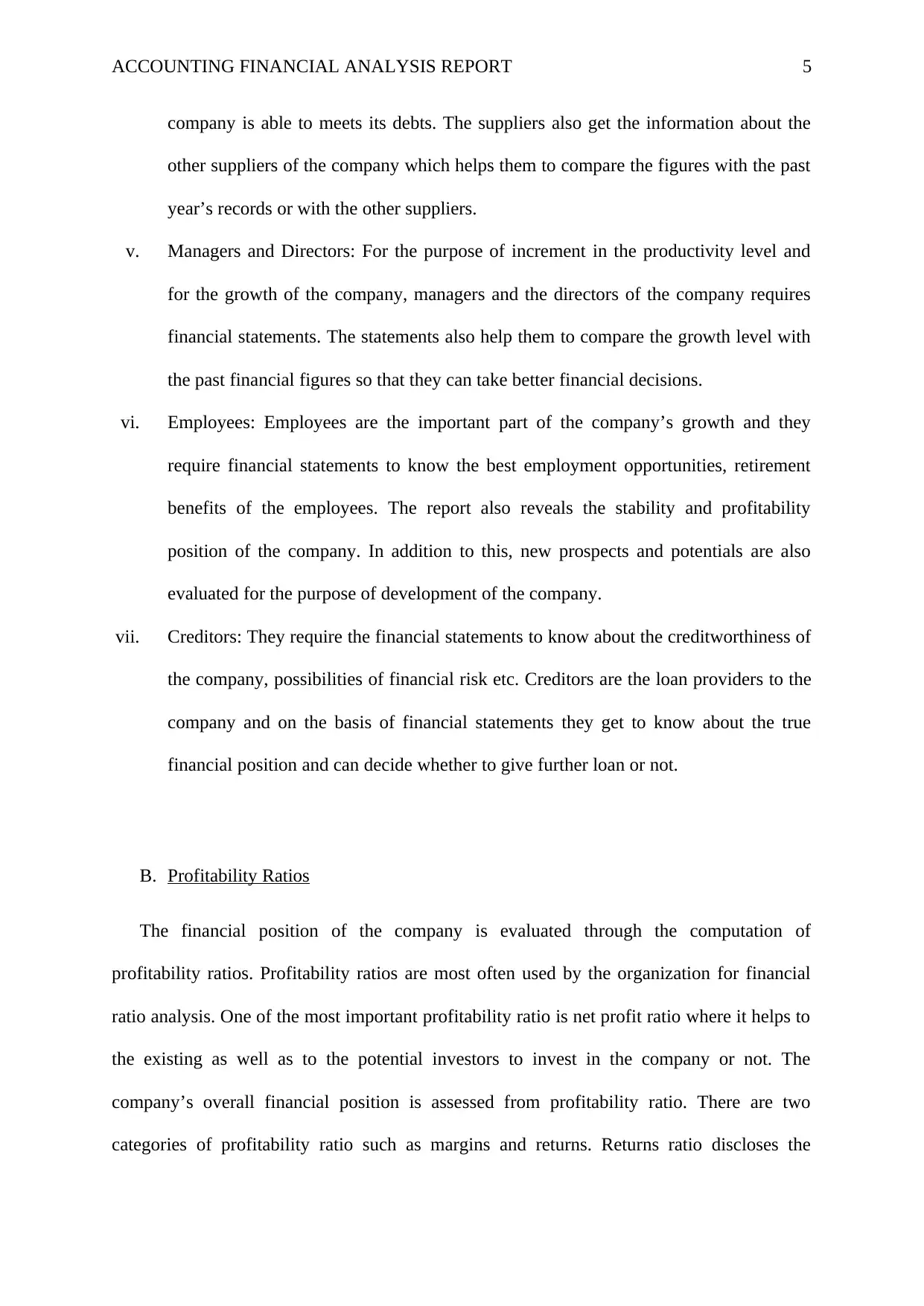
company is able to meets its debts. The suppliers also get the information about the
other suppliers of the company which helps them to compare the figures with the past
year’s records or with the other suppliers.
v. Managers and Directors: For the purpose of increment in the productivity level and
for the growth of the company, managers and the directors of the company requires
financial statements. The statements also help them to compare the growth level with
the past financial figures so that they can take better financial decisions.
vi. Employees: Employees are the important part of the company’s growth and they
require financial statements to know the best employment opportunities, retirement
benefits of the employees. The report also reveals the stability and profitability
position of the company. In addition to this, new prospects and potentials are also
evaluated for the purpose of development of the company.
vii. Creditors: They require the financial statements to know about the creditworthiness of
the company, possibilities of financial risk etc. Creditors are the loan providers to the
company and on the basis of financial statements they get to know about the true
financial position and can decide whether to give further loan or not.
B. Profitability Ratios
The financial position of the company is evaluated through the computation of
profitability ratios. Profitability ratios are most often used by the organization for financial
ratio analysis. One of the most important profitability ratio is net profit ratio where it helps to
the existing as well as to the potential investors to invest in the company or not. The
company’s overall financial position is assessed from profitability ratio. There are two
categories of profitability ratio such as margins and returns. Returns ratio discloses the
company is able to meets its debts. The suppliers also get the information about the
other suppliers of the company which helps them to compare the figures with the past
year’s records or with the other suppliers.
v. Managers and Directors: For the purpose of increment in the productivity level and
for the growth of the company, managers and the directors of the company requires
financial statements. The statements also help them to compare the growth level with
the past financial figures so that they can take better financial decisions.
vi. Employees: Employees are the important part of the company’s growth and they
require financial statements to know the best employment opportunities, retirement
benefits of the employees. The report also reveals the stability and profitability
position of the company. In addition to this, new prospects and potentials are also
evaluated for the purpose of development of the company.
vii. Creditors: They require the financial statements to know about the creditworthiness of
the company, possibilities of financial risk etc. Creditors are the loan providers to the
company and on the basis of financial statements they get to know about the true
financial position and can decide whether to give further loan or not.
B. Profitability Ratios
The financial position of the company is evaluated through the computation of
profitability ratios. Profitability ratios are most often used by the organization for financial
ratio analysis. One of the most important profitability ratio is net profit ratio where it helps to
the existing as well as to the potential investors to invest in the company or not. The
company’s overall financial position is assessed from profitability ratio. There are two
categories of profitability ratio such as margins and returns. Returns ratio discloses the
⊘ This is a preview!⊘
Do you want full access?
Subscribe today to unlock all pages.
Trusted by 1+ million students worldwide

ACCOUNTING FINANCIAL ANALYSIS REPORT 6
complete performance of the company whereas margins ratio measures the ability of the
company to convert sales into profits (Morning Star, 2018).
i. Gross profit ratio: Gross profit measures the ability of the company to generate profit
after the deduction of direct expenses from the sales revenue. This will reveal the
ability of the company on controlling manufacturing expenses as well as on
inventories. The gross profit ratio is computed by dividing gross profit to sales. This
ratio is expressed in percentage form. Higher the ratio better is the financial position
for the company (Morning Star, 2018). Formula is: Gross profit*100/sales.
Particulars 2017 2018
Gross Profit $ 13,000,000 $ 15,000,000
Sales $ 24,000,000 $ 27,000,000
Gross Profit ratio [$13000000*100/$
24000000] = 54.17%
[$15000000*100/$
27000000] = 55.55%
Industry Average 24%
From the above table, it is observed that in year 2017 gross profit ratio was 54.17% which
was increased to 55.55% in year 2018. The above performance of Folkston limited is
favorable due to increase in 1.5% in gross profit ratio. For future years the company needs to
control on cost of inventories and on direct expenses to raise the gross profit ratio. Further the
industry average shown above is 24% which means company is earning more than the
industry average in both years which is favourable to the users of the financial statements. In
addition to this, higher the gross profit, the shareholders will invest more and also employees
and managers will get more bonus. Thus, it can be said that increment in gross profit ratio is
complete performance of the company whereas margins ratio measures the ability of the
company to convert sales into profits (Morning Star, 2018).
i. Gross profit ratio: Gross profit measures the ability of the company to generate profit
after the deduction of direct expenses from the sales revenue. This will reveal the
ability of the company on controlling manufacturing expenses as well as on
inventories. The gross profit ratio is computed by dividing gross profit to sales. This
ratio is expressed in percentage form. Higher the ratio better is the financial position
for the company (Morning Star, 2018). Formula is: Gross profit*100/sales.
Particulars 2017 2018
Gross Profit $ 13,000,000 $ 15,000,000
Sales $ 24,000,000 $ 27,000,000
Gross Profit ratio [$13000000*100/$
24000000] = 54.17%
[$15000000*100/$
27000000] = 55.55%
Industry Average 24%
From the above table, it is observed that in year 2017 gross profit ratio was 54.17% which
was increased to 55.55% in year 2018. The above performance of Folkston limited is
favorable due to increase in 1.5% in gross profit ratio. For future years the company needs to
control on cost of inventories and on direct expenses to raise the gross profit ratio. Further the
industry average shown above is 24% which means company is earning more than the
industry average in both years which is favourable to the users of the financial statements. In
addition to this, higher the gross profit, the shareholders will invest more and also employees
and managers will get more bonus. Thus, it can be said that increment in gross profit ratio is
Paraphrase This Document
Need a fresh take? Get an instant paraphrase of this document with our AI Paraphraser

ACCOUNTING FINANCIAL ANALYSIS REPORT 7
very important either through rising in sales revenue or decreasing the cost of sales by
purchasing efficient equipment.
ii. Net operating profit ratio: This ratio calculates operating profit earned on sales revenue
after deduction of operating expenses such as vehicle running expenses, salaries etc.
This ratio evaluates how proficiently company earns returns after all the necessary
operating expenses which is favorable (Morning Star, 2018). This ratio is expressed in
percentage form. Formula is: Net operating profit*100/sales.
Particulars 2017 2018
Net operating Profit $ 1,360,000 $ 2,150,000
Sales $ 24,000,000 $ 27,000,000
Net operating Profit ratio [$1360000*100/$
24000000] = 5.67%
[$2150000*100/$
27000000] = 7.96%
Industry Average 4%
From the above table it is seen that net operating profit ratio in year 2017 was 5.67%
whereas in year 2018 it was 7.96% that is increment is about 2.2% which depicts the
favorable to the company because the company earns returns after all the deduction of
operating expenses. Further it can also have said that Folkston limited has good net operating
profit ratio in comparison to industry average. The company should focus on the increment in
the sales price or in the increment of units sold which can be achieved through proper
advertising, marketing etc.
iii. Return on Assets: This is also a type of profitability ratio where returns are determined
on the assets of the company. Higher the return on assets means the assets of the
very important either through rising in sales revenue or decreasing the cost of sales by
purchasing efficient equipment.
ii. Net operating profit ratio: This ratio calculates operating profit earned on sales revenue
after deduction of operating expenses such as vehicle running expenses, salaries etc.
This ratio evaluates how proficiently company earns returns after all the necessary
operating expenses which is favorable (Morning Star, 2018). This ratio is expressed in
percentage form. Formula is: Net operating profit*100/sales.
Particulars 2017 2018
Net operating Profit $ 1,360,000 $ 2,150,000
Sales $ 24,000,000 $ 27,000,000
Net operating Profit ratio [$1360000*100/$
24000000] = 5.67%
[$2150000*100/$
27000000] = 7.96%
Industry Average 4%
From the above table it is seen that net operating profit ratio in year 2017 was 5.67%
whereas in year 2018 it was 7.96% that is increment is about 2.2% which depicts the
favorable to the company because the company earns returns after all the deduction of
operating expenses. Further it can also have said that Folkston limited has good net operating
profit ratio in comparison to industry average. The company should focus on the increment in
the sales price or in the increment of units sold which can be achieved through proper
advertising, marketing etc.
iii. Return on Assets: This is also a type of profitability ratio where returns are determined
on the assets of the company. Higher the return on assets means the assets of the

ACCOUNTING FINANCIAL ANALYSIS REPORT 8
company are effectively managed. It is also expressed in percentage form (Morning
Star, 2018). Formula is: Net operating profit*100/total assets.
Particulars 2017 2018
Net operating Profit $ 1,360,000 $ 2,150,0000
Total Assets $ 43,050,000 $ 38,870,000
Return on assets (ROA) [$1360000*100/$
43050000] = 3.16%
[$21500000*100/$38870000]
= 5.53%
Industry Average 5%
The return on assets ratio are also very important for evaluating the profitability position of
the company, The ROA evaluates how well the company’s assets are managed. In this case it
can be observed that company earned Return on assets in the year 2017 of 3.16% whereas it
was increased to 5.53% in the year 2018 that is increment is approximately by 2.5% from last
year which shows sound position of the company by managing its assets efficiently and
effectively. As a whole, Folkston limited performance is sound and stable in these two years.
Thus, it can be said that returns earned by the company is showing that the expenses are paid
off which is better for the growth of the company. Further in addition to this, stakeholders of
the company are also get the benefit in different aspects to achieve more profit. For the
improvement perspective it can be suggested that company should monitor assets expenses
every month by renting the equipment, furniture or machinery instead of buying them
(Johnston, 2018).
iv. Return on Equity: This is also a type of profitability ratio which evaluates company’s
ability to earn returns on the shareholders’ investments. This ratio computes profits
company are effectively managed. It is also expressed in percentage form (Morning
Star, 2018). Formula is: Net operating profit*100/total assets.
Particulars 2017 2018
Net operating Profit $ 1,360,000 $ 2,150,0000
Total Assets $ 43,050,000 $ 38,870,000
Return on assets (ROA) [$1360000*100/$
43050000] = 3.16%
[$21500000*100/$38870000]
= 5.53%
Industry Average 5%
The return on assets ratio are also very important for evaluating the profitability position of
the company, The ROA evaluates how well the company’s assets are managed. In this case it
can be observed that company earned Return on assets in the year 2017 of 3.16% whereas it
was increased to 5.53% in the year 2018 that is increment is approximately by 2.5% from last
year which shows sound position of the company by managing its assets efficiently and
effectively. As a whole, Folkston limited performance is sound and stable in these two years.
Thus, it can be said that returns earned by the company is showing that the expenses are paid
off which is better for the growth of the company. Further in addition to this, stakeholders of
the company are also get the benefit in different aspects to achieve more profit. For the
improvement perspective it can be suggested that company should monitor assets expenses
every month by renting the equipment, furniture or machinery instead of buying them
(Johnston, 2018).
iv. Return on Equity: This is also a type of profitability ratio which evaluates company’s
ability to earn returns on the shareholders’ investments. This ratio computes profits
⊘ This is a preview!⊘
Do you want full access?
Subscribe today to unlock all pages.
Trusted by 1+ million students worldwide
ACCOUNTING FINANCIAL ANALYSIS REPORT 9
earned on per dollar of equity. This ratio is very important for the prospective investors
in order to assess the company’s stability to generate income from their money. Higher
ratio is always preferable because it depicts better financial health of the company. The
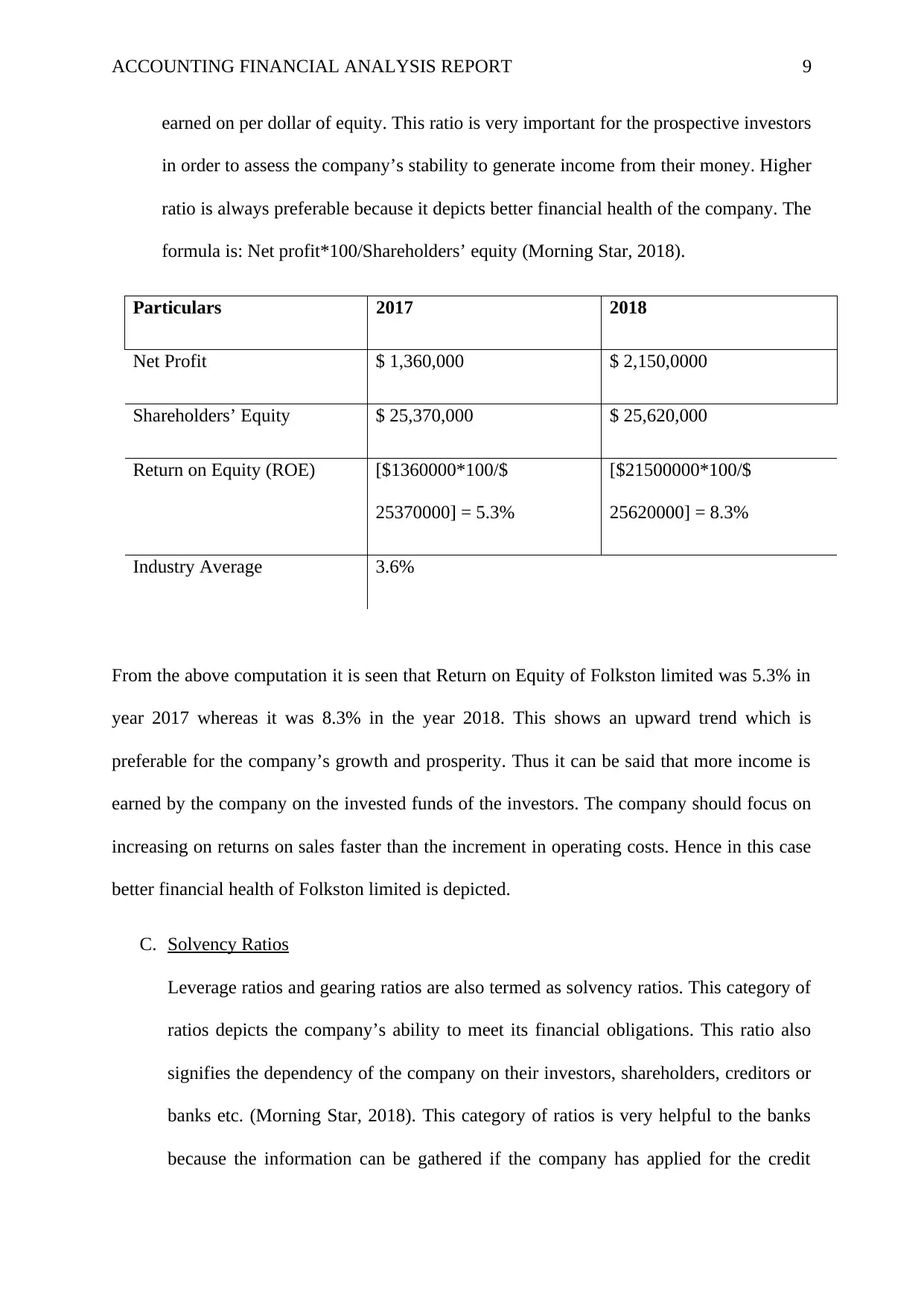
formula is: Net profit*100/Shareholders’ equity (Morning Star, 2018).
Particulars 2017 2018
Net Profit $ 1,360,000 $ 2,150,0000
Shareholders’ Equity $ 25,370,000 $ 25,620,000
Return on Equity (ROE) [$1360000*100/$
25370000] = 5.3%
[$21500000*100/$
25620000] = 8.3%
Industry Average 3.6%
From the above computation it is seen that Return on Equity of Folkston limited was 5.3% in
year 2017 whereas it was 8.3% in the year 2018. This shows an upward trend which is
preferable for the company’s growth and prosperity. Thus it can be said that more income is
earned by the company on the invested funds of the investors. The company should focus on
increasing on returns on sales faster than the increment in operating costs. Hence in this case
better financial health of Folkston limited is depicted.
C. Solvency Ratios
Leverage ratios and gearing ratios are also termed as solvency ratios. This category of
ratios depicts the company’s ability to meet its financial obligations. This ratio also
signifies the dependency of the company on their investors, shareholders, creditors or
banks etc. (Morning Star, 2018). This category of ratios is very helpful to the banks
because the information can be gathered if the company has applied for the credit
earned on per dollar of equity. This ratio is very important for the prospective investors
in order to assess the company’s stability to generate income from their money. Higher
ratio is always preferable because it depicts better financial health of the company. The
formula is: Net profit*100/Shareholders’ equity (Morning Star, 2018).
Particulars 2017 2018
Net Profit $ 1,360,000 $ 2,150,0000
Shareholders’ Equity $ 25,370,000 $ 25,620,000
Return on Equity (ROE) [$1360000*100/$
25370000] = 5.3%
[$21500000*100/$
25620000] = 8.3%
Industry Average 3.6%
From the above computation it is seen that Return on Equity of Folkston limited was 5.3% in
year 2017 whereas it was 8.3% in the year 2018. This shows an upward trend which is
preferable for the company’s growth and prosperity. Thus it can be said that more income is
earned by the company on the invested funds of the investors. The company should focus on
increasing on returns on sales faster than the increment in operating costs. Hence in this case
better financial health of Folkston limited is depicted.
C. Solvency Ratios
Leverage ratios and gearing ratios are also termed as solvency ratios. This category of
ratios depicts the company’s ability to meet its financial obligations. This ratio also
signifies the dependency of the company on their investors, shareholders, creditors or
banks etc. (Morning Star, 2018). This category of ratios is very helpful to the banks
because the information can be gathered if the company has applied for the credit
Paraphrase This Document
Need a fresh take? Get an instant paraphrase of this document with our AI Paraphraser

ACCOUNTING FINANCIAL ANALYSIS REPORT 10
facilities. Solvency ratios depicts the capacity of the company to pay off their debts in
time that is wealth position of the company is gauged. There are two categories of
solvency ratios such as short-term which includes current ratio and acid test ratio and
the other is long-term which includes debt to equity ratio and debt to assets ratio
(Morning Star, 2018).
i. Debt to Equity Ratio: This ratio is a long term solvency ratio which compares total
debts to total shareholders’ equity. This is also termed as balance sheet ratio
because it identifies percentage of finances comes from shareholders and
creditors. Higher debt to equity ratio signifies that the company has more finances
from external parties such as creditors and less from internal parties such as
shareholders (Morning Star, 2018). Formula is: Total liabilities/ total
shareholders’ equity.
Particulars 2017 2018
Total Liabilities $ 17,680,000 $ 13,250,000
Shareholders’ Equity $ 25,370,000 $ 25,620,000
Debt to Equity ratio [$17680000/$ 25370000] =
0.69
[$13250000/$ 25620000]
= 0.52
Industry Average 0.50
From the above table it is seen that Debt to equity ratio of the company is 0.69 in the year
2017 whereas it was decreased to 0.52 in the year 2018 which depicts that in 2017 company
has financed more from external parties that is creditors but whereas in the year 2018 the
situation is vice versa which means that the company has financed more from shareholders’
facilities. Solvency ratios depicts the capacity of the company to pay off their debts in
time that is wealth position of the company is gauged. There are two categories of
solvency ratios such as short-term which includes current ratio and acid test ratio and
the other is long-term which includes debt to equity ratio and debt to assets ratio
(Morning Star, 2018).
i. Debt to Equity Ratio: This ratio is a long term solvency ratio which compares total
debts to total shareholders’ equity. This is also termed as balance sheet ratio
because it identifies percentage of finances comes from shareholders and
creditors. Higher debt to equity ratio signifies that the company has more finances
from external parties such as creditors and less from internal parties such as
shareholders (Morning Star, 2018). Formula is: Total liabilities/ total
shareholders’ equity.
Particulars 2017 2018
Total Liabilities $ 17,680,000 $ 13,250,000
Shareholders’ Equity $ 25,370,000 $ 25,620,000
Debt to Equity ratio [$17680000/$ 25370000] =
0.69
[$13250000/$ 25620000]
= 0.52
Industry Average 0.50
From the above table it is seen that Debt to equity ratio of the company is 0.69 in the year
2017 whereas it was decreased to 0.52 in the year 2018 which depicts that in 2017 company
has financed more from external parties that is creditors but whereas in the year 2018 the
situation is vice versa which means that the company has financed more from shareholders’

ACCOUNTING FINANCIAL ANALYSIS REPORT 11
than from creditors which is the favourable position for the company because in 2018 the
liabilities are less than the shareholders’ equity. Thus it is very important for the companies to
reduce the liabilities and increase equity by issuing more shares.
i. Debt to total assets ratio: This ratio computes the paying of the debts from its
asset utilization. Lower ratio is preferable because it signifies company has
low debts than its assets. Formula is: Total liabilities*100/ total assets
(Morning Star, 2018).
Particulars 2017 2018
Total Liabilities $ 17,680,000 $ 13,250,000
Total Assets $ 43,050,000 $ 38,870,000
Debt to total assets ratio [$17680000*100/$
43050000] = 41.07%
[$13250000*100/$
38870000] = 34.09%
Industry Average 74%
From the above calculation table, it is seen that debt to total assets ratio was 41.07%
in the year 2017 whereas it was decreased to 34.09% in the year 2018. Industry average given
was 74%. It depicts beneficial position for the Folkston limited because the company has
ability to paying off its debts from the utilised assets. In other words, it can be said that
company has low debts than the availability of assets. Also if the debt to total asset ratio is
decreased then it means shareholders’ will more invest in the company. It can be suggested
that the company should focus on selling of unproductive assets or issuing more shares and
reducing liabilities by meeting the obligations.
than from creditors which is the favourable position for the company because in 2018 the
liabilities are less than the shareholders’ equity. Thus it is very important for the companies to
reduce the liabilities and increase equity by issuing more shares.
i. Debt to total assets ratio: This ratio computes the paying of the debts from its
asset utilization. Lower ratio is preferable because it signifies company has
low debts than its assets. Formula is: Total liabilities*100/ total assets
(Morning Star, 2018).
Particulars 2017 2018
Total Liabilities $ 17,680,000 $ 13,250,000
Total Assets $ 43,050,000 $ 38,870,000
Debt to total assets ratio [$17680000*100/$
43050000] = 41.07%
[$13250000*100/$
38870000] = 34.09%
Industry Average 74%
From the above calculation table, it is seen that debt to total assets ratio was 41.07%
in the year 2017 whereas it was decreased to 34.09% in the year 2018. Industry average given
was 74%. It depicts beneficial position for the Folkston limited because the company has
ability to paying off its debts from the utilised assets. In other words, it can be said that
company has low debts than the availability of assets. Also if the debt to total asset ratio is
decreased then it means shareholders’ will more invest in the company. It can be suggested
that the company should focus on selling of unproductive assets or issuing more shares and
reducing liabilities by meeting the obligations.
⊘ This is a preview!⊘
Do you want full access?
Subscribe today to unlock all pages.
Trusted by 1+ million students worldwide

1 out of 23


Related Documents


Your All-in-One AI-Powered Toolkit for Academic Success.
+13062052269
info@desklib.com
Available 24*7 on WhatsApp / Email
![[object Object]](/_next/static/media/star-bottom.7253800d.svg)
Unlock your academic potential
Copyright © 2020–2026 A2Z Services. All Rights Reserved. Developed and managed by ZUCOL.