Food & Beverage Management: Investigation of Cost Control Practices

Verified

Added on  2023/06/11

|9
|2099
|482
Report
AI Summary
This report presents an investigation into the cost control and financial management practices within a food and beverage enterprise, specifically focusing on the Australian Leisure and Hospitality Group. The report analyzes interview findings with the food and beverage manager, detailing strategies employed in both front and back of house operations, including cross-training, service cost negotiation, and financial control measures like control logs and insurance policies. The effectiveness of these measures is evaluated, highlighting benefits such as predictive budgeting, optimized labor costs, and efficient vendor sourcing. The report also emphasizes the importance of energy cost control, property maintenance, and inventory management, along with the implementation of POS systems for financial oversight. The interview questions are included in the appendix, providing a comprehensive overview of the cost control strategies used in the organization. Desklib provides past papers and solved assignments for students.
Document Page
Running head: FOOD AND BEVERAGE MANAGEMENT
Food and Beverage Management
Name of the University:
Name of the Student:
Authors Note:
tabler-icon-diamond-filled.svg

Paraphrase This Document

Need a fresh take? Get an instant paraphrase of this document with our AI Paraphraser
Document Page
1FOOD AND BEVERAGE MANAGEMENT
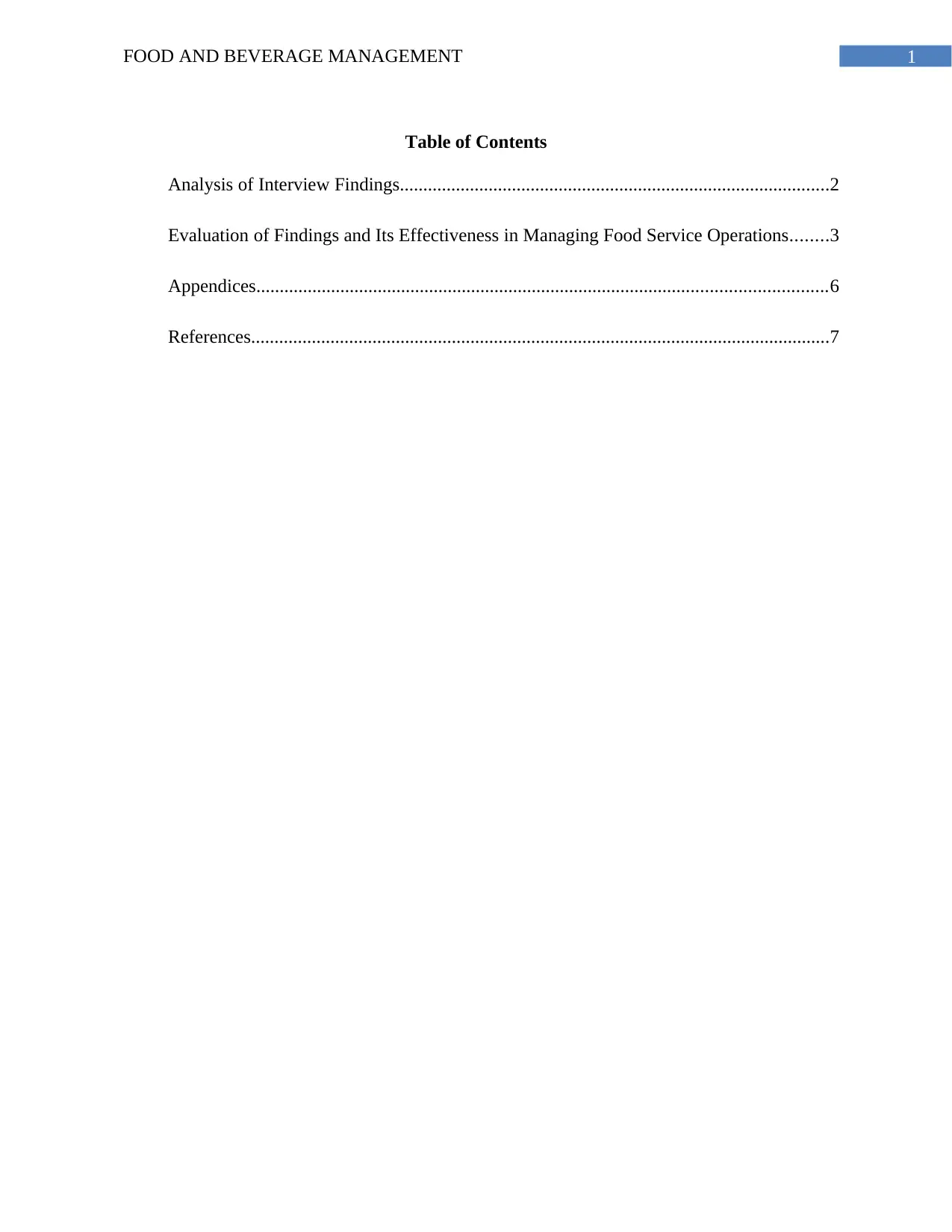
Table of Contents
Analysis of Interview Findings............................................................................................2
Evaluation of Findings and Its Effectiveness in Managing Food Service Operations........3
Appendices..........................................................................................................................6
References............................................................................................................................7
Document Page
2FOOD AND BEVERAGE MANAGEMENT
Analysis of Interview Findings
Interview was conducted with the food and beverage department manager of Australian
Leisure and Hospitality Group in which certain responses were gathered regarding the
description of the hospitality enterprise within which the interviewee manages operations.
Certain responses were also gathered regarding interview questions on maintenance of cost
control in front and back of house operations (Ball et al. 2015). The interviewee was also asked
questions regarding the financial control methods use in the daily business operation of the hotel.
Certain effective interview results were gathered that facilitated in evaluating the use of cost
control measures in the operations of the hotel by food and beverage manager.
The interviewee presented a view that he belongs to one of the renowned hotel group in
Australia that offers services such as food, beverages, restaurant and accommodation to the
visitors (Brown 2018). Cross training is used by the food and beverage manager in Australian
Leisure and Hospitality Group in decreasing costs in front house operations. It was also gathered
from the interview results that strategy of service cost negotiation is implemented by food and
beverage manager in Australian Leisure and Hospitality Group in decreasing costs of back house
operations. Food and beverage manager in Australian Leisure and Hospitality Group employs
financial cost control measures such as using control logs, implementing reasonable insurance
policy and establishing self-budget and cost control contracts (Huang et al. 2017).
It was also gathered from the interview that best financial cost control practices that are
used by Australian Leisure and Hospitality Group considers use of regular logs for financial,
inventory and maintainice records to be filled on daily, weekly or monthly basis. This is then
presented to the top management of the hotel (Lal et al. 2017). The food and beverage manager
Document Page
3FOOD AND BEVERAGE MANAGEMENT
also responded that to ensure better cost control in both the front and back house operations in
the hotel, use of reasonable insurance policy is considered. The manager also explained in the
interview that marginal profits from each transaction is gathered and the point of failure is traced
for maintaining better cost control in daily activities of Australian Leisure and Hospitality Group.
Evaluation of Findings and Its Effectiveness in Managing Food Service Operations
The findings those are gathered from the interview carried out on the interviewee that is
the food and beverage manager of Australian Leisure and Hospitality Group (Le et al. 2016).
The findings those are gathered from the interview responses is deemed to be useful in
evaluating whether the cost control measures followed by the manager in front and back office
operations as well as for daily operations are effective enough in managing food service
operations within the hotel. The cost of operations is controlled by the manager in a better
manner through making predictive budgets for all the departments (Mialon, Swinburn, Allender
and Sacks 2016). Such cost control measure has produced effective results for the hotel as this
has facilitated in hiring professional chefs and workers those can select the best measure for all
the vendors those requisite goods. The cost control measure such as negotiating laundry contract
prices, implementation of power saving technology within the guest rooms has also facilitated in
attaining better profit margins through decreasing unnecessary expenses.
It was also gathered from the interview that front office cost control is maintained in
Australian Leisure and Hospitality Group through controlling labor expenses (Pathak et al.
2015). This is done in the hotel through monitoring the time taken by the housekeepers to clean
the stay over rooms verses the check-outs. This cost control strategy is observed to be effective
for the hotel as it facilitated the food and beverage manager in determining time taken by the
tabler-icon-diamond-filled.svg

Paraphrase This Document

Need a fresh take? Get an instant paraphrase of this document with our AI Paraphraser
Document Page
4FOOD AND BEVERAGE MANAGEMENT
workers in cleaning each room type and then staffing accordingly to help control the labor costs.
Controlling labor costs is deemed to be effective in forecasting within Australian Leisure and
Hospitality Group. This is because associates can be scheduled relied on accurate forecast of
food and beverage needs in the hotel that can further better manage service expectations of
consumers through providing right number of employees (Sonneville et al. 2015).
The interview presented a clear view regarding opportunities offered by the food and
beverage department of Australian Leisure and Hospitality Group in controlling costs at
properties when it comes to sourcing of food. This cost control strategy is observed to be
effective in the hotel for the reason that it makes sure that the hotel is working with less number
of vendors for sourcing all types of food and dropping sizes of food sourcing that ensured a huge
difference in their cost (Verghese, Lewis, Lockrey and Williams 2015). For daily operations
financial control menu audit is deemed to be highly effective on a quarterly basis to maintain
operations in check. For cost control Software as a Service (SaaS) that facilitates in maintaining
cheaper up-front expenses and it can also be simpler to setup and install that makes the
operations highly secure. Certain effective cost control measures are implemented by the food
and beverage manager through implementing better front office and property management
(Wood 2018). Implementation of cost control measures in Australian Leisure and Hospitality
Group also made sure that restaurant point of sale is maintained along with the core accounting
measures.
The interview also revealed that energy cost control is highly necessary in the hotel in
dealing with the unnecessary expenses and for enhancing profit margin. In implementing this
cost control strategy within this hotel, the food and beverage manager indicated that old
thermostats are used as they are highly wasteful and for tis reason replacing them has facilitated
Document Page
5FOOD AND BEVERAGE MANAGEMENT
in decreasing the electricity expenses of the hotel by 40% annually (Verghese, Lewis, Lockrey
and Williams 2015). The energy star benchmark along with other green certifications are attained
by Australian Leisure and Hospitality Group has increased profit of the hotel and served as
effected cost control tool. To control costs in the front office operations, the hotel also makes
great attempts in decreasing property operations and maintainice expenses. To control such
expenses, it is made sure by the manager that was interviewed that the vendors are in place to fix
equipment at a reasonable price. This strategy has been effective in the hotel for the reason that it
has resulted in long term agreements that has stabilized expenses and have provided the hotel
with increased power of negotiation (Verghese, Lewis, Lockrey and Williams 2015).
Certain effective interview results were gathered that facilitated in evaluating the use of
cost control measures in the operations of the hotel by food and beverage manager. The hotel is
also observed to decrease lowering inventory levels as this has facilitated Australian Leisure and
Hospitality Group to attain the advantage of getting rid of the situation in which they have more
food on the shelves of the kitchen than they require. For this reason, the interviewee presented a
view that inventory levels are evaluated product by product based on which the reorder levels are
decided. This has offered added advantage to the hotel for the reason that it has decreased excess
accumulation of inventory, decreased waste and spoilage and the staff is observed to handle
expensive products when there is less availability of the same in the hotel (Verghese, Lewis,
Lockrey and Williams 2015). Implementation of POS has facilitated Australian Leisure and
Hospitality Group for calculating cash with every checkout
Document Page
6FOOD AND BEVERAGE MANAGEMENT
Appendices
Interview questions for the food and beverage manager of Australian Leisure and
Hospitality Group.
1. Which type of hospitality enterprise does the interviewee manage?
The interviewee belongs to one of the renowned hotel group in Australia that offers
services such as food, beverages, restaurant and accommodation to the visitors.
2. How does the interviewee maintain cost control of the:
a. Front of House Operations: Cross training is used by the food and beverage manager in
Australian Leisure and Hospitality Group in decreasing costs in front house operations.
b. Back of House Operations: Strategy of service cost negotiation is implemented by
food and beverage manager in Australian Leisure and Hospitality Group in decreasing costs of
back house operations.
3. Which financial control methods does the interviewee use in daily business operation?
Food and beverage manager in Australian Leisure and Hospitality Group employs
financial cost control measures such as using control logs, implementing reasonable insurance
policy and establishing self-budget and cost control contracts.
tabler-icon-diamond-filled.svg

Paraphrase This Document

Need a fresh take? Get an instant paraphrase of this document with our AI Paraphraser
Document Page
7FOOD AND BEVERAGE MANAGEMENT
References
Ball, K., McNaughton, S.A., Le, H.N., Gold, L., Ni Mhurchu, C., Abbott, G., Pollard, C. and
Crawford, D., 2015. Influence of price discounts and skill-building strategies on purchase and
consumption of healthy food and beverages: outcomes of the Supermarket Healthy Eating for
Life randomized controlled trial–. The American journal of clinical nutrition, 101(5), pp.1055-
1064.
Brown, A.C., 2018. Understanding food: principles and preparation. Cengage learning.
Huang, H.W., Wu, S.J., Lu, J.K., Shyu, Y.T. and Wang, C.Y., 2017. Current status and future
trends of high-pressure processing in food industry. Food Control, 72, pp.1-8.
Lal, A., Mantilla-Herrera, A.M., Veerman, L., Backholer, K., Sacks, G., Moodie, M., Siahpush,
M., Carter, R. and Peeters, A., 2017. Modelled health benefits of a sugar-sweetened beverage tax
across different socioeconomic groups in Australia: A cost-effectiveness and equity
analysis. PLoS medicine, 14(6), p.e1002326.
Le, H.N., Gold, L., Abbott, G., Crawford, D., McNaughton, S.A., Mhurchu, C.N., Pollard, C.
and Ball, K., 2016. Economic evaluation of price discounts and skill-building strategies on
purchase and consumption of healthy food and beverages: The SHELf randomized controlled
trial. Social Science & Medicine, 159, pp.83-91.
Mialon, M., Swinburn, B., Allender, S. and Sacks, G., 2016. Systematic examination of publicly-
available information reveals the diverse and extensive corporate political activity of the food
industry in Australia. BMC public health, 16(1), p.283.
Document Page
8FOOD AND BEVERAGE MANAGEMENT
Pathak, N., Hagare, P., Guo, W. and Ngo, H.H., 2015. Australian food processing industry and
environmental aspect–a review. In International conference on biological civil and engineering
(BCEE-2015) Feb (pp. 3-4).
Sonneville, K.R., Long, M.W., Ward, Z.J., Resch, S.C., Wang, Y.C., Pomeranz, J.L., Moodie,
M.L., Carter, R., Sacks, G., Swinburn, B.A. and Gortmaker, S.L., 2015. BMI and healthcare cost
impact of eliminating tax subsidy for advertising unhealthy food to youth. American journal of
preventive medicine, 49(1), pp.124-134.
Verghese, K., Lewis, H., Lockrey, S. and Williams, H., 2015. Packaging's role in minimizing
food loss and waste across the supply chain. Packaging Technology and Science, 28(7), pp.603-
620.
Wood, R.C., 2018. Strategic questions in food and beverage management. Routledge.
chevron_up_icon
1 out of 9
circle_padding
hide_on_mobile
zoom_out_icon
[object Object]