Food and Beverage Operations Management Report for Four Seasons Hotel
VerifiedAdded on 2020/07/23
|14
|4376
|50
Report
AI Summary
This report provides a detailed analysis of food and beverage operations management, focusing on a hypothetical five-star hotel in Blackpool, UK. It explores various food service styles, including American, silver, pre-plated, family, buffet, cafeteria, and fine dining, evaluating their suitability for different customer needs. The report then delves into food production systems, encompassing dry heat methods like roasting and grilling, as well as moist heat and cook-chill techniques. It emphasizes the importance of standardization in maintaining quality, controlling costs, and ensuring uniform service. The report also discusses costing and value addition strategies to enhance the overall dining experience. The report provides a thorough overview of crucial aspects in the hospitality sector and provides key insights for effective management.
Food and Beverage
Operations Management
Operations Management

Paraphrase This Document
Need a fresh take? Get an instant paraphrase of this document with our AI Paraphraser
Table of Contents
INTRODUCTION...........................................................................................................................1
TASK 1............................................................................................................................................1
Food service styles......................................................................................................................1
Food Production systems............................................................................................................3
Standardisation............................................................................................................................4
Costing........................................................................................................................................5
Value addition.............................................................................................................................7
CONCLUSION................................................................................................................................8
REFERENCES..............................................................................................................................10
INTRODUCTION...........................................................................................................................1
TASK 1............................................................................................................................................1
Food service styles......................................................................................................................1
Food Production systems............................................................................................................3
Standardisation............................................................................................................................4
Costing........................................................................................................................................5
Value addition.............................................................................................................................7
CONCLUSION................................................................................................................................8
REFERENCES..............................................................................................................................10
INTRODUCTION
United Kingdom is one of most popular tourist destinations around the world. The
tourism industry in country have experienced a significant rise in recent times (Brotherton,
2012). It has shown significant results post-recession and growth in the same is huge. Amongst
all tourist destinations, Blackpool fetches the top position. The town was constructed in 1894 on
the Irish Sea cost in England. The main attraction are its water parks, pleasure beaches, tower
ballroom and Blackpool tower eye. The only drawback to the place is lack of dining restaurant.
Considering the opinions and feedback of consumers in mind, Four seasons hotels corporations
have ventured in the market of UK with its five star hotel. started a five star hotel to cater the
hospitality and dining needs of people. This report focuses on developing an understanding about
the types, standardisation and costing as well as value addition to food and beverages operations
in Blackpool.
TASK 1
Food service styles
There are a variety of food service styles offered in the market. It depends upon the
organisation that what types of needs they wish to cater. Variety of ways are there in which food
can be reached to the guest table. Some of the significant ways are:
American service
It is an common way through which food is served. This service style is preferred in
hotels where portions are placed on the plates and then served on the table to the guests. The
food is pre-portioned in the kitchen itself then served to the guests. It is one of the labour
intensive approach and requires very less space to perform. When it comes to preference of chefs
, this style wins the prize. The reason is that it provides a platform to show creativity to the
guests (Yeoman and et. al., 2012).
Silver service
This type of service also goes by the name of Platter to plate or English service. This
service focuses on presentation of platter to guest and then served from the same (Davis and et.
al., 2013). The platter must be served from the left side of guests. The need and utilisation of
service gear is high and this should be done with utmost respect and expertise of service
provider.
1
United Kingdom is one of most popular tourist destinations around the world. The
tourism industry in country have experienced a significant rise in recent times (Brotherton,
2012). It has shown significant results post-recession and growth in the same is huge. Amongst
all tourist destinations, Blackpool fetches the top position. The town was constructed in 1894 on
the Irish Sea cost in England. The main attraction are its water parks, pleasure beaches, tower
ballroom and Blackpool tower eye. The only drawback to the place is lack of dining restaurant.
Considering the opinions and feedback of consumers in mind, Four seasons hotels corporations
have ventured in the market of UK with its five star hotel. started a five star hotel to cater the
hospitality and dining needs of people. This report focuses on developing an understanding about
the types, standardisation and costing as well as value addition to food and beverages operations
in Blackpool.
TASK 1
Food service styles
There are a variety of food service styles offered in the market. It depends upon the
organisation that what types of needs they wish to cater. Variety of ways are there in which food
can be reached to the guest table. Some of the significant ways are:
American service
It is an common way through which food is served. This service style is preferred in
hotels where portions are placed on the plates and then served on the table to the guests. The
food is pre-portioned in the kitchen itself then served to the guests. It is one of the labour
intensive approach and requires very less space to perform. When it comes to preference of chefs
, this style wins the prize. The reason is that it provides a platform to show creativity to the
guests (Yeoman and et. al., 2012).
Silver service
This type of service also goes by the name of Platter to plate or English service. This
service focuses on presentation of platter to guest and then served from the same (Davis and et.
al., 2013). The platter must be served from the left side of guests. The need and utilisation of
service gear is high and this should be done with utmost respect and expertise of service
provider.
1
⊘ This is a preview!⊘
Do you want full access?
Subscribe today to unlock all pages.

Trusted by 1+ million students worldwide
Pre-Plated service
This is another significant style of service. The service is provided to the guests who are
seated. The food is arranged on the plates and is ready to be served. This food must be served
from the left and beverages from right. From service provider’s point of view, this service is the
most efficient and economic out of all. But, the other side to it is that may lose it appeal when
served before hand and may question the quality as well (Wu and Pagell, 2011).
Family service
This is another common approach while selecting the type of service. The food is
prepared and put gracefully on the table. The guests are given with an opportunity to serve
themselves using napkins which are provided along with. This style is used in upscale dining and
restaurants. Another name of this service is French service. This approach is mostly used while
serving Indian cuisine.
Buffet service
In this style of service, food is displayed and arranged on the table. The guests are
supposed to move along table where the food items are presented and serve themselves items
they wish to eat. For the purpose of eating guests occupy a table in the banquet. However,
beverages on this type of service style is served on their respective places. This is another
common service style used in the upscale restaurants (Wang and et. al., 2013).
This type of service is helpful for an organisation. for the tourists who need a quick bite
in the Blackpool area. This is suitable for people who have limited time. The bar fulfils the
beverage needs of people on their respective seats.
Cafeteria
Cafeteria services are somewhat identical to Buffet services. The guests have to stand in
line and are served by the servicemen. This is generally done to control the size of servings to
each individual (Grekova and et. al., 2014). This practice is carried out by small and economic
restaurants along with dining on expensive items such as meat and sweets. The items that are not
expensive can be served by guests only. This style of service should not be considered by any
upscale diner.
Fine dining
This is the most ideal way in which services are provided to guests. The focus is on
providing quality services to upscale clientele. The guests are seated and provided with a fancy
2
This is another significant style of service. The service is provided to the guests who are
seated. The food is arranged on the plates and is ready to be served. This food must be served
from the left and beverages from right. From service provider’s point of view, this service is the
most efficient and economic out of all. But, the other side to it is that may lose it appeal when
served before hand and may question the quality as well (Wu and Pagell, 2011).
Family service
This is another common approach while selecting the type of service. The food is
prepared and put gracefully on the table. The guests are given with an opportunity to serve
themselves using napkins which are provided along with. This style is used in upscale dining and
restaurants. Another name of this service is French service. This approach is mostly used while
serving Indian cuisine.
Buffet service
In this style of service, food is displayed and arranged on the table. The guests are
supposed to move along table where the food items are presented and serve themselves items
they wish to eat. For the purpose of eating guests occupy a table in the banquet. However,
beverages on this type of service style is served on their respective places. This is another
common service style used in the upscale restaurants (Wang and et. al., 2013).
This type of service is helpful for an organisation. for the tourists who need a quick bite
in the Blackpool area. This is suitable for people who have limited time. The bar fulfils the
beverage needs of people on their respective seats.
Cafeteria
Cafeteria services are somewhat identical to Buffet services. The guests have to stand in
line and are served by the servicemen. This is generally done to control the size of servings to
each individual (Grekova and et. al., 2014). This practice is carried out by small and economic
restaurants along with dining on expensive items such as meat and sweets. The items that are not
expensive can be served by guests only. This style of service should not be considered by any
upscale diner.
Fine dining
This is the most ideal way in which services are provided to guests. The focus is on
providing quality services to upscale clientele. The guests are seated and provided with a fancy
2
Paraphrase This Document
Need a fresh take? Get an instant paraphrase of this document with our AI Paraphraser
menu and well groomed server takes the order. Upscale experience is the main attraction to this
type of service. Ambience of this place is a combination of class and simplicity.
Services play a crucial role in determining the success of restaurant or diner. It is
necessary to carefully evaluate all the above mentioned services and choose the most suitable
one. The guests should be provided with a choice to prefer economic restaurant and premium
services such as fine dining. If appropriate, the organisation can opt for a mixture of services
such as appetizers at welcome and led to banquet halls where tables and food is arranged
beautifully (Vogel, Papathanassis and Wolber, 2012).
Food Production systems
Food plays a crucial role in the success and failure of a restaurant. Main attraction of food
can be the way it is produced and served. Food production means conversion of raw material into
a dish which is to be served to the guests (Sisson and Adams, 2013). The food preparation is
transformation of raw food into consumable items. Four season focuses on housing and
entertaining guests who come to visit Blackpool. The five star residential will not be enough
until provided with equally good dining facilities. Their food production incorporates number of
ways through which final goods are produced. The various ways through which food production
takes place are:
Dry heat: It is a manner through which food is prepared. The transfer of heat takes place
through air or through metal. The temperature attained in dry heat are competitively higher than
moist heat methods. The various types of dry heat cooking are roasting, grilling, deep frying and
barbecuing (Sisson and Adams, 2013).
Sous-vide
Sous-vide in French means 'under vacuum'. It is a way of producing a recipe in which
food is produced in a vacuum closed plastic pouch which further put into steam for gradual
cooking. This approach is difficult and time consuming. The process of cooking generally
involves 3 to 7 hours. This method ensures food is cooked properly from within. This method is
less preferred for the place where guests are time conscious.
Roasting
This is the most common approach of producing a food. Cooking is done with the help of
an oven or an open fire. dry heat is utilised to cook the evenly from all sides. This process is
mainly used to cook meat at gradual rate from inside as well. 'Red Meat' which is a popular dish
3
type of service. Ambience of this place is a combination of class and simplicity.
Services play a crucial role in determining the success of restaurant or diner. It is
necessary to carefully evaluate all the above mentioned services and choose the most suitable
one. The guests should be provided with a choice to prefer economic restaurant and premium
services such as fine dining. If appropriate, the organisation can opt for a mixture of services
such as appetizers at welcome and led to banquet halls where tables and food is arranged
beautifully (Vogel, Papathanassis and Wolber, 2012).
Food Production systems
Food plays a crucial role in the success and failure of a restaurant. Main attraction of food
can be the way it is produced and served. Food production means conversion of raw material into
a dish which is to be served to the guests (Sisson and Adams, 2013). The food preparation is
transformation of raw food into consumable items. Four season focuses on housing and
entertaining guests who come to visit Blackpool. The five star residential will not be enough
until provided with equally good dining facilities. Their food production incorporates number of
ways through which final goods are produced. The various ways through which food production
takes place are:
Dry heat: It is a manner through which food is prepared. The transfer of heat takes place
through air or through metal. The temperature attained in dry heat are competitively higher than
moist heat methods. The various types of dry heat cooking are roasting, grilling, deep frying and
barbecuing (Sisson and Adams, 2013).
Sous-vide
Sous-vide in French means 'under vacuum'. It is a way of producing a recipe in which
food is produced in a vacuum closed plastic pouch which further put into steam for gradual
cooking. This approach is difficult and time consuming. The process of cooking generally
involves 3 to 7 hours. This method ensures food is cooked properly from within. This method is
less preferred for the place where guests are time conscious.
Roasting
This is the most common approach of producing a food. Cooking is done with the help of
an oven or an open fire. dry heat is utilised to cook the evenly from all sides. This process is
mainly used to cook meat at gradual rate from inside as well. 'Red Meat' which is a popular dish
3
around the world is cooked by roasting exclusively. This method is essential to incorporate into
production system due to its high preference and demand. Four Seasons can opt for this
production style as roasting method is popular in beach side areas.
Grilling
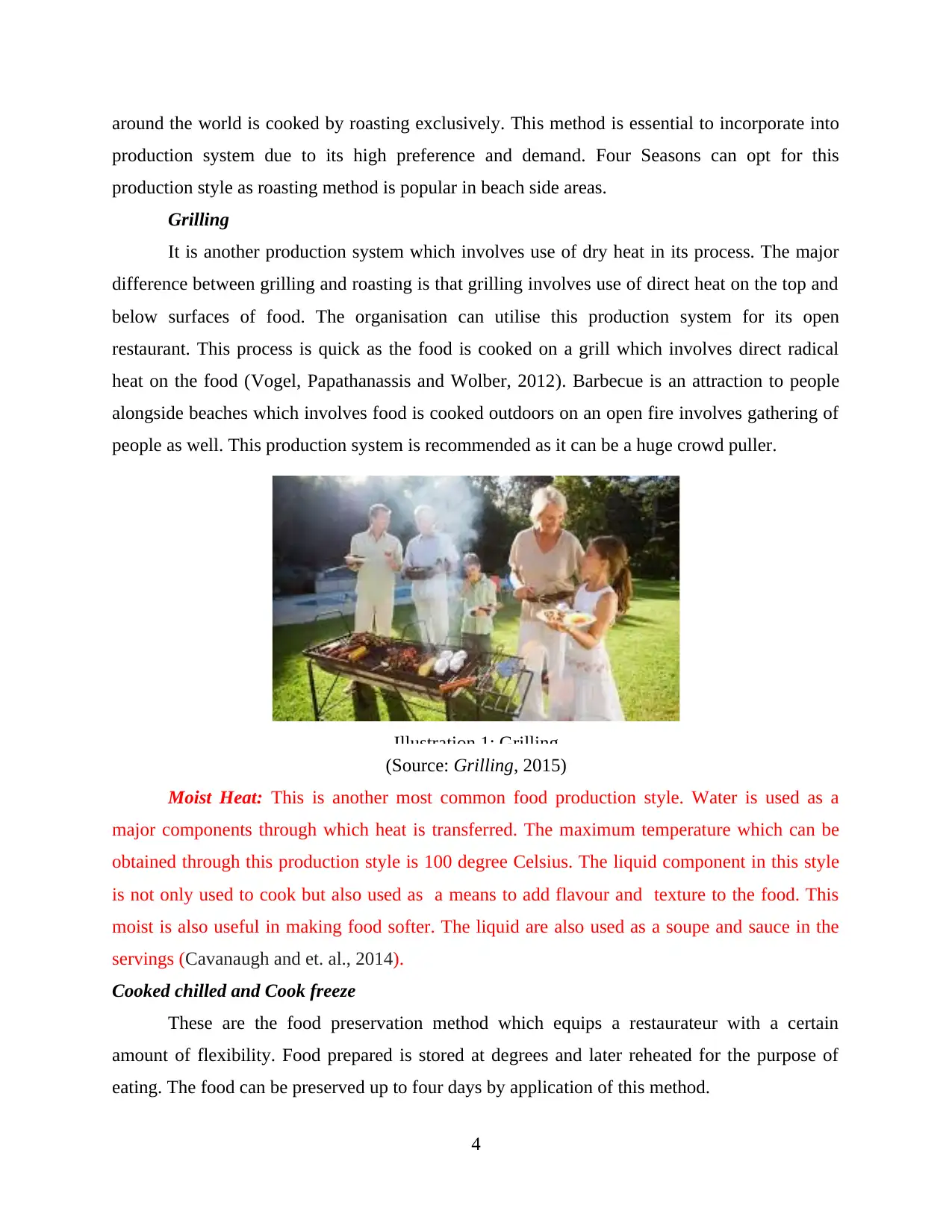
It is another production system which involves use of dry heat in its process. The major
difference between grilling and roasting is that grilling involves use of direct heat on the top and
below surfaces of food. The organisation can utilise this production system for its open
restaurant. This process is quick as the food is cooked on a grill which involves direct radical
heat on the food (Vogel, Papathanassis and Wolber, 2012). Barbecue is an attraction to people
alongside beaches which involves food is cooked outdoors on an open fire involves gathering of
people as well. This production system is recommended as it can be a huge crowd puller.
(Source: Grilling, 2015)
Moist Heat: This is another most common food production style. Water is used as a
major components through which heat is transferred. The maximum temperature which can be
obtained through this production style is 100 degree Celsius. The liquid component in this style
is not only used to cook but also used as a means to add flavour and texture to the food. This
moist is also useful in making food softer. The liquid are also used as a soupe and sauce in the
servings (Cavanaugh and et. al., 2014).
Cooked chilled and Cook freeze
These are the food preservation method which equips a restaurateur with a certain
amount of flexibility. Food prepared is stored at degrees and later reheated for the purpose of
eating. The food can be preserved up to four days by application of this method.
4
Illustration 1: Grilling
production system due to its high preference and demand. Four Seasons can opt for this
production style as roasting method is popular in beach side areas.
Grilling
It is another production system which involves use of dry heat in its process. The major
difference between grilling and roasting is that grilling involves use of direct heat on the top and
below surfaces of food. The organisation can utilise this production system for its open
restaurant. This process is quick as the food is cooked on a grill which involves direct radical
heat on the food (Vogel, Papathanassis and Wolber, 2012). Barbecue is an attraction to people
alongside beaches which involves food is cooked outdoors on an open fire involves gathering of
people as well. This production system is recommended as it can be a huge crowd puller.
(Source: Grilling, 2015)
Moist Heat: This is another most common food production style. Water is used as a
major components through which heat is transferred. The maximum temperature which can be
obtained through this production style is 100 degree Celsius. The liquid component in this style
is not only used to cook but also used as a means to add flavour and texture to the food. This
moist is also useful in making food softer. The liquid are also used as a soupe and sauce in the
servings (Cavanaugh and et. al., 2014).
Cooked chilled and Cook freeze
These are the food preservation method which equips a restaurateur with a certain
amount of flexibility. Food prepared is stored at degrees and later reheated for the purpose of
eating. The food can be preserved up to four days by application of this method.
4
Illustration 1: Grilling
⊘ This is a preview!⊘
Do you want full access?
Subscribe today to unlock all pages.
Trusted by 1+ million students worldwide
Cook freeze is another food preservation technique. The Food cooked is stored at -20
degrees which preserves it for minimum 8 weeks. There are multi benefits of these techniques.
The food can be stored which means there is decline in wastage of resources and another benefit
is that it can fulfil the demand of quick biters as chefs just have to reheat the food and it is ready
to be served. This incorporation of production system in the restaurant will save time, money and
resources. However, this technique should not be applied for fine diners (Goode and et. al.,
2013).
Standardisation
Standardisation in terms of food refers to establishing and maintaining quality of goods
(Wang and et. al., 2013). There are various guidelines established by government in terms of
quality and quantity of food. The main purpose of enforcing a standardisation is maintain a
certain level of consistency in food. Standard recipes are crucial and are beneficial for
organisation in many aspects.
Quality control: this is one of the reason of formation of standardisation. The main focus
to maintain a certain level of quality in the food and beverages department. The standardisation
in the recipe helps in delivering quality goods to the customer. There is a increase in the
customer retention of the people because quality have been maintained. Another benefit is that
the standards established have been thoroughly analysed and tested so there is no dissatisfaction
with customers (Bureau, 2013).
Portion control: the another major benefit of the standardised recipe is that same quantity
of goods is produced everyday will result in lesser leftover. The standard recipe should be
enough for a guest couple. Fulfilling the requirements of food of two people should be
standardised. The provision of right amount and quality of good is what a customer desires and
standardisation of recipe ensures that these desires are fulfilled (Wu and Pagell, 2011). It is
necessary to establish standards for upcoming diners and restaurants so that food is adequate for
the people visiting the hotel.
Cost control: Establishing and following a standard recipe bring ease in the task of
procurements of inputs. Standardisation in food and beverages will ensure that same ingredients
are used which can be purchased in bulk and in a rational manner. The Four seasons must
enforce a standardisation in recipe to ensure that goods are effectively procured and utilised.
5
degrees which preserves it for minimum 8 weeks. There are multi benefits of these techniques.
The food can be stored which means there is decline in wastage of resources and another benefit
is that it can fulfil the demand of quick biters as chefs just have to reheat the food and it is ready
to be served. This incorporation of production system in the restaurant will save time, money and
resources. However, this technique should not be applied for fine diners (Goode and et. al.,
2013).
Standardisation
Standardisation in terms of food refers to establishing and maintaining quality of goods
(Wang and et. al., 2013). There are various guidelines established by government in terms of
quality and quantity of food. The main purpose of enforcing a standardisation is maintain a
certain level of consistency in food. Standard recipes are crucial and are beneficial for
organisation in many aspects.
Quality control: this is one of the reason of formation of standardisation. The main focus
to maintain a certain level of quality in the food and beverages department. The standardisation
in the recipe helps in delivering quality goods to the customer. There is a increase in the
customer retention of the people because quality have been maintained. Another benefit is that
the standards established have been thoroughly analysed and tested so there is no dissatisfaction
with customers (Bureau, 2013).
Portion control: the another major benefit of the standardised recipe is that same quantity
of goods is produced everyday will result in lesser leftover. The standard recipe should be
enough for a guest couple. Fulfilling the requirements of food of two people should be
standardised. The provision of right amount and quality of good is what a customer desires and
standardisation of recipe ensures that these desires are fulfilled (Wu and Pagell, 2011). It is
necessary to establish standards for upcoming diners and restaurants so that food is adequate for
the people visiting the hotel.
Cost control: Establishing and following a standard recipe bring ease in the task of
procurements of inputs. Standardisation in food and beverages will ensure that same ingredients
are used which can be purchased in bulk and in a rational manner. The Four seasons must
enforce a standardisation in recipe to ensure that goods are effectively procured and utilised.
5
Paraphrase This Document
Need a fresh take? Get an instant paraphrase of this document with our AI Paraphraser
Uniformity of service: Following a standard procedure will ensure that activities and
functions are carried out in a uniform manner and repetition of the same will ensure expertise in
service provider. The uniformity is very important in a service as it rules out the variation
between two services. The consistency in the services increase the brand awareness and
reputation of an establishment (Kregiel, 2014).
Time management: Time management focuses on implementing control on the activities
and time spent on them. It is one of crucial aspects while running a business. The standardisation
in recipe focuses on following a standard pattern to produce a product and service (Yeoman and
et. al., 2012.). The server when while following same pattern continuous at regular intervals
gains expertise in that area. The chefs while preparing the same commodity for a time frame will
achieve effectiveness and efficiency in the same. There can be a control on the quality of time
spent on the specified activity.
The implementation of standardisation in the hospitality domain is must. It helps in
providing quality goods in the desirable amount and ensures that there is minimum wastages in
the process. The Four seasons must ensure the applicability of standards in its activities. The
customer satisfaction and retention is significant. The morale of the employees will be raised as
well as they are able to influence productivity and efficiency of organisation (Thorndike and et.
al., 2014).
Costing
Costing is defined as the process of estimating the value of establishing a venture. It is a
monetary value of efforts, resources, time and risks. It is very important to costing of a venture as
it provides a company with an estimate of the financial funds required. To start a diner and a
restaurant it is important for Four Seasons Hotels corp. to estimate the costs of the venture. The
main costs include are food cost, operational costs and marketing costs.
Food Costing
Food costing is defined to be the monetary value of the inventories. Food costing is an
important part in starting a business. It comprises of 25- 40% of the total cost incurred to start a
business. Food costing can be calculated manually by determining the level of profitability
derived out of the output. The restaurateur should ensure that food costs are kept minimum so
that maximum profits can be derived out of that sales (Controlling Food Costs In A Restaurant,
2014). The costing should match the quality of product. For fine dining an organisation is able to
6
functions are carried out in a uniform manner and repetition of the same will ensure expertise in
service provider. The uniformity is very important in a service as it rules out the variation
between two services. The consistency in the services increase the brand awareness and
reputation of an establishment (Kregiel, 2014).
Time management: Time management focuses on implementing control on the activities
and time spent on them. It is one of crucial aspects while running a business. The standardisation
in recipe focuses on following a standard pattern to produce a product and service (Yeoman and
et. al., 2012.). The server when while following same pattern continuous at regular intervals
gains expertise in that area. The chefs while preparing the same commodity for a time frame will
achieve effectiveness and efficiency in the same. There can be a control on the quality of time
spent on the specified activity.
The implementation of standardisation in the hospitality domain is must. It helps in
providing quality goods in the desirable amount and ensures that there is minimum wastages in
the process. The Four seasons must ensure the applicability of standards in its activities. The
customer satisfaction and retention is significant. The morale of the employees will be raised as
well as they are able to influence productivity and efficiency of organisation (Thorndike and et.
al., 2014).
Costing
Costing is defined as the process of estimating the value of establishing a venture. It is a
monetary value of efforts, resources, time and risks. It is very important to costing of a venture as
it provides a company with an estimate of the financial funds required. To start a diner and a
restaurant it is important for Four Seasons Hotels corp. to estimate the costs of the venture. The
main costs include are food cost, operational costs and marketing costs.
Food Costing
Food costing is defined to be the monetary value of the inventories. Food costing is an
important part in starting a business. It comprises of 25- 40% of the total cost incurred to start a
business. Food costing can be calculated manually by determining the level of profitability
derived out of the output. The restaurateur should ensure that food costs are kept minimum so
that maximum profits can be derived out of that sales (Controlling Food Costs In A Restaurant,
2014). The costing should match the quality of product. For fine dining an organisation is able to
6
charge premium prices but for a restaurant suitable prices are to be charged considering a
specified profit margin.
Operational Costing
Operational costing is defined as an amalgamation of job costing and process costing.
This costing is available only to business which provides services rather then providing physical
commodities. The operational cost undertakes determination and provision of service rather than
manufacturing costs. In case of restaurant the operational costs can be classified into various
sections such as
Operating charges: Costs which are variable in nature. Cost of inventories
Up-keeping charges: Essential costs which semi variable in nature
Fixed charges: Rent, machinery and salaries of staff (Velazquez and Pasch, 2014).
Selling Price
Selling price is another important costs paid by the company. These are the expenses
incurred by sales team to enhance the sales of the product. These costs are indispensable part of
the cost structure. After inception guests of the Blackpool are need to be lured in to try the
restaurant and diner of Four Seasons. The leading expenditures under selling costs are:
Salaries and wages to salespersons.
Administrative costs
Rent
Promotional materials.
In such organisation marketing and selling are considered to be same domain only. The
costs of marketing and selling are included in selling costs only. Billboards, advertisement,
travel agencies are to be utilised in the ideal manner to promote the sales of the restaurants and
diner (Wendt and Todd, 2011).
Yield management
Also goes by the name of Revenue management. It is a pricing strategy which focus on
influencing consumer demand and behaviour. This strategy is most often utilised in the
hospitality sector. In layman terms, the prices are charged as per the time period. The Four
Season hotels can charge premium pricing for its rooms and services at the peak time of tourist
visitors. The company however in the off season can provide discounts to increase the traffic
over its restaurant and diners. It is a vital feature which is to be utilised by an organisation when
7
specified profit margin.
Operational Costing
Operational costing is defined as an amalgamation of job costing and process costing.
This costing is available only to business which provides services rather then providing physical
commodities. The operational cost undertakes determination and provision of service rather than
manufacturing costs. In case of restaurant the operational costs can be classified into various
sections such as
Operating charges: Costs which are variable in nature. Cost of inventories
Up-keeping charges: Essential costs which semi variable in nature
Fixed charges: Rent, machinery and salaries of staff (Velazquez and Pasch, 2014).
Selling Price
Selling price is another important costs paid by the company. These are the expenses
incurred by sales team to enhance the sales of the product. These costs are indispensable part of
the cost structure. After inception guests of the Blackpool are need to be lured in to try the
restaurant and diner of Four Seasons. The leading expenditures under selling costs are:
Salaries and wages to salespersons.
Administrative costs
Rent
Promotional materials.
In such organisation marketing and selling are considered to be same domain only. The
costs of marketing and selling are included in selling costs only. Billboards, advertisement,
travel agencies are to be utilised in the ideal manner to promote the sales of the restaurants and
diner (Wendt and Todd, 2011).
Yield management
Also goes by the name of Revenue management. It is a pricing strategy which focus on
influencing consumer demand and behaviour. This strategy is most often utilised in the
hospitality sector. In layman terms, the prices are charged as per the time period. The Four
Season hotels can charge premium pricing for its rooms and services at the peak time of tourist
visitors. The company however in the off season can provide discounts to increase the traffic
over its restaurant and diners. It is a vital feature which is to be utilised by an organisation when
7
⊘ This is a preview!⊘
Do you want full access?
Subscribe today to unlock all pages.
Trusted by 1+ million students worldwide
the business is low. The seasonal nature of the business prompts the business to use yield
management strategy in organisation.
Value addition
As the name suggests, Value addition is a process of enhancing the products and services
of the company so that there is an significant increase in sales volume. It is done to differentiate
company's product from its competitors (Different Styles of Service, 2016). The 'Add on' product
is done to lure the customers into availing services of the company. The value addition to a
product may also increase the demand but this is not the case in all the domains. Sometimes
value addition is done just to promote the sales. In terms of hospitality sector, value addition is
done through various measures which make the guests feel more special. Discounts are treated to
be a bad value addition which ensures win-lose situation for consumers and organisation. The
most commonly used value added services are complimentary breakfast, upgrade and other
complimentary items. The contribution of the value added items in enhancing the customer
experience is as follows:
Value Added Items 14.00%
Complimentary Breakfast 6.00%
Upgrade 4.00%
Welcome Amenity 2.00%
Other complimentary items 4.00%
It can be analysed from the above table that complimentary breakfast is one of the best value
addition to the experience of guests in the hospitality sector.
Complimentary Breakfast
It is most common way to increase the experience of customer with the organisation. The
guests who are entertained by the service provider gets the breakfast at the price of their room.
This is one of the tried and tested approach by hotel across the world. Four season should also
incorporate this value addition items into their strategy so as to provide a guest with better
experience and satisfaction. The satisfied person will spread a positive word of mouth therefore
carries a positive impact on the sales turnover (Mouls and Fulcrand, 2012).
Loyalty programs
8
management strategy in organisation.
Value addition
As the name suggests, Value addition is a process of enhancing the products and services
of the company so that there is an significant increase in sales volume. It is done to differentiate
company's product from its competitors (Different Styles of Service, 2016). The 'Add on' product
is done to lure the customers into availing services of the company. The value addition to a
product may also increase the demand but this is not the case in all the domains. Sometimes
value addition is done just to promote the sales. In terms of hospitality sector, value addition is
done through various measures which make the guests feel more special. Discounts are treated to
be a bad value addition which ensures win-lose situation for consumers and organisation. The
most commonly used value added services are complimentary breakfast, upgrade and other
complimentary items. The contribution of the value added items in enhancing the customer
experience is as follows:
Value Added Items 14.00%
Complimentary Breakfast 6.00%
Upgrade 4.00%
Welcome Amenity 2.00%
Other complimentary items 4.00%
It can be analysed from the above table that complimentary breakfast is one of the best value
addition to the experience of guests in the hospitality sector.
Complimentary Breakfast
It is most common way to increase the experience of customer with the organisation. The
guests who are entertained by the service provider gets the breakfast at the price of their room.
This is one of the tried and tested approach by hotel across the world. Four season should also
incorporate this value addition items into their strategy so as to provide a guest with better
experience and satisfaction. The satisfied person will spread a positive word of mouth therefore
carries a positive impact on the sales turnover (Mouls and Fulcrand, 2012).
Loyalty programs
8
Paraphrase This Document
Need a fresh take? Get an instant paraphrase of this document with our AI Paraphraser
Loyalty is a situation where a consumer prefers the products and services of a single
brand. The attitude and perception of a person is way positive to look for other organisation.
Every organisation looks to maintain a loyal customer base so that they don't have to make
efforts to sell their products to them. Every organisation have a loyalty programme which
ensures providing value to customer who visit the same numerous times (Fleming-Milici, and
Schwartz, 2013).
Four Seasons pursue loyalty programs as well. Which ensures the guests are rewarded
every time they visit and rewards should ensure value addition to the existing services. The loyal
customer should have a better experience than existing customers paying the same prices. This is
an crucial way to enhance experience of a customer so that they remain loyal to organisation.
Other value addition programs
There are variety of other programs which ensure garnering customer with the best
experience. The best among them is upgrade. This is the process of supplying premium room at
the cost of standard one. The customer will be delighted when upgraded to premium services at
the same price. This technique is often used in the off season where higher level of vacant rooms
are available with the hotel. Four season can adopt the mentioned strategies to improve the sales
through customer experience. Welcome amenities and complimentary are essential components
of the loyalty programs as well (Kregiel, 2014). These programs fuel the sales turnover of an
organisation.
CONCLUSION
It can be concluded from the above report that management food and beverages in an
organisation is important. The corporations have to carefully consider the style through which a
product will be produced. The establishment of a standard recipe is followed to ensure
uniformity in quality of services which are to be produced. The costing is estimation of services
which is vital in procurement and arrangements of funds. The organisation in the hospitality
sector use loyalty programs to enhance the customer experience by providing something of value
with the standard service. The major added value are complimentary breakfast, rewards,
upgrades etc.
9
brand. The attitude and perception of a person is way positive to look for other organisation.
Every organisation looks to maintain a loyal customer base so that they don't have to make
efforts to sell their products to them. Every organisation have a loyalty programme which
ensures providing value to customer who visit the same numerous times (Fleming-Milici, and
Schwartz, 2013).
Four Seasons pursue loyalty programs as well. Which ensures the guests are rewarded
every time they visit and rewards should ensure value addition to the existing services. The loyal
customer should have a better experience than existing customers paying the same prices. This is
an crucial way to enhance experience of a customer so that they remain loyal to organisation.
Other value addition programs
There are variety of other programs which ensure garnering customer with the best
experience. The best among them is upgrade. This is the process of supplying premium room at
the cost of standard one. The customer will be delighted when upgraded to premium services at
the same price. This technique is often used in the off season where higher level of vacant rooms
are available with the hotel. Four season can adopt the mentioned strategies to improve the sales
through customer experience. Welcome amenities and complimentary are essential components
of the loyalty programs as well (Kregiel, 2014). These programs fuel the sales turnover of an
organisation.
CONCLUSION
It can be concluded from the above report that management food and beverages in an
organisation is important. The corporations have to carefully consider the style through which a
product will be produced. The establishment of a standard recipe is followed to ensure
uniformity in quality of services which are to be produced. The costing is estimation of services
which is vital in procurement and arrangements of funds. The organisation in the hospitality
sector use loyalty programs to enhance the customer experience by providing something of value
with the standard service. The major added value are complimentary breakfast, rewards,
upgrades etc.
9
REFERENCES
Books and Journal
Brotherton, B. ed., 2012. International Hospitality Industry. Routledge.
Davis, B. and et. al., 2013. Food and beverage management. Routledge.
Grekova, K and et. al., 2014. Extending environmental management beyond the firm boundaries:
An empirical study of Dutch food and beverage firms. International Journal of
Production Economics. 152, pp.174-187.
Sisson, L. G. and Adams, A. R., 2013. Essential hospitality management competencies: The
importance of soft skills. Journal of Hospitality & Tourism Education. 25(3), pp.131-
145.
Vogel, M., Papathanassis, A. and Wolber, B., 2012. The business and management of ocean
cruises. CABI.
Wang, Y.F. And et. al., 2013. Developing green management standards for restaurants: An
application of green supply chain management. International Journal of Hospitality
Management. 34, pp.263-273.
Wu, Z. and Pagell, M., 2011. Balancing priorities: Decision-making in sustainable supply chain
management. Journal of Operations Management. 29(6), pp.577-590.
Yeoman, I. And et. al., 2012. Festival and events management. Routledge.
Cavanaugh, E. and et. al., 2014. Changes in food and beverage environments after an urban
corner store intervention. Preventive Medicine. 65. pp.7-12.
Goode, K. R. and et. al., 2013. Fouling and cleaning studies in the food and beverage industry
classified by cleaning type. Comprehensive reviews in food science and food safety.
12(2). pp.121-143.
Bureau, B. B., 2013. Children’s food and beverage advertising initiative. Accessed online
February, 15.
Kregiel, D., 2014. Advances in biofilm control for food and beverage industry using organo-
silane technology: a review. Food Control. 40. pp.32-40.
Thorndike, A.N. and et. al., 2014. Traffic-light labels and choice architecture: promoting healthy
food choices. American journal of preventive medicine. 46(2). pp.143-149.
10
Books and Journal
Brotherton, B. ed., 2012. International Hospitality Industry. Routledge.
Davis, B. and et. al., 2013. Food and beverage management. Routledge.
Grekova, K and et. al., 2014. Extending environmental management beyond the firm boundaries:
An empirical study of Dutch food and beverage firms. International Journal of
Production Economics. 152, pp.174-187.
Sisson, L. G. and Adams, A. R., 2013. Essential hospitality management competencies: The
importance of soft skills. Journal of Hospitality & Tourism Education. 25(3), pp.131-
145.
Vogel, M., Papathanassis, A. and Wolber, B., 2012. The business and management of ocean
cruises. CABI.
Wang, Y.F. And et. al., 2013. Developing green management standards for restaurants: An
application of green supply chain management. International Journal of Hospitality
Management. 34, pp.263-273.
Wu, Z. and Pagell, M., 2011. Balancing priorities: Decision-making in sustainable supply chain
management. Journal of Operations Management. 29(6), pp.577-590.
Yeoman, I. And et. al., 2012. Festival and events management. Routledge.
Cavanaugh, E. and et. al., 2014. Changes in food and beverage environments after an urban
corner store intervention. Preventive Medicine. 65. pp.7-12.
Goode, K. R. and et. al., 2013. Fouling and cleaning studies in the food and beverage industry
classified by cleaning type. Comprehensive reviews in food science and food safety.
12(2). pp.121-143.
Bureau, B. B., 2013. Children’s food and beverage advertising initiative. Accessed online
February, 15.
Kregiel, D., 2014. Advances in biofilm control for food and beverage industry using organo-
silane technology: a review. Food Control. 40. pp.32-40.
Thorndike, A.N. and et. al., 2014. Traffic-light labels and choice architecture: promoting healthy
food choices. American journal of preventive medicine. 46(2). pp.143-149.
10
⊘ This is a preview!⊘
Do you want full access?
Subscribe today to unlock all pages.
Trusted by 1+ million students worldwide

1 out of 14


Related Documents


Your All-in-One AI-Powered Toolkit for Academic Success.
+13062052269
info@desklib.com
Available 24*7 on WhatsApp / Email
![[object Object]](/_next/static/media/star-bottom.7253800d.svg)
Unlock your academic potential
Copyright © 2020–2026 A2Z Services. All Rights Reserved. Developed and managed by ZUCOL.