Annotated Bibliography: The Role of Food in Shaping One's Identity
VerifiedAdded on 2023/01/20
|8
|2185
|55
Annotated Bibliography
AI Summary
This annotated bibliography examines the multifaceted role of food in shaping individual and cultural identities. The paper analyzes various scholarly sources, including articles and research papers, to explore how food serves as a form of cultural expression and influences social bonds. The bibliography delves into the concept of "you are what you eat," highlighting the significance of food in defining communal belonging and fostering relationships within different cultures. It explores the impact of culinary practices, food preferences, and the sharing of meals on identity formation, emphasizing how food choices reflect and reinforce cultural values. The sources discussed cover aspects such as the cultural dimensions of food, culinary culture in specific regions, and the influence of media in shaping food identities. The bibliography also addresses the emotional and psychological aspects of food, examining how it regulates emotions and creates social connections. Overall, the document provides a comprehensive overview of the literature concerning food and its profound impact on shaping individual and collective identities, demonstrating that food is not merely sustenance but a powerful means of communication and cultural expression.
The role of food in influencing one’s identity
THE ROLE OF FOOD IN INFLUENCING ONE’S IDENTITY
Student’s Name
Course
Professor’s Name
Institutional Affiliation
Date
THE ROLE OF FOOD IN INFLUENCING ONE’S IDENTITY
Student’s Name
Course
Professor’s Name
Institutional Affiliation
Date
Paraphrase This Document
Need a fresh take? Get an instant paraphrase of this document with our AI Paraphraser

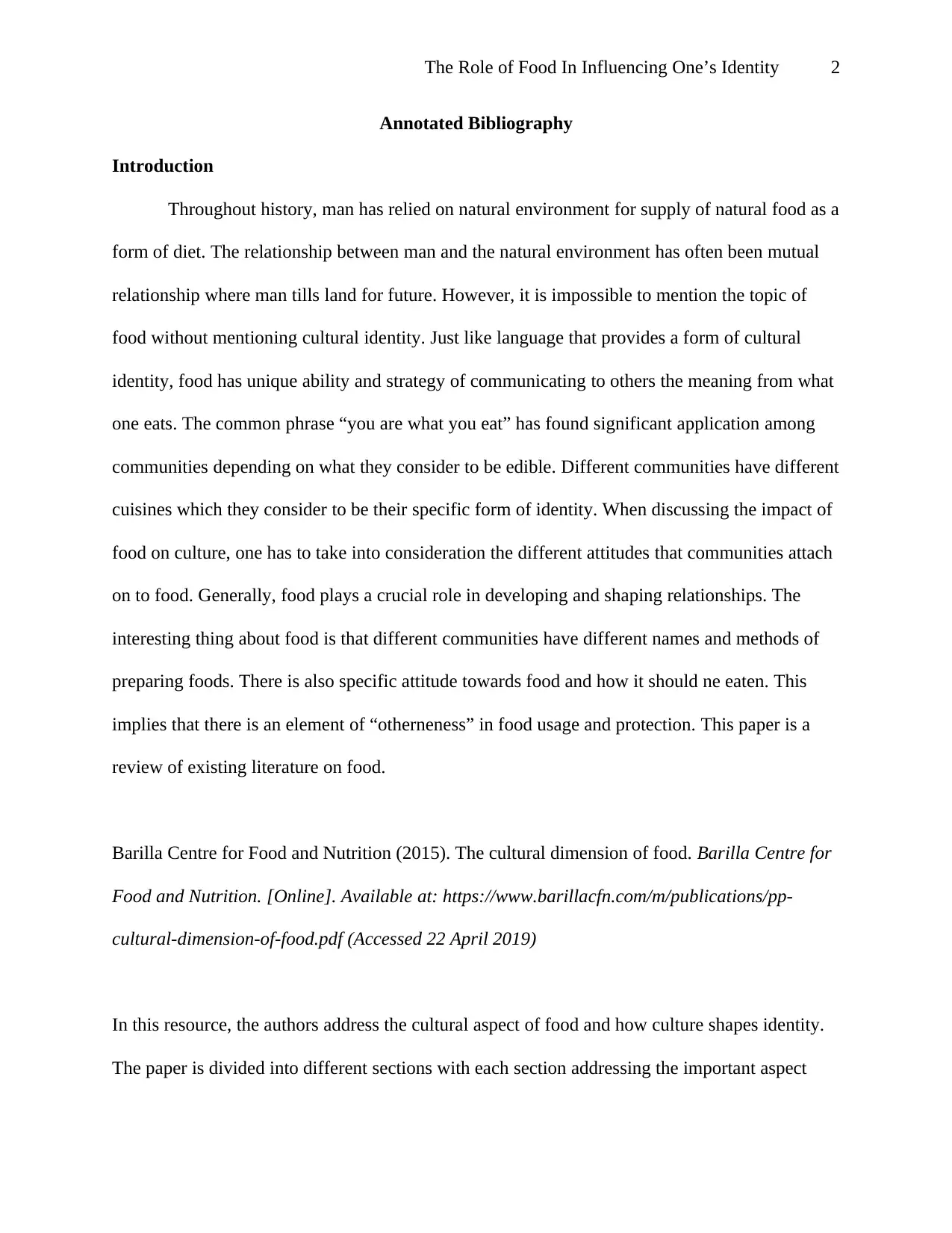
The Role of Food In Influencing One’s Identity 2
Annotated Bibliography
Introduction
Throughout history, man has relied on natural environment for supply of natural food as a
form of diet. The relationship between man and the natural environment has often been mutual
relationship where man tills land for future. However, it is impossible to mention the topic of
food without mentioning cultural identity. Just like language that provides a form of cultural
identity, food has unique ability and strategy of communicating to others the meaning from what
one eats. The common phrase “you are what you eat” has found significant application among
communities depending on what they consider to be edible. Different communities have different
cuisines which they consider to be their specific form of identity. When discussing the impact of
food on culture, one has to take into consideration the different attitudes that communities attach
on to food. Generally, food plays a crucial role in developing and shaping relationships. The
interesting thing about food is that different communities have different names and methods of
preparing foods. There is also specific attitude towards food and how it should ne eaten. This
implies that there is an element of “otherneness” in food usage and protection. This paper is a
review of existing literature on food.
Barilla Centre for Food and Nutrition (2015). The cultural dimension of food. Barilla Centre for
Food and Nutrition. [Online]. Available at: https://www.barillacfn.com/m/publications/pp-
cultural-dimension-of-food.pdf (Accessed 22 April 2019)
In this resource, the authors address the cultural aspect of food and how culture shapes identity.
The paper is divided into different sections with each section addressing the important aspect
Annotated Bibliography
Introduction
Throughout history, man has relied on natural environment for supply of natural food as a
form of diet. The relationship between man and the natural environment has often been mutual
relationship where man tills land for future. However, it is impossible to mention the topic of
food without mentioning cultural identity. Just like language that provides a form of cultural
identity, food has unique ability and strategy of communicating to others the meaning from what
one eats. The common phrase “you are what you eat” has found significant application among
communities depending on what they consider to be edible. Different communities have different
cuisines which they consider to be their specific form of identity. When discussing the impact of
food on culture, one has to take into consideration the different attitudes that communities attach
on to food. Generally, food plays a crucial role in developing and shaping relationships. The
interesting thing about food is that different communities have different names and methods of
preparing foods. There is also specific attitude towards food and how it should ne eaten. This
implies that there is an element of “otherneness” in food usage and protection. This paper is a
review of existing literature on food.
Barilla Centre for Food and Nutrition (2015). The cultural dimension of food. Barilla Centre for
Food and Nutrition. [Online]. Available at: https://www.barillacfn.com/m/publications/pp-
cultural-dimension-of-food.pdf (Accessed 22 April 2019)
In this resource, the authors address the cultural aspect of food and how culture shapes identity.
The paper is divided into different sections with each section addressing the important aspect

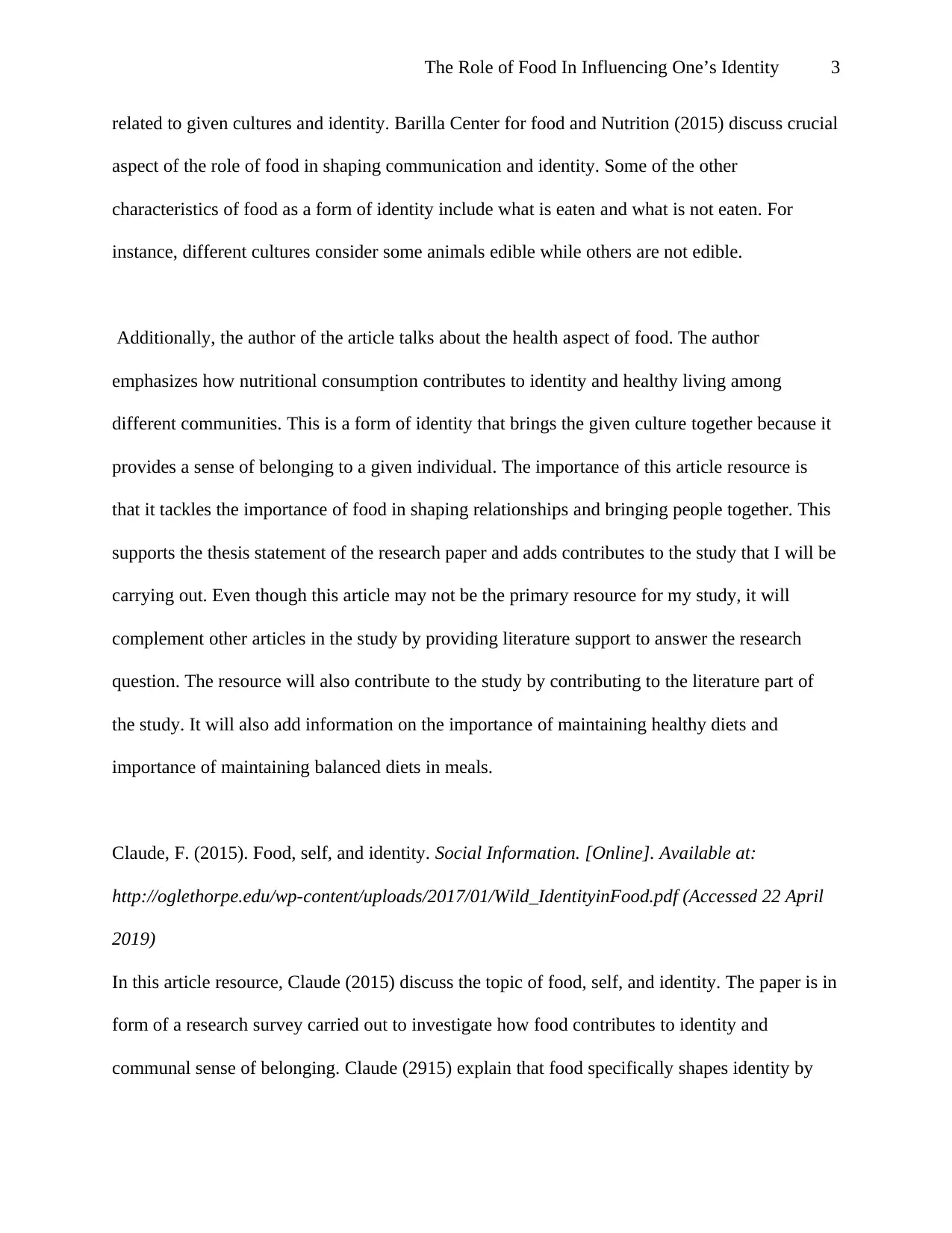
The Role of Food In Influencing One’s Identity 3
related to given cultures and identity. Barilla Center for food and Nutrition (2015) discuss crucial
aspect of the role of food in shaping communication and identity. Some of the other
characteristics of food as a form of identity include what is eaten and what is not eaten. For
instance, different cultures consider some animals edible while others are not edible.
Additionally, the author of the article talks about the health aspect of food. The author
emphasizes how nutritional consumption contributes to identity and healthy living among
different communities. This is a form of identity that brings the given culture together because it
provides a sense of belonging to a given individual. The importance of this article resource is
that it tackles the importance of food in shaping relationships and bringing people together. This
supports the thesis statement of the research paper and adds contributes to the study that I will be
carrying out. Even though this article may not be the primary resource for my study, it will
complement other articles in the study by providing literature support to answer the research
question. The resource will also contribute to the study by contributing to the literature part of
the study. It will also add information on the importance of maintaining healthy diets and
importance of maintaining balanced diets in meals.
Claude, F. (2015). Food, self, and identity. Social Information. [Online]. Available at:
http://oglethorpe.edu/wp-content/uploads/2017/01/Wild_IdentityinFood.pdf (Accessed 22 April
2019)
In this article resource, Claude (2015) discuss the topic of food, self, and identity. The paper is in
form of a research survey carried out to investigate how food contributes to identity and
communal sense of belonging. Claude (2915) explain that food specifically shapes identity by
related to given cultures and identity. Barilla Center for food and Nutrition (2015) discuss crucial
aspect of the role of food in shaping communication and identity. Some of the other
characteristics of food as a form of identity include what is eaten and what is not eaten. For
instance, different cultures consider some animals edible while others are not edible.
Additionally, the author of the article talks about the health aspect of food. The author
emphasizes how nutritional consumption contributes to identity and healthy living among
different communities. This is a form of identity that brings the given culture together because it
provides a sense of belonging to a given individual. The importance of this article resource is
that it tackles the importance of food in shaping relationships and bringing people together. This
supports the thesis statement of the research paper and adds contributes to the study that I will be
carrying out. Even though this article may not be the primary resource for my study, it will
complement other articles in the study by providing literature support to answer the research
question. The resource will also contribute to the study by contributing to the literature part of
the study. It will also add information on the importance of maintaining healthy diets and
importance of maintaining balanced diets in meals.
Claude, F. (2015). Food, self, and identity. Social Information. [Online]. Available at:
http://oglethorpe.edu/wp-content/uploads/2017/01/Wild_IdentityinFood.pdf (Accessed 22 April
2019)
In this article resource, Claude (2015) discuss the topic of food, self, and identity. The paper is in
form of a research survey carried out to investigate how food contributes to identity and
communal sense of belonging. Claude (2915) explain that food specifically shapes identity by
⊘ This is a preview!⊘
Do you want full access?
Subscribe today to unlock all pages.

Trusted by 1+ million students worldwide

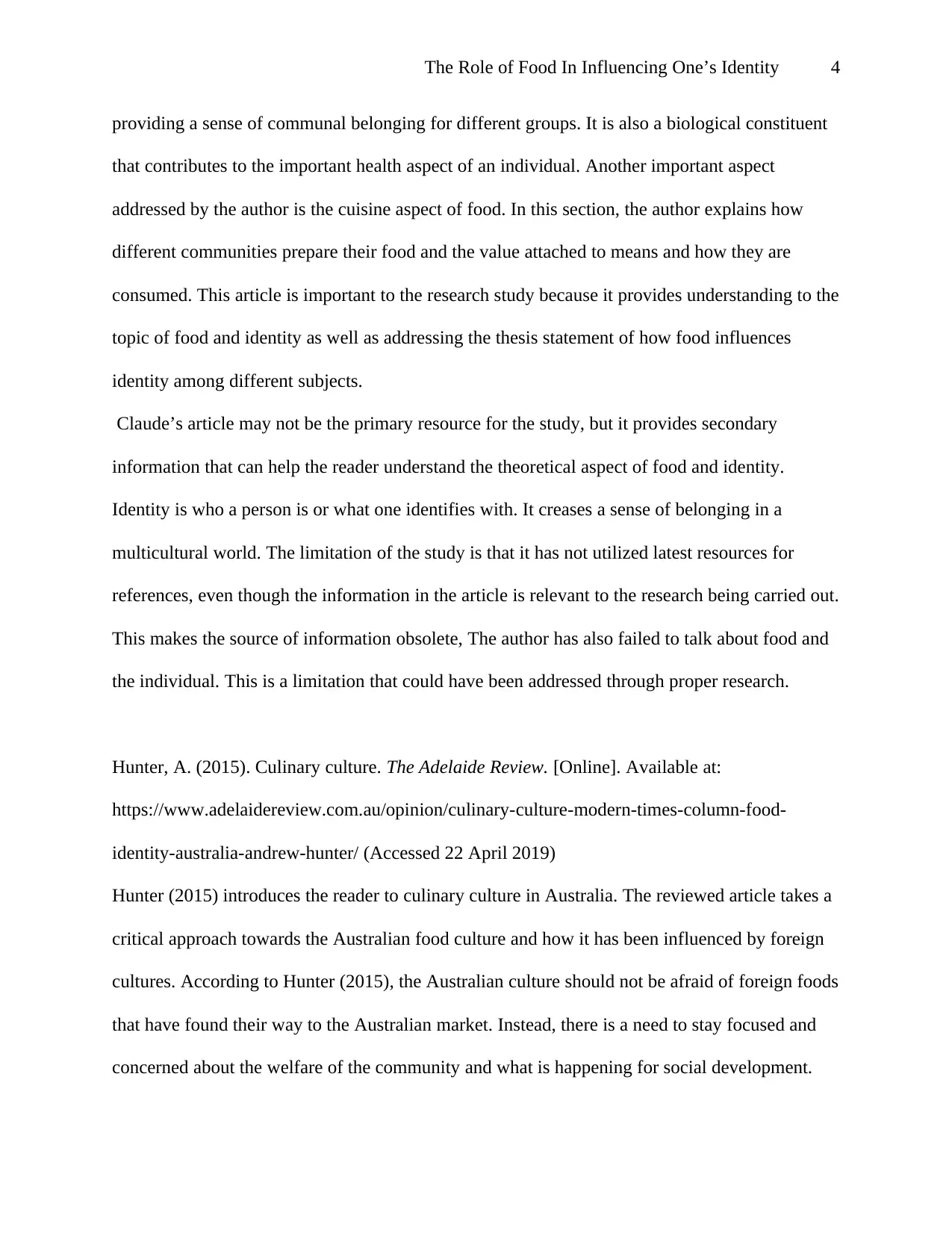
The Role of Food In Influencing One’s Identity 4
providing a sense of communal belonging for different groups. It is also a biological constituent
that contributes to the important health aspect of an individual. Another important aspect
addressed by the author is the cuisine aspect of food. In this section, the author explains how
different communities prepare their food and the value attached to means and how they are
consumed. This article is important to the research study because it provides understanding to the
topic of food and identity as well as addressing the thesis statement of how food influences
identity among different subjects.
Claude’s article may not be the primary resource for the study, but it provides secondary
information that can help the reader understand the theoretical aspect of food and identity.
Identity is who a person is or what one identifies with. It creases a sense of belonging in a
multicultural world. The limitation of the study is that it has not utilized latest resources for
references, even though the information in the article is relevant to the research being carried out.
This makes the source of information obsolete, The author has also failed to talk about food and
the individual. This is a limitation that could have been addressed through proper research.
Hunter, A. (2015). Culinary culture. The Adelaide Review. [Online]. Available at:
https://www.adelaidereview.com.au/opinion/culinary-culture-modern-times-column-food-
identity-australia-andrew-hunter/ (Accessed 22 April 2019)
Hunter (2015) introduces the reader to culinary culture in Australia. The reviewed article takes a
critical approach towards the Australian food culture and how it has been influenced by foreign
cultures. According to Hunter (2015), the Australian culture should not be afraid of foreign foods
that have found their way to the Australian market. Instead, there is a need to stay focused and
concerned about the welfare of the community and what is happening for social development.
providing a sense of communal belonging for different groups. It is also a biological constituent
that contributes to the important health aspect of an individual. Another important aspect
addressed by the author is the cuisine aspect of food. In this section, the author explains how
different communities prepare their food and the value attached to means and how they are
consumed. This article is important to the research study because it provides understanding to the
topic of food and identity as well as addressing the thesis statement of how food influences
identity among different subjects.
Claude’s article may not be the primary resource for the study, but it provides secondary
information that can help the reader understand the theoretical aspect of food and identity.
Identity is who a person is or what one identifies with. It creases a sense of belonging in a
multicultural world. The limitation of the study is that it has not utilized latest resources for
references, even though the information in the article is relevant to the research being carried out.
This makes the source of information obsolete, The author has also failed to talk about food and
the individual. This is a limitation that could have been addressed through proper research.
Hunter, A. (2015). Culinary culture. The Adelaide Review. [Online]. Available at:
https://www.adelaidereview.com.au/opinion/culinary-culture-modern-times-column-food-
identity-australia-andrew-hunter/ (Accessed 22 April 2019)
Hunter (2015) introduces the reader to culinary culture in Australia. The reviewed article takes a
critical approach towards the Australian food culture and how it has been influenced by foreign
cultures. According to Hunter (2015), the Australian culture should not be afraid of foreign foods
that have found their way to the Australian market. Instead, there is a need to stay focused and
concerned about the welfare of the community and what is happening for social development.
Paraphrase This Document
Need a fresh take? Get an instant paraphrase of this document with our AI Paraphraser

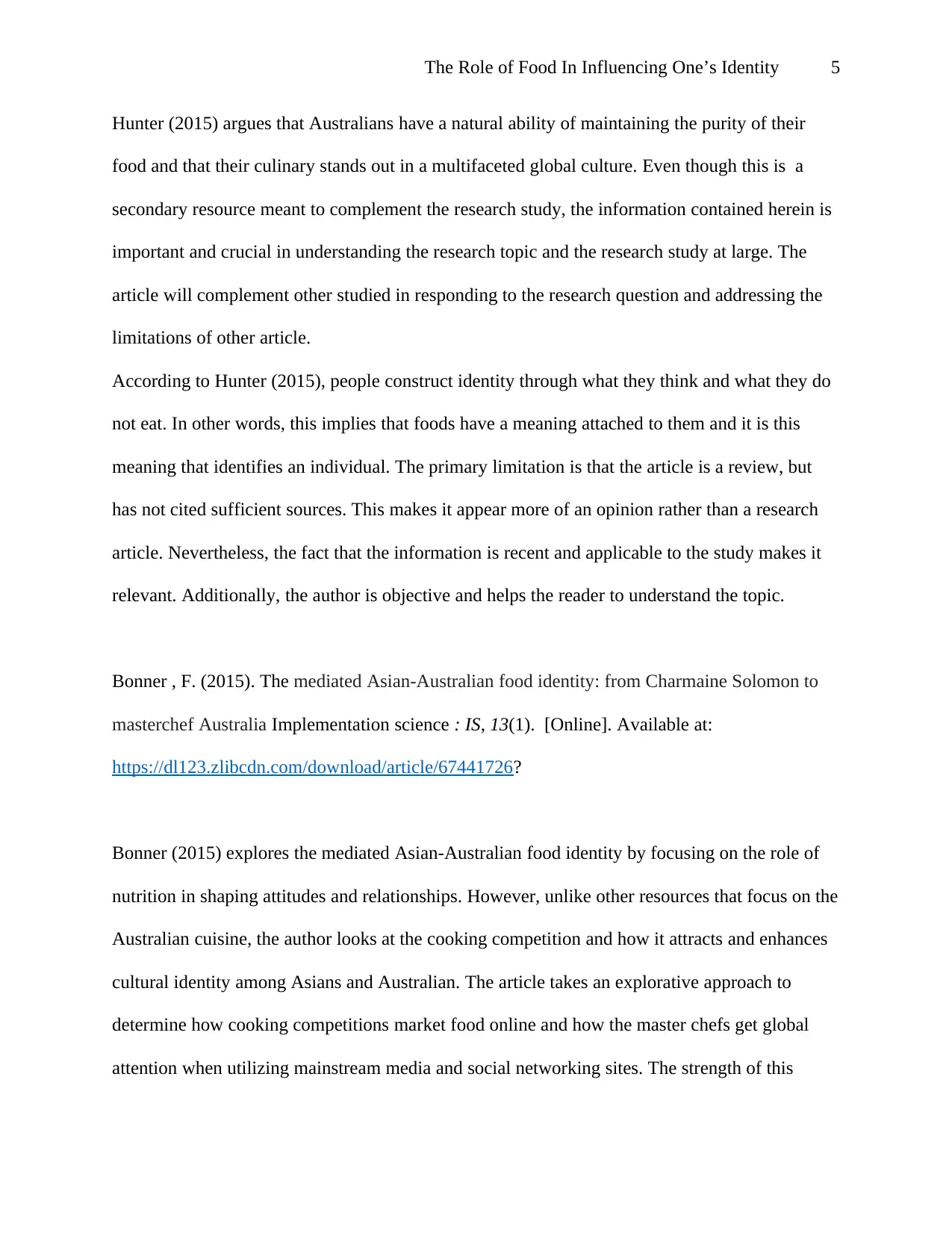
The Role of Food In Influencing One’s Identity 5
Hunter (2015) argues that Australians have a natural ability of maintaining the purity of their
food and that their culinary stands out in a multifaceted global culture. Even though this is a
secondary resource meant to complement the research study, the information contained herein is
important and crucial in understanding the research topic and the research study at large. The
article will complement other studied in responding to the research question and addressing the
limitations of other article.
According to Hunter (2015), people construct identity through what they think and what they do
not eat. In other words, this implies that foods have a meaning attached to them and it is this
meaning that identifies an individual. The primary limitation is that the article is a review, but
has not cited sufficient sources. This makes it appear more of an opinion rather than a research
article. Nevertheless, the fact that the information is recent and applicable to the study makes it
relevant. Additionally, the author is objective and helps the reader to understand the topic.
Bonner , F. (2015). The mediated Asian-Australian food identity: from Charmaine Solomon to
masterchef Australia Implementation science : IS, 13(1). [Online]. Available at:
https://dl123.zlibcdn.com/download/article/67441726?
Bonner (2015) explores the mediated Asian-Australian food identity by focusing on the role of
nutrition in shaping attitudes and relationships. However, unlike other resources that focus on the
Australian cuisine, the author looks at the cooking competition and how it attracts and enhances
cultural identity among Asians and Australian. The article takes an explorative approach to
determine how cooking competitions market food online and how the master chefs get global
attention when utilizing mainstream media and social networking sites. The strength of this
Hunter (2015) argues that Australians have a natural ability of maintaining the purity of their
food and that their culinary stands out in a multifaceted global culture. Even though this is a
secondary resource meant to complement the research study, the information contained herein is
important and crucial in understanding the research topic and the research study at large. The
article will complement other studied in responding to the research question and addressing the
limitations of other article.
According to Hunter (2015), people construct identity through what they think and what they do
not eat. In other words, this implies that foods have a meaning attached to them and it is this
meaning that identifies an individual. The primary limitation is that the article is a review, but
has not cited sufficient sources. This makes it appear more of an opinion rather than a research
article. Nevertheless, the fact that the information is recent and applicable to the study makes it
relevant. Additionally, the author is objective and helps the reader to understand the topic.
Bonner , F. (2015). The mediated Asian-Australian food identity: from Charmaine Solomon to
masterchef Australia Implementation science : IS, 13(1). [Online]. Available at:
https://dl123.zlibcdn.com/download/article/67441726?
Bonner (2015) explores the mediated Asian-Australian food identity by focusing on the role of
nutrition in shaping attitudes and relationships. However, unlike other resources that focus on the
Australian cuisine, the author looks at the cooking competition and how it attracts and enhances
cultural identity among Asians and Australian. The article takes an explorative approach to
determine how cooking competitions market food online and how the master chefs get global
attention when utilizing mainstream media and social networking sites. The strength of this

The Role of Food In Influencing One’s Identity 6
article is that it takes a considerable approach to discuss how mainstream media and international
TVs play a role in marketing Australian cuisine. This is directly linked to food as an individual
identity because Australians will always identify with their food. This is in line with the thesis
statement of the research study as it helps the reader understand the way food shapes Australian
culture.
Even though this research article deviates a bit from the topic of identity by focusing on the role
of marketing in shaping Australian cuisine, the theme of Australian culture still dominates the
study. As a result, the article will complement other studies in understanding how Australians
identify with their cuisine. Additionally, Bonner (2015) discusses the importance of sharing
meals among families. In other words, the author is interested about how food creates social
connections and bonds. When people share meals, they feel a sense of belonging. This point is
important in addressing the influence of foods on identity and how it can be encouraged.
Hamburg, E., M., Finkeneur, C., and Schuengel, K. (2014). Food for love: the role of food
offering in empathic emotion regulation. Frontiers on Psychology, 5(52). [Online].
https://www.ncbi.nlm.nih.gov/pmc/articles/PMC3907771/ Available at: (Accessed 13 April
2019)
In this peer reviewed article, the author takes a critical approach to analyze the value of food
away from the nutritional point of view. Hamburg, Finkeneur, and Schuengel (2014) argue that
people construct meanings from the food they consume. The meaning may be political,
especially when a small group wants to maintain purity of its culture in a multicultural society.
The authors take a critical approach to analyze and understand how food shapes and cultivates a
article is that it takes a considerable approach to discuss how mainstream media and international
TVs play a role in marketing Australian cuisine. This is directly linked to food as an individual
identity because Australians will always identify with their food. This is in line with the thesis
statement of the research study as it helps the reader understand the way food shapes Australian
culture.
Even though this research article deviates a bit from the topic of identity by focusing on the role
of marketing in shaping Australian cuisine, the theme of Australian culture still dominates the
study. As a result, the article will complement other studies in understanding how Australians
identify with their cuisine. Additionally, Bonner (2015) discusses the importance of sharing
meals among families. In other words, the author is interested about how food creates social
connections and bonds. When people share meals, they feel a sense of belonging. This point is
important in addressing the influence of foods on identity and how it can be encouraged.
Hamburg, E., M., Finkeneur, C., and Schuengel, K. (2014). Food for love: the role of food
offering in empathic emotion regulation. Frontiers on Psychology, 5(52). [Online].
https://www.ncbi.nlm.nih.gov/pmc/articles/PMC3907771/ Available at: (Accessed 13 April
2019)
In this peer reviewed article, the author takes a critical approach to analyze the value of food
away from the nutritional point of view. Hamburg, Finkeneur, and Schuengel (2014) argue that
people construct meanings from the food they consume. The meaning may be political,
especially when a small group wants to maintain purity of its culture in a multicultural society.
The authors take a critical approach to analyze and understand how food shapes and cultivates a
⊘ This is a preview!⊘
Do you want full access?
Subscribe today to unlock all pages.

Trusted by 1+ million students worldwide

The Role of Food In Influencing One’s Identity 7
sense of identity. This is important in understanding the significance of food in creating
emotional bonds and identity. The discuss how Australians construct meanings from the foods
they consume. The authors state that food has a significant impact in regulating emotions and
shaping relationships among people sharing common meals. This is especially important when
considering the important aspect of food and interpersonal relationships and its power to create
and manage social relationships in multicultural cultures.
This article contributes significant information that addresses the topic of food and how it
identifies a person’s identity. The primary argument that food is the primary factor for social
identity makes this article resource relevant to the study in attempt to answering the research
question on food and a person’s identity. This research article will act as a secondary resource in
answering the research question and addressing the limitations that other secondary resources
have not addressed. It will also complement other articles to help the reader understand the
cultural value of food to the individual and the community at large.
Conclusion
Food plays a significant role in influencing identity. People from diverse cultures use food as a
form of identity. When people share meals, they create social bonds that give them a sense of
belonging. Even though different cultures have different preferences and tastes on food, the
connection created through sharing meals plays a significant role in determining cultural bonds.
References
Barilla Centre for Food and Nutrition (2015). The cultural dimension of food. Barilla Centre for
Food and Nutrition. [Online]. Available at: https://www.barillacfn.com/m/publications/pp-
cultural-dimension-of-food.pdf (Accessed 22 April 2019)
sense of identity. This is important in understanding the significance of food in creating
emotional bonds and identity. The discuss how Australians construct meanings from the foods
they consume. The authors state that food has a significant impact in regulating emotions and
shaping relationships among people sharing common meals. This is especially important when
considering the important aspect of food and interpersonal relationships and its power to create
and manage social relationships in multicultural cultures.
This article contributes significant information that addresses the topic of food and how it
identifies a person’s identity. The primary argument that food is the primary factor for social
identity makes this article resource relevant to the study in attempt to answering the research
question on food and a person’s identity. This research article will act as a secondary resource in
answering the research question and addressing the limitations that other secondary resources
have not addressed. It will also complement other articles to help the reader understand the
cultural value of food to the individual and the community at large.
Conclusion
Food plays a significant role in influencing identity. People from diverse cultures use food as a
form of identity. When people share meals, they create social bonds that give them a sense of
belonging. Even though different cultures have different preferences and tastes on food, the
connection created through sharing meals plays a significant role in determining cultural bonds.
References
Barilla Centre for Food and Nutrition (2015). The cultural dimension of food. Barilla Centre for
Food and Nutrition. [Online]. Available at: https://www.barillacfn.com/m/publications/pp-
cultural-dimension-of-food.pdf (Accessed 22 April 2019)
Paraphrase This Document
Need a fresh take? Get an instant paraphrase of this document with our AI Paraphraser

The Role of Food In Influencing One’s Identity 8
Claude, F. (2015). Food, self, and identity. Social Information. [Online]. Available at:
http://oglethorpe.edu/wp-content/uploads/2017/01/Wild_IdentityinFood.pdf (Accessed 22 April
2019)
Hunter, A. (2015). Culinary culture. The Adelaide Review. [Online]. Available at:
https://www.adelaidereview.com.au/opinion/culinary-culture-modern-times-column-food-
identity-australia-andrew-hunter/ (Accessed 22 April 2019)
Bonner , F. (2015). the mediated Asian-Australian food identity: from Charmaine Solomon to
masterchef Australia Implementation science : IS, 13(1). [Online]. Available at:
https://dl123.zlibcdn.com/download/article/67441726?
token=2d50f71a16aabbb2ba658ebe06829756 (Accessed 13 April 2019)
Hamburg, E., M., Finkeneur, C., and Schuengel, K. (2014). Food for love: the role of food
offering in empathic emotion regulation. Frontiers on Psychology, 5(52). [Online].
https://www.ncbi.nlm.nih.gov/pmc/articles/PMC3907771/ Available at: (Accessed 13 April
2019)
Claude, F. (2015). Food, self, and identity. Social Information. [Online]. Available at:
http://oglethorpe.edu/wp-content/uploads/2017/01/Wild_IdentityinFood.pdf (Accessed 22 April
2019)
Hunter, A. (2015). Culinary culture. The Adelaide Review. [Online]. Available at:
https://www.adelaidereview.com.au/opinion/culinary-culture-modern-times-column-food-
identity-australia-andrew-hunter/ (Accessed 22 April 2019)
Bonner , F. (2015). the mediated Asian-Australian food identity: from Charmaine Solomon to
masterchef Australia Implementation science : IS, 13(1). [Online]. Available at:
https://dl123.zlibcdn.com/download/article/67441726?
token=2d50f71a16aabbb2ba658ebe06829756 (Accessed 13 April 2019)
Hamburg, E., M., Finkeneur, C., and Schuengel, K. (2014). Food for love: the role of food
offering in empathic emotion regulation. Frontiers on Psychology, 5(52). [Online].
https://www.ncbi.nlm.nih.gov/pmc/articles/PMC3907771/ Available at: (Accessed 13 April
2019)
1 out of 8
Related Documents
Your All-in-One AI-Powered Toolkit for Academic Success.
+13062052269
info@desklib.com
Available 24*7 on WhatsApp / Email
Unlock your academic potential
Copyright © 2020–2025 A2Z Services. All Rights Reserved. Developed and managed by ZUCOL.