Food Insecurity and Its Impact on University Students' Health

Verified

Added on  2020/03/16

|6
|1387
|38
Report
AI Summary
This report examines food insecurity among university students, drawing on a case study conducted at Deakin University in 2012. The study, which used a cross-sectional design and a questionnaire, revealed that a significant percentage of students experienced food insecurity, with a considerable portion experiencing hunger. The report identifies factors contributing to food insecurity, such as living independently and relying on government support. It highlights the negative impacts of food insecurity on students' health and academic performance. The report concludes that food insecurity is a major problem in tertiary institutions and recommends interventions like regulating food prices and providing more financial aid. The report also discusses the relevance of these findings to higher education institutions and the government, proposing strategies to address and mitigate food insecurity on a broader scale.
Document Page
Running head: BUSINESS RESEARCH AND REPORT WRITING 1
Business Research and Report Writing
Name:
Institution:
tabler-icon-diamond-filled.svg

Paraphrase This Document

Need a fresh take? Get an instant paraphrase of this document with our AI Paraphraser
Document Page
Business Research and Report Writing 2
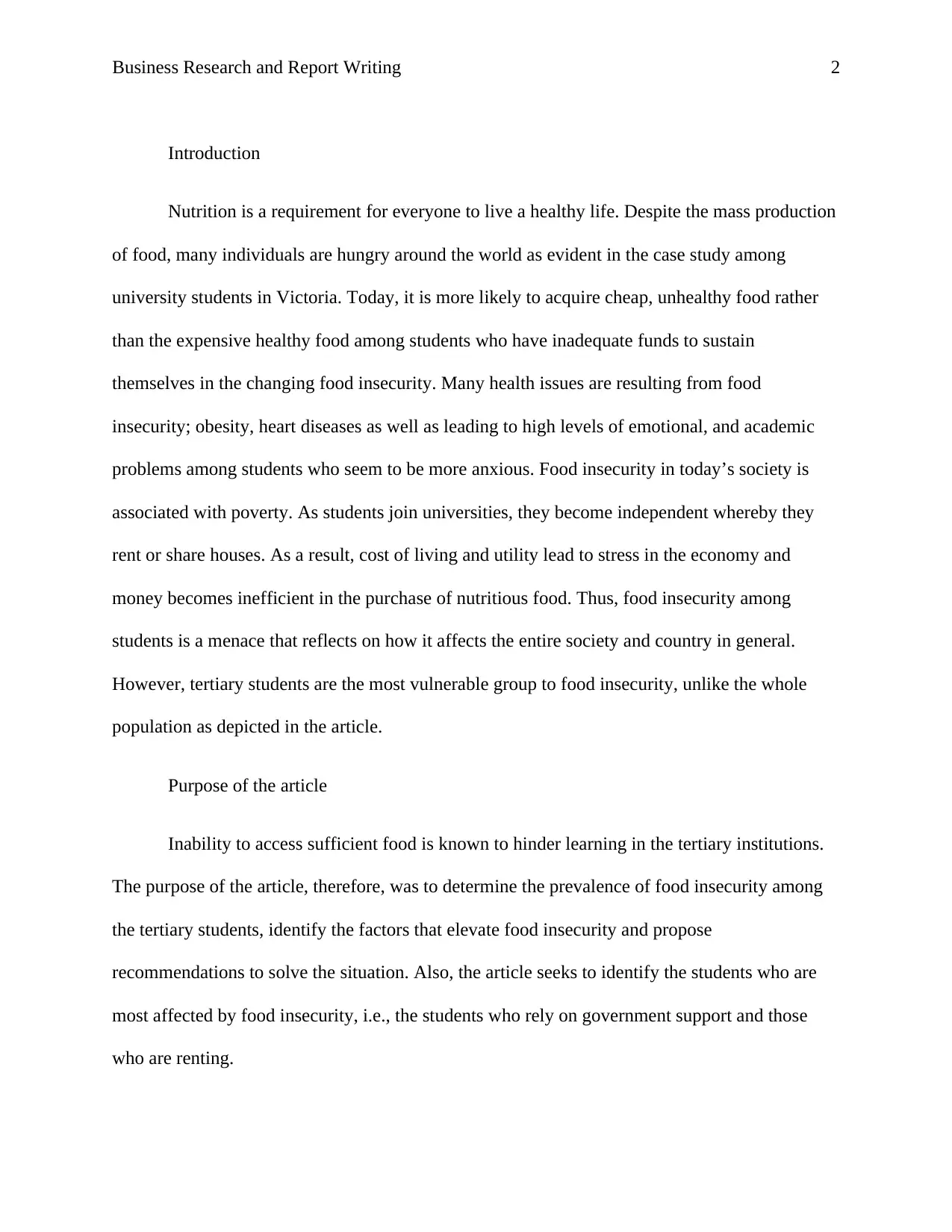
Introduction
Nutrition is a requirement for everyone to live a healthy life. Despite the mass production
of food, many individuals are hungry around the world as evident in the case study among
university students in Victoria. Today, it is more likely to acquire cheap, unhealthy food rather
than the expensive healthy food among students who have inadequate funds to sustain
themselves in the changing food insecurity. Many health issues are resulting from food
insecurity; obesity, heart diseases as well as leading to high levels of emotional, and academic
problems among students who seem to be more anxious. Food insecurity in today’s society is
associated with poverty. As students join universities, they become independent whereby they
rent or share houses. As a result, cost of living and utility lead to stress in the economy and
money becomes inefficient in the purchase of nutritious food. Thus, food insecurity among
students is a menace that reflects on how it affects the entire society and country in general.
However, tertiary students are the most vulnerable group to food insecurity, unlike the whole
population as depicted in the article.
Purpose of the article
Inability to access sufficient food is known to hinder learning in the tertiary institutions.
The purpose of the article, therefore, was to determine the prevalence of food insecurity among
the tertiary students, identify the factors that elevate food insecurity and propose
recommendations to solve the situation. Also, the article seeks to identify the students who are
most affected by food insecurity, i.e., the students who rely on government support and those
who are renting.
Document Page
Business Research and Report Writing 3
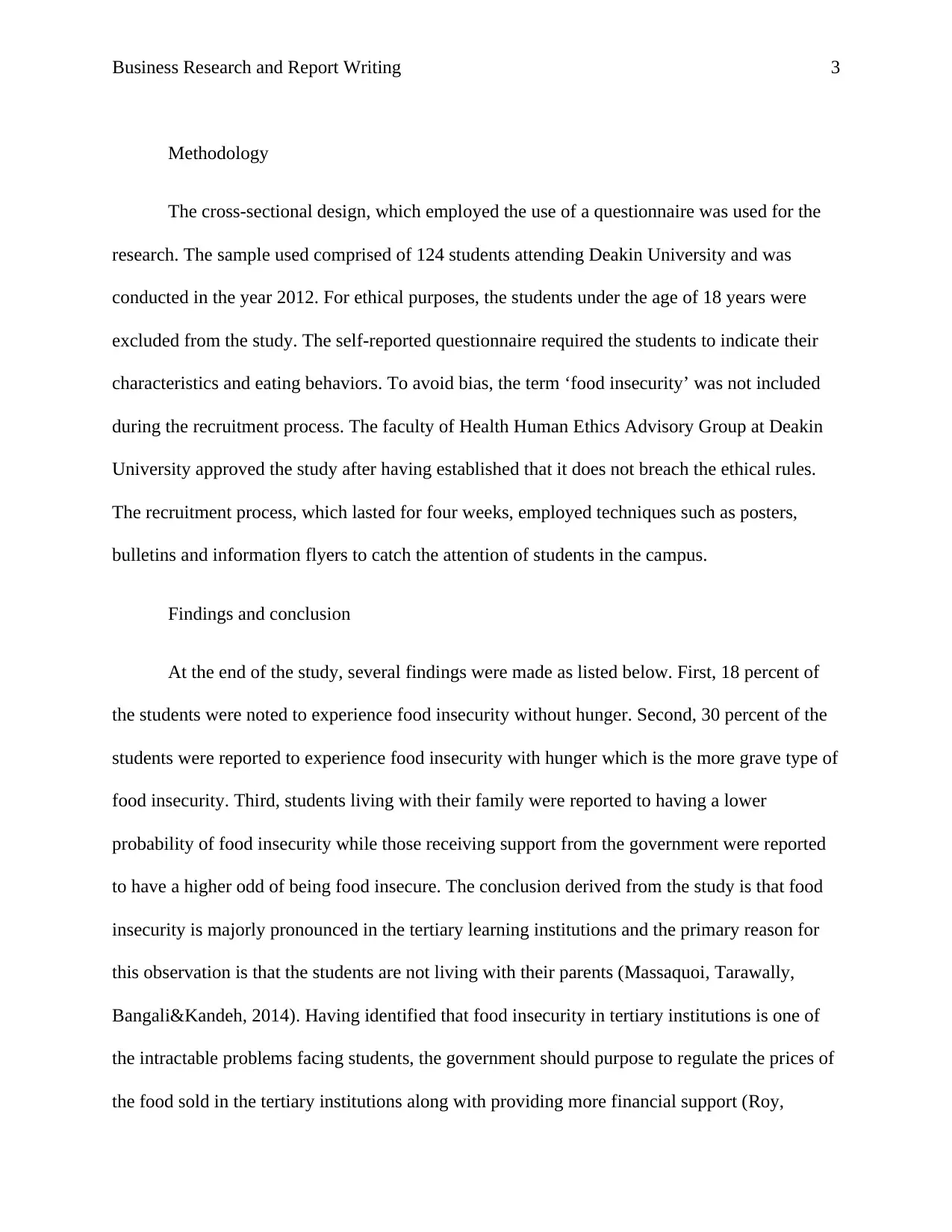
Methodology
The cross-sectional design, which employed the use of a questionnaire was used for the
research. The sample used comprised of 124 students attending Deakin University and was
conducted in the year 2012. For ethical purposes, the students under the age of 18 years were
excluded from the study. The self-reported questionnaire required the students to indicate their
characteristics and eating behaviors. To avoid bias, the term ‘food insecurity’ was not included
during the recruitment process. The faculty of Health Human Ethics Advisory Group at Deakin
University approved the study after having established that it does not breach the ethical rules.
The recruitment process, which lasted for four weeks, employed techniques such as posters,
bulletins and information flyers to catch the attention of students in the campus.
Findings and conclusion
At the end of the study, several findings were made as listed below. First, 18 percent of
the students were noted to experience food insecurity without hunger. Second, 30 percent of the
students were reported to experience food insecurity with hunger which is the more grave type of
food insecurity. Third, students living with their family were reported to having a lower
probability of food insecurity while those receiving support from the government were reported
to have a higher odd of being food insecure. The conclusion derived from the study is that food
insecurity is majorly pronounced in the tertiary learning institutions and the primary reason for
this observation is that the students are not living with their parents (Massaquoi, Tarawally,
Bangali&Kandeh, 2014). Having identified that food insecurity in tertiary institutions is one of
the intractable problems facing students, the government should purpose to regulate the prices of
the food sold in the tertiary institutions along with providing more financial support (Roy,
Document Page
Business Research and Report Writing 4
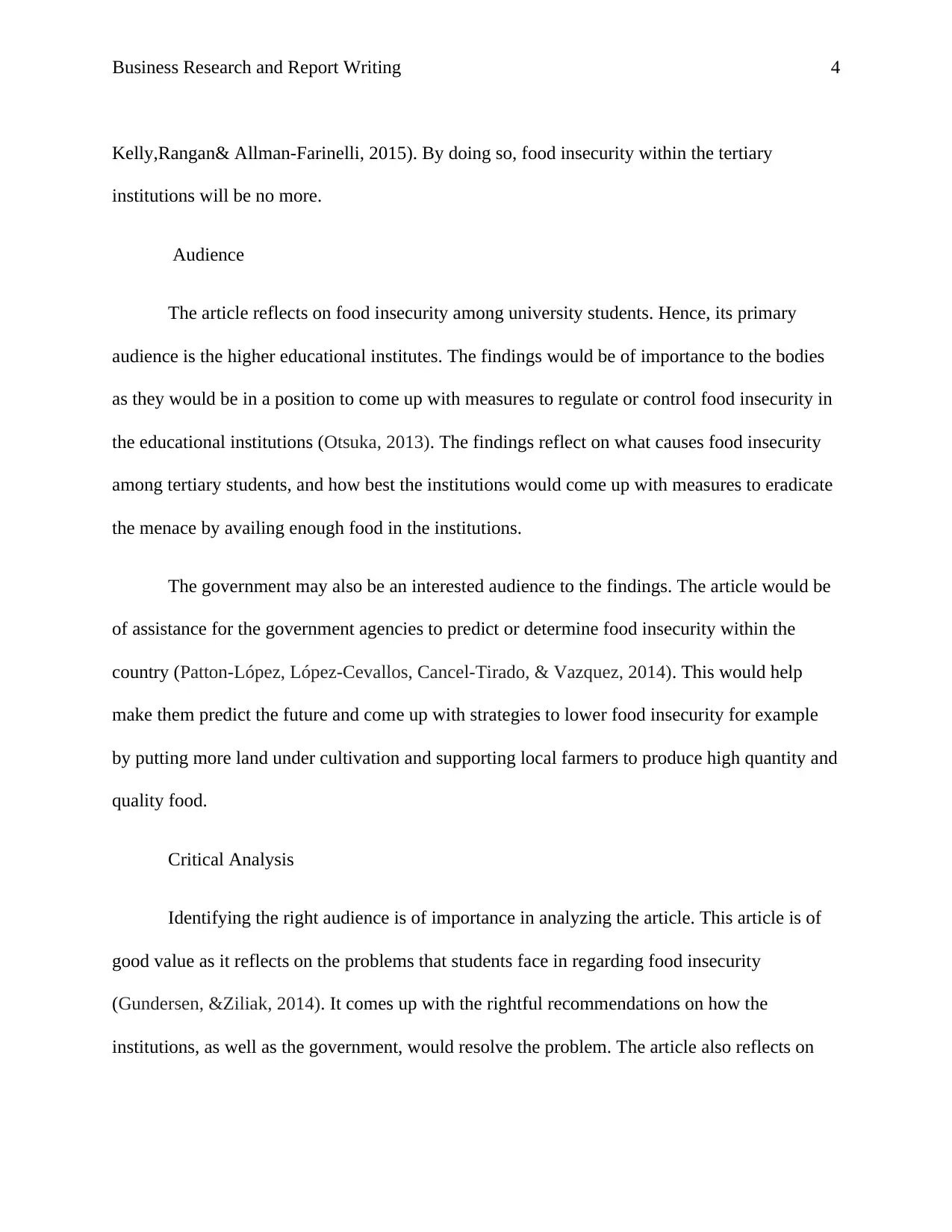
Kelly,Rangan& Allman-Farinelli, 2015). By doing so, food insecurity within the tertiary
institutions will be no more.
Audience
The article reflects on food insecurity among university students. Hence, its primary
audience is the higher educational institutes. The findings would be of importance to the bodies
as they would be in a position to come up with measures to regulate or control food insecurity in
the educational institutions (Otsuka, 2013). The findings reflect on what causes food insecurity
among tertiary students, and how best the institutions would come up with measures to eradicate
the menace by availing enough food in the institutions.
The government may also be an interested audience to the findings. The article would be
of assistance for the government agencies to predict or determine food insecurity within the
country (Patton-López, López-Cevallos, Cancel-Tirado, & Vazquez, 2014). This would help
make them predict the future and come up with strategies to lower food insecurity for example
by putting more land under cultivation and supporting local farmers to produce high quantity and
quality food.
Critical Analysis
Identifying the right audience is of importance in analyzing the article. This article is of
good value as it reflects on the problems that students face in regarding food insecurity
(Gundersen, &Ziliak, 2014). It comes up with the rightful recommendations on how the
institutions, as well as the government, would resolve the problem. The article also reflects on
tabler-icon-diamond-filled.svg

Paraphrase This Document

Need a fresh take? Get an instant paraphrase of this document with our AI Paraphraser
Document Page
Business Research and Report Writing 5
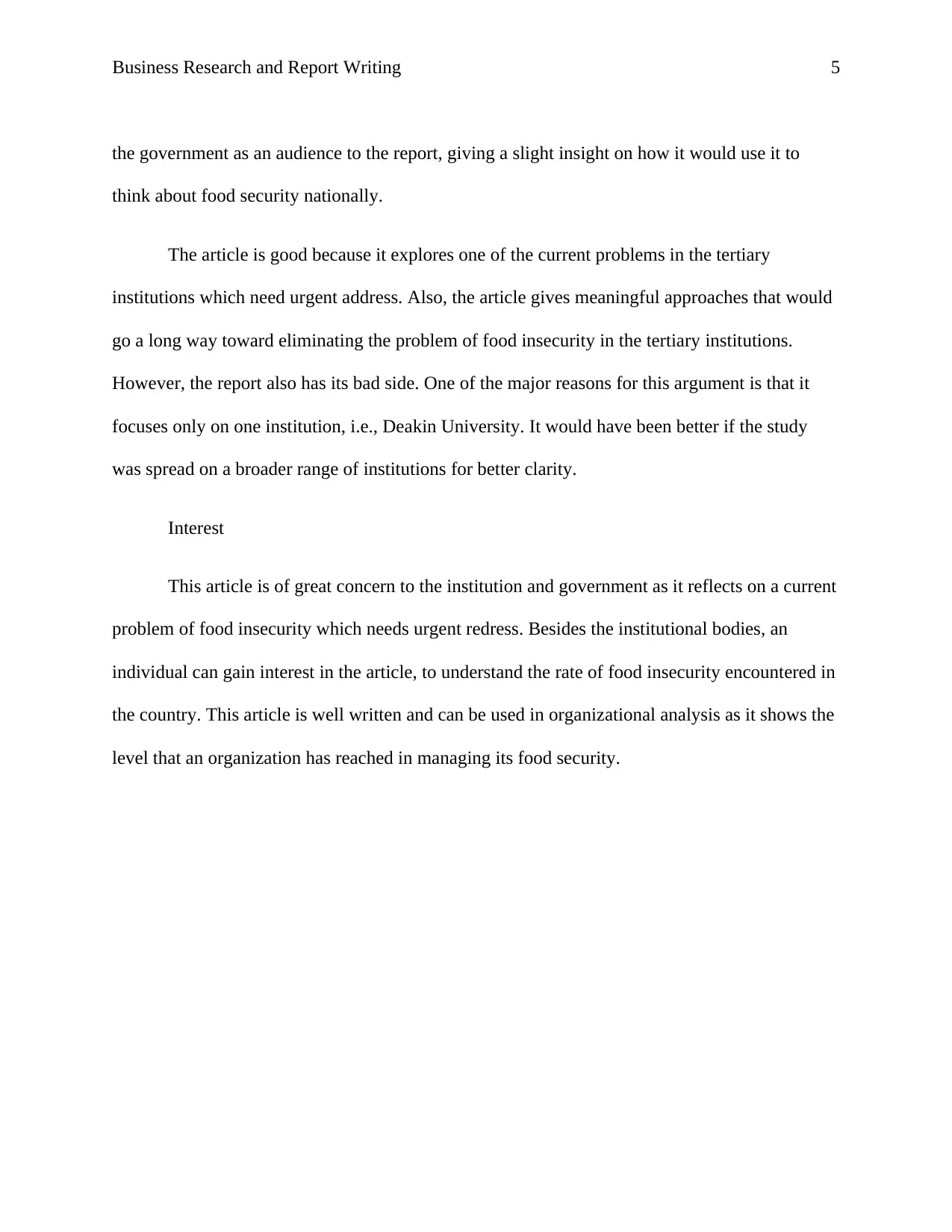
the government as an audience to the report, giving a slight insight on how it would use it to
think about food security nationally.
The article is good because it explores one of the current problems in the tertiary
institutions which need urgent address. Also, the article gives meaningful approaches that would
go a long way toward eliminating the problem of food insecurity in the tertiary institutions.
However, the report also has its bad side. One of the major reasons for this argument is that it
focuses only on one institution, i.e., Deakin University. It would have been better if the study
was spread on a broader range of institutions for better clarity.
Interest
This article is of great concern to the institution and government as it reflects on a current
problem of food insecurity which needs urgent redress. Besides the institutional bodies, an
individual can gain interest in the article, to understand the rate of food insecurity encountered in
the country. This article is well written and can be used in organizational analysis as it shows the
level that an organization has reached in managing its food security.
Document Page
Business Research and Report Writing 6
References
Gundersen, C., &Ziliak, J. P. (2014). Childhood food insecurity in the US: Trends, causes, and
policy options. The Future of Children, 24(2), 1-19.
Massaquoi, S. B., Tarawally, F., Bangali, E., &Kandeh, J. B. A. (2014). Impact of tertiary
education institutions on rural agricultural communities in Sierra Leone. Afreduc dev
issues, 6, 103-128.
Micevski, D. A., Thornton, L. E., & Brockington, S. (2014). Food insecurity among university
students in Victoria: A pilot study. Nutrition & dietetics, 71(4), 258-264.
Otsuka, K. (2013). Food insecurity, income inequality, and the changing comparative advantage
in world agriculture. Agricultural Economics, 44(s1), 7-18.
Patton-López, M. M., López-Cevallos, D. F., Cancel-Tirado, D. I., & Vazquez, L. (2014).
Prevalence and correlates of food insecurity among students attending a midsize rural
university in Oregon. Journal of nutrition education and behavior, 46(3), 209-214.
Roy, R., Kelly, B., Rangan, A., & Allman-Farinelli, M. (2015). Food environment interventions
to improve the dietary behavior of young adults in tertiary education settings: a
systematic literature review. Journal of the Academy of Nutrition and Dietetics, 115(10),
1647-1681.
chevron_up_icon
1 out of 6
circle_padding
hide_on_mobile
zoom_out_icon
[object Object]