Detailed Food Safety and Inventory Management Report for ALH Group
VerifiedAdded on 2023/01/19
|34
|8034
|87
Report
AI Summary
This report provides a comprehensive analysis of food safety and inventory management within the context of the ALH Group of hotels. The report begins with an introduction to the importance of food safety and inventory control, highlighting the role of a well-structured plan in minimizing financial losses and ensuring customer satisfaction. It then delves into the core of the food safety plan, focusing on the HACCP (Hazard Analysis and Critical Control Points) system, detailing the formation of a HACCP team, defining the scope and purpose of the plan, and providing detailed product descriptions, including intended use, ingredients, form, packaging, shelf life, and storage for various food items like French fries, chicken breast, and chocolate pudding. The report includes process flow charts for preparing these dishes and performs a thorough hazard analysis, identifying potential risks at each stage and outlining control measures. Furthermore, it addresses support programs like maintenance, supplier approvals, cleaning and sanitation, pest control, personal hygiene, product recall, staff training, and document control, providing a holistic view of the food safety system. The report also includes appendices and concludes with a summary of the key findings and recommendations, providing a practical guide for implementing and maintaining effective food safety and inventory management practices within the hotel group.
Food Safety and
Inventory
Inventory

Paraphrase This Document
Need a fresh take? Get an instant paraphrase of this document with our AI Paraphraser
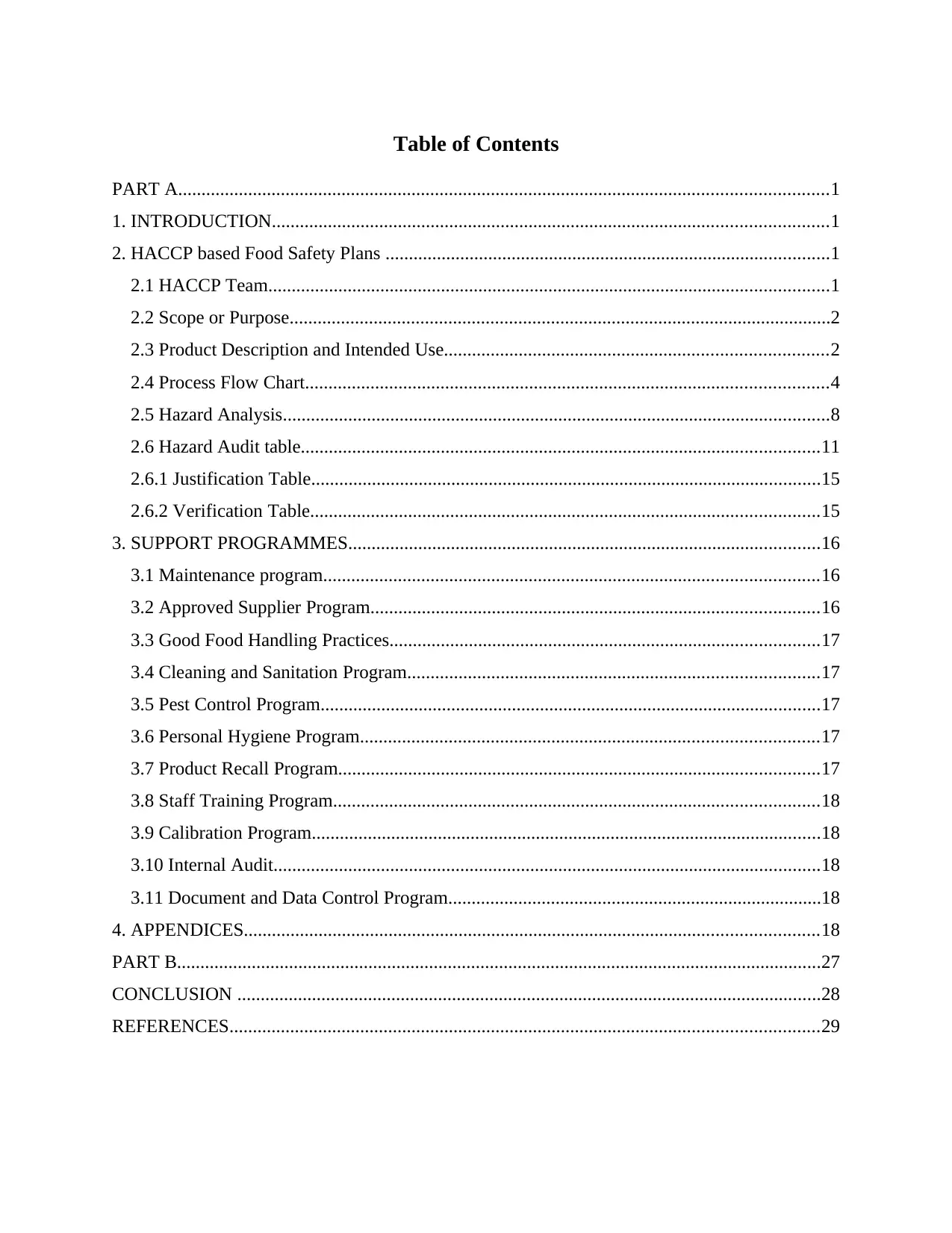
Table of Contents
PART A...........................................................................................................................................1
1. INTRODUCTION.......................................................................................................................1
2. HACCP based Food Safety Plans ...............................................................................................1
2.1 HACCP Team........................................................................................................................1
2.2 Scope or Purpose....................................................................................................................2
2.3 Product Description and Intended Use..................................................................................2
2.4 Process Flow Chart................................................................................................................4
2.5 Hazard Analysis.....................................................................................................................8
2.6 Hazard Audit table...............................................................................................................11
2.6.1 Justification Table.............................................................................................................15
2.6.2 Verification Table.............................................................................................................15
3. SUPPORT PROGRAMMES.....................................................................................................16
3.1 Maintenance program..........................................................................................................16
3.2 Approved Supplier Program................................................................................................16
3.3 Good Food Handling Practices............................................................................................17
3.4 Cleaning and Sanitation Program........................................................................................17
3.5 Pest Control Program...........................................................................................................17
3.6 Personal Hygiene Program..................................................................................................17
3.7 Product Recall Program.......................................................................................................17
3.8 Staff Training Program........................................................................................................18
3.9 Calibration Program.............................................................................................................18
3.10 Internal Audit.....................................................................................................................18
3.11 Document and Data Control Program................................................................................18
4. APPENDICES...........................................................................................................................18
PART B..........................................................................................................................................27
CONCLUSION .............................................................................................................................28
REFERENCES..............................................................................................................................29
PART A...........................................................................................................................................1
1. INTRODUCTION.......................................................................................................................1
2. HACCP based Food Safety Plans ...............................................................................................1
2.1 HACCP Team........................................................................................................................1
2.2 Scope or Purpose....................................................................................................................2
2.3 Product Description and Intended Use..................................................................................2
2.4 Process Flow Chart................................................................................................................4
2.5 Hazard Analysis.....................................................................................................................8
2.6 Hazard Audit table...............................................................................................................11
2.6.1 Justification Table.............................................................................................................15
2.6.2 Verification Table.............................................................................................................15
3. SUPPORT PROGRAMMES.....................................................................................................16
3.1 Maintenance program..........................................................................................................16
3.2 Approved Supplier Program................................................................................................16
3.3 Good Food Handling Practices............................................................................................17
3.4 Cleaning and Sanitation Program........................................................................................17
3.5 Pest Control Program...........................................................................................................17
3.6 Personal Hygiene Program..................................................................................................17
3.7 Product Recall Program.......................................................................................................17
3.8 Staff Training Program........................................................................................................18
3.9 Calibration Program.............................................................................................................18
3.10 Internal Audit.....................................................................................................................18
3.11 Document and Data Control Program................................................................................18
4. APPENDICES...........................................................................................................................18
PART B..........................................................................................................................................27
CONCLUSION .............................................................................................................................28
REFERENCES..............................................................................................................................29
PART A
1. INTRODUCTION
Food safety and inventory management is a system to track the stock that comes into the
premises and inventory that has been used from that stack, calculate the leftover and maintain the
quality of the food so that it can provide satisfaction to the customers. A good food safety and
inventory plan is also helpful for gaining the insights of the ways from which the organization
may loss valuable funds (Scheinberg & et.al 2017). Food inventory is related with ordering,
storing and utilization of food and other ingredients while food safety can be referred as
handling, preparing and storing of food in such a way that it can reduce the risk of becoming
sick.
For preparing this report, ALH Group of hotels has been chosen which operates over 300
venues across the Australian countries such as New South Wales, Queensland, South Australia,
Northern Territory, Victoria, Western Australia and Tasmania. The Hotel group was established
by Bruce Mathieson and his family in 1974 and has developed over the ages by acquiring the
other individual hotels and hotel groups of the Australia. This report will cover a food safety and
inventory management programme that will help in specifying the reports which helps in
keeping the food safe. It will contain a HACCP plan and support programs like maintenance
program, good food handling program, approved supplier program, cleaning and sanitation
program, pest control, personal hygiene, product recall, internal audit, calibration, staff training,
document and data control program, etc.
2. HACCP based Food Safety Plans
2.1 HACCP Team
HACCP (Hazard Analysis and Critical Control Points) is a group of people who required
specific skills & knowledge in order to understand of complete their task in effective manner.
This group prepare to preventing food safety strategy. Company follow the systematic approach
in order to assess the risk of hazard related to food or food production process. HACCP team
based on the food safety program and members included as per the requirement of business
activity. ALH group of hotels followed this plan for food safety so there are some members who
include in the HACCP team.
HACCP team includes:
1
1. INTRODUCTION
Food safety and inventory management is a system to track the stock that comes into the
premises and inventory that has been used from that stack, calculate the leftover and maintain the
quality of the food so that it can provide satisfaction to the customers. A good food safety and
inventory plan is also helpful for gaining the insights of the ways from which the organization
may loss valuable funds (Scheinberg & et.al 2017). Food inventory is related with ordering,
storing and utilization of food and other ingredients while food safety can be referred as
handling, preparing and storing of food in such a way that it can reduce the risk of becoming
sick.
For preparing this report, ALH Group of hotels has been chosen which operates over 300
venues across the Australian countries such as New South Wales, Queensland, South Australia,
Northern Territory, Victoria, Western Australia and Tasmania. The Hotel group was established
by Bruce Mathieson and his family in 1974 and has developed over the ages by acquiring the
other individual hotels and hotel groups of the Australia. This report will cover a food safety and
inventory management programme that will help in specifying the reports which helps in
keeping the food safe. It will contain a HACCP plan and support programs like maintenance
program, good food handling program, approved supplier program, cleaning and sanitation
program, pest control, personal hygiene, product recall, internal audit, calibration, staff training,
document and data control program, etc.
2. HACCP based Food Safety Plans
2.1 HACCP Team
HACCP (Hazard Analysis and Critical Control Points) is a group of people who required
specific skills & knowledge in order to understand of complete their task in effective manner.
This group prepare to preventing food safety strategy. Company follow the systematic approach
in order to assess the risk of hazard related to food or food production process. HACCP team
based on the food safety program and members included as per the requirement of business
activity. ALH group of hotels followed this plan for food safety so there are some members who
include in the HACCP team.
HACCP team includes:
1
⊘ This is a preview!⊘
Do you want full access?
Subscribe today to unlock all pages.

Trusted by 1+ million students worldwide
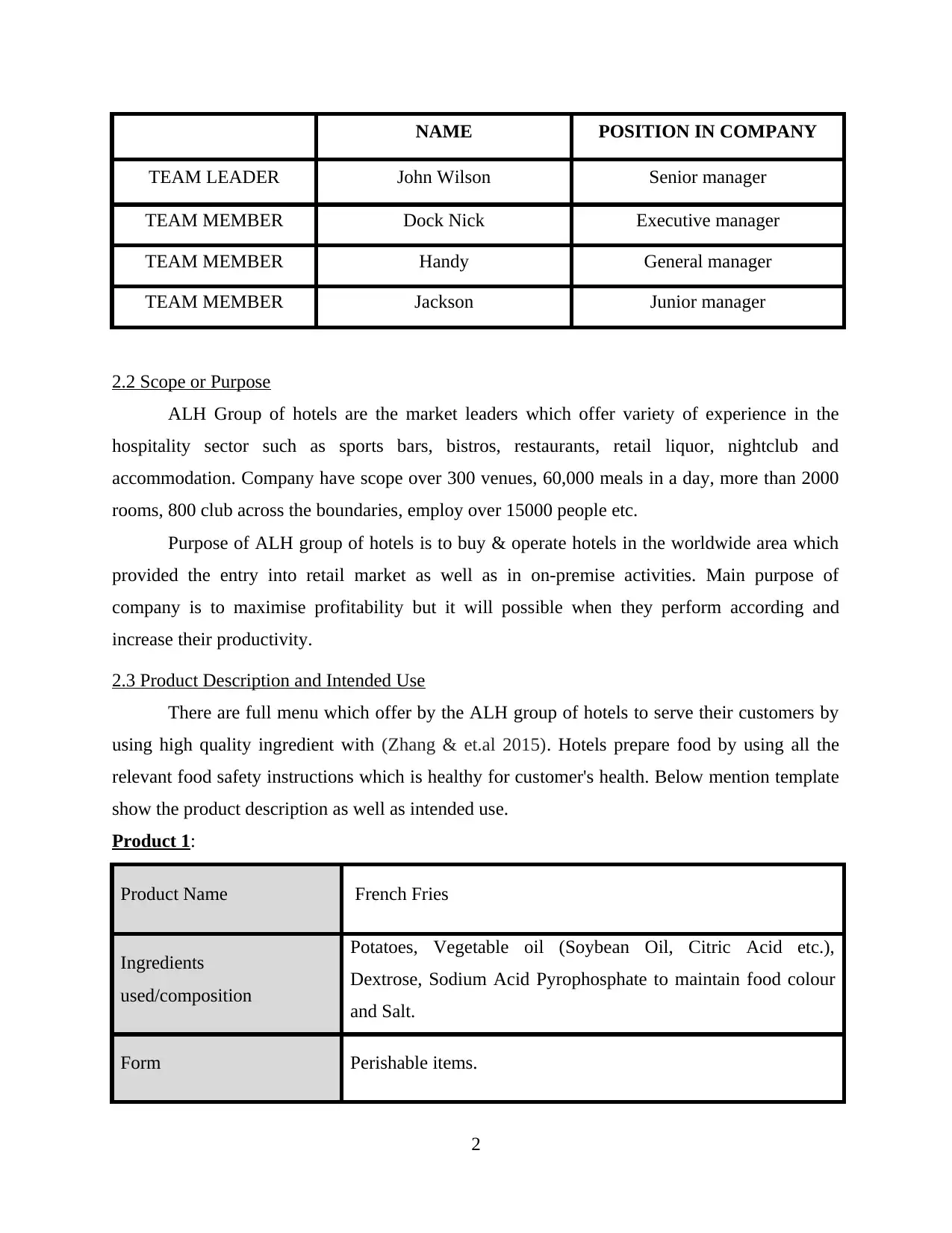
NAME POSITION IN COMPANY
TEAM LEADER John Wilson Senior manager
TEAM MEMBER Dock Nick Executive manager
TEAM MEMBER Handy General manager
TEAM MEMBER Jackson Junior manager
2.2 Scope or Purpose
ALH Group of hotels are the market leaders which offer variety of experience in the
hospitality sector such as sports bars, bistros, restaurants, retail liquor, nightclub and
accommodation. Company have scope over 300 venues, 60,000 meals in a day, more than 2000
rooms, 800 club across the boundaries, employ over 15000 people etc.
Purpose of ALH group of hotels is to buy & operate hotels in the worldwide area which
provided the entry into retail market as well as in on-premise activities. Main purpose of
company is to maximise profitability but it will possible when they perform according and
increase their productivity.
2.3 Product Description and Intended Use
There are full menu which offer by the ALH group of hotels to serve their customers by
using high quality ingredient with (Zhang & et.al 2015). Hotels prepare food by using all the
relevant food safety instructions which is healthy for customer's health. Below mention template
show the product description as well as intended use.
Product 1:
Product Name French Fries
Ingredients
used/composition
Potatoes, Vegetable oil (Soybean Oil, Citric Acid etc.),
Dextrose, Sodium Acid Pyrophosphate to maintain food colour
and Salt.
Form Perishable items.
2
TEAM LEADER John Wilson Senior manager
TEAM MEMBER Dock Nick Executive manager
TEAM MEMBER Handy General manager
TEAM MEMBER Jackson Junior manager
2.2 Scope or Purpose
ALH Group of hotels are the market leaders which offer variety of experience in the
hospitality sector such as sports bars, bistros, restaurants, retail liquor, nightclub and
accommodation. Company have scope over 300 venues, 60,000 meals in a day, more than 2000
rooms, 800 club across the boundaries, employ over 15000 people etc.
Purpose of ALH group of hotels is to buy & operate hotels in the worldwide area which
provided the entry into retail market as well as in on-premise activities. Main purpose of
company is to maximise profitability but it will possible when they perform according and
increase their productivity.
2.3 Product Description and Intended Use
There are full menu which offer by the ALH group of hotels to serve their customers by
using high quality ingredient with (Zhang & et.al 2015). Hotels prepare food by using all the
relevant food safety instructions which is healthy for customer's health. Below mention template
show the product description as well as intended use.
Product 1:
Product Name French Fries
Ingredients
used/composition
Potatoes, Vegetable oil (Soybean Oil, Citric Acid etc.),
Dextrose, Sodium Acid Pyrophosphate to maintain food colour
and Salt.
Form Perishable items.
2
Paraphrase This Document
Need a fresh take? Get an instant paraphrase of this document with our AI Paraphraser
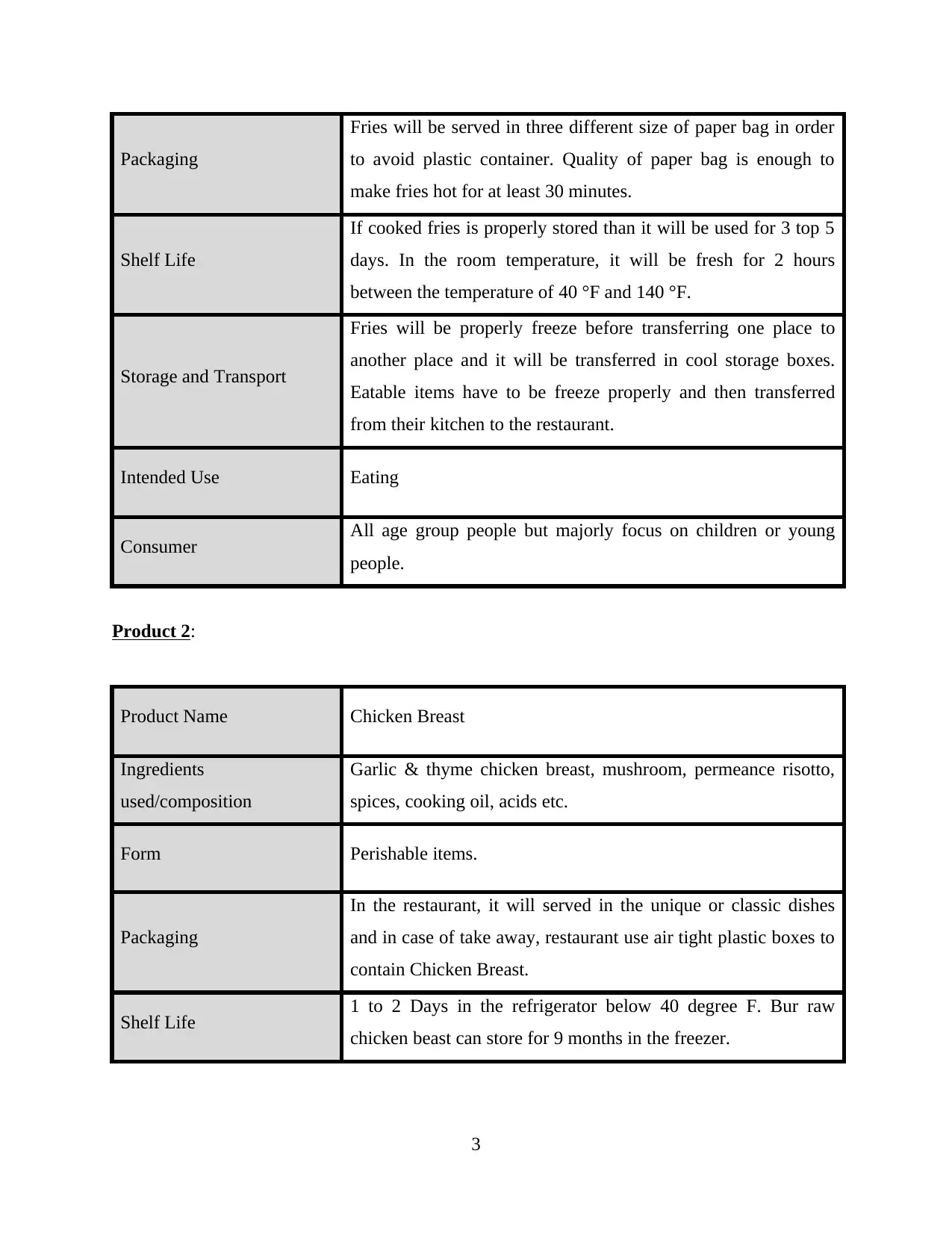
Packaging
Fries will be served in three different size of paper bag in order
to avoid plastic container. Quality of paper bag is enough to
make fries hot for at least 30 minutes.
Shelf Life
If cooked fries is properly stored than it will be used for 3 top 5
days. In the room temperature, it will be fresh for 2 hours
between the temperature of 40 °F and 140 °F.
Storage and Transport
Fries will be properly freeze before transferring one place to
another place and it will be transferred in cool storage boxes.
Eatable items have to be freeze properly and then transferred
from their kitchen to the restaurant.
Intended Use Eating
Consumer All age group people but majorly focus on children or young
people.
Product 2:
Product Name Chicken Breast
Ingredients
used/composition
Garlic & thyme chicken breast, mushroom, permeance risotto,
spices, cooking oil, acids etc.
Form Perishable items.
Packaging
In the restaurant, it will served in the unique or classic dishes
and in case of take away, restaurant use air tight plastic boxes to
contain Chicken Breast.
Shelf Life 1 to 2 Days in the refrigerator below 40 degree F. Bur raw
chicken beast can store for 9 months in the freezer.
3
Fries will be served in three different size of paper bag in order
to avoid plastic container. Quality of paper bag is enough to
make fries hot for at least 30 minutes.
Shelf Life
If cooked fries is properly stored than it will be used for 3 top 5
days. In the room temperature, it will be fresh for 2 hours
between the temperature of 40 °F and 140 °F.
Storage and Transport
Fries will be properly freeze before transferring one place to
another place and it will be transferred in cool storage boxes.
Eatable items have to be freeze properly and then transferred
from their kitchen to the restaurant.
Intended Use Eating
Consumer All age group people but majorly focus on children or young
people.
Product 2:
Product Name Chicken Breast
Ingredients
used/composition
Garlic & thyme chicken breast, mushroom, permeance risotto,
spices, cooking oil, acids etc.
Form Perishable items.
Packaging
In the restaurant, it will served in the unique or classic dishes
and in case of take away, restaurant use air tight plastic boxes to
contain Chicken Breast.
Shelf Life 1 to 2 Days in the refrigerator below 40 degree F. Bur raw
chicken beast can store for 9 months in the freezer.
3
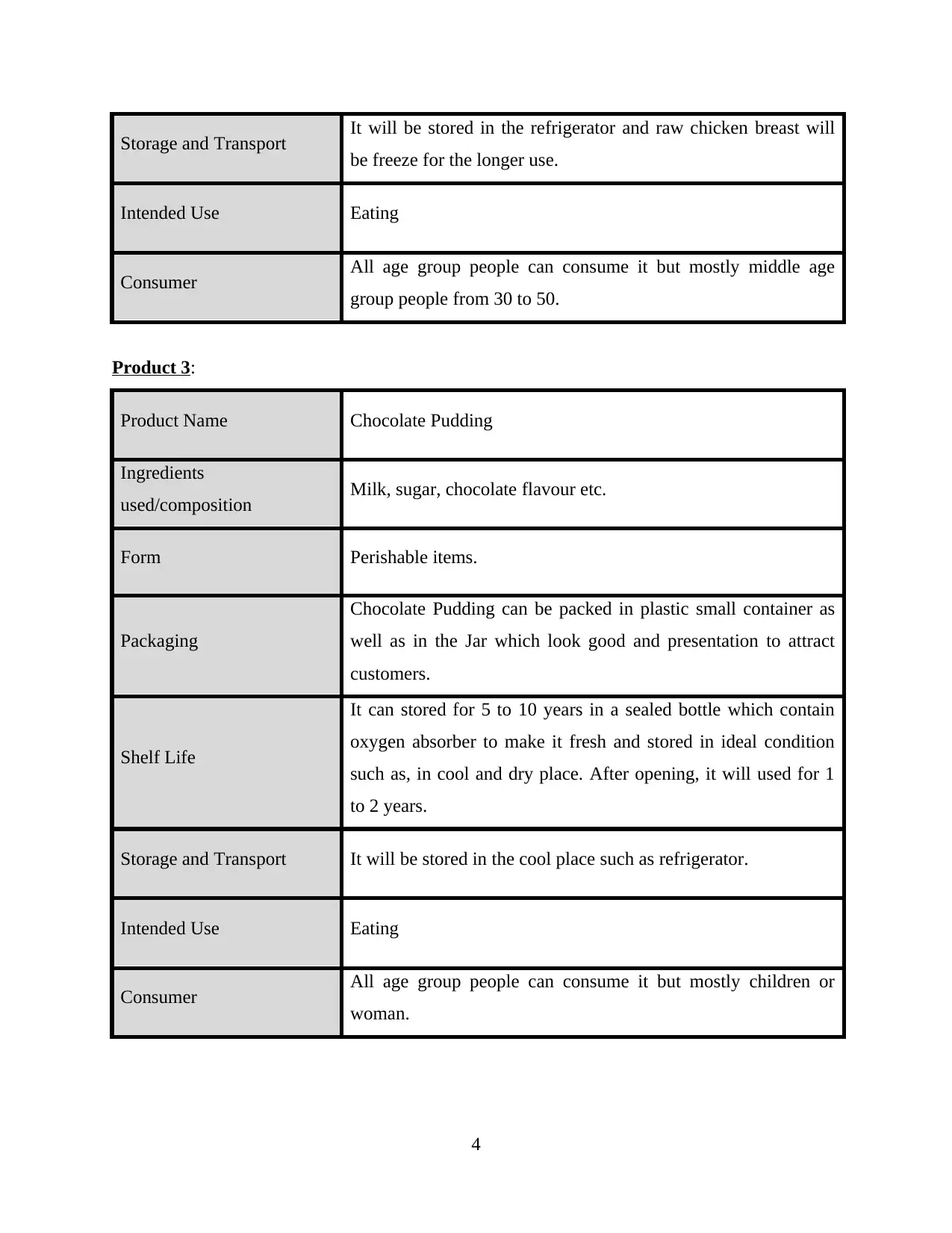
Storage and Transport It will be stored in the refrigerator and raw chicken breast will
be freeze for the longer use.
Intended Use Eating
Consumer All age group people can consume it but mostly middle age
group people from 30 to 50.
Product 3:
Product Name Chocolate Pudding
Ingredients
used/composition Milk, sugar, chocolate flavour etc.
Form Perishable items.
Packaging
Chocolate Pudding can be packed in plastic small container as
well as in the Jar which look good and presentation to attract
customers.
Shelf Life
It can stored for 5 to 10 years in a sealed bottle which contain
oxygen absorber to make it fresh and stored in ideal condition
such as, in cool and dry place. After opening, it will used for 1
to 2 years.
Storage and Transport It will be stored in the cool place such as refrigerator.
Intended Use Eating
Consumer All age group people can consume it but mostly children or
woman.
4
be freeze for the longer use.
Intended Use Eating
Consumer All age group people can consume it but mostly middle age
group people from 30 to 50.
Product 3:
Product Name Chocolate Pudding
Ingredients
used/composition Milk, sugar, chocolate flavour etc.
Form Perishable items.
Packaging
Chocolate Pudding can be packed in plastic small container as
well as in the Jar which look good and presentation to attract
customers.
Shelf Life
It can stored for 5 to 10 years in a sealed bottle which contain
oxygen absorber to make it fresh and stored in ideal condition
such as, in cool and dry place. After opening, it will used for 1
to 2 years.
Storage and Transport It will be stored in the cool place such as refrigerator.
Intended Use Eating
Consumer All age group people can consume it but mostly children or
woman.
4
⊘ This is a preview!⊘
Do you want full access?
Subscribe today to unlock all pages.
Trusted by 1+ million students worldwide
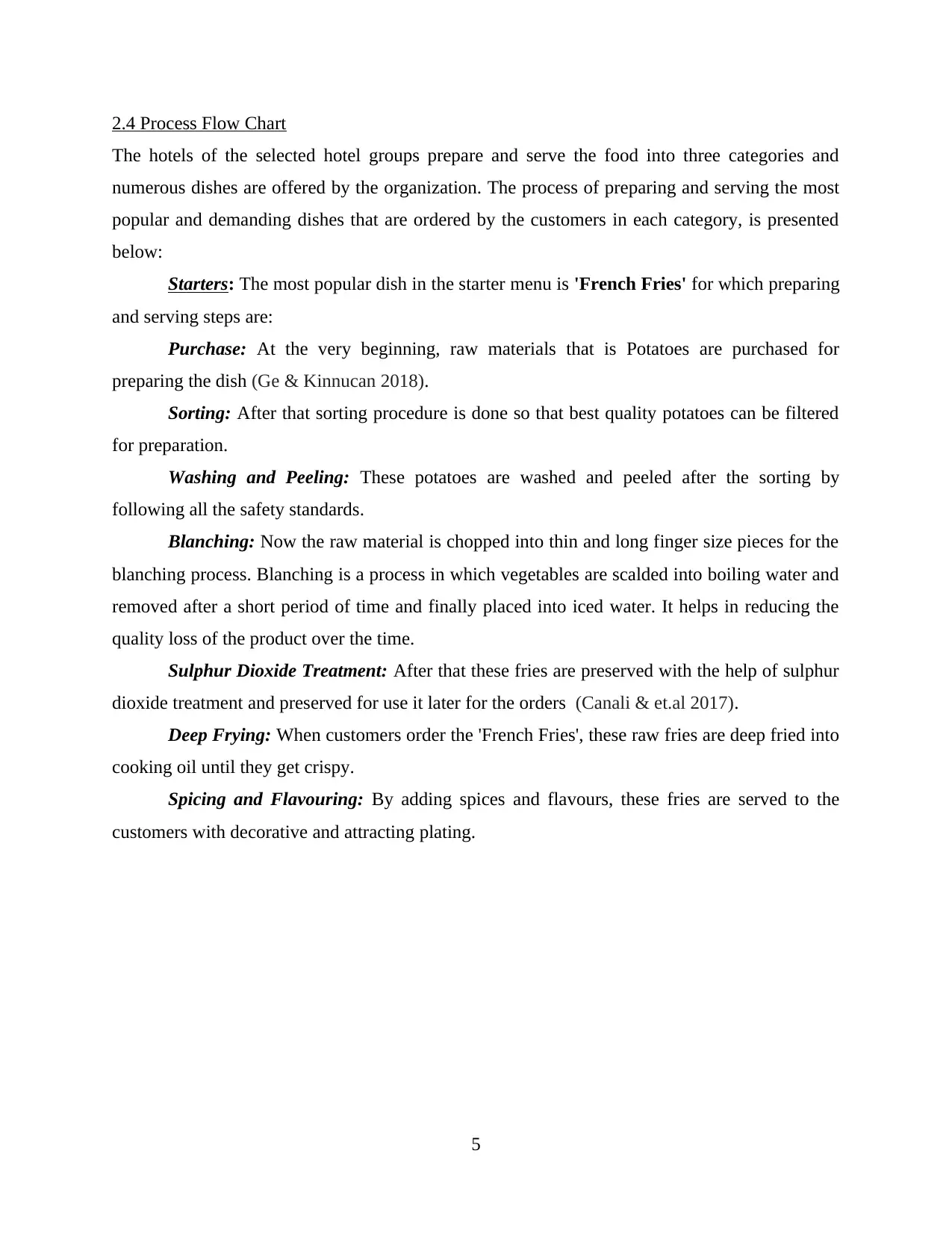
2.4 Process Flow Chart
The hotels of the selected hotel groups prepare and serve the food into three categories and
numerous dishes are offered by the organization. The process of preparing and serving the most
popular and demanding dishes that are ordered by the customers in each category, is presented
below:
Starters: The most popular dish in the starter menu is 'French Fries' for which preparing
and serving steps are:
Purchase: At the very beginning, raw materials that is Potatoes are purchased for
preparing the dish (Ge & Kinnucan 2018).
Sorting: After that sorting procedure is done so that best quality potatoes can be filtered
for preparation.
Washing and Peeling: These potatoes are washed and peeled after the sorting by
following all the safety standards.
Blanching: Now the raw material is chopped into thin and long finger size pieces for the
blanching process. Blanching is a process in which vegetables are scalded into boiling water and
removed after a short period of time and finally placed into iced water. It helps in reducing the
quality loss of the product over the time.
Sulphur Dioxide Treatment: After that these fries are preserved with the help of sulphur
dioxide treatment and preserved for use it later for the orders (Canali & et.al 2017).
Deep Frying: When customers order the 'French Fries', these raw fries are deep fried into
cooking oil until they get crispy.
Spicing and Flavouring: By adding spices and flavours, these fries are served to the
customers with decorative and attracting plating.
5
The hotels of the selected hotel groups prepare and serve the food into three categories and
numerous dishes are offered by the organization. The process of preparing and serving the most
popular and demanding dishes that are ordered by the customers in each category, is presented
below:
Starters: The most popular dish in the starter menu is 'French Fries' for which preparing
and serving steps are:
Purchase: At the very beginning, raw materials that is Potatoes are purchased for
preparing the dish (Ge & Kinnucan 2018).
Sorting: After that sorting procedure is done so that best quality potatoes can be filtered
for preparation.
Washing and Peeling: These potatoes are washed and peeled after the sorting by
following all the safety standards.
Blanching: Now the raw material is chopped into thin and long finger size pieces for the
blanching process. Blanching is a process in which vegetables are scalded into boiling water and
removed after a short period of time and finally placed into iced water. It helps in reducing the
quality loss of the product over the time.
Sulphur Dioxide Treatment: After that these fries are preserved with the help of sulphur
dioxide treatment and preserved for use it later for the orders (Canali & et.al 2017).
Deep Frying: When customers order the 'French Fries', these raw fries are deep fried into
cooking oil until they get crispy.
Spicing and Flavouring: By adding spices and flavours, these fries are served to the
customers with decorative and attracting plating.
5
Paraphrase This Document
Need a fresh take? Get an instant paraphrase of this document with our AI Paraphraser
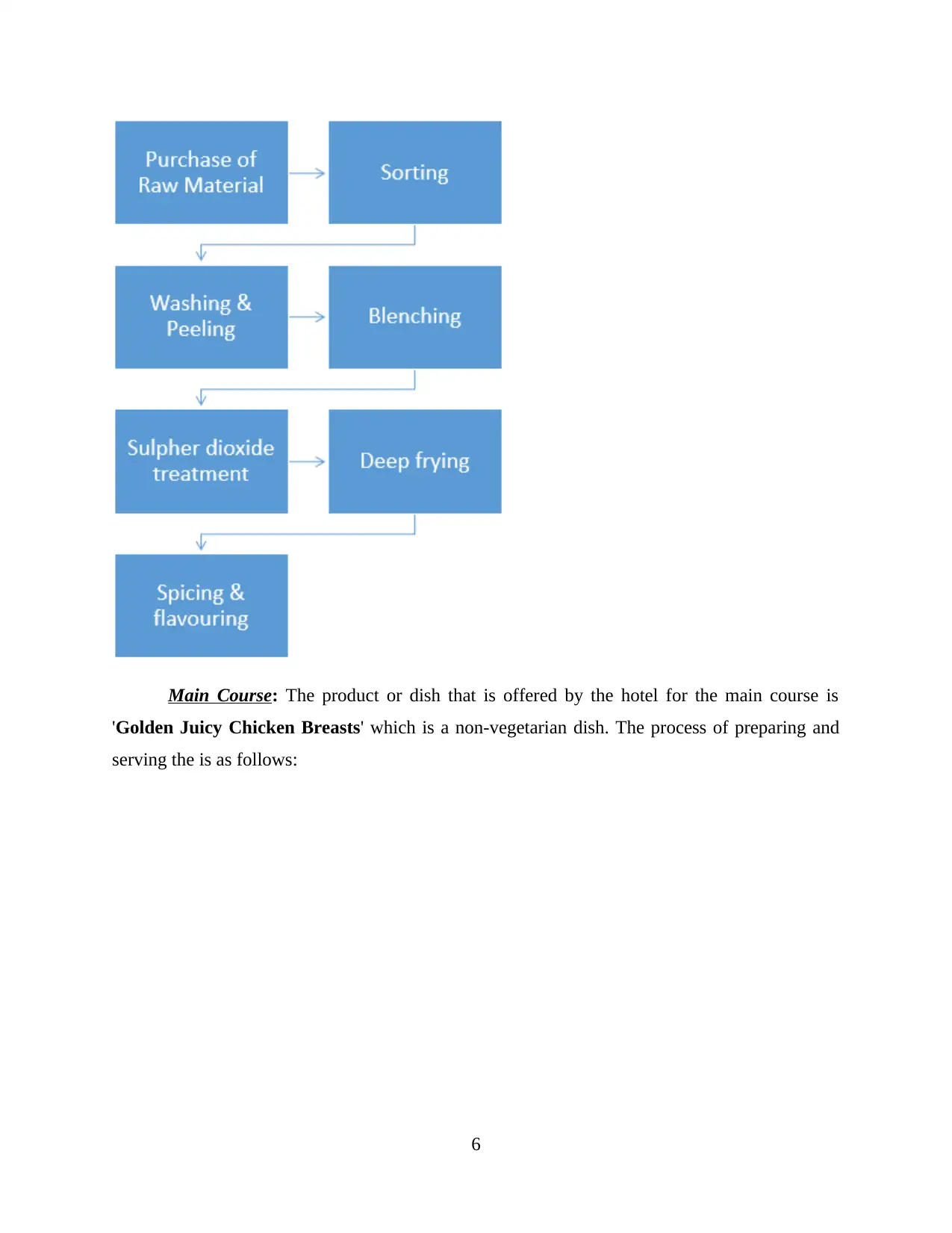
Main Course: The product or dish that is offered by the hotel for the main course is
'Golden Juicy Chicken Breasts' which is a non-vegetarian dish. The process of preparing and
serving the is as follows:
6
'Golden Juicy Chicken Breasts' which is a non-vegetarian dish. The process of preparing and
serving the is as follows:
6
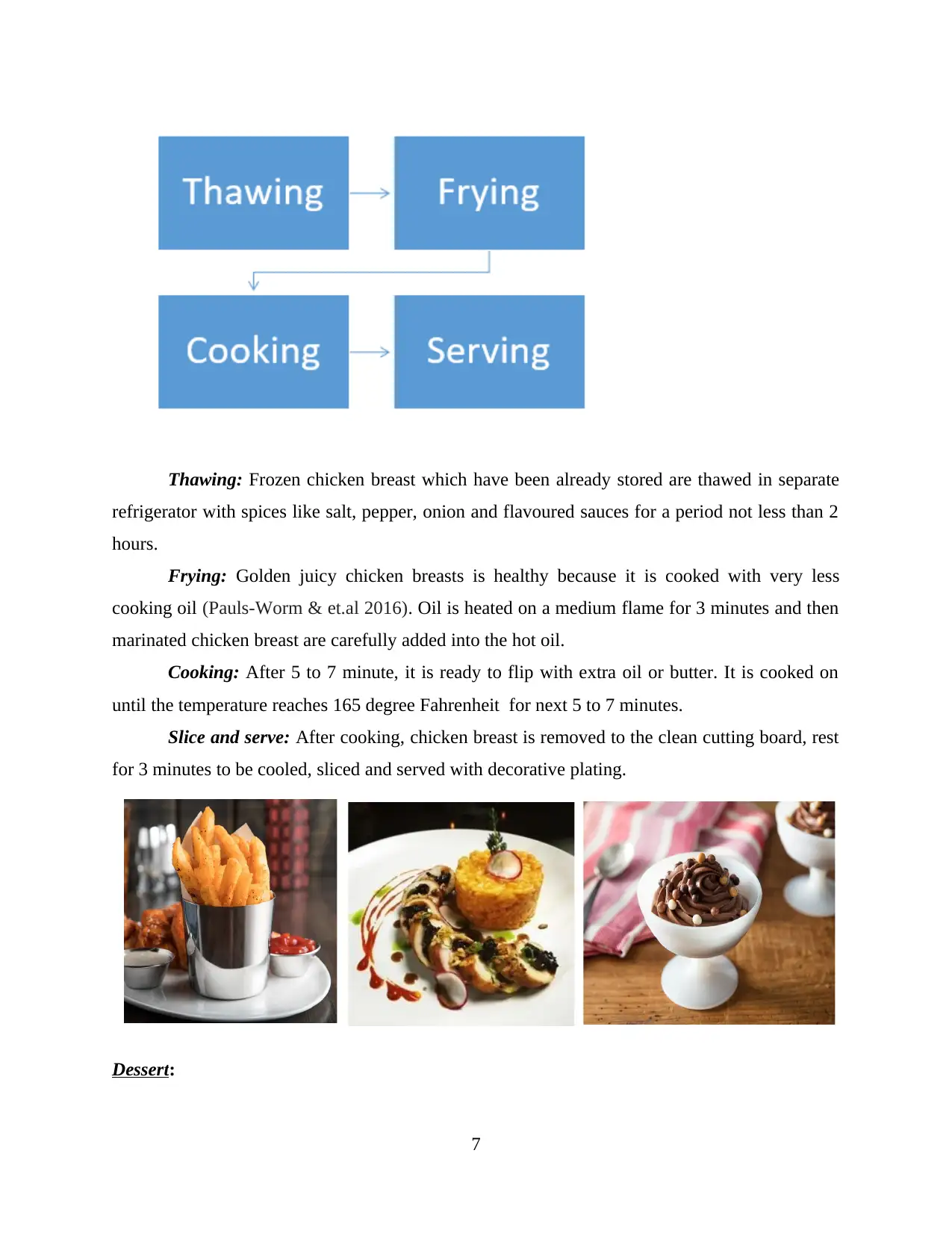
Thawing: Frozen chicken breast which have been already stored are thawed in separate
refrigerator with spices like salt, pepper, onion and flavoured sauces for a period not less than 2
hours.
Frying: Golden juicy chicken breasts is healthy because it is cooked with very less
cooking oil (Pauls-Worm & et.al 2016). Oil is heated on a medium flame for 3 minutes and then
marinated chicken breast are carefully added into the hot oil.
Cooking: After 5 to 7 minute, it is ready to flip with extra oil or butter. It is cooked on
until the temperature reaches 165 degree Fahrenheit for next 5 to 7 minutes.
Slice and serve: After cooking, chicken breast is removed to the clean cutting board, rest
for 3 minutes to be cooled, sliced and served with decorative plating.
Dessert:
7
refrigerator with spices like salt, pepper, onion and flavoured sauces for a period not less than 2
hours.
Frying: Golden juicy chicken breasts is healthy because it is cooked with very less
cooking oil (Pauls-Worm & et.al 2016). Oil is heated on a medium flame for 3 minutes and then
marinated chicken breast are carefully added into the hot oil.
Cooking: After 5 to 7 minute, it is ready to flip with extra oil or butter. It is cooked on
until the temperature reaches 165 degree Fahrenheit for next 5 to 7 minutes.
Slice and serve: After cooking, chicken breast is removed to the clean cutting board, rest
for 3 minutes to be cooled, sliced and served with decorative plating.
Dessert:
7
⊘ This is a preview!⊘
Do you want full access?
Subscribe today to unlock all pages.
Trusted by 1+ million students worldwide
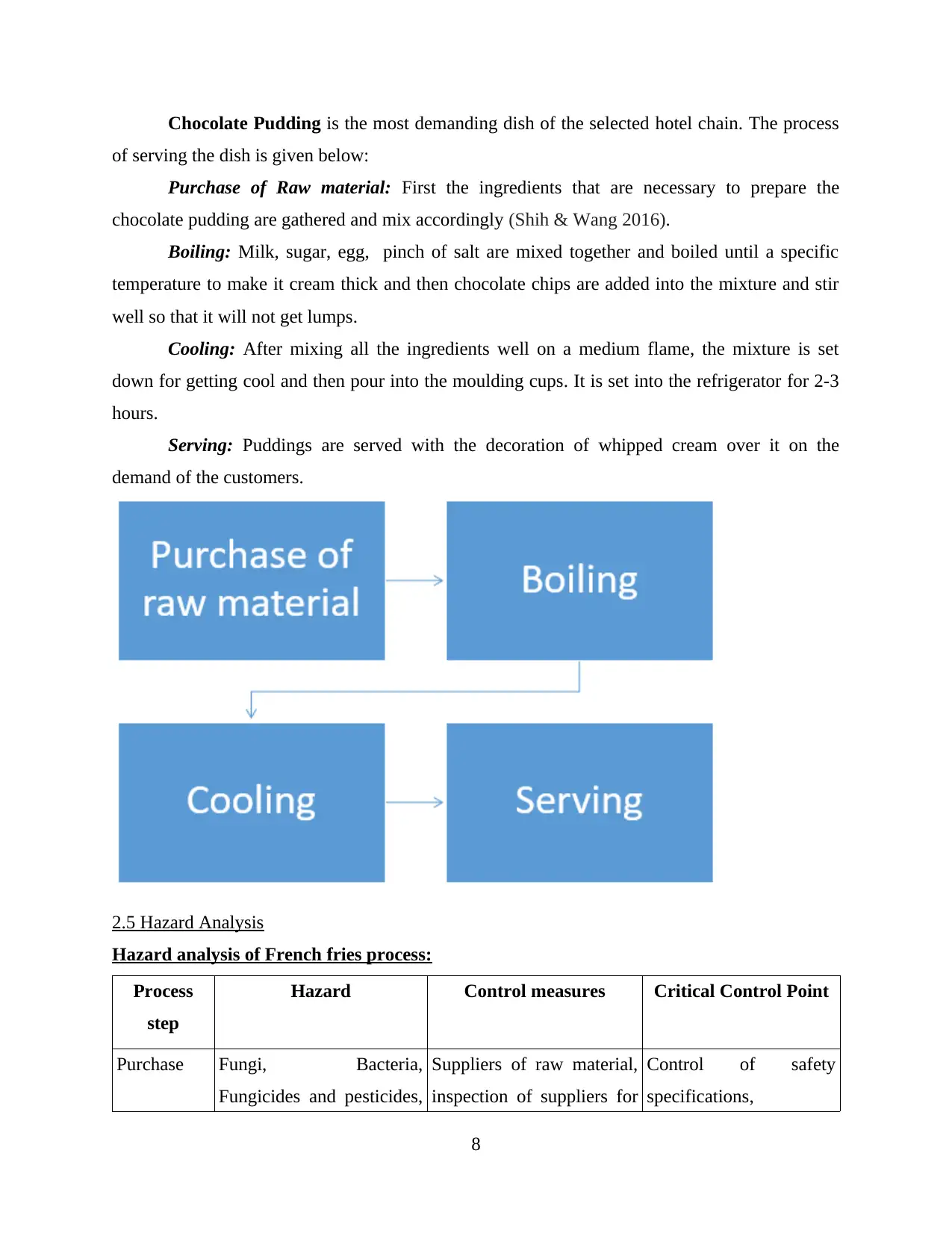
Chocolate Pudding is the most demanding dish of the selected hotel chain. The process
of serving the dish is given below:
Purchase of Raw material: First the ingredients that are necessary to prepare the
chocolate pudding are gathered and mix accordingly (Shih & Wang 2016).
Boiling: Milk, sugar, egg, pinch of salt are mixed together and boiled until a specific
temperature to make it cream thick and then chocolate chips are added into the mixture and stir
well so that it will not get lumps.
Cooling: After mixing all the ingredients well on a medium flame, the mixture is set
down for getting cool and then pour into the moulding cups. It is set into the refrigerator for 2-3
hours.
Serving: Puddings are served with the decoration of whipped cream over it on the
demand of the customers.
2.5 Hazard Analysis
Hazard analysis of French fries process:
Process
step
Hazard Control measures Critical Control Point
Purchase Fungi, Bacteria,
Fungicides and pesticides,
Suppliers of raw material,
inspection of suppliers for
Control of safety
specifications,
8
of serving the dish is given below:
Purchase of Raw material: First the ingredients that are necessary to prepare the
chocolate pudding are gathered and mix accordingly (Shih & Wang 2016).
Boiling: Milk, sugar, egg, pinch of salt are mixed together and boiled until a specific
temperature to make it cream thick and then chocolate chips are added into the mixture and stir
well so that it will not get lumps.
Cooling: After mixing all the ingredients well on a medium flame, the mixture is set
down for getting cool and then pour into the moulding cups. It is set into the refrigerator for 2-3
hours.
Serving: Puddings are served with the decoration of whipped cream over it on the
demand of the customers.
2.5 Hazard Analysis
Hazard analysis of French fries process:
Process
step
Hazard Control measures Critical Control Point
Purchase Fungi, Bacteria,
Fungicides and pesticides,
Suppliers of raw material,
inspection of suppliers for
Control of safety
specifications,
8
Paraphrase This Document
Need a fresh take? Get an instant paraphrase of this document with our AI Paraphraser
foreign material from soil
harvesting.
hygiene (Abdelhamid &
et.al 2017).
fungicides/pesticides
residuals limits, control
over foreign material.
Sorting Microorganism from
equipments or personnels,
residual of cleaning agents
in equipments, foreign
material from metallic
surface.
Assurance of hygiene
conditions, equipment
cleaning, equipment
personnel training and
disinfection of approved
lubricants.
Macrobiotics control,
control over foreign
material, control over
cleaning and disinfection
program.
Washing &
Peeling
Microorganism from
equipments, water or
surfaces, residual of
cleaning agents in
lubricants or equipments
(Citraresmi & Azizah,
2019).
Equipment cleaning and
disinfection renewal of
water, maintenance of
equipments.
Control of washing
efficiency, reuse of
water, cleaning program.
Blanching Microorganism from water
or equipments, foreign
materials, residual of
cleaning agents.
Assurance of hygiene
conditions, equipment
cleaning and personnel
training.
Control of blanching
time and temperature,
control of water quality.
Sulphur
Dioxide
Treatment
Very toxic (fatal if
inhaled), Corrosive, cause
explosion, suspect
mutagen, cause genetic
defects.
Installation of exhaust
ventilation and enclosure,
stringent control measures,
respiratory protection.
Control of quantity,
environment and
freezing rate.
Deep
Frying
Contamination of fresh oil
with used oil/fat, oxidation
and polymerization
products of oil, the
majority of microorganism
Use of approved lubricants
and cleaning agents,
personnel training,
maintenance of
equipments, disinfection of
Control of temperature
(165-185 degree
Celsius), turn over time,
replacement of oil,
maximum consumption
9
harvesting.
hygiene (Abdelhamid &
et.al 2017).
fungicides/pesticides
residuals limits, control
over foreign material.
Sorting Microorganism from
equipments or personnels,
residual of cleaning agents
in equipments, foreign
material from metallic
surface.
Assurance of hygiene
conditions, equipment
cleaning, equipment
personnel training and
disinfection of approved
lubricants.
Macrobiotics control,
control over foreign
material, control over
cleaning and disinfection
program.
Washing &
Peeling
Microorganism from
equipments, water or
surfaces, residual of
cleaning agents in
lubricants or equipments
(Citraresmi & Azizah,
2019).
Equipment cleaning and
disinfection renewal of
water, maintenance of
equipments.
Control of washing
efficiency, reuse of
water, cleaning program.
Blanching Microorganism from water
or equipments, foreign
materials, residual of
cleaning agents.
Assurance of hygiene
conditions, equipment
cleaning and personnel
training.
Control of blanching
time and temperature,
control of water quality.
Sulphur
Dioxide
Treatment
Very toxic (fatal if
inhaled), Corrosive, cause
explosion, suspect
mutagen, cause genetic
defects.
Installation of exhaust
ventilation and enclosure,
stringent control measures,
respiratory protection.
Control of quantity,
environment and
freezing rate.
Deep
Frying
Contamination of fresh oil
with used oil/fat, oxidation
and polymerization
products of oil, the
majority of microorganism
Use of approved lubricants
and cleaning agents,
personnel training,
maintenance of
equipments, disinfection of
Control of temperature
(165-185 degree
Celsius), turn over time,
replacement of oil,
maximum consumption
9
are destroyed. antioxidants (Zhang, Li &
Yuan, 2015).
of fat.
Spicing and
Flavouring
Residual of chemicals in
the materials,
contamination of
personnels, air and
equipments, foreign
material.
Assurance of hygiene
condition, personnel
training and disinfection of
materials.
Inspection of material by
personnels, control of
foreign material and
fatty acids.
Hazard analysis of Chicken Breast process:
Process
step
Hazard Control measures Critical Control Point
Thawing Temperature and time
control, quantity of sauces
and spices, hygiene
conditions.
Assurance of hygiene
condition, personnel
training and disinfection of
materials. Discard the food
if the surface temperature
has reached 10 °C or
higher
Check core and surface
temperature of the food
at least twice per day,
Check thawing time,
Investigate
temperature/time
Frying Time control, Hygiene
conditions, Microorganism
from equipments.
Simmering time must be
25 to 30 minutes for
boneless breast and grilling
time is 6-8 minute each
side.
Check temperature
Check heating time
Visual checks
investigate
temperature/time abuse
and evaluate risk
Cooking Core temperature control,
heating time, risk of
foreign material,
temperature.
75 °C or higher (core
temperature) Temperature
180 °C, Avoid⩽
intermittent Removing
foreign material.
Check temperature
Check heating time
Visual checks
investigate
temperature/time abuse
10
Yuan, 2015).
of fat.
Spicing and
Flavouring
Residual of chemicals in
the materials,
contamination of
personnels, air and
equipments, foreign
material.
Assurance of hygiene
condition, personnel
training and disinfection of
materials.
Inspection of material by
personnels, control of
foreign material and
fatty acids.
Hazard analysis of Chicken Breast process:
Process
step
Hazard Control measures Critical Control Point
Thawing Temperature and time
control, quantity of sauces
and spices, hygiene
conditions.
Assurance of hygiene
condition, personnel
training and disinfection of
materials. Discard the food
if the surface temperature
has reached 10 °C or
higher
Check core and surface
temperature of the food
at least twice per day,
Check thawing time,
Investigate
temperature/time
Frying Time control, Hygiene
conditions, Microorganism
from equipments.
Simmering time must be
25 to 30 minutes for
boneless breast and grilling
time is 6-8 minute each
side.
Check temperature
Check heating time
Visual checks
investigate
temperature/time abuse
and evaluate risk
Cooking Core temperature control,
heating time, risk of
foreign material,
temperature.
75 °C or higher (core
temperature) Temperature
180 °C, Avoid⩽
intermittent Removing
foreign material.
Check temperature
Check heating time
Visual checks
investigate
temperature/time abuse
10
⊘ This is a preview!⊘
Do you want full access?
Subscribe today to unlock all pages.
Trusted by 1+ million students worldwide

1 out of 34


Related Documents


Your All-in-One AI-Powered Toolkit for Academic Success.
+13062052269
info@desklib.com
Available 24*7 on WhatsApp / Email
![[object Object]](/_next/static/media/star-bottom.7253800d.svg)
Unlock your academic potential
Copyright © 2020–2026 A2Z Services. All Rights Reserved. Developed and managed by ZUCOL.