Good Practices in Social Impact Assessment and Force Displacement
VerifiedAdded on 2022/09/28
|8
|2067
|25
Report
AI Summary
This report delves into the critical intersection of force displacement and Social Impact Assessment (SIA), examining what constitutes 'good practice' in evaluating the societal impacts of displacement. The paper begins by defining force displacement as coerced migration, exploring its causes, including environmental stress and development-induced displacement (DIDR). It then examines the SIA model, derived from Environmental Impact Assessment (EIA), and its role in assessing the effects of large-scale projects on communities, focusing on cultural values, livelihood, and quality of life. The report highlights the risks associated with DIDR, such as impoverishment, and discusses the Sungai Selangor water supply scheme as a case study, illustrating the shortcomings of inadequate compensation and poor SIA. Drawing on the works of Koenig, Scudder, Swainson, and Wilmsen & Webber, the report outlines frameworks for improved resettlement, including Scudder's four-stage framework and Carnea's impoverishment risks model, emphasizing the importance of proper planning, monitoring, and bureaucratic goodwill. The conclusion underscores the necessity of ethical and responsible measures to mitigate the negative impacts of force displacement and promote good practices in SIA.
Running head: FORCE DISPLACEMENT
Force Displacement
Student’s name:
University:
Author’s note:
Force Displacement
Student’s name:
University:
Author’s note:
Paraphrase This Document
Need a fresh take? Get an instant paraphrase of this document with our AI Paraphraser

1
FORCE DISPLACEMENT
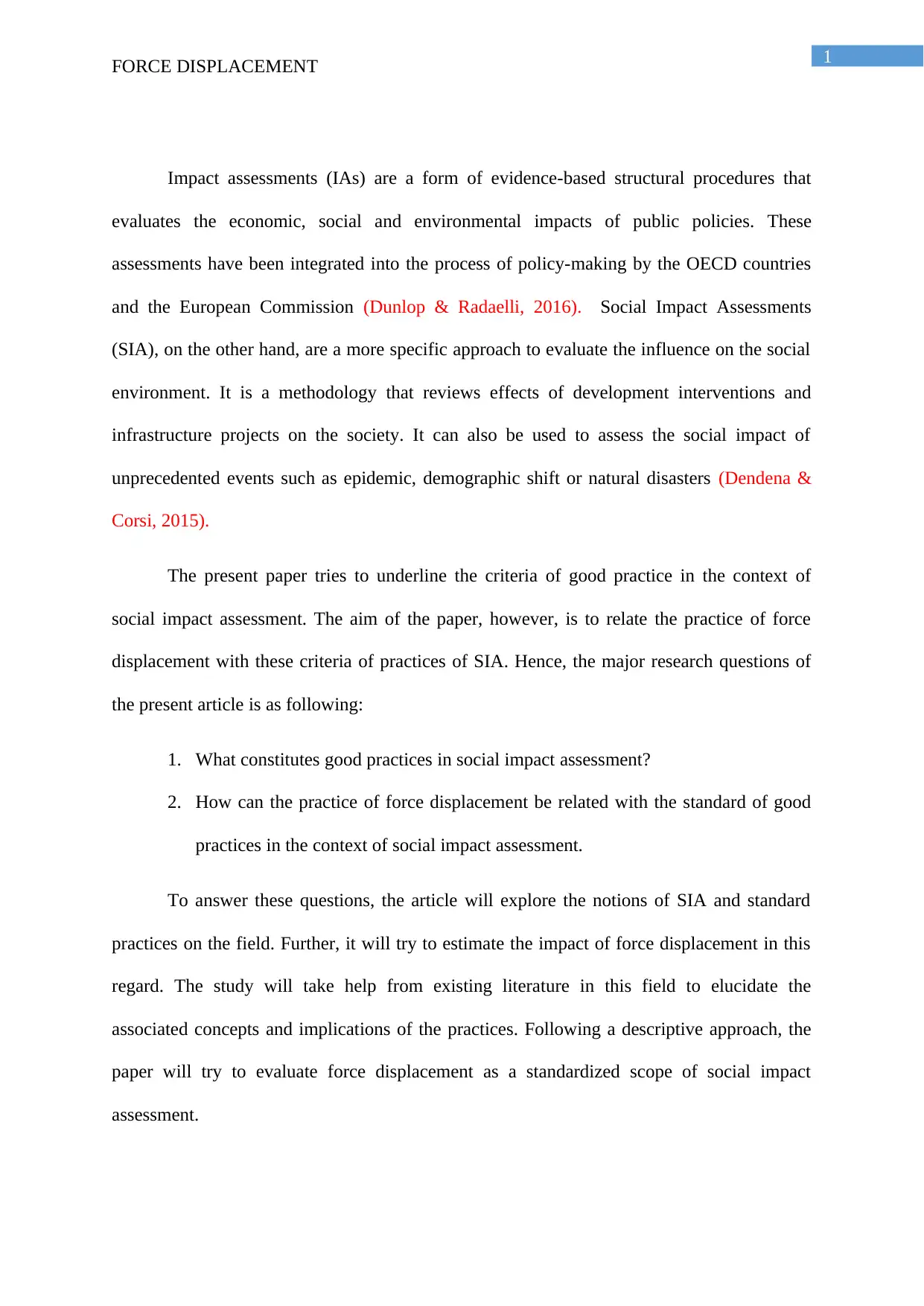
Impact assessments (IAs) are a form of evidence-based structural procedures that
evaluates the economic, social and environmental impacts of public policies. These
assessments have been integrated into the process of policy-making by the OECD countries
and the European Commission (Dunlop & Radaelli, 2016). Social Impact Assessments
(SIA), on the other hand, are a more specific approach to evaluate the influence on the social
environment. It is a methodology that reviews effects of development interventions and
infrastructure projects on the society. It can also be used to assess the social impact of
unprecedented events such as epidemic, demographic shift or natural disasters (Dendena &
Corsi, 2015).
The present paper tries to underline the criteria of good practice in the context of
social impact assessment. The aim of the paper, however, is to relate the practice of force
displacement with these criteria of practices of SIA. Hence, the major research questions of
the present article is as following:
1. What constitutes good practices in social impact assessment?
2. How can the practice of force displacement be related with the standard of good
practices in the context of social impact assessment.
To answer these questions, the article will explore the notions of SIA and standard
practices on the field. Further, it will try to estimate the impact of force displacement in this
regard. The study will take help from existing literature in this field to elucidate the
associated concepts and implications of the practices. Following a descriptive approach, the
paper will try to evaluate force displacement as a standardized scope of social impact
assessment.
FORCE DISPLACEMENT
Impact assessments (IAs) are a form of evidence-based structural procedures that
evaluates the economic, social and environmental impacts of public policies. These
assessments have been integrated into the process of policy-making by the OECD countries
and the European Commission (Dunlop & Radaelli, 2016). Social Impact Assessments
(SIA), on the other hand, are a more specific approach to evaluate the influence on the social
environment. It is a methodology that reviews effects of development interventions and
infrastructure projects on the society. It can also be used to assess the social impact of
unprecedented events such as epidemic, demographic shift or natural disasters (Dendena &
Corsi, 2015).
The present paper tries to underline the criteria of good practice in the context of
social impact assessment. The aim of the paper, however, is to relate the practice of force
displacement with these criteria of practices of SIA. Hence, the major research questions of
the present article is as following:
1. What constitutes good practices in social impact assessment?
2. How can the practice of force displacement be related with the standard of good
practices in the context of social impact assessment.
To answer these questions, the article will explore the notions of SIA and standard
practices on the field. Further, it will try to estimate the impact of force displacement in this
regard. The study will take help from existing literature in this field to elucidate the
associated concepts and implications of the practices. Following a descriptive approach, the
paper will try to evaluate force displacement as a standardized scope of social impact
assessment.

2
FORCE DISPLACEMENT
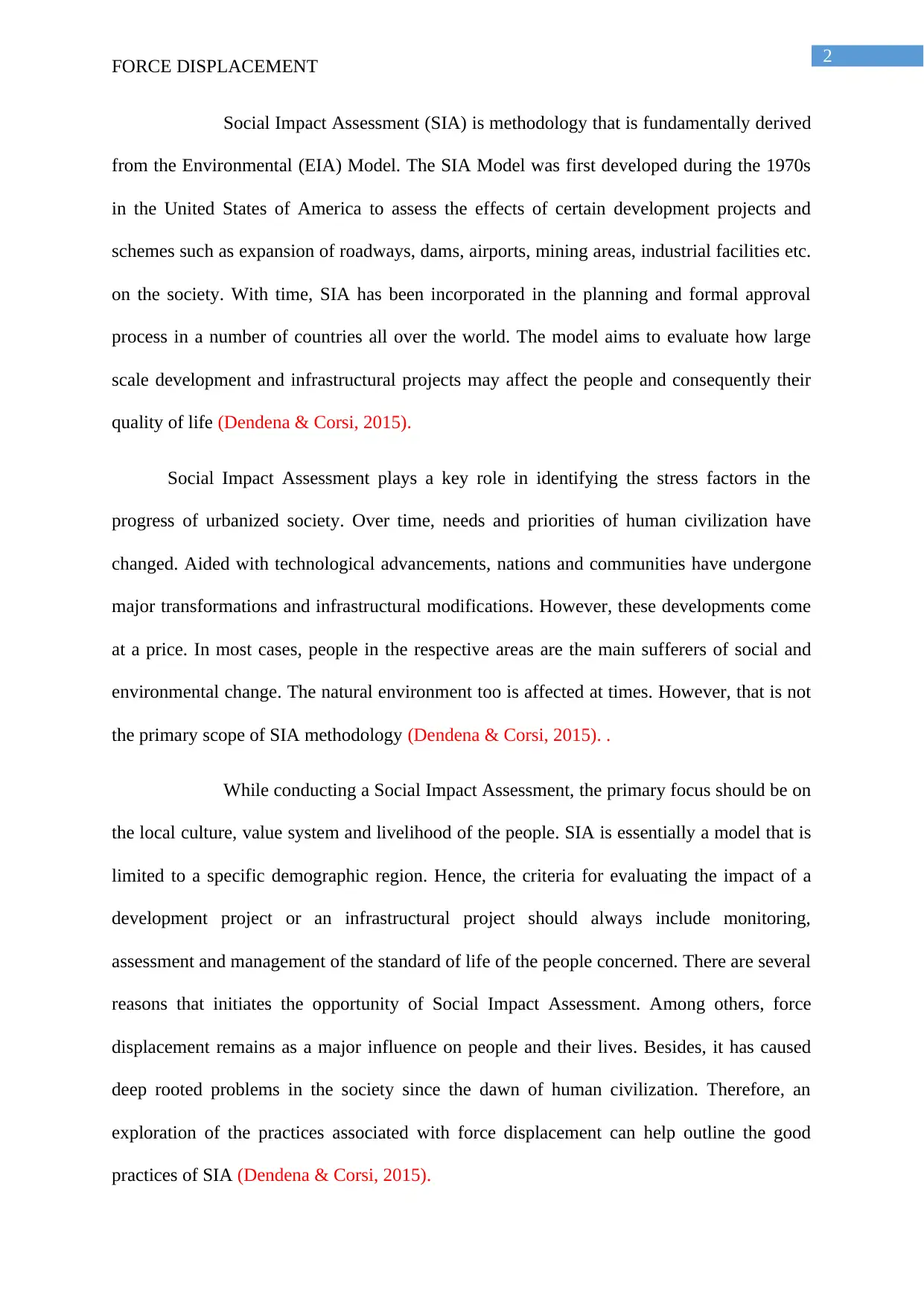
Social Impact Assessment (SIA) is methodology that is fundamentally derived
from the Environmental (EIA) Model. The SIA Model was first developed during the 1970s
in the United States of America to assess the effects of certain development projects and
schemes such as expansion of roadways, dams, airports, mining areas, industrial facilities etc.
on the society. With time, SIA has been incorporated in the planning and formal approval
process in a number of countries all over the world. The model aims to evaluate how large
scale development and infrastructural projects may affect the people and consequently their
quality of life (Dendena & Corsi, 2015).
Social Impact Assessment plays a key role in identifying the stress factors in the
progress of urbanized society. Over time, needs and priorities of human civilization have
changed. Aided with technological advancements, nations and communities have undergone
major transformations and infrastructural modifications. However, these developments come
at a price. In most cases, people in the respective areas are the main sufferers of social and
environmental change. The natural environment too is affected at times. However, that is not
the primary scope of SIA methodology (Dendena & Corsi, 2015). .
While conducting a Social Impact Assessment, the primary focus should be on
the local culture, value system and livelihood of the people. SIA is essentially a model that is
limited to a specific demographic region. Hence, the criteria for evaluating the impact of a
development project or an infrastructural project should always include monitoring,
assessment and management of the standard of life of the people concerned. There are several
reasons that initiates the opportunity of Social Impact Assessment. Among others, force
displacement remains as a major influence on people and their lives. Besides, it has caused
deep rooted problems in the society since the dawn of human civilization. Therefore, an
exploration of the practices associated with force displacement can help outline the good
practices of SIA (Dendena & Corsi, 2015).
FORCE DISPLACEMENT
Social Impact Assessment (SIA) is methodology that is fundamentally derived
from the Environmental (EIA) Model. The SIA Model was first developed during the 1970s
in the United States of America to assess the effects of certain development projects and
schemes such as expansion of roadways, dams, airports, mining areas, industrial facilities etc.
on the society. With time, SIA has been incorporated in the planning and formal approval
process in a number of countries all over the world. The model aims to evaluate how large
scale development and infrastructural projects may affect the people and consequently their
quality of life (Dendena & Corsi, 2015).
Social Impact Assessment plays a key role in identifying the stress factors in the
progress of urbanized society. Over time, needs and priorities of human civilization have
changed. Aided with technological advancements, nations and communities have undergone
major transformations and infrastructural modifications. However, these developments come
at a price. In most cases, people in the respective areas are the main sufferers of social and
environmental change. The natural environment too is affected at times. However, that is not
the primary scope of SIA methodology (Dendena & Corsi, 2015). .
While conducting a Social Impact Assessment, the primary focus should be on
the local culture, value system and livelihood of the people. SIA is essentially a model that is
limited to a specific demographic region. Hence, the criteria for evaluating the impact of a
development project or an infrastructural project should always include monitoring,
assessment and management of the standard of life of the people concerned. There are several
reasons that initiates the opportunity of Social Impact Assessment. Among others, force
displacement remains as a major influence on people and their lives. Besides, it has caused
deep rooted problems in the society since the dawn of human civilization. Therefore, an
exploration of the practices associated with force displacement can help outline the good
practices of SIA (Dendena & Corsi, 2015).
⊘ This is a preview!⊘
Do you want full access?
Subscribe today to unlock all pages.

Trusted by 1+ million students worldwide

3
FORCE DISPLACEMENT
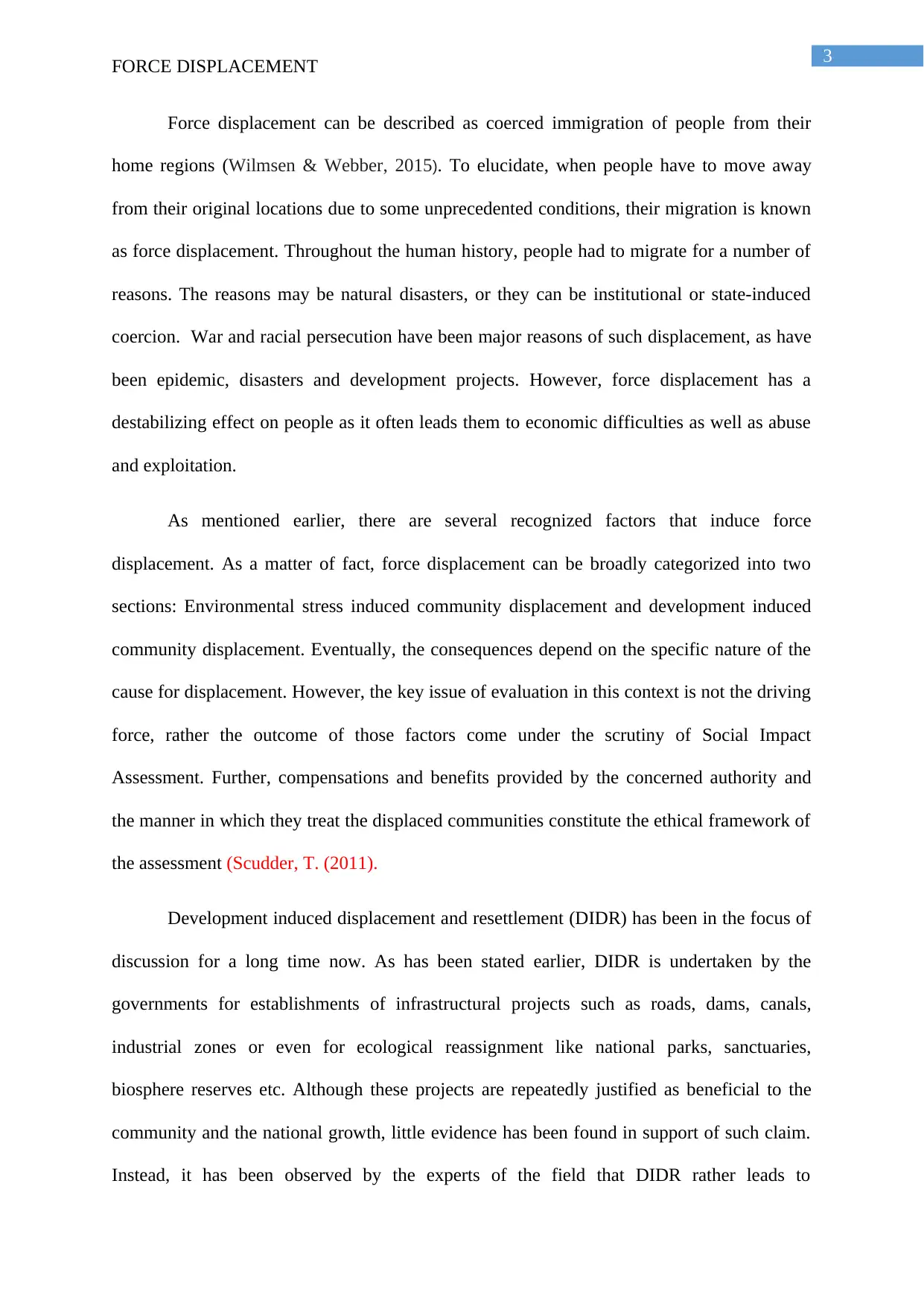
Force displacement can be described as coerced immigration of people from their
home regions (Wilmsen & Webber, 2015). To elucidate, when people have to move away
from their original locations due to some unprecedented conditions, their migration is known
as force displacement. Throughout the human history, people had to migrate for a number of
reasons. The reasons may be natural disasters, or they can be institutional or state-induced
coercion. War and racial persecution have been major reasons of such displacement, as have
been epidemic, disasters and development projects. However, force displacement has a
destabilizing effect on people as it often leads them to economic difficulties as well as abuse
and exploitation.
As mentioned earlier, there are several recognized factors that induce force
displacement. As a matter of fact, force displacement can be broadly categorized into two
sections: Environmental stress induced community displacement and development induced
community displacement. Eventually, the consequences depend on the specific nature of the
cause for displacement. However, the key issue of evaluation in this context is not the driving
force, rather the outcome of those factors come under the scrutiny of Social Impact
Assessment. Further, compensations and benefits provided by the concerned authority and
the manner in which they treat the displaced communities constitute the ethical framework of
the assessment (Scudder, T. (2011).
Development induced displacement and resettlement (DIDR) has been in the focus of
discussion for a long time now. As has been stated earlier, DIDR is undertaken by the
governments for establishments of infrastructural projects such as roads, dams, canals,
industrial zones or even for ecological reassignment like national parks, sanctuaries,
biosphere reserves etc. Although these projects are repeatedly justified as beneficial to the
community and the national growth, little evidence has been found in support of such claim.
Instead, it has been observed by the experts of the field that DIDR rather leads to
FORCE DISPLACEMENT
Force displacement can be described as coerced immigration of people from their
home regions (Wilmsen & Webber, 2015). To elucidate, when people have to move away
from their original locations due to some unprecedented conditions, their migration is known
as force displacement. Throughout the human history, people had to migrate for a number of
reasons. The reasons may be natural disasters, or they can be institutional or state-induced
coercion. War and racial persecution have been major reasons of such displacement, as have
been epidemic, disasters and development projects. However, force displacement has a
destabilizing effect on people as it often leads them to economic difficulties as well as abuse
and exploitation.
As mentioned earlier, there are several recognized factors that induce force
displacement. As a matter of fact, force displacement can be broadly categorized into two
sections: Environmental stress induced community displacement and development induced
community displacement. Eventually, the consequences depend on the specific nature of the
cause for displacement. However, the key issue of evaluation in this context is not the driving
force, rather the outcome of those factors come under the scrutiny of Social Impact
Assessment. Further, compensations and benefits provided by the concerned authority and
the manner in which they treat the displaced communities constitute the ethical framework of
the assessment (Scudder, T. (2011).
Development induced displacement and resettlement (DIDR) has been in the focus of
discussion for a long time now. As has been stated earlier, DIDR is undertaken by the
governments for establishments of infrastructural projects such as roads, dams, canals,
industrial zones or even for ecological reassignment like national parks, sanctuaries,
biosphere reserves etc. Although these projects are repeatedly justified as beneficial to the
community and the national growth, little evidence has been found in support of such claim.
Instead, it has been observed by the experts of the field that DIDR rather leads to
Paraphrase This Document
Need a fresh take? Get an instant paraphrase of this document with our AI Paraphraser

4
FORCE DISPLACEMENT
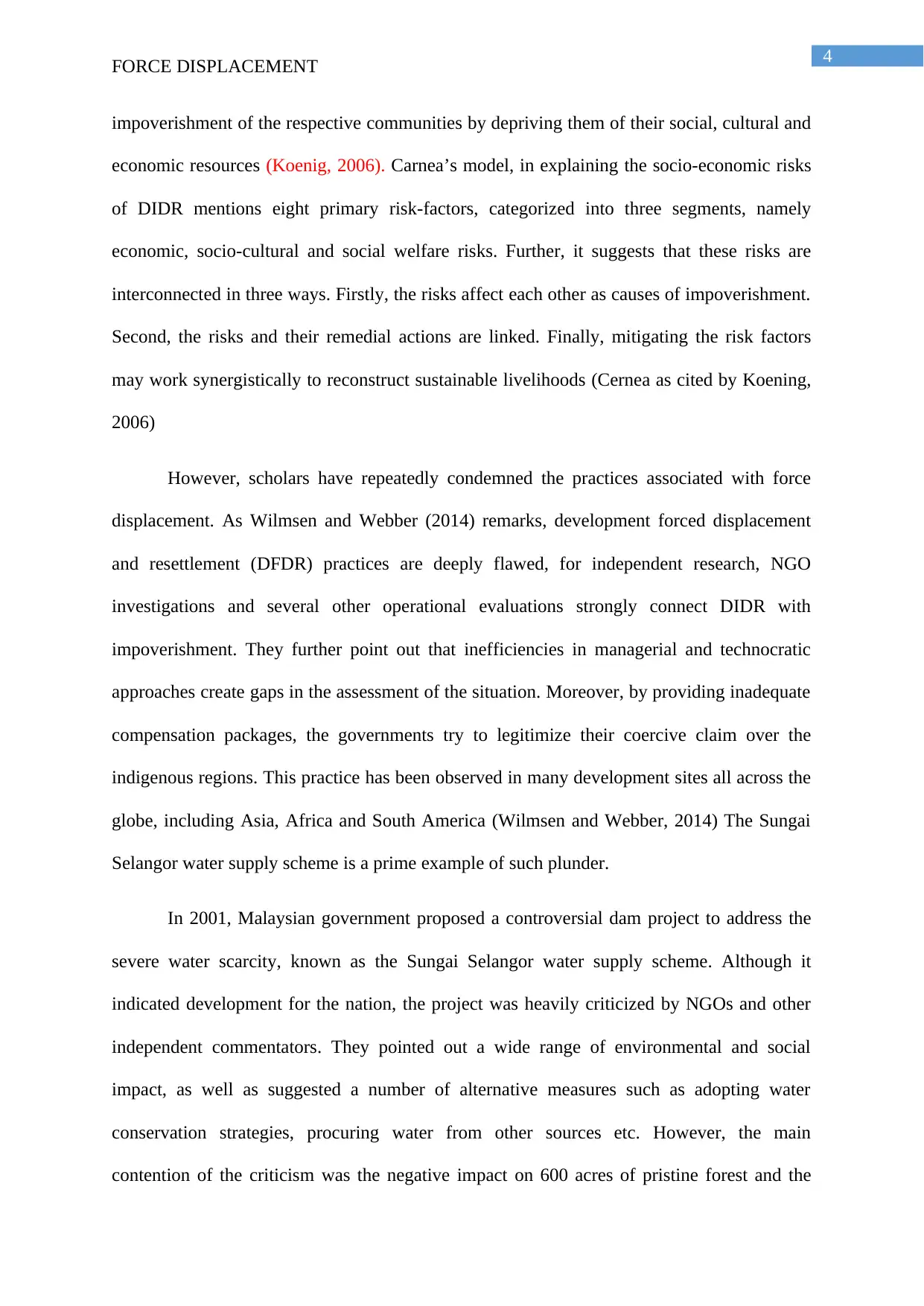
impoverishment of the respective communities by depriving them of their social, cultural and
economic resources (Koenig, 2006). Carnea’s model, in explaining the socio-economic risks
of DIDR mentions eight primary risk-factors, categorized into three segments, namely
economic, socio-cultural and social welfare risks. Further, it suggests that these risks are
interconnected in three ways. Firstly, the risks affect each other as causes of impoverishment.
Second, the risks and their remedial actions are linked. Finally, mitigating the risk factors
may work synergistically to reconstruct sustainable livelihoods (Cernea as cited by Koening,
2006)
However, scholars have repeatedly condemned the practices associated with force
displacement. As Wilmsen and Webber (2014) remarks, development forced displacement
and resettlement (DFDR) practices are deeply flawed, for independent research, NGO
investigations and several other operational evaluations strongly connect DIDR with
impoverishment. They further point out that inefficiencies in managerial and technocratic
approaches create gaps in the assessment of the situation. Moreover, by providing inadequate
compensation packages, the governments try to legitimize their coercive claim over the
indigenous regions. This practice has been observed in many development sites all across the
globe, including Asia, Africa and South America (Wilmsen and Webber, 2014) The Sungai
Selangor water supply scheme is a prime example of such plunder.
In 2001, Malaysian government proposed a controversial dam project to address the
severe water scarcity, known as the Sungai Selangor water supply scheme. Although it
indicated development for the nation, the project was heavily criticized by NGOs and other
independent commentators. They pointed out a wide range of environmental and social
impact, as well as suggested a number of alternative measures such as adopting water
conservation strategies, procuring water from other sources etc. However, the main
contention of the criticism was the negative impact on 600 acres of pristine forest and the
FORCE DISPLACEMENT
impoverishment of the respective communities by depriving them of their social, cultural and
economic resources (Koenig, 2006). Carnea’s model, in explaining the socio-economic risks
of DIDR mentions eight primary risk-factors, categorized into three segments, namely
economic, socio-cultural and social welfare risks. Further, it suggests that these risks are
interconnected in three ways. Firstly, the risks affect each other as causes of impoverishment.
Second, the risks and their remedial actions are linked. Finally, mitigating the risk factors
may work synergistically to reconstruct sustainable livelihoods (Cernea as cited by Koening,
2006)
However, scholars have repeatedly condemned the practices associated with force
displacement. As Wilmsen and Webber (2014) remarks, development forced displacement
and resettlement (DFDR) practices are deeply flawed, for independent research, NGO
investigations and several other operational evaluations strongly connect DIDR with
impoverishment. They further point out that inefficiencies in managerial and technocratic
approaches create gaps in the assessment of the situation. Moreover, by providing inadequate
compensation packages, the governments try to legitimize their coercive claim over the
indigenous regions. This practice has been observed in many development sites all across the
globe, including Asia, Africa and South America (Wilmsen and Webber, 2014) The Sungai
Selangor water supply scheme is a prime example of such plunder.
In 2001, Malaysian government proposed a controversial dam project to address the
severe water scarcity, known as the Sungai Selangor water supply scheme. Although it
indicated development for the nation, the project was heavily criticized by NGOs and other
independent commentators. They pointed out a wide range of environmental and social
impact, as well as suggested a number of alternative measures such as adopting water
conservation strategies, procuring water from other sources etc. However, the main
contention of the criticism was the negative impact on 600 acres of pristine forest and the

5
FORCE DISPLACEMENT
Selangor River, as well as the indigenous Orang Asli community. Although the authorities
announced compensation packages for the community, it was unable to compensate for the
cultural and psychological loss. (Swainson & McGregor, 2008)
This particular shortcoming of the compensation marks the malpractices of DIDR,
where the concerned bodies do not meet the required criteria for delivering proper
compensation. Furthermore, in many cases, marginalized displaced people go unnoticed and
thus are deprived of any compensation. However, scholars suggest that these risk factors arise
due to lack of monitoring and poor assessment of the social and environmental parameters.
Moreover, this is an exemplary instance of poor Social Impact Assessment.
To avoid such malpractices, several national and international bodies, along with
academic stalwarts of the field have recommended certain procedures and frameworks. Most
notable among them is Scudder’s policy-relevant theoretical frameworks of the resettlement
process. In the said model, Scudder proposes a four stage framework:
Stage 1: Proper planning for resettlement before the actual removal
Stage 2: Managing the initial downfall of the living standards that follows the removal
consequentially
Stage 3: Initiating proper economic development programs and community information prior
to the resettlement
Stage 4: Providing a sustainable resettlement plan to the second generation of the resettlers
and to other non-project authority institutions. (Scudder, 2011)
Carnea’s impoverishment risks and reconstruction model, as has been mentioned
earlier is another significant approach to address forced displacement and resettlement.
Organizations such as World Bank and United Nations have also proposed effective
FORCE DISPLACEMENT
Selangor River, as well as the indigenous Orang Asli community. Although the authorities
announced compensation packages for the community, it was unable to compensate for the
cultural and psychological loss. (Swainson & McGregor, 2008)
This particular shortcoming of the compensation marks the malpractices of DIDR,
where the concerned bodies do not meet the required criteria for delivering proper
compensation. Furthermore, in many cases, marginalized displaced people go unnoticed and
thus are deprived of any compensation. However, scholars suggest that these risk factors arise
due to lack of monitoring and poor assessment of the social and environmental parameters.
Moreover, this is an exemplary instance of poor Social Impact Assessment.
To avoid such malpractices, several national and international bodies, along with
academic stalwarts of the field have recommended certain procedures and frameworks. Most
notable among them is Scudder’s policy-relevant theoretical frameworks of the resettlement
process. In the said model, Scudder proposes a four stage framework:
Stage 1: Proper planning for resettlement before the actual removal
Stage 2: Managing the initial downfall of the living standards that follows the removal
consequentially
Stage 3: Initiating proper economic development programs and community information prior
to the resettlement
Stage 4: Providing a sustainable resettlement plan to the second generation of the resettlers
and to other non-project authority institutions. (Scudder, 2011)
Carnea’s impoverishment risks and reconstruction model, as has been mentioned
earlier is another significant approach to address forced displacement and resettlement.
Organizations such as World Bank and United Nations have also proposed effective
⊘ This is a preview!⊘
Do you want full access?
Subscribe today to unlock all pages.

Trusted by 1+ million students worldwide

6
FORCE DISPLACEMENT
strategies to counteract the risk factors arising from the issue (Wilmsen & Webber, 2015). All
these methods and frameworks indicate the importance of accurate SIA as well as EIA, while
emphasizing on the good practices related to such assessments.
In conclusion, it can be said that forced displacement is one kind of social menace if
not handled properly. It removes people from the comfort of their homes, cultural
environment and their habits of economic practices. Besides, the uncertainty of resettlement
is another trauma for those marginalized people. Although, the infrastructural projects are
promoted as beneficial activities for the future of the nation, development forced
displacement is criticized by many scholars as a form of authoritative coercion. However,
adoption of ethical and responsible measures to ensure economic and social security of the
affected people can lessen the negative impact to a certain extent. Proper assessment,
planning, management and most importantly bureaucratic goodwill are necessary criteria for
implementing development projects. And these measures consequentially mark the good
practices in social impact assessment as well.
FORCE DISPLACEMENT
strategies to counteract the risk factors arising from the issue (Wilmsen & Webber, 2015). All
these methods and frameworks indicate the importance of accurate SIA as well as EIA, while
emphasizing on the good practices related to such assessments.
In conclusion, it can be said that forced displacement is one kind of social menace if
not handled properly. It removes people from the comfort of their homes, cultural
environment and their habits of economic practices. Besides, the uncertainty of resettlement
is another trauma for those marginalized people. Although, the infrastructural projects are
promoted as beneficial activities for the future of the nation, development forced
displacement is criticized by many scholars as a form of authoritative coercion. However,
adoption of ethical and responsible measures to ensure economic and social security of the
affected people can lessen the negative impact to a certain extent. Proper assessment,
planning, management and most importantly bureaucratic goodwill are necessary criteria for
implementing development projects. And these measures consequentially mark the good
practices in social impact assessment as well.
Paraphrase This Document
Need a fresh take? Get an instant paraphrase of this document with our AI Paraphraser

7
FORCE DISPLACEMENT
References
Koenig, D. (2006). Enhancing local development in development-induced displacement and
resettlement projects. Development-induced displacement: Problems, policies and
people, 18, 105-140.
Scudder, T. (2011). 11. development-induced community resettlement1. New directions in
social impact assessment: conceptual and methodological advances, 186.
Swainson, L., & McGregor, A. (2008). Compensating for development: Orang Asli
experiences of Malaysia's Sungai Selangor dam. Asia Pacific Viewpoint, 49(2), 155-
167.
Wilmsen, B., & Webber, M. (2015). What can we learn from the practice of development-
forced displacement and resettlement for organised resettlements in response to
climate change?. Geoforum, 58, 76-85.
Dunlop, C. A., & Radaelli, C. M. (Eds.). (2016). Handbook of regulatory impact assessment. Edward
Elgar Publishing.
Dendena, B., & Corsi, S. (2015). The Environmental and Social Impact Assessment: a further step
towards an integrated assessment process. Journal of cleaner production, 108, 965-977.
FORCE DISPLACEMENT
References
Koenig, D. (2006). Enhancing local development in development-induced displacement and
resettlement projects. Development-induced displacement: Problems, policies and
people, 18, 105-140.
Scudder, T. (2011). 11. development-induced community resettlement1. New directions in
social impact assessment: conceptual and methodological advances, 186.
Swainson, L., & McGregor, A. (2008). Compensating for development: Orang Asli
experiences of Malaysia's Sungai Selangor dam. Asia Pacific Viewpoint, 49(2), 155-
167.
Wilmsen, B., & Webber, M. (2015). What can we learn from the practice of development-
forced displacement and resettlement for organised resettlements in response to
climate change?. Geoforum, 58, 76-85.
Dunlop, C. A., & Radaelli, C. M. (Eds.). (2016). Handbook of regulatory impact assessment. Edward
Elgar Publishing.
Dendena, B., & Corsi, S. (2015). The Environmental and Social Impact Assessment: a further step
towards an integrated assessment process. Journal of cleaner production, 108, 965-977.
1 out of 8
Related Documents
Your All-in-One AI-Powered Toolkit for Academic Success.
+13062052269
info@desklib.com
Available 24*7 on WhatsApp / Email
Unlock your academic potential
Copyright © 2020–2025 A2Z Services. All Rights Reserved. Developed and managed by ZUCOL.